


When you’re running a busy commercial or industrial facility, the doors are more than just an entry point—they’re workhorses. This guide will walk you through everything you need to know about choosing, installing, and maintaining the right commercial steel door, with a special focus on the rolling steel models that are essential for warehouses, loading docks, and high-security areas. You’ll learn how to understand technical specs, navigate building codes, and implement a maintenance plan that protects your investment and prevents costly downtime.
Your Essential Guide to Rolling Steel Doors
Consider this your complete roadmap to understanding commercial steel doors, especially the rolling steel models that keep modern industrial sites running smoothly. We’ve designed this guide to cut through the technical jargon and give facility managers, maintenance teams, and business owners a clear path to upgrading their operations.
We’ll dig into what really separates one rolling steel door from another and what critical specs—like fire ratings and insulation—actually mean for your facility’s safety and bottom line.
Making an informed choice is a big deal. For example, a busy distribution center might need a high-cycle, insulated rolling door to manage climate control at a loading dock, while a small auto repair shop may prioritize a heavy-gauge door for overnight security. This guide will arm you with the expert knowledge you need to make confident decisions that secure your building and improve workflow.
What You Will Learn in This Guide
Think of this as your checklist for choosing the right door. We’ll walk through the essentials, offering practical insights every step of the way.
- Core Components and Materials: We’ll take apart a rolling steel door to show you how different materials and construction methods directly affect its toughness and lifespan.
- Performance Metrics Explained: You’ll learn how to translate specs like R-values and fire ratings into tangible benefits, like lower energy bills and a safer workplace.
- Code and Compliance: We’ll help you navigate building codes so your installation is compliant and safe right from the start.
- Maintenance and Longevity: Discover the simple, proactive maintenance routines that will get the most out of your investment and prevent frustrating, costly downtime.
By the time you’re done, you’ll be ready to pick the perfect door for your facility’s unique demands. If you want a head start, check out some of the top-quality roll-up doors available for every budget in our companion article.
At Wilcox Door Service, we believe in being “Respected Partners, Reliable Service,” and that starts with sharing what we know. Let’s dive in.
Understanding the Anatomy of a Rolling Steel Door
A commercial steel door, particularly a rolling steel model, is a whole lot more than just a sheet of metal. It’s a complex system, with every single component engineered to work in harmony to provide security, access, and sheer durability. Getting to know its anatomy is the first step toward making a smart decision for your facility.
Think of it like popping the hood of a work truck; once you know what the key parts do, you start to appreciate its power and can spot what really matters for long-term performance. Let’s break down what makes these doors the undisputed workhorses of the commercial and industrial world.
This diagram boils it down to the three core pillars that every part of a steel door supports: security, efficiency, and code compliance.
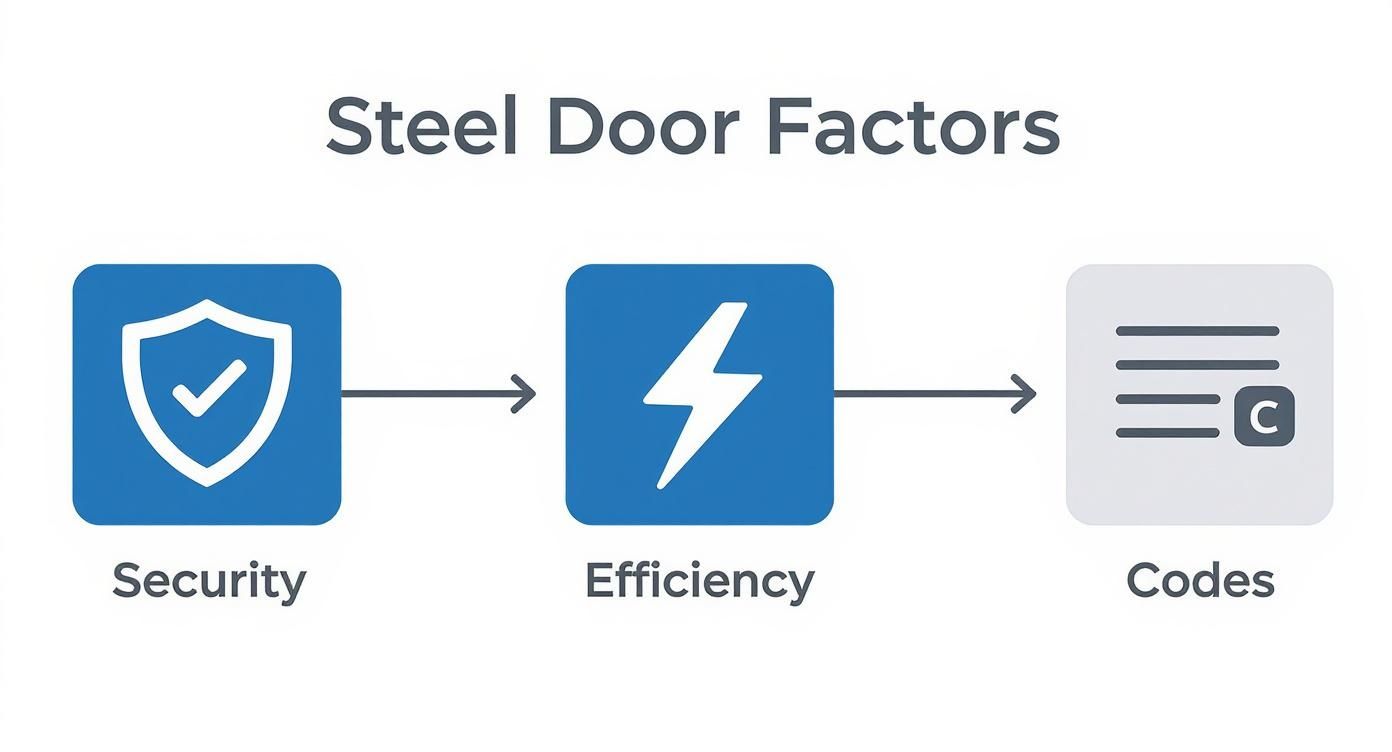
Alt text: Diagram showing three key factors for a commercial steel door: Security represented by a shield, Efficiency by a lightning bolt, and Codes by a document.
As you can see, a truly well-built door is a careful balance of these three critical elements, and the quality of its construction underpins them all.
The Core Components and Their Roles
Every piece of a rolling steel door has a job to do. From the curtain that forms the physical barrier to the powerful springs doing the heavy lifting, each part is essential for the door to operate smoothly and safely, day in and day out.
- The Curtain (Slats): This is the main body of the door, made up of interlocking horizontal steel pieces called slats. The curtain neatly coils up into a barrel when the door opens, which is precisely why these doors are fantastic for saving space in areas with limited headroom.
- The Barrel Assembly: Housed just above the door opening, this is the large, spring-loaded tube that the curtain wraps around. The springs inside are calibrated to perfectly counterbalance the door’s weight, making it possible to open and close it, whether by hand or with a motor.
- The Guides: These are the vertical tracks running down each side of the opening, and they’re the unsung heroes of the system. They keep the curtain perfectly aligned, provide stability against wind and physical force, and ensure it travels smoothly without jamming.
- The Bottom Bar: This isn’t just any slat; it’s a heavily reinforced bar at the base of the curtain. It adds crucial structural rigidity and is typically where the weatherstripping is housed to create a tight seal against the floor. An effective seal is non-negotiable, and you can learn more about why a quality weatherstrip for a garage door and its commercial counterparts are so vital in our detailed guide.
Steel Gauge: The Foundation of Strength
When we talk about how tough a commercial steel door is, what we’re really talking about is its gauge. Put simply, gauge is just a measurement of the steel’s thickness. Here’s the key thing to remember: the lower the gauge number, the thicker and stronger the steel.
For instance, a 20-gauge door is significantly thicker and more robust than a 24-gauge door. The thicker steel provides far better resistance to impacts from forklifts, attempted break-ins, and the general wear and tear of a busy facility.
Expert Insight: For a high-traffic loading dock or an exterior door that gets battered by the elements, investing in a lower gauge (thicker steel) like 18 or 20 is just smart business. For less demanding interior jobs, like a supply closet, a higher gauge might be perfectly fine.
Finishes That Fight the Elements
The raw strength of steel is only half the battle. A door’s finish acts as its suit of armour, protecting it from corrosion, rust, and abrasion. The right finish depends entirely on your facility’s environment.
- Galvanized Steel: This is the industry standard for good reason. The steel is coated in a layer of zinc to fend off rust, making it a reliable choice for the vast majority of exterior and interior applications.
- Powder Coating: This process creates an incredibly tough finish. A dry powder is applied electrostatically and then cured with heat, forming a hard shell that’s much more resistant to chipping and scratching than regular paint. It also comes in a huge range of colours to match your building’s aesthetic.
- Stainless Steel: When you’re dealing with high moisture, corrosive chemicals, or strict hygiene standards (think food processing plants or wash-down bays), stainless steel is the top contender. It offers unparalleled resistance to corrosion.
By understanding these fundamentals—the components, the steel gauge, and the protective finishes—you’re equipped to ask the right questions and choose a rolling steel door that’s genuinely built for the job at hand.
Translating Performance Ratings into Real-World Value
When you’re looking at a commercial steel door, the spec sheet can feel like a jumble of acronyms and numbers—R-value, STC, UL. But these aren’t just technical jargon; they are your best tools for picking the right door for your facility. These ratings are a direct measure of how a door will perform in the real world, telling you exactly how it will protect your people, your property, and your bottom line.
Understanding these specs is the difference between just buying a door and making a smart investment—one that actively improves your facility’s safety, energy efficiency, and daily operations. Let’s break down what these ratings really mean for you.
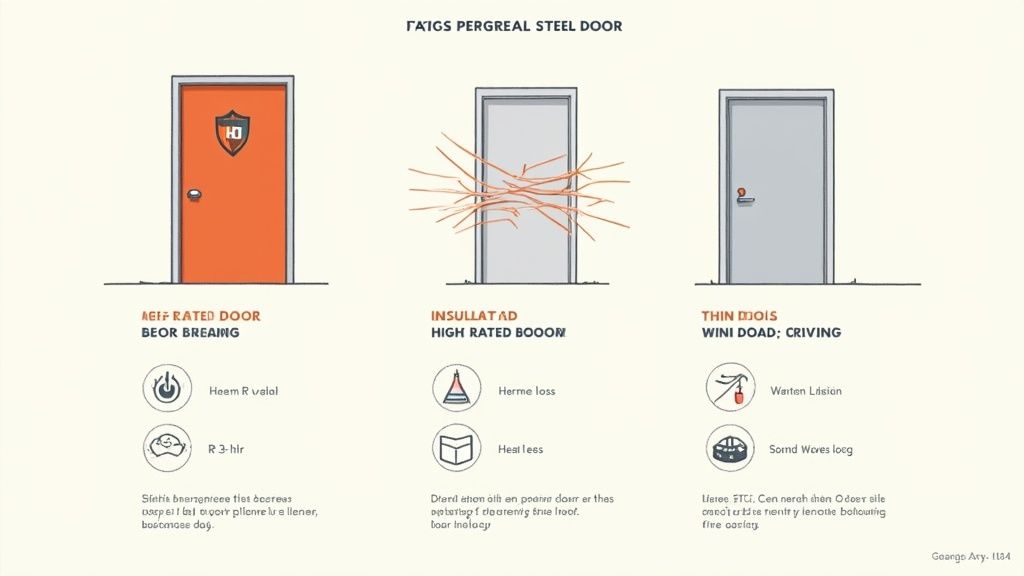
Alt text: Infographic comparing three types of commercial steel doors: a fire-rated door, an insulated door, and a standard non-insulated door, highlighting their key features.
To make sense of these critical specs, it helps to see them side-by-side.
Performance Specification Breakdown
| Specification | What It Measures | Real-World Example Application |
|---|---|---|
| Fire Rating (UL) | The duration (in minutes or hours) a door assembly can contain a fire while maintaining its structural integrity. | A 90-minute rated door separating a kitchen from a dining hall, containing a fire long enough for evacuation and emergency response. |
| R-Value | Thermal Resistance, or how well the door prevents heat transfer. Higher numbers mean better insulation. | A high R-value door for a cold storage facility, preventing outside heat from getting in and saving on cooling costs. |
| STC Rating | Sound Transmission Class, measuring how effectively a door blocks airborne sound. A higher rating means better soundproofing. | A high STC door between a noisy manufacturing floor and the front office, ensuring a quiet, productive workspace. |
| Wind Load Rating | The amount of wind pressure a door can withstand without failing or being torn from its tracks. | A wind-load rated door on a coastal warehouse, designed to hold strong during severe storms and protect the building’s interior. |
Each of these ratings addresses a specific challenge you might face in your facility. Let’s dig a little deeper into how they apply.
Fire Ratings: Your First Line of Defence
A fire rating is arguably one of the most critical specs for any commercial building. It tells you exactly how long a door can withstand fire, containing a blaze to give people time to evacuate safely.
Certified by organizations like Underwriters Laboratories (UL), the rating is given in minutes or hours (e.g., 90-minute, 3-hour). This indicates how long the entire door assembly can resist fire exposure before its integrity is compromised.
Imagine a fire breaks out in a workshop. A 3-hour fire-rated rolling steel door between that shop and your main warehouse becomes a powerful barrier. It contains the flames, heat, and smoke, buying crucial time for firefighters and protecting thousands of dollars in inventory. To keep this vital safety feature in working order, check out our certified fire door testing and inspection services.
Insulation and R-Value: Saving Energy and Costs
Insulation isn’t just about comfort; it’s about controlling your operating costs. The R-value is the metric that tells you how effective a door’s insulation really is.
Key Takeaway: A higher R-value means better thermal resistance. The door is more effective at preventing heat transfer, keeping your heated or cooled air inside where you’re paying for it.
Think of it like this: a non-insulated steel door is like a single-pane window in the middle of winter—you can feel the cold right through it. A rolling steel door with a high R-value, on the other hand, acts like a fully insulated wall, helping you maintain a stable interior climate. For a cold storage facility or a loading dock in a heated warehouse, this is non-negotiable, as it stops the HVAC system from constantly fighting to offset heat or cold seeping in from outside.
Sound Transmission Class (STC): Keeping Noise in Its Place
In many industrial settings, noise is a constant. A Sound Transmission Class (STC) rating measures how well a door assembly blocks airborne sound. The higher the STC rating, the more peace and quiet you get.
This really matters when you have a noisy fabrication area right next to your office space. An unrated door would let the constant clang of machinery bleed through, killing productivity and creating a stressful work environment. By installing a commercial steel door with a high STC rating, you create an effective acoustic barrier, allowing the workshop to run at full tilt while the office remains a quiet, focused space.
Wind Load Ratings: Standing Strong Against the Elements
For any large exterior door, especially in regions prone to high winds, a wind load rating is a must-have. This spec tells you how much wind pressure a door can handle before it buckles or, in a worst-case scenario, gets ripped right off its tracks.
A door without an adequate wind load rating on a large warehouse opening is a major liability during a storm, potentially exposing your entire facility to the elements. A properly rated door, however, is engineered to hold its ground, protecting your building and everything inside.
Choosing the right door is a big decision, and the demand for durable solutions is clear. North America’s steel door market was valued at around $4.4 billion in 2023, with galvanized steel being a top choice for its ability to resist corrosion in varied climates. You can explore more details on this growing market in this comprehensive industry analysis.
Making sense of these ratings is key to choosing the right commercial steel door. If you need help matching your facility’s needs with the right specifications, our team of experts is here to help. Contact Wilcox Door Service today to request a quote and ensure your next door is a valuable asset.
Navigating Building Codes and Compliance
For any facility manager, “compliance” is a lot more than just a box to tick. It’s the very foundation of safety, operational stability, and risk management. When you’re installing a commercial steel door, the web of building codes and standards can feel like a maze, but getting through it is a non-negotiable part of the job. These regulations are what ensure your doors actually protect people and property when it counts.
Getting a handle on this regulatory landscape is the key to preventing expensive project delays, failed inspections, and future legal headaches. A fully compliant installation isn’t just about avoiding a fine; it’s about making sure your facility’s access points are assets, not liabilities. This is where partnering with someone who’s been through it a thousand times makes all the difference, turning a headache into a smooth process.
Key Codes Affecting Your Doors
Building codes have a direct impact on how you choose and install rolling steel doors. It’s important to remember these codes aren’t the same everywhere; some cities and counties have even stricter rules based on local fire risks or building types.
- Building Codes: These are the primary rulebooks for all construction. They lay out the requirements for door materials, hardware, and installation methods to guarantee structural integrity and safety.
- Fire Codes: This code is all about stopping fires from spreading. It requires fire-rated doors in certain locations to create compartments within a building. For example, a door that connects a warehouse to an office space will almost always need a specific fire rating.
- Energy Standards: Many regions have codes focused on efficiency. They set minimum performance standards for the entire building envelope, which absolutely includes your doors. An insulated steel door is often the only way to meet these rules, especially for climate-controlled areas like food storage facilities or data centres.
Fire-Rated Doors in High-Stakes Environments
Fire safety is a massive priority. Many areas have incredibly strict rules for fire-rated doors in commercial, industrial, and multi-family residential buildings. The doors themselves are tested to hold back a fire for a specific amount of time, like 90 minutes or 3 hours.
An inspector doesn’t just glance at the fire-rated label. They check the entire assembly—the door, frame, hardware, and closing mechanism—to ensure it’s all certified to work together as a single unit. One mismatched part can cause the whole installation to fail inspection. A classic example is using a non-rated lock on a fire-rated door, which immediately voids the entire door’s certification.
This is exactly why you need a professional installation. Our experts make sure every single component of your fire door testing and inspection process is handled perfectly, guaranteeing you’ll pass with flying colours. The heavy emphasis on fire-rated doors is a huge reason the commercial steel door market is so strong. Steel doors already command roughly 45.6% of the broader US metal door market share because they are so tough and reliable—a trend that’s even more pronounced by code-driven demand.
ADA Accessibility and Operational Safety
Compliance goes beyond fire and energy codes. It’s also about ensuring your doors are accessible and safe for everyone to use. The Americans with Disabilities Act (ADA) has clear standards for door openings, hardware, and the amount of clear floor space needed for easy access. This includes things like the maximum force needed to open a door and the types of handles or activators that can be used.
On top of that, any motorized commercial steel door has to be outfitted with modern safety features. This means photo-eye sensors and reversing edges that stop the door from closing on a person or an object. A certified installation ensures these safety systems are wired in correctly and tested thoroughly, protecting both your team and your business from preventable accidents.
Staying on top of all these different requirements takes real expertise. As your trusted partner, Wilcox Door Service provides the reliable service you need to ensure every installation is perfectly aligned with state and local codes.
Don’t let compliance become a roadblock. Contact us today to talk about your project and make sure your facility is safe, efficient, and 100% compliant.
Maximizing Door Longevity with Proactive Maintenance
A commercial steel door isn’t just a door; it’s a serious investment in your facility’s security and daily workflow. Like any other piece of heavy-duty equipment, its lifespan and reliability hinge entirely on proactive care. Putting a preventative maintenance plan in place is the single best thing you can do to protect that investment, helping you sidestep expensive emergency repairs and the kind of unexpected downtime that can bring your entire operation to a halt.
Think of it this way: you wouldn’t run a forklift for years without checking the hydraulics or tires. Your rolling steel door at a busy loading dock works just as hard, day in and day out. A simple, consistent maintenance routine is its best defence against a catastrophic failure.
Alt text: A service technician performs a maintenance inspection on a large commercial rolling steel door, highlighting the importance of professional service.
Here, we’ll lay out a practical roadmap for facility managers, clarifying the critical difference between the daily checks your team can handle and the essential tasks that absolutely demand a certified technician.
Your In-House Preventative Maintenance Checklist
Giving your on-site team a daily or weekly inspection checklist is your first line of defence. These quick visual checks only take a few minutes but are incredibly effective at catching small issues before they snowball into major headaches.
- Visual Inspection of Tracks and Curtain: Take a quick look for any obvious signs of damage, like bent tracks or dented slats on the door curtain. You’ll also want to check the tracks for debris—dirt, gravel, or bits of broken pallets can easily obstruct the door’s path and cause it to jam.
- Listen for Unusual Sounds: As you operate the door, just listen. Any grinding, squeaking, or popping sounds are clear red flags that something isn’t right. These noises usually point to friction or a component under stress that needs looking at right away.
- Test Safety Features: Make it a habit to test the door’s safety mechanisms. For any motorized door, this means checking the photo-eye sensors by waving something in their path to make sure the door reverses. You should also test the reversing edge along the bottom bar to confirm it retracts when it makes contact.
By making these checks part of your team’s daily opening or closing procedures, you build a culture of awareness. This simple habit is the most cost-effective way to ensure the long-term health of your rolling steel doors.
Sometimes, proactive maintenance involves aesthetic updates or adding a protective layer. If you’re thinking about painting, you can find some great insights on the best paint for interior doors that might apply.
When to Call a Certified Technician
While those daily checks are crucial, some components of a rolling steel door are under extreme tension and pose a serious safety risk if messed with by anyone who isn’t trained. For these parts, professional service isn’t just a suggestion—it’s a must for safety and compliance.
The most critical of these components are the torsion springs. Tucked away inside the barrel assembly, these springs are wound incredibly tight to counterbalance the immense weight of the door. If that tension is released suddenly and without control, the result can be destructive and even lethal. Never, ever try to adjust, repair, or replace door springs yourself.
The Value of a Professional Service Plan
A scheduled visit from a certified professional goes way beyond what your in-house team can safely do. It’s a deep dive into the mechanical health of your entire door system.
A typical professional inspection includes:
- Spring Tension and Balance Adjustment: Technicians have the specialized tools and training to safely check and tweak the spring tension, ensuring the door is perfectly balanced for smooth, almost effortless operation.
- Motor and Operator Inspection: This involves a thorough check of the motor, gearbox, wiring, and limit switches to make sure the operator is working correctly and safely.
- Comprehensive Lubrication: A pro will lubricate all the moving parts—bearings, rollers, chains—with the right industrial-grade lubricants to cut down on friction and wear.
- Hardware and Fastener Check: Over time, vibration can cause nuts, bolts, and other fasteners to loosen. A technician will inspect and tighten everything to keep it secure.
This comprehensive approach not only guarantees safety but also extends the operational life of every single component. For a more detailed breakdown of what a professional check-up entails, take a look at our guide on maintaining a rolling steel door.
A smart maintenance strategy that combines daily in-house checks with annual professional servicing is the key to making sure your commercial steel door remains a reliable asset for years to come.
So, What’s the Next Step for Your Doors?
Choosing and maintaining the right commercial steel door isn’t just about filling a hole in the wall—it’s a critical decision that impacts your facility’s security, day-to-day efficiency, and the overall flow of your operations. We’ve walked through a lot in this guide, from the nitty-gritty of construction and performance ratings to the complexities of compliance and upkeep.
The sticker price is just the beginning of the story. Real, long-term value comes from a door that can take a beating day in and day out, saves you money on energy bills, and just plain works, keeping your business moving without a hitch.
Turning Good Advice into Smart Action
When you make the right calls—like picking the correct steel gauge for your environment, choosing the right insulation to hit your energy targets, and sticking to a proactive maintenance schedule—you turn your door from a potential headache into a reliable asset. It’s a strategic shift that makes your door more than just an entry point; it becomes a core part of your building’s infrastructure.
The best door solution is always the one that’s perfectly matched to its job and backed by a solid service plan. Getting that synergy right between the product and the support is how you truly maximize your return on investment.
Your Partner in Keeping Things Running Smoothly
At Wilcox Door Service, we’re not just a vendor; we’re your partner in making these important decisions. Whether you’re looking at a brand-new installation for a busy loading dock, need a certified safety inspection to stay on the right side of the code, or are facing an urgent shutdown and need immediate emergency repairs, our team has your back.
Our goal is simple: to help you find the perfect solution that fits your facility’s unique needs, ensuring your doors are safe, secure, and performing flawlessly for years to come.
Ready to take the next step toward a more secure and efficient facility? Contact Wilcox Door Service today for a consultation or to schedule a professional service inspection.
Frequently Asked Questions (FAQ)
When you’re running a busy facility, you need straight answers, fast. We get a lot of questions from business owners and facility managers about their commercial rolling steel doors, so we’ve put together the most common ones right here. Our goal is to give you the clear, straightforward information you need to make the right call for your property.
How Often Should My Commercial Rolling Steel Door Be Serviced?
Think of it like a vehicle. For a standard-use door, a professional tune-up at least once a year is a solid plan. But if you’ve got a high-cycle door—say, at a loading dock that never stops or in a busy parking garage—you’ll want to bump that up to every three to six months. This is the best way to catch problems early and avoid a sudden breakdown that brings your operations to a halt.
Your own team can help by doing quick visual checks daily. A quick look can spot small issues before they snowball. When a certified technician comes out, they’ll do the heavy lifting: ensuring all the critical safety features are functioning and that high-tension parts like the springs are perfectly balanced. That professional touch is what truly extends the life of your door.
What’s the Difference Between a Rolling Steel and a Sectional Door?
The main difference comes down to how they’re built and how they open. A rolling steel door is constructed from many small, interlocking steel slats. When it opens, it coils up neatly into a barrel just above the doorway. This compact design is a lifesaver in spaces with limited headroom and a must-have where security is top priority.
A sectional door, on the other hand, is made of several large, hinged panels. These panels slide up along tracks that run along the ceiling. While they might offer more options for insulation or window designs, they eat up a lot of overhead space. In a tough, high-traffic industrial setting, they generally can’t match the raw durability of a rolling steel door.
Can I Get My Manual Rolling Steel Door Motorized?
Absolutely. In almost every case, a manual chain-hoist rolling steel door can be upgraded with a commercial motor operator. This is one of the most common and impactful upgrades we do, as it instantly boosts both efficiency and safety for your staff.
The process involves fitting a motor that’s properly sized for the job, along with the necessary wiring and controls like push-button stations or remote access. It’s crucial to have a professional assess the door first to make sure it’s balanced correctly and to choose an operator that can handle the door’s weight and your expected daily use.
At Wilcox Door Service Inc., we believe in being “Respected Partners, Reliable Service.” If you have more questions or need an expert eye on your doors, our team is always ready to help.
Explore our commercial door services and schedule an inspection today.