


Understanding a fire doors rating is crucial for facility safety. It tells you precisely how long a door assembly can resist a fire, typically in minutes like 20, 60, or 90. This rating is a key part of your building’s fire safety system, designed to contain fire and smoke, giving people vital time to evacuate. This guide will demystify the codes, labels, and standards that protect your building and its occupants, helping you ensure your facility is not just compliant, but genuinely safe.
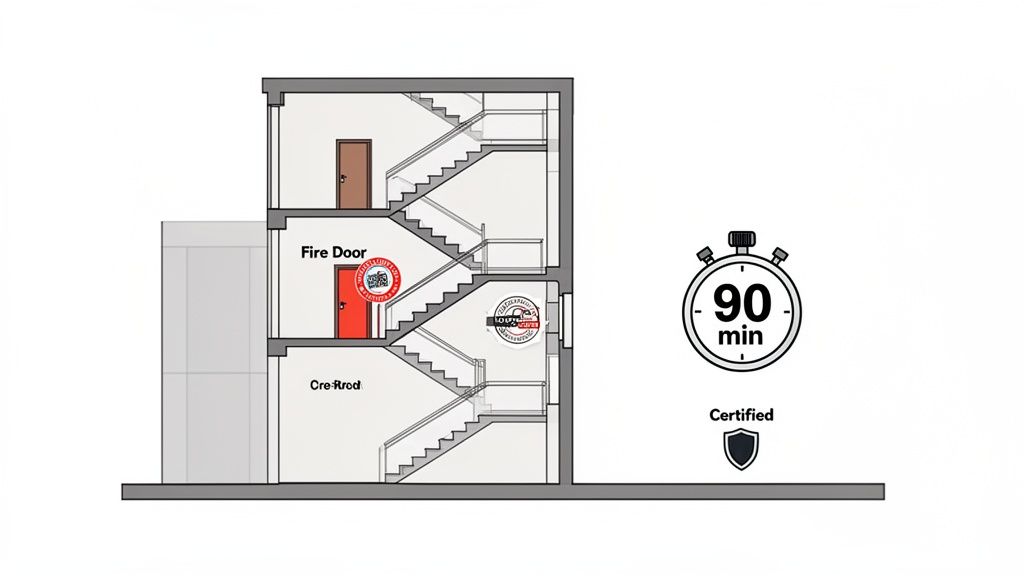
Alt text: A certified 90-minute fire door in a building stairwell, illustrating fire safety and a clear escape route.
As your trusted partners in reliable service, we’re here to break down what terms like ’90-minute’ or ‘temperature-rise limit’ mean for your day-to-day operations. From large rolling fire doors in a warehouse to standard office doors, this guide will equip you with the knowledge to ensure every fire-rated assembly performs as intended during an emergency.
Here’s what you’ll learn:
- How to read and interpret certification labels from agencies like ULC.
- The essential role the NFPA 80 standard plays in your maintenance strategy.
- How to identify common compliance issues before they become costly problems.
A fire door rating is a vital piece of your overall fire safety puzzle, contributing to effective workplace fire prevention strategies. Our goal is to provide you with practical knowledge to maintain the safest possible environment, protecting your people, property, and operations.
When it’s time for an expert inspection, you can rely on the certified team at Wilcox Door Service. Contact us today to ensure your facility is fully compliant and prepared.
What a Fire Door Rating Really Means for Your Building
A fire door’s rating is more than just a label; it’s a performance guarantee measured in minutes. Think of it as a crucial safety timer for your building. This rating tells you exactly how long a complete door assembly—which includes the door, frame, and all its hardware—is certified to hold back fire and smoke during an emergency.
Getting this right is fundamental to ensuring your facility is genuinely safe for everyone inside.
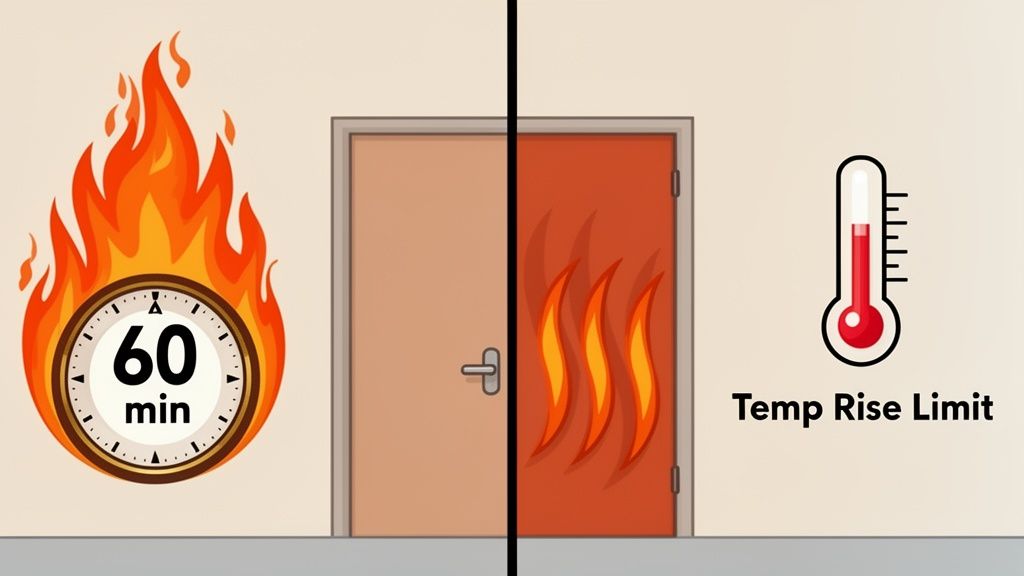
Alt text: An illustration detailing a fire door’s rating, showing 60 minutes of fire resistance and a temperature rise limit.
This system is based on a strategy called compartmentation. This simply means dividing a building into smaller, fire-resistant zones. If a fire starts, these compartments contain it, slowing its spread and buying precious time for evacuation and for first responders to arrive. A 90-minute fire door rating means the entire assembly has been rigorously tested to withstand fire for at least that long.
But time is only part of the story. To truly understand how a fire door works, you need to look at two different types of ratings that function together.
Time-Based Ratings: The Endurance Clock
This is the number everyone recognizes: 20, 45, 60, 90, or 180 minutes. It’s the most straightforward part of a fire door rating, indicating how long the door can endure direct exposure to fire.
Fire codes specify which rating is required for different locations. For example, a door between a main corridor and an office might only need a 20-minute rating. However, a door protecting a critical stairwell in a high-rise could demand a 90-minute or even a 3-hour (180-minute) rating. For facility managers, selecting the right rating isn’t a suggestion—it’s a non-negotiable part of your life safety plan.
You can learn more about how different materials perform by exploring our guide on steel fire-rated doors.
Common Fire Door Ratings and Their Typical Locations
This table breaks down standard fire door ratings and where you’ll typically find them in a commercial or industrial facility.
| Rating (Minutes) | Typical Location in a Building | Primary Purpose |
|---|---|---|
| 20 | Corridor doors, office entryways, hotel room doors. | Resists the passage of smoke and drafts, providing initial containment. |
| 45-60 | Stairwell doors, separations between different building wings or occupancies. | Protects critical escape routes and prevents fire from spreading between major areas. |
| 90 | Doors in multi-storey stairwells and walls separating major building areas. | Offers a higher level of containment for vertical escape routes and key separations. |
| 180 (3-Hour) | Firewalls separating major building sections or dividing a single large building into smaller fire areas. | Provides maximum fire separation for the most critical fire barriers. |
As you can see, the higher the risk and the more critical the location, the longer the required fire resistance time.
Temperature-Rise Ratings: Controlling the Heat
While stopping flames is essential, an effective fire door must also control heat. That’s where the temperature-rise rating comes in.
This rating limits how hot the non-fire side of the door can get. It’s vital for preventing “radiant heat ignition,” a dangerous scenario where objects near the door spontaneously ignite from the intense heat, even without direct contact with flames.
A low temperature-rise rating is especially critical for doors along escape paths, like stairwells. It ensures the route stays passable and that heat doesn’t build to a level that could injure evacuating occupants or ignite nearby materials.
These combined ratings are more than just numbers; they are a tested guarantee that your fire protection system will perform as designed. Understanding and maintaining these assemblies is a core responsibility for any facility manager.
If you have questions about the ratings on your doors or need a professional inspection, our expert team is here to help. Contact Wilcox Door Service today to schedule a comprehensive fire door assessment.
How to Decode Fire Door Labels and Certifications
Every compliant fire door has a special label. Think of it as the door’s passport—official proof from a trusted third-party agency like Underwriters Laboratories of Canada (ULC) that it has been rigorously tested and is ready to perform in a fire.
Knowing how to read these labels is a practical skill for any facility manager. It allows you to quickly confirm a door’s specifications during walkthroughs and stay ahead of official inspections by an Authority Having Jurisdiction (AHJ), such as the local fire marshal. A quick glance can tell you almost everything you need to know about its role in your building’s fire safety plan.
The Anatomy of a Fire Door Label
A fire door label is its technical resume. While layouts may vary, all compliant labels contain the same core information.
Here’s a breakdown of what you’ll find:
- Certification Mark: The logo of the testing agency, like ULC or UL, guaranteeing the door passed its fire tests.
- Manufacturer’s Name: Identifies who made the door, which is essential for ordering replacement parts or verifying specifications.
- Fire Resistance Rating: The time rating, such as “90 MIN,” “1-1/2 HR,” or “3 HR,” indicating how long the assembly can resist fire.
- Unique Serial Number: A unique identifier for tracking the door’s manufacturing history.
- Smoke and Draft Control Rating: An ‘S’ on the label indicates the assembly is also rated to stop the spread of smoke, which is critical for protecting escape routes.
- Hose Stream Test: In Canada, the label also confirms the door passed the hose stream test, which ensures the hot door can withstand the force of a high-pressure fire hose without failing.
Understanding these elements is the first step to ensuring your facility’s fire protection is up to standard. You can find more details on how different interior fire-rated door options are selected for various ratings and building areas.
Putting It All Together: A Real-World Example
Let’s apply this in a real-world scenario. Imagine you are the facility manager of a large warehouse. During an inspection, the fire marshal will immediately check the certification label on the rolling fire door separating your main storage area from the loading dock.
Here’s an example of a certification mark you’ll often see on fire-rated products.
Alt text: The Underwriters Laboratories (UL) logo, a certification mark found on fire-rated doors and components.
Seeing this mark instantly tells the inspector that the door has been properly tested. Next, they’ll read the details. A label stating “3 HR” with an ‘S’ rating confirms two critical facts: the door has the high fire resistance required for a firewall, and it’s designed to block smoke, keeping escape routes clear.
By knowing how to interpret this simple label, you can proactively identify if the correct door is installed long before an official inspection. This small piece of metal is your proof of compliance.
Mastering these labels transforms them from a mere code requirement into a powerful tool for maintaining a safer building. If you ever find a label that’s missing or damaged, it’s time to call in an expert.
The Role of NFPA 80 in Your Maintenance Strategy
While the National Building Code of Canada tells you where to install a fire door, the NFPA 80 standard tells you how to keep it working properly. It’s the official instruction manual for the installation, inspection, testing, and maintenance of every fire door assembly in your facility.
For facility managers, understanding NFPA 80 is essential for ensuring both safety and legal compliance. It provides the framework for a proactive maintenance strategy, ensuring your fire doors perform as designed in an emergency.
Annual Inspections: The Heart of NFPA 80 Compliance
The most critical requirement of NFPA 80 is the mandate for annual inspections and functional testing of all fire door assemblies. This is a mandatory, documented process to confirm every component is present, operational, and in good condition.
This annual check-up is comprehensive, involving a detailed 13-point inspection of the door, frame, hinges, latches, and closing devices. For rolling steel fire doors common in warehouses, this includes a functional “drop test” to ensure the automatic closing mechanism works correctly. An inspector’s first stop is always the certification label.
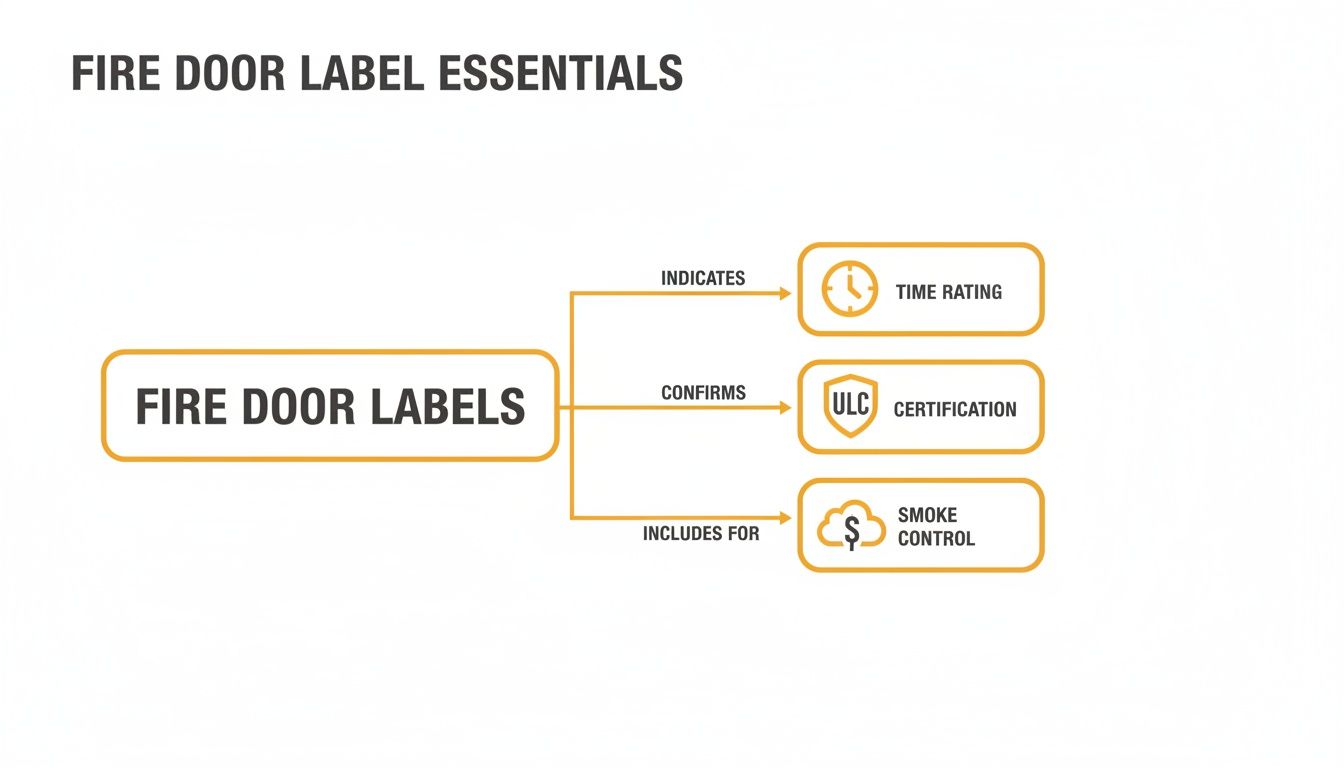
Alt text: A diagram explaining the essentials of a fire door label, including time rating, ULC certification, and smoke control features.
This label provides immediate confirmation of the door’s time rating and certifications, setting the stage for the detailed NFPA 80 inspection. The goal is to catch minor issues, like a bent frame or a missing screw, before they become critical failures.
Key Checks During an NFPA 80 Inspection
During an annual inspection, a qualified technician will methodically verify several critical points:
- Labels are Present and Legible: Certification labels on the door and frame must be visible. A missing or painted-over label means non-compliance.
- No Open Holes or Breaks: The door and frame must be free of damage. Drilling into a fire door can void its fire rating.
- Proper Latching and Closing: The door must close and latch securely on its own.
- Intact and Aligned Hardware: All components must be the correct type and in good condition.
- Acceptable Clearance: Gaps around the door must be within specified tolerances, typically no more than 1/8 inch (3 mm).
Why Documentation is Non-Negotiable
Since 2007, mandatory annual inspections for fire-rated doors as outlined in NFPA 80 have been a key part of Canadian fire safety. This requires signed, written records to be kept for review by the AHJ. For managers of warehouses, manufacturing plants, and other commercial facilities, this means partnering with certified technicians who can perform and document these tests.
This documentation is your official proof of due diligence. In the event of a fire or an audit, these reports demonstrate that you have taken the necessary steps to maintain your building’s life safety systems.
Failing to produce these records can result in fines and liability issues. Our team provides comprehensive reports on all fire door drop testing and inspections to ensure you always have the records you need.
By integrating NFPA 80 requirements into your maintenance schedule, you protect your people, property, and operations with reliable, documented proof of safety.
Common Compliance Mistakes and How to Avoid Them
Even with the best intentions, it’s easy to fall into common compliance traps with fire doors. These missteps can lead to failed inspections, fines, and a compromised safety system. Understanding these frequent errors is the first step toward a resilient fire safety plan.
Think of a fire door assembly like a sealed system—every component must work perfectly. Any unauthorized change, no matter how small, can cause a failure.
Propping Doors Open
The most common and dangerous mistake is propping a fire door open with a wedge or other object. This single action defeats the door’s purpose, allowing fire and smoke to spread rapidly. This often happens for convenience in high-traffic areas, like a loading dock. The solution involves staff training and proper hardware. If a door must be held open, it requires an electromagnetic hold-open device linked to the fire alarm system, which allows it to close automatically when an alarm sounds.
Unapproved Modifications and Field Repairs
Well-intentioned but unapproved alterations are another major compliance issue. Drilling a hole for a sign, adding a new kick plate, or replacing a closer with a standard one can instantly void the fire door’s rating.
A fire-rated door is a listed assembly, meaning the door, frame, and all hardware have been tested together as a certified unit. Any modification or replacement part must also be listed for use with that specific assembly.
Even seemingly minor changes can have serious consequences:
- Drilling Holes: Creates a path for heat and smoke.
- Adding Hardware: Unlisted components can prevent proper latching.
- Incorrect Repairs: Using non-rated hardware can cause the door to fail in a fire.
For any repairs, it’s critical to call a professional. Certified technicians from Wilcox Door Service can source and install the correct, listed components to maintain the door’s compliance.
Obscuring or Removing Certification Labels
The label on the edge of the door is its official proof of compliance. If it’s painted over, damaged, or removed, the door is non-compliant. An inspector cannot verify the fire door’s rating without a clear, legible label. Staff should be trained to protect these labels. If a label is unreadable, contact a certified service provider to explore re-labelling options. A professional fire door inspection will always start by checking these labels.
Building a Proactive Fire Door Maintenance Plan
True fire door reliability comes from a proactive, consistent maintenance strategy, not a “fix it when it breaks” approach. This ensures your doors will work in an emergency, keeps you compliant, and extends the life of your safety equipment. An effective plan combines routine checks by your team with a comprehensive annual inspection by a professional—daily vigilance backed by expert oversight. This reflects our “Respected Partners, Reliable Service” promise, giving you peace of mind through forward-thinking care.
Your Team’s Role in Daily Safety
Your on-site staff are your first line of defence. Empower them with a simple visual checklist to spot common problems early.
Encourage your team to look for these four things:
- Clear Pathways: Ensure nothing blocks the door’s path. Carts or stored materials can prevent a door from closing and latching.
- No Propping: Immediately remove any wedges or blocks holding a fire door open.
- Visible Damage: Report any significant dents or bent components that could affect the door’s operation.
- Legible Labels: Check that certification labels are visible and readable.
The Professional Inspection: Your Annual Guarantee
While daily checks are vital, the cornerstone of your maintenance plan is the annual inspection and drop test performed by a certified technician, as required by NFPA 80. This goes far beyond a simple visual check.
A professional inspection is your documented proof of due diligence. It verifies that every component—from latching hardware to frame integrity—meets the strict standards required for its fire doors rating.
Partnering with a specialist like Wilcox Door Service for a Planned Maintenance Program streamlines this process. We handle the scheduling, perform certified testing, and provide the detailed documentation you need. This strategic partnership ensures your facility is always prepared, minimizing liability and protecting your people.
Ready to build a maintenance plan that guarantees safety and compliance? Contact Wilcox Door Service today to schedule your annual fire door inspection or learn more about our proactive maintenance programs.
Frequently Asked Questions About Fire Door Ratings
Here are straightforward answers to some of the most common questions facility managers have about fire door ratings. This quick-reference guide cuts through the jargon to give you practical clarity.
Can I Paint a Fire-Rated Door?
Yes, but with extreme care. A thick coat of paint can prevent the door from closing and latching properly. Most importantly, you must never paint over the certification label. An inspector cannot verify the door’s rating if the label is covered, which makes the assembly non-compliant. Always check NFPA 80 guidelines or consult a professional to ensure you don’t void the door’s life-saving fire doors rating.
What Is the Difference Between a Fire Door and a Fire Exit Door?
The distinction is simple. A fire door is designed for containment—its job is to hold back fire and smoke. A fire exit door is designed for egress—getting people out of the building safely. While some doors can serve both functions (like a rated door in a stairwell), their primary purposes are different. One contains the hazard, while the other provides a path away from it. Both are essential parts of a building’s life safety system.
Does a Damaged Fire Door Need Full Replacement?
Not always. Minor damage to components like hinges or closers can often be repaired by a qualified technician using listed, equivalent parts from the original manufacturer. Using a generic part from a hardware store will void the door’s certification. A professional assessment is the only way to determine if a compliant repair is possible or if the damage requires a full replacement. Our certified technicians can perform expert repairs to ensure your doors are up to code.
Your fire doors are a critical life safety system. At Wilcox Door Service Inc., our union-certified technicians provide expert inspections, testing, and maintenance to ensure your facility is always protected and compliant. Schedule your annual fire door inspection today.