


This guide explains everything a facility manager needs to know about 20 minutes fire rated doors. You’ll learn what a 20-minute rating really means, where building codes require these doors, how they are tested, and what it takes to keep them compliant. We’ll provide clear, practical insights to help you ensure your building is safe and up to code. As your Respected Partners in Reliable Service, Wilcox Door is here to help you navigate these critical safety requirements with confidence.
Understanding the Role of 20 Minute Fire Doors
When you hear the term 20 minutes fire rated doors, it’s easy to focus on the number. But what that 20 minutes truly represents is a lifeline—a crucial window of time for people to safely evacuate a building during a fire and for first responders to arrive. It’s not just a door; it’s a critical piece of your building’s life safety system.
A 20-minute fire-rated door is a guardian designed to compartmentalize a fire, which simply means containing smoke and flames within a specific area. By holding back the blaze, it protects vital escape routes and prevents a small incident from spreading throughout your entire facility.
That ’20-minute’ rating isn’t a guess—it’s a hard-earned certification. It means the complete door assembly—including the door itself, the frame, hardware, and seals—has passed rigorous standardized tests to prove it can withstand fire for that specific duration.
For example, a fire starting in an electrical room can be contained by its fire door, preventing smoke from filling the main corridor. This gives your staff the time they need to exit safely. The National Building Code of Canada (NBC) requires 20 minutes fire rated doors in these key areas, such as the separation between an office suite and a public hallway. These requirements are based on standards like CAN/ULC S104, where doors are tested to endure extreme temperatures before being hit with a high-pressure fire hose. You can discover more insights about these fire-rated solutions and their role in code compliance.
Ultimately, knowing how to properly select, install, and maintain 20 minutes fire rated doors is a cornerstone of any effective life safety plan.
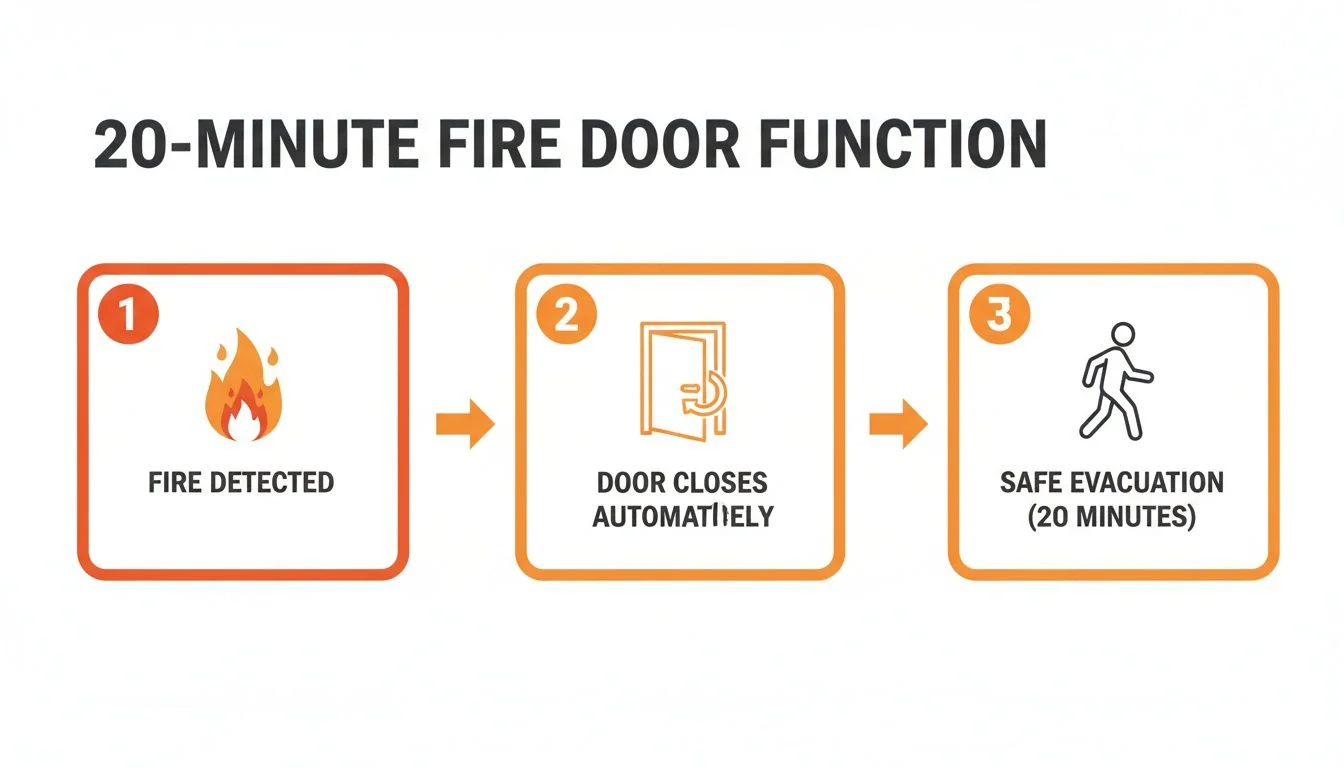
Alt text: A clear infographic illustrating the function of 20 minutes fire rated doors, showing fire detection, automatic door closure, and a 20-minute safe evacuation window.
How Fire Doors Earn Their Safety Rating
Ever wonder what really makes a 20-minute fire-rated door different from a standard door? It’s not just about using thicker steel. The secret is a demanding certification process that proves the entire door assembly can perform when lives are on the line.
It’s a common misconception that only the door panel itself is rated. In reality, the entire system—frame, hinges, latches, and seals—must pass the test together as one cohesive unit. This process is governed by strict standards, primarily CAN/ULC S104, the Standard Method for Fire Tests of Door Assemblies.
The Trial by Fire and Water
To earn its rating, a complete door assembly is installed in a test wall, just like a real-world installation. It then faces a specially designed furnace that follows a precise time-temperature curve, reaching over 760°C (1400°F) for a 20-minute test.
Throughout this intense heating, the door must stay securely in its frame and stop any flames from getting through. But surviving the heat isn’t enough. Immediately after, the still-glowing door assembly is blasted with a high-pressure fire hose. This simulates the immense force and thermal shock from actual firefighting efforts, ensuring it won’t shatter under pressure.
A critical part of modern testing is something called “positive pressure.” A real fire builds up intense pressure that actively forces smoke and hot gases through tiny gaps. Today’s positive pressure tests replicate this, making current fire door ratings far more reliable and true to life.
The Importance of Certification Labels
Once a door assembly successfully passes, it’s awarded a certification label from an accredited organization like Underwriters Laboratories of Canada (ULC) or Warnock Hersey (WH). For any fire inspector, this label is non-negotiable proof that the door meets required safety standards.
- Proof of Performance: The label confirms the door, frame, and hardware have been tested as a complete, working system.
- Compliance Guarantee: It’s the official visual check that your facility is aligned with the National Building Code.
- Essential for Inspection: If that label is missing or painted over, it can mean a failed inspection and even fines.
This entire process guarantees a 20-minute fire-rated door will perform as a reliable barrier when it matters most. For a deeper dive, check out our guide on fire door ratings. The principles of fire safety also extend to other building components, such as fire rated downlights, which work to create a fully compartmentalized, safe environment.
Where Your Facility Needs 20 Minute Fire Doors
Figuring out where to install 20 minutes fire rated doors isn’t a guessing game. It’s a life-saving calculation dictated by building codes. Think of your building as a series of compartments. Fire-rated doors act as critical gatekeepers, ensuring a fire in one area doesn’t spread—especially along the paths people need to escape.
These doors aren’t placed arbitrarily. The National Building Code of Canada (NBC) spells out exactly where they need to go. For facility managers, knowing these locations is the foundation of a compliant and safe building.
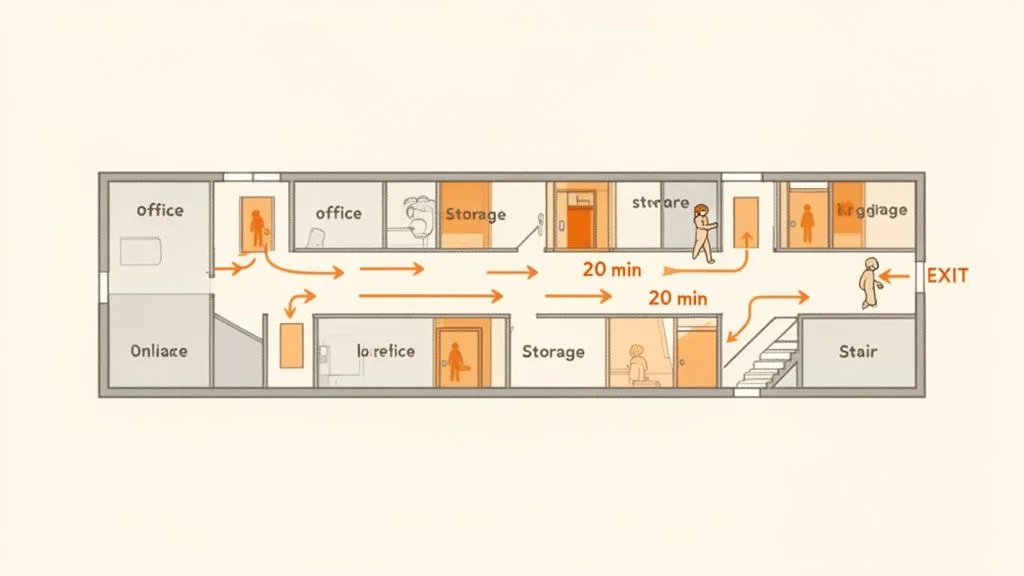
Alt text: A commercial building floor plan showing evacuation routes protected by 20 minutes fire rated doors, with key locations highlighted.
Protecting Corridors and Escape Routes
One of the most common places you’ll find a 20-minute fire-rated door is at any opening that leads into a fire-rated corridor. These hallways are the main arteries for evacuation, so keeping them clear of smoke and fire is non-negotiable.
Imagine a fire breaks out in a single office. A properly functioning 20-minute door will hold back smoke and flames, keeping the main corridor passable for at least 20 minutes. That’s a crucial window of time for everyone to get to a fire exit safely.
Here’s a real-world example: A property manager of a multi-tenant office building must ensure that every single suite door opening onto the main hallway is a certified 20-minute fire-rated assembly. If even one door fails, a fire in that suite could quickly fill the entire corridor with toxic smoke, trapping dozens of people.
Fire doors are a key part of your building’s life safety ecosystem. They work with fire alarms, which provide the alert, and sprinkler systems, which actively fight the fire. The door’s job is passive but vital: to hold the line and maintain a safe path.
Key Locations Requiring 20 Minute Doors
While every building layout is different, the NBC generally requires 20 minutes fire rated doors in several key areas. Getting familiar with these helps you stay ahead of compliance issues.
Common mandatory locations include:
- Corridor Doors: Any door connecting a private space (like an office, apartment, or hotel room) to a public, fire-rated hallway.
- Stairway Enclosures: Doors that provide access to stairwells. Since stairwells are the primary vertical escape route, these doors are essential for keeping them free of smoke.
- Occupancy Separations: Openings between two areas with different uses, like a door between an office and a light-duty storage area.
- Hazardous Area Containment: Some rooms with potential ignition sources may also need a 20-minute separation to contain a potential fire.
Our team at Wilcox Door Service specializes in identifying these critical points. We can assess your current doors and make sure they meet every code requirement, giving you complete peace of mind. And since compliance extends to all your openings, it’s just as important to understand the regulations around commercial sectional doors. Whether you need a new installation or service on existing doors, our experts deliver solutions you can count on. Contact our team today for a comprehensive safety assessment.
Choosing the Right Door: 20-Minute vs. Higher Ratings
Is a 20-minute fire-rated door enough, or do you need a higher rating? Getting this right is non-negotiable. The answer isn’t about the door itself—it’s about the wall you’re putting it in.
Think of it this way: a fire-rated door and its wall are a team. The door’s rating must be correctly matched to the wall’s rating for the entire barrier to work. A simple rule of thumb is that the door’s fire rating is usually a fraction of the wall’s rating. This ensures the whole assembly holds up.
Matching Door Ratings to Wall Assemblies
For many common spots in a building, a 20-minute fire-rated door is exactly what you need. Building codes typically call for them in 1-hour rated walls. These are the walls forming corridors and smoke barriers—the critical pathways people use to exit safely.
But when the wall’s job gets more serious, the door’s rating has to climb. A major firewall designed to completely separate two parts of a building might be rated for 3 or 4 hours. In that case, the opening needs a much tougher door, like a 90-minute or 3-hour fire door.
Putting a door with too low a rating into a highly-rated wall is a major compliance failure that puts lives at risk. On the flip side, installing a much higher-rated door than needed can needlessly drive up costs.
Getting this right from the start saves you from expensive rework. To get a deeper understanding of how materials play a role, check out our guide on steel fire-rated doors.
At-a-Glance Guide to Fire Door Ratings
To make things clearer, here’s a quick guide showing how door ratings typically line up with their corresponding walls.
Fire Door Rating vs. Wall Rating Guide
| Wall Fire-Resistance Rating | Required Door Fire Rating | Common Application Example |
|---|---|---|
| 1 Hour | 20, 30, or 45 Minutes | Corridor walls, room partitions, and some stairwell doors. |
| 2 Hours | 90 Minutes (1.5 Hours) | Stairwell enclosures and walls separating occupancies. |
| 3 or 4 Hours | 180 Minutes (3 Hours) | Major firewalls that divide a building into fire areas. |
As you can see, the more critical the wall’s function, the higher the required rating for the door. Navigating these codes can be tricky, but as your partners in safety, the Wilcox team is here to ensure you select the correct, code-compliant 20 minutes fire rated doors or higher-rated assemblies for every opening.
Installation and Maintenance That Protects Your Investment
A 20-minute fire-rated door’s certification is only as good as its installation and upkeep. The fire door assembly is a complete system—the door, frame, hinges, latch, and closer must work together perfectly. If one part is installed incorrectly or fails, the entire system’s fire rating is compromised. That’s why a certified professional must install every component as a cohesive, tested unit.
Proper installation and maintenance go beyond just ticking a compliance box. For example, a properly sealed fire door can also improve energy efficiency. You can learn more about the benefits of fire-rated doors and how they boost operational efficiency.
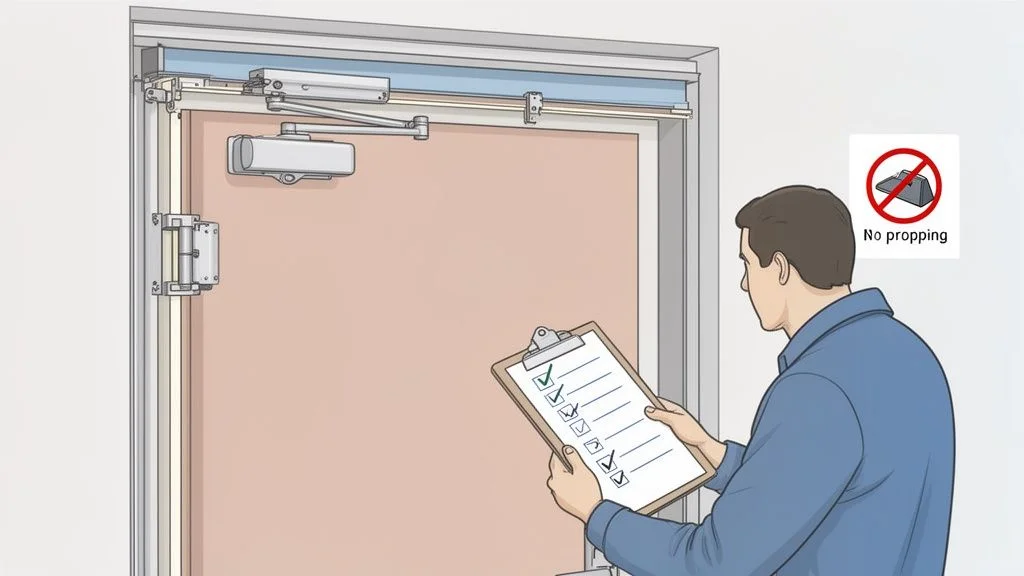
Alt text: A service technician inspecting a 20 minutes fire rated door‘s hardware and label for an annual safety compliance check.
Common Compliance Killers to Avoid
Even a perfectly installed door can fail an inspection if it’s not maintained. Over time, small issues can become major safety gaps that void your door’s fire rating. As a facility manager, knowing these “compliance killers” is your first line of defence.
Keep an eye out for these common red flags:
- Propping Doors Open: A fire door can’t stop a fire if it’s wedged open. This is one of the most frequent and dangerous violations.
- Damaged or Missing Seals: The intumescent seals around the frame are designed to swell with heat and block smoke. If they’re cracked or peeling, smoke will pour through.
- Unapproved Hardware: Any change—from a new lock to an unlisted kick plate—can void the assembly’s certification. All hardware must be fire-rated and listed for that specific door.
- Excessive Gaps: Gaps around the door’s edge should never exceed specifications (usually 1/8 inch). Anything larger is an open invitation for smoke and flames.
- Faulty Closers or Latches: The door must close and latch securely on its own, every time. A weak closer or a sticky latch makes the door useless in an emergency.
The Importance of NFPA 80 Inspections
To ensure your fire doors are always ready, the National Fire Protection Association (NFPA) 80 standard requires all swinging fire doors to be inspected and tested annually. This isn’t a suggestion—it’s a mandatory requirement enforced by local fire marshals. A failed inspection can lead to stiff fines and significant liability.
A fire door is a life safety device. Just like sprinklers, it needs regular, documented testing to prove it will work in an emergency. An annual inspection is your proof of due diligence.
Our union-certified technicians are experts in these meticulous inspections. We use a comprehensive checklist to verify every component of your 20 minutes fire rated door assembly is compliant. This proactive approach helps you maintain safety and avoid penalties. For more on the technical side, learn more about fire door drop testing in our article.
Your Partner in Safety and Compliance
Getting 20 minutes fire rated doors right isn’t just a box to tick on a compliance checklist—it’s about protecting people and keeping your business running. At Wilcox Door Service, we understand the pressures you face, from minimizing downtime to navigating complex safety codes.
We’re here to take that weight off your shoulders. We provide expert installation, NFPA 80-compliant inspections, and responsive 24/7 emergency repairs to ensure your facility is not only safe but always operational. A solid plan for Life safety inspections is non-negotiable for facility managers, and a thorough check of your fire-rated doors is a critical piece of that puzzle.
Let us manage the fine print of fire door compliance so you can focus on your core business. We’ll be your expert on the ground, making sure every fire-rated opening is secure, certified, and up to code.
Our union-certified technicians handle every detail, from sourcing and installation to the ongoing maintenance that keeps you compliant year after year.
Ready to ensure your facility is safe and compliant? Contact Wilcox Door Service today to schedule an inspection or discuss your facility’s needs with one of our experts.
Frequently Asked Questions
When it comes to 20 minutes fire rated doors, facility managers often have the same core questions. Getting these details right is crucial for keeping your building safe and compliant.
Can I Install a Window in a 20 Minute Door?
Yes, but it’s not a simple DIY job. The glass, called a lite kit, must also be fire-rated and specifically listed for use in a 20-minute door assembly. The frame and glazing holding it in place must carry the same certification. Building codes are very strict about the maximum size of the glass panel. To ensure the door’s fire rating isn’t voided, any modification must be done by a certified professional.
What Is the Difference Between a Fire Door and a Smoke Door?
This is a critical distinction. A fire door is engineered to block flames and intense heat for a set period, like 20 minutes. Its primary function is to compartmentalize a building and stop a fire from spreading. A smoke door’s main job is to stop the spread of smoke. While many fire-rated doors also have smoke seals (look for an ‘S’ on the label), not every smoke door has a fire rating. In many applications, a 20-minute fire-rated door will effectively serve as both a fire and smoke barrier.
Do I Need to Replace a Door if the Label Is Missing?
Not necessarily, but you need to act fast. A missing or painted-over label is a major compliance issue. Without it, an inspector has no way to verify the fire rating.
In some situations, the door can be re-certified. A qualified fire door inspector can perform an assessment, and if the door still meets every specification, it can be re-labeled. However, if the door has been damaged or altered, replacement is the only safe and compliant option.
How Often Do My Fire Doors Need to Be Inspected?
The NFPA 80 standard is clear: all swinging fire doors must be professionally inspected and tested at least once a year. This is a mandatory life-safety requirement. This annual checkup confirms that every component—from hinges and latch to the closer—is functioning exactly as it should.
Partnering with Wilcox Door Service means you have a team of experts ready to handle your annual NFPA 80 inspections, ensuring every fire door in your facility is compliant. To schedule an inspection or learn more, visit us online.