


This guide will walk you through the essentials of fire door safety for your commercial or industrial facility. You will learn why fire door compliance is critical, how to understand Ontario’s specific regulations, what happens during a professional fire door drop test, and what to look for in a reliable service partner. Our goal is to demystify abc fire door testing & manufacturing in Mississauga, providing you with the practical knowledge to keep your people safe and your facility compliant.
Why Fire Door Compliance Is a Non-Negotiable
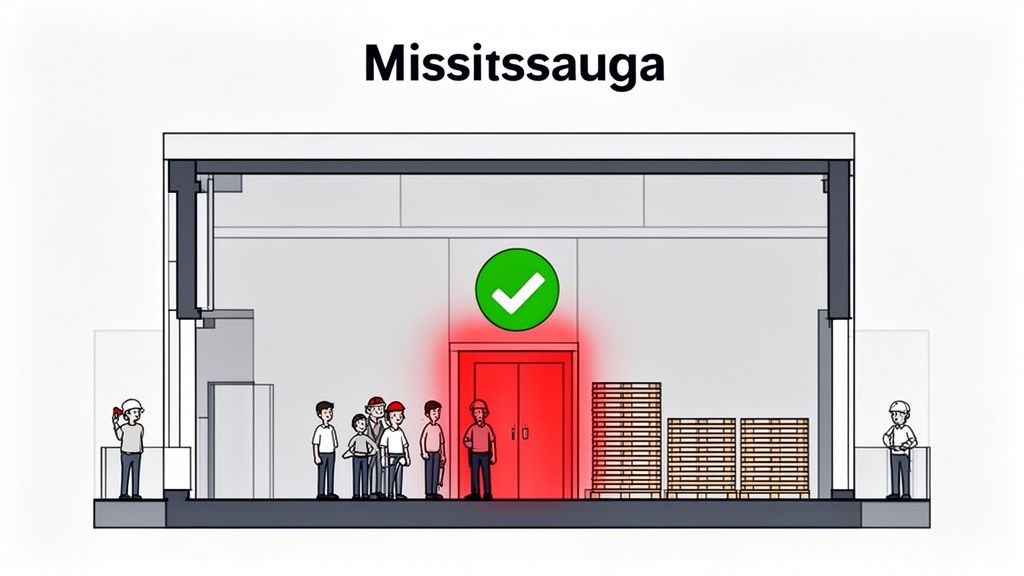
alt text: An illustration of a building cross-section showing a red fire door protecting people, emphasizing safety and compliance for abc fire door testing in Mississauga.
It’s easy to see a fire door as just another door, but in an emergency, it’s an engineered life-saving device. When a fire breaks out, these doors are designed to automatically close and create a protective barrier. This containment is what stops the rapid spread of flames, smoke, and toxic gases, buying precious time for everyone to evacuate safely and for emergency services to get the situation under control.
For anyone managing a busy warehouse or manufacturing plant, a properly functioning fire door can be the difference between a small, contained incident and a catastrophic loss. On the other hand, a non-compliant door is a massive liability. It can lead to steep fines, operational shutdowns, and even voided insurance claims—not to mention the unacceptable human risk.
The Growing Importance in Mississauga
As a major industrial and manufacturing hub, Mississauga has an amplified need for strict fire safety measures. The demand for these protective systems is surging, with Canada’s fire doors market projected to grow from USD 551.8 million in 2024 to USD 1,024.6 million by 2030. Local manufacturers follow strict CAN/ULC-S104 protocols, ensuring doors can resist fire for specific durations, like 90 minutes—a standard crucial for high-risk industrial settings.
This growth underlines why proactive compliance is so important. It’s not just about meeting a code; it’s about protecting your assets and your people in one of Canada’s most dynamic economic centres. For a deeper dive into this, it’s worth consulting resources dedicated to understanding the extensive impact of fire damage.
A fire door is an active part of your building’s life safety system. Unlike a standard door, its sole purpose in an emergency is to perform its one, critical job: to close and compartmentalize a fire. This is why annual testing is not just a recommendation—it’s a legal necessity.
Partnering with a trusted provider ensures this critical job is done right. As “Respected Partners, Reliable Service,” we at Wilcox Door Service Inc. bring the certified expertise needed to guarantee your facility’s fire doors meet all safety standards. For more details, have a look at our guide on what to look for in a new commercial fire door.
Decoding Ontario’s Fire Door Regulations
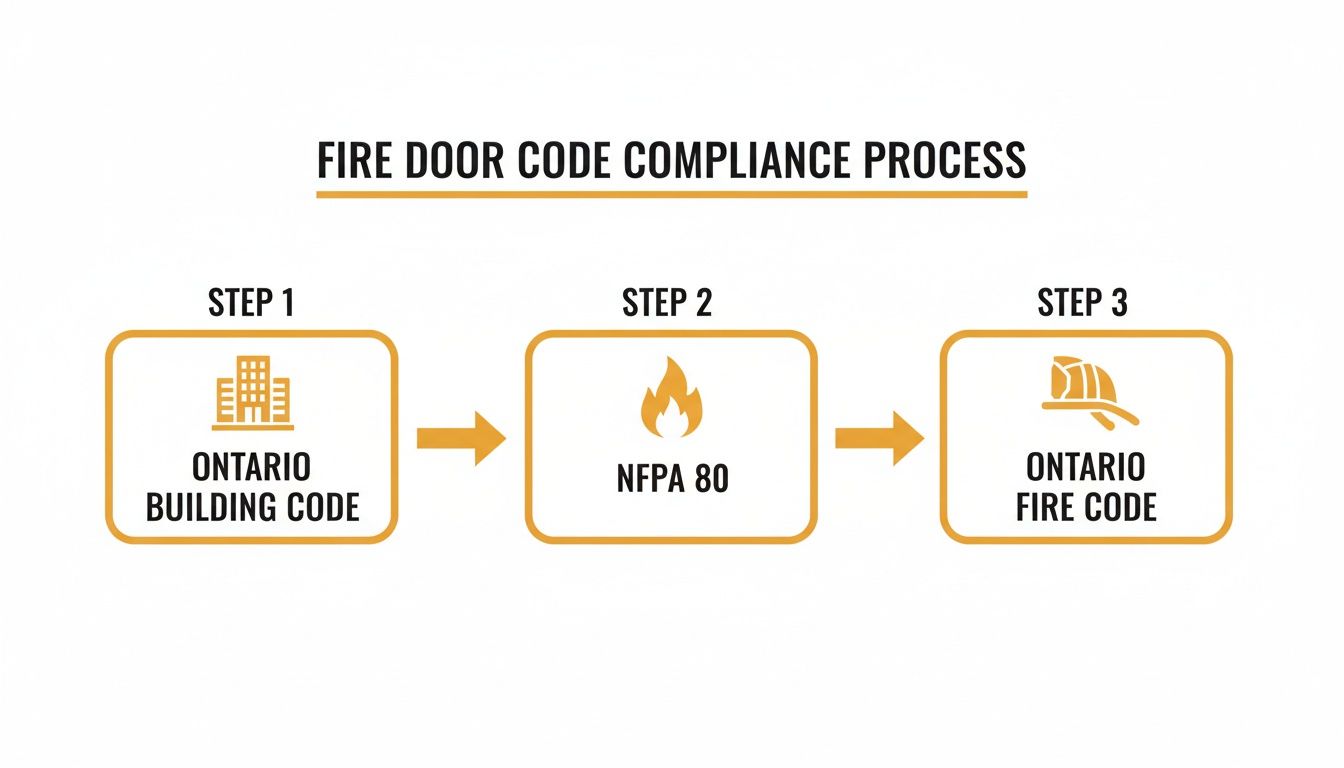
alt text: A diagram showing the compliance process for abc fire door testing in Mississauga, with arrows connecting the Ontario Building Code, NFPA 80, and Ontario Fire Code.
When it comes to fire safety in your Mississauga facility, the rules can seem like a tangled mess of codes and standards. But getting a handle on what’s required is simpler than you might think. Fire door compliance is a legal requirement enforced through a few key pieces of legislation. We’ll break down these regulations so you understand not just what they are, but why they’re so important for your day-to-day operations and safety.
The rulebook for fire door safety in Ontario comes down to three main documents: the Ontario Building Code (OBC), the Ontario Fire Code (OFC), and NFPA 80. The simplest way to think about them is to see how they apply over the life of your building. The OBC sets the rules for new construction or major renovations, telling you where fire-rated separations have to be. Once the building is up and running, the OFC takes over, making sure everything is properly maintained and tested.
And NFPA 80? That’s the “how-to” guide. It’s the detailed, North American standard that spells out the specific methods for installing, inspecting, testing, and maintaining fire doors and their hardware. It’s this standard that mandates the annual drop test—a critical check-up we’ll get into shortly.
The Big Three of Fire Door Compliance
Understanding how these three codes connect is the key to staying compliant. Let’s use a simple real-world example: think of your building as a new car.
- Ontario Building Code (OBC): This is the factory specification sheet. It dictates that the car must be built with airbags and seatbelts in certain spots before it can even leave the assembly line. For your building, the OBC is what requires fire-rated walls and doors to be installed in the first place, creating self-contained, fire-resistant zones.
- Ontario Fire Code (OFC): This is the mandatory annual safety inspection for your car. It doesn’t care how it was built; it cares that the airbags and seatbelts are still in perfect working order today. For your facility, the OFC is what requires you to keep your fire doors in good shape and have them professionally tested every single year.
- NFPA 80 Standard for Fire Doors: This is the mechanic’s service manual. It gives the precise, step-by-step instructions for how to test the airbags to make sure they’ll actually deploy in an accident. It gives us the exact procedures for a proper fire door drop test, which confirms the door will close and latch automatically when it’s needed most.
These three pillars work together to ensure your fire doors are installed correctly from day one and stay fully operational for the entire life of your building. It’s a complete system that every business involved in abc fire door testing & manufacturing in Mississauga needs to master.
What Fire Ratings and Labels Really Mean
Take a look at any fire-rated door in your facility and you’ll find a small metal label, usually attached to the edge of the door near the hinges. That little plate isn’t just for show; it’s the door’s official certification. This label is your proof that the entire door assembly—the door, the frame, and the hardware—has been successfully tested as a single unit by a recognized agency like Underwriters Laboratories (UL) or Intertek. It verifies the door’s fire-resistance rating, which tells you exactly how long it can hold back a fire.
Fire-Resistance Rating: This is a technical term for the length of time a door assembly can withstand fire under controlled test conditions. A “90-minute rating” means that specific door assembly was tested in a laboratory furnace and proven to stop a fire from passing through for a full hour and a half. In a real-world warehouse fire, that gives your team a critical 90-minute window to evacuate and allows Mississauga Fire and Emergency Services time to arrive and respond.
When a fire marshal or inspector visits, that label is one of the first things they’ll check. If it’s missing, painted over, or unreadable, the door’s certification is void, and you’ll get a compliance order. Our technicians are trained to spot these issues right away and can advise on the proper fire door repair and recertification needed to get you back in compliance. Keeping up with these rules isn’t just about avoiding fines; it’s about being a “Respected Partner” in safety for our community.
Inside a Fire Door Drop Test
Ever wondered what goes into an annual fire door drop test? It’s much more than just watching a door slide shut. This mandatory procedure, outlined by the NFPA 80 standard, is a precise, step-by-step process. It’s designed to prove your fire door will work exactly as intended when a fire breaks out.
Let’s walk through the process just as a Wilcox technician would at your facility. The whole test is methodical, ensuring no detail is missed. It’s a disciplined routine that combines a careful visual inspection with critical hands-on operational checks.
The Initial Visual Inspection
Before anything moves, our technician performs a thorough visual inspection of the entire fire door assembly. This isn’t a quick glance over. It’s a detailed check of every single component for wear, damage, or anything that could cause it to fail.
Key items on this initial checklist include:
- Door and Frame Integrity: We look for dents, rust, or damage to the door curtain, slats, and guide rails that could stop it from moving smoothly.
- Hardware and Components: We examine the fusible links, release mechanisms, and governor controls to make sure they’re intact and haven’t been painted over or tampered with.
- Clearance and Obstructions: The door’s path must be completely clear of debris, stored materials, or any new construction that might block its descent.
A common real-world example we find, especially in busy warehouses or manufacturing plants, is grime and debris built up in the guide tracks. It might seem minor, but that gunk can create just enough friction to cause a test failure.
The Two Critical Operational Tests
Once the visual check is done, the hands-on testing begins. The NFPA 80 standard demands that the door is tested twice to confirm its reliability.
Test 1: Simulating an Automatic Release
The first test mimics a real fire. The technician carefully detaches the fusible link—that small, heat-sensitive device designed to melt and release the door. This triggers the door to close under its own weight, with no help.
Test 2: Verifying the Manual Release
For the second test, the technician resets the door. Then, they activate the manual release handle, which should also cause the door to close smoothly and completely.
In both tests, the door must close fully and securely. The single most important measurement, however, is its speed. The door has to descend at a controlled rate of no less than 6 inches per second and no more than 24 inches per second. If it’s too slow, it won’t seal the opening in time. Too fast, and it becomes a serious safety hazard.
This makes professional testing essential, especially when you consider that Canadian industrial surveys show 72% of fire door failures in manufacturing settings are due to untested release devices or blocked tracks.
NFPA 80 Annual Drop Test Checklist
This table breaks down the key stages of a compliant drop test, giving you a clear picture of what to expect during an inspection.
| Test Phase | Key Actions & Checks | Purpose |
|---|---|---|
| Visual Inspection | – Examine door curtain, guides, and bottom bar for damage. – Check that fusible links are not painted or damaged. – Ensure the chain and gears are in good condition. – Verify the door’s path is unobstructed. |
To identify any visible defects, wear, or blockages that could prevent the door from operating correctly before the drop test begins. |
| Operational Test (Automatic) | – Manually release the fusible link to simulate a fire. – Observe the door’s descent. – Measure the closing speed (must be 6-24 in/sec). – Confirm the door fully closes and seats properly. |
To verify that the primary, automatic fire-release mechanism functions correctly and the door closes at a safe and effective speed. |
| Operational Test (Manual) | – Reset the door after the first test. – Operate the manual release handle. – Observe the door’s descent and measure the speed again. – Confirm a full and secure closure. |
To ensure the manual override system works, providing a secondary method for closing the door in an emergency. |
| Reset & Documentation | – Properly reset the door to its normal, open position. – Attach a new, signed, and dated test tag to the door. – Complete and sign a detailed written inspection report. |
To return the door to service and provide official, auditable proof of compliance for fire inspectors and insurance providers. |
Following these steps meticulously ensures every aspect of the fire door’s safety system is functioning as it should.
Documentation: The Final, Critical Step
After a successful test, the final and most important step is documentation. The technician attaches a new tag to the door, recording the date of the test and their signature. They also complete a detailed report, which serves as your official record of compliance.
This paperwork is your definitive proof for fire marshals and insurance providers that you have met your legal obligations. It’s the final piece of the puzzle in a process that protects your people, property, and business. You can learn more about this vital procedure in our comprehensive article on the importance of fire door drop testing.
The Craft of Manufacturing a Fire Door
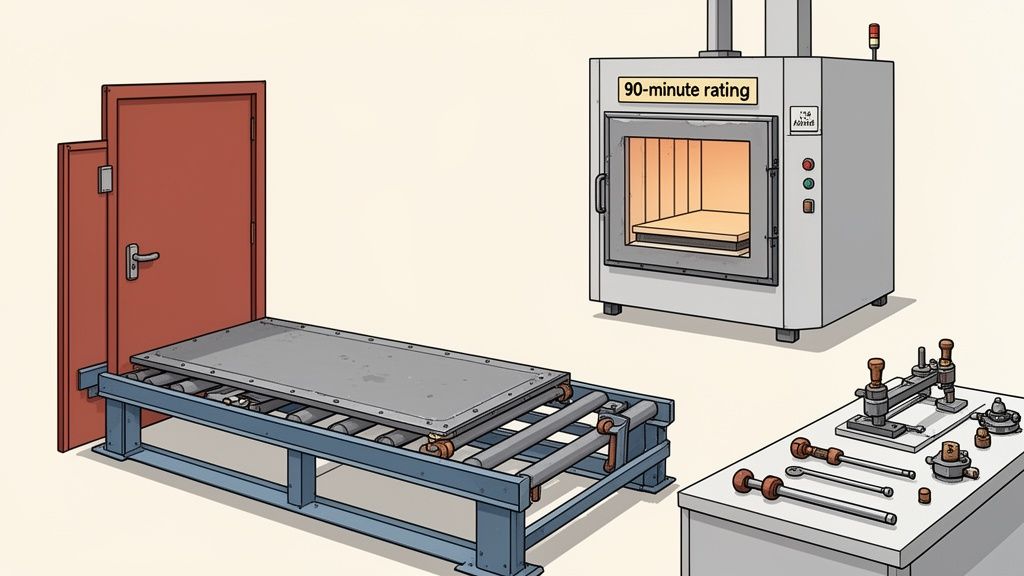
alt text: A fire door component on a conveyor at a manufacturing facility in Mississauga, with a testing oven in the background, showing the fire door manufacturing process.
A fire door might look like a simple steel curtain, but it’s really a life-saving system engineered with incredible precision. Its journey from raw materials to a rated barrier is a demanding process, guided by strict standards that turn basic steel into a system that can hold back extreme heat and fire for a set amount of time. That whole process is what stands behind the certification label on your facility’s door—it’s the proof of its protective power.
Knowing what goes into making one helps facility managers understand why abc fire door testing & manufacturing in Mississauga is such a specialized field. You’re not just building a door; you’re engineering a complete, code-compliant assembly where every single part must work in perfect harmony to provide passive fire protection. The frame, hardware, slats, and release mechanism are all designed and built to act as one integrated unit.
From Raw Steel to a Rated Assembly
It all starts with high-quality raw materials, usually galvanized steel chosen for its sheer strength and ability to resist intense heat. The steel is then cut, shaped, and formed into interlocking slats that make up the door’s curtain. The process is meticulous—even tiny imperfections could compromise the door’s integrity when it matters most.
The real transformation, though, happens when these individual pieces are brought together into a complete assembly. This includes the guide rails the door slides in, the barrel it coils around, and the all-important automatic closing mechanism. Each part is fabricated to meet exacting specs, ensuring a smooth, reliable descent when it’s triggered.
A fire door is much more than the sum of its parts. It’s certified as a complete “assembly,” meaning the door, frame, hardware, and closing mechanism have all been tested together as one unit. If you swap out a single component with a non-approved part, the entire door’s fire rating is instantly voided.
This is a critical point our Wilcox technicians stress on every service call. Using uncertified parts for a repair is a common but dangerous shortcut that completely invalidates the door’s life-saving certification.
The Trial by Fire: Laboratory Testing
Before any fire door model can be sold, it has to survive a brutal trial by fire in a certified laboratory. This is where the door earns its fire-resistance rating. Governed by strict standards like CAN/ULC-S104, the test involves mounting the entire door assembly in a test wall and blasting one side with a massive furnace that mimics the ferocious heat of a real building fire.
Temperatures inside the furnace climb rapidly, following a precise time-temperature curve. To earn a 90-minute rating, the assembly has to stop flames from passing through for a full hour and a half. It also has to limit how much heat transfers to the non-fire side, preventing things on the other side from spontaneously igniting. Only after passing this destructive test does the door earn its official rating label from an agency like UL or Intertek.
As an industrial hub in Canada, Mississauga is a key centre for this type of work. Local manufacturing is driven by national standards like CAN/ULC-S104, ensuring every door is properly lab-tested for fire resistance. For example, metal doors, which account for 43.8% of the market’s revenue share, are perfect for high-stakes environments like pharmaceutical plants or government buildings that demand rigid code compliance.
Rolling Steel vs. Sectional Fire Doors
Fire doors come in a few different designs to suit various buildings. The two most common types you’ll see in commercial settings are rolling steel fire doors and sectional fire doors. Rolling steel doors coil up neatly into a compact drum above the opening, making them a top choice for durability and saving space in high-traffic spots like loading docks and warehouses. You can find out more about these tough options by reading our article on the benefits of steel fire-rated doors.
Sectional fire doors, on the other hand, operate more like a standard overhead door, retracting along tracks up on the ceiling. They are often used in places where aesthetics or insulation are a bigger priority. Picking the right type depends entirely on your facility’s unique needs—a decision our experts are always ready to help with to ensure you get the best safety and functionality.
Choosing the Right Fire Door Service Partner
Picking a provider for fire door testing & manufacturing in Mississauga is a big decision. It directly affects your facility’s safety, your compliance status, and whether you can keep your doors open and operating. This isn’t about chasing the lowest price; it’s about finding a team you can truly trust to protect your people and your property.
Think of the right partner as an extension of your own team—one that brings certified expertise and unwavering reliability to the table. You need more than just a technician with a toolbox. You need someone who fully grasps the immense responsibility of maintaining life-saving equipment. Their work is what stands between a small flare-up and a full-blown disaster, making your choice a crucial piece of your risk management strategy.
Key Qualities of a Dependable Partner
To make a smart decision, you need to focus on a few non-negotiable qualities. These are the things that separate the real experts from the rest of the pack, ensuring the service you get genuinely meets your safety obligations.
Here’s a practical checklist to help you evaluate potential partners:
- Certified and Qualified Technicians: Never be shy about asking for qualifications. A top-tier provider will have union-certified technicians who get continuous training on the latest codes, products, and safety procedures. This is your guarantee that the person working on your fire doors is a genuine, up-to-date expert.
- Proven Local Track Record: Look for a company with deep roots in Mississauga and the Greater Toronto Area. A long history of serving local businesses, from manufacturing plants to distribution centres, is a powerful sign of reliability and trust.
- Comprehensive Compliance Documentation: Your service partner absolutely must provide clear, accurate, and prompt documentation after every single visit. This means detailed reports and signed test tags, which serve as your official proof of compliance for fire marshals and insurance auditors.
Choosing a partner who ticks all these boxes makes your compliance duties much simpler and gives you real confidence that your facility is properly protected.
The Importance of 24/7 Emergency Service
A fire door doesn’t care if it’s after 5 p.m. on a Friday. Imagine a forklift clips a guide rail at 10 p.m., damaging a critical fire door and leaving it stuck open. This isn’t just a maintenance headache; it’s an immediate operational and safety emergency.
A damaged fire door can force a partial or complete shutdown of your operations until it’s repaired and certified. Without round-the-clock support, you could face significant downtime, lost productivity, and a serious compliance breach.
This scenario shows exactly why 24/7 emergency service isn’t a luxury—it’s an absolute necessity. A partner who can get a qualified technician to your site at any hour is vital for minimizing disruption and keeping your business running. This level of responsiveness is the hallmark of a company truly committed to being a “Respected Partner, Reliable Service.” When you need them most, they’re there.
Vetting Your Potential Service Providers
Beyond the basics, it’s worth digging a little deeper. Ask for references from businesses in your industry. Inquire about their safety record and their process for handling complicated repairs. A professional partner will welcome these questions and give you transparent answers.
You should also confirm they can service the specific types and brands of commercial and industrial doors you have in your facility.
By taking a structured approach to choosing your service partner, you’re really investing in peace of mind. You’re building a relationship with a team that is just as dedicated to your facility’s safety and uptime as you are. A great partner doesn’t just fix problems—they help prevent them.
What Does the Wilcox Advantage Mean for Your Facility?
When a company has been around for over a century, you learn a few things. For us, it’s that promises don’t mean much until they deliver real results for your facility. As Canada’s most trusted name in industrial doors and a certified Indigenous-owned company, our reputation isn’t just about history—it’s about the tangible benefits we bring to every client, from minimizing expensive downtime to ensuring you’re always ready for a fire marshal’s visit.
Our promise of “Respected Partners, Reliable Service” isn’t just a nice-sounding slogan. It’s the core of how we operate. It means we’re in the business of proactively protecting your operations, not just showing up when something’s already gone wrong.
Proactive Protection in Action
Here is a practical, real-world example. One of our union-certified technicians is on-site at a loading dock for a routine check-up. While inspecting your fire doors, they notice a subtle flaw in a release mechanism. It’s not causing a problem today, but their experience tells them it’s a failure waiting to happen.
They fix it right there on the spot. In that moment, they didn’t just repair a small part—they likely saved you from a failed fire inspection, a potential stop-work order, and costly fines. That’s the Wilcox advantage. It’s about applying our deep expertise in fire door testing & manufacturing in Mississauga to see the risks others might miss.
Here’s how this approach makes a real difference to your bottom line:
- Slash Costly Downtime: A damaged or non-compliant fire door can shut you down. Our 24/7 emergency service means that won’t happen. We get you back up and running, day or night.
- Extend the Life of Your Doors: Through our proactive Planned Maintenance Programs, we catch the small stuff—the wear and tear—before it cascades into a major, expensive failure. It’s about maximizing the return on your investment.
- Guarantee Compliance: Our technicians live and breathe Ontario’s fire codes. We provide the meticulous testing and iron-clad documentation you need to face any audit with total confidence.
Choosing a service provider isn’t just about getting things fixed. It’s about having a partner who actively works to keep your facility safe, compliant, and productive. That’s the peace of mind we’ve been delivering for over 100 years.
This proactive mindset is absolutely critical when it comes to something as complex as a fire door system. You need a partner who understands the entire life of the equipment—from the specific manufacturing standards it must meet to the small details of an annual drop test. Our long history and singular focus on commercial and industrial doors gives us a perspective that’s simply unmatched, allowing us to protect your facility from risks you might not even know exist.
Frequently Asked Questions About Fire Door Services
When it comes to fire door compliance, a lot of questions come up. We get it. Navigating the codes and requirements can feel overwhelming, but it doesn’t have to be.
To help clear things up for facility managers, we’ve put together answers to the questions we hear most often. Our aim is to make abc fire door testing & manufacturing in Mississauga feel straightforward so you can manage your facility’s safety with confidence.
How Often Do My Fire Doors Need To Be Tested in Mississauga?
This is probably the most critical question we get. According to NFPA 80 standards—which are the law across Ontario—all rolling and sliding fire doors must be tested at least once a year.
This annual “drop test” is mandatory. It’s not just a suggestion; it’s the only official way to prove your door will work as intended during a fire and keep your building compliant with the Ontario Fire Code. Fire marshals and insurance providers absolutely expect to see this documentation.
What Is the Most Common Reason a Fire Door Fails Inspection?
Nine times out of ten, a fire door fails its inspection because of simple neglect or obstructions. For example, in a busy loading dock area, it’s common for debris to get kicked into the guide tracks, or for components to get damaged by equipment traffic. Sometimes, a well-meaning maintenance team might accidentally paint over a critical part without realizing the consequences.
A fire door is an assembly where every part matters. Even something as small as a painted fusible link or a dent in a guide rail can lead to a failed test, leaving your facility non-compliant and at risk.
The best way to sidestep these common pitfalls is with a good planned maintenance program. It catches small issues before they become big, expensive problems.
Can I Perform a Fire Door Drop Test Myself?
While a drop test might look simple from a distance, NFPA 80 is very clear: testing must be done by a qualified and knowledgeable person. This means someone who is professionally trained and understands the specific type of door they’re working on.
Using a certified professional, like a Wilcox technician, guarantees three things:
- The test is done correctly and safely, without putting your staff or property at risk.
- The door’s performance is properly evaluated against NFPA 80’s exact technical requirements, like its closing speed.
- You get the official, signed paperwork that fire marshals and insurance agents require to prove compliance.
Professional oversight is the only way to ensure your fire door repair and recertification is handled properly from start to finish, giving you complete peace of mind.
Your facility’s safety and compliance are too important to leave to chance. As “Respected Partners, Reliable Service,” Wilcox Door Service Inc. ensures your fire doors meet all regulatory standards. Contact Wilcox Door Service Inc. today to schedule your annual fire door inspection and ensure your facility is fully compliant and prepared.