


Selecting the right commercial garage gates is more than just choosing an entry point—it's a critical decision that impacts your facility's security, workflow efficiency, and even your energy costs. This guide will walk you through everything you need to know, from matching the right type of gate to your business needs, to understanding essential safety standards and the importance of proactive maintenance. By the end, you'll have a clear, practical understanding of how to make a smart, long-term investment in your facility's performance.
Why Your Commercial Garage Gates Are Mission Critical
Think of your commercial garage gates as the primary guardians of your facility. They are the first line of defence for your assets and the main artery for your daily operations. A slow, unreliable, or insecure gate doesn't just cause a minor inconvenience; it can create significant bottlenecks, drive up operational costs, and expose your business to unnecessary risks.
For example, a distribution centre with a poorly insulated loading dock door will see its heating and cooling costs skyrocket. In the same way, a manufacturing plant with a slow-moving gate can experience delays that disrupt the entire production schedule, impacting everything from material intake to final shipments.
More Than Just an Opening
A modern commercial gate system is a sophisticated piece of equipment designed to perform several critical functions at once. Viewing them as simple doors overlooks their true value to your business. Their impact is felt across multiple areas of your operation.
- Operational Efficiency: The right gate streamlines the flow of goods and personnel. High-speed doors, for instance, can drastically reduce wait times at busy loading docks, directly boosting productivity.
- Security and Access Control: These gates are fundamental to your security strategy. Integrating them with access control systems ensures only authorized individuals can enter sensitive areas, protecting valuable inventory and equipment. For a deeper look into this, explore our guide on top commercial security gate solutions.
- Energy Conservation: Properly sealed and insulated doors are essential for maintaining stable indoor climates. This is especially important for temperature-sensitive environments like food processing plants or pharmaceutical storage, where energy savings can be substantial.
- Safety and Compliance: Modern gates are equipped with advanced safety features to protect your staff and equipment. Adhering to safety standards isn't just about following rules; it's about creating a secure work environment and avoiding costly accidents and liabilities.
A well-chosen and maintained commercial garage gate is not an expense—it is a performance-enhancing tool that delivers a return on investment through improved security, lower energy consumption, and increased operational uptime.
Ultimately, understanding the multifaceted role of your commercial garage gates allows you to make smarter decisions. This guide will serve as your roadmap, ensuring you select, install, and maintain a system that supports your business goals and reinforces your commitment to reliable, secure operations. As your Respected Partners, Reliable Service, we are here to help you achieve that reliability.
Matching the Right Gate to Your Business Needs
Picking the right commercial garage gate can feel like a huge task, but it really just boils down to one simple thing: matching the gate’s function to your daily operations. You don’t need to be an engineer to make a smart choice. Let's break down the main options so you can see which one is the best fit for your facility's unique challenges.
Think of it like choosing the right tool for a job. A hammer and a screwdriver are both essential, but you wouldn’t use a hammer to turn a screw. In the same way, each type of commercial gate is built to solve a specific problem, whether that’s airtight security, climate control, or just moving things faster.
This infographic breaks down the core value every solid commercial gate should deliver.
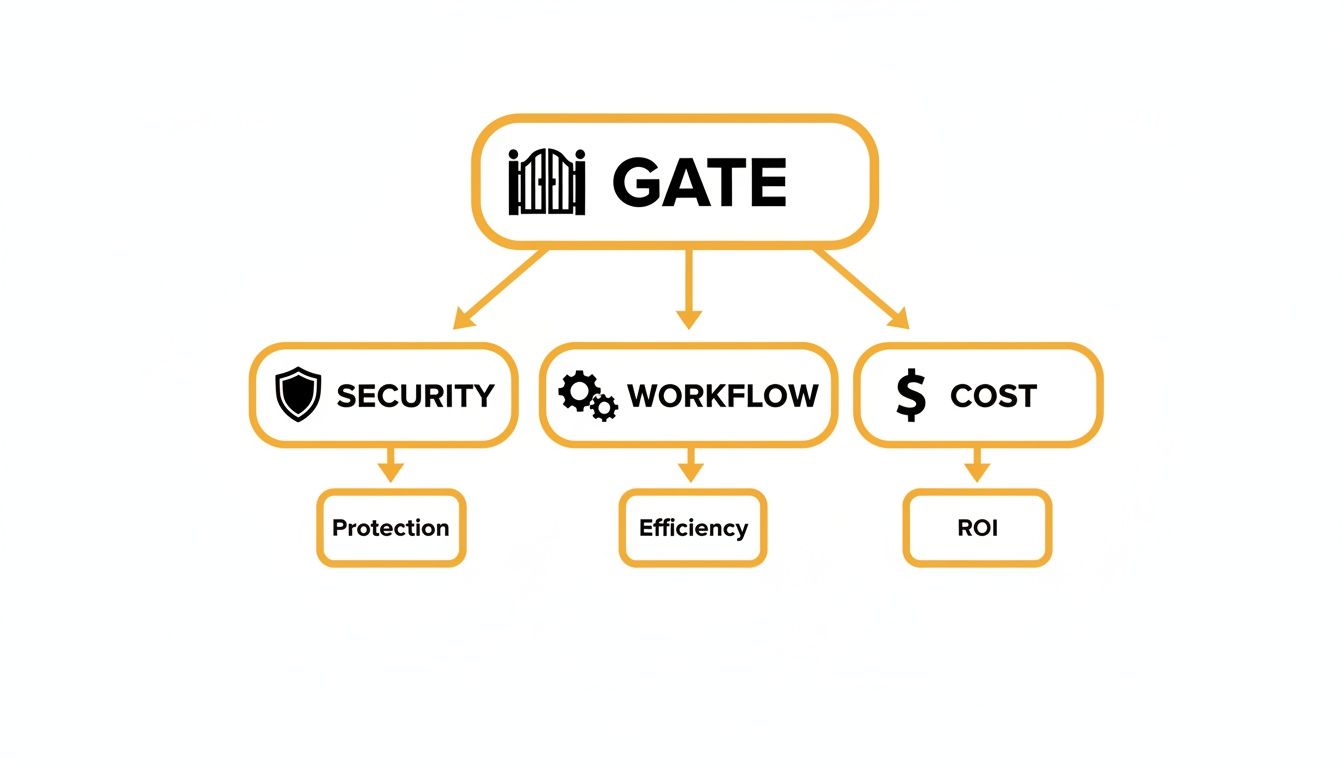
As you can see, the ideal commercial gate strikes a balance between tough security, smooth workflow, and a positive return on investment, making it a critical asset for any business.
Commercial Gate Quick Comparison Guide
To help you get started, this table offers a quick snapshot of the most common commercial gate types and where they shine. It's a handy reference for zeroing in on the options that make the most sense for your industry.
| Gate Type | Ideal Application | Key Benefit | Common Industries |
|---|---|---|---|
| Sectional Doors | General purpose, climate-controlled areas | Insulation & versatility | Warehousing, Auto Shops, Distribution Centres |
| Rolling Steel Doors | High-security exterior openings | Maximum durability & security | Retail, Storage Facilities, Industrial Plants |
| High-Speed Doors | High-traffic interior/exterior doorways | Speed & environmental control | Food Processing, Cold Storage, Pharmaceutical |
| Security Grilles | Storefronts, parking, public areas | Visible security & ventilation | Retail Malls, Parking Garages, Airports |
This table should give you a good starting point. Now, let’s dig a little deeper into what makes each of these gates tick.
Sectional Doors: The All-Around Performer
Sectional doors are probably what you picture when you think of a standard garage door. They're made of horizontal panels linked by hinges, which slide up and back on a track system. But don’t be fooled—the commercial versions are in a different league entirely.
Built with heavy-gauge steel and seriously powerful hardware, they're designed to handle constant use, day in and day out. Their biggest advantage is insulation. For a busy distribution centre in a cold Canadian climate, an insulated sectional door isn't just a nice-to-have; it's a must for controlling heating costs and keeping your team comfortable. Check out our range of durable commercial doors to see how they can be customized for your facility.
Rolling Steel Doors: The Security Specialist
When you need absolute, uncompromising security and durability, rolling steel doors are the answer. Instead of panels, these gates are constructed from interlocking metal slats that coil up tightly into a roll above the opening. This design makes them incredibly tough against impacts and forced entry.
Picture a storefront in a busy urban core or a warehouse that stores high-value goods. A rolling steel door is like an impenetrable metal curtain, offering maximum protection when you lock up for the night. They're also perfect for spots with limited headroom, since the coiled door takes up very little space.
High-Speed Doors: The Efficiency Expert
In facilities where climate control is everything and traffic never stops, every second a door stays open, money is walking out. High-speed fabric or rubber doors are engineered for one job: to open and close incredibly fast, often at speeds over 100 inches per second.
Think about a food processing plant or a pharmaceutical clean room. These places have to stay sterile and maintain exact temperatures. A high-speed door minimizes air exchange, slashes energy loss, and keeps the supply chain moving without a hitch. This makes them essential for protecting product integrity and operational efficiency. Learn more about how these systems can benefit your facility by reviewing our door and gate operators.
Security Grilles: Visibility Meets Protection
For places like retail stores in a mall or underground parking garages, you need security, but you also need visibility. Security grilles solve this problem perfectly. They create a strong physical barrier while still allowing air to flow and letting people see inside, even after closing time.
This type of gate is ideal for securing an area without putting up a solid wall. It deters unauthorized access while maintaining an open, inviting feel, which is crucial for both retail appeal and safety in public spaces. Here in Canada, the most common sizes for commercial loading dock doors are 8 feet wide by 10 feet high and 9 feet wide by 10 feet high, designed to fit the vast majority of transport trucks. These dimensions are key for creating a tight seal with dock shelters, which boosts safety and cuts down on energy loss. You can find more details on standard commercial door dimensions at doorcare.ca.
The best commercial garage gate isn’t the most expensive or the strongest; it’s the one that integrates seamlessly into your facility’s daily rhythm, solving more problems than it creates.
By understanding these core differences, you can start to narrow down the options that truly line up with what you need. The next step is to look at the specific materials and performance features that will ensure your chosen gate delivers value for years to come. Ready to talk about which gate is right for you? Our team is here to offer expert advice and find a solution you can count on. Let's discuss your needs and explore our 24-hour service commitment to keep your operation running without a hitch.
Specifying Your Gate: Materials and Performance Features
Alright, you've narrowed down the type of commercial gate you need. That's a great first step. But now comes the real work: digging into the nitty-gritty details that turn a good gate into the perfect gate for your facility.
Think of it like getting a custom suit made. You wouldn't just pick one off the rack; you'd get measured for everything. Specifying a commercial gate is the same. We need to build a spec sheet that matches the right materials and performance features to your unique environment. It’s the blueprint that guarantees your investment will handle every single operational demand you throw at it.
Let's walk through the essential factors that will form the foundation of your decision.
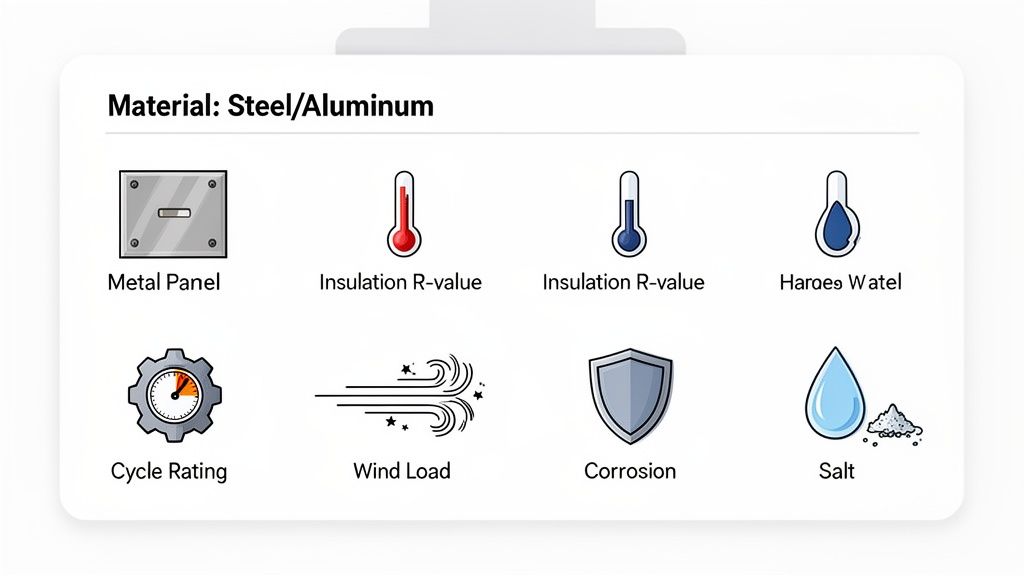
Material And Durability
The material you choose is the single biggest factor dictating your gate's strength, lifespan, and maintenance headaches. For most applications, it boils down to a choice between steel and aluminum.
- Steel Doors: In high-impact zones like manufacturing plants or busy warehouses, heavy-gauge steel is the undisputed champ. It’s built to take a beating from forklifts and heavy machinery without flinching.
- Aluminum Doors: If you’re in a humid environment, a car wash, or a coastal area getting blasted with salt air, aluminum is the smarter play. It’s naturally corrosion-resistant, so you won’t have to worry about the rust that can eat a steel door alive over time.
Insulation And Energy Efficiency
A commercial gate is a huge hole in your building’s envelope. If it’s not insulated properly, your energy bills will show it. This is where you need to get familiar with R-value.
Simply put, R-value measures how well something resists heat flow—the higher the number, the better the insulation. A basic, non-insulated door has an R-value near zero. A high-performance insulated door, on the other hand, can hit an R-value of R-16 or higher.
For any climate-controlled facility—think food distribution centres or heated repair shops—a high R-value is non-negotiable. It traps your expensive heated or cooled air inside, taking a massive load off your HVAC system and delivering real energy savings. The financial impact is a critical piece of the puzzle, and you can learn more about the factors influencing the overall cost of a commercial garage door in our detailed guide.
Operational Frequency And Cycle Life
Here’s a simple but crucial question: how many times a day will this gate open and close? Your answer determines the kind of guts you need inside, especially the springs. Spring lifespan is measured in cycles, where one cycle is one full open-and-close sequence.
A standard commercial spring might be rated for 10,000 to 20,000 cycles. That’s perfectly fine for a small auto shop or a low-traffic storage facility. But for a bustling logistics hub running 24/7? You could burn through those cycles in less than a year.
For any high-traffic application, investing in high-cycle springs rated for 50,000, 100,000, or even more cycles is a smart long-term play. It costs more upfront, but it saves you from the frequent, costly downtime that comes with constant spring replacements.
Performance And Code Requirements
Finally, your gate has to meet specific performance standards and local building codes. One of the big ones is the wind load rating, which tells you how well a door can stand up to high winds without failing. In areas prone to severe weather, getting this right isn’t just a good idea—it’s a legal and safety requirement.
Other performance needs are tied directly to your industry. A pharmaceutical facility might need a high-speed door with an airtight seal to keep its environment sterile. A heavy manufacturing plant, however, would prioritize a fire-rated steel door designed to automatically close and contain a fire.
Understanding these factors is how you build a clear, effective spec sheet. It’s what ensures the commercial gate you choose is perfectly dialled in for your facility, ready to perform day in and day out.
Making Sense of Safety Standards and Code Compliance
When it comes to your facility, the safety of your people and the protection of your assets are flat-out non-negotiable. For commercial garage gates, safety isn’t just a nice-to-have feature—it's a mandatory, regulated requirement. Let’s break down the essential safety standards and building codes that govern these systems, so you understand not just what’s required, but why it's so critical for your operation's integrity and liability.
Getting a handle on these regulations turns safety from an abstract idea into a practical, daily reality. A compliant gate system is a reliable system, one that actively prevents accidents and keeps your business running like a well-oiled machine. The smartest move is to partner with experts who know these codes inside and out, ensuring your facility is both safe and productive.
Understanding the ANSI/CAN/UL 325 Safety Standard
The cornerstone of modern commercial door safety is the ANSI/CAN/UL 325 standard. Don't let the technical name throw you off; its purpose is simple. It's a set of rules designed to keep automated gates from causing injury or damage by making sure they can detect and react to anything in their path.
Think of it as the built-in reflexes for your heavy-duty doors. Rolled out in 2017, this binational standard was a massive step forward for safety across Canada. It mandates that commercial door operators must have at least two independent safety entrapment protection devices. This critical update was woven into the Canadian Electrical Code to dramatically cut down on accidents in industrial settings. You can learn more about the binational standard's impact from UL.com.
This requirement made two key technologies mandatory:
- Photo-Eyes (Photoelectric Sensors): These are the small sensors you see on each side of the door opening. They shoot an invisible infrared beam across the doorway. If anything—a person, a pallet jack, or a forklift—breaks that beam while the door is closing, the operator immediately stops and reverses the door.
- Reversing Edge (Sensing Edge): This is a pressure-sensitive strip attached to the bottom edge of the door itself. If this edge bumps into an obstruction while closing, it sends a signal to the operator to instantly reverse direction.
Together, these systems create a redundant safety net. If one system somehow fails to detect an issue, the other is right there as a backup. It’s a robust, legally required layer of protection for any modern commercial garage gate.
The Critical Role of Fire-Rated Doors
Beyond day-to-day operational safety, some commercial gates play a huge role in emergency preparedness. Fire-rated doors are specifically engineered to contain the spread of fire and smoke, basically compartmentalizing a building to protect escape routes and limit property damage.
These specialized rolling or sliding steel doors aren't just regular doors made from fire-resistant materials. They are complete, integrated systems designed to close automatically the second a fire alarm or smoke detector goes off.
To ensure they perform perfectly during an emergency, fire-rated doors must undergo a mandatory annual inspection and drop test. This test verifies that the door's automatic closing mechanism works correctly and that the door closes at the right speed without getting hung up on anything. A certified technician has to perform and document this test to maintain compliance with local fire codes and National Fire Protection Association (NFPA) standards. Flawless installation and ongoing commercial door maintenance are absolutely essential for passing these critical inspections.
Why Professional Installation and Service Matter
Trying to navigate these complex codes and standards on your own just isn't worth the risk. Achieving and maintaining full compliance requires deep industry knowledge and technical skill. An improperly installed safety sensor or a poorly maintained fire door doesn't just fail to meet code—it creates a massive liability risk for your business.
A trusted partner ensures every component is installed, tested, and documented correctly right from the start. By relying on certified technicians for both installation and 24/7 emergency service, you can rest easy knowing your commercial garage gates are protecting your people, your assets, and your bottom line. Contact us to schedule a safety compliance inspection for your facility.
A Proactive Approach to Maintenance and Repairs
A commercial gate’s true value isn’t just about the day it’s installed; it’s measured over its entire lifecycle. The secret to long-term performance is shifting your mindset from reactive, costly emergency calls to a proactive maintenance plan. This strategy doesn't just prevent failures—it extends the life of your asset, minimizes operational chaos, and protects your bottom line.
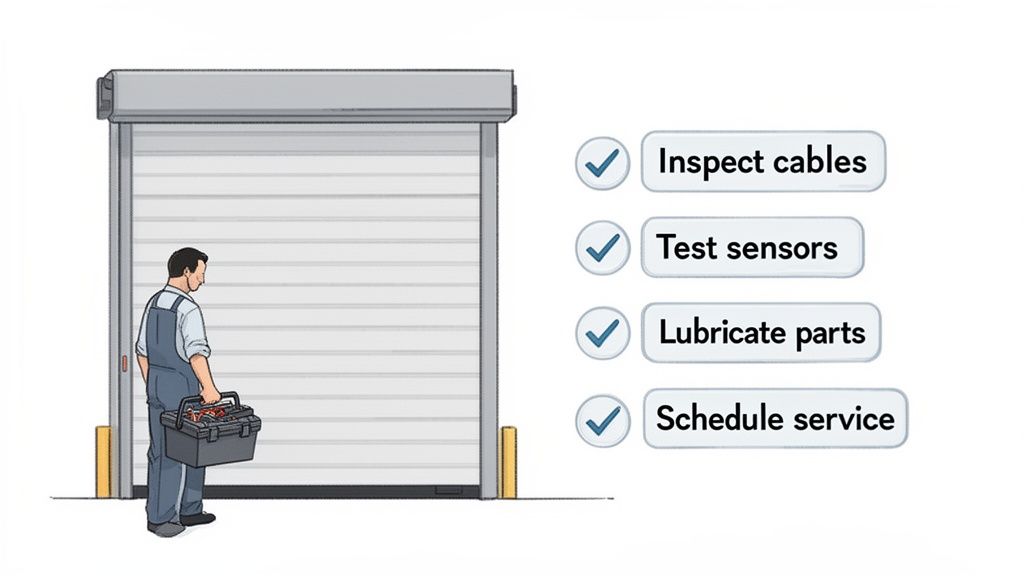
This journey to long-term reliability starts with the installation, where the path can look very different depending on whether you're building from scratch or upgrading an existing facility.
Installation: New Construction vs Retrofit
Putting commercial garage gates into a new construction project is about as straightforward as it gets. The openings are designed and built specifically for the door system, guaranteeing a perfect fit and optimal structural support from day one. Everything is planned, measured, and executed in a controlled environment.
Retrofitting a door into an older building, however, is a whole different ball game. The existing structure probably wasn't designed to handle the weight and forces of a modern commercial door. You can run into all sorts of issues, like not enough headroom, uneven floors, or walls that need reinforcing before a new system can be safely installed. A professional assessment is non-negotiable here to spot those structural hurdles and engineer a solution that’s both safe and effective.
But no matter how perfect the installation, the real work of ensuring longevity starts the moment the door is up and running.
The Power of Proactive Maintenance
Waiting for a commercial garage gate to break down is a recipe for disaster. Think about it: a failed door at a busy loading dock right in the middle of a major shipment can halt your entire operation. That means lost revenue, delayed deliveries, and unhappy customers.
Proactive maintenance isn’t an expense; it’s an investment in uptime. By catching small issues before they become catastrophic failures, you safeguard your productivity and turn an unpredictable liability into a reliable asset.
A planned maintenance program is the best way to make this happen. It involves regular, scheduled check-ups and servicing by trained technicians who know exactly what to look for. This approach not only keeps your gates in peak condition but also helps you budget for repairs instead of getting blindsided by emergency costs.
Your Practical Maintenance Checklist
While you can't beat professional servicing, your on-site team can play a huge role in catching problems early. A simple internal inspection routine can make a massive difference. Here’s a basic checklist to get your team started.
Daily Checks (Performed by Staff):
- Visual Inspection: Just a quick look-over for anything that seems out of place—frayed cables, loose hardware, or damage to the door panels or track.
- Clear the Area: Make sure the door's path is completely free of obstructions, debris, and equipment before anyone operates it.
- Listen for Unusual Noises: Grinding, scraping, or popping sounds are the door’s way of telling you something is wrong. Don't ignore them.
Monthly Inspections (Performed by a Maintenance Lead):
- Test Safety Features: Place a soft object (like a cardboard box) in the door's path. The photo-eyes should detect it and the door should immediately reverse.
- Check Weather Seals: Inspect the seals around the door for cracks or gaps. These are open invitations for drafts, pests, and moisture.
- Balance Test: If it's safe to do so, disconnect the door from the operator and manually lift it halfway. A properly balanced door should stay put. If it drifts up or slams down, the springs need a professional adjustment—fast.
For a deeper dive, you can learn more about effective garage door maintenance strategies in our dedicated article.
The Wilcox Planned Maintenance Program
A formal Planned Maintenance Program (PMP) takes this proactive approach to the next level. A certified technician conducts a thorough, multi-point inspection and service on a regular schedule—usually quarterly, semi-annually, or annually, depending on how heavily your doors are used.
During a PMP visit, a technician will:
- Inspect and Lubricate All Moving Parts: This includes rollers, hinges, bearings, and chains to keep things running smoothly and quietly.
- Adjust Springs and Cables: Proper tension is absolutely critical for the safe and efficient lifting of the door.
- Test and Calibrate Safety Devices: Technicians will verify that all safety sensors and reversing mechanisms meet ANSI/CAN/UL 325 standards.
- Provide Detailed Reporting: You’ll get a full report on your doors' condition, highlighting any necessary repairs and providing recommendations for future upkeep.
Ultimately, a proactive maintenance plan is the key to getting the most out of your commercial garage gates. It transforms your doors from a potential point of failure into a dependable part of your daily operations.
Ready to shift from reactive repairs to proactive performance? Contact Wilcox Door Service today to learn more about our Planned Maintenance Programs and schedule a facility assessment.
Your Partner for Long-Term Performance and Reliability
As we've covered, choosing the right commercial garage gate is a major decision that echoes through your entire operation. It's not just a door; it’s an investment in your facility's security, efficiency, and workflow.
The takeaways are simple but critical: match the gate to your specific needs, choose materials built to last, prioritize safety compliance, and don't skip proactive maintenance. Getting it right from the start requires a partner who has been in the trenches and understands the stakes.
To ensure your facility's access points are secure, compliant, and built for the long haul, you need a partner who sees the complete lifecycle of commercial garage gates—from the initial blueprint to ongoing upkeep.
Our team has the experience to guide you through your next project, whether that's a brand-new installation, a critical safety audit, or setting up a smart planned maintenance program. We make sure your doors work exactly as they should, day in and day out, protecting your assets without causing headaches. We handle it all, from specifying the right commercial doors to being there when you need 24/7 emergency service.
Reach out to our team for a professional consultation. Let's talk about how a true partnership can strengthen your facility’s performance and security for years to come.
Your Top Commercial Garage Gate Questions Answered
When you're managing a busy facility, you need straight answers. Here are some of the most common questions facility managers ask about their commercial garage gates, with practical advice to help you keep things running smoothly.
How Often Should Our Commercial Garage Gates Be Serviced?
Honestly, it all comes down to how much you use them. If you have a high-cycle door in a bustling warehouse that opens and closes more than 50 times a day, you’ll want to get a professional in for a quarterly inspection. This is the best way to catch small issues before they turn into major downtime.
For gates with less traffic—think of a small auto shop or a storage facility—a semi-annual or annual service plan is usually plenty. A technician will check all the critical wear-and-tear parts like springs, cables, and safety sensors to make sure you don't get any nasty surprises.
A planned maintenance program is the single best way to maximize uptime, ensure safety compliance, and protect your investment. You're essentially swapping unpredictable emergency repair bills for predictable, manageable upkeep costs.
What Is the Typical Lifespan of a Commercial Garage Gate?
A well-cared-for sectional or rolling steel door can easily last 20 to 30 years. But its real lifespan hinges on three things: maintenance, environment, and daily use. The most critical components—the springs—are rated by cycles, not years.
- Standard Springs: These are typically good for 10,000 to 20,000 cycles (one cycle is one full open-and-close).
- High-Cycle Springs: Built for the busiest doors, these can handle 10,000 cycles or more.
Without a doubt, consistent professional maintenance is the number one factor in hitting—or even exceeding—that expected lifespan. It keeps every part working in harmony, which dramatically cuts down on premature wear.
Can We Upgrade an Older Commercial Gate with Modern Technology?
Absolutely. In most cases, retrofitting an older gate with modern tech is a fantastic, cost-effective way to improve security, safety, and efficiency without a full replacement.
Common upgrades include adding smart operators for remote access and monitoring, integrating keypads or card readers for better access control, or installing modern safety devices like photo-eyes and reversing edges. These are essential for meeting current ANSI/CAN/UL 325 safety standards. The best first step is to have a professional come out for a site assessment to map out the best upgrade path for your specific door.
At Wilcox Door Service, we know that long-term performance comes from reliable service you can trust. Whether you need a safety inspection, an upgrade consultation, or a comprehensive maintenance plan, our team is here to help.
Find out more about our full range of solutions by visiting us at https://www.wilcoxdoor.com.