


This guide provides a comprehensive overview of commercial door roller shutters, designed for facility managers and operations leaders. You will learn about their core components, compare different materials like steel and aluminum, understand critical performance ratings for security and insulation, and follow a practical checklist for selecting the right door. We'll also cover essential maintenance practices to ensure longevity and reliability, reinforcing Wilcox Door Service’s commitment to being your Respected Partners in Reliable Service.
Your Complete Guide to Door Roller Shutters
If you're a facility manager or operations leader, you know that the right door can make or break your workflow, security, and energy efficiency. That’s where this guide comes in. As industry experts, we're here to demystify commercial door roller shutters, giving you the practical knowledge to select, install, and maintain the perfect solution for your building.
While the basic concept isn't new—roller shutters have roots in Europe stretching back to the 1850s—today's commercial doors are highly engineered systems. Think of this guide as a conversation with a trusted partner, walking you through everything you need to know.
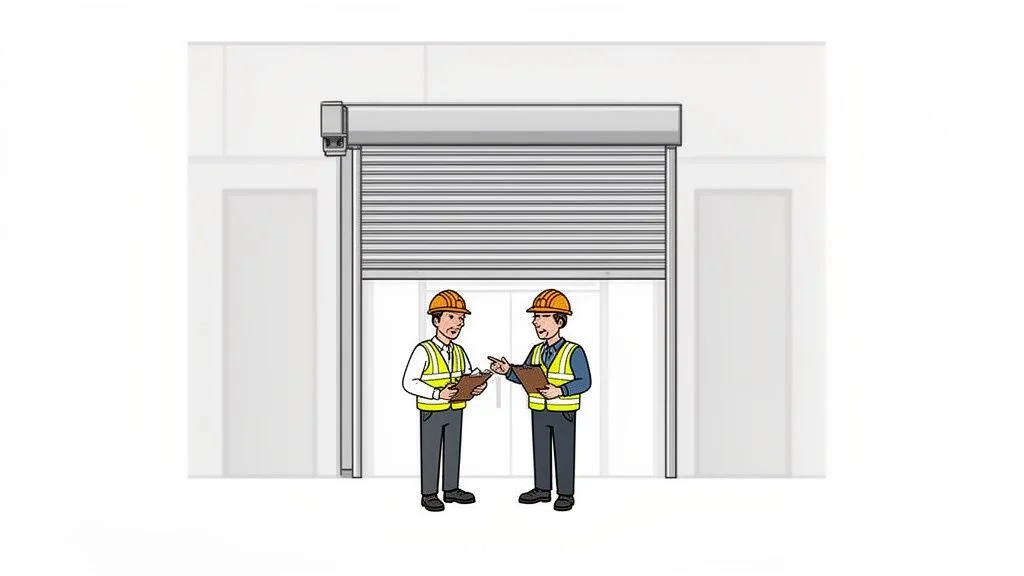
Alt text: Two Wilcox Door Service technicians in hard hats inspecting a large commercial door roller shutter.
We'll break down the key areas so you can make decisions with confidence:
- How They Work: We’ll look past the curtain and into the core components, from the interlocking slats that form the door to the barrel assembly that makes it all move.
- Materials and Types: Is steel always the answer? We’ll compare steel, aluminum, and other specialized materials to help you match the door to your environment.
- Performance Ratings: This is where the details matter. We’ll explain what to look for in security features, thermal insulation (R-values), and non-negotiable fire safety ratings.
- Selection and Installation: Consider this your pre-flight checklist. We’ll cover everything from measuring your opening and determining your duty cycle to choosing the right operator and controls.
- Maintenance and Lifecycle: A good door is a long-term asset. We’ll outline proactive maintenance strategies to get the most out of your investment and lower the total cost of ownership.
For a deeper dive into how these doors stack up against other popular systems, our article on sectional vs. rolling steel doors is a great next step. By the time you're done with this guide, you’ll have the expertise to choose a roller shutter that truly works for your facility.
How a Door Roller Shutter Actually Works
At its heart, a door roller shutter works on a brilliantly simple principle, but it’s engineered to be tough enough for the most demanding commercial settings. Think of it as an industrial-strength window blind, but instead of vinyl slats, you have a heavy-duty, interlocking curtain built for security.
The entire door curtain coils neatly into a compact box mounted just above the opening. This is a huge plus for busy facilities. When the door is open, it’s completely out of sight, giving you maximum vertical and horizontal clearance. That means forklifts, trucks, and people can move through freely without ducking under any overhead tracks.
The Core Components Explained
The system's reliability hinges on a few key parts working together. Once you understand them, you’ll see why these doors are a fixture in facilities where security and efficiency are top priorities.
- Slats: These are the horizontal, interlocking segments that make up the door curtain. Usually crafted from galvanized steel or aluminum, each slat hooks into the next to form a continuous, solid barrier that’s incredibly tough to break through when closed.
- Guide Rails: You'll find these vertical tracks mounted on both sides of the doorway. The ends of the slats run inside these guides, keeping the curtain perfectly straight and stable as it moves, even when facing high winds or an attempt at forced entry.
- Barrel Assembly: This is the muscle of the operation. Located at the very top, the barrel is a large steel tube that the curtain coils onto. Inside, it contains powerful springs that are tensioned to counterbalance the curtain's weight, making it surprisingly easy to lift, whether by hand or with a motor.
In short, the slats provide the barrier, the guide rails ensure stability, and the barrel assembly delivers the lifting force. It’s a powerful and proven combination of strength and straightforward mechanics, refined over decades for industrial work.
The Operational Cycle
When you open the door, the motor (or manual chain) rotates the barrel assembly. As it turns, it neatly wraps the curtain of interlocking slats around itself, pulling it straight up into its housing. Closing is just the reverse. The barrel gently uncoils the curtain, letting it slide down the guide rails in a controlled descent. This simple, reliable mechanism is what gives you both a formidable security barrier when you need it and completely unobstructed access when you don’t.
For facility managers wanting to get the most out of their door systems, digging into the specifics of a roll-up steel door can offer deeper insights. As your partners in facility performance, we believe that understanding these fundamentals helps you make smarter, more informed decisions for the long haul.
Comparing Roller Shutter Materials and Types
Picking the right material for your door roller shutters is one of the most important calls a facility manager will make. It’s a decision that directly affects the door’s durability, security level, maintenance schedule, and total cost over its lifespan. The goal isn't to find the single "best" material, but to find the best fit for your specific building and how you use it.
Think of it like choosing tires for a company truck. You wouldn't put high-performance racing tires on a dump truck that spends all day on a gravel construction site. In the same way, a lightweight aluminum shutter might be perfect for an indoor pharmacy counter but wouldn't stand a chance on an exposed, high-traffic loading dock that needs serious security.
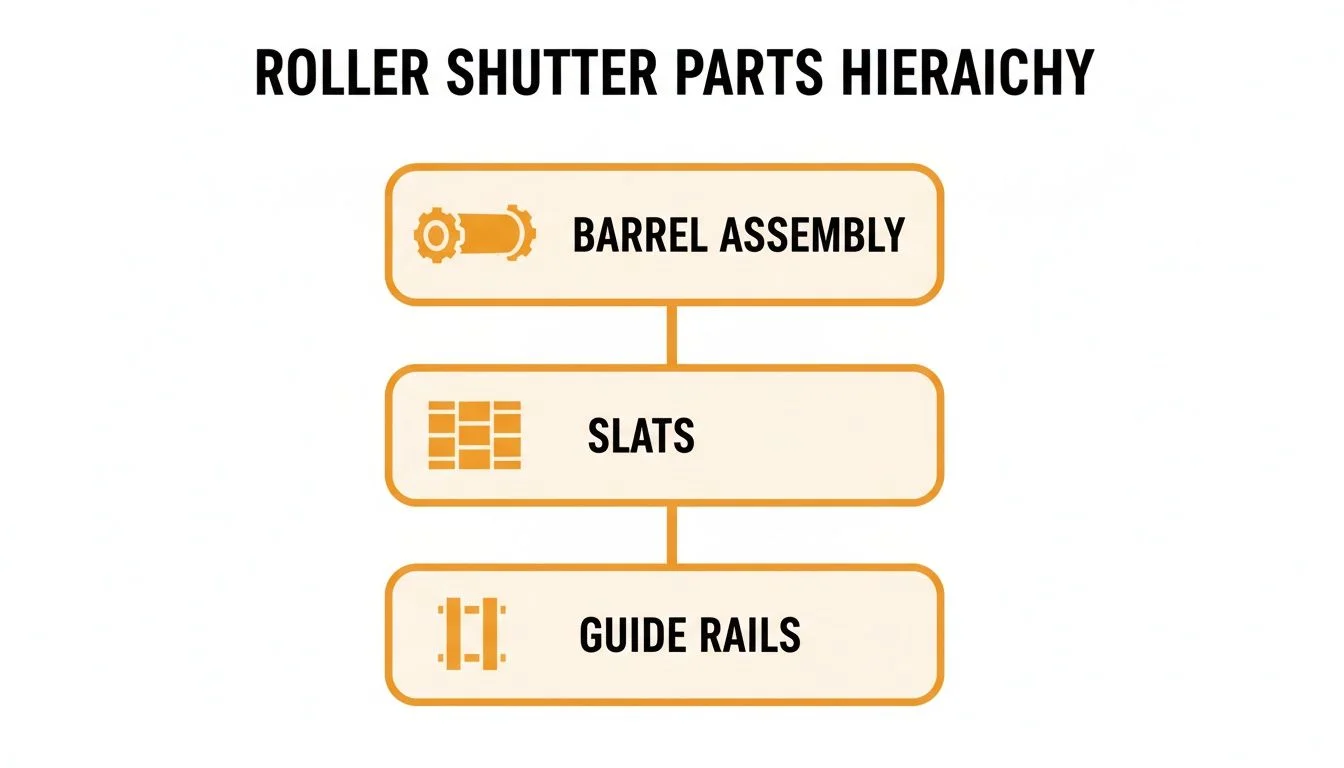
Alt text: Diagram of door roller shutter parts: barrel assembly, slats, and guide rails.
The material of the barrel assembly, slats, and guide rails determines everything from strength to how smoothly the door operates day in and day out.
To help you decide, here's a look at the most common materials and types we see in the field.
| Material/Type | Primary Benefit | Best For | Considerations |
|---|---|---|---|
| Steel | Maximum security & durability | Industrial, warehouses, high-security areas | Heavier, requires rust prevention, puts more strain on operators |
| Aluminum | Lightweight & corrosion-resistant | Retail, parkades, coastal or high-humidity areas | Less impact-resistant than heavy-gauge steel |
| Insulated | Thermal control | Cold storage, heated warehouses, food processing | Higher upfront cost, slats can be damaged by impact |
| Fire-Rated | Code compliance & life safety | Firewalls, corridors, any code-required location | Requires mandatory annual inspections and drop testing |
The Workhorse: Steel Roller Shutters
When brute strength and security are non-negotiable, heavy-gauge steel is the top contender. Steel door roller shutters are the go-to standard for industrial sites like manufacturing plants, warehouses, and distribution centres where the risk of impact or a break-in is real.
Their sheer mass makes them a powerful deterrent, both visually and physically. But that toughness comes with trade-offs. Steel is heavy, and if its galvanized coating gets scratched or damaged, it's prone to rust. This means you have to stay on top of maintenance, especially in damp or corrosive environments.
Key Takeaway: Choose steel for maximum security and impact resistance in demanding industrial settings. It’s the proven solution for protecting valuable assets and securing the building perimeter.
The Versatile Choice: Aluminum Roller Shutters
Aluminum shutters give you a great combination of respectable strength in a much lighter package. They are naturally resistant to corrosion, which makes them a fantastic choice for buildings in coastal areas or for interior applications with high humidity, like food processing plants or car washes.
Because they’re lighter, they put less strain on the motor and other moving parts. This often translates to a longer service life and fewer maintenance calls. While aluminum won't resist a direct, heavy impact as well as steel, it provides more than enough security for most commercial uses.
- Corrosion Resistance: Perfect for exterior doors exposed to rain, snow, and road salt.
- Lighter Weight: Leads to smoother, quieter operation and can allow for faster open-and-close cycles.
- Aesthetic Options: Often comes in various finishes and colours to match a building's exterior.
Specialized Shutters for Unique Demands
Sometimes, a standard steel or aluminum door just won’t cut it. That's where specialized door roller shutters come in. These are engineered to solve very specific problems, going beyond simple access to provide active performance.
Insulated Shutters: For any space where you're trying to control the temperature—whether it's a cold storage freezer or a heated warehouse—insulated shutters are a must. The slats are injected with polyurethane foam, which gives them a high R-value (a measure of thermal resistance). This barrier stops energy from escaping, lowers your HVAC bills, and keeps temperatures stable to protect sensitive products.
Fire-Rated Shutters: In most commercial and industrial buildings, fire-rated doors aren't optional; they are required by building codes for life safety. These shutters are designed to close automatically when a fire alarm is triggered. This contains the fire and smoke to one area for a specific amount of time (like 90 minutes or 3 hours), giving people time to evacuate safely. To ensure they work when you need them most, these doors require mandatory annual inspections and drop tests. For more on how different door materials perform under stress, our post on fiberglass vs. steel doors offers some useful insights.
Understanding Key Performance Ratings
Beyond the base material, the real value of a door roller shutter is in its performance ratings. These are certified numbers that tell you exactly how a door will stand up to specific, real-world stress. For a facility manager, knowing these ratings is the difference between simply filling a hole in the wall and installing a door that actively protects your people, property, and bottom line.
Think of it like the specs on a new piece of machinery. You wouldn't buy a generator without knowing its power output, right? In the same way, you shouldn’t pick a roller shutter without knowing its security, thermal, and fire safety capabilities.
Fortifying Your Facility with Security Ratings
Security is often the number one reason for installing a roller shutter. But what actually makes one door more secure than another? It all comes down to specific design features engineered to resist forced entry and stand up to extreme weather. When you're evaluating a shutter’s security, here’s what to look for:
- Heavy-Duty Locking Mechanisms: Go beyond a standard lock. You can get options like slide bolts, cylinder locks, or even advanced electromechanical locks that tie directly into your building’s access control system.
- Wind Locks: These are specialized clips on the end of the slats that hook into the guide rails. If someone tries to force the door or during high winds, these locks prevent the curtain from being pushed out of its tracks. It’s a simple feature that dramatically strengthens the entire barrier.
- Gauge of Steel: For steel shutters, the rule is simple: a lower gauge number means thicker, stronger steel. An 18-gauge steel slat is far tougher and more resistant to impact than a lighter 22-gauge version.
A shutter with a high security rating is both a physical and visual deterrent. It sends a clear message to would-be intruders that your facility is not an easy target, protecting your inventory and equipment 24/7.
Controlling Your Climate with Thermal Efficiency
For any business where temperature control is a big deal—think food processing plants, pharmaceutical warehouses, or even just a heated distribution centre in a cold climate—an insulated door roller shutter is a mission-critical piece of equipment. These doors are built to stop energy loss, and their effectiveness is measured by an R-value.
The R-value is a straightforward measure of how well a material resists heat flow. The higher the R-value, the better the insulation, and the more you'll save on your heating and cooling bills.
An uninsulated metal door might have an R-value close to 1. An insulated shutter, by contrast, can hit an R-value of 8 or higher. This is because the slats are injected with polyurethane foam, which creates a solid thermal break that stops outdoor temperatures from creeping inside. This helps maintain product integrity and can lead to major energy savings, year after year. When looking at commercial door roller shutters, it's also helpful to be familiar with other industry benchmarks like NEMA standards, which specify the level of protection electrical enclosures offer against environmental hazards.
Ensuring Life Safety with Fire Ratings
In most commercial buildings, fire-rated doors aren’t just a good idea; they are a legal requirement mandated by local and national fire codes. A fire-rated door roller shutter is a life-saving device designed to close automatically in a fire, containing flames and smoke to one specific area.
These doors are given a time rating, like 90-minute or 3-hour, which tells you how long they can withstand a fire and stop it from spreading. This compartmentalization is crucial for two main reasons:
- It protects escape routes, giving people precious time to get out of the building safely.
- It limits property damage by containing the fire to its point of origin.
A fire door, however, is only effective if it works flawlessly when you need it most. That’s why standards like the NFPA 80 require all fire-rated doors to undergo a professional inspection and "drop test" at least once a year. This test confirms that the automatic closing mechanism is functioning correctly. Keeping up with these annual tests is mandatory for compliance and, more importantly, for the safety of everyone in your building.
A Practical Checklist for Selecting Your Shutter
Choosing a new door roller shutter is more than just picking a product off a shelf. It's a major decision for your facility, one that impacts security, workflow, and your bottom line. Get it wrong, and you could be facing frustrating operational delays, unexpected downtime, and a string of repair bills.
By thinking through these five key areas, you'll be able to specify a shutter that fits your operation like a glove and provides years of reliable service.
Step 1: Measure the Opening Size and Headroom
First things first, you need to get out the measuring tape. You’ll need the exact width and height of the door opening, of course. But just as crucial is the headroom—that’s the clear space between the top of the opening and the ceiling or any obstructions like pipes or light fixtures. This is where the coiled shutter and its barrel assembly live when the door is open. Not having enough headroom is one of the most common hurdles we see during installation.
Step 2: Determine the Duty Cycle
Next, you need to get a handle on how hard this door is going to work. The duty cycle is simply the number of times you expect the door to open and close each day. This figure is probably the single most important factor for the lifespan of the motor and springs.
- Low-Cycle Doors: If a door only opens in the morning and closes at night (fewer than 20 cycles), standard-cycle springs and a basic motor will do the job.
- High-Cycle Doors: For a busy loading dock door that cycles 50+ times a day, you absolutely need a high-cycle spring system and a tough, industrial-duty operator built for that kind of punishment.
Matching the door’s mechanics to your operational tempo isn't optional. Skimping on the duty cycle is the quickest route to premature failure and those dreaded middle-of-the-night emergency repair calls.
Step 3: Assess Insulation and Environmental Needs
Now, think about the environment on either side of the opening. Is the shutter separating your heated warehouse from the cold Canadian winter? Or is it inside a food-grade facility where temperature control is non-negotiable? Your answers will tell you if you need an insulated door roller shutter.
An insulated door with a high R-value is a thermal barrier, plain and simple. It stops energy from escaping. For facilities in Canada, that means real savings on heating bills and a more stable, comfortable indoor climate for your people and your products.
For any door on the building's perimeter, the investment in good insulation almost always pays for itself in energy savings. To see how these specifications are developed from the ground up, you can discover more insights about rolling door specifications from industry experts at cornelliron.com.
Step 4: Choose the Right Operator and Controls
Think about how your team will use the door day in and day out. The operator and control system you choose should match the speed of your workflow and your safety protocols.
You have a wide range of options, from the simple to the sophisticated:
- Manual Chain Hoist: The most basic choice, perfect for doors that are rarely used and where opening speed doesn't matter.
- Push-Button Motor: This is the workhorse for most commercial doors, offering dependable, powered operation.
- High-Speed Operators: In high-traffic zones where seconds matter, these motors open a door up to three times faster, boosting productivity and minimizing heat loss.
- Smart Controls: Modern systems can be tied into motion sensors, loop detectors in the floor, or even your building management system for fully automated, hands-free operation.
Step 5: Confirm Essential Safety Features
Last but certainly not least, you have to confirm the door has the right safety features to protect your staff and equipment. A modern door roller shutter should never be installed without them. The two non-negotiable safety devices are:
- Photo-Eyes: These project an infrared beam across the opening. If a person, forklift, or any object breaks that beam, the door will immediately stop or reverse its direction, preventing a dangerous impact.
- Reversing Edge: This is a pressure-sensitive strip running along the bottom edge of the door. If it touches an obstruction while closing, it instantly signals the motor to reverse.
Cutting corners on these features is a major safety gamble and a huge liability risk. By following this checklist, you can move forward confidently, knowing you’re selecting a door that’s safe, efficient, and built for the long haul. If you need help navigating these choices, our team is always ready to offer expert advice on everything from commercial doors to loading dock solutions.
Installation, Maintenance, and Troubleshooting
A premium door roller shutter is only as good as its installation and the care it receives afterward. Investing in an expert installation isn't just about getting the door hung correctly; it's about making sure every single component works in harmony for safety, proper alignment, and long-term reliability. A door that’s even slightly off can lead to premature wear, frustrating operational failures, and serious safety hazards for your team.
This is where professional, certified technicians make a world of difference. They ensure the guide rails are perfectly plumb, the barrel assembly is properly tensioned, and all safety systems are calibrated correctly from day one. That expert setup is the foundation for a door that will perform flawlessly for years to come.
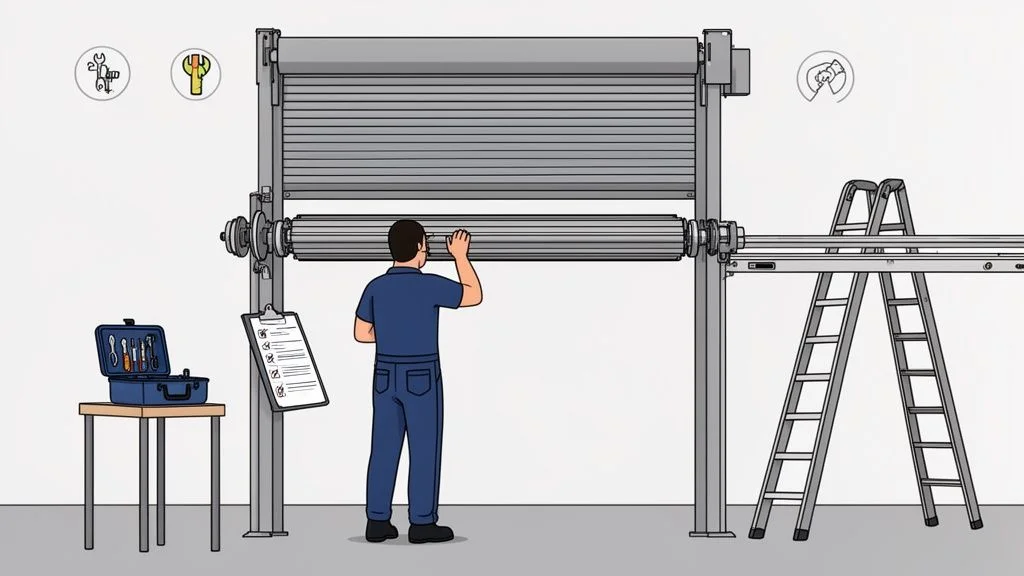
Alt text: A technician performs maintenance on an industrial door roller shutter.
Proactive Care With a Planned Maintenance Program
The absolute best way to avoid emergency breakdowns is to catch problems before they even start. A Planned Maintenance Program (PMP) is the most effective strategy you can have to maximize the lifespan of your roller shutters and minimize costly, disruptive downtime. Instead of just reacting to failures, you proactively address wear and tear on your own schedule.
Our PMP is designed to keep your doors running safely and efficiently. During each service visit, our certified technicians perform a detailed multi-point inspection, hunting for any little issue that could escalate into a major problem.
What a Wilcox technician inspects:
- Spring Tension and Balance: We make sure the springs are perfectly tensioned to counterbalance the door’s weight. This is crucial for preventing unnecessary strain on the motor.
- Motor and Operator Function: Our technicians test the motor, gearbox, and all control functions to confirm smooth, consistent, and reliable operation every time.
- Slat and Curtain Integrity: We meticulously check for any dents, damage, or misaligned slats that could cause the door to jam or compromise your building's security.
- Safety Device Calibration: Photo-eyes and reversing edges are tested rigorously. We ensure they are functioning exactly as they should to protect your staff and equipment.
For more on developing a structured approach, check out a practical guide to PPM preventive maintenance.
A Quick Troubleshooting Guide for Your Team
Even with the best maintenance, small issues can pop up. Empowering your on-site team to spot the difference between a simple fix and a true emergency will save you both time and money. Here are some common symptoms and what they might mean.
Key Insight: Unusual noises or changes in operating speed are almost always the first warning signs of a developing problem. Addressing them early can prevent a small issue from becoming a complete system failure.
If your door starts showing these signs, here's what to look for:
Symptom: The door is running much slower than usual.
- Possible Cause: This often points to a loss of spring tension, which means the motor is struggling to lift the door's full weight. It could also signal an issue inside the motor's gearbox.
- Action: This requires a service call. Stop operating the door, as continuing to use it can burn out the motor.
Symptom: You hear a loud grinding, squealing, or popping noise.
- Possible Cause: Grinding can indicate worn bearings or a problem within the motor. A loud, sudden POP could be a spring breaking—a very dangerous situation.
- Action: Stop using the door immediately and call for emergency service. A broken spring can cause the entire door curtain to fall without warning.
Symptom: The door stops and reverses before closing fully.
- Possible Cause: The most common culprit is an obstructed or misaligned photo-eye safety sensor. Check if a box, pallet, or even dirt is blocking the sensor's beam.
- Action: Your team can often solve this by simply cleaning the photo-eye lenses and making sure the path is clear. If that doesn't fix it, it's time to call in a professional.
Knowing when to call for help is crucial. For any urgent issues that put safety or security at risk, our 24/7 emergency service is always available. For routine checks or non-urgent repairs, you can easily schedule a service inspection with our expert team.
Your Top Questions About Roller Shutters, Answered
When you're looking at a big investment for your facility, it's only natural to have a few questions. Our experts get asked about door roller shutters all the time, so we've put together straight-to-the-point answers for the most common ones.
How Much Do Commercial Door Roller Shutters Cost?
The price for a commercial roller shutter can swing quite a bit based on a few key things. The big ones are the overall size of the opening, the material you choose (think heavy-gauge steel versus lighter aluminum), and any special features like insulation, high-speed motors, or fire ratings.
A basic, manual door might start in the low thousands, but a large, high-cycle, insulated door will be a more significant investment. It’s crucial to look past the sticker price and think about the total lifecycle cost. A higher-quality door often means lower energy bills and fewer repair calls, saving you more money in the long run.
How Long Do Industrial Roller Shutters Last?
With a professional installation and a consistent planned maintenance program, a quality industrial door roller shutter can easily serve your facility for 20 to 30 years. The two biggest things that affect its lifespan are the environment it’s in and its duty cycle—how many times it opens and closes every day.
Doors in a busy loading dock or a corrosive environment will see more wear and tear. Having certified technicians perform regular inspections is the single best thing you can do to get the most out of your door, head off unexpected failures, and ensure it stays a reliable asset for decades.
What Is the Difference Between a Rolling Door and a Sectional Door?
The main difference comes down to how they open and the space they take up. A door roller shutter coils up into a tight, compact roll right above the doorway. This is perfect for facilities with low ceilings or overhead obstacles like cranes or fire sprinklers.
A sectional door, on the other hand, is built from larger hinged panels that slide up and then run horizontally along tracks on the ceiling. While sectional doors can offer great insulation, roller shutters are generally seen as more durable, more secure, and the better choice for high-traffic applications where you need both security and maximum headroom. For a direct comparison, check out our article on sectional vs. rolling steel doors.
Is Annual Testing Required for Fire-Rated Roller Shutters?
Yes, without a doubt. Annual testing for fire-rated doors isn’t just a good idea—it is absolutely mandatory. Fire safety codes like NFPA 80 legally require that every fire-rated door is professionally inspected and tested at least once a year.
This critical check is called a "drop test." It verifies that the door’s automatic closing system is working correctly and will deploy as designed in an emergency. A certified technician must perform and formally document this test to keep your facility compliant and, more importantly, to keep your people safe.
Ready to find the right door solution for your facility? The experts at Wilcox Door Service are here to help. As your Respected Partners providing Reliable Service, we can assist with everything from a quote to professional installation and a comprehensive maintenance plan. Contact us today to schedule an inspection.