


Understanding the correct door width for wheelchair access is the first, most crucial step toward making your commercial or industrial facility truly welcoming and compliant. This guide will walk you through the key measurements, Canadian building codes, and practical solutions you need to create a safe, accessible environment. You’ll learn about clear width, maneuvering clearances, accessible hardware, and how to audit your own facility, ensuring every entryway is a gateway, not a barrier.
Decoding the Essentials of Accessible Doorways
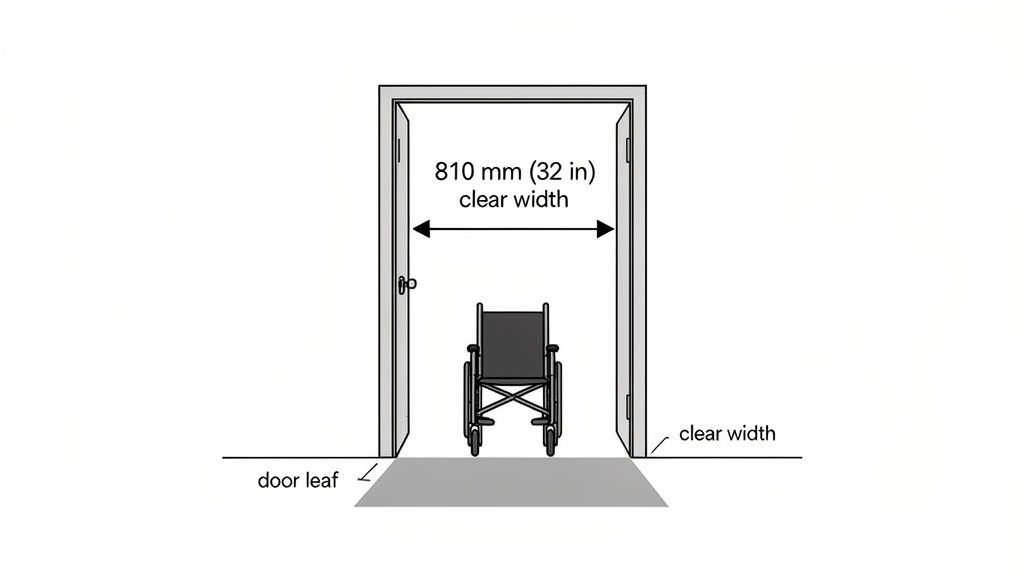
Alt text: Diagram illustrating the minimum 810 mm (32 inch) clear door width for wheelchair access, measured from the door face to the frame.
Achieving true accessibility is about much more than a single measurement. It’s about understanding a few key concepts that create a smooth, barrier-free experience for anyone using a mobility device. Getting these terms mixed up can easily lead to non-compliance and create real obstacles for people.
For a practical example, think of a loading dock designed for a large delivery truck. The bay door is much wider than the truck itself. That extra space isn’t wasted; it’s essential for maneuvering safely, unloading cargo, and preventing costly accidents. Accessible doorways operate on the very same principle—the space around the door is just as important as the opening.
Key Terms for Accessible Doorways
Before we dive deeper, let’s clarify the technical language in simple terms. Understanding this vocabulary will make planning and discussing accessible doorways much clearer.
| Term | Simple Explanation | Why It Matters for Your Facility |
|---|---|---|
| Clear Width | The actual, usable opening you can pass through when the door is open 90 degrees. | This is the non-negotiable measurement for accessibility. It’s not the width of the door panel itself, but the space from the door face to the opposite frame. |
| Maneuvering Clearance | The clear, unobstructed floor space on both sides of the doorway. | This is the “runway” a person in a wheelchair needs to approach, open the door, and pass through without struggling or bumping into walls or equipment. |
| Path of Travel | The continuous, clear route connecting all accessible areas in your building. | A perfectly wide door is useless if the hallway leading to it is too narrow or cluttered. The entire journey has to be accessible. |
Having this table handy can help demystify the core requirements as you assess your own facility’s doorways.
A common mistake is to confuse the door’s total size with its clear width. For example, a standard 34-inch door may only provide about 32 inches of clear width once the door’s thickness and the doorstop are factored in.
Understanding the subtle but critical difference between these measurements is key. For more context on typical dimensions, you might find our guide on standard door sizes in Canada useful.
Ultimately, all these elements form a complete system. By looking beyond just the door width for wheelchair access, you ensure your commercial or industrial facility isn’t just compliant, but genuinely safe, efficient, and accessible for every employee and visitor. This is what we mean at Wilcox Door Service when we say we are “Respected Partners, Reliable Service”—we help you see the full picture.
Properly planning these spaces prevents bottlenecks, especially in high-traffic zones like loading docks or main entryways, and ensures fluid movement throughout your entire property.
Navigating Canadian Building Codes and Standards
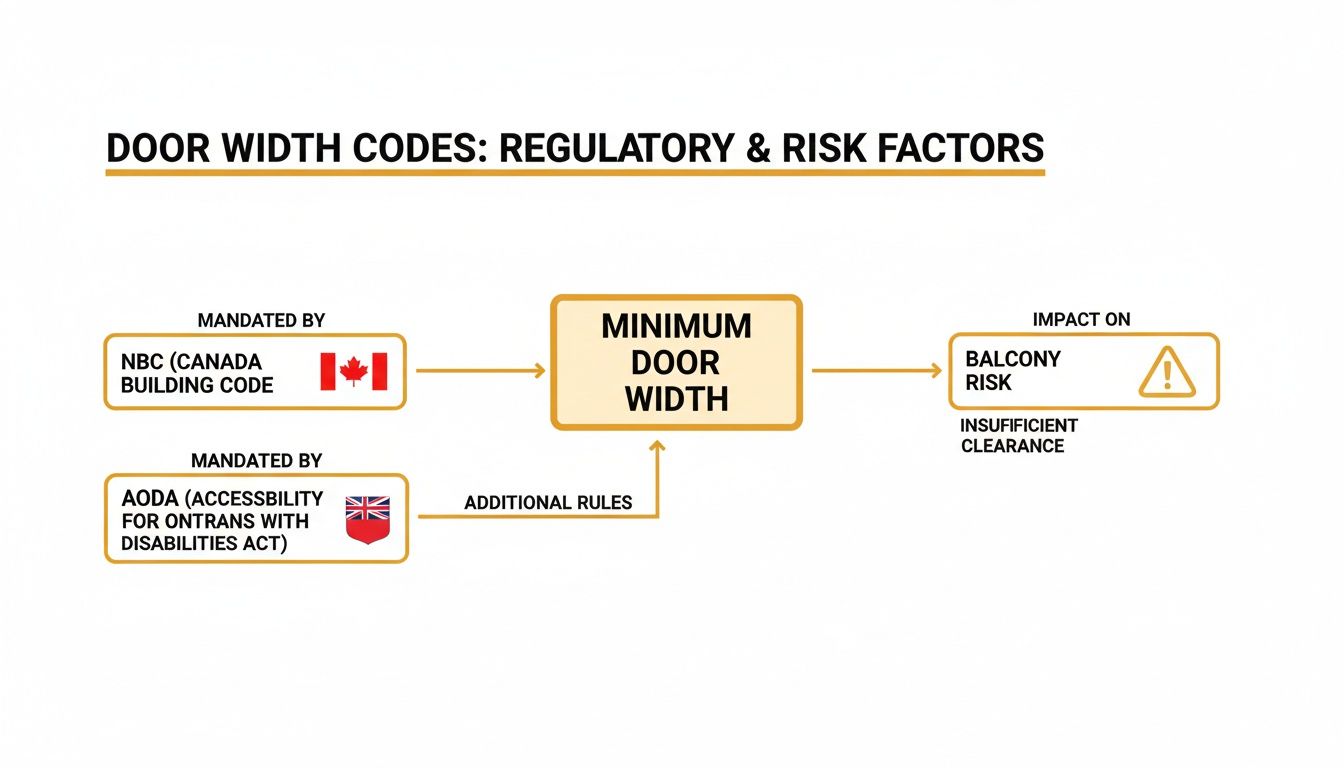
Alt text: Flowchart of Canadian building codes like NBC and AODA showing requirements for accessible door width and maneuvering space.
Making sense of Canadian accessibility regulations can feel like assembling a complex puzzle. To build a facility that’s both safe and fully compliant, you need a clear roadmap. This means looking at national standards, like the National Building Code of Canada (NBC), while also keeping a close eye on influential provincial rules, such as Ontario’s Accessibility for Ontarians with Disabilities Act (AODA).
These codes are far more than just legal checkboxes; they are the foundation for ensuring safety and equal access. They spell out the minimum door width for wheelchair access, but creating a truly accessible space often means going beyond the basics. Let’s break down what this means for you in practical, actionable terms.
National and Provincial Requirements
The NBC establishes the baseline for accessibility across the country. However, provinces often introduce their own standards that build upon or even tighten these national rules.
For example, a facility manager in Toronto must ensure their building complies with both the NBC and the AODA. This dual compliance ensures every access point—from the main entrance to interior office doors—meets strict requirements for clear width, maneuvering space, and hardware type.
A common mistake is assuming that meeting national compliance is enough. Provincial regulations like the AODA often have more specific or stricter requirements. Failing to meet them can lead to hefty penalties and, more importantly, create dangerous barriers for people in your building.
A Critical Look at Life-Safety Risks
In Canada, the National Building Code mandates a minimum clear width of 810 mm for main entrance doors in single-unit dwellings and 800 mm for those in multi-unit buildings. While this helps standardize basic access, there’s a critical safety gap when it comes to balcony doors in multi-unit buildings, where codes might only require a 760 mm clear width.
Consider that most wheelchairs are between 610-760 mm wide. That narrow opening can make escape impossible during a fire, creating a severe life-safety risk. You can dive deeper into these specifics in the 2010 Compendium of Canadian Accessible Housing Codes and Standards.
This risk is even more pronounced for emergency exits and fire doors. As a real-world example, imagine a facility manager overlooking this detail during a warehouse retrofit—they could be endangering lives and inviting serious liability. The integrity of these doors is non-negotiable for occupant safety. To learn more, check out our guide on commercial fire doors and their safety standards.
At Wilcox Door Service, our “Respected Partners, Reliable Service” promise means we help you spot these risks before they become problems. We often recommend widths of 850-1000 mm, which aligns with best practices that put safety far ahead of simple compliance. When you partner with experts, you create a genuinely safe environment that protects both people and your property.
Why Space Around the Door Matters So Much
A door that’s wide enough is a great start, but it’s only one part of the accessibility puzzle. A compliant doorway is useless if a person in a wheelchair can’t get to it, open it, and pass through it smoothly. We need to look beyond the door itself and focus on the critical space around it—what’s known in the industry as maneuvering and approach clearances.
Think about a busy loading dock. You wouldn’t just make the bay door wide enough for the truck; you need plenty of room for it to turn, back in, and for your team to work safely around it. The exact same logic applies here. The “path of travel” leading to and from a door is just as vital as the opening.
Without enough clearance, you create frustrating bottlenecks. Imagine a tight warehouse hallway leading to a mandatory emergency exit. Even if that door meets the minimum width, a cluttered or narrow corridor can make a safe evacuation impossible, creating a massive liability.
Understanding Approach Clearances
The amount of clear floor space needed depends on how a person approaches the door. Are they coming straight-on, or navigating a turn from the side? Each scenario demands different dimensions to ensure seamless movement.
- Front Approach (Pull Side): When someone pulls a door open towards them, they need space to roll backward as the door swings out. This requires a deeper clear area in front of the door.
- Front Approach (Push Side): Pushing a door open is simpler. It generally requires less depth because the person can move forward as the door swings away.
- Latch-Side Approach: Coming at the door from the same side as the handle requires the most space. This allows the user to get close enough to reach the handle and then move out of the way of the door’s swing path.
Putting Numbers to the Space
Canadian barrier-free standards, like those detailed by Accessibility Standards Canada, require a minimum 920 mm unobstructed width for any path leading to a doorway. But for high-traffic, two-way corridors in a busy distribution centre, we often recommend doubling that to 1840 mm. This foresight prevents logistical jams and boosts safety.
These path requirements are tied to doorway clearances, where maneuvering zones of 1200 mm to 1500 mm are often needed, plus an 1800 mm turning diameter for a full 180-degree turn. For facility managers, ignoring these specs isn’t just about creating frustrating barriers; it risks fines of up to $100,000 under provincial and federal acts.
By viewing accessibility as a complete system—path, clearance, and door—you ensure smooth, safe, and efficient movement. This is the core of our “Respected Partners, Reliable Service” philosophy.
Considering the entire journey is fundamental to creating a genuinely accessible facility. Upgrading to compliant high-speed fabric doors or sectional doors not only meets these standards but also improves your overall operational flow.
Choosing Accessible Door Hardware and Operators
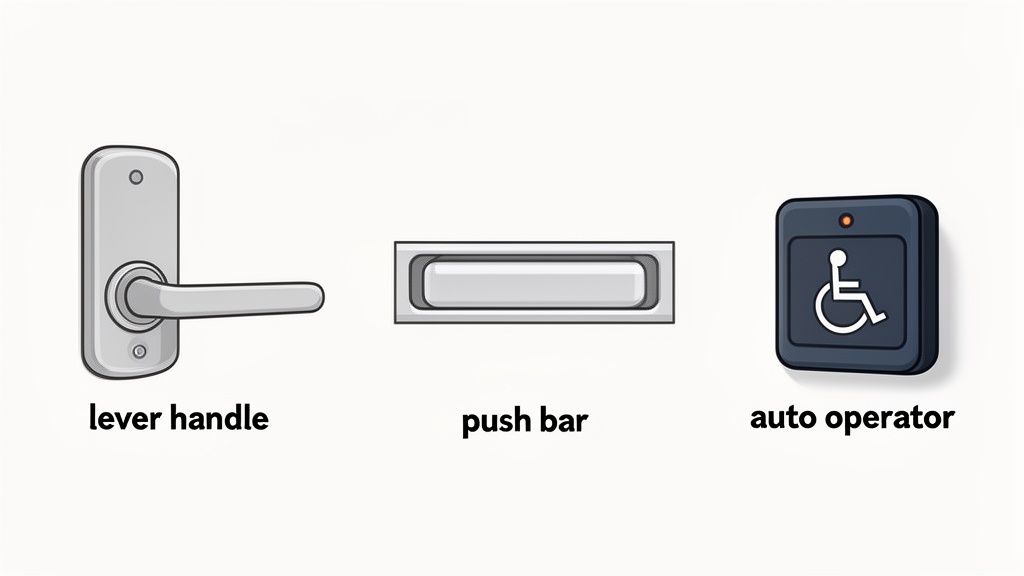
Alt text: Three accessible door hardware options: a lever handle, a push bar for emergency exits, and an automatic door operator.
A compliant door width is only half the battle. If a person can’t easily open the door, it’s not truly accessible. The right hardware and operators turn a compliant opening into a genuinely usable entryway for everyone. This isn’t just about convenience—it’s about empowering every individual to navigate your facility with independence and dignity.
The goal is to eliminate any hardware that requires tight grasping, pinching, or twisting—actions that can be a major barrier for anyone with limited hand strength or mobility.
Hardware That Makes a Difference
Outdated hardware is one of the most common accessibility issues we see. The classic round doorknob is a perfect example of a design that fails modern accessibility standards and is non-compliant in almost all commercial settings.
Here’s a look at hardware that gets it right:
- Lever Handles: These are fantastic because they can be operated with a closed fist or an elbow, requiring very little force.
- Push Bars (Panic Bars): A must-have for emergency exits, these allow doors to be opened with a simple body push, which is critical in a high-stress evacuation.
- Push/Pull Plates: Often seen on swinging doors, these large, flat plates provide an obvious and easy way to open the door without any fine motor skills.
Imagine a busy commercial facility replacing its old, stiff doorknobs with modern lever handles. It’s a relatively simple upgrade that makes an immediate, positive impact.
The Power of Automatic Door Operators
For high-traffic areas like a main entrance, hospital corridor, or busy manufacturing floor, an automatic door operator is the gold standard. These systems remove the physical barrier of a manual door entirely, making them the most inclusive solution. They do more than improve access; they also smooth out traffic flow and reduce wear and tear on your doors.
Accessible Door Hardware Comparison
| Hardware Type | Best Use Case | Compliance Benefit | Wilcox Service Note |
|---|---|---|---|
| Lever Handles | Interior offices, restrooms, and low-traffic doors. | Eliminates the need for grasping or twisting, meeting basic accessibility standards. | We can quickly retrofit existing doors, replacing non-compliant knobs with modern levers. |
| Push Bars (Panic Bars) | Emergency exits and high-occupancy spaces. | Allows for single-motion egress during an emergency, which is a critical life-safety feature. | Regular inspection and maintenance are key to ensuring they function flawlessly when needed most. |
| Push/Pull Plates | Manual swinging doors in corridors or kitchens. | Provides a large, clear target for opening without needing any gripping strength. | A simple, durable, and low-maintenance option for many interior passageways. |
| Automatic Operators | Main entrances, high-traffic corridors, and accessible restrooms. | Removes all physical effort, guaranteeing compliance with opening force and closing speed rules. | As a full-service provider, we install and maintain these systems to ensure long-term reliability. |
This table shows there’s a solution for every entryway, but automatic systems solve the trickiest compliance issues.
A crucial but often overlooked accessibility rule is opening force. Codes strictly limit how much physical effort can be required to open a manual door. Automatic operators take this concern off the table completely.
Similarly, regulations control a door’s closing speed to prevent it from swinging shut too quickly. A properly installed and maintained automatic operator is calibrated to meet these exact safety standards, protecting every person who passes through.
Ultimately, the right hardware ensures your compliant door width for wheelchair access is supported by true, functional usability. At Wilcox Door Service, our “Respected Partners, Reliable Service” commitment means we help you select and install the perfect solution for every door.
Accessibility for Commercial and Industrial Doors
Commercial and industrial facilities present unique accessibility challenges that are a world away from a standard office building. When dealing with specialized equipment like rolling commercial fire doors, high-speed warehouse doors, or heavy-duty insulated doors, compliance requires a deeper level of expertise. It’s a constant balance between operational demands and the non-negotiable standards of accessibility and safety.
This is where off-the-shelf solutions don’t cut it. For example, how do you make a massive cold-storage door at a pharmaceutical plant accessible without compromising its thermal efficiency? What modifications does a rolling fire door need to double as a safe, usable emergency exit for everyone? These are the real-world questions facility managers in logistics, manufacturing, and food processing face daily.
Addressing Specialized Door Challenges
While the core principles of clear width and maneuvering space still apply, the doors themselves demand specific solutions. A standard automatic operator might not have the power for a heavy industrial door, and a simple lever handle can’t be installed on a rolling steel door.
Common compliance traps we see include:
- Heavy Manual Doors: Industrial doors are often built to be robust and can far exceed the maximum opening force allowed by accessibility codes.
- Complex Locking Mechanisms: High-security grilles or doors can feature hardware that’s difficult for someone with limited dexterity to operate.
- High Thresholds: Specialized doors, especially for clean rooms or exterior loading docks, can have thresholds that are a complete barrier for a wheelchair user.
A key insight for facility managers is that accessibility solutions for industrial doors often improve overall operational efficiency. For example, installing an automatic operator on a high-speed warehouse door not only aids accessibility but also speeds up forklift traffic and reduces energy loss.
Solutions for Tough Environments
The goal is not to compromise the door’s primary function but to enhance it with accessible technology. For a heavy, insulated door, a heavy-duty automatic operator paired with push-plate activators is a perfect match. This ensures anyone can open the door while it maintains a tight seal when closed.
For a rolling fire door that must also serve as an accessible exit, the solution is integrating it with the building’s fire alarm system and adding a motor operator with a battery backup. This is critical, as it ensures the door opens automatically during an emergency, clearing the path of travel.
Making these specialized doors accessible protects your people and your operations. By partnering with experts who understand the unique demands of your industry, you can find solutions that satisfy both compliance regulations and your facility’s needs. This practical, problem-solving approach is central to our “Respected Partners, Reliable Service” commitment.
How to Audit Your Facility and Plan Upgrades
Now that you understand the regulations, it’s time to move from theory to action with a clear, practical plan. Auditing your facility’s doorways doesn’t have to be a massive undertaking; it’s about systematically identifying barriers and prioritizing solutions to ensure a clear path for everyone.
A proactive approach helps you build a smart, cost-effective plan for any retrofits. This process is key to minimizing future downtime, avoiding compliance issues, and demonstrating a real commitment to an accessible environment.
Conducting a Basic Doorway Audit
Grab a tape measure and a notepad, and start looking at your facility with a critical eye. Focus on the primary paths of travel first: main entrances, emergency exits, and routes to common areas like washrooms and break rooms.
Use this as a simple checklist. For each key doorway, measure and note the following:
- Clear Opening Width: Swing the door open to 90 degrees. Measure the usable space from the face of the door to the opposite doorstop. Does it meet the 810 mm (32-inch) minimum?
- Maneuvering Clearance: Look at the floor space on both the push and pull sides. Is there enough room? Remember, this space must be clear of obstructions like garbage bins or stacked equipment.
- Threshold Height: Is the threshold flush or very low (under 13 mm or 1/2 inch) with a bevelled edge? High, squared-off thresholds are a common barrier.
- Door Hardware: Does the door have levers or push bars? Round knobs that require a tight grip are non-compliant.
- Opening Force: Give the door a push. Does it feel excessively heavy? A door that’s tough for an able-bodied person to open will almost certainly fail a formal compliance test.
Prioritizing and Planning Your Upgrades
Once you have a list of non-compliant doorways, prioritize them logically to make the task manageable.
Don’t try to fix everything at once. Focus first on high-impact areas. Your top priorities should always be primary entrances and designated emergency exit routes. Securing these paths addresses the most critical safety and access needs immediately.
From there, you can create a phased plan. Perhaps tackle main corridor doors in phase one, then move on to washroom access in phase two. This methodical approach makes the upgrade process more manageable and budget-friendly.
Regular inspections and a proactive planned maintenance program can prevent small issues from becoming major compliance headaches. Partnering with experts ensures that every retrofit, whether it’s installing an automatic door operator or adjusting door closers, is done right the first time.
At Wilcox Door Service Inc., our “Respected Partners, Reliable Service” promise means we help you develop a smart, strategic plan to make your facility safe, compliant, and accessible for all. If you’re ready to ensure your doors meet the highest standards, contact us to schedule a professional site assessment. https://www.wilcoxdoor.com
2026 Accessibility Update: What Facility Managers Need to Know
Accessibility compliance for commercial doors continues to evolve in Canada. Here are the key updates relevant to door width and accessible design for 2026:
- NBC 2025 maintains 810mm minimum: The National Building Code of Canada’s 2025 edition maintains the 810mm (32″) clear width as the minimum for accessible doorways, with 915mm (36″) as the recommended best practice for high-traffic accessible routes.
- AODA Built Environment consultations: Ontario’s ongoing review of the Built Environment Standard under AODA is expected to push for 915mm as a hard minimum in future amendments. Getting ahead of this now saves costly retrofits later.
- Power door operators are increasingly expected: For public-facing commercial spaces, power door operators (automatic openers) are becoming the standard accessibility feature. Low-energy operators from LCN, Stanley, and Hormann are now more cost-effective than ever.
- Maneuvering clearances matter: Door width alone isn’t enough — inspectors and auditors are paying closer attention to the 1500mm × 1500mm turning radius requirement inside accessible spaces.
- Retrofit solutions available: If your existing door frame is too narrow, offset hinges can gain up to 50mm of additional clear width without full frame replacement — a cost-effective interim solution.
Wilcox Door Service provides accessibility assessments and compliant door installations across Ontario. Book a site visit today.