


A broken commercial overhead door isn’t just an inconvenience; it’s a critical failure that can halt your operations, compromise security, and create serious safety risks. This guide provides facility managers and business owners in Toronto with a clear, practical roadmap for handling commercial doors repair in Toronto. You will learn how to diagnose common issues with overhead doors, decide between a repair and a full replacement, navigate emergency service calls, and choose a reliable service partner to keep your business running smoothly and safely.
From a stuck warehouse sectional door to a malfunctioning loading dock system, we will cover everything you need to know to make informed decisions quickly and confidently.
Alt text: A service building with a large overhead door, representing expert commercial doors repair in Toronto.
A Practical Guide to Commercial Door Repair
When a commercial overhead door breaks down, it can bring your business to a standstill. It jeopardizes your building’s security and poses real safety hazards for staff and customers. Whether it’s a sectional steel door that won’t budge or a rolling fire door that has failed an inspection, you need a dependable solution—fast. This guide offers a clear plan for managing these situations effectively.
The need for reliable door services is significant. The Sheet Metal, Window & Door Manufacturing industry in Canada is projected to reach a market size of $13.0 billion in 2025. It has grown at a steady 4.2% annually over the last five years, highlighting how much businesses in hubs like Toronto rely on both new installations and expert repairs.
What You’ll Learn in This Guide
We’ve designed this guide to transform complex technical problems into simple, actionable knowledge. Our goal is to provide you with the practical insights needed to make smart decisions that keep your facility secure and fully operational.
Here’s what we’ll cover:
- Spotting the Problem: Learn to diagnose the most common failures in commercial overhead doors, from snapped torsion springs to faulty electrical operators.
- Repair vs. Replace: Get a clear framework for deciding when a repair is sufficient and when a full replacement is the wiser long-term investment for your facility.
- Handling Emergencies: Understand what to expect from an emergency service call, including typical response times and how to prepare for the technician’s arrival.
- Costs & Compliance: We’ll break down the factors that influence repair costs and explain the critical fire safety regulations you must follow to remain compliant.
- Choosing the Right Pro: Discover how to identify a qualified, reliable service provider who will act as a true partner in maintaining your facility.
Of course, the best repair is the one you never have to make. For a deeper look at proactive care, it’s worth exploring the top preventive maintenance best practices to keep your doors functioning flawlessly.
By the end of this guide, you’ll have the confidence to tackle any commercial door issue. Let’s begin by diagnosing common failures.
Facing a door issue right now? Contact Wilcox Door Service for a professional assessment and quote.
Figuring Out What’s Wrong With Your Commercial Door
Your commercial overhead doors are the workhorses of your facility, cycling open and closed countless times a day. But even the most robust doors will eventually show signs of wear. Identifying what to look for is the first step toward a fast, effective repair before a minor issue becomes a major shutdown.
Think of your overhead door as a complex system where every part depends on the others. When one component fails, it can halt your entire operation. Spotting early warning signs helps you request the right kind of doors repair in Toronto and get your business back on track quickly.
Mechanical Failures: The Muscle That Gives Out
When something goes wrong mechanically, the signs are usually obvious and impossible to ignore. These issues typically involve the heavy-duty components responsible for lifting and lowering the door’s substantial weight. They require immediate professional attention because a failing mechanical part can create a serious safety hazard.
For example, imagine a warehouse loading dock door that begins grinding loudly, then stops halfway open. The most likely culprit is a broken torsion spring. This tightly coiled spring acts as a counterbalance, doing the heavy lifting to make the door feel light. When it snaps—often with a startling loud bang—the door becomes incredibly heavy and dangerous. It may not open at all or could slam shut without warning.
Other common mechanical problems include:
- Snapped or Frayed Cables: These steel cables work with the springs to lift the door evenly. If one breaks, the door will hang crookedly and become jammed in its tracks.
- Damaged Rollers or Tracks: A minor collision with a forklift or years of wear can bend tracks or break rollers. You’ll often hear scraping noises or see the door shudder as it moves.
- Worn-Out Drums: Located at each end of the torsion spring shaft, these grooved drums wind the lift cables. If they crack or wear down, the door will open and close unevenly.
Electrical and Motor Issues: When the Brains Go Offline
Modern commercial doors rely on electrical operators (motors) and control systems for automated function. When these systems fail, the door often becomes completely unresponsive, creating an operational bottleneck or a major security risk.
Consider a high-speed door in a temperature-controlled facility that suddenly stops responding. The problem may not be the door curtain, but rather the motor or the logic board. The logic board is the operator’s “brain,” processing commands from buttons, sensors, and remote controls. A power surge or component failure can render it useless.
Common electrical glitches include:
- Motor Burnout: Continuous, heavy use without regular maintenance can cause a motor to overheat and fail. You might notice a burning smell just before it stops working.
- Faulty Photo-Eye Sensors: These are critical safety devices that prevent the door from closing on an object or person. If they become misaligned or dirty, the door will refuse to close, assuming an obstruction is present.
- Limit Switch Malfunctions: These switches tell the motor when the door is fully open or closed. If they fail, the door might not close completely, leaving a security gap, or it may travel too far and damage the operator.
The demand for technicians skilled in diagnosing these issues is growing. The garage door installation and repair industry in Toronto is a prime example, with projections showing a market size increase of 2.8% in 2023 alone. This growth highlights the continuous need for expert service in a major commercial centre. Discover more insights about Toronto’s door service industry.
As a respected partner, Wilcox Door Service believes that understanding the why behind a failure is as important as the fix. A technician who explains that your door is stuck due to a misaligned limit switch, not just a “broken motor,” empowers you to make smarter maintenance decisions.
Structural and Panel Damage
Finally, there’s direct physical damage to the door itself. This can compromise security, insulation, and overall function, and is particularly common in high-traffic loading bays. For instance, if a truck accidentally backs into a sectional steel door, the dented panels may no longer roll smoothly in the tracks. This not only looks unprofessional but also creates gaps that waste energy and drive up utility bills. Prompt repair is essential to protect your facility.
If you observe any of these signs, it’s time to call a professional. For expert diagnosis and reliable commercial doors repair in Toronto, schedule a service inspection with our certified technicians today.
Deciding Between Repair and Replacement
When your commercial overhead door fails, you face a critical business decision: is a repair sufficient, or is it time to invest in a complete replacement? Making the right choice can save significant money and prevent future operational disruptions. This section provides a clear framework to help you weigh the key factors and determine the most cost-effective solution.
The decision is similar to maintaining an old fleet vehicle. A single damaged panel on a newer door is like a flat tire—an obvious repair. However, if your door suffers from chronic issues like a failing motor, rusted tracks, and poor insulation, it’s like facing major engine trouble. In such cases, replacement is often the smarter financial move.
Evaluating the Cost of Frequent Repairs
First, review your door’s service history. An occasional repair for a minor issue is normal. But if you find yourself calling for doors repair in Toronto every few months for the same door, those costs are accumulating and signaling a larger problem.
This flowchart categorizes common door problems to help you visualize potential root causes.
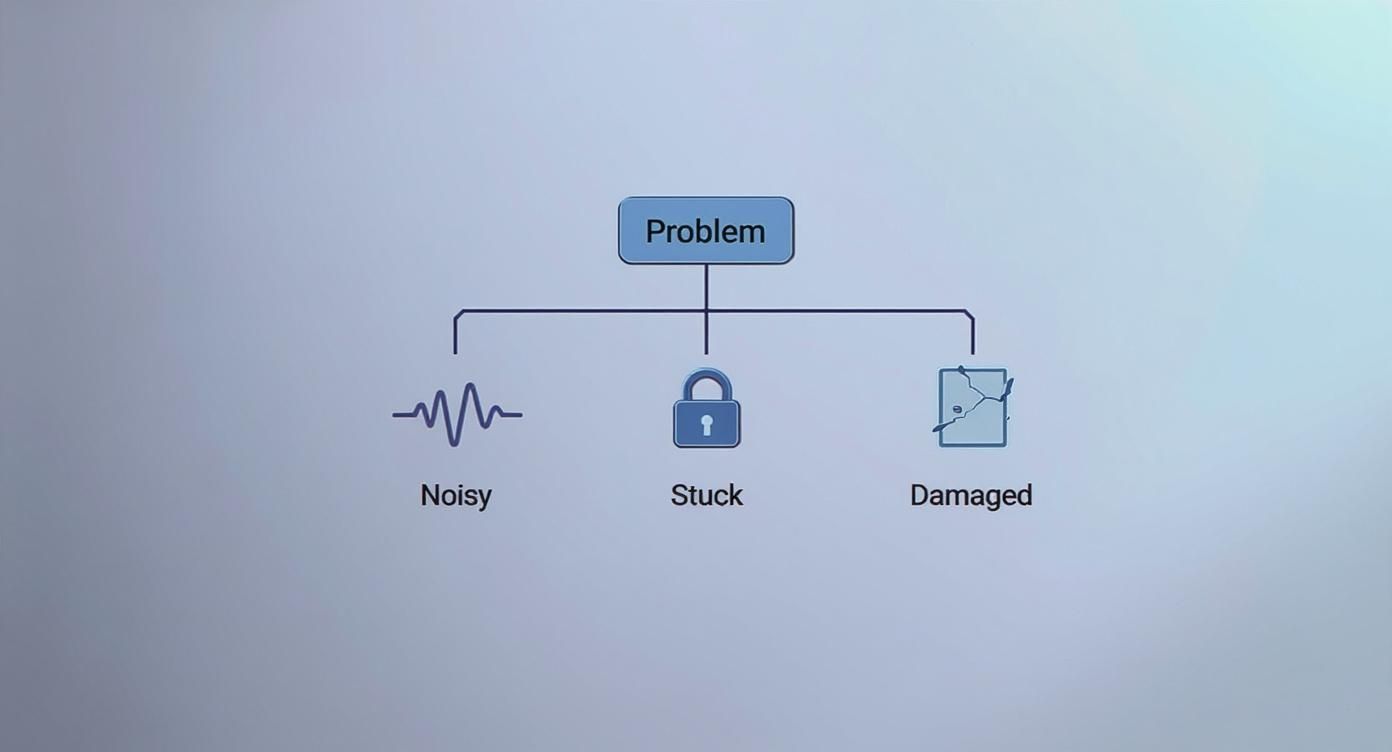
Alt text: A flowchart illustrating common commercial overhead door problems like noise, sticking, or damage.
As shown, issues like noise or sticking can have simple or complex causes, helping indicate whether a quick fix or a more thorough investigation is needed. A pattern of recurring failures is a major red flag, suggesting a systemic issue that patchwork repairs can no longer solve.
A good rule of thumb: When the cost of repairs over a two-year period approaches 50% of the cost of a new door, replacement becomes the more financially sound option. This considers the total cost of ownership, including downtime and energy loss, not just the immediate repair bill.
Key Factors to Consider
Beyond immediate cost, several other factors should guide your decision. A professional assessment will evaluate these elements to provide a data-driven recommendation.
- Age and Condition: With proper maintenance, most commercial steel doors have a lifespan of 15-20 years. If your door is approaching this age and experiencing frequent breakdowns, it is likely nearing the end of its operational life.
- Parts Availability: Finding replacement parts for older or discontinued models can be difficult and expensive. If a critical component, like a specific logic board or panel style, is no longer manufactured, replacement may be your only viable option.
- Safety and Compliance: An old, damaged door may not meet current safety standards. Modern features like photo-eye sensors and automatic reversing mechanisms are essential for preventing accidents. A new door ensures you comply with the latest regulations, protecting your staff and your business from liability.
- Energy Efficiency: Door technology has advanced significantly. Modern insulated doors provide a superior thermal seal, which can dramatically reduce your heating and cooling costs. The energy savings from a new door can help offset the initial investment over time.
Ultimately, a professional technician can perform a thorough inspection to identify the root cause of the problem. They will assess the overall health of the entire system and provide a clear comparison of repair costs versus the long-term benefits of a new installation.
Navigating Emergency Door Repair Services
When a commercial overhead door fails after hours, it’s more than an inconvenience—it’s a significant security risk that can halt your operations. Understanding what to expect from an emergency repair for your commercial doors in Toronto can make a critical difference. The priority is always to get your facility secure and operational as quickly as possible.
Alt text: A delivery driver works at a loading dock at night, highlighting the need for 24/7 commercial doors repair in Toronto.
A warehouse door stuck open overnight, a rolling steel door that has jumped its tracks, or a sectional door damaged by a vehicle impact are true emergencies. These situations require an immediate response to protect your inventory, equipment, and personnel.
What to Expect During an Emergency Call
When you place an urgent call for doors repair in Toronto, the objective is a fast and effective solution. A reputable company will operate a 24/7 dispatch service for these scenarios. In the Greater Toronto Area, you should expect a certified technician to arrive on-site within a few hours, ready to diagnose the problem and begin work.
To expedite the process, have this information ready:
- Door Type and Location: Is it a sectional steel door, a rolling door, or a high-speed model? Where is it located in your facility?
- Description of the Problem: Be as specific as possible. Is the door stuck? Did you hear a loud noise? Is there any visible damage?
- Site Access Information: Provide instructions for after-hours property access.
Providing these details helps the dispatcher send the right technician with the appropriate tools and parts, saving valuable time.
Understanding Emergency Service Costs
Emergency service naturally costs more than a scheduled appointment due to immediate, after-hours dispatch. A transparent provider will explain the factors influencing the final bill to avoid surprises.
At Wilcox Door Service, clear communication is our standard. Our team will outline potential costs, including after-hours rates and any required specialized equipment, before commencing work. Our first priority is to secure your facility, followed by providing a detailed plan for any necessary follow-up repairs.
The main factors influencing the invoice are:
- Time of Call: Calls late at night, on weekends, or on public holidays will have higher labour rates.
- Specialized Equipment: If the repair requires a scissor lift to access a high motor or a welder to fix a track, these will add to the cost.
- Parts Required: Service vehicles are typically well-stocked, but if your door needs a unique or custom part, sourcing it may affect the timeline and final cost.
The repair and maintenance subsector is a vital part of Canada’s economy, reflecting the heavy reliance of businesses on these services. Data from Statistics Canada’s surveys on service industries shows steady growth in this area, underscoring the constant demand for skilled technicians who keep businesses like yours operational. Learn more about the service industry’s economic impact.
Dealing with an emergency is stressful, but understanding the process helps. A reliable partner will not only solve the immediate problem but also provide peace of mind.
Understanding Repair Costs and Safety Compliance
When budgeting for commercial doors repair in Toronto, it’s essential to see the full picture. The cost extends beyond the immediate fix; it includes the significant financial consequences of non-compliance with safety regulations. Understanding both aspects helps you make informed decisions that protect your facility, your people, and your bottom line.
A proper repair does more than restore function. It reinstates safety features, secures your property, and ensures you meet all legal requirements. Cutting corners is a significant risk that can lead to heavy fines, operational shutdowns, and severe legal liability.
Key Factors That Shape Your Repair Bill
No two repair jobs are identical, so the final invoice will vary based on several key factors. Knowing these variables helps you understand your quote and feel confident you’re receiving a fair price.
Here’s a breakdown of what drives the cost:
- Door Type and Size: A large, heavy-duty rolling steel door at a busy loading dock is inherently more complex and costly to repair than a standard aluminum storefront door. The door’s size, weight, and mechanical system are primary cost drivers.
- Extent of Damage: A minor adjustment, like realigning a photo-eye sensor, is typically quick and affordable. In contrast, replacing a snapped torsion spring or repairing multiple panels after a vehicle impact requires more labour and expensive parts.
- Required Parts: Component costs vary widely. A new set of rollers may be a minor expense, whereas a replacement motor for a high-speed door or a specialized logic board represents a more significant investment.
- Labour and Urgency: An emergency call-out at 2 a.m. on a holiday will have a higher labour rate than a scheduled maintenance visit during business hours. The technician’s expertise also plays a role—and that expertise is worth the investment.
It’s also important to remember that properly maintained commercial doors are a critical component of effective theft protection, safeguarding your assets from preventable losses.
Factors Influencing Commercial Door Repair Costs
This table outlines the primary variables that determine the final cost of a commercial door repair service in the Toronto area.
| Cost Factor | Description | Impact on Price |
|---|---|---|
| Door Type & Complexity | From simple pedestrian doors to complex rolling steel or high-speed fabric doors. | High Impact: More complex systems require specialized parts and expertise. |
| Extent of Damage | Minor issues like sensor adjustments vs. major structural damage from an impact. | High Impact: Determines the scope of labour and the number of parts needed. |
| Parts Required | The cost of replacement components, from basic hardware to custom-ordered panels or motors. | Variable Impact: A single motor can cost more than all other parts combined. |
| Labour & Urgency | Standard business hours vs. emergency after-hours or weekend service calls. | High Impact: Emergency rates are significantly higher due to on-call premiums. |
| Accessibility | Working on a ground-level door vs. one that requires specialized lifts or equipment to reach. | Moderate Impact: Adds time and equipment rental costs to the job. |
| Geographic Location | Travel time and distance for technicians to reach your facility in the GTA. | Low Impact: Usually a standard trip charge, but can increase for remote sites. |
Understanding these elements demystifies the quoting process and sets clear expectations before work begins.
The High Cost of Non-Compliance
Beyond the repair bill, the cost of ignoring safety and building codes can be astronomical. In Ontario, commercial facilities must adhere to strict regulations designed to protect employees and the public. For commercial overhead doors, these are not mere suggestions—they are legal requirements.
A compliant door is a safe door. Investing in proper repairs and certified inspections isn’t just an expense; it’s a critical part of your facility’s risk management strategy. It protects your people and your business from preventable accidents and legal troubles.
Let’s focus on one of the most critical areas: fire-rated doors.
Fire Door Compliance: A Non-Negotiable Responsibility
Fire-rated doors are essential life-saving devices. They are engineered to contain fire and smoke, providing crucial time for evacuation. Because of their critical role, they are legally required to undergo regular inspection and testing to ensure they function perfectly in an emergency.
What every facility manager needs to know:
- Mandatory Drop Tests: The National Fire Protection Association (NFPA 80) standards, referenced by the Ontario Building Code, mandate that all rolling and sliding fire-rated doors undergo an annual inspection and “drop test.”
- What is a Drop Test? This is a physical test where a certified technician triggers the door’s release mechanism. They verify that the door closes completely, at the proper speed, and without obstruction, confirming the fusible links and closing system are operational.
- Record-Keeping: You must maintain detailed written records of these tests for the local Authority Having Jurisdiction (AHJ), such as the fire marshal. Failure to produce these records during an inspection can result in immediate fines.
Ignoring these regulations is a serious gamble. A non-compliant fire door not only endangers lives but also exposes your business to severe penalties and could potentially void your insurance coverage in the event of a fire.
When you invest in professional doors repair in Toronto, you are hiring experts who understand these regulations, ensuring your facility remains safe, operational, and fully compliant.
To ensure your facility meets all necessary safety standards, schedule a professional compliance inspection and fire door drop test with Wilcox Door Service today.
How to Choose a Qualified Repair Partner
Selecting the right commercial door repair partner is the most critical step in ensuring a safe, durable, and high-quality solution. In a competitive market like Toronto, knowing how to identify a truly reliable provider will save you from costly repeat repairs and keep your facility secure. This checklist will help you vet potential vendors for your doors repair in Toronto and find a genuine partner focused on reliability.
You need a company that operates as an extension of your own team under the principle of “Respected Partners, Reliable Service.” This means looking beyond the price and evaluating their commitment to safety, expertise, and the long-term value they provide. The right partner will keep your operations running smoothly for years to come.
The Non-Negotiables: Credentials and Certifications
Before discussing any repair, confirm these essential credentials. They are the baseline for any serious provider and signal a commitment to safety, professionalism, and quality.
- WSIB Coverage: Always verify that the company has active Workplace Safety and Insurance Board (WSIB) coverage. This protects you from liability in the event of an accident on your property.
- Liability Insurance: Request proof of substantial liability insurance. This ensures that any accidental damage to your property during the repair is fully covered.
- Industry Certifications: Look for technicians certified by recognized industry bodies. These credentials demonstrate that the team has undergone rigorous training and is up-to-date on the latest standards for commercial overhead doors.
Key Questions to Ask Potential Vendors
Once the basics are confirmed, it’s time to dig deeper. The answers to these questions reveal a company’s operational readiness, technical skill, and customer service approach.
- What is your technicians’ training and experience? Inquire about their training programs, especially for specialized systems like rolling fire doors or high-speed operators. An experienced team can diagnose issues faster and more accurately.
- What is your parts availability? Ask about their inventory for your specific door models. A provider with a well-stocked warehouse can often complete repairs in a single visit, minimizing your downtime.
- What are your warranty policies? A reputable company will stand behind its work. Ask for clear details on their warranties for both parts and labour to ensure you are protected long after the service is complete.
Choosing a provider is about more than the immediate repair. A true partner offers a comprehensive service approach, from 24/7 emergency response to proactive maintenance, ensuring the longevity and reliability of your critical access points.
The Long-Term Value of a Proactive Partner
The best commercial door service companies do more than fix what’s broken—they help you prevent failures from happening in the first place. A company that offers both 24/7 emergency repairs and structured preventive maintenance plans is invested in your facility’s long-term health.
Proactive maintenance is the key to extending the life of your equipment and avoiding unexpected, costly emergencies. To better understand the significant advantages of this approach, explore the benefits of a planned garage door maintenance program. Choosing a partner who provides this level of care is a strategic investment in your business’s continuity and safety.
Ready to find a reliable partner for your facility? Contact Wilcox Door Service to discuss your needs with our certified experts.
Got Questions About Commercial Door Repair? We Have Answers.
When a commercial door breaks down, facility managers and business owners in Toronto often have the same questions. Here are straightforward answers to the most common inquiries to help you make informed decisions quickly.
How Fast Can I Get Someone Here For an Emergency?
For a true emergency—like a door stuck wide open, leaving your facility unsecured—you need immediate assistance. You should expect a technician on-site within a few hours. At Wilcox, our goal for the Greater Toronto Area is a 2 to 4-hour response window, 24/7. While Toronto traffic can be unpredictable, a reliable service provider will always prioritize securing your building.
Can You Fix a Really Old or Discontinued Door?
In most cases, yes. An experienced technician can often find compatible parts or engineer a custom solution to get an older door working again.
The main challenge arises when a critical electronic component, such as a proprietary logic board or a specific motor, is no longer manufactured. In these situations, a full replacement may be the only practical solution. A professional assessment will determine what is possible and whether a repair is financially viable. To see what modern doors offer, feel free to browse our range of commercial door solutions.
How Often Should My Commercial Doors Be Inspected?
For optimal safety, compliance, and reliability, we strongly recommend a professional inspection and tune-up at least once a year.
For high-traffic operations, such as a busy distribution centre where doors cycle constantly, increasing inspections to twice a year is a wise investment.
Regular preventive maintenance is the single most effective way to avoid expensive, after-hours emergency calls. It’s about identifying and addressing small problems—like worn rollers or fraying cables—before they lead to a complete system failure.
This also ensures your facility remains compliant. For example, fire-rated doors are legally required to be professionally inspected and drop-tested annually to meet Ontario’s strict safety codes.
Is It Cheaper To Repair My Damaged Door or Just Replace It?
The best choice depends on three key factors: the door’s age, the extent of the damage, and its service history.
As a general rule, if a repair quote approaches 50% of the cost of a brand-new door, it’s time to seriously consider replacement. The same applies to a door that is over 15 years old and requires frequent service calls. A new door is an upgrade, offering better energy efficiency, modern safety features, and a new warranty that provides far greater long-term value.
Have more questions or need an expert to assess a specific problem? The team at Wilcox Door Service Inc. is here to provide the clear answers and reliable service you need. Contact us today for a professional consultation.