


In a fire, every second counts. That’s why fire shutters for windows are one of your building’s most critical lines of automated defense. Designed to seal vulnerable openings the moment trouble starts, they act as a powerful shield to protect lives, minimize property damage, and ensure you meet strict fire safety codes.
This guide will provide you with a clear, practical understanding of these essential safety systems. You will learn:
- How fire shutters automatically detect a fire and deploy.
- The key fire codes, like NFPA 80, that govern their use and maintenance.
- Why the legal liability for shutters is the same as for fire doors in commercial, industrial, and even condominium properties.
- How to choose the right type of shutter for your facility’s specific needs.
Your Guide to Facility Safety and Compliance
If you’re a facility or property manager, this guide is your playbook for understanding these essential safety systems. We’ll demystify how fire shutters work, what codes you need to follow, and which types are best for different buildings—from sprawling warehouses to residential condominiums.
Think of these systems as a core part of your building’s life safety infrastructure. Just like their larger cousins, rolling fire doors, ensuring a fire shutter works perfectly isn’t just a good idea—it’s a legal and ethical responsibility.
What You Will Learn
As we go through this guide, you’ll get practical, real-world insights into:
- How They Work: A look at the mechanics behind how these shutters automatically detect a fire and spring into action.
- The Rules and Regulations: We’ll break down the codes, like NFPA 80 and the Ontario Building Code, that dictate how and where they must be used.
- Liability and Testing: Professional installation and mandatory annual drop tests aren’t just suggestions; they’re legal requirements that shield you from massive liability. We dig deeper into this in our article on understanding the importance of fire-rated doors.
A fire shutter that fails its annual test carries the exact same legal weight as a failed rolling fire door. For managers of condos and commercial buildings, the liability is identical. This makes certified, professional maintenance an absolute necessity, not an option.
A Broader View on Window Protection
Of course, managing a facility means looking at safety from every angle. Beyond fire, having a good grasp of general strategies for protecting windows from extreme conditions provides a wider perspective on maintaining your building’s overall resilience.
Our goal is to give you the knowledge to make smart, informed decisions—ones that not only satisfy legal codes but create a genuinely safer space for everyone inside. As your Respected Partners providing Reliable Service, we’re here to help you navigate these critical safety components with total confidence.
How Fire Shutters Automatically Protect Your Openings
Think of a fire shutter as a dedicated firefighter, permanently stationed at every vulnerable window in your building, ready to spring into action the moment a fire breaks out. These systems aren’t just passive barriers; they’re active, automated safety devices designed for an immediate response.
The real magic often lies in a simple but brilliant device called a fusible link. This small metal component is engineered to hold the shutter open during normal day-to-day operations. However, it’s designed with a very specific melting point, usually around 74°C (165°F). When the air temperature near the window hits that critical point, the link melts and breaks.
This triggers the shutter to close automatically, driven purely by gravity. The descent seals the opening, creating a formidable barrier against flames, smoke, and suffocating heat. Because the process is entirely mechanical, it works even during a power failure—a common and dangerous scenario in a real fire.
Understanding the Activation Process
While the classic fusible link is a time-tested and reliable mechanism, many modern buildings need a more proactive approach. Today, advanced fire shutters for windows can be integrated directly into a building’s central fire alarm and life safety system.
This kind of setup offers a huge advantage. Instead of waiting for intense heat to build up right at the window, the shutters can be triggered by a smoke detector anywhere in that fire zone.
The activation sequence unfolds in just a few seconds:
- Detection: A smoke or heat detector picks up the first signs of trouble and signals the main fire alarm control panel.
- Activation: The alarm panel instantly sends an electronic signal to a release device holding the shutter open.
- Descent: The mechanism lets go, and the shutter curtain closes safely. A governor often controls its speed to prevent it from slamming down dangerously.
- Containment: The opening is now sealed, effectively compartmentalizing the fire. This stops it from spreading through the window to other floors or nearby buildings.
Practical Applications in Commercial and Residential Settings
This rapid containment is absolutely critical in so many different environments. In a multi-storey warehouse, for instance, a fire on a lower level can easily climb the outside of the building and jump into upper-floor windows. A fire shutter stops this vertical spread in its tracks. Or, picture a busy loading dock where bay doors are close together—a shutter can prevent a fire in a truck from spreading into an adjacent office window.
At its core, a fire shutter serves three key functions: containing the immediate threat, protecting people and property, and ensuring compliance with strict fire codes. This three-pronged approach makes them an indispensable part of any modern building’s life safety system.
The infographic below really brings this powerful purpose to life.
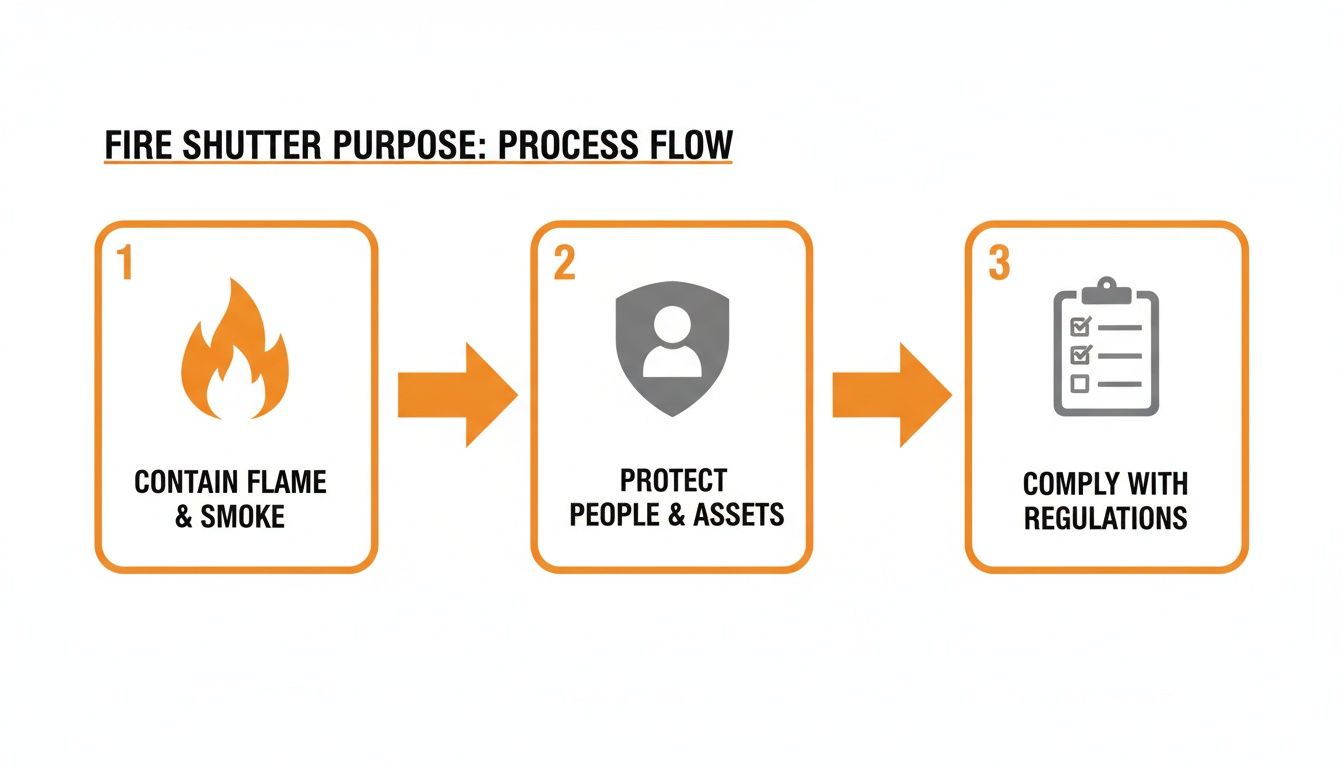
Alt text: A process flow diagram showing three icons representing the purposes of fire shutters for windows: containment of flames, protection of people and assets, and compliance with safety regulations.
As you can see, containment leads directly to protection, which in turn helps you meet mandatory compliance requirements.
This technology is just as vital in residential settings, especially in dense urban areas. Across the Greater Toronto Area (GTA) and Southern Ontario, fire shutters for windows have become a critical compliance tool for new homes built on narrow lots. When homes are built very close to property lines, the Ontario Building Code (OBC) mandates protection to stop fire from spreading to neighbours. Residential fire shutters, often with a 45-minute fire rating, solve this problem perfectly. They automatically seal windows when a fusible link melts, a solution that’s seen widespread adoption in recent years.
Ultimately, whether it’s activated by a simple fusible link or a sophisticated alarm system, the goal is always the same: to create a reliable, automatic barrier that turns a vulnerable window into a fire-rated wall at a moment’s notice. This dependable action is what makes commercial fire door systems such a cornerstone of facility safety.
Navigating Critical Fire Codes and Ratings
Getting a handle on the rules for fire shutters for windows isn’t just about checking a box on a compliance form. It’s about fundamentally understanding how to protect your people, your property, and your business from serious liability. Fire codes can feel a bit dense, but they all boil down to one critical goal: making absolutely sure a safety device works when a crisis hits.
For any facility manager, being able to translate this regulatory landscape into practical action is crucial. It all starts with fire ratings and the standards that tell us how these life-saving systems need to be installed, tested, and looked after.
Decoding Fire Ratings: What You Need to Know
When you see a fire shutter advertised with a rating like 45-minute, 1.5-hour, or 3-hour, that number isn’t arbitrary. It tells you exactly how long that shutter has been tested and proven to hold back fire, containing flames and smoke and stopping them from moving through the window opening. A fire rating is simply a measure of time-based resistance to fire.
The core rule here is simple: the fire rating of the shutter must correspond to the fire-resistance rating of the wall it is installed in. You can’t just put a 45-minute shutter in a wall built to resist fire for three hours and call it a day—it completely undermines the wall’s integrity. The goal is to create a continuous, unbroken fire barrier.
For instance, a fire shutter that separates a high-risk storage area from an office space might need a tough 3-hour rating. On the other hand, one protecting a window down a less critical hallway might only require a 45-minute rating. A certified professional is the one who can nail down the exact requirement based on your building’s construction and local codes.
The Gold Standard: NFPA 80
In North America, the bible for all things related to fire-rated doors and shutters is NFPA 80, Standard for Fire Doors and Other Opening Protectives. This document is the definitive guide for everything, from the materials used and the initial installation to the ongoing maintenance and testing. It’s not just a set of friendly recommendations; it’s the standard that local fire marshals and building inspectors hold you to.
NFPA 80 is precisely why professional, certified installation is a non-negotiable. An improperly installed fire shutter—one with gaps around the frame, misaligned guides, or the wrong kind of release mechanism—is a failed shutter from the moment it’s put in.
For property and facility managers, the single most critical takeaway from NFPA 80 is the requirement for an annual inspection and drop test. This isn’t optional. It’s a legal mandate to verify and document that every single fire shutter will close automatically when it’s supposed to.
The Same Liability Applies: Condo Managers Take Note
This brings us to a vital point, especially for anyone managing multi-residential buildings or commercial properties like condominiums. The legal liability tied to a failed fire shutter is identical to that of a massive rolling fire door in an industrial plant. If a fire shutter for windows fails to drop during a fire because of neglected maintenance, the fallout can be incredibly severe.
For property managers of condominiums, this means the duty of care is just as high. A shutter that fails to contain a fire, allowing it to spread from one unit to another or between floors, can lead to catastrophic damage and, more importantly, put lives on the line. Professionally documented maintenance isn’t just good practice; it’s your proof of due diligence. You can explore our comprehensive guide on fire door safety to learn more about these responsibilities.
In dense urban centres like Toronto, these regulations have a huge impact on construction. The Ontario Building Code (OBC) often requires fire shutters to solve proximity issues when new buildings are squeezed onto narrow lots. These shutters, with ratings from 45 minutes up to 4 hours, are essential for getting building permits and avoiding common project delays.
Ultimately, navigating fire codes is all about having a clear chain of responsibility, backed by the reliable work of a partner you can trust.
Choosing the Right Fire Shutter for Your Facility
Not all fire shutters are created equal. Just like you wouldn’t use the same door for a front office and a refrigerated warehouse, picking the right fire shutters for windows means matching the system to your building’s real-world needs. This guide is designed to help facility managers compare different models and make a smart, informed investment in both safety and compliance.
Making the right choice means looking past just the fire rating. You have to consider how the shutter will actually function in your unique environment day-to-day. After all, the demands of a massive warehouse window are worlds apart from those of a service counter in a corporate cafeteria. Getting this right can make a huge difference in both safety and operational flow.
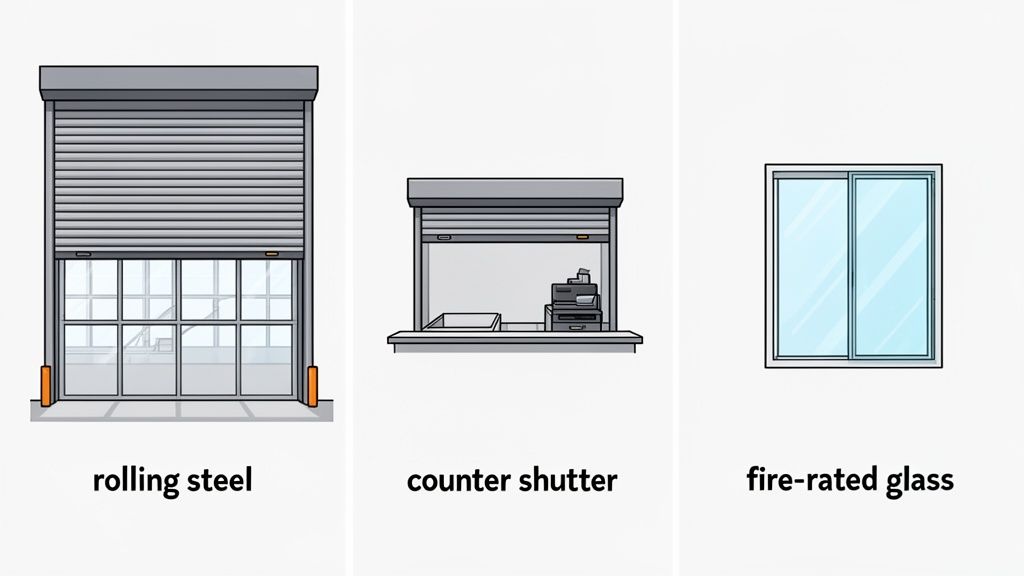
Alt text: Three images showcasing different fire and security solutions for buildings: a rolling steel door, a counter fire shutter, and fire-rated window glass.
Comparing Common Fire Shutter Models
To make the best choice, it helps to understand the main types of fire shutters and where they shine. Here’s a quick breakdown to help you match the right product to the right application.
Fire Shutter Types and Ideal Applications
| Shutter Type | Common Fire Rating | Ideal Application | Key Benefit |
|---|---|---|---|
| Rolling Steel Fire Shutter | 1.5 – 4 hours | Large exterior openings, warehouses, loading docks, manufacturing facilities. | Maximum durability and fire resistance for large spans and harsh environments. |
| Counter Shutter | 1.5 hours | Service counters, reception desks, school cafeterias, pharmacies, pass-through windows. | Sleek, compact design that integrates cleanly into commercial interiors. |
| Fire-Rated Glass | 45 – 120 minutes | Lobbies, hallways, and areas where visibility is a priority during an emergency. | Provides visibility and natural light while maintaining fire separation. |
| Insulated Fire Shutter | 1.5 – 4 hours | Exterior walls, climate-controlled environments, facilities needing sound reduction. | Combines fire protection with thermal insulation and sound-dampening properties. |
Selecting the right shutter from this list is the first step toward a cost-effective, compliant, and genuinely practical fire safety solution for your facility.
For large openings, like those on the exterior of a manufacturing plant or along a loading dock, heavy-duty rolling steel fire shutters are the undisputed industry standard. Their robust construction is engineered to cover huge spans and stand up to the tough conditions of an industrial setting. They deliver the high fire-resistance ratings—often up to 3 or 4 hours—required to protect critical infrastructure.
On the other hand, for smaller openings like a reception desk, pharmacy window, or school cafeteria pass-through, a more compact counter shutter is the perfect fit. These are much sleeker, lighter-duty systems that provide essential fire protection without the industrial look of their larger cousins. They’re designed for a clean, finished appearance that blends right into commercial or institutional interiors.
The core principle is simple: match the shutter’s design and durability to its application. A heavy-duty shutter is complete overkill for a small service window, while a counter shutter would be totally inadequate for a large warehouse opening. Understanding this distinction is key to a cost-effective and compliant solution.
Key Features That Save Time and Money
Modern fire shutters for windows are packed with features designed to boost safety and cut down on long-term maintenance costs. As you evaluate your options, there are two features in particular that facility managers should keep an eye out for:
- Governor-Controlled Descent: This is a non-negotiable safety mechanism. It ensures the shutter closes at a slow, controlled speed—typically between six inches and two feet per second. This prevents the shutter from slamming down, which could seriously injure someone or damage the shutter and the floor.
- Easy Floor-Resettable Mechanisms: After a drop test or an accidental activation, some older shutters are a nightmare to reset, requiring specialized tools and causing significant downtime. Look for models with non-tension release mechanisms that can be reset quickly and easily from the floor without a service call. That’s a huge saving in time and money right there.
These features directly contribute to easier and more affordable compliance with mandatory annual testing. At Wilcox, we specialize in systems that prioritize both safety and operational ease, ensuring your facility is protected without creating unnecessary maintenance headaches. Our expertise in industrial door solutions helps us identify the perfect fit for any environment.
Fire Shutters vs Fire-Rated Glass
When an opening in a fire-rated wall needs protection, managers often find themselves weighing shutters against fire-rated glass. While fire-rated glass offers visibility, it comes with some pretty significant drawbacks.
Fire shutters almost always provide superior fire-resistance ratings. In Canada, commercial roller models can be rated for up to 4 hours, which is far beyond what you can typically get with fire-rated glass. Even more importantly, shutters are a much more cost-effective solution. Openable fire-rated windows can cost 50-100% more than a comparable fire shutter because of their complex materials and closure systems.
For most commercial and industrial applications, fire shutters for windows deliver a higher level of protection at a lower cost, making them the smarter long-term investment. They fulfill the core promise of compartmentalization without the hefty price tag of specialized glazing. Making the right choice ensures your facility is not only compliant but also financially prudent. As your trusted partner, we can help you assess these options and select the most reliable system for your needs, including robust rolling steel doors for larger openings.
Why Professional Installation And Maintenance Are Non-Negotiable
A top-tier fire shutter is only as reliable as the hands that install it and the plan in place to maintain it. In the world of life safety equipment, cutting corners on professional service isn’t just a bad idea—it’s a serious liability. This is where our commitment to being “Respected Partners, Reliable Service” moves from a motto to a mission, ensuring your facility is genuinely protected.
Simply put, the effectiveness of fire shutters for windows depends entirely on flawless installation and diligent upkeep. Without both, even the highest-rated shutter is little more than a piece of metal on the wall. The process is far more complex than just bolting a unit in place.
Alt text: A certified technician on a ladder performs an annual fire door drop test on a rolling shutter, with an icon showing a certification and a calendar to represent scheduled maintenance.
The Critical Role Of Professional Installation
Think of a certified installation as building a single, seamless fire-rated assembly where the shutter and wall work together as one. Every detail matters, because anything less compromises the entire system.
Here’s what a professional technician handles that an amateur might miss:
- Wall Assembly Verification: The first step is confirming the wall itself can not only support the shutter’s weight but, more importantly, that it meets the required fire rating. Installing a 3-hour shutter on a 1-hour wall is a critical compliance failure right out of the gate.
- Precise Guide Alignment: The vertical tracks the shutter curtain travels in must be perfectly plumb and aligned. Even a slight misalignment can cause the shutter to bind or jam during a descent, preventing it from closing completely when it counts.
- Correct Release Mechanism Setup: Whether it’s a traditional fusible link or an electronic connection to your fire alarm, the release device must be installed and calibrated exactly to manufacturer and code specifications for immediate, reliable activation.
This meticulous work ensures the shutter isn’t just present, but prepared to perform its life-saving function without fail.
A documented, professional installation is your first line of defence in proving due diligence. In the aftermath of a fire, inspectors will scrutinize installation records. Having a certified report from a trusted provider like Wilcox is invaluable.
The Annual Fire Door Drop Test: A Legal Requirement
Once a fire shutter is installed, your responsibility is far from over. The NFPA 80 standard is crystal clear: every fire shutter, regardless of its size, must be professionally inspected and drop tested at least once per year. This isn’t a friendly suggestion; it’s a legal requirement enforced by fire marshals. A fire door drop test is a systematic, documented check-up on the shutter’s operational readiness.
Here’s what a certified technician will do:
- Visually inspect every component—curtain, guides, hardware—for any signs of damage or wear.
- Manually activate the release mechanism to ensure the shutter descends smoothly and closes completely.
- Check the controlled descent speed to confirm it operates within safe limits.
- Reset the shutter correctly and verify it is ready for service.
- Provide a signed and dated report documenting the successful test for your records. This paperwork is your proof of compliance.
This annual test is your best tool for catching a potential failure before it becomes a catastrophe. We dive deeper into this process in our guide on fire door drop testing in manufacturing facilities.
The Same Liability Applies To Condos And Commercial Buildings
For property managers of condominiums and other commercial buildings, this is a critical point. The legal and financial fallout from a neglected fire shutter drop test is identical to that for a massive rolling fire door in a warehouse. If a fire spreads because a window shutter failed to deploy, the liability falls squarely on the building management for failing to perform mandated maintenance.
A documented maintenance program from a certified provider is more than just a piece of paper. It’s your proof of due diligence—evidence that you took every required step to protect your occupants and property.
Protecting your facility means investing in professional expertise from start to finish. Our union-certified technicians have the training and experience to ensure your fire shutters are installed correctly and maintained for absolute reliability when you need them most.
Your Questions About Fire Shutters for Windows, Answered
When it comes to fire safety, you need clear, straightforward answers. Facility managers and property owners often have the same core questions about costs, testing, and operations. Let’s tackle them head-on so you can make the best decisions for your building’s safety and compliance.
How Often Do Our Fire Shutters Need To Be Drop Tested?
This one is non-negotiable: once a year. That’s the rule set by the NFPA 80 standard, which is the backbone of local fire codes right across Canada. Think of it less as a guideline and more as a legal requirement.
This annual test is the only way to be certain the shutter will actually do its job in a fire. A certified technician needs to perform the test, document everything, and create a formal record for the fire marshal. Skipping this crucial service doesn’t just put people at risk—it opens your facility up to serious fines and liability if a fire ever breaks out.
Can Fire Shutters Be Installed In An Existing Building?
Absolutely. Retrofitting fire shutters for windows is a very common project. It often comes up when a building is being renovated, its purpose is changing, or an older property needs to be brought up to today’s fire codes.
The main thing to look at is the wall structure around the window opening. It has to be beefy enough to support the entire shutter assembly and meet the necessary fire rating. Sometimes this means reinforcing the wall with steel jambs or adding extra layers of fire-rated drywall. The first step is always a professional assessment to make sure the retrofit can be done safely and correctly.
Should Fire Shutters Be Connected To The Main Fire Alarm System?
While not always required, it’s a fantastic idea and highly recommended for superior protection. A standard fusible link is designed to melt and release the shutter when it detects high heat right at the window. It works, but it’s a reactive measure.
Integrating the shutters with your building’s central fire alarm system makes your response proactive and much, much faster. The moment a smoke detector goes off anywhere in the building, it can send an electronic signal to immediately release the shutters. This can contain smoke and flames long before the heat even builds up at the window, which is a critical advantage in places with high-risk materials or where every second of containment counts.
For managers of condos and other multi-unit residential buildings, it is crucial to remember that the legal liability for a failed fire shutter drop test is identical to that for a large industrial fire door. The duty of care and the consequences of neglect are the same, making professional annual testing non-negotiable.
What Is The Typical Cost Of A Commercial Fire Shutter?
The price tag can vary quite a bit, driven by a few key things: the size of the window, the required fire rating (a 3-hour shutter will cost more than a 45-minute one), the material, and the release mechanism.
That said, even with all those variables, fire shutters are almost always a more budget-friendly way to protect an opening compared to fire-rated glazing. In many cases, specialized fire-rated glass can cost 50-100% more to achieve the same level of protection. The only way to get a real number is to have a professional assess your specific needs and code requirements, ensuring you get a solution that works for your budget and keeps you compliant.
At Wilcox, our expertise isn’t just in providing the right hardware; it’s about being your trusted partner in navigating the complexities of fire safety and compliance. We believe in providing reliable service that protects your assets and, most importantly, your people. Our union-certified technicians are equipped to handle everything from new installations to the legally required annual drop tests, ensuring your facility remains safe and compliant year after year.
This commitment to safety is why we emphasize a holistic approach, which you can learn more about by exploring our insights into fire door drop testing in manufacturing facilities. We help you understand not just the what, but the why behind every safety standard.
Your facility’s safety and compliance are our top priorities. At Wilcox Door Service Inc., we provide expert installation, maintenance, and testing for all your fire protection needs.
Contact us today for a professional assessment or to schedule your annual fire door drop test.