


This guide will teach you everything a facility or operations manager needs to know about folding security gates. You’ll learn what they are, how they work, the different types available, and how to choose, install, and maintain the right one for your commercial property—ensuring you make a smart, long-term security investment.
Why Folding Security Gates Are Essential for Your Facility
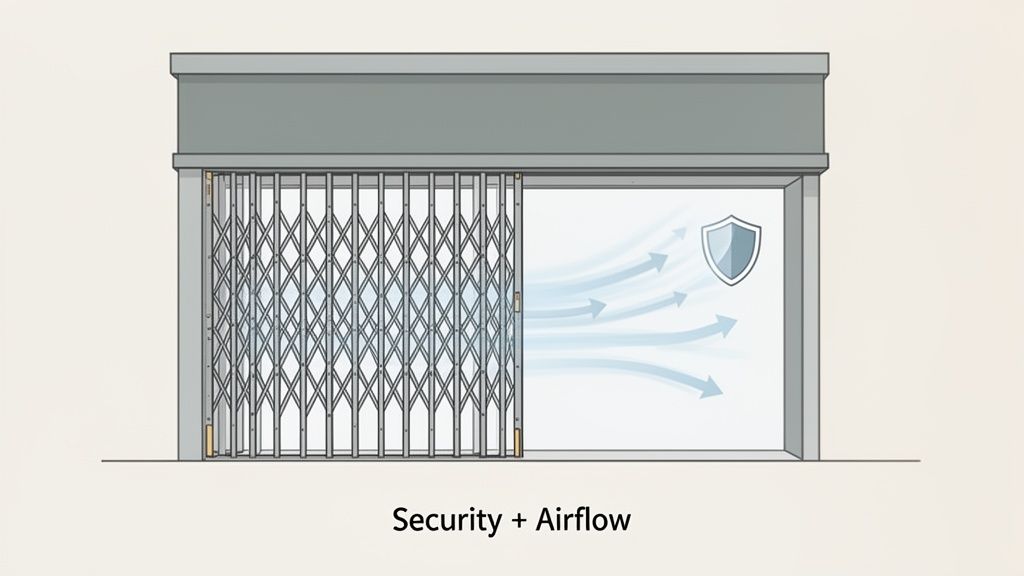
Alt text: A folding security gate providing security for a commercial entrance while allowing for airflow.
As a facility manager or operations professional, you know that securing your property is a balancing act. You need to protect valuable assets and control access without transforming your building into a fortress that kills workflow, ventilation, and sightlines. This is precisely the challenge folding security gates are designed to solve.
You can think of them as a heavy-duty, retractable barrier for your building’s most vulnerable points. Unlike a solid door, their crisscrossing lattice design—often called a scissor or accordion gate—forms a tough physical obstacle that still allows air and light to pass through. This is a simple but powerful feature for maintaining both security and a healthy indoor environment.
Versatile Security for Diverse Applications
The true value of folding security gates lies in their versatility. They adapt to all sorts of commercial and industrial settings, tackling specific security problems without hindering day-to-day work. Because they can secure an opening and then fold away neatly, they’re perfect for high-traffic areas where every square foot counts.
You’ll find them in a wide range of real-world applications:
- Loading Dock Doors: They secure bay openings after hours to prevent unauthorized entry while still permitting ventilation—a critical factor for maintaining air quality inside a busy warehouse. Explore our complete loading dock solutions.
- Retail Storefronts: Protect merchandise from break-ins and smash-and-grab theft overnight without completely obscuring your displays from passing security patrols or window shoppers.
- Warehouse and Hallway Access Control: Easily partition large spaces to create secure zones for high-value goods or to block access to sensitive areas during certain hours.
- Public Facilities: Help manage foot traffic in places like schools, hospitals, or transit centres by closing off corridors or entire wings after hours.
By providing a physical deterrent that remains visually open, folding security gates address two critical needs at once: robust protection and operational transparency. This dual function is what makes them an indispensable tool in modern facility management.
More Than Just a Barrier
Beyond theft prevention, these gates perform other important functions. They improve employee safety by clearly marking off restricted areas, which helps prevent anyone from accidentally walking into a hazardous zone like an active loading dock or machine room. They also help create a more organized workflow by guiding traffic and separating specific operational areas.
Investing in high-quality folding security gates is a strategic move that strengthens your building’s security and contributes to a safer, more efficient environment. As your “Respected Partners, Reliable Service,” we understand these challenges well. To see how different gate systems compare, check out our guide to commercial gates. Ultimately, the right gate pays for itself through loss prevention, improved safety, and operational peace of mind—a goal we help facilities achieve with our comprehensive maintenance programs.
How Do Folding Security Gates Actually Work
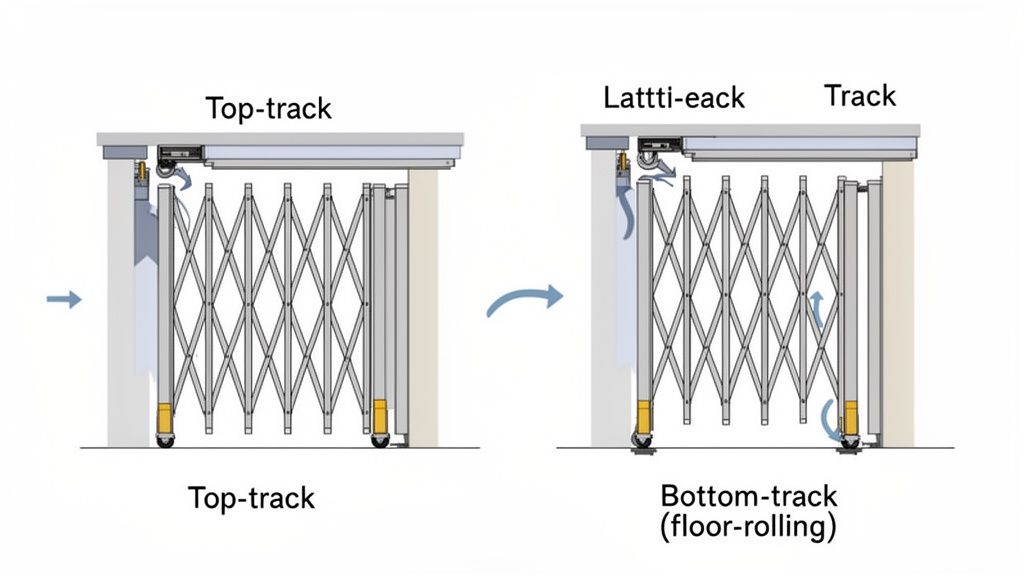
Alt text: Comparison of top-track and bottom-track folding security gates showing their different mounting mechanisms.
Let’s break down how these gates actually secure a space. Think of them as a heavy-duty accordion for your building’s most vulnerable openings. The technical term for this is a “scissor gate.” They create a tough, retractable barrier that secures an entryway while still letting air, light, and visibility through.
Their unique crisscrossing design is the key. It allows the entire gate to collapse neatly into a compact bundle at the side of the opening—a huge advantage over traditional swing gates that need significant clearance space. This makes them a perfect fit for busy loading docks or retail storefronts where every inch of floor space matters. The mechanics are beautifully simple yet incredibly effective.
The Core Components and Their Roles
At its heart, a folding gate is a system of three main parts working together. Each piece has a critical job, from providing strength to ensuring the gate glides smoothly day after day.
- The Webbing (Lattice): This is the crisscrossing “scissor” part of the gate. It’s built from interconnected steel channels that pivot, allowing the gate to expand and contract. When fully extended, this webbing forms a formidable grid that’s both a visual deterrent and a tough physical barrier.
- Vertical Bars and End Posts: The webbing is attached to heavy-duty vertical bars that give the entire structure its rigidity and strength. The end posts are the final upright sections that house the locking mechanism and anchor the assembly securely to the wall.
- The Track System: This is the guide the gate runs on as it opens and closes. A quality track system is crucial for smooth movement and keeps the gate perfectly aligned, preventing jams and premature wear.
The real genius behind the folding security gate is its ability to transform from a compact, out-of-the-way unit into a solid, full-width barrier. This is all thanks to the simple but incredibly strong pivot points connecting the webbing, which allow for thousands of open-and-close cycles without losing structural integrity.
Understanding the Track System
The track system dictates how the gate moves and, just as importantly, where its weight is supported. You’ll generally encounter two main types, and each has distinct advantages depending on your facility’s specific needs.
Top-Hung Gates
With a top-hung system, the gate hangs from a track mounted overhead. This is a massive benefit because it leaves the floor completely clear of any obstructions. It’s the go-to choice in environments where hygiene is a top priority or where heavy equipment like forklifts and pallet jacks are constantly moving through. For instance, a food processing facility will almost always opt for a top-hung gate to secure a warehouse opening. This avoids a floor track that could trap dirt and debris, making it much easier to meet strict cleaning protocols. They are also ideal for high-traffic loading dock solutions where a bottom track would inevitably get damaged.
Bottom-Rolling Gates
These gates use a track mounted directly onto the floor. Small wheels, or casters, are attached to the bottom of the gate and guide it along this track. They are often simpler and faster to install, especially in retrofit projects where the overhead structure might not be strong enough to support the full weight of a top-hung gate. Their popularity in the industrial world is a primary driver of market growth. Globally, the quick folding gate market is projected to expand at a compound annual growth rate of 5.4% through 2033, with industrial applications accounting for a commanding 45.2% share. You can read more about the trends in the quick folding gate market to see its growing impact.
Ultimately, choosing between these track types comes down to the specific needs of your facility—from daily operational workflow to hygiene standards. For a closer look at all your options, our overview of commercial gates can provide further guidance.
Single vs. Double Gates
Picking the right folding security gate isn’t about finding the “best” one—it’s about finding the best one for your specific problem. The perfect choice always comes down to the size of your opening, your day-to-day operations, and the security threats you’re trying to mitigate. Let’s start with the most basic configurations: single versus double gates.
A single folding security gate is just what it sounds like—one gate that pulls back to one side of an opening. These are your go-to solution for standard personnel doors, smaller interior hallways, or any entryway up to about 3.6 metres (12 feet) wide. Think of a retail stockroom entrance or a school hallway; both can be easily secured with a single gate.
For anything wider, you’ll need a double folding security gate. This setup uses two gates that meet and lock in the middle, with each half retracting to its own side. They are the standard for securing large spans like warehouse loading bays, storefronts, and large double-door entrances. A distribution centre manager, for instance, would use a double gate to lock down a 4.8-metre (16-foot) wide dock door, getting full coverage without putting too much strain on a single structure.
Comparison of Folding Gate Materials
The material a gate is made from has a huge impact on its strength, longevity, and where it should be used. Your choice will almost always come down to galvanized steel or aluminum. Each has distinct pros and cons.
| Material | Key Benefit | Primary Drawback | Ideal Environment |
|---|---|---|---|
| Galvanized Steel | Maximum strength and durability | Heavier and susceptible to corrosion if coating is compromised | High-security industrial, warehouses, and general indoor use |
| Aluminum | Superior corrosion and rust resistance | Less resistant to brute force than steel | Coastal areas, high-humidity interiors, and storefronts |
For most indoor and general industrial applications, galvanized steel delivers the best all-around value. But if you’re dealing with high humidity or corrosive salt air, aluminum is the smarter long-term investment. To see how different systems apply in the real world, you might find our guide on various commercial gates helpful. Getting the type and material right from the start ensures your folding security gate isn’t just another barrier, but a reliable and effective part of your facility’s security for years to come.
Navigating Installation and Code Compliance
Getting a folding security gate installed properly is about much more than just making it open and close. It’s a job that demands structural integrity, operational safety, and full legal compliance. A DIY approach can lead to gate failure, property damage, or even serious injury—this is a job for certified professionals.
Attempting an in-house installation might seem like a way to save money, but it can easily lead to gate failure, property damage, or even serious injury. Certified technicians have the expertise to see the whole picture, from assessing the mounting surface to ensuring the gate operates flawlessly for years to come.
The Foundation of a Secure Installation
The first thing a professional installer does is a thorough site assessment. The wall or frame your gate attaches to is the absolute foundation of its security. If it can’t withstand significant force, the gate is just for show.
- Concrete and Masonry: A technician will check the quality of the concrete or block, choosing the right heavy-duty anchors to ensure the end posts are locked in tight. A gate with weak anchors offers little real-world security.
- Steel Beams: When mounting to structural steel, like at a loading dock, the process involves precise drilling or welding. This creates a connection that’s as strong as the beam itself, ensuring the gate won’t give way under an attack.
Once the gate is anchored, perfect alignment is critical. It must open and close smoothly without binding, sagging, or scraping the floor. A technician will meticulously level the tracks and fine-tune the hardware to guarantee effortless movement and prevent premature wear on the wheels, pivots, and locking parts. Our technicians are trained to handle all types of commercial gates and their unique challenges.
Professional installation isn’t just about putting a gate in place; it’s about integrating it into your building’s structure so it functions as a reliable, long-term security asset. This is a core part of our commitment to being your “Respected Partners, Reliable Service.”
Staying Compliant with Fire and Safety Codes
This is where having an experienced partner becomes non-negotiable. Fire and life safety codes are complex, strictly enforced, and can vary by municipality. Getting it wrong can lead to failed inspections, steep fines, or a genuine safety hazard for your staff.
One of the biggest rules to watch for is the means of egress. A path of egress is a clear, continuous, and unobstructed way out of the building during an emergency. If your folding gate is installed along one of these paths, it must meet strict standards, like those from the National Fire Protection Association (NFPA). This typically means the gate must be easy to open from the inside, in the direction people are exiting, without needing a key, special knowledge, or excessive effort. Simply padlocking a gate that blocks a fire exit is a major violation.
A certified installation team knows these rules inside and out. They will install the right code-compliant hardware—like panic bars or thumb-turn locks—to ensure your facility is both secure from the outside and safe for everyone inside. From loading dock solutions to interior passages, our team lives and breathes these regulations. A knowledgeable partner makes sure every installation is done right the first time, protecting your assets, your people, and your business’s legal standing.
Integrating Automation And Access Control
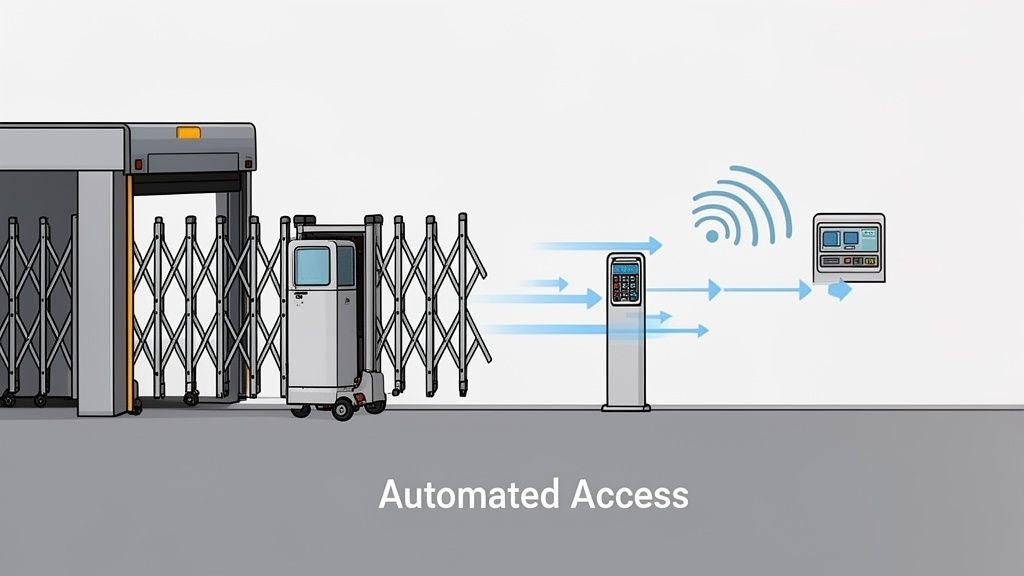
Alt text: Automated folding security gate integrated with an access control panel for smart security management.
A manual folding gate is a tough physical barrier. But when you add automation and access control, that gate transforms from a simple obstacle into a smart, responsive part of your security strategy. It’s the difference between a deadbolt and a fully integrated security system.
For example, in a busy distribution centre, having an employee manually open and close a large double gate every time a truck arrives costs time and labour. By motorizing that gate, you instantly improve traffic flow and reduce manual workload, allowing your team to focus on their primary tasks. The upfront cost is often easily recovered through improved efficiency and lower labour expenses. The market for automatic gate opening systems is expected to jump from US$ 3.51 billion in 2025 to US$ 6.70 billion by 2032, driven by this need for greater efficiency and security.
Smart Activation And Access Methods
Automating your folding security gates opens up numerous options for how you control them. The right choice depends on who needs access, when, and how closely you want to track movement.
- Push-Button Controls: This is the most straightforward automation. A hard-wired station is mounted near the gate, ideal for a shipping office that overlooks the loading dock, where an authorized person is always on hand to grant access.
- Key Card or Fob Systems: This is where security gets much tighter. By giving each employee a unique card or fob, you not only ensure only authorized people can open the gate but also create a digital log of every entry.
- PIN Pads: Similar to key cards, PIN pads require a specific code for entry. They’re perfect for granting temporary access to vendors or contractors without having to issue a physical card you need to retrieve later.
- Biometric Scanners: For facilities that require the highest level of security, biometric systems use unique physical traits like fingerprints. This virtually eliminates the risk of shared or stolen credentials.
The real power is unlocked when you tie these activation methods into your facility’s central security system. It creates one unified platform to monitor all access points, pull detailed audit trails, and boost overall accountability.
To fully lock down your site, integrating your folding gates often means connecting them with sophisticated and reliable commercial alarm systems.
Creating A Complete Security Ecosystem
Integration means your folding security gates can “talk” to your other systems. For example, you could program a gate to automatically lock if a fire alarm is triggered in a non-essential area, helping to contain a threat. Or you could link it to your video surveillance to automatically record footage every time the gate opens or closes.
This connectivity gives you a complete, auditable record of all movement, which is invaluable for investigating incidents or analyzing operational flow. It’s about building layers of security that work together. For instance, if you’re thinking about other ways to secure doors within this ecosystem, you might find our guide on how to choose a magnetic lock for a door helpful. By combining a strong physical barrier with intelligent controls, you turn a simple gate into an active player in your facility’s security.
Understanding Maintenance and Total Cost of Ownership
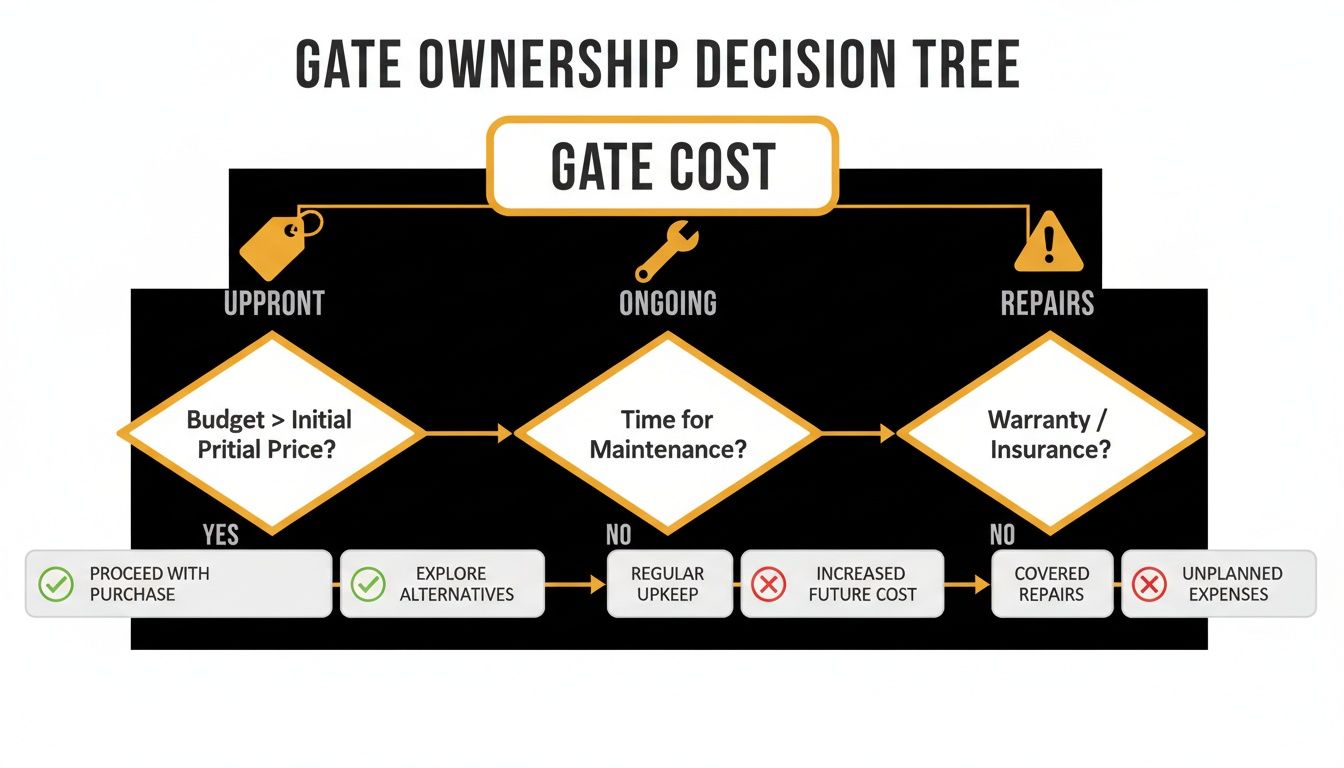
Alt text: Decision tree showing the total cost of ownership for a folding security gate, including purchase, maintenance, and repair costs.
When you invest in a folding security gate, you’re not just buying equipment; you’re acquiring a long-term asset for your facility’s safety and daily operations. To get the most value, it’s crucial to look beyond the initial price tag and consider the true lifecycle cost. This approach helps you make a smarter financial decision, prioritizing long-term reliability over a short-term saving. A cheaper gate that constantly breaks down will ultimately cost you far more in service calls and operational downtime than a quality gate backed by a solid maintenance plan.
Planned Maintenance for Lasting Performance
Just like any other critical piece of equipment, your folding security gates need regular, planned maintenance to work reliably. Neglecting them invites premature wear, sudden failures, and serious security gaps. A simple, consistent maintenance routine can add years to your gate’s life and save you from expensive downtime.
Here’s a practical checklist your on-site team can follow:
- Lubricate Pivot Points: All “scissor” points in the gate’s webbing and the rollers in the track need regular lubrication. This ensures the gate moves smoothly and reduces strain on the system.
- Check and Tighten Hardware: Constant vibration can loosen nuts, bolts, and anchors. Periodically inspect all mounting hardware and connection points to ensure they remain secure.
- Inspect and Test Locks: Your lock is the most critical part of the gate’s security. Regularly test the locking mechanism to ensure it engages properly and provides a secure hold.
- Clear the Tracks: For bottom-rolling gates, the floor track must be kept clear of dirt, gravel, and other debris. Any obstruction can jam the gate, damage the rollers, and become a major operational headache.
For a deeper look into preventative care, you can learn more about comprehensive maintenance on garage doors.
Responding to Damage and Unexpected Repairs
Even with the best maintenance plan, accidents happen. In a busy warehouse, it’s not uncommon for a forklift to clip a gate track or a delivery truck to back into the webbing. When this occurs, the damage can compromise your security and halt operations.
This is precisely why access to a responsive, 24/7 repair service is not a luxury—it’s a necessity. Downtime at a critical entry point costs money every minute it’s not secure, impacting everything from logistics to employee safety.
Having a dependable partner like Wilcox Door Service means a certified technician can be dispatched quickly to assess the situation and make necessary repairs, minimizing your facility’s vulnerability. As your “Respected Partners,” we deliver “Reliable Service” when you need it most.
Your Guide to Choosing the Right Gate and Partner
Making the final decision on a folding security gates system isn’t just about picking a product. It’s a two-part process: first, getting crystal clear on your facility’s real-world needs, and second, finding the right partner to install and support it. Nail both, and you’ve made a smart, long-term security investment. Before you even look at a single gate, you need to assess your operations and security weaknesses.
Your Gate Selection Checklist
To choose the right gate, you first have to define the job it needs to do. This checklist is a great place to start:
- What’s the main threat? Are you trying to stop after-hours break-ins, control employee access, or manage foot traffic? Your answer points you toward the right strength and locking hardware.
- What are the opening’s dimensions? Measure the exact width and height. This simple step determines if a standard single gate will work or if you need a double gate for a wide loading bay.
- What’s the traffic volume? A gate at a busy loading dock that opens and closes dozens of times a day requires a much tougher track and operator system than one securing a rarely used storage closet.
- Is durability or aesthetics the priority? For a rugged industrial environment, a heavy-duty steel gate is a no-brainer. But for a public-facing retail storefront, a sleeker, lighter-weight aluminum gate might be a better fit.
Choosing Your Installation and Service Partner
A great gate is only half the battle. The expertise, reliability, and support of your installation partner are what ensure that gate performs as it should for years to come. The partner you choose is just as critical as the gate itself.
The global security gates market was valued at $7.2 billion in 2024 and is projected to hit $13.8 billion by 2033. This growth shows a rising demand not just for proven security products, but for expert partners who know how to integrate them properly. You can learn more about the trends shaping the security gates market and why professional installation is so vital.
Look for a partner who embodies reliability. Your gate is a critical asset, and the company that stands behind it should offer unwavering support, from initial consultation to emergency repairs.
Here’s what to look for in a top-tier service provider:
- Certified Technicians: Ensure they employ union-certified professionals trained to handle complex installations and adhere to strict safety protocols.
- Proven Commercial Experience: You want a company with a long, documented history of working with facilities just like yours, whether in manufacturing, property management, or logistics.
- A Commitment to Safety: Your partner should put safety above all else, ensuring every installation is fully code-compliant.
- 24/7 Emergency Service: Downtime costs money and creates security gaps. A great partner must offer around-the-clock repair services to get you back up and running fast.
Securing your facility with confidence comes down to making informed choices and working with a team you can truly trust.
Ready to secure your facility with a partner who understands your needs? At Wilcox Door Service, we deliver “Respected Partners, Reliable Service.” Contact us today for a professional consultation and site assessment to find the perfect folding security gate solution for your business. https://www.wilcoxdoor.com