


A garage doors man door—a person-sized door built directly into a larger overhead garage door—is a simple yet powerful feature for any commercial facility. In this guide, you will learn about the different types of pedestrian access doors, how to choose the right materials for durability and energy efficiency, and the critical safety codes you need to know. Understanding these solutions will help you improve operational workflow, enhance security, and reduce long-term costs.
Unpacking the Garage Door Man Door
Think of a garage doors man door—often called a pedestrian door or a pass-through door—as a convenient express lane for foot traffic in a busy commercial space. Instead of cycling a massive, 14-foot overhead door every time a technician needs to grab a tool or a warehouse worker steps outside, they just use a normal-sized door. This one concept can dramatically improve the operational flow in any building that combines vehicle and personnel access.
For facility managers, understanding this feature is key. A man door directly impacts your daily operations, energy bills, and the lifespan of your critical door assets. It’s not just an add-on; it's a strategic choice that makes your building function better, reflecting our commitment to being “Respected Partners, Reliable Service.”
The Two Main Types of Pedestrian Access
When you're figuring out how to manage foot traffic near your overhead doors, you have two main choices. Each serves the same basic purpose but is better suited for different layouts, operational needs, and budgets.
- Integrated Man Door: This is the classic "door-within-a-door." It's engineered and built directly into the panels of a sectional overhead door. It’s the perfect solution for buildings where wall space is tight and installing a separate entryway isn't an option.
- Standalone Pedestrian Door: This is a separate, standard entry door installed in the wall right next to the overhead garage door. While it requires available wall space, it is structurally independent and is often the preferred choice for new construction projects where workflow and durability are top priorities.
The choice between these two isn't just about appearance. It has real implications for structural integrity, long-term maintenance needs, and compliance with local building codes.
Integrated Man Door vs. Standalone Pedestrian Door At a Glance
This quick comparison helps facility managers weigh the core benefits and trade-offs of each pedestrian access solution.
| Feature | Integrated Man Door | Standalone Pedestrian Door |
|---|---|---|
| Space Requirement | Excellent for tight spaces; no extra wall needed. | Requires dedicated wall space next to the overhead door. |
| Structural Impact | Modifies the overhead door structure; requires reinforced panels. | Independent structure; does not affect the overhead door. |
| Installation | More complex; must be factory-installed or retrofitted by a pro. | Simpler installation; can be done during or after construction. |
| Cost | Often higher initial cost due to custom engineering. | Generally lower initial cost for the door itself. |
| Code Compliance | Subject to strict safety and egress codes (e.g., cannot swing out over a ledge). | Fewer compliance hurdles as it functions like a standard door. |
| Maintenance | Adds complexity to overhead door maintenance. | Maintained separately; simple and straightforward. |
| Best For | Retrofits, facilities with limited wall space, specific operational flows. | New construction, facilities with ample space, high-traffic areas. |
Ultimately, the right door depends entirely on your building's layout and how your team operates day-to-day.
Why Does This Matter for Your Facility?
Picture a busy loading dock at a distribution centre. Without a man door, every time a driver needs to check in at the office, the entire massive dock door has to open. This exposes your building's interior to the outside weather, lets in dust and pests, and forces the powerful door operator—the motor that lifts the door—to cycle dozens of times a day.
This constant cycling not only accelerates wear and tear on expensive components like springs and motors but also drives up energy costs. A simple man door can mitigate these issues, demonstrating a clear return on investment through reduced maintenance and lower heating or cooling bills.
By providing a different way in, you're investing in a more durable and efficient system. For instance, a food processing plant can maintain strict climate control by limiting how often the main door opens, while a high-security government facility can better manage who comes and goes. As your partners in facility solutions, we at Wilcox Door believe understanding these core concepts is the first step toward making smarter, more cost-effective decisions for your building. We provide both robust commercial entry doors and comprehensive overhead door solutions to meet these diverse needs.
In the end, whether it's integrated or standalone, a pedestrian door is a vital part of creating a safe and productive environment. To see how these solutions work in the real world, you can explore our past projects, like this man door replacement in Toronto.
Choosing Between Integrated and Standalone Man Doors
When it comes to pedestrian access near your overhead doors, you’re looking at a critical choice for your facility. You have two main routes: an integrated garage doors man door built right into the main overhead system, or a separate, standalone pedestrian door installed in the wall next to it.
This decision has long-term impacts on your building's workflow, security, and maintenance budget. Let's break down the two options to see which makes the most sense for your space and daily operations. Often, the answer comes down to one simple factor: available wall space.
The Case for Integrated Man Doors
An integrated man door is your go-to solution when wall space is non-existent. Think of a packed urban warehouse or a tricky retrofit where cutting a new opening in a concrete wall is either structurally impossible or too expensive. In those tight spots, building the door directly into the overhead system is really the only practical way to add foot traffic access.
For example, a modern logistics centre with loading bays lined up one after another might not have room for separate doors. Integrating man doors into a few of the overhead systems lets staff move between the loading dock and the warehouse without opening a massive door and disrupting the flow of vehicles.
An integrated man door acts as a space-saving workhorse. It preserves the full width of your bay for vehicles while providing essential foot traffic access, making it invaluable for maximizing operational density in tight quarters.
This "door-within-a-door" solution is more complex than it looks, requiring specially reinforced panels and hardware to keep the main door balanced and secure. This is where professional installation from a trusted expert becomes non-negotiable.
This decision tree helps visualize the choice based on your facility's physical layout.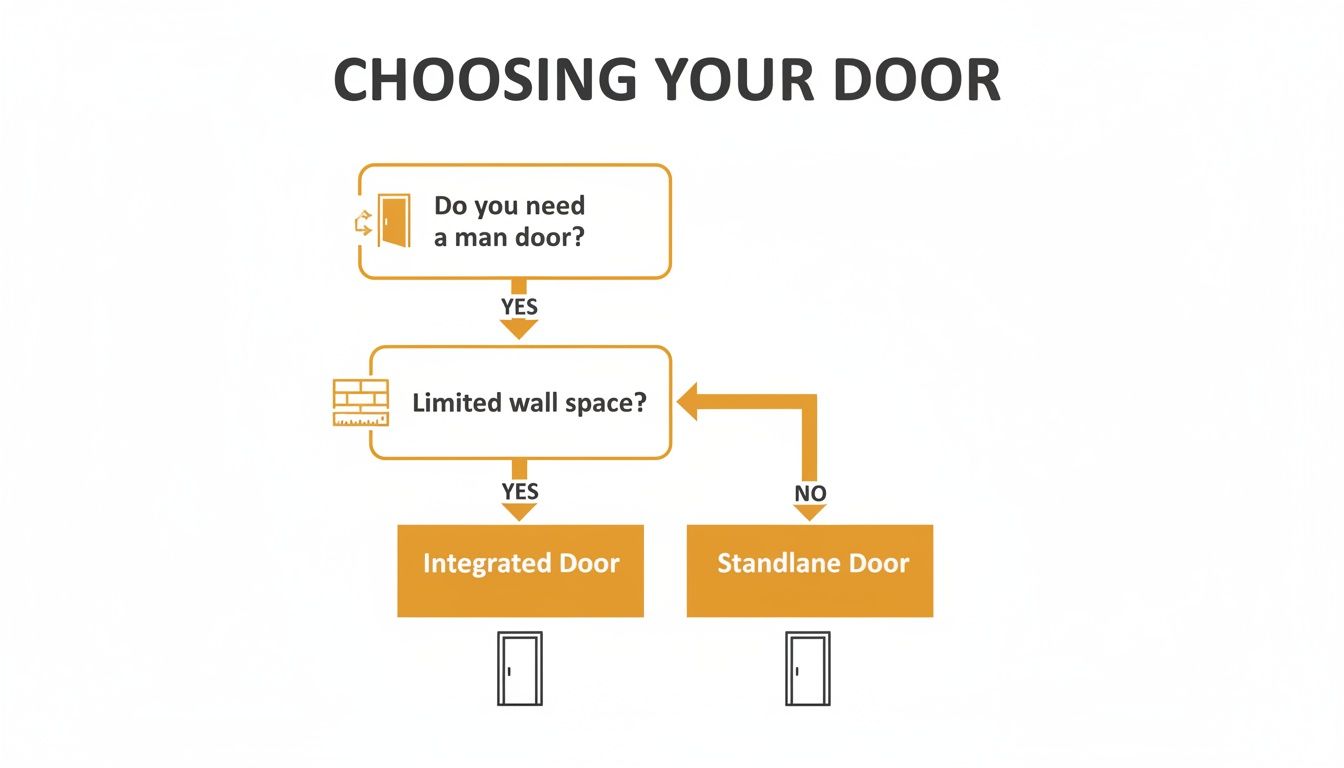
As you can see, if wall space is your main constraint, an integrated door is the most logical path forward.
When a Standalone Door Is the Superior Choice
If you have the wall space, a standalone pedestrian door is almost always the better option for a few compelling reasons. Since it’s structurally independent, it doesn’t compromise the integrity or insulation of your main overhead door. That separation simplifies everything from the initial installation to long-term maintenance.
A standalone door is also far easier to secure and seal properly. There are no complex seams or extra moving parts that could create air leaks, security weak points, or headaches down the road. This is why facilities needing high levels of security or environmental control—like a pharmaceutical cleanroom—will almost always opt for standalone doors to maintain a tight seal.
Consider the clear benefits of a standalone door:
- Greater Structural Integrity: It has zero effect on the performance or balance of your main overhead door system.
- Simplified Compliance: Meeting fire codes and accessibility standards is much more straightforward with a standard entry door.
- Lower Long-Term Maintenance: Fewer custom parts mean repairs are simpler and generally less costly.
- Better Insulation: A standard door frame and threshold provide a much better seal against weather, pests, and dust.
The demand for pedestrian access isn't just a nice-to-have anymore. In fact, over 70% of commercial garage door installations in Canadian industrial sectors now include some form of man door, largely driven by new safety regulations and a focus on operational efficiency.
Ultimately, choosing a standalone door is an investment in simplicity and durability. While both options get the job done, knowing their distinct advantages helps you make a call that supports your facility's goals for years to come. For a deeper dive into entrance solutions, you can also learn more about selecting the right entry doors for your garage.
Selecting the Right Materials and Customizations
A man door is far from a one-size-fits-all product. The right materials, size, and hardware are what truly define its performance and longevity in your facility. Making the right call here ensures your garage doors man door can stand up to daily use, bolster security, and meet very specific operational demands.
Let’s start with the basics: size. A standard pedestrian door integrated into an overhead system usually falls between 32 to 36 inches wide and 78 to 80 inches tall. This is often plenty for regular foot traffic. However, your facility might have unique needs, like accessibility compliance or moving small carts through, which would call for a wider opening. The goal is to find that sweet spot between easy access and maintaining the structural integrity of the main overhead door.
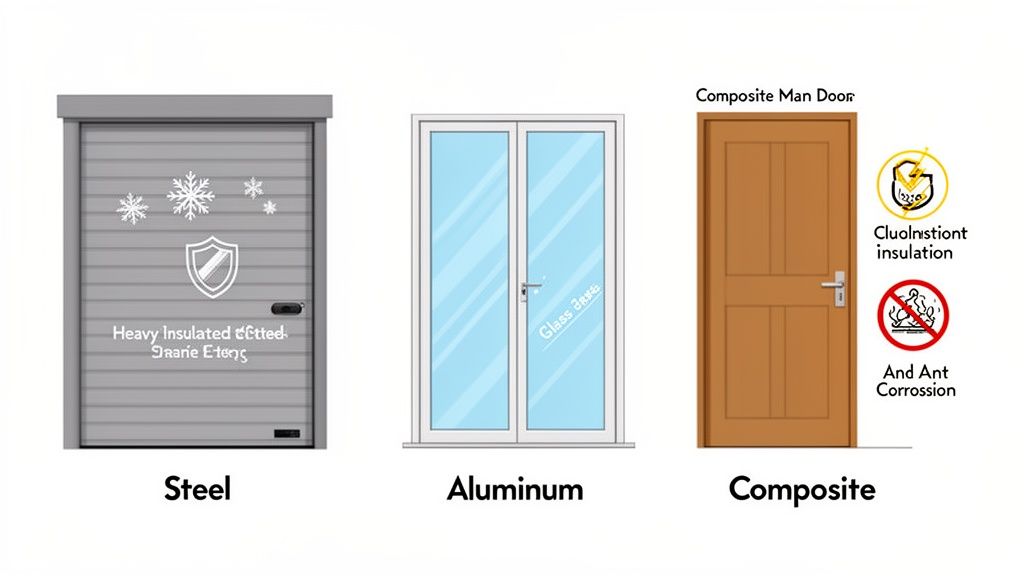
Choosing the Right Material for Canadian Climates
The material you choose for your man door is arguably its most critical feature, especially here in Canada where temperature swings, moisture, and corrosion are constant battles. Each material brings a different set of strengths to the table.
- Steel: This is the workhorse. For most commercial applications, steel is the go-to choice because of its sheer strength and security. When insulated, it delivers a high R-value—a measure of thermal resistance—to fight heat loss, making it the only practical option for a cold storage warehouse in Edmonton.
- Aluminum: Lighter than steel, aluminum’s key advantage is its natural resistance to rust and corrosion. This makes it a perfect fit for high-moisture environments like car washes or coastal facilities. An aluminum and glass man door also lends a modern look to a retail storefront or a service bay that needs more natural light.
- Composites: These doors blend materials like fibreglass and wood to give you a mix of durability, insulation, and design flexibility. They stand up well to dents and corrosion but can sometimes come with a higher price tag.
In North America, steel dominates the commercial door market with a 60% market share, and for good reason. Its ability to endure a -30°C winter while still meeting strict fire codes makes it the reliable default for man doors in tough industrial settings.
Essential Customizations for Function and Safety
Beyond the core material, custom features are what turn a standard door into a solution perfectly fitted to your facility's daily grind. These aren’t just nice-to-haves; they are functional necessities tied directly to safety, security, and how smoothly your operation runs.
For a facility manager, customizing a man door is about solving problems before they happen. The right hardware can prevent accidents, secure sensitive areas, and ensure your building complies with complex safety codes, proving that thoughtful design delivers reliable service.
Here are a few of the most important customizations to think about:
- Vision Lites (Windows): Putting a small, reinforced window in a man door is a simple but incredibly effective safety feature. In a busy warehouse, it lets people on either side see what’s coming, preventing collisions between personnel and forklifts.
- Panic Hardware: If a door is a designated emergency exit, a panic bar (or push bar) isn’t optional—it’s a code requirement. This hardware allows for fast, one-motion escapes during an emergency, even if the door is locked from the outside.
- Specialized Locks: A simple lockset won’t cut it for every application. A high-security area like a data centre or a pharmaceutical storage room needs something more robust. Your options can range from keypad entry and card readers to advanced biometric scanners that control access and keep a detailed log of who enters and when. For more on robust door solutions, our guide on hollow metal doors offers great insights.
Ultimately, picking the right material and customizations is all about matching the door to its environment and its job. A heavy-duty insulated steel door at a loading dock has completely different requirements than a full-view glass and aluminum door at a car dealership. By taking the time to consider these elements, you ensure your investment enhances both safety and efficiency for years to come.
Navigating Building Codes and Safety Requirements
For any facility manager, getting the details right on building codes isn’t just about ticking boxes—it's about ensuring the safety of your people and the security of your facility. This is especially true when it comes to a garage doors man door. The rules can feel complex, but we're here to explain them in simple terms.
Let's break down the essential codes and safety features you need to know. Think of this as your practical guide to keeping your operation safe, accessible, and fully compliant. Before you start any installation, it’s vital to review all local building regulations to make sure your door system meets every structural and safety requirement.
The Critical Role of Safety Interlock Switches
One of the most important safety features for an integrated man door is the safety interlock switch. Simply put, this device prevents the main overhead door from being operated if the pedestrian door is open—even a little bit.
Picture this: an employee walks through the man door at the exact moment someone else hits the button to open the overhead door. Without an interlock, the system would try to lift, ripping the swinging man door from its hinges and causing catastrophic damage to the panels, tracks, and the door operator. Even worse, it could cause a serious injury.
The interlock switch acts as a crucial fail-safe. It confirms the pedestrian door is securely closed before allowing the main door to move. Professional installation is absolutely essential to wire these switches correctly and ensure they work without fail. At Wilcox, we test these systems rigorously on every single installation as part of our commitment to reliable service.
Fire-Rating and Emergency Egress Standards
In many commercial and industrial buildings, certain doors are part of a designated emergency exit route. If your man door falls into this category, it must meet strict codes for fire-resistance and emergency egress.
- Fire-Rated Doors: If a man door is located in a fire separation wall—a wall designed to stop fire from spreading—it needs a specific fire rating, like 20, 45, or 90 minutes. This means the door is built and tested to hold back fire and smoke for that amount of time. Our team can help you select a fire-rated commercial door that satisfies your local code.
- Panic Hardware: Any door on an emergency egress path must have panic hardware, which you might know as a push bar or crash bar. This hardware allows someone to open the door with a single push from the inside, no keys or special knowledge needed. It’s all about fast and easy escape.
- Clear Path of Egress: A vital rule for integrated man doors is that they cannot open out over an elevation change, such as the edge of a loading dock. This is a massive safety hazard, as someone could easily trip and fall during an emergency evacuation. It's a key reason why standalone pedestrian doors are often the better choice for primary escape routes.
Accessibility Mandates for Public and Work Spaces
Accessibility is another major piece of the compliance puzzle. Regulations like the Accessibility for Ontarians with Disabilities Act (AODA) set clear standards for door openings to ensure they can be used by everyone.
Key accessibility requirements often include:
- Minimum Clear Width: The doorway has to be wide enough to comfortably accommodate a wheelchair.
- Threshold Height: The threshold—the bottom of the door frame—must be low enough to prevent it from becoming a tripping hazard or an obstacle for wheels.
- Operating Hardware: Door handles must be levers, not knobs, as they are far easier for people with limited hand strength to operate.
A multi-tenant commercial building, for instance, has to ensure every man door in its common areas meets these accessibility standards. When you partner with an expert like Wilcox Door Service, you can be confident that every detail, from the panic bars down to the handle style, is compliant from the get-go. Our team stays on top of regulations from bodies like the Canadian Standards Association (CSA), ensuring every job we do isn't just functional—it's fully compliant.
Navigating these codes can seem daunting, but you don’t have to go it alone. For a complete assessment of your facility's needs, contact our team to discuss our comprehensive commercial door solutions.
Optimizing Your Door for Security and Energy Savings
A garage doors man door in a modern facility isn't just about convenient foot traffic. It’s a crucial asset that directly impacts your security protocols and your bottom line. By outfitting your pedestrian door with the right features, you can turn it from a simple entryway into a high-performance part of your building's operational strategy.
Let's break down how to upgrade your door with modern access control and the essential energy-saving features needed to tackle Canada’s demanding climate. You’ll see how these improvements deliver a clear return on investment and lower the total cost of ownership for your facility.
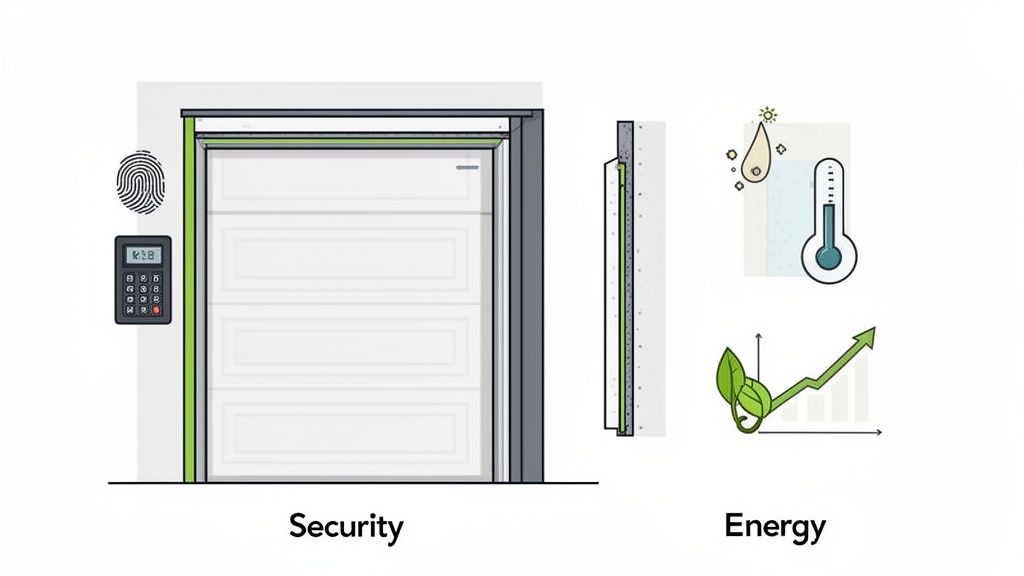
Upgrading Your Door with Advanced Access Control
For facilities needing to manage who goes where, a standard lock and key just doesn't cut it anymore. Advanced access control systems give you precise command over entry points—a must-have for protecting sensitive areas and valuable assets.
Instead of a traditional key, think about these modern solutions:
- Keypad Entry: A simple but powerful upgrade that requires a PIN code for access. This immediately gets rid of the risk that comes with lost or duplicated keys.
- Card or Fob Readers: Employees get programmed cards or fobs, which lets you grant or revoke access in an instant and track entry and exit times.
- Biometric Scanners: For maximum security, these systems use unique biological traits like fingerprints or facial recognition. They're perfect for high-security zones like data centres, R&D labs, or pharmaceutical storage rooms where access must be strictly limited and logged.
Imagine a manufacturing plant with a research and development lab. By installing a biometric scanner on the man door, the facility manager ensures only authorized personnel can get in. This creates a highly secure environment while keeping a detailed access log for compliance and security audits. That level of control is just not possible with a classic lock and key.
Boosting Energy Efficiency for Canadian Winters
In Canada, a poorly insulated or unsealed door is like having an open window in the middle of winter—it’s a constant drain on your heating budget. Because a man door introduces extra seams where air can escape, top-quality, energy-efficient features are non-negotiable.
A well-insulated man door is a direct investment in your bottom line. By preventing heat loss, you can significantly reduce your facility's energy consumption, leading to lower utility bills and a more comfortable indoor environment for your team.
For real energy savings, you need to focus on these three critical components:
- High-Quality Weatherstripping: Durable seals around the entire perimeter of the man door are your first line of defence against drafts. They create a tight barrier that blocks cold air, wind, and moisture from getting into your facility.
- Thermal Breaks: In a metal door, a thermal break is a piece of low-conductivity material (like a reinforced polymer) that separates the interior and exterior metal surfaces. This barrier stops the cold from travelling through the metal, preventing frost buildup on the inside and drastically reducing heat loss.
- Insulated Panels: The door itself should be filled with high-density polyurethane foam insulation. The effectiveness of insulation is measured by its R-value—the higher the R-value, the better it is at resisting heat transfer.
Think about a distribution centre in Calgary that retrofitted its loading bay man doors. They chose insulated models with new weatherstripping and thermal breaks. The facility manager reported a noticeable drop in heating costs the very next winter, as the building could hold its internal temperature much better, even with frequent foot traffic. This real-world example demonstrates a clear financial win and shows our commitment to providing reliable, cost-saving solutions.
Optimizing your man door for both security and energy efficiency is a smart play for any facility manager. To explore access control or energy-saving upgrades for your doors, contact our experts to schedule a facility assessment.
Ensuring Long-Term Reliability with Maintenance and Repairs
Even the toughest garage doors man door needs regular attention to stay reliable. Think of it as a critical piece of facility equipment. Just like your HVAC system or a conveyor belt, this door needs proactive care to stop small annoyances from turning into major operational shutdowns.
A man door often sees more action—more opening and closing cycles—than the big overhead door it's part of. All that daily traffic puts constant stress on its hinges, locksets, and seals. A simple, consistent maintenance routine is your best defence against unexpected failures and costly downtime.
A Practical Inspection Checklist for Your Team
A great first step is to arm your in-house team with a basic inspection checklist. This lets them spot common wear-and-tear before it gets serious. A quick weekly or monthly check should cover these key points:
- Hinges and Hardware: Look for any loose screws, signs of metal fatigue, or grinding sounds. A quick shot of the right lubricant on the hinges will keep them operating quietly and smoothly.
- Locks and Latches: Make sure the door latches securely every time. If it doesn't catch properly, you have a security weak spot and a potential safety hazard, as it might stop the overhead door's safety interlock from working.
- Seals and Weatherstripping: Visually check the seals around the door's frame. Are there any cracks, brittle spots, or noticeable gaps? A busted seal is a direct pipeline for energy loss.
- Panic Hardware Function: If the door has a panic bar, test it. It needs to unlatch the door with a single, easy push. A bar that sticks or fails to engage is a critical safety violation.
- Safety Interlock Switch: This is the most important check. Carefully test that the main overhead door operator will not turn on if the man door is open, even just a little. This feature is non-negotiable for safety.
Knowing When to Call the Professionals
While these in-house checks are incredibly valuable, some problems need a certified technician's expertise. In fact, man door service is a growing part of our work here in Canada. For our industrial clients, these doors make up as much as 28% of all service requests, usually because of worn-out hinges or failing seals that can’t stand up to harsh Canadian weather.
A planned maintenance program isn’t a cost—it’s an investment in uptime. When a certified technician regularly services your man door, you prevent the kind of surprise breakdowns that trigger expensive emergency calls and grind your operations to a halt.
Our service data shows that roughly 65% of commercial buildings over 10 years old have man doors that need energy efficiency upgrades. Simply getting these doors properly sealed and serviced can cut energy waste by 12-18%, delivering a solid return on investment.
It's time to bring in a professional when you see:
- The door has become difficult to open or close.
- The door frame looks bent, warped, or damaged.
- The safety interlock switch is failing or acting up.
Our Planned Maintenance Programs are built to catch these more complex issues, making sure your door stays safe, compliant, and efficient. We’ve seen time and again how proactive service prevents major failures, just like in this Toronto-based man door replacement project.
For those sudden problems that threaten your security or operations, our 24/7 emergency repair services are here to get you back in business fast. With a 90% first-visit fix rate for man doors, we live up to our promise of “Reliable Service” when you need it most.
If your man door is showing its age or you want to set up a maintenance plan to prevent future headaches, contact our service team today.
Frequently Asked Questions About Garage Door Man Doors
When facility managers look into adding a man door to an overhead door, a few key questions always come up. Our team gets these all the time, so we’ve put together some straightforward answers based on our hands-on experience as respected partners in the industry.
How Much Does A Garage Door Man Door Cost?
You should expect the cost to be higher than a standard overhead door, and for good reason. It’s not just a simple cutout; there's a lot of extra engineering involved.
You're paying for heavily reinforced panels around the opening, specialized hardware like heavy-duty hinges and locks, and a critical safety interlock switch. This is the device that prevents the main door from opening when the man door is ajar. Professional installation is non-negotiable, as the entire system needs precise alignment and re-balancing, which adds to the total investment.
Can You Add A Man Door To An Existing Garage Door?
While it’s technically possible to retrofit a man door into an existing overhead door, this is a job that demands significant expertise and should never be a DIY project.
The process involves cutting into the existing door panels, installing a robust frame to reinforce the new opening, and completely recalibrating the system. This includes adjusting the springs and motor to account for the new weight distribution and balance. It's a task strictly for certified professionals.
Key Takeaway: An improper retrofit can easily compromise the structural integrity of your entire overhead door system. This can lead to catastrophic operational failures and create serious safety hazards for your team. Always bring in an expert.
Are Man Doors Less Secure?
They don’t have to be, but security is entirely dependent on the quality of the door and the installation. A well-built man door featuring a robust, commercial-grade lockset and a solid, reinforced frame can be just as secure as any standalone pedestrian door.
On the other hand, a poorly installed door with a flimsy latch or weak frame can quickly become your building’s most obvious security vulnerability. This is why professional installation is so crucial.
Do Integrated Man Doors Leak or Cause Drafts?
They certainly can if they aren’t properly sealed, which is a major concern given Canada's climate. Every man door creates additional seams where air and water can potentially get in.
To prevent drafts and avoid energy loss, it's essential to select a door system with high-quality perimeter weatherstripping and a well-designed threshold. Weatherstripping refers to the flexible seals around the door's edge. Together, these components should create a tight, reliable seal when the door is closed.
At Wilcox Door Service, we provide solutions that deliver both convenience and long-term reliability. To get answers to your specific questions or to request a quote for your facility, contact our team today.