


This guide provides facility managers with a comprehensive plan for effective maintenance garage door upkeep. You will learn how to identify potential failures before they happen, understand the critical difference between proactive care and reactive repairs, and create a service schedule that protects your facility's safety, productivity, and bottom line. We'll cover essential inspection checklists, safety system testing, and compliance requirements for specialized doors, empowering you to make informed decisions that ensure operational reliability.
The True Cost of a Failed Garage Door
It's a common but costly mistake to think a commercial garage door will just keep running without any attention. This "run-it-'til-it-breaks" mindset almost always leads to sudden operational gridlock, eye-watering emergency repair bills, and serious safety hazards that put your people and property on the line.
Imagine a busy distribution centre on a Monday morning. A delivery truck is backed in, but the main rolling steel door is jammed halfway open because a worn-out roller finally gave out. Now, you’re not just scrambling to get a technician on-site; you're losing money every minute that truck sits idle and your team can't move product. Your day has just shifted from productive work to crisis management.
The Ripple Effect of Neglect
A single door failure is rarely an isolated problem. It triggers a domino effect across your entire operation, touching everything from logistics and shipping schedules to employee morale. The initial repair bill is often just the tip of the iceberg.
When you skip routine checks, here’s what you're really paying for:
- Operational Downtime: In high-volume environments like manufacturing plants or fulfilment centres, every hour a key door is out of commission can mean thousands of dollars in lost productivity and revenue.
- Emergency Repair Premiums: After-hours or weekend emergency calls come at a significant premium compared to a scheduled maintenance visit. You're paying extra for urgency, often for a problem that was completely preventable.
- Safety and Liability Risks: A malfunctioning door is a massive liability. A failing safety sensor or a high-tension spring that snaps can cause serious injuries, leading to WSIB claims, Ministry of Labour investigations, and costly legal battles.
Industry data paints a very clear picture. In high-traffic commercial hubs, a staggering 77% of facilities are vulnerable to unexpected breakdowns because they skip annual overhead door maintenance. When those failures happen, the average daily loss from downtime alone can hit $2,400. This shows a huge gap between perception and reality, where avoiding a small, planned expense leads directly to a massive, reactive one.
Proactive vs. Reactive: A Financial Breakdown
The difference between a proactive and a reactive approach is stark. A planned maintenance program is an operational strategy, not just a repair service. It empowers technicians to spot and fix minor issues—like a fraying cable, a misaligned track, or a worn bearing—before they can escalate into a full-blown crisis.
Take a simple action like lubrication. Applying the right lubricant consistently can prevent the vast majority of common problems, like binding tracks or a strained door operator. The operator is the motor that lifts the door. This small step, which is part of any good maintenance plan, protects the expensive motor and mechanical parts from premature wear. Without it, you're just waiting for a component to break under stress. The costs tied to repairing or replacing major components far outweigh the small investment in preventive care. For a deeper look at these figures, you can check out our analysis of garage door costs.
Preventive Maintenance vs. Emergency Repair: A Cost Comparison
To put it in perspective, let's look at the financial difference between a planned approach and a reactive one. A planned program is a predictable, manageable expense, while an emergency call comes with a cascade of hidden costs.
| Expense Category | Annual Planned Maintenance Program | Emergency Repair Scenario |
|---|---|---|
| Labour Costs | Fixed, predictable rate per visit | Higher hourly rate + after-hours premium |
| Parts Costs | Minor parts replaced at standard cost | Often requires major, more expensive components |
| Operational Impact | Minimal; scheduled during off-peak hours | Significant downtime; halted production/shipping |
| Hidden Costs | None | Lost revenue, expedited shipping fees, overtime pay |
| Long-Term Asset Value | Extends the life of the door and operator | Reduces asset lifespan due to stress/damage |
As you can see, the choice is clear. Investing a small amount upfront in a maintenance program consistently saves you from the much larger, unpredictable costs of a breakdown.
A planned maintenance program isn't about fixing what's broken; it's about ensuring nothing breaks in the first place. It transforms your maintenance budget from an unpredictable expense into a manageable, strategic investment in reliability. As "Respected Partners, Reliable Service," we see this firsthand with our clients every day.
Ultimately, proactive maintenance on your garage doors protects your bottom line by guaranteeing uptime, improving safety, and extending the life of your valuable assets.
Your Essential Garage Door Inspection Checklist
When it comes to your facility's garage doors, being proactive is the single most effective way to sidestep costly downtime and keep your work environment safe. This inspection checklist is your practical, hands-on guide for what your team can—and should—be checking on a regular basis. We'll walk through the key components, explaining not just what to look for, but why it’s critical for your facility's uptime.
The path you take is a clear choice. A planned maintenance schedule leads directly to consistent uptime, while neglect will inevitably land you in a world of expensive downtime and operational chaos.
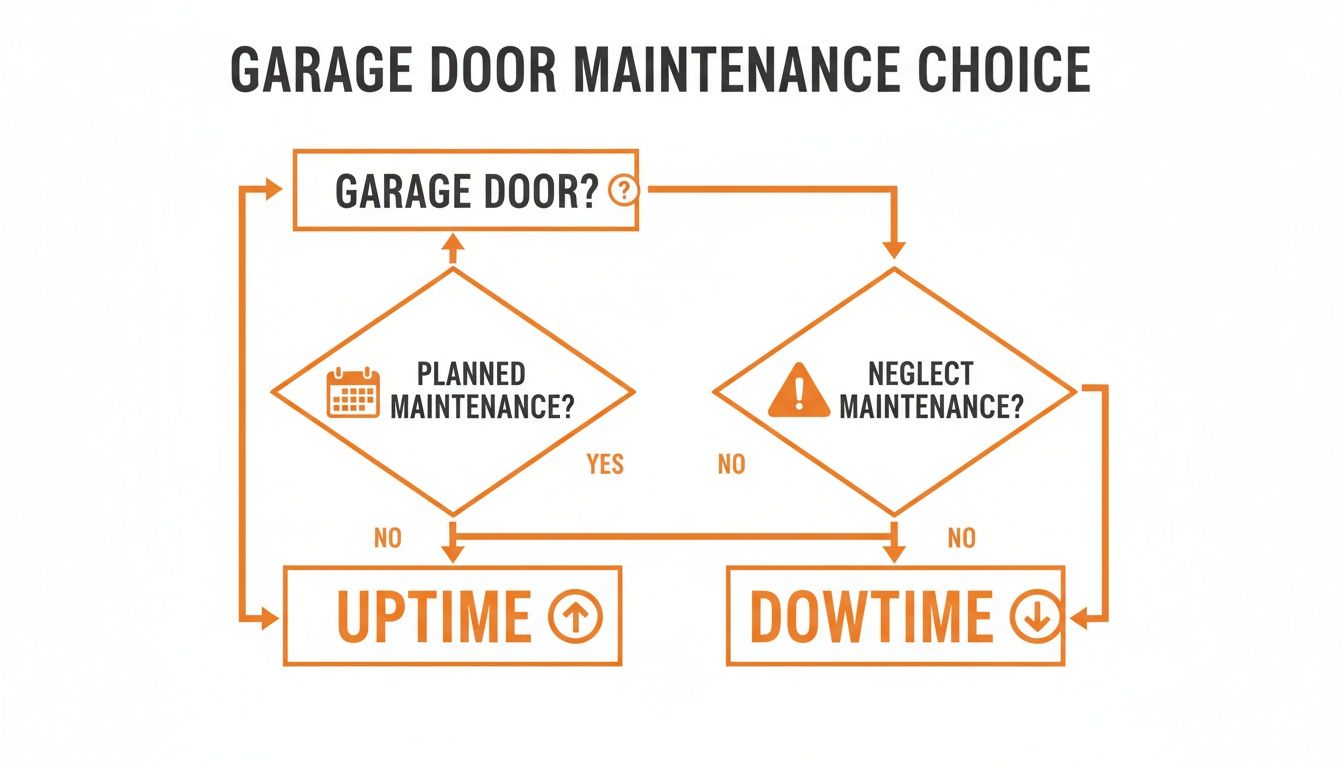
alt="Flowchart showing planned maintenance garage door leads to uptime, while neglect leads to downtime and costs."
The choice between a smooth-running facility and a major headache is a direct result of your maintenance strategy. As your Respected Partners, we believe in giving your team the knowledge to make the right one.
Visual and Auditory Checks Your Team Can Perform
Think of your in-house facility team as your first line of defence. With just a keen eye and a good ear, they can perform simple visual and auditory checks that catch small issues before they become major problems. No specialized tools are needed.
Start by running the door through a few cycles. Watch its movement from a safe distance and listen carefully for any unusual sounds. A healthy commercial door should operate smoothly and with minimal noise. Any grinding, scraping, or jerky motions are immediate red flags that something’s wrong.
For instance, a loud, sudden popping sound could point to a problem with the torsion springs—the large, powerful springs that do the heavy lifting. A scraping noise might mean the door is misaligned and rubbing against its tracks. These are the early warnings that should trigger a closer look or a call to a professional.
Inspecting Tracks and Rollers
The tracks and rollers are the road and wheels for your overhead door. Their condition is absolutely crucial for smooth, reliable movement, as they guide the entire weight of the door.
Begin with a visual inspection of the vertical and horizontal tracks on both sides of the door.
- Look for Misalignment or Bends: It’s common for tracks to get knocked out of alignment by forklifts or other heavy equipment at a loading dock. Even a minor bend can put immense strain on the entire system.
- Check for Debris: Dirt, grease, and other grime can build up in the tracks over time, blocking the rollers and causing the door to bind or stick.
- Examine the Brackets: Make sure all mounting brackets are fastened securely to the wall. A loose bracket can allow the tracks to shift, creating a serious operational and safety hazard.
Next, shift your focus to the rollers themselves. These small wheels carry the full weight of the door. In a busy warehouse, rollers wear out much faster than you’d think. Look for signs of wear like cracking, chipping, or rollers that wobble excessively in the track. A single worn-out roller can seize up and cause the door to jump right out of its track.
Examining Cables and Drums
The lifting cables and drums do the real heavy lifting, working with the springs to raise and lower the door. Because they operate under incredibly high tension, these parts demand a very careful inspection.
Visually check the cables on both sides of the door, from the bottom to the top. Look for any signs of fraying, rust, or broken wire strands.
In facilities near coastal areas, salt in the air can dramatically speed up the corrosion of steel cables. This makes frequent inspections even more critical. A single frayed strand compromises the entire cable's integrity and is a clear signal that it needs to be replaced immediately.
Also, watch the drums—the circular spools at the top of the door—as it opens and closes. The cables should wind evenly onto them. If you see uneven winding, a condition known as "cable-throwing," it's a sure sign of a bigger problem with the door's alignment or spring tension.
The Clear Line for Safety: Springs and High-Tension Parts
This is the most important part of the entire checklist: knowing exactly when to stop and call in a professional. While your team can inspect many components, torsion springs and lifting cables are under extreme tension and should NEVER be adjusted, repaired, or replaced by untrained personnel.
A sudden, uncontrolled release of this tension is powerful enough to cause severe injury or even death. Torsion springs are specifically engineered to counterbalance the door’s massive weight, and only a certified technician has the specialized tools and training to handle them safely.
If your team spots any of the following, it is time to stop and escalate the issue to Wilcox Door Service:
- A Visible Gap in a Torsion Spring: This means the spring has broken completely. The door is now unsafe and should not be operated.
- Fraying or Broken Lifting Cables: This is an immediate and serious safety risk.
- A Door That Feels Extremely Heavy: If the door is very difficult to lift by hand (when disengaged from the operator), the springs have failed and are no longer doing their job.
- The Door is Off-Track: Do not try to force it back into place. This often points to an underlying problem with the springs or cables that must be addressed first.
By training your team to spot these critical warnings, you empower them to be guardians of your facility’s safety while ensuring dangerous repairs are left to the experts. You can explore our commercial services to see how our certified technicians can help.
This division of labour is at the core of a successful garage door maintenance strategy. Your team handles the routine observations, and you bring in a reliable partner for the high-risk, technical work. This approach not only keeps your people safe but also ensures the job is done right the first time. To learn more about our commitment to safe and reliable door solutions, read about Wilcox Door Service.
Maintaining Operators and Safety Systems
If the door panel is the body of your overhead door system, the operator—the motor—is the muscle that does all the heavy lifting. The safety systems? That’s the brain and nervous system, and it’s arguably the most important part of your entire setup. Taking care of these components isn’t just about keeping the door moving; it’s about ensuring every cycle is safe, reliable, and compliant.
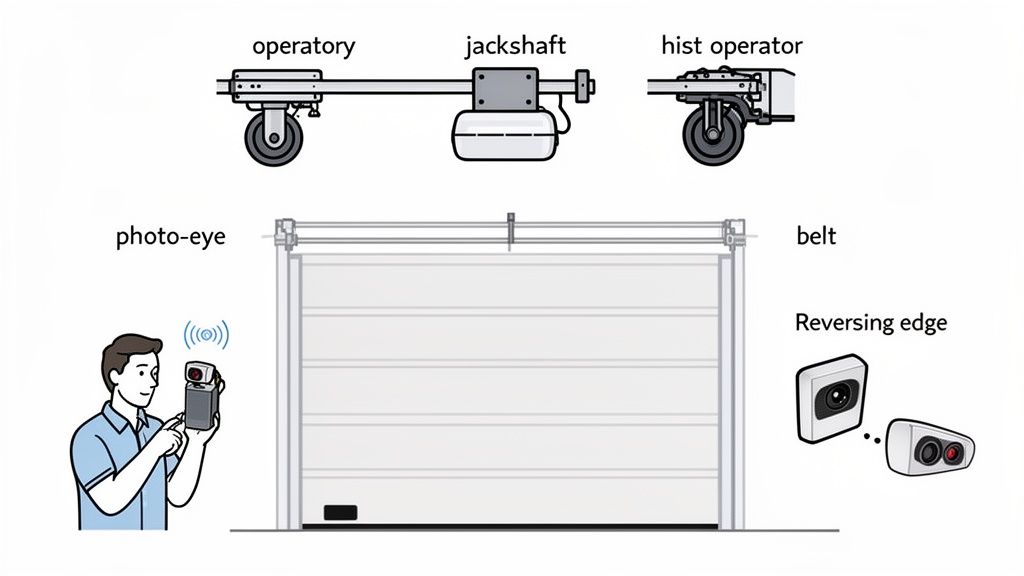
alt="Diagram showing key maintenance garage door components like operators, jackshafts, photo-eyes, and reversing edges."
Before you can inspect it, you need to know what you’re looking at. Most commercial doors rely on one of three workhorse operator types, each designed for a specific job.
- Trolley Operators: These are the most common type you’ll see. A motor drives a trolley along a rail to pull the door up, making them a perfect fit for standard sectional doors in places like auto repair shops or smaller warehouses.
- Hoist Operators: Built for the big jobs, these operators use a heavy-duty chain and sprocket to manage high-cycle or very heavy doors. They’re the go-to for busy manufacturing plants and distribution centres where endurance is key.
- Jackshaft Operators: These mount right on the wall next to the door and turn the torsion bar directly. You’ll find them in facilities with high-lift tracks or where overhead space is limited, like a parts department with a mezzanine above the door.
Operator and Drivetrain Inspection
With the operator disengaged from the door and the power safely disconnected, your maintenance team can perform some fundamental checks. These simple visual and auditory inspections are your first line of defense against a major breakdown.
Start with the drive chain or belt. A chain needs a little bit of play—about half an inch is a good rule of thumb. If it’s sagging badly or you can lift it right off the sprocket, it’s far too loose. A belt, on the other hand, should be taut and show no signs of fraying, cracking, or glazing.
Next, get a close look at the sprockets—the toothed wheels that engage the chain. You’re searching for teeth that are visibly worn down, hooked, or broken off. A bad sprocket won’t let the chain engage properly, leading to jerky movement that puts a massive strain on the motor. Finally, just listen. A healthy operator running under power should produce a steady, low hum. Any grinding, popping, or squealing is a clear sign of trouble, likely pointing to worn gears or failing motor bearings that demand a professional service call.
Testing Critical Safety Systems
This is the one part of your maintenance routine you can never, ever skip. It directly impacts the safety of your people and your legal liability. Commercial doors are legally required to have functioning safety devices that reverse the door if it encounters an obstruction. The two main systems you'll find are photo-electric sensors and pressure-sensitive reversing edges.
OSHA and other regulatory bodies have zero tolerance for failed safety systems. A door that doesn't reverse properly isn't just a maintenance problem; it's a major liability. In the event of an accident, it can lead to devastating consequences and serious legal action. Regular testing is non-negotiable.
Fortunately, testing these systems is quick, easy, and should be part of your monthly checklist.
Testing Photo-Eyes:
Often called photo-electric sensors, these are the small lenses mounted near the floor on each side of the door. They create an invisible light beam across the opening.
- First, make sure the indicator lights on both sensors are solid and not flickering. A flickering light usually means they are misaligned. For more troubleshooting tips, check out our guide on garage door sensors.
- With the door in the open position, press the close button on your controls.
- As the door is closing, simply pass a broom or any solid object through the beam.
- The door must immediately stop its downward travel and reverse to the fully open position.
Testing the Reversing Edge:
This is the flexible, pressure-sensitive rubber strip running along the bottom edge of the door.
- To test it, place a soft object on the ground directly in the door’s path. A 2×4 board laid flat or a couple of stacked rolls of paper towels work perfectly.
- Press the close button to begin lowering the door.
- The moment the reversing edge makes contact with the object, the door should immediately stop and reverse to the open position.
If your door fails either of these tests, it is unsafe to operate. It needs to be taken out of service right away. Disconnect the power and place large, clear "Do Not Use" signs on it until a certified technician can perform the necessary repairs. A few minutes of testing each month provides powerful protection for your team and your business.
How Often to Service Your Commercial Doors
"How often should we service our doors?" It's a question we get all the time, and the answer is never as simple as "once a year." The old one-size-fits-all approach just doesn't cut it for facilities where every minute of uptime counts. The right maintenance garage door schedule is always tailored to your specific operation: the type of door you have, how hard you run it, and the environment it lives in.
Figuring out the right frequency is about shifting from a reactive "fix-it-when-it-breaks" mindset to a proactive strategy that keeps you ahead of costly failures. Instead of guessing, let's break down the factors that truly matter.
Tailoring Your Maintenance Schedule
It really boils down to three key things: usage, door type, and your operating environment. A high-speed door at a food processing plant cycling 300 times a day needs a completely different level of care than a standard sectional door at a self-storage facility that opens a few times daily.
- Usage (Cycle Count): This is the big one. A cycle is one complete open-and-close sequence. High-cycle applications put immense wear on critical parts like springs, rollers, and operators. The more you use it, the faster it wears out.
- Door Type: Specialized doors, like rolling fire doors or the insulated doors in a cold-storage warehouse, have unique components and compliance requirements. These demand more frequent and specific checks to function correctly and safely.
- Operating Environment: Is your door exposed to corrosive salt air, extreme temperatures, or the fine dust of a manufacturing plant? These harsh conditions will cause components to degrade much faster than a door in a clean, climate-controlled space.
When you understand how these three factors work together, you can build a maintenance plan that actually protects your assets and your operation.
Recommended Service Frequencies
Here is a practical starting point for setting up your planned maintenance. A professional technician can help you fine-tune these frequencies based on a direct assessment of your equipment.
| Door Usage Level & Environment | Recommended Professional Service |
|---|---|
| Low Usage (< 20 cycles/day) | Annually (1x per year) |
| Medium Usage (20-100 cycles/day) | Semi-Annually (2x per year) |
| High Usage (> 100 cycles/day) | Quarterly (4x per year) |
| Extreme Environments (Corrosive, Dusty, High Temps) | Quarterly (4x per year) or as needed |
For instance, the loading dock doors at a busy distribution centre can easily top 100 cycles a day. This puts them squarely in the quarterly service category. Overlooking this can bring your entire operation to a screeching halt during your peak season.
The Importance of Pre-Season Checks
When you schedule service can be just as important as how often. Industry data from active markets shows a significant 18-22% spike in garage door service calls during the winter months. This isn't a coincidence. Cold temperatures make metal springs more brittle and can cause lubricants to thicken, putting a major strain on operators.
Smart facility managers get ahead of this by scheduling pre-season tune-ups in the fall and spring. They avoid the holiday rush and peak-season scramble, ensuring their doors are ready for whatever the weather throws at them. You can learn more about these service cost trends and consumer research on smb.panews.com.
A Planned Maintenance Program (PMP) is more than just a calendar reminder. It creates a detailed service history for every single door. This data helps you forecast repairs, budget for future replacements, and prove you're meeting safety compliance standards. It's a powerful tool for managing your facility's assets effectively.
By putting your service schedule on autopilot with a trusted partner, you can stop reacting to emergencies and start focusing on your business. A well-designed PMP is the foundation of our "Respected Partners, Reliable Service" promise, turning a necessary chore into a real strategic advantage. It means your facility is always prepared, and you're never caught off-guard by a breakdown that could have been prevented. For more proactive tips, see our guide on general maintenance on garage doors.
Specialized Doors and Fire Code Compliance
Chances are, your facility relies on more than just standard overhead doors. Specialized systems, from rolling fire doors to high-speed clean room doors, are critical assets, and each comes with its own rulebook for maintenance and compliance. Looking after these doors isn't just about uptime—it's a matter of life safety, energy efficiency, and meeting strict legal requirements.
This section gets into the crucial role of these specialized doors. We'll put a sharp focus on rolling fire doors and the mandatory annual drop testing required by the National Fire Protection Association (NFPA). You'll get a clear picture of what a drop test involves, why it has to be documented by certified pros, and how maintaining other unique doors, like those in cold storage, directly protects your bottom line.
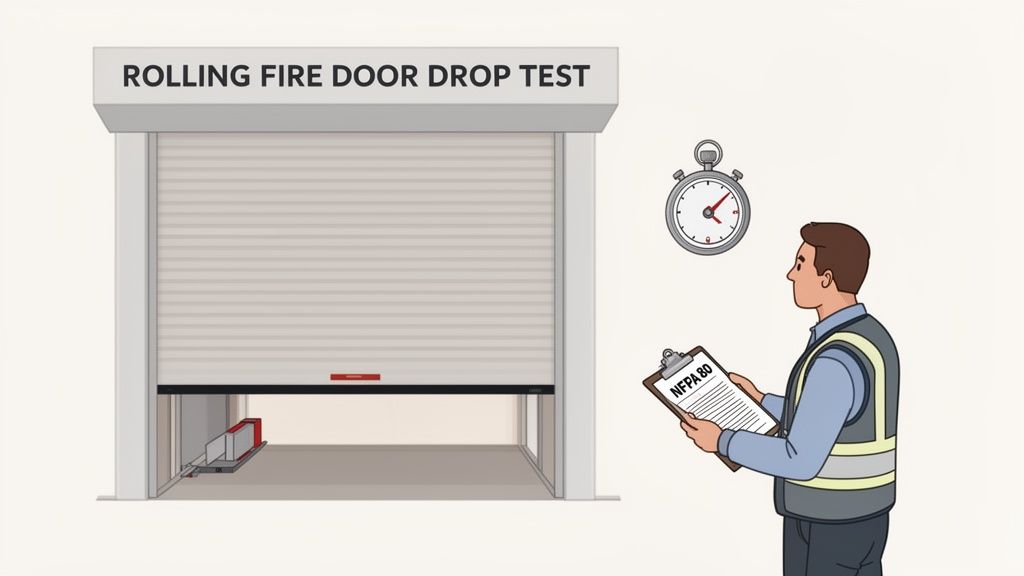
alt="Certified technician performing a maintenance garage door drop test on a fire door to meet NFPA 80 compliance."
The Life-Saving Role of Rolling Fire Doors
A rolling fire door is much more than a steel curtain. It's an engineered life-safety device designed to close automatically in a fire. By creating compartments within a building, these doors contain smoke and flames, protecting escape routes for your people and buying crucial time for emergency services to respond. Their reliability isn't a "nice-to-have"—it's the law.
The governing code here is NFPA 80, which states that all fire-rated doors must be tested and inspected at least annually by a qualified person. This isn't a suggestion; it's a legal requirement that carries serious liability if you overlook it.
A fire door drop test isn’t just about ticking a box. It is your documented proof that you are providing a safe environment and taking every necessary precaution to protect your people and property. In the event of an incident or an audit from a fire marshal, this paperwork is your first line of defence.
Understanding the Fire Door Drop Test
So, what exactly is a "drop test"? It might sound dramatic, but it's really just a controlled procedure to prove the door will close on its own when activated by a fire alarm or a fusible link.
A certified technician will run two distinct tests:
- Automatic Closing Test: The technician simulates a fire alarm signal. This ensures the door's operator releases correctly, allowing the door to close under its own weight as designed.
- Fusible Link Separation: Next, the tech will carefully separate the fusible link. This is a small, heat-sensitive device made to melt in a fire, and this test confirms the door will still deploy mechanically even if the building loses power.
After a successful test, the door is reset. The technician then provides detailed documentation of the results, which you must keep for your facility's records. As "Respected Partners, Reliable Service," Wilcox provides this certified testing to make sure your facility meets every fire code requirement.
Maintenance for Other Specialized Doors
Beyond fire safety, other unique doors in your facility need their own specific kind of attention.
- Cold Storage Doors: In a refrigerated warehouse, the seal on an insulated door is everything. A worn or damaged gasket can cause massive energy loss as your cooling systems work overtime to compensate. Regular inspections of seals, hardware, and door alignment are absolutely essential for controlling energy costs and protecting temperature-sensitive inventory.
- High-Speed Doors: Often found in clean rooms or high-traffic zones, these doors are built for speed and a high number of cycles. Maintenance here focuses on the operator, safety sensors, and breakaway bottom bars. This ensures they function safely at high speed and can be reset quickly after an accidental impact, minimizing downtime.
Navigating the complex world of specialized door maintenance and compliance codes can feel overwhelming. Partnering with a certified professional is the best way to ensure these critical assets are always ready to do their job, whether that's saving lives or saving money on your energy bills.
Common Questions About Garage Door Maintenance
When it comes to managing your facility’s overhead doors, a few key questions always come up. As a facility or operations manager, you’re trying to keep things running smoothly without breaking the budget. We get it. Here are the practical answers to the questions we hear most often from our partners, based on our years of experience in the field.
How Much Should We Budget for Maintenance?
This is usually the first thing people ask, and the good news is that proactive maintenance costs far less than a full-blown emergency repair. A professional maintenance visit, which includes a full inspection, lubrication, and minor adjustments, typically runs between $100 and $300. In a competitive market like Los Angeles, the average is around $190.
Think of it this way: when you consider that a staggering 75% of door failures are caused by a lack of maintenance, that small planned expense becomes a powerful tool against thousands of dollars in potential downtime. You can dig into more garage maintenance cost details on californiagaragerepair.com.
Can My In-House Team Handle All Maintenance?
Your in-house team is your first line of defence. They are perfectly suited for daily visual checks and basic upkeep like clearing debris from tracks. Their observations are invaluable.
However, any work involving high-tension components like springs or cables is a different story. These parts are under immense force and require specialized tools and training to handle safely. Attempting to adjust or repair them without proper expertise can lead to catastrophic failure and severe injury.
The most effective strategy is a partnership. Your team handles the day-to-day observations, and a certified partner like Wilcox Door Service takes care of the technical, high-risk work. This approach keeps your people safe and your doors reliable.
What's the Most Overlooked Maintenance Task?
Without question, it's testing the safety systems. It's so easy to forget, but it's critically important. Both the photo-electric sensors and the reversing edge on the bottom of the door need to be tested every single month.
This task takes just a few minutes, but it is a non-negotiable step for ensuring OSHA compliance and, more importantly, protecting your people. A malfunctioning safety system is a serious liability just waiting to happen.
Does a Planned Maintenance Program Really Save Money?
Absolutely, and in more ways than one. A Planned Maintenance Program (PMP) isn't just about scheduling service calls. It’s about building a comprehensive service history for every single door in your facility.
This data allows you to move from a reactive to a proactive mindset. You can anticipate future repairs, budget accurately for replacements, and easily prove compliance during safety audits. It transforms your spending from unpredictable, expensive emergencies into manageable, planned investments that genuinely extend the life of your assets. It’s the very core of our “Respected Partners, Reliable Service” philosophy.
Don't wait for a breakdown to disrupt your operations. Take control of your facility's reliability with a proactive approach. If your facility has fire doors or other specialized systems, contact Wilcox Door Service today to schedule a certified fire door drop test or explore a tailored Planned Maintenance Program. Let us be your respected partners in reliable service.