


Choosing the right overhead door commercial solution is one of the most critical decisions a facility manager, business owner, or contractor can make for their building. This guide is designed to cut through the technical jargon and provide clear, practical advice to help you invest wisely. It’s not just about closing an opening; it’s about selecting a vital piece of machinery that directly impacts your facility’s safety, efficiency, and long-term costs.
In this guide, you will learn how to:
- Select the Right Door Type: Understand the practical differences between sectional, rolling steel, high-speed, and fire-rated doors to match the perfect system to your daily operations.
- Understand Key Specifications: Learn what technical terms like R-value (insulation), cycle ratings, and material choice actually mean for your building’s energy efficiency and durability.
- Meet Safety and Compliance Standards: Get a clear overview of the non-negotiable safety requirements, such as fire-ratings and mandatory testing, that protect your people and your business.
- Implement Effective Maintenance: Discover how a proactive approach to installation and maintenance can dramatically extend the life of your door and prevent expensive operational failures.
Making the right choice upfront ensures safer operations, lower energy bills, and less unexpected downtime. Whether you’re managing a busy distribution centre, a climate-controlled food processing plant, or a small auto shop, the right door is the gateway to productivity and security.
A commercial overhead door isn’t just an access point; it’s a dynamic asset that contributes directly to your facility’s uptime, energy efficiency, and overall safety. Making the right choice upfront is one of the most impactful decisions a facility manager can make.
By the end of this guide, you’ll have the insight to select, install, and maintain the perfect overhead door for your needs, reinforcing our commitment at Wilcox Door Service to be your “Respected Partners, Reliable Service.”
Finding the Right Fit: A Guide to Commercial Overhead Door Types
Choosing a commercial overhead door isn’t like picking one off a shelf. The right door is a core part of your facility’s daily rhythm, directly impacting everything from security and energy bills to workflow and safety.
From a busy distribution centre to a climate-controlled food processing plant, the perfect door is out there. The first step is understanding the main types and what they’re built to do. Let’s break down the most common models to help you find the right match for your operations.
The Workhorse: Sectional Steel Doors
For most facilities, the sectional steel door is the undisputed workhorse. Picture the door on a standard loading dock or an automotive service bay—that’s almost certainly a sectional door. They’re built from horizontal panels hinged together, which roll up and back along tracks, resting parallel to the ceiling when open.
Their biggest strength is versatility. You can get them heavily insulated to save on heating costs, fit them with windows (known as vision lites) for natural light, or build them from heavy-gauge steel for maximum security. For a real-world example, a distribution centre in a cold Canadian climate relies on insulated sectional doors to minimize heat loss every time a truck is loaded. That small detail delivers significant energy savings over the long run.
The Defender: Rolling Steel Doors
When you need uncompromising security and durability, rolling steel doors are the go-to choice. Instead of panels, these doors are made of interlocking steel slats that form a single, tough curtain. When opened, the entire curtain coils up into a tight, compact roll just above the door opening.
This coiling design is a key advantage in facilities with limited ceiling space, as it leaves the area clear for lighting, sprinklers, or overhead cranes. You’ll often find them in industrial manufacturing plants, parking garages, and high-security environments where resisting impact and forced entry is a top priority.
This simple flowchart can help you visualize where to start based on your facility’s primary needs.
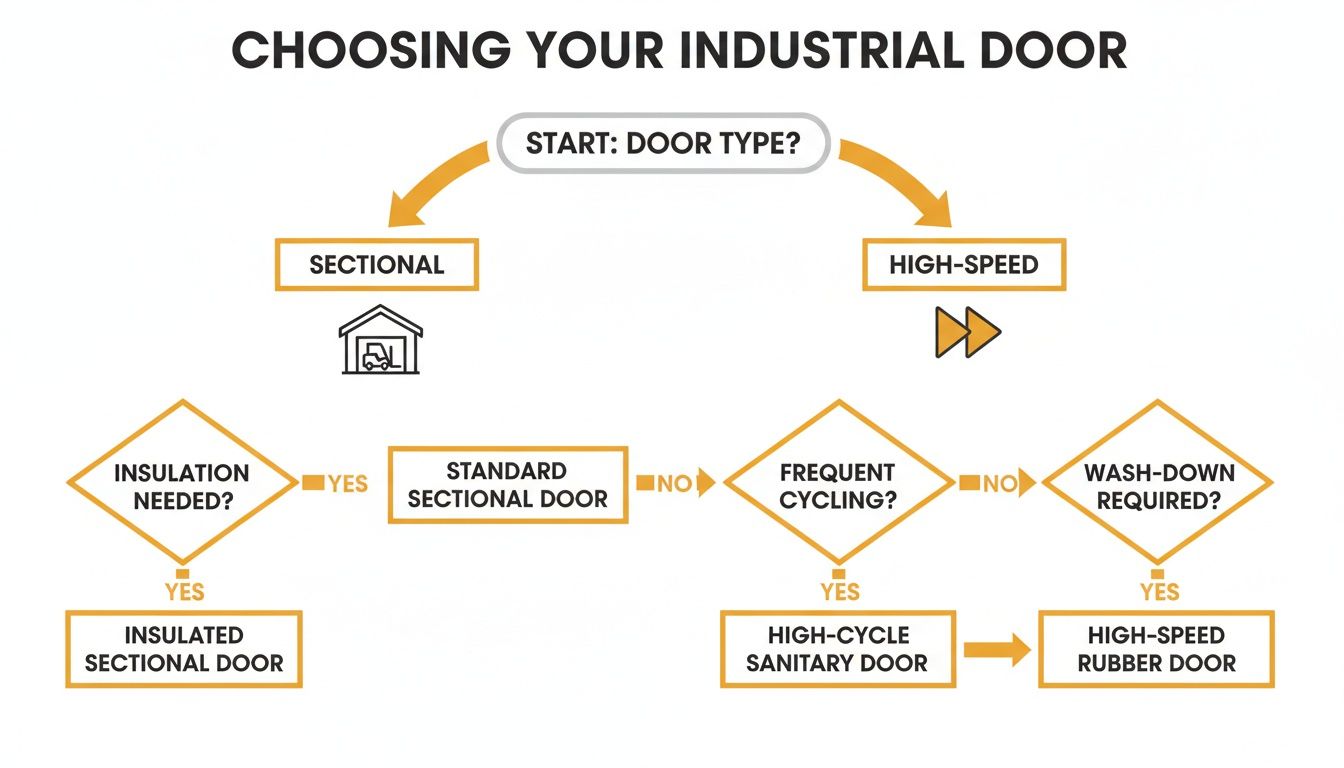
alt=”Flowchart for choosing an overhead door commercial solution, starting with facility needs and leading to sectional, rolling, or high-speed doors.”
As you can see, things like traffic volume and the need for environmental control are major factors in deciding between a standard sectional door and a more specialized high-speed model.
The Specialist: High-Speed Doors
As the name implies, high-speed doors are engineered for one thing: speed. They open and close in a matter of seconds, which makes them absolutely essential in places where controlling the climate or preventing cross-contamination is non-negotiable.
Consider these practical examples:
- Cold Storage: In a freezer warehouse, a high-speed door acts like an airlock. It opens and closes so fast that it drastically minimizes the exchange between cold and ambient air, which in turn slashes energy consumption from refrigeration units.
- Food & Beverage: For a processing plant, these doors are critical for hygiene. They cycle quickly to let people and equipment through while preventing airborne contaminants from entering controlled production zones.
- Manufacturing: In high-traffic production areas, they smooth out the workflow. Forklifts and personnel don’t have to wait around for a slow door to open, improving both safety and productivity.
The demand for these specialized doors is growing. Canada’s overhead door market analysis projects a 5.31% CAGR for roll-up doors through 2031, partly because they save valuable ceiling space and reduce air exchange. For property managers overseeing multiple sites, integrating these doors with smart access systems can cut energy losses by an impressive 25-40%, according to some efficiency studies. You can learn more about trends in the future of the overhead door market from The Business Research Company.
The Lifesaver: Fire-Rated Doors
Finally, we have fire-rated doors. These aren’t just for access; they are life-saving systems that are a non-negotiable safety requirement in many buildings. Their job is to automatically close during a fire to contain flames and smoke within a specific area. This process, called compartmentalization, buys precious time for people to evacuate safely and helps minimize property damage.
Most often built as rolling steel or counter-shutter doors, they are mandated by building codes to protect any openings in firewalls. For instance, the doorway connecting an office area to a warehouse floor almost always requires a fire-rated door. These doors must also pass a mandatory annual fire door drop test to certify that they will work correctly in an emergency.
Commercial Overhead Door Comparison By Use Case
| Door Type | Primary Application | Key Benefits | Common Industries |
|---|---|---|---|
| Sectional Door | General-purpose loading docks and service bays | Versatile, can be insulated, cost-effective | Warehousing, Automotive, Retail |
| Rolling Door | High-security areas, limited headroom applications | Extreme durability, security, space-saving design | Manufacturing, Parking Garages, Storage |
| High-Speed Door | High-traffic areas needing climate/hygiene control | Fast cycle times, energy efficiency, process control | Cold Storage, Food & Beverage, Pharma |
| Fire-Rated Door | Openings in firewalls between building sections | Fire containment, smoke protection, code compliance | All industries with firewalls |
This table simplifies the decision by aligning each door’s strengths with specific operational demands, making it easier to see which solution best fits your facility’s needs. By understanding these fundamental differences, you’re in a much better position to work with a professional to specify a door that will deliver real performance and value for years.
Ready to talk about which door is right for your facility? Explore our commercial and industrial door solutions to find the perfect fit.
Understanding Key Specifications and Materials
Picking the right type of overhead door is just the start. The real performance of a commercial system comes down to its technical DNA—the materials and specifications that dictate its strength, efficiency, and lifespan. Think of it like buying a work truck; you wouldn’t just choose a model, you’d specify the engine, payload, and drivetrain.
Getting these details right ensures you’re not just buying a door, but investing in a piece of equipment that will perform exactly how your business needs it to, day in and day out.
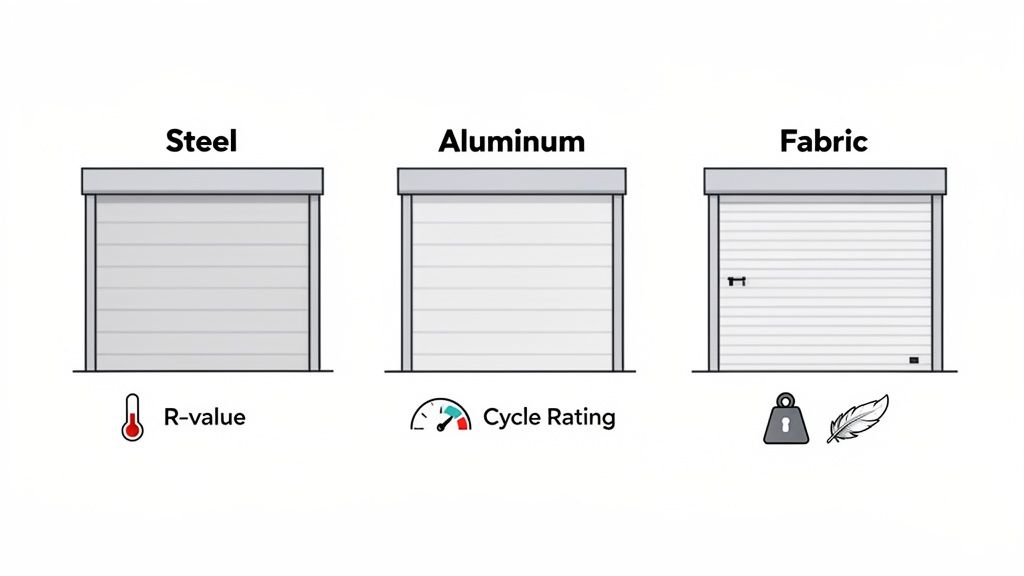
alt=”Comparison of overhead door commercial materials: steel for durability, aluminum for corrosion resistance, and fabric for high-speed use.”
The Power of Insulation: Understanding R-Value
Think of your overhead door’s insulation like a winter coat for your building. The R-value is simply a measure of its thermal resistance—its ability to stop heat from passing through. A higher R-value means better insulation, just like a thicker, higher-quality coat keeps you warmer. For a deeper look at this, our article on the benefits of insulated overhead doors is a great resource.
For a heated warehouse or a cold storage facility, a door with a high R-value isn’t just a nice-to-have; it’s a financial necessity. A well-insulated door minimizes heat transfer when it’s closed, which can lead to huge savings on your heating and cooling bills.
For example, a food distribution centre in a cold climate that upgrades from non-insulated doors to sectional doors with an R-16 rating can drastically reduce the workload on its refrigeration units, cutting energy consumption and preventing temperature fluctuations that could spoil products.
This focus on insulation is a huge driver in the Canadian market. The North American garage and overhead doors market, valued at $3.93 billion in 2024, is expected to hit $5.52 billion by 2033. Canada holds a significant 12.90% share of this market, largely because our climate makes insulated solutions that can slash energy bills by up to 30% so valuable. You can explore detailed market forecasts on Market Data Forecast to see how these trends are shaping demand.
Choosing the Right Material
The material your door is made from will define its strength, weight, maintenance needs, and ultimately, its cost. Each one brings a distinct set of advantages matched to specific operational demands.
- Steel: It’s the industry workhorse for a reason. Steel offers a fantastic mix of durability, security, and design flexibility. You can get it in various gauges (thicknesses) for different levels of strength and impact resistance, making it perfect for everything from busy loading docks to high-security applications.
- Aluminum: Much lighter than steel, aluminum is the go-to choice when you need to fight corrosion. It’s often used for doors in facilities like car washes or in coastal areas where salt in the air is an issue. You’ll also see full-view aluminum doors with large glass panels in car dealerships and restaurants, where a modern look and visibility are key.
- Fabric: Used mostly in high-speed doors, modern engineered fabrics are lightweight, tough, and incredibly flexible. They’re built to handle thousands of high-speed open-and-close cycles and are often used for interior separations, like between a warehouse and a clean room, where speed trumps heavy-duty security.
Understanding Door Cycle Ratings
Finally, let’s talk about endurance. A door’s cycle rating tells you how many times it’s designed to open and close before key components, like the springs, will likely need to be serviced or replaced.
It’s just like choosing tires. A quiet storage unit might only need a standard-duty door rated for 10,000 cycles—the equivalent of tires for a family car. But a busy distribution centre where doors fly open hundreds of times a day needs a high-cycle door rated for 100,000 cycles or more. Those are your long-haul truck tires, built for extreme use.
Specifying a door with the wrong cycle rating is a recipe for premature failure, leading to expensive and completely avoidable downtime. By carefully considering insulation, material, and cycle life, you can lock in an overhead door commercial system that’s perfectly tuned to your facility’s operational and financial goals.
Ready to find a door with the right specifications for your business? Explore our commercial and industrial door solutions to see the options.
Meeting Critical Safety and Compliance Standards
An overhead door commercial system isn’t just an access point—it’s a core piece of your facility’s entire safety framework. For any facility manager, overlooking safety and compliance is more than a minor error; it can trigger severe fines, operational shutdowns, and most importantly, put your team at unacceptable risk. Getting these standards right is simply non-negotiable.
The Lifesaving Role of Fire-Rated Doors
In most commercial and industrial buildings, fire-rated doors are mandated by building codes to separate key areas. Think of the doorway between your office and the warehouse floor, or the one connecting a parking garage to the main building. These are not just ordinary doors; they are engineered life-safety systems.
Their sole purpose is to close automatically when a fire alarm sounds, creating a barrier that contains flames and smoke. This function, known as compartmentalization, is designed to starve a fire of oxygen and buy precious time for everyone to evacuate safely. It also gives first responders the critical window they need to arrive and control the situation, dramatically reducing property damage.
Annual Fire Door Drop Testing: A Non-Negotiable Requirement
Just installing a fire-rated door isn’t enough. To be certain it will perform in an emergency, an annual fire door drop test is mandatory under the National Fire Code of Canada. This isn’t a recommendation—it’s the law.
A fire door that fails to close during an emergency is no better than an open hole in the wall. The annual drop test certifies that the automatic closing mechanism is working correctly and that the door will seal the opening as designed.
During this test, a certified technician triggers a simulated alarm to verify the door releases and closes as it should. They inspect every single component, from the release mechanism and fusible links to the guides and bottom bar, confirming everything is in perfect working order. Maintaining detailed records of these tests is vital for proving compliance during an inspection by the fire marshal. You can explore our certified fire door drop testing services to ensure your facility remains compliant.
For a deeper dive into this topic, you can learn more by reading our guide on the future of the overhead door commercial market.
Preventing Accidents With Entrapment Protection
Beyond fire safety, every automated commercial door must be equipped with systems to prevent it from closing on a person or an object. These are called entrapment protection systems, and they are legally required to prevent serious injury or even death. The two main types are:
- Photo-Eyes (Photoelectric Sensors): These are the small sensors you see mounted on either side of the door opening, typically about six inches from the floor. They shoot an invisible infrared beam across the opening. If anything breaks that beam while the door is closing, the operator will immediately stop and reverse the door.
- Reversing Edge (Sensing Edge): This is the compressible rubber strip running along the bottom edge of the door itself. If this edge makes contact with an obstruction as it closes, the pressure instantly tells the operator to stop and reverse.
The real-world consequences of non-compliance can be severe. Imagine a forklift driver rushing to get through a closing door, only to have the mast struck because the photo-eyes were misaligned. Or worse, a person getting pinned by a door with a faulty reversing edge. These aren’t just tragic accidents; they lead to serious legal and financial liability for the business.
Making sure your overhead door commercial systems meet all safety and compliance standards is fundamental to running a safe, responsible operation. It protects your team, your property, and your bottom line.
Is it time for your annual fire door inspection? Contact us today to schedule a service with our union-certified technicians.
Putting a Proactive Maintenance Strategy into Action
Think of your overhead door as a long-term asset. But like any heavy machinery, its lifespan and reliability come down to one thing: your maintenance strategy. Just waiting for something to break—what we call a ‘run-to-failure’ approach—is a fast track to costly emergency repairs, operational shutdowns, and lost revenue. A proactive approach, built around a Planned Maintenance Program (PMP), is a powerful investment in reliability.
This strategy completely shifts your focus from reacting to disasters to preventing them. By scheduling routine inspections and service with a qualified technician, you catch and fix minor issues before they snowball into major failures. This doesn’t just extend the life of your overhead door commercial system; it ensures it operates safely and efficiently, day in and day out.
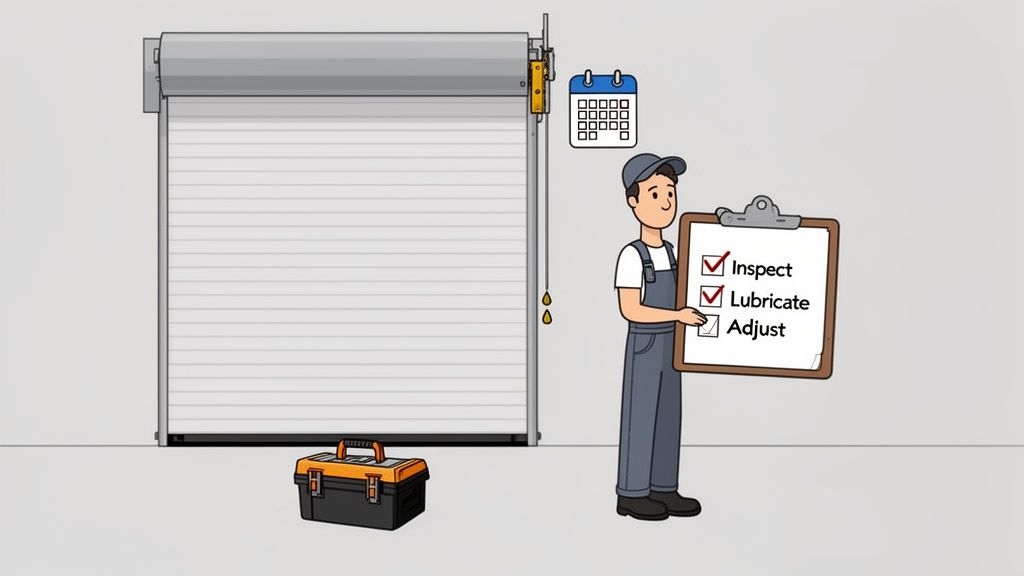
alt=”Illustration of preventative maintenance for an overhead door commercial system, showing inspection and lubrication tasks.”
The Core of a Planned Maintenance Program
A successful PMP is far more than a quick glance. It’s a structured, thorough service performed by a certified technician. Key activities in a typical PMP include:
- Detailed Visual Inspection: A technician will examine all moving parts, including rollers, cables, tracks, and hardware, for any signs of wear, damage, or misalignment.
- Proper Lubrication: All moving components—springs, hinges, rollers—are properly lubricated. This reduces friction, prevents parts from wearing out too soon, and guarantees smooth, quiet operation.
- Balancing and Adjustments: The door’s balance is checked to ensure the springs have the correct tension. An unbalanced door puts immense strain on the motor and other parts, leading to early failure.
- Safety System Checks: All safety devices, like photo-eyes and reversing edges, are tested to confirm they’re working correctly and will prevent accidents before they happen.
A proactive PMP can prevent the vast majority of commercial overhead door failures. Think of it like the routine maintenance you do on your car; skipping oil changes and tire rotations always leads to a much bigger, more expensive problem down the road. The exact same principle applies to your facility’s doors.
This preventative approach is becoming more critical than ever. In the Canadian overhead door market, sales revenue recently hit an impressive $153.31 million, with projections soaring toward $190.51 million. This growth is driven by the e-commerce boom and the need for high-speed, energy-efficient doors in warehouses and distribution centres. For these facilities, downtime simply isn’t an option, making planned maintenance a cornerstone of their operations.
When the Unexpected Happens: Emergency Repairs
Even with the best maintenance plan, things can still go wrong. Accidents happen. A forklift might clip a door track, or a key part could fail under extreme stress, bringing your operations to a grinding halt. When this occurs, you need a partner who can respond immediately.
Picture a distribution centre during its peak holiday season. A failed loading dock door could mean a multi-day shutdown, leading to thousands in lost revenue and total logistical chaos. The real value of having a reliable service partner is measured in these critical moments. A rapid, 24/7 emergency repair service turns a potential catastrophe into a manageable problem.
This is where having a trusted partner like Wilcox Door Service becomes invaluable. Our “Respected Partners, Reliable Service” promise means we’re ready to act when you need us most, minimizing your downtime and getting your facility back to full capacity. If you’re currently facing a door malfunction and need guidance, it’s important to know the next steps; you can find more information in our guide to commercial overhead door repair.
Ultimately, the best protection for your investment is a combined strategy of proactive maintenance and access to reliable emergency support. It ensures your overhead door commercial systems stay safe, compliant, and ready to perform when your business depends on them most.
Choosing Wilcox: Your Long-Term Service Partner
Choosing the right overhead door commercial system is a huge investment. But the door itself is only half the story. The real, long-term value comes from professional installation and a service partner you can count on for decades. This turns a simple purchase into a reliable, long-lasting asset.
For more than a century, Wilcox Door Service has built its reputation on being that partner. Our motto, “Respected Partners, Reliable Service,” isn’t just a tagline—it’s how we operate every single day. As a certified Indigenous-owned company with union-certified technicians, we support facilities all across Canada with expertise you won’t find anywhere else.
When you partner with Wilcox, you get more than a supplier. You get a century of expertise focused on making your facility safer, more efficient, and completely compliant. We don’t just solve problems—we help you achieve your operational goals.
From Blueprint to Operation
The best door systems don’t start with an installation; they start with a smart plan. This is true whether you’re building a brand-new facility or undertaking a complex retrofit. We get involved right from the beginning, working alongside facility managers and contractors to make sure every detail is right.
In new construction projects, for instance, getting the door specifications right from the start is critical. Planning for a new commercial installation requires the right team, and understanding the process of hiring a commercial builder ensures your door systems are integrated flawlessly into the building’s design from day one.
A Partnership Focused on Your Goals
Our entire approach is built around delivering results that matter to your business. We have a long track record of helping facilities in the most demanding industries hit their targets.
- Boosting Uptime: For a food and beverage distribution centre, we’ll pair high-cycle door systems with a rigorous planned maintenance program to all but eliminate unexpected downtime, especially during your busiest seasons.
- Cutting Energy Costs: In pharmaceutical cleanrooms, we can install insulated, high-speed doors that maintain precise climate control, dramatically cutting energy waste while protecting sensitive products.
- Guaranteeing Safety Compliance: We help property management firms with multiple sites by managing national programs for fire door testing and certification. This ensures every single location meets strict safety codes and shields the business from liability.
Choosing Wilcox is an investment in a relationship founded on trust. We’re here to support your facility at every stage, from the initial planning call all the way to 24/7 emergency service.
Ready to build a partnership that improves your facility’s performance and safety? Contact us today to start the conversation with our expert team.
Your Commercial Overhead Door Questions Answered
When you’re managing a facility, the performance of your commercial overhead doors is always top of mind. We hear a lot of the same great questions from business owners and facility managers trying to make the right decisions. Here are some straightforward answers from our team of experts.
How Often Should My Commercial Overhead Door Be Serviced?
The honest answer? It depends entirely on how much you use it. The key metric here is the door’s cycle count—one cycle being one full opening and closing.
For a high-traffic door, like you’d find in a busy distribution centre or a logistics hub, we always recommend quarterly planned maintenance. This isn’t just about ticking a box; it’s a strategic move to prevent a sudden failure right in the middle of your busiest hours, which can bring operations to a grinding halt.
On the other hand, for doors that see less action—think of a self-storage facility or a small workshop—an annual service is usually enough to keep things running safely and reliably. The best first step is to have a certified technician assess your doors. They can help you build a maintenance schedule that actually fits your operational needs, prevents costly breakdowns, and gets the most life out of your investment.
What Is the Difference Between a Commercial and a Residential Overhead Door?
The gap between a commercial and a residential door is huge, and it boils down to three things: durability, performance, and non-negotiable safety compliance. Commercial overhead doors are built for a completely different world—one with higher cycle counts, much larger openings, and tough industrial conditions. They’re constructed with heavier-gauge steel, more robust hardware, and powerful operators designed for constant, demanding use.
The most critical distinction, however, involves safety and fire-rating codes. Commercial doors are engineered and rigorously tested to meet strict legal requirements for commercial and industrial buildings. A residential door simply isn’t built for this purpose, making it both unsuitable and unsafe for any commercial application.
Can I Upgrade My Manual Overhead Door to an Automated System?
Absolutely. Converting a manual door to a motorized, automated system is one of the most common and impactful upgrades you can make. It’s a game-changer for workflow, allowing your team to operate the door faster and more easily. It also immediately boosts your facility’s security and, most importantly, creates a safer environment for your staff.
The process starts with a certified technician evaluating your existing door. They’ll look at its size, weight, balance, and overall condition to recommend the right motor operator for the job. From there, they will install all the required safety devices, like photo-eye sensors and a reversing edge, to make sure your newly automated system is 100% compliant with all current safety standards.
Ready to get expert answers for your specific facility needs? The team at Wilcox Door Service is here to help. Contact us today for a consultation or to schedule a service inspection.