


This guide will teach you everything you need to know about the width of doorways for commercial and industrial facilities. You will learn the difference between key terms like nominal width and clear opening, understand the critical Canadian building codes and accessibility laws that govern your facility, and discover practical tips for choosing the right door size for your specific industry—from warehouses to clean rooms. By the end, you'll be equipped to avoid common compliance traps and make smart, future-proof decisions for your building.
Getting Started with Doorway Widths
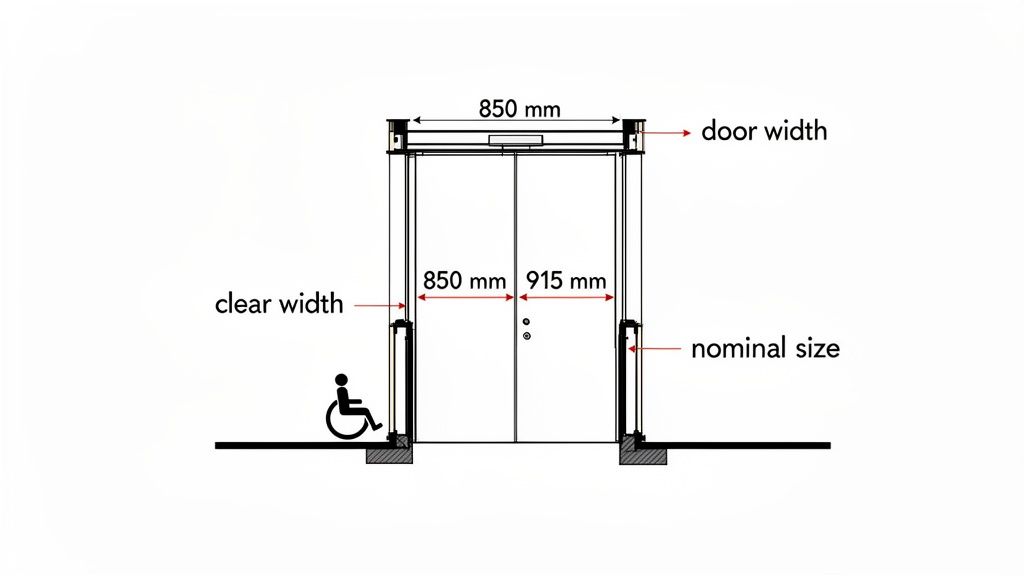
Alt text: Diagram illustrating the nominal size, clear width, and rough opening of a commercial doorway with accessibility measurements.
When we talk with facility managers about doorway widths, the conversation quickly moves beyond the door slab itself. We start talking about operational flow, safety responsibilities, and legal obligations. Getting these measurements wrong can lead to frustrating retrofits, hefty fines, and—most importantly—creating real barriers for employees and visitors.
Think of your facility’s doorways as lanes on a highway. If they’re wide enough, traffic flows smoothly. If they’re too narrow, you get bottlenecks. For example, a warehouse door that's even a few inches too tight can slow down every forklift cycle, costing you minutes of productivity each day. The right width ensures people, equipment, and products move freely, which is critical for both day-to-day operations and emergency evacuations.
Key Terms You Need to Know
To properly audit your doorways or specify new ones, you need to speak the language. These terms might sound technical, but understanding them is the first step to avoiding costly compliance mistakes.
Here are the essential doorway width terms every facility manager needs to know:
| Term | Simple Definition | Practical Example for Facility Managers |
|---|---|---|
| Nominal Door Width | The "catalogue size" of the door slab itself, before installation. | You order a standard 36-inch (914 mm) door from a supplier. This is its nominal width. |
| Clear Opening Width | The actual, usable space for passage when the door is open to 90 degrees. | This is the crucial measurement for accessibility and building codes. It's the space between the door face and the frame's stop. A 36-inch nominal door will not provide a 36-inch clear opening. |
| Rough Opening | The framed hole in the wall before the door frame is installed. | For a 36-inch nominal door, the rough opening might be 38 inches wide to allow room for the door frame and shims for proper fitting. |
Getting these terms right helps ensure your project specifications are accurate from the start, saving time and preventing miscommunication with contractors and suppliers.
Understanding the difference between nominal size and clear opening is fundamental. A 36-inch nominal door does not provide a 36-inch clear opening—it's usually about 2 inches less. This distinction is a frequent source of compliance errors, especially concerning accessibility standards.
This is where many facilities run into trouble. If an accessible route requires a 915 mm clear opening, simply ordering a 915 mm door won't work. Once you account for the thickness of the door and the doorstop on the frame, you’ll fall short of the required space. You can learn more about how this impacts universal access in our guide to door width for wheelchair access.
How Canadian Doorway Standards Evolved
Why are today’s doorway codes so specific? For facility managers, understanding the history behind these regulations is more than a trivia lesson—it’s about appreciating the ‘why’ behind the rules. This context is a powerful tool for making smarter, future-proof decisions and avoiding costly retrofits down the road.
The story of Canadian doorway standards starts with fire safety, shifts to include accessibility, and continues to evolve to meet modern needs.
From Fire Safety to Standardized Egress
The origins of our doorway standards trace back to early concerns about fire safety. Before any formal codes existed, door sizes were wildly inconsistent. This created serious risks, especially in public buildings where a quick, orderly evacuation was a matter of life and death.
The push toward modern regulations got its official start with Canada's first National Building Code (NBC) in 1941. This first code borrowed heavily from U.S. standards, which set exit widths based on 550 mm "units," a measurement calculated to allow for the evacuation of 60 people per minute. This foundation persisted for decades, showing just how much early safety models shaped Canadian regulations. You can explore the historical development of these building size limits in this detailed document from the Canadian Wood Council.
The initial focus was almost entirely on getting people out safely during a fire. The result was a set of rules that, while effective for its time, laid the groundwork for the more complex codes we navigate today.
The Shift Toward Accessibility and Efficiency
While early codes prioritized evacuation, the latter half of the 20th century brought a major shift in thinking. Advocacy from disability rights groups and a growing awareness of inclusivity started to reshape building standards across the country.
The original fire-centric rules were no longer enough. Codes had to evolve to ensure that everyone—regardless of mobility—could not only exit a building safely but also enter and move through it with dignity.
This shift fundamentally changed the conversation around doorway widths. The focus expanded from a simple "how many people can get out?" to a more inclusive "how can everyone get in and move around freely?"
This evolution is why we have the clear width standards we see in modern codes. By the 2015 NBCC, for instance, requirements had become much more specific:
- Dwelling Entrances: Standardized to a clear width of 810 mm.
- Commercial Facilities: Suites in Part 3 buildings required a wider 850 mm clear opening.
These changes reflect a deeper understanding of real-world needs. For facility managers, this history highlights a critical lesson: building codes are not static. They are living documents that adapt to new safety data, technologies, and societal values. Understanding this evolution is key to specifying doors that are not just compliant today but are ready for tomorrow.
Ready to ensure your facility meets current and future standards? Contact Wilcox Door Service for an expert consultation.
Navigating Building Codes and Accessibility Laws

Alt text: Map of Canada highlighting the importance of the National Building Code (NBC) and provincial laws for determining the correct width of doorways.
Getting the right width of doorways in your facility means navigating a complex mix of national and provincial rules. It can be a headache, but getting it right is non-negotiable for safety, accessibility, and staying on the right side of the law.
The National Building Code of Canada (NBC) sets the groundwork, but provinces often have their own, stricter requirements that facility managers must follow. Understanding this legal maze is the key to avoiding fines, operational shutdowns, and expensive retrofits.
The National Building Code of Canada (NBC)
Think of the NBC as the rulebook for the entire country, establishing the baseline for construction and safety. For commercial and industrial buildings, it lays out the minimum clear opening widths for all types of doors—entrances, exits, and interior passages.
A common number you'll see in the NBC is the requirement for a clear opening of at least 850 mm for many commercial doorways. But the code is nuanced; rules change based on the building’s purpose, its occupancy load, and whether a door is part of an accessible route or a fire-rated path.
It's important to know that these codes are always being updated. For instance, while the current NBC has set minimums for years, proposed changes are looking to increase the clear width for at least one accessible entrance in new homes to 850 mm. This push comes from research showing that roughly 10% of modern wheelchairs simply can't get through older doorways that are technically compliant. You can read the full details in the proposed NBC updates.
This kind of forward thinking in residential codes is often a sign of what's to come for commercial standards. Partnering with an expert who keeps an eye on these trends is your best bet for future-proofing your facility.
Provincial Accessibility Laws: The AODA Example
While the NBC provides a national framework, provinces can—and do—enforce their own, often more stringent, accessibility standards. A perfect example is Ontario's Accessibility for Ontarians with Disabilities Act (AODA). The AODA's mission is to make Ontario fully accessible, and its Design of Public Spaces Standard has specific rules for buildings.
When it comes to doorways, the AODA often demands a wider clear opening than the NBC minimum, typically requiring 915 mm for accessible routes. It also drills down into specifics like:
- Threshold height: Must be low and bevelled for a smooth transition.
- Door operating hardware: Lever-style handles are a must over traditional knobs.
- Clear floor space: Generous space is needed on both sides of the door for easy maneuvering.
- Closing speed: Automatic doors have to close slowly enough for everyone to pass through safely.
Creating an inclusive environment means getting these details right, from the front entrance to other key areas like safe, accessible bathrooms.
Avoiding Common Compliance Traps
So, where do most facilities trip up? A common mistake is confusing the nominal door size with the required clear opening—they are not the same thing. Another pitfall is failing to account for how different regulations, like accessibility and fire safety, work together. We dive deeper into how these interact in our guide on door fire rating requirements.
Misreading these codes isn't just a paperwork problem; it can lead to failed inspections, frustrating project delays, and the nightmare of having to rip out and replace brand-new doors. The most reliable way to make sure your facility is fully compliant is to work with certified pros who know both national and local codes like the back of their hand.
Choosing the Right Commercial Door Size
When you’re planning your facility's access points, one of the most common—and costly—mistakes we see is a simple misunderstanding: many facility managers assume a 36-inch door gives them a 36-inch opening. It doesn't.
Understanding the difference between a door's nominal size (its catalogue dimension) and its actual clear opening (the usable passage space) is the first step. This section will walk you through standard commercial door sizes, from the pedestrian doors in your office to the massive openings in your warehouse, so you can avoid expensive errors.
Pedestrian and Office Door Widths
For most commercial buildings, the main entry, exit, and interior doors are all about people. How they move, how they get in and out safely, and how they access the building if they have mobility challenges. That’s why their widths are so heavily guided by building codes and accessibility laws.
Here’s a quick breakdown for common uses:
- Exterior Entrance Doors: The most common nominal width is 36 inches (914 mm). When you open this door to a 90-degree angle, you end up with a clear opening of about 34 inches (864 mm), which satisfies most basic code requirements.
- Accessible Routes: For a truly barrier-free path, you'll need a wider door. To get the required 36-inch (915 mm) clear opening specified by laws like the AODA, you'll almost certainly need to specify a 40-inch (1016 mm) nominal door.
- Interior Office Doors: Inside the building, standard doors are often 32 to 36 inches wide. The right choice really depends on the foot traffic and what the room is used for.
Industrial and Warehouse Door Widths
Once you step into an industrial setting, the conversation shifts from people to products. For sectional or overhead doors, the width of doorways is all about moving goods and machinery as efficiently and safely as possible.
In a busy warehouse, a door that is even slightly too narrow can create significant bottlenecks. A forklift operator who has to slow down and carefully navigate a tight opening multiple times a day loses precious seconds with every pass. That time adds up, leading to substantial productivity losses over a year.
Picking the right width for these big doors means thinking about a few key factors:
- Type of Equipment: What's the widest vehicle or load that needs to get through? Measure it, and then add a safety buffer of at least 2 feet (610 mm) to that width. Never cut this corner.
- Traffic Flow: Is this a one-way street, or will you have two-way traffic? For a path where two forklifts need to pass each other safely, you’ll need a door that’s 12 feet (3.7 m) wide or even more.
- Loading Dock Doors: The industry standard for a loading dock door is typically 8 to 10 feet (2.4 to 3 m) wide. The final choice usually comes down to the size of the truck trailers your facility will be servicing. You can get more details in our guide to standard commercial door sizes.
Making the right call upfront is what keeps your operations flowing and your facility productive. Our "Respected Partners, Reliable Service" promise means you’ll get a solution that’s not just compliant, but built to perform.
Matching Doorway Widths to Your Industry
When it comes to your facility's doorways, there’s no such thing as a one-size-fits-all solution. The right dimension isn't just about meeting a building code; it's a critical decision that directly impacts your operational flow, safety, and ultimately, your bottom line.
A doorway that works perfectly in an office is a guaranteed bottleneck in a busy warehouse. Thinking strategically about width means looking at how your people, equipment, and products actually move through your space every single day. For a warehouse manager, that means faster forklift cycles and fewer costly impacts. For a property manager, it means ensuring consistency and mitigating legal risks. At the heart of this is one core principle: the clear, usable opening.
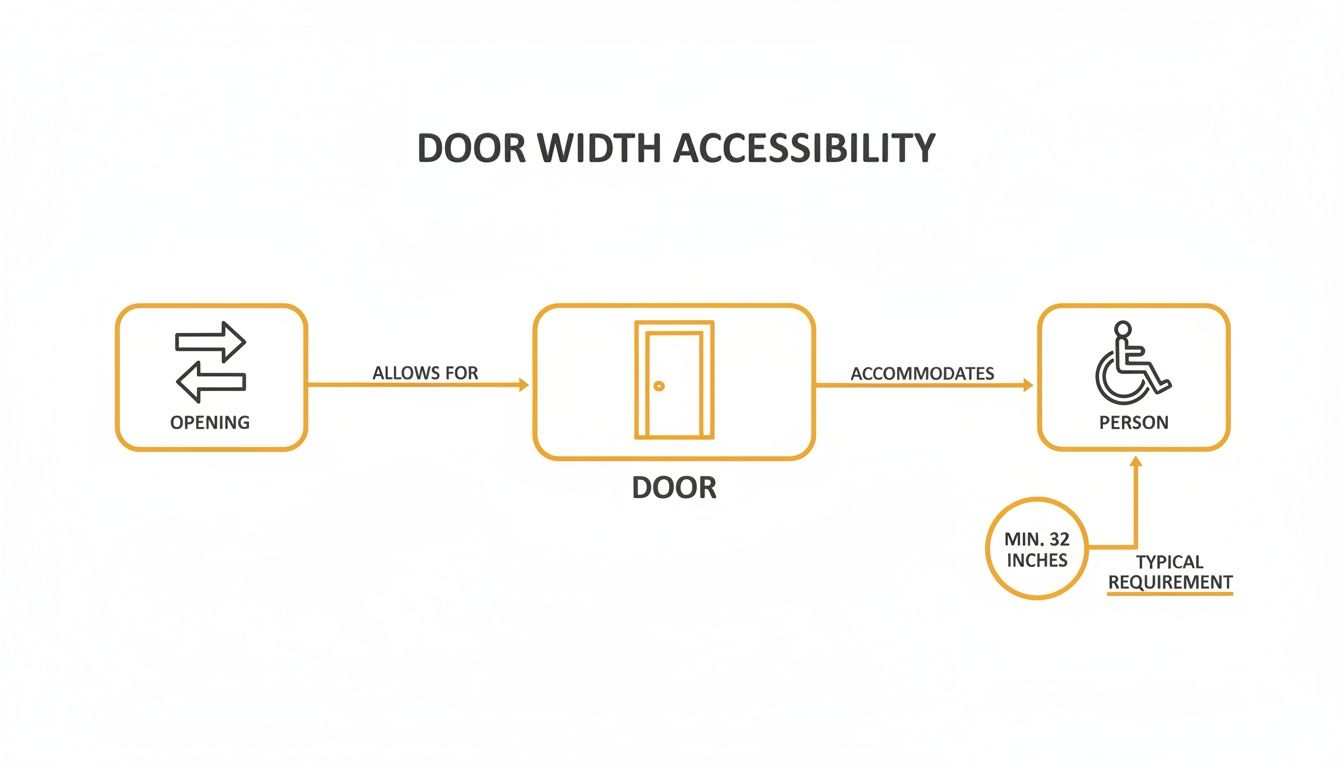
Alt text: Diagram showing how a minimum 32-inch door width provides clear accessibility for a person using a wheelchair.
This visual gets right to the point. It’s not about the size of the door panel itself, but the actual space available for passage. Let’s see how this principle applies across different commercial environments.
Warehouses and Distribution Centres
In any logistics operation, time is money and collisions are costly. Your loading dock and interior passage doors have a massive influence on both. A door that's too narrow forces a forklift operator to slow down and realign, losing seconds that add up to serious productivity losses.
- Loading Dock Doors: While 8 to 10 feet is a common width, facilities handling oversized pallets are moving to 12-foot wide doors to improve throughput and reduce damage.
- High-Traffic Interior Corridors: For any main artery with two-way forklift traffic, a clear width of 12 feet is the benchmark to prevent bottlenecks.
- Safety Buffer: A simple but crucial rule of thumb: measure your widest piece of equipment and add a minimum of 2 feet to determine your required door width.
Swapping out a standard door for a wider high-speed fabric door not only improves flow but also enhances environmental control, delivering a return on investment you can see in your operations and on your energy bills.
Cold Storage and Food Processing
In a temperature-controlled facility, every doorway is a weak point for energy loss. The solution isn’t to make openings smaller; it’s to install a smarter, faster door system.
In a cold storage facility, the goal is to balance maximum access with minimal thermal exchange. A wide, fast-acting insulated door is the perfect solution, allowing for quick forklift passage while minimizing the time the doorway remains open.
For these applications, you have to look at the entire system:
- Door Speed: High-speed roll-up doors that open and close in seconds are non-negotiable.
- Insulation: The door must have a high R-value (a measure of its ability to resist heat flow) to stop energy transfer.
- Seals: A complete perimeter seal is essential to prevent air infiltration when the door is closed.
An undersized or slow-moving door in a freezer environment can easily lead to thousands of dollars in wasted energy and put food safety at risk.
Pharmaceutical Clean Rooms and Health Care
In pharma manufacturing and health-care settings, the focus shifts from moving forklifts to controlling contamination and ensuring total accessibility. Here, the width of doorways is dictated by strict regulations.
- Clean Rooms: Doors must be wide enough for large lab carts to pass through without disturbing the room's critical air pressure. Smooth, non-porous surfaces and hands-free operators are standard.
- Hospitals: Hallways and patient room doors must accommodate hospital beds and bulky medical equipment. This often demands clear openings of 44 inches (1118 mm) or even wider.
Recommended Doorway Widths by Commercial Application
To bring it all together, here’s a look at optimal doorway widths for different environments:
| Application Area | Recommended Clear Width | Key Consideration | Wilcox Door Solution |
|---|---|---|---|
| Warehouse Loading Dock | 10 ft – 12 ft | Throughput for forklifts and wide pallets | Sectional Overhead Doors, High-Speed Doors |
| Warehouse Interior | 8 ft – 12 ft | Accommodating two-way forklift traffic | High-Speed Fabric Doors, Rubber Doors |
| Cold Storage / Freezer | 8 ft – 10 ft | Balancing access with minimizing energy loss | Insulated High-Speed Doors |
| Clean Room | 4 ft – 6 ft | Movement of carts, equipment, and personnel | High-Performance Doors, specialty pharma doors |
| Health-Care Facility | 44 in+ (1118 mm+) | Passage of hospital beds, gurneys, and equipment | Fire-Rated Doors, Automatic Swing/Sliding Doors |
This table serves as a solid starting point, but every facility is unique. If you need help tailoring a door solution to your unique operational needs, contact the experts at Wilcox Door Service today.
A Practical Plan for Your Facility's Doorways
You’ve got the theory down. Now it’s time to move from the blueprints to the facility floor. A proactive approach starts with a thorough audit of what you already have. You’d be surprised what you can find—hidden compliance gaps and clear opportunities for upgrades are often hiding in plain sight.
Your Facility Audit Checklist
Before you specify a single new door, walk your facility with a critical eye. This simple audit can reveal vulnerabilities you never knew you had.
- Measure Clear Widths: Don't trust old blueprints. Grab a tape measure and physically check the clear opening of all critical doorways—from main entrances to loading docks—with the door open at a 90-degree angle.
- Assess High-Traffic Zones: Watch how forklifts and people move through key areas. Are there bottlenecks? Scuff marks and damage on door frames are tell-tale signs that an opening is too narrow for your actual operations.
- Check Accessibility Compliance: Verify that all accessible routes meet the National Building Code and any stricter provincial laws, like the AODA. Look at the details: door hardware, threshold heights, and the clear floor space in front of the door.
- Review Door Condition: Look for the little things that signal bigger problems. Are the seals damaged? Do operators move slowly? An inefficient door is a constant drain on your energy budget and a potential safety risk.
Future-Proofing New Construction and Retrofits
When it comes to new doorways, thinking ahead is your most valuable tool. Building codes are always evolving. Specifying a door that only meets today’s minimum requirements is a recipe for an expensive retrofit down the line.
A forward-thinking facility manager doesn't just meet the current code; they anticipate the next one. Choosing a slightly wider door today—for instance, opting for a 12-foot wide door at a loading dock instead of a 10-foot one—can future-proof your operation against larger vehicles and evolving logistics standards, representing a minor upfront cost for a major long-term gain.
This is where a trusted partner becomes invaluable. A professional facility assessment from Wilcox Door Service can identify those hidden gaps and opportunities you might miss. Our experts provide a detailed roadmap, helping you prioritize upgrades that enhance safety, improve efficiency, and ensure long-term compliance.
Your doorways are critical operational assets. Contact Wilcox Door Service today to schedule your expert consultation and start building a more resilient facility.
Frequently Asked Questions About Doorway Widths
Doorway widths seem straightforward, but they can be a real headache for facility managers. The codes are complex, the terms are confusing, and a small mistake in measurement can lead to big compliance problems. Here are some clear, no-nonsense answers to help you navigate the essentials.
What Is the Minimum Legal Doorway Width for a Commercial Building?
This is a common question, but there isn't a single answer. While the National Building Code (NBC) often points to a clear width of 850 mm for many commercial doors, that's just the starting point. Accessible routes frequently require a wider 915 mm opening, and provincial regulations like Ontario's AODA can be even more specific. A professional assessment is always the best way to ensure your facility is fully compliant.
How Do I Measure the Clear Width of a Doorway Correctly?
This is where many people get tripped up. The clear width is the actual, usable space you can move through when the door is open to a 90-degree angle. To get this measurement, open the door and measure the distance from the face of the door itself to the doorstop on the latch side of the frame. You're measuring the narrowest point of the opening. It's a critical mistake to just measure the door slab—the door’s own thickness and hardware shrink the usable space.
The clear width is the only measurement that matters for code compliance. A nominal 36-inch door does not provide a 36-inch clear opening. This small detail is where many compliance issues begin.
Are Wider Doorways Better for Energy Efficiency?
Not on their own, no. A wider opening creates a bigger hole in your wall, increasing the potential for energy loss. True energy efficiency comes from the entire door system working together. What really makes a difference is a high-quality insulated door, like a sectional overhead door with a high R-value, paired with tight weather seals. For a loading dock, a practical example is combining a wide door with robust dock seals to get both easy access and serious energy savings.
Can I Replace an Old Door with a New One of the Same Size?
A simple "like-for-like" swap can land you in trouble. Building and accessibility codes are updated regularly. A door that was compliant when your building was constructed might not meet today's standards. Any replacement project is considered new work and must follow all current NBC and provincial codes for clear width, hardware, and fire rating requirements. A consultation is essential before you begin.
At Wilcox Door Service, our “Respected Partners, Reliable Service” promise means we provide solutions that are not just compliant but built to perform for the long haul. If you have questions about your facility’s doorways, contact us today.