


Draft complaints usually don't start in the mechanical room. They start at the perimeter. A tenant calls about a cold seating area near the patio. Staff wedge a mat against the threshold. The HVAC runs longer, but the room still feels uneven. Then the maintenance team discovers the actual issue: the door slides poorly, the frame has shifted, and air is getting in around an opening that never sealed properly.
That's why energy efficient patio doors deserve a closer look in commercial and multi-unit facilities. This isn't just a glass upgrade. It's a building envelope decision that affects comfort, operating cost, maintenance workload, and long-term asset performance.
For facility teams, the question isn't just which patio door has the best label. The better question is which door system will perform in your actual opening, under daily use, through Canadian weather, with serviceable hardware and reliable sealing. If you're also evaluating adjacent glazing strategies, this guide to North Atlanta window tinting is a useful comparison point for understanding where film upgrades fit versus full door replacement.
Why Energy Efficient Patio Doors Matter for Your Facility
A facility team usually notices a failing patio door the same way. Comfort complaints show up first. Then maintenance gets pulled into sticking panels, worn rollers, wet thresholds, and repeat callouts that never seem large enough on their own to justify a capital project.
That pattern gets expensive.
A patio door sits at a hard-working part of the envelope, where conditioned air, weather exposure, foot traffic, and building movement all meet. In a common room, clubhouse, amenity area, or staff space, that opening has to do more than look good on a spec sheet. It has to hold alignment, seal consistently, drain properly, and keep operating after years of daily use.
Energy performance matters because the door affects more than utility bills. It influences occupant comfort, HVAC run time, service frequency, water management risk, and the lifespan of surrounding finishes. If the opening leaks air or water, the cost shows up across several budgets, not one line item.
Real savings depend on the full opening
Product ratings still matter, but rated glass alone does not deliver real-world results. I have seen well-specified doors underperform because the frame was installed out of square, the sill pan was missing, the drainage path was blocked, or the perimeter seal failed within the first season. On paper, the door looked efficient. In the field, it became a draft source.
That is why facility teams should evaluate the entire opening, not just the brochure highlights. The frame, threshold, anchors, flashing, sealant, weatherstripping, rollers, and adjacent wall condition all affect whether the door reduces heat loss and air leakage.
A practical review usually covers:
- Opening condition: Check for frame movement, water staining, substrate damage, failed sealant, and threshold wear before selecting a new door.
- Traffic and use: Match the system to how the space operates. A lightly used residential-style opening will not hold up the same way in a busy amenity area.
- Serviceability: Confirm hardware availability, adjustment access, and maintenance requirements before purchase, not after turnover.
- Weatherproofing details: Verify sill support, flashing, shimming, drainage, and air sealing. These details often determine whether projected energy savings show up in operation.
Practical rule: If the existing opening has a history of air or water infiltration, replacing the glass or panel alone rarely fixes the root cause.
Teams that treat patio doors as part of the building envelope usually make better long-term decisions. They avoid paying for high-performance glass in an opening that cannot support it, and they avoid short-term savings that lead to repeat service calls, premature hardware failure, and persistent comfort issues. For teams comparing door replacement with other envelope measures, this guide to North Atlanta window tinting is a useful reference point for where film upgrades fit and where a door system upgrade is the better investment.
Understanding Key Energy Performance Ratings
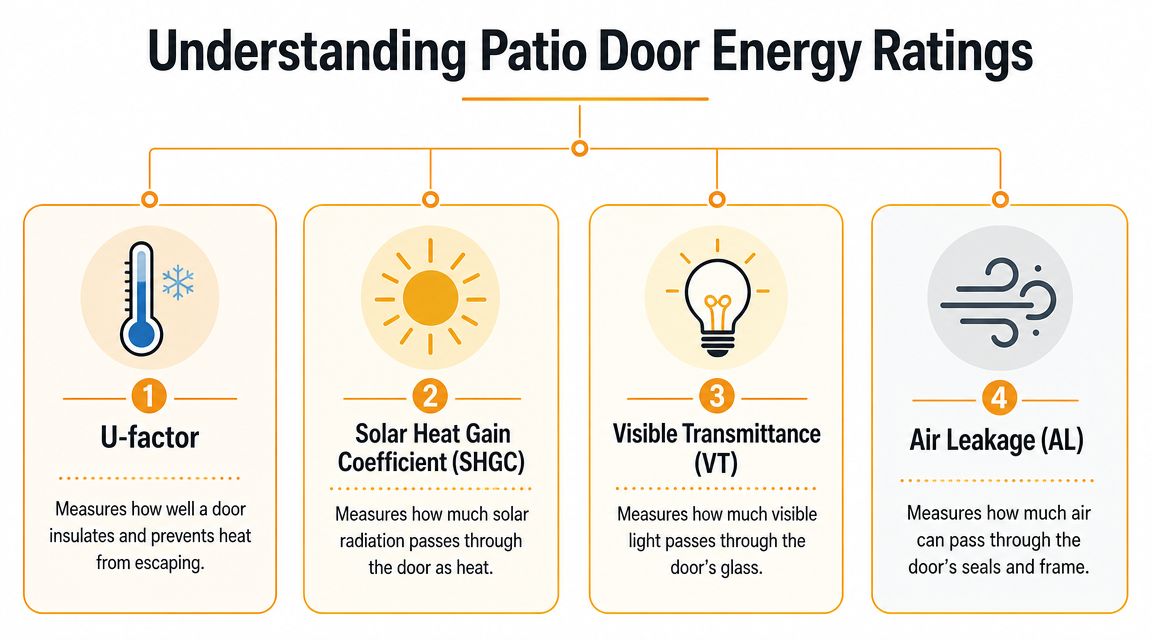
Published ratings help screen products, but they only help if you read them in the context of the whole opening. I see teams get pulled toward headline glass numbers and miss the ratings that better predict winter complaints, perimeter drafts, and disappointing utility results.
U-factor in plain language
U-factor measures how quickly heat passes through the door assembly. Lower values indicate less heat loss. In Canadian projects, this is often the first rating to review because heating demand usually drives the payback case more than cooling.
Use it carefully, though. U-factor is useful for comparing tested products. It does not account for a poorly supported sill, gaps at the perimeter, or field conditions that let cold air bypass the assembly. That distinction matters in occupied facilities, where real savings depend on installation quality as much as the label.
SHGC and R-value without the jargon
Solar Heat Gain Coefficient (SHGC) measures how much solar heat enters through the glazing. Lower SHGC can help on west-facing elevations or spaces with summer overheating issues. Higher SHGC may be reasonable where winter solar gain helps offset heating load and glare is controlled.
R-value expresses resistance to heat flow. Higher is better, but many commercial teams compare doors more easily by U-factor because that metric is more commonly listed for full assemblies.
A practical review looks like this:
- Start with U-factor: It usually gives the clearest read on cold-weather performance.
- Check SHGC by orientation: South and west exposures deserve closer review than shaded openings.
- Treat R-value as supporting information: It helps with context, but it should not drive the decision on its own.
- Ask for air leakage data if available: A good glass package will not fix a door that allows too much uncontrolled air movement.
For teams comparing options across opening types, this guide to glass commercial doors covering style, security, and performance is a useful reference point.
Don't read the glass rating in isolation
A patio door performs as a system. Glass, spacer, frame, interlock, weatherstripping, threshold design, and hardware all affect whether the tested rating holds up after turnover.
That is why I treat spec sheets as a starting point, not the decision. If the door is going into a high-use amenity area, multi-unit common space, or exposed elevation, ask harder questions:
- Will the active panel stay square and maintain gasket contact over time?
- Can worn rollers, locks, and seals be serviced without major disassembly?
- Does the threshold design support drainage and air control in your exposure conditions?
- Is the tested unit comparable to the size and configuration being quoted?
Those questions separate a product that performs in the lab from one that performs on site. Broader consumer comparisons, such as lists of the best bifold doors for kitchen extensions, can be useful for understanding door formats, but facility decisions should stay focused on assembly performance, service life, and how well the opening can be sealed in the field.
A Closer Look at Frames and Glazing Technology
Once you understand the ratings, the next step is tying them to real parts. At this point, many projects drift off course. Teams compare labels, but the door they choose doesn't match the opening size, traffic pattern, or service environment.
Frame material is a good example. No frame is best in every facility. The right choice depends on thermal performance, abuse resistance, maintenance expectations, and how large the opening is.
Frame choices for commercial settings
| Material | Insulation Performance | Durability & Strength | Maintenance | Best For |
|---|---|---|---|---|
| Aluminum with thermal break | Moderate to strong when properly designed | Strong and stable for larger assemblies | Low routine upkeep | High-traffic openings and larger spans |
| Fibreglass | Strong thermal performance | Very durable and dimensionally stable | Low to moderate | Facilities prioritising insulation and long-term stability |
| Vinyl | Good thermal performance | Less ideal for heavy commercial abuse or very large openings | Low | Lower-traffic applications and cost-conscious projects |
| Wood composite | Generally good insulation | Depends on product build and exposure conditions | Moderate | Projects balancing appearance with performance |
In many commercial applications, aluminum with a thermal break remains a practical choice because it handles larger door assemblies well. The trade-off is that not all aluminum systems perform equally. The thermal break, frame profile, and perimeter sealing details make a major difference.
Fibreglass often appeals to teams that want strong insulation and better dimensional stability. It can be a smart fit where temperature swings are hard on lesser frames.
Vinyl works in the right setting, but it's rarely the universal answer for a busy shared facility. If the opening sees carts, repeated impact, or heavy year-round use, durability and hardware support should be reviewed carefully.
For readers comparing wide-opening concepts in residential-style projects, this review of the best bifold doors for kitchen extensions is useful background on how opening style affects design choices, even though commercial priorities are usually tougher on hardware and maintenance.
Glazing layers that change performance
Glazing should be viewed as a stack of decisions, not a single feature.
Start with double glazing. Two panes create an insulating space that performs better than a basic single pane arrangement. Move to triple glazing, and you add another barrier to heat flow, but usually at the cost of more weight, different hardware demands, and a higher upfront price.
Then there's Low-E coating. In simple terms, it's a microscopically thin coating that helps manage heat transfer through the glass. It can improve comfort near the opening and support the overall thermal target without changing how the door operates.
Gas fills such as argon or krypton are often part of the insulating package as well. They're not magic. They're one piece of the system.
Where teams often overfocus
The most common misstep is buying the highest glazing package available and assuming the project is solved. In reality:
- A stronger glass package can add weight: That affects rollers, track wear, and operating force.
- The frame still matters: A premium glass unit in a weak or poorly insulated frame won't deliver the full benefit.
- Exposure matters: A heavily shaded elevation may not need the same solar-control strategy as a bright west-facing common area.
- Serviceability matters: If a component fails, replacement complexity affects downtime and future cost.
A detailed guide to glass commercial doors, style, security, and performance is helpful when you need to compare appearance goals with security, durability, and maintenance considerations.
The best patio door package is the one that stays aligned, seals consistently, and fits the way people actually use the space.
Why Professional Installation Determines Performance
A facility can buy a high-performing patio door, approve the premium glazing package, and still end up with drafts at the latch side, water at the sill, and occupant complaints by the first heating season. In practice, the opening decides whether the product delivers what the spec sheet promised.
At Wilcox, we see this regularly on retrofit and replacement work. Door performance depends on installation quality as much as the glass package. A top-tier unit will underperform if the rough opening is out of square, the sill is not level, the perimeter insulation is inconsistent, or the weather seal is interrupted. A properly installed mid-tier assembly often gives better real-world results than a premium door set into a compromised opening.
What goes wrong in the field
Installation failures usually show up as operating issues first, then energy loss, then envelope damage.
- An out-of-level sill changes how the panel rides and how evenly it compresses against gaskets.
- Poor perimeter air sealing lets outside air bypass the insulated glass unit entirely.
- Gaps in insulation around the frame create cold edges, condensation risk, and comfort complaints near the opening.
- Weak flashing or drainage details let water reach materials that were never meant to stay wet.
- Improper shimming or anchoring can rack the frame enough to affect locking, sliding force, and hardware life.
That is why many "door problems" are opening and weatherproofing problems.
What professional installation actually includes
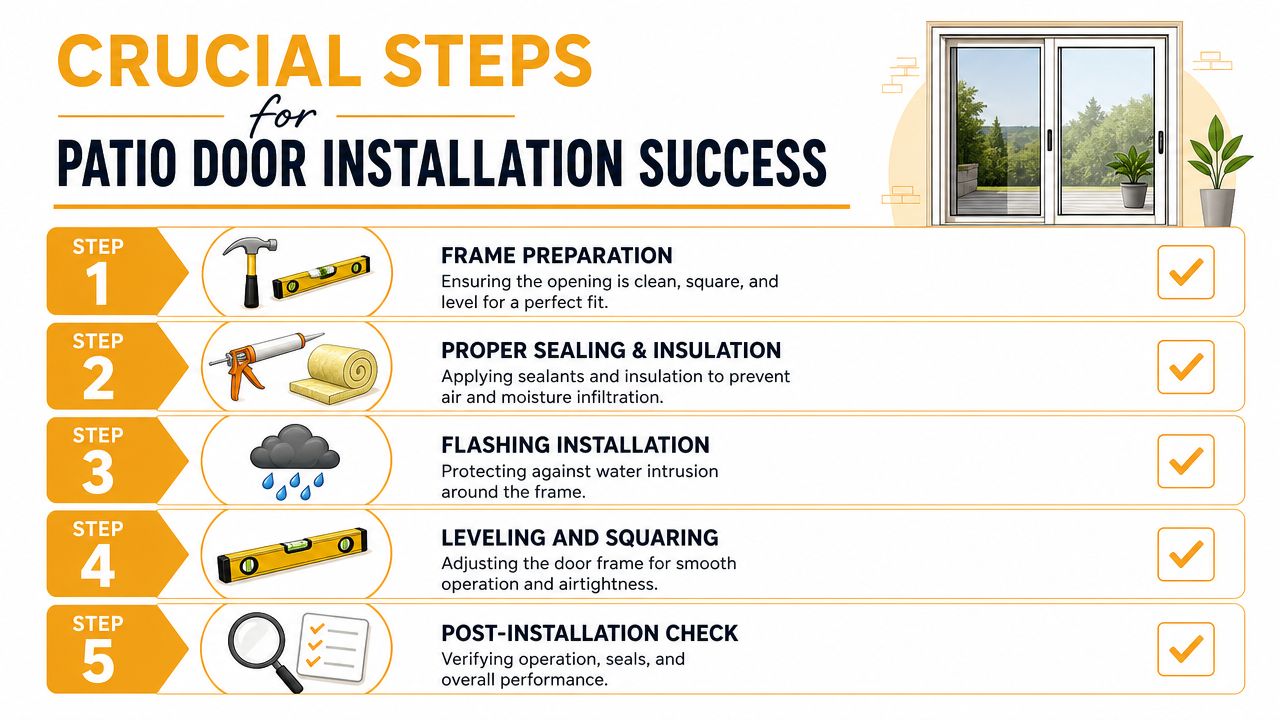
Good installation starts before the frame is set. The opening needs to be checked for square, plumb, level, substrate condition, and moisture damage. If those basics are off, crews end up forcing the unit into place, and the door pays for it for the rest of its service life.
The work itself needs a full air and water management approach, not just foam and sealant applied where they are visible. That means correct shimming, anchoring that does not distort the frame, perimeter insulation installed without voids, flashing tied into the surrounding assembly, and drainage paths kept clear. After that, the installer still needs to confirm panel alignment, latch engagement, roller adjustment, and uniform contact at the seals.
For high-use openings, maintenance matters almost as much as the initial install. Worn seals, damaged sweeps, and neglected perimeter components can erase a lot of the efficiency the project was meant to gain. The same principles covered in this guide to automatic door weather stripping and air-leakage control apply here.
Field check: If the meeting rails do not line up, the panel drags, or daylight shows where the door should seal, inspect alignment, sill condition, and perimeter sealing before blaming the glass.
The payoff is straightforward. Better comfort near the opening. Fewer service calls. Less risk of hidden moisture damage. Better return on the money already spent on the door package.
Navigating Canadian Building Codes and ENERGY STAR
A patio door can clear code, carry the right label, and still disappoint in service. I see that gap most often when teams buy from the spec sheet and treat compliance as proof of field performance. For facilities in Canadian climates, code and ENERGY STAR are useful filters. They are not a guarantee of low air leakage, good occupant comfort, or stable maintenance costs after the first winter.
For sliding glass doors sold in Canada, the federal ENERGY STAR program gives procurement teams a common reference point for comparing assemblies. As noted earlier, the top tier sets a demanding threshold for thermal performance and Canadian certification status. That helps narrow the list, but the better question is whether the tested configuration matches the door you are buying, installing, and exposing to wind, traffic, and seasonal movement.
What that means for buyers
Procurement reviews should stay very specific. Ask for the exact Canadian-certified configuration, including frame, glazing package, spacer, and operating style. Confirm that the published rating applies to the full assembly. Not just the centre of glass. Then check whether the product was selected for the opening you have, not the opening shown in a catalogue detail.
A short list of questions usually exposes weak submissions fast:
- Is the exact sliding door configuration certified for the Canadian market?
- Do the submitted values apply to the full assembly?
- Does the sill, frame, and hardware package suit the site exposure and expected traffic?
- Can the supplier provide submittals that support permit review, site coordination, and closeout documentation?
- Who is responsible for perimeter conditions that affect actual thermal and air-sealing performance once the unit is installed?
That last point matters more than many guides admit. The label covers the product. Your energy bill reflects the installed opening.
Compliance has to be matched with site conditions
Facility teams get better results when they treat code compliance as one input in a larger risk review. A door at a sheltered amenity space has different demands than one facing wind, drifting snow, and frequent use. In those tougher conditions, the weak point is often not the insulated glass unit. It is the interface between the frame and the surrounding wall, the threshold detailing, or the service life of seals and hardware under daily use.
That is why code review should sit beside operations review. If the opening serves a high-use area, supports accessibility requirements, or connects conditioned space to a severe exterior exposure, the selection and installation details deserve the same scrutiny as the published ratings. Teams planning multiple upgrades often fold this work into a broader facility energy cost reduction strategy so the door package, envelope detailing, and maintenance plan support the same payback target.
A compliant product is a starting point. Real savings show up when the certified assembly, the opening condition, and the installation standard all line up.
Retrofit vs Replacement and Calculating ROI
Not every underperforming patio door needs full replacement. Some openings respond well to targeted upgrades. Others are already past the point where another repair is money spent in the wrong place.

When retrofit makes sense
Retrofit is usually worth considering when the door structure is sound and the main issues are related to wear or air leakage.
A sensible retrofit candidate often has:
- Usable frame geometry: The opening is stable and the frame hasn't twisted or deteriorated.
- Serviceable hardware: Rollers, locks, and guides can still be adjusted or replaced.
- Localized sealing problems: Weatherstripping, sealant, or threshold details are the clear weak points.
- No ongoing water intrusion: Once moisture is affecting the surrounding assembly, replacement often becomes more defensible.
Retrofit measures can include weatherstripping updates, hardware service, glass replacement in some systems, and targeted envelope improvements. Such efforts underscore the utility of a broader energy cost reduction strategy for facilities, as the patio door should be evaluated as one part of the building's total air leakage and heat-loss picture.
When replacement is the smarter move
Replacement becomes easier to justify when the opening has multiple failures at once. If the frame is worn, the door no longer tracks well, sealing has failed repeatedly, and comfort complaints keep coming back, patching one component usually won't fix the whole problem.
Use a practical ROI lens instead of a narrow purchase-price lens. Ask:
- What are we spending now on repeat service and adjustment?
- How often do occupants complain about drafts, condensation, or poor operation?
- Is the opening affecting adjacent finishes or creating moisture risk?
- Will a new assembly reduce maintenance burden as well as improve thermal performance?
A simple ROI discussion doesn't need invented payback numbers to be useful. Compare the full replacement cost against the current pattern of maintenance calls, occupant disruption, comfort issues, and likely future repairs. If the existing door consumes staff time every season and still leaves the space uncomfortable, replacement often wins on total cost of ownership even before energy savings are fully modelled.
A short visual overview can help teams frame that decision:
Good ROI isn't just lower energy use. It's fewer nuisance calls, less emergency work, and a door that operators don't have to fight with.
Your Next Step Toward a More Efficient Facility
The strongest patio door projects usually share one trait. They don't treat the product label as the whole answer. They evaluate the opening, choose materials that suit the use case, and install the system with the same care given to any other critical envelope component.
That's the takeaway with energy efficient patio doors. Ratings matter. Frame design matters. Glazing matters. But the opening has to be prepared correctly, sealed correctly, and maintained like an asset that affects comfort and operating cost every day.
For facility managers building a budget case, keep the discussion grounded in field reality. A door that slides poorly, leaks air, or lets water into the wall isn't just inefficient. It creates recurring maintenance work and undermines confidence in the whole upgrade.
If you're comparing budgets across regions or project types, even consumer-facing resources such as this breakdown of Tampa Bay sliding glass door costs can be useful for understanding how pricing shifts with size, configuration, and scope. The commercial decision still comes down to lifecycle performance, serviceability, and installation discipline.
The next smart move is a site-based assessment. Review the opening condition, confirm the performance target, and decide whether retrofit or replacement will hold up in real operation.
If you're planning a patio door upgrade, Wilcox Door Service Inc. can help you assess the opening, identify practical efficiency gains, and build a solution around long-term performance. Contact Wilcox for a site review, quote, or service inspection and work with a team known for Respected Partners, Reliable Service.