


A new overhead door has arrived, the pallet is on the floor, and someone has already found the garage door installation instructions PDF. That's usually the moment a facility manager has to make a fast judgement call. Is this a straightforward install for the in-house team, or a job that needs certified door technicians, lift equipment, lockout procedures, and a proper commissioning plan?
For commercial and industrial openings, the PDF isn't a casual how-to sheet. It's the working document that tells the crew what clearances the system needs, how the hardware must be assembled, how the spring system is to be handled, and what must be checked before the opening goes into service. If the opening is at a shipping door, a service bay, or a high-cycle warehouse access point, mistakes don't stay small for long. They show up as binding, noisy travel, opener strain, downtime, and safety exposure.
The practical question isn't whether someone can hang panels and bolt up tracks. The question is whether the door can be installed exactly as specified, safely tensioned, tested, and handed over as a reliable asset.
Your Guide to Commercial Overhead Door Installation
The pallet is on the dock, the opening is scheduled for service by end of week, and the manufacturer's garage door installation instructions PDF is already circulating between maintenance, operations, and procurement. In a commercial setting, that PDF is not a casual assembly guide. It is the document that ties the installed door to the specified hardware, required clearances, rated performance, and safe commissioning procedure.
That distinction matters.
Most search results for this topic are built around residential DIY projects. Commercial and industrial overhead doors are a different class of work. The doors are heavier, the track arrangements are more varied, the spring systems carry more stored energy, and the opening often has to serve forklifts, delivery traffic, security requirements, and fire separation rules without interruption. A bad install does not stay a small problem. It shows up as track wear, cable issues, operator strain, unreliable sealing, unplanned downtime, and safety exposure for the people using the opening every day.
Facility managers do not need generic advice. They need to know what the manual governs, what must match the approved door package, and where installation risk shifts from routine hardware work to specialized overhead door work. In the field, the manufacturer PDF answers questions that affect liability as much as function. Are the jambs and header suitable for the load path? Is the correct lift type being installed for the building conditions? Are the spring assemblies, shaft components, and cable drums being matched exactly to the door size and weight?
For Canadian commercial work, the manual also sits inside a larger compliance picture. Historical standards such as CAN/CSA A440 helped establish the expectation that assemblies used in Canadian conditions must be matched to tested performance criteria, especially where structural loading and weather resistance are part of the specification. On an overhead door project, that means the instructions tied to the exact door system matter more than any generic installation article found in search results.
Retrofit projects raise the stakes. Older service buildings and mixed-use facilities often hide the problems until teardown starts. Headroom is tighter than the drawings suggest. The slab is out of level. Steel support is missing where the operator needs to mount. Existing framing has been modified by other trades. In those jobs, the PDF becomes a control document for what can be installed safely and what has to be corrected before the first section goes up.
After twenty years in this trade, I can say the failure point is rarely the panel itself. It is the assumption that a commercial overhead door can be treated like a basic handyman install.
Good results come from exact layout, correct hardware identification, safe spring handling, proper anchorage, and a documented handover. That is how the opening leaves installation and enters service as a reliable building asset.
Pre-Installation Checklist and Site Preparation
At 6:00 a.m., the dock door is scheduled to come out, trucks are booked, and the facility expects the new overhead door to be in service by afternoon. Then the crew finds a twisted jamb angle, sprinkler pipe in the backroom, and a floor that has settled enough to leave a gap under the future bottom seal. The installation PDF matters before any hardware is staged because it sets the site conditions the system was designed for. On a commercial job, that document is a compliance record tied to load path, clearances, anchorage, and safe operation.
Verify the opening against the specific door package
Start with the approved submittal, the manufacturer's instructions, and the actual opening in front of you. Measure all three. Old shop drawings and prior door sizes are a poor substitute for field verification, especially on retrofit work where steel, masonry, and concrete have moved over time.
Headroom, sideroom, and backroom need to match the door type, track configuration, spring arrangement, and operator layout being installed. A sectional dock door with high-lift hardware has different spatial demands than a standard-lift service door. The same opening can accept one system and reject another. That decision should be made before material arrives.
The field check should cover:
- Opening width and height: Measure the structural opening, not the existing trim, seal line, or worn frame edge.
- Headroom: Confirm space for track radius, spring line, shaft, bearing plates, operator brackets, and future service access.
- Sideroom: Check both jambs for flag angles, track brackets, cable drums, and safe clearance for technicians working on the assembly later.
- Backroom: Verify full horizontal travel without conflicts from joists, gas lines, conduit, lighting, ductwork, or storage racks.
- Floor condition: Check level across the opening and inspect for settlement, spalling, broken concrete, or a sill that will prevent proper seal contact.
- Mounting surfaces: Confirm the wall, steel, or concrete can carry the imposed loads and accept the specified anchors.
One missed measurement can stop the whole job.
Treat the opening like an active industrial work zone
Commercial door installations happen in shipping lanes, service bays, food plants, warehouses, and mixed-use buildings. People are moving. Equipment is moving. Production often continues a few feet away. Site preparation has to control that risk before teardown starts.
Barricade the area. Establish lift access and material staging. Confirm lighting. Remove stored product, pallets, and loose obstructions from the swing and travel path. If the existing door is being removed, plan for debris handling, weather exposure, and building security during the changeout window.
Energy isolation also needs to be settled early. Existing operators, interlocks, photo eyes, and powered accessories should be locked out before disconnection or demolition. Facility teams should review 2026 LOTO compliance requirements before the work date so responsibilities are clear between operations, electrical, and the installing contractor.
If a motor operator is part of the scope, confirm power supply, disconnect location, control station placement, and line of sight at the opening before mounting begins. Facilities planning a new operator or replacing an old one can use this guide to commercial garage door opener installation requirements to coordinate electrical and structural prep ahead of the install date.
Tools, access equipment, and hardware need to match the job
A commercial opening should not be set with improvised access gear or mixed fasteners from a service truck bin. The crew needs lifting equipment rated for the work, proper winding bars for the spring system, and anchors approved for the actual substrate. Hollow block, structural steel, and reinforced concrete each call for different fastening methods and load considerations.
| Category | Item | Notes |
|---|---|---|
| Lifting and access | Scissor lift or material lift | Used to raise tracks, shaft assemblies, and operators safely |
| Hand tools | Socket set, spanners, screwdrivers, locking pliers | For hardware assembly, adjustment, and alignment |
| Power tools | Impact wrench, drill, hammer drill | For brackets, anchors, and structural fastening |
| Measuring and layout | Tape measure, chalk line, framing square, level | Used to establish opening geometry and track position |
| Spring work | Proper winding bars | Required for controlled torsion spring adjustment |
| Fastening and anchors | Manufacturer-specified bolts, nuts, lag screws, concrete anchors | Must match the substrate and approved door system |
| Safety equipment | PPE, barricades, lockout tags | Used to isolate the work area and control hazards |
| Sealing and finishing | Weatherseal, bottom seal, lubricant | Installed during final fit-up and inspection |
Site readiness should be documented, not assumed
A short pre-install checklist saves hours of rework and protects everyone involved. The facility representative, general contractor, and installer should all know who is providing steel, power, backing, lifts, permits, and access. If one of those items is unclear, the schedule is not ready.
I have seen more delays caused by unprepared openings than by damaged door sections. The pattern is consistent. Missing support steel, blocked access, and unconfirmed power turn a planned installation into field correction work, and field correction work carries more risk, more cost, and more downtime.
Good preparation gives the crew a stable opening, clear authority, and a documented starting point. That is how a commercial overhead door installation begins safely and stays inside warranty, code, and schedule.
Deconstructing the Core Installation Process
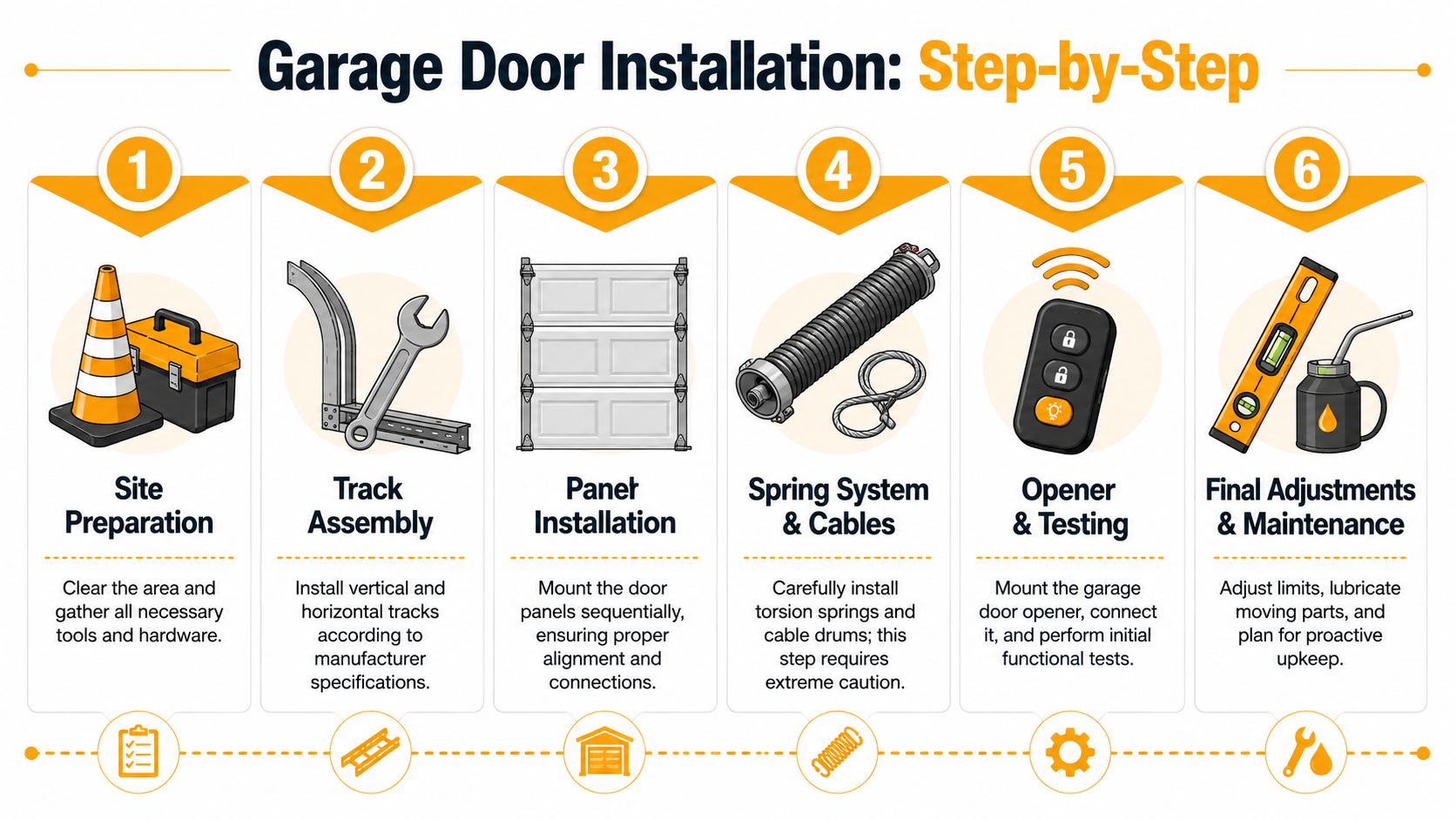
Commercial door installation follows a logical sequence, but the sequence only works if each phase is left square, plumb, and ready for the next one. That's why experienced crews move deliberately. Fast isn't the same as efficient when the opening has to cycle every day under load.
Tracks set the character of the whole system
If the vertical tracks are out of plumb or the horizontals aren't square, the problem won't always show up right away. Sometimes the crew can still get the door to move. The trouble appears later as roller wear, cable tracking issues, noisy travel, or an operator that works harder than it should.
Manufacturer instructions make that point with measurable tolerances. Amarr's residential aluminium instructions call for checking plumb with a level, pre-drilling jamb holes with a 3/16-inch bit, maintaining a 1/2-inch to 3/8-inch clearance between the door and the track through the assemblies, and confirming the door is square with the opening before final use, as outlined in Amarr's installation instructions PDF.
Those numbers matter because a commercial door doesn't forgive sloppy geometry. In Canadian conditions, freeze-thaw cycling, snow exposure, and temperature swings can tighten an already marginal install. A door that was merely “a little off” on day one often becomes a service call later.
Panels and hardware go in as a controlled assembly
Once the tracks are established, the panels, hinges, rollers, brackets, and reinforcing hardware are installed in sequence. This part looks straightforward from the ground. It isn't. Section placement affects roller line, hinge action, cable alignment, and the load path through the whole assembly.
On a busy distribution-centre opening, one small track deviation can create operational headaches. A common example is a door that seems fine during a quick hand test but starts hesitating under repeated cycles. In the field, that often traces back to geometry. The door isn't failing because the opener is weak. The opener is exposing a mechanical problem upstream.
What works is checking alignment constantly as the door is built. What doesn't work is hanging all the sections first and assuming adjustment can fix everything at the end.
Operators belong after the mechanical system proves itself
The opener is not there to compensate for poor installation. It's there to automate a door that already moves correctly by hand. On many jobs, the most expensive mistake is connecting the operator too early and using powered travel as the first real test.
Before motor work begins, teams should follow site isolation procedures. If your facility is reviewing door installations alongside broader electrical and mechanical shutdown practices, this overview of 2026 LOTO compliance requirements is a useful refresher on controlled energy isolation around active equipment.
When the mechanical side is ready, operator mounting, arm connection, limit setup, and safety device integration can proceed. If you're reviewing the automation side of a project, commercial garage door opener installation is its own scope and should be treated that way.
A smooth manual door becomes a reliable powered door. A bad manual door becomes an expensive powered problem.
The Critical Role of Torsion Spring and Cable Systems
A lot of people treat spring work like one more line item in the manual. It isn't. This is the line where a commercial install stops being a general mechanical assembly job and becomes a high-risk task.
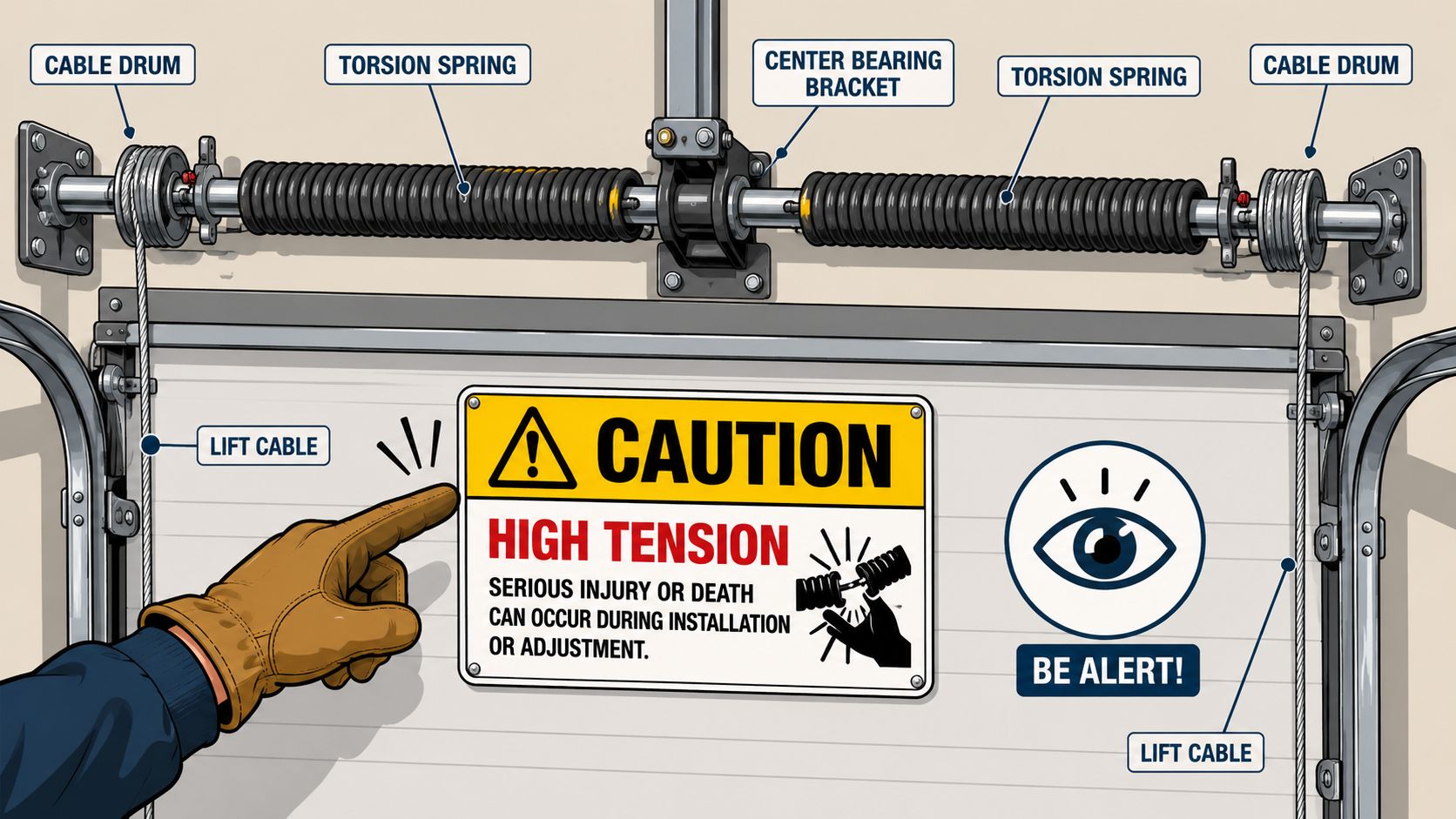
Torsion springs lift the door by storing and releasing mechanical energy through the shaft and cable drums. That stored energy is what makes a heavy overhead door feel manageable during operation. It's also what makes improper handling dangerous.
Why this phase is different
The tracks can be corrected. Brackets can be re-drilled. Panels can be reset. Spring tensioning is different because an error here can turn a tool, a shaft component, or the door itself into the thing that fails violently.
Professional guidance across installation sources keeps returning to the same benchmark. After panels, tracks, and cables are installed, the door should be tested manually for balance before opener engagement. A properly balanced door should hold at mid-height without drifting, as explained in this overview of garage door spring and installation practice.
Spring tension is never guessed. It is set to the manufacturer's method and then verified by door behaviour.
Miscounted turns, incorrect winding technique, poor cable seating, or an out-of-square assembly can all lead to the same end result. An unbalanced door, a strained operator, or a dangerous release of stored energy.
What the crew is actually checking
A trained technician isn't just “adding tension”. They're confirming that the entire lifting system is behaving as one assembly.
Key checks include:
- Cable path: The lift cables need to sit correctly on the drums and remain even through travel.
- Track condition: If the tracks aren't true, spring adjustment can hide the issue for a short time and then make diagnostics harder.
- Door balance: The door should lift evenly and remain controlled through manual travel.
- Hardware reaction: Hinges, rollers, shaft supports, and bearing points should move without visible distortion or jump.
This is also where extension spring systems require extra attention. Professional instructions note that extension springs should be paired with safety cables to contain the spring if it breaks. That's not a convenience feature. It's a failure-containment measure.
For teams dealing with an aging or damaged counterbalance system, garage door spring repair should be handled as specialized work, not folded casually into a broader maintenance list.
A short visual can help non-specialists understand the hazard and the sequence involved before approving the work:
The mistake facility teams make most often
The common assumption is that if the door opens and closes once, the spring setup must be fine. That's not a valid test. A door can complete a cycle and still be badly balanced, improperly tensioned, or masking a cable problem.
The primary success measure is controlled manual operation and stable hold in the travel range where balance is meant to show itself. If the door drifts, jerks, binds, or races, the system isn't ready for service.
Final Testing and Proactive Maintenance Planning
A commercial overhead door isn't finished when the last fastener is tightened. It's finished when the door has been commissioned, documented, and handed over in a condition the facility team can trust.
Commissioning proves the install, not just the assembly
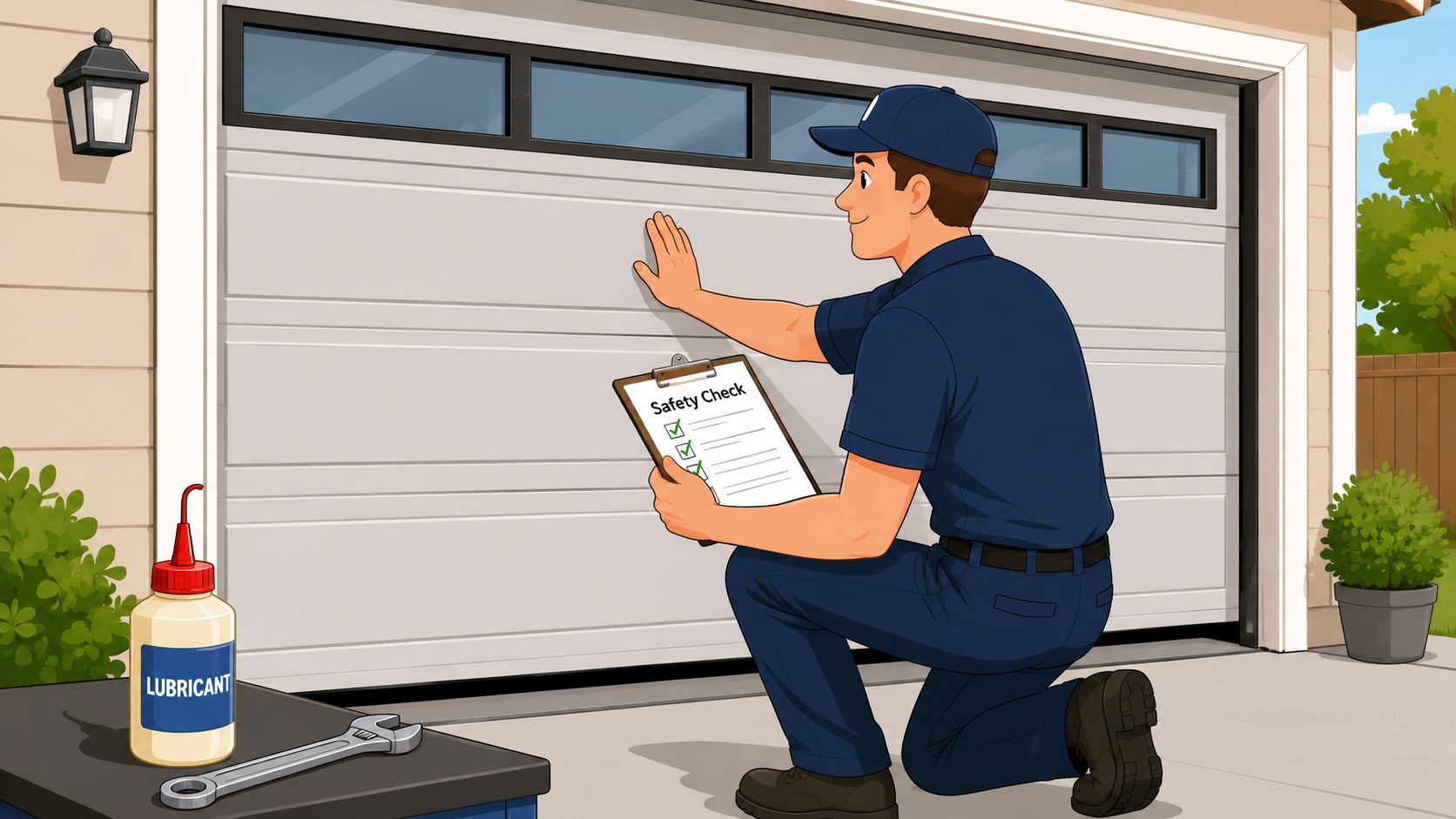
The final testing phase should confirm that the door moves properly by hand, operates correctly under power, and responds as intended to its safety devices. That includes travel through the full opening, clean seat at the floor, and stable response at normal operating speed.
For operator-equipped doors, the crew should verify the reversing system, confirm sensor alignment where applicable, and make sure controls are behaving consistently under normal use. The goal is simple. A finished opening shouldn't need the site team to “learn its quirks.”
The handover should leave the manager with a reliable opening, not a list of things to watch in case it acts up.
Documentation matters more than most sites expect
Many installations fall short because the door works, everyone is in a hurry, and the paperwork gets treated like an afterthought. In commercial settings, that's a mistake.
The handover package should include:
- Manufacturer instructions: The exact manual tied to the installed system and hardware.
- Operator documents: Controls, limits, safety devices, and basic operating guidance.
- Service record: Notes on what was installed, what was adjusted, and what the crew verified.
- Outstanding items: Any access issue, structural concern, or follow-up requirement that still needs attention.
- Maintenance expectations: What the site team can monitor and what should be left to trained technicians.
This is also the point where permit and inspection questions have to be closed out. Manufacturer PDFs usually explain assembly and clearances, but they generally don't tell a California facility manager whether a local permit, anchorage review, or post-install inspection is required. That gap matters because local building departments, not the door manual, determine those obligations for many projects, as reflected in Clopay's installation literature.
Maintenance starts on day one
A new door doesn't stay “new” for long in a shipping environment. Dust, impact, weather, vibration, and cycle demand start working on the system immediately. That's why proactive planning belongs in the installation conversation, not months later after the first service event.
A proper maintenance plan should match the opening to its actual use. A lightly used service-bay door and a busy loading door don't age the same way. The site should know who is responsible for inspections, lubrication, hardware checks, safety-device verification, and when a technician should be called.
For facilities that want that process formalized, a planned maintenance program gives operations teams a defined schedule and a clear record of service activity. That handoff is part of what “Respected Partners, Reliable Service” looks like in practice. The install is complete, and the long-term care of the asset is already organised.
When to Partner with a Certified Installer
Some openings leave very little room for debate. If the project involves a high-speed door, a fire-rated assembly, a cold-storage application, a clean-room opening, or a dock door in constant traffic, certified installation isn't just the safer option. It's the responsible one.
The same goes for retrofits in older buildings. If the opening has unknown structure behind the jambs, limited overhead space, unusual track requirements, or active operations that can't tolerate downtime, the install has to be managed by people who know how to work inside those constraints. A bad fit-up at a low-use storage bay is frustrating. A bad fit-up at a live loading opening can affect shipping, security, and safety on the same day.
Scenarios where outside expertise is the right call
A facility manager should pause and bring in certified installers when any of these apply:
- Non-standard geometry: Custom tracks, unusual radii, sloped floors, or structural offsets.
- Integrated life-safety requirements: Fire doors, release systems, and related testing obligations. If that's part of your project, review our fire door drop testing and certification services.
- Electrical coordination: Operators, controls, interlocks, and power work that must line up with the rest of the site.
- High risk environment: High-clearance work, active docks, occupied tenant sites, or production areas.
- Warranty and compliance sensitivity: Projects where improper installation can create disputes, rework, or inspection delays.
Electrical coordination is a good example. Many overhead door jobs look mechanical at first, but operator circuits, accessories, disconnects, and control integration can pull licensed electrical work into the scope. For site teams reviewing vendors, this guidance on important advice for hiring an electrician is useful for understanding what to look for when electrical trades are part of the project.
What a certified installer changes
The value isn't just labour. It's sequencing, hazard control, documentation, and accountability. Certified crews know when the opening is ready, when it isn't, and when another trade has to resolve an issue before the door can be installed properly.
That's especially important for multi-site operators and property managers. Consistency matters. One site shouldn't get a careful, documented install while another gets a field-built compromise because the opening was awkward and everyone wanted to keep moving.
If you're assessing options for your next project, commercial garage door installers near you should be evaluated on scope control, safety process, and experience with commercial openings, not just on whether they can get the door up quickly.
When the manufacturer's PDF raises more questions than answers, that's usually a sign the project deserves a professional review. Wilcox Door Service Inc. supports commercial and industrial facilities with code-conscious installation, service, and maintenance planning so your opening is safe, compliant, and ready for daily use.