


At 5:30 a.m., the receiving team is waiting on inbound trucks, a dock leveler is down, and the overhead door at bay three will not close cleanly. The facility manager is not asking for theory in that moment. They need the right vendor, the right response time, the service history, and a clear path to get the opening safe and the dock back in service.
That is why vendor management deserves more attention in facility operations than it usually gets. For teams responsible for commercial doors, loading docks, access systems, and fire-rated assemblies, vendor performance affects uptime, safety exposure, audit readiness, and repair spend. A weak process shows up fast. Missed inspections create compliance risk. Slow callbacks hold up shipments. Poor documentation turns a simple follow-up repair into a chain of emails and guesswork.
The practical challenge is balance. Facilities teams need enough structure to control risk and cost, but not so much process that every service call gets buried in approvals and paperwork. Good vendor management solves that by setting priorities. Critical assets get tighter standards. Higher-risk vendors get closer review. Routine work gets handled with simpler controls.
This guide focuses on that operating reality.
The 10 practices that follow are built for facility and operations managers, not procurement teams working at a distance from the site. Each one is grounded in common issues around sectional doors, rolling steel doors, dock levelers, truck restraints, seals, and after-hours emergency service. The goal is straightforward. Improve response quality, reduce avoidable downtime, protect people, and make vendor decisions with better evidence than whoever answered the phone last time.
If your current approach depends on personal relationships, scattered invoices, and memory, it will eventually fail under pressure. A stronger system gives your team clear expectations, measurable performance, and records you can trust before the next breakdown, audit, or contract renewal.
1. Establish Clear Service Level Agreements with Defined Response Times
Most vendor problems start with a simple issue. The facility team and the vendor thought they agreed on the same level of service, but they didn't.
A strong SLA, or service level agreement, turns vague promises into operating rules. For commercial doors and dock equipment, that means spelling out response expectations for emergency breakdowns, planned maintenance visits, follow-up repairs, parts sourcing, inspection documentation, and after-hours calls. Canadian and North American vendor-management guidance consistently points toward contract-level performance criteria tied to delivery reliability, service quality, and invoice accuracy, plus ongoing monitoring instead of relying only on periodic scorecards (contract-level KPI guidance for vendor management).
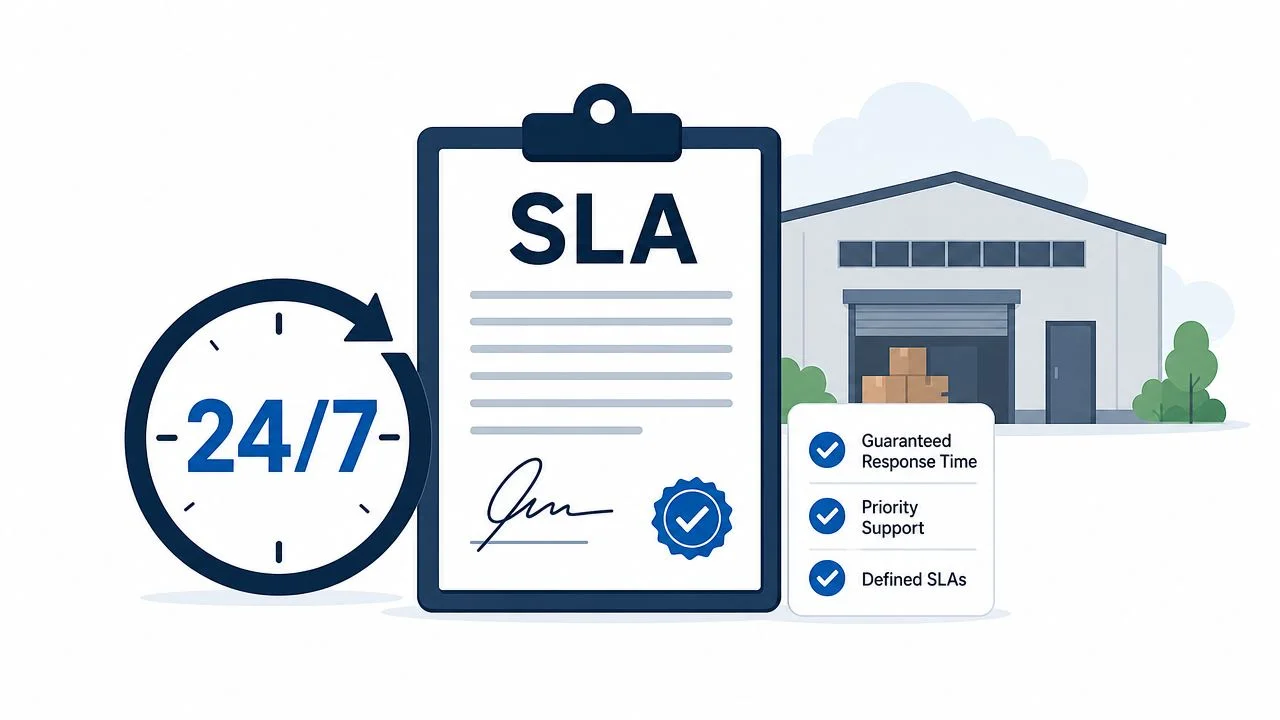
What a useful SLA actually includes
For facility maintenance, the contract should distinguish between critical assets and routine assets. A failed rolling fire door is not the same as a minor issue on a low-traffic pedestrian door. The response standard, escalation path, and reporting cadence should reflect that.
Useful SLA language usually covers:
- Emergency categories: Define what counts as a true emergency, such as a jammed dock door blocking shipping or a fire door that won't operate as required.
- Routine service windows: State how quickly non-critical repairs, quotes, and scheduled maintenance visits should be handled.
- Escalation rules: Name who gets involved if the first response doesn't solve the issue or if the vendor misses a commitment.
- Documentation requirements: Require service reports, deficiency notes, and compliance records after each visit.
Practical rule: If an SLA can't be understood by a site supervisor at 2 a.m., it's too vague.
Winter also matters in Canada. If your site deals with frozen thresholds, wind load issues, or snow-driven wear on dock equipment, put seasonal response expectations in writing rather than assuming the vendor will adapt on the fly.
2. Implement Vendor Performance Scorecards and Regular Evaluations
At 6:10 a.m., the shipping team is waiting on a dock door that failed again two days after a repair. The vendor says they responded quickly and completed the work. Operations still lost trailer time, supervision had to reroute traffic, and accounting is now sorting out an invoice that does not match the approved scope. Without a scorecard, that conversation turns into opinions. With one, the discussion stays on facts.
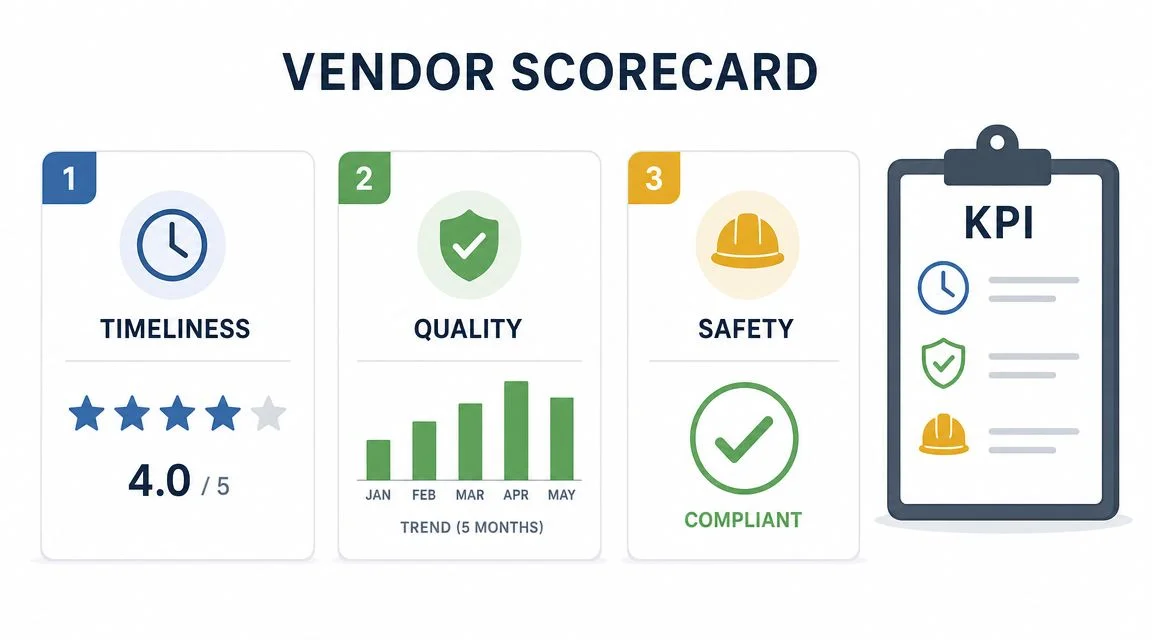
What to measure in facility maintenance
A useful scorecard for facility and operations managers should reflect what affects uptime, safety, and cost control. For commercial doors and loading docks, that usually means four categories:
- Response and completion performance: Did the technician arrive in the agreed window, and was the asset returned to service when promised?
- First-time fix quality: Did the repair hold, or did the same door operator, dock leveler, or restraint need another visit within days or weeks?
- Safety and documentation: Were lockout procedures followed, site hazards noted, and service records detailed enough for audits and future troubleshooting?
- Billing discipline: Did the invoice match the approved labor, parts, and scope, or did extra charges appear after the work was done?
Keep it simple at first. A one-page quarterly scorecard usually works better than a complicated dashboard nobody updates.
The trade-off is real. If you track too many metrics, site teams stop using the tool. If you track too few, weak performance hides inside a good relationship. I usually recommend starting with five to seven measures, then adjusting after two review cycles.
Regular evaluations matter as much as the scorecard itself. A vendor can post acceptable numbers for months while small issues build up, such as incomplete deficiency notes, repeat callbacks on the same dock position, or technicians arriving without the right lift access planned. Quarterly reviews catch those patterns early and give both sides a chance to correct them before they turn into downtime or safety exposure.
This process also helps separate operational risk from personal preference. Procurement teams often focus on unit cost. Site supervisors focus on responsiveness. HR and compliance teams look at screening, documentation, and outside contractor controls. That broader view is one reason many organizations tie vendor reviews to wider oversight practices, including third-party risk management for HR.
I have seen a simple review sheet change the tone of vendor meetings fast. Instead of hearing, "your team has been slipping lately," the vendor sees that emergency response was on target, but first-time fix rate on high-cycle dock doors dropped and paperwork quality fell below standard at two sites. That is a productive conversation. It gives the vendor something concrete to fix, and it gives the facility team a defensible basis for renewal, probation, or reallocation of work.
3. Develop a Vendor Qualification and Certification Process
Bad vendor management often begins before the first work order. The wrong vendor gets approved because they answered the phone quickly, had a low quote, or were already known to someone on site.
That approach works until the vendor is asked to service a rolling steel fire door, certify a technician for a safety-sensitive repair, or produce proof of insurance after an incident. For regulated and safety-critical facilities in Canada, generic procurement advice usually isn't enough. Guidance often misses the operational controls that matter on the ground, such as permit-to-work, fire-door inspection records, technician certification, response-time SLAs, and emergency escalation paths (vendor oversight for regulated Canadian facilities).
Vet for the work they'll actually do
Prequalification should match asset risk. A vendor that can handle a routine overhead door spring replacement may not be the right choice for clean-room doors, dock equipment integrated with traffic control, or fire-rated assemblies that affect life safety.
Before onboarding, verify:
- Insurance and legal standing: Keep current certificates and make sure expiry dates are tracked.
- Technical capability: Ask for examples of similar equipment and environments, not generic project lists.
- Safety readiness: Confirm site-specific training, supervisory process, and incident reporting expectations.
- Documentation discipline: Make sure they can provide service records that support maintenance history and compliance.
If your organization already thinks in terms of risk tiers, apply that same mindset here. This is the same logic behind third-party risk management for HR. Higher-risk vendors need deeper review and tighter controls.
A practical test is simple. Ask the vendor to walk you through how they'd handle an after-hours fire-door issue at a multi-tenant property. If the answer is loose, their field execution will be loose too.
4. Establish Collaborative Planning and Maintenance Scheduling
A dock door fails at 8:10 a.m., trucks are stacking up, and the vendor's first open slot is late afternoon. That problem usually started weeks earlier. The rollers were getting noisy, the leveler was cycling harder than normal, and nobody carved out time to deal with it before the rush.
Collaborative planning reduces those avoidable failures. Facility teams and vendors should build the schedule together, using the site's operating reality instead of a fixed calendar. Review peak shipping periods, shutdown windows, weather exposure, pending capital work, and assets with a recent history of trouble. A loading dock with heavy trailer impact, worn seals, and an aging restraint system deserves planned attention before it turns into a service call during receiving hours.
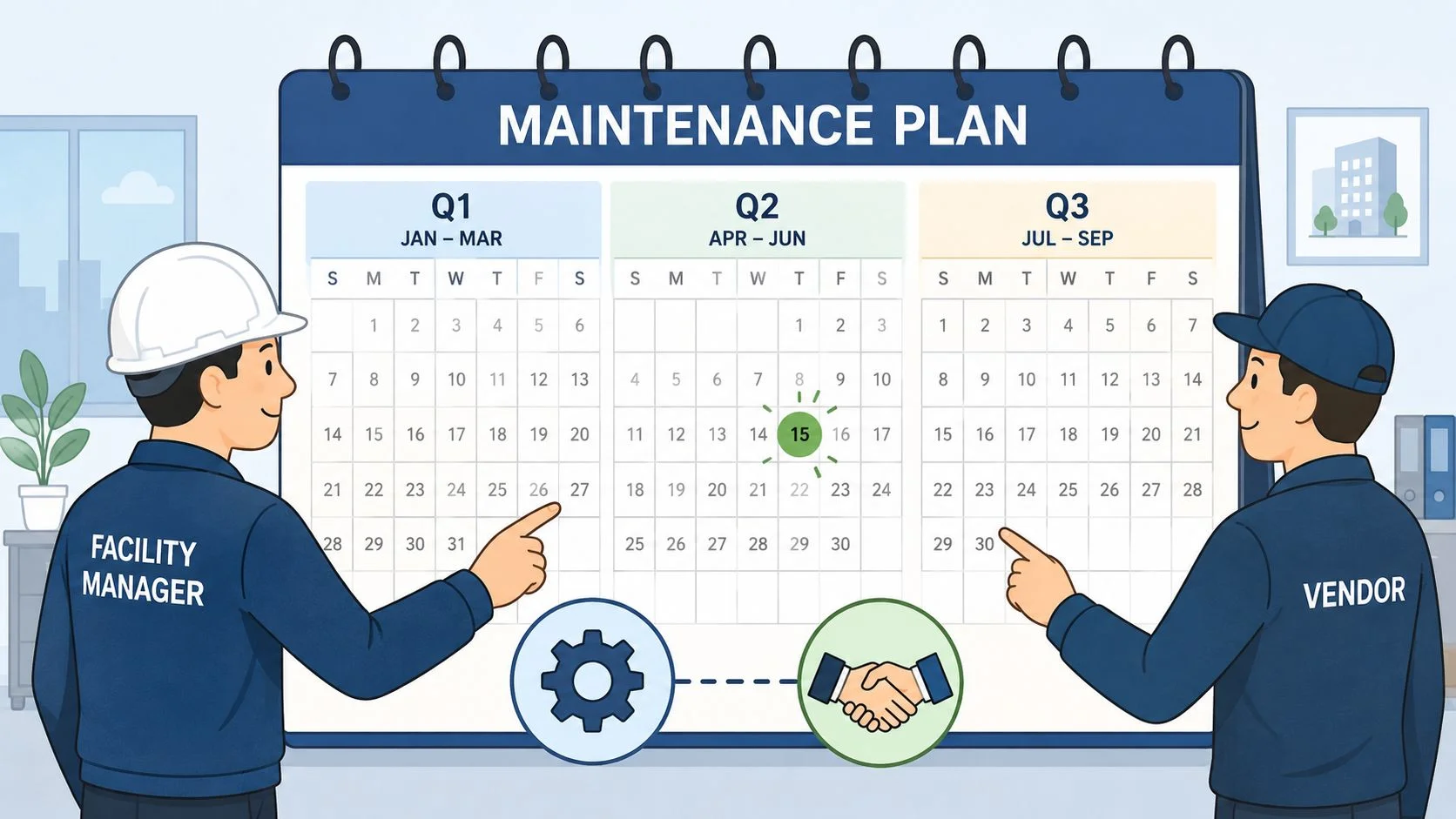
Plan by operating rhythm, not calendar habit
Calendar-based maintenance is easy to administer. It is not always the right way to protect uptime.
Strong schedules reflect how the facility runs and how the equipment is used:
- Seasonal strain: Exterior doors, dock levelers, seals, and operators often need different service timing than interior openings, especially before winter or storm seasons.
- Production rhythm: Plants get better results when planned work lands during shutdowns, line changeovers, or slower shifts.
- Multi-site logistics: Regional portfolios can group similar work across nearby sites to cut travel time and improve oversight.
- Known weak points: A high-speed door that handles constant forklift traffic should be inspected more often than a low-use opening at the back of the building.
I have seen this pay off most clearly at busy docks. If a facility knows Thursday and Friday are heavy outbound days, scheduling PM work for those mornings creates friction before the technician even arrives. Put that same work on a lower-volume shift, stage parts in advance, and confirm access with operations. The maintenance itself may be identical, but the business impact is very different.
Planned work should happen when operations can absorb it. That is the standard to use.
5. Create Transparent Communication Protocols and Escalation Procedures
A lot of vendor friction isn't a technical problem. It's a communication problem disguised as a technical one.
The technician thinks the issue is waiting on approval. The facility manager thinks the vendor is sourcing parts. Accounts payable is holding the invoice because the work order number is missing. Meanwhile, the dock door is still down. That's what happens when nobody defines who contacts whom, by what method, and how fast.
A communication protocol should cover emergency calls, routine requests, quote approvals, change orders, billing questions, and unresolved service issues. Keep it short. One page is often enough if it clearly names contacts, roles, and escalation steps.
Keep the message path simple
For most facility teams, these communication rules work well:
- Primary channel for work orders: Use a shared system or a defined email workflow so requests aren't buried in personal inboxes.
- Separate emergency contact path: Critical failures need a dedicated phone route, not the same path used for routine scheduling.
- Named decision-makers: Vendors should know who can approve extra work, who handles access, and who receives closeout documentation.
- Escalation ladder: Move issues from dispatcher to service manager to account lead when commitments slip.
A short visual can help teams align on this process:
Monthly business reviews also help. They don't need to be elaborate. Review open issues, recurring failures, invoice disputes, and upcoming facility changes. Most communication failures repeat because nobody formalized the fix after the first one.
6. Implement Supplier Diversity and a Multi-Vendor Strategy
Single-vendor dependence feels efficient until that vendor is overloaded, short on parts, or weak in one technical area.
That doesn't mean every site should spread work across a long list of providers. Too many vendors create their own management burden. The practical middle ground is to identify where you want a primary partner, where you need backup coverage, and where specialist support makes sense.
Build depth without creating confusion
For facility operations, a balanced model often looks like this:
- Primary vendor for core systems: One main provider handles most preventive work, standard service, and account coordination.
- Secondary vendor for continuity: A backup can step in during peak demand, regional gaps, or service failures.
- Specialist vendor for niche equipment: Use this only where technical depth differs, such as unusual clean-room access systems or specialized controls.
This strategy also creates room to align procurement goals with broader organizational values. If supplier diversity is part of your mandate, review resources on Indigenous-owned businesses in Canada when assessing qualified partners.
The trade-off is real. More competition can sharpen performance, but too much fragmentation weakens accountability. If three vendors touch the same loading dock and nobody owns the whole picture, recurring faults will drag on longer than they should.
7. Establish Cost Management and Transparency in Vendor Pricing
Cost control doesn't come from forcing the lowest hourly rate. It comes from understanding what you're buying, what triggers extra charges, and how much reactive work is hiding inside the annual spend.
A vendor relationship becomes expensive when labour categories aren't clear, travel charges are inconsistent, parts markups are opaque, and emergency calls swallow the budget that should have gone to planned maintenance. The answer isn't distrust. It's pricing structure.
What transparent pricing looks like
Ask for a rate framework that clearly separates routine service, emergency response, planned maintenance, quoted project work, and parts. If the vendor can't explain the difference in plain language, your team will struggle to approve and audit invoices later.
Use these controls:
- Detailed rate cards: Clarify labour categories, after-hours treatment, travel assumptions, and material handling.
- Approval thresholds: Require written approval before the vendor exceeds a defined scope on non-emergency work.
- Estimate standards: Larger repairs should come with scope notes, assumptions, exclusions, and change-order rules.
- Spend pattern reviews: Compare how much goes to emergency work versus planned work and ask why.
For many facilities, the primary savings opportunity is reducing hidden ownership cost, not squeezing line items. This is the same thinking behind reducing total cost of ownership for facility assets.
If your quote process is messy, tighten that up too. A structured intake method such as a quote request form for service and project scoping can reduce missing information before pricing is even discussed.
8. Build Strategic Partnerships Beyond Transactional Relationships
A vendor becomes more useful when they understand your operation, not just your equipment list.
That's the difference between a transactional relationship and a strategic one. A transactional vendor waits for a service call. A strategic partner notices that one dock position is taking unusual impact, that a high-speed fabric door no longer suits traffic flow, or that repeated repairs point to a replacement decision you should make before peak season.
Bring vendors into the right conversations
You don't need to share everything. You do need to share enough for the vendor to plan properly and make relevant recommendations.
That usually means:
- Quarterly review meetings: Discuss site changes, recurring trouble spots, and service performance.
- Capital planning visibility: Let the vendor understand upcoming expansions, retrofits, or operational changes.
- Operational context: Explain how each asset is used, not just what it is.
- Recognition for useful input: If a vendor helps prevent downtime or improves safety, say so.
The best vendor relationships are built when both sides understand the operating consequences of failure.
Supply continuity is part of that relationship too. If parts lead times, service access, or scheduling constraints affect your site, early coordination matters. In such instances, Wilcox's perspective on managing supply chain disruptions fits naturally into a stronger partnership model.
9. Document All Vendor Interactions and Maintain Institutional Knowledge
A dock leveler fails during the morning rush. The service vendor asks whether this unit had the same hydraulic issue last winter, whether a temporary fix was approved, and whether the site wanted replacement quotes. If those answers live in one retired manager's inbox, the repair starts slower, costs more, and carries more risk than it should.
That problem shows up in facility maintenance more often than teams admit. Service history gets split between email threads, paper work orders, technician notes, and accounting files. Then a recurring issue on one door gets treated like a brand-new problem every time.
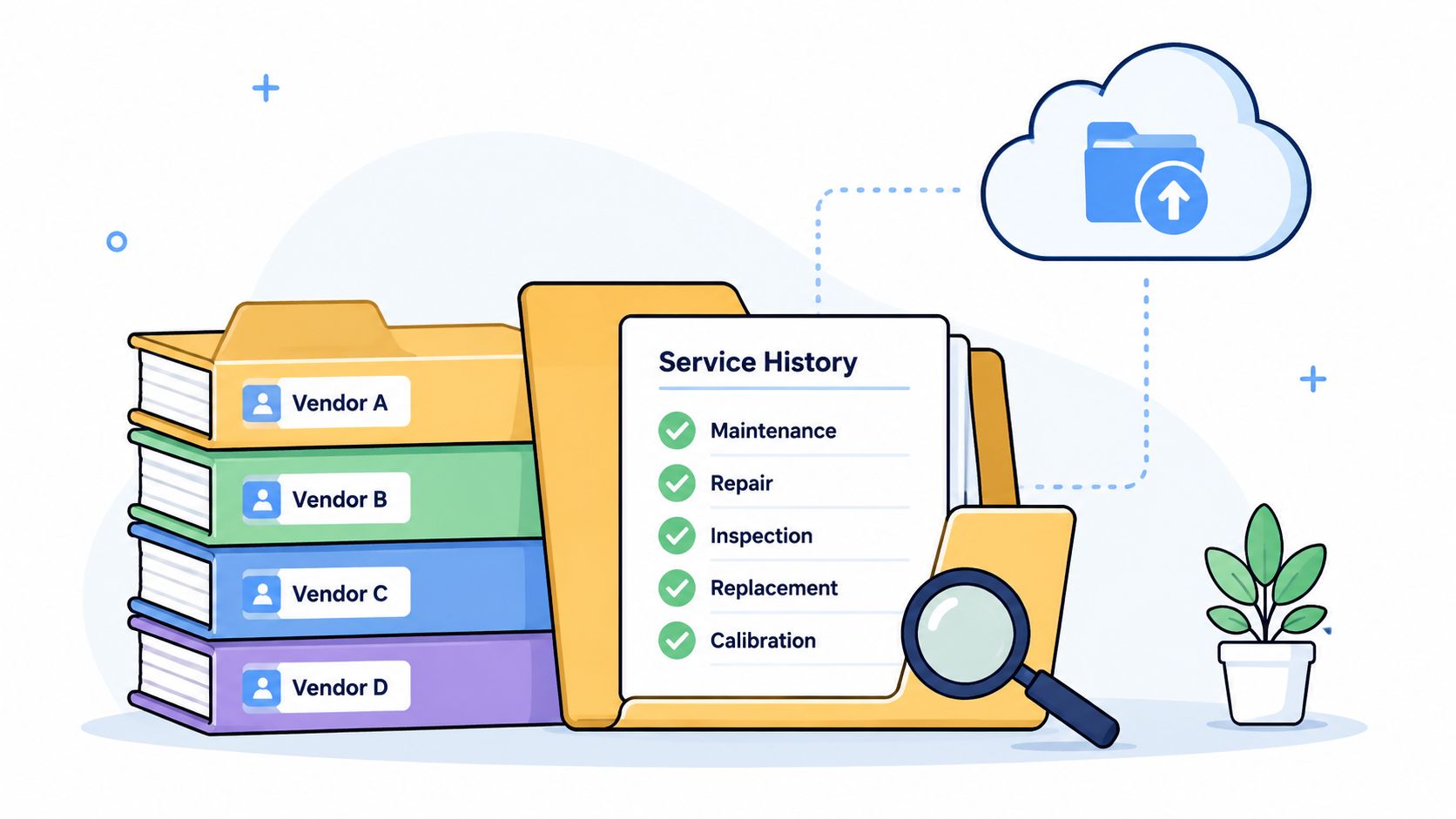
Create one source of truth
Use one system and make it the default. A CMMS is ideal if your team already uses it well. A shared service portal or structured drive can work too. The tool matters less than the discipline.
For doors, docks, and access equipment, the record should be tied to the asset, not just the vendor. If a sectional door at Dock 12 has taken three impact repairs in six months, that history should be obvious to anyone reviewing the file. The same goes for fire door deficiencies, operator replacements, restraint faults, and repeated after-hours calls on the same opening.
Keep these records current:
- Contracts and amendments: Current pricing terms, scope, renewal dates, and response commitments
- Insurance and compliance files: Certificates, safety documentation, training records, and qualification status
- Asset-level service history: Every visit tied to the specific door, operator, leveler, restraint, or gate involved
- Quoted versus approved work: What the vendor recommended, what the site approved, and what was deferred
- Lessons learned: Repeat failure causes, successful fixes, and site conditions the next technician should know
This is how teams protect institutional knowledge when supervisors change, sites expand, or responsibilities shift between operations and facilities.
I've found one detail makes a big difference. Require vendors to document not just what they repaired, but why the issue happened, what parts were used, and what should be checked next. “Adjusted door” is not useful. “Adjusted track after forklift impact, noted worn bottom section, recommend replacement before peak shipping month” is useful.
If your process still relies on scattered notes, start by standardizing file names, asset IDs, and closeout requirements. Then build from there. These actionable tips for knowledge management are useful for turning service records into information your team can reuse.
10. Align Vendor Incentives with Facility Goals and Outcomes
People pay attention to what the contract rewards.
If your vendor is paid the same whether a problem is permanently fixed or repeatedly revisited, don't be surprised when temporary solutions linger. If your contract only values low quoted pricing, don't expect the vendor to prioritize documentation quality, preventive recommendations, or root-cause analysis.
Reward the outcomes you actually care about
For facility operations, incentives should stay simple and tied to a short list of priorities. Usually that means uptime, safety, documentation quality, and response reliability.
A practical structure might include:
- Performance consequences: Missed response commitments or repeated unresolved issues should trigger formal review and remediation.
- Preference for planned work: Encourage preventive service and asset planning rather than constant emergency dispatch.
- Recognition for problem prevention: Reward vendors that identify recurring failure causes and help remove them.
- Renewal decisions tied to evidence: Use scorecards, records, and service history. Don't renew on habit alone.
This approach works best when combined with the earlier practices. Incentives don't fix weak contracts, poor communication, or missing documentation. They amplify whatever system is already in place. If the system is sound, incentives help both sides focus on the same outcomes.
Top 10 Vendor Management Best Practices Comparison
| Practice | 🔄 Implementation complexity | ⚡ Resource requirements | ⭐📊 Expected outcomes | Ideal use cases | 💡 Key advantages |
|---|---|---|---|---|---|
| Establish Clear Service Level Agreements (SLAs) with Defined Response Times | 🔄 Medium–High, negotiation and legal review | ⚡ Medium, SLA drafting, monitoring & reporting tools | ⭐⭐⭐⭐ Clear accountability; 📊 reduced downtime and predictable uptime | 24/7 operations, warehouses, cold-storage, safety‑critical doors | 💡 Predictable service levels, enforceable remedies, easier budgeting |
| Implement Vendor Performance Scorecards and Regular Evaluations | 🔄 Medium–High, metric design and governance | ⚡ Medium–High, data collection, dashboards, periodic reviews | ⭐⭐⭐⭐ Data-driven improvements; 📊 trend visibility for renewal/termination decisions | Multi-site managers, high vendor volumes, quality-focused ops | 💡 Reduces bias, detects trends early, motivates vendor improvement |
| Develop a Vendor Qualification and Certification Process | 🔄 High, vetting, audits, legal & financial checks | ⚡ High, credential verification, site audits, recertification | ⭐⭐⭐⭐ Risk and compliance reduction; 📊 ensures qualified technicians and insurance coverage | Regulated industries, safety‑critical equipment (fire doors) | 💡 Minimizes liability, ensures regulatory compliance, pre‑approved vendor pool |
| Establish Collaborative Planning and Maintenance Scheduling | 🔄 Medium, coordination across teams and calendars | ⚡ Low–Medium, planning meetings, shared calendars, CMMS integration | ⭐⭐⭐⭐ Fewer emergencies; 📊 extended equipment life and better budgeting | Seasonal operations, multi‑site fleets, planned production shutdowns | 💡 Shifts from reactive to preventive maintenance; optimizes vendor resources |
| Create Transparent Communication Protocols and Escalation Procedures | 🔄 Low–Medium, define contacts and escalation ladders | ⚡ Low, contact lists, work order system, agreed channels | ⭐⭐⭐⭐ Faster resolutions; 📊 fewer miscommunications and clearer accountability | Any facility with emergency-response needs; 24/7 equipment coverage | 💡 Speeds decision‑making, preserves institutional knowledge, reduces delays |
| Implement Supplier Diversity and Multi‑Vendor Strategy | 🔄 Medium, portfolio planning and contract management | ⚡ Medium, onboarding backups, periodic RFPs, capacity planning | ⭐⭐⭐ Risk mitigation; 📊 improved negotiating leverage and backup capacity | Large portfolios, peak seasons, critical single‑vendor risk scenarios | 💡 Reduces single‑vendor risk, encourages competition, provides backup capacity |
| Establish Cost Management and Transparency in Vendor Pricing | 🔄 Medium, negotiate rate cards and billing rules | ⚡ Medium, benchmarking, invoicing controls, reconciliation | ⭐⭐⭐⭐ Budget predictability; 📊 fewer billing surprises and better cost control | Tight budgets, high spend environments, long‑term maintenance programs | 💡 Predictable pricing, dispute reduction, incentives for preventive maintenance |
| Build Strategic Partnerships Beyond Transactional Relationships | 🔄 High, sustained leadership engagement and joint planning | ⚡ Medium, executive time, joint projects, long‑term contracts | ⭐⭐⭐⭐ Higher value outcomes; 📊 priority service, innovation and favorable terms | Strategic accounts, modernization projects, long‑term capital plans | 💡 Priority capacity, collaborative innovation, improved pricing and loyalty |
| Document All Vendor Interactions and Maintain Institutional Knowledge | 🔄 Low–Medium, standards and regular updates required | ⚡ Low–Medium, CMMS/work order system, storage and backups | ⭐⭐⭐⭐ Continuity and auditability; 📊 faster onboarding and informed decisions | Multi‑site organizations, high staff turnover, audit‑sensitive facilities | 💡 Preserves lessons learned, enables trend analysis, protects against knowledge loss |
| Align Vendor Incentives with Facility Goals and Outcomes | 🔄 High, KPI design, contractual incentives/penalties | ⚡ Medium, monitoring systems, payout/penalty administration | ⭐⭐⭐⭐ Shared accountability; 📊 improved uptime, safety, and cost outcomes | Facilities aiming to shift vendor behavior to proactive performance | 💡 Aligns vendor motivation with facility goals, encourages preventive action and innovation |
Your Next Step Building Respected Partners for Reliable Service
The best practices for vendor management aren't about adding paperwork for its own sake. They're about building control where it matters most. In facility operations, that means clear SLAs, disciplined qualification, useful scorecards, centralized records, transparent pricing, and communication paths that hold up when something breaks after hours.
This is especially important for Canadian operators managing safety-critical assets. Generic vendor advice often stops at selection and contract language. Real facility oversight goes further. It addresses permit-to-work expectations, technician certification, fire-door inspection records, emergency escalation, business continuity, and the practical details that affect uptime and compliance on active sites. That's the difference between procurement administration and operational risk management.
The strongest programs also accept a basic truth. Not every vendor should be treated the same way. A low-risk supplier of non-critical consumables doesn't need the same oversight as the company maintaining your rolling fire doors, high-speed doors, dock levelers, or secure access points. Focus your effort where downtime, safety exposure, or audit pressure is highest. Keep the system strict where it needs to be and simple everywhere else.
For many teams, the fastest improvement comes from fixing three things first:
- Get contracts and SLAs into one place
- Start measuring performance consistently
- Put asset history and vendor records into a shared system
Once those are in place, the rest becomes easier. Planning improves. Billing disputes fall faster. Renewal decisions get cleaner. Site teams spend less time retelling the same story to new technicians and more time solving actual problems.
That's also where the Wilcox message of “Respected Partners, Reliable Service” fits this topic well. It's a useful model for how facility leaders should evaluate any service provider. Respect shows up in communication, documentation, and accountability. Reliability shows up in execution, response discipline, and follow-through. If you're reviewing vendors for commercial doors, loading docks, or access systems, those are the traits worth testing for in the field.
Wilcox Door Service Inc. is one relevant option for organizations that want that kind of structure, particularly where planned maintenance, documentation, emergency service, and code-conscious facility support matter. The right next step is simple. Review your current vendor list, identify your critical assets, and decide which relationships need to move from informal to managed.
If you want to put these vendor management practices into action for your commercial doors, loading docks, or access systems, contact Wilcox Door Service Inc. to discuss a quote, service review, or planned maintenance program.