


At 6:45 a.m., receiving is about to start and a dock door will not close ahead of a storm. A leveler hesitates with a trailer at the bay. A rolling fire door is due for inspection, but the service record is missing. That is what risk management looks like in a facility. It usually shows up first at the access points that keep people, products, and vehicles moving.
For operations leaders, the highest-impact risks are often tied to doors, loading docks, gates, pedestrian openings, operators, restraints, and access controls. These assets affect safety, compliance, throughput, security, energy loss, and emergency response every day. If a front office lock sticks, it is an inconvenience. If a shipping door, gate operator, or dock position fails at the wrong time, schedules slip, trailers back up, and exposure grows fast.
Good risk management for facilities is not a yearly binder exercise. It is an operating discipline built around known failure points, documented decisions, and regular review as conditions change. Equipment ages. Traffic patterns shift. Weather exposes weak seals and worn components. A site expansion changes how trucks queue and how pedestrians cross active dock areas. Teams that treat those changes early usually spend less on disruption later.
That is also why this article stays focused on facility access points instead of drifting into generic corporate risk language. Doors and docks create a specific mix of mechanical, safety, compliance, and business continuity risk. In practice, the job is to identify what can fail, decide what matters most, assign ownership, and act before a stuck door or downed leveler turns into an injury, a lost shipment, or a failed inspection. Facilities that want to go beyond break-fix service should also understand how predictive maintenance supports earlier intervention.
The ten practices below are built for warehouses, plants, airports, government buildings, and multi-site portfolios. They are meant to help you protect the openings your operation depends on, document risk clearly, and make better calls about maintenance, response, vendors, capital, and coverage.
1. Establish a Proactive Preventive Maintenance Program
Reactive service feels cheaper until a critical door fails during receiving hours or a dock leveler goes down with trucks lined up outside. By then, you're paying for disruption, not just repair. Preventive maintenance changes the conversation from “what broke?” to “what's wearing out, and when do we deal with it on our terms?”
For doors and docks, that usually means scheduled inspection, lubrication, adjustment, testing, and replacement of known wear items before they create a bigger incident. A high-speed fabric door with a frayed edge, a sectional overhead door with a drifting spring balance, or a dock leveler with inconsistent lip deployment all give warning signs if someone is looking for them.
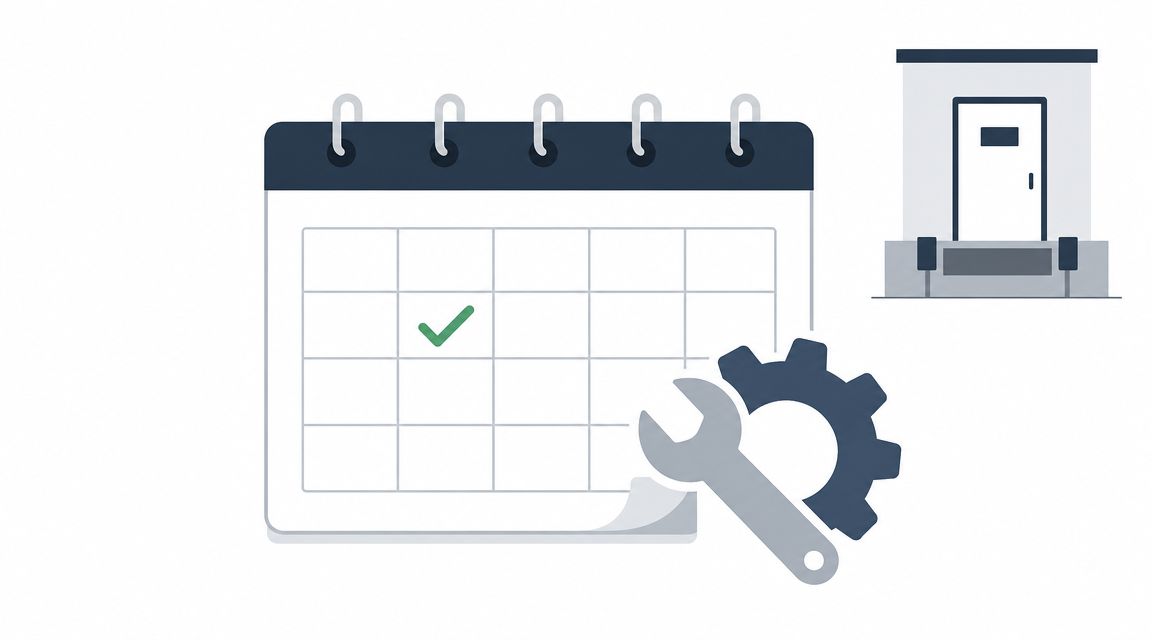
Alt text: Scheduled maintenance graphic for best practices for risk management in commercial door and loading dock service.
What good PM looks like
A solid program starts with criticality. The shipping door that cycles constantly and the fire-rated opening protecting egress don't belong on the same service interval as a low-use side entrance. Usage, environment, and consequence of failure should drive the schedule.
A food distribution site might inspect dock equipment before peak shipping periods. A pharmaceutical facility might verify clean-room door performance more tightly because seal failure affects the controlled space, not just convenience. If you're deciding between strategies, it helps to understand the difference between scheduled and condition-based approaches in this overview of predictive maintenance.
Practical rule: If a door or dock failure would stop product flow, compromise life safety, or create a security gap, it belongs in a formal maintenance plan, not a call-when-it-breaks list.
A maintenance log matters as much as the wrench work. If your team can't show what was checked, what was adjusted, and what trend was spotted early, you're not really managing risk. You're just hoping the same problem doesn't come back.
2. Conduct Comprehensive Risk Assessments and Asset Inventories
A dock door goes down at 4:30 p.m., and the true problem starts when nobody can answer three basic questions. What door is it, what else depends on it, and how hard does the operation get hit if it stays out of service for eight hours? If your team has to figure that out during the failure, the risk assessment started too late.
Start with a detailed asset inventory. List every commercial door, loading dock position, gate, restraint, operator, access control point, and fire-rated opening. Record location, asset type, manufacturer, age if known, condition, cycle or usage pattern, and the operational job that asset supports. A facility often learns that one dock handles the only inbound refrigerated trailer, or one high-speed freezer door protects a temperature-sensitive process. Those assets deserve different attention than a low-use side entrance.
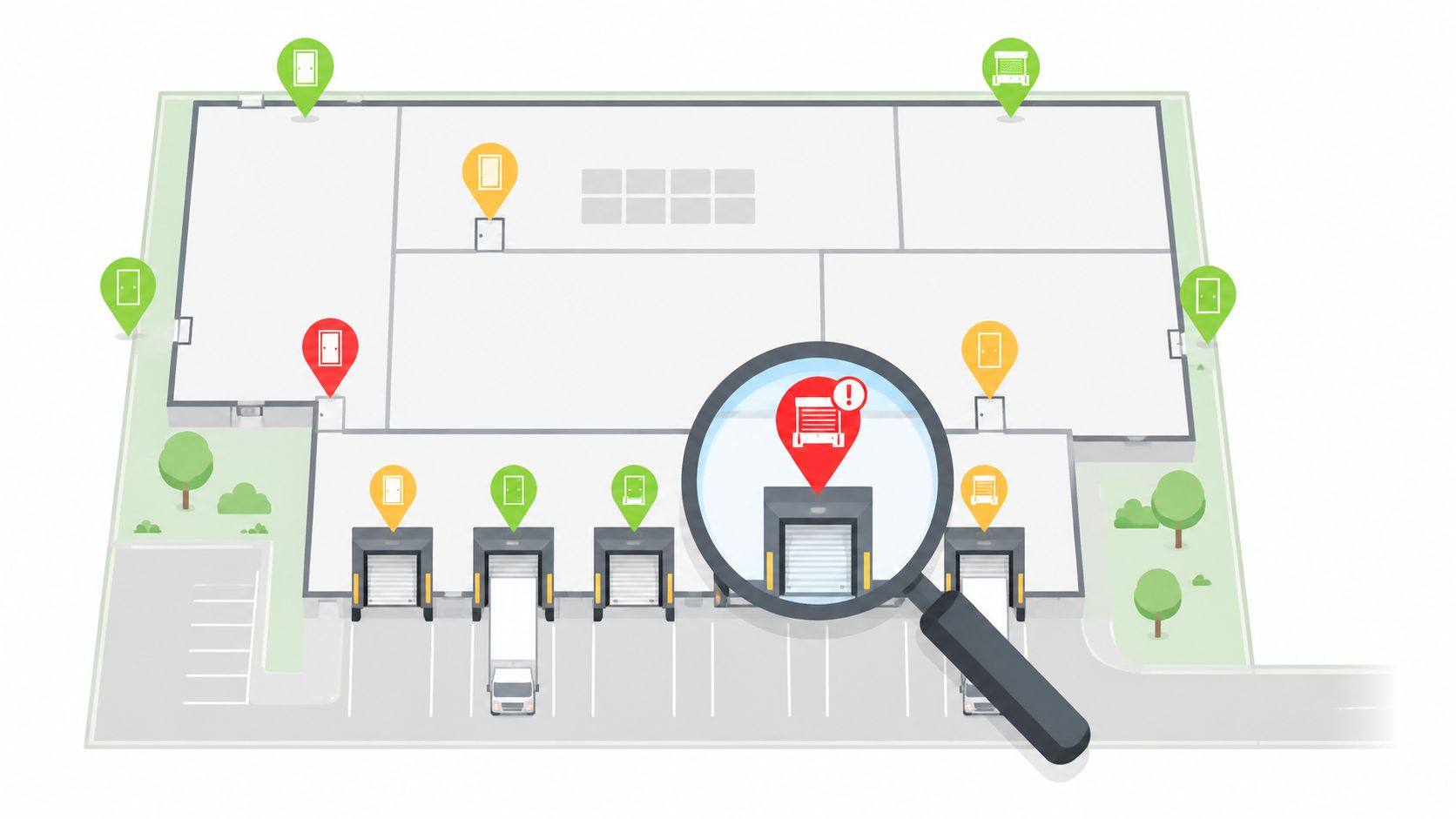
Alt text: Facility asset map for best practices for risk management across warehouse doors and loading docks.
Build the register around real assets
A useful risk register stays tied to actual equipment and actual consequences. As noted earlier, structured risk programs typically follow a practical sequence: define the operating context, identify the risk, record existing controls, rate the likely impact and likelihood, then assign one owner who is accountable for follow-up. For access points, that only works if the register points to a real opening, not a vague label like “shipping area” or “entry system.”
In practice, document issues such as:
- Asset dependency: Dock 5 is the only position that fits a specific trailer configuration.
- Life-safety role: A rolling fire door protects a rated separation required for occupant protection.
- Security exposure: A sliding gate controls after-hours yard access where high-value inventory is stored.
- Recurring failure pattern: A pedestrian automatic door has repeated sensor faults during cold weather.
- Operational consequence: If a leveler, restraint, or overhead door fails, receiving shifts to a slower manual process.
As a result, operations leaders get better decisions, not just better records. Once the inventory is accurate, priorities stop being political. The loudest complaint no longer wins by default. A worn personnel door at a secondary entrance may be inconvenient, while a damaged dock leveler at the only outbound lane can disrupt revenue, carrier schedules, and site safety in the same shift.
There is a trade-off. Building and maintaining this inventory takes time, and nobody on a busy site asks for more administrative work. But for doors, docks, and gates, the payoff is immediate. You can rank risk by consequence, direct spending toward the openings that matter most, and avoid treating every asset like it carries the same operational weight.
3. Develop a Robust Emergency Response and Continuity Plan
Even the best maintenance program won't eliminate every failure. Motors burn out. Impact damage happens. Storms knock out power. Someone jams a dock plate with poor operating practice. What separates a controlled disruption from a chaotic one is the plan you already had in place.
For access points, emergency planning needs to be painfully specific. If the main receiving door fails shut, where do trucks go? If a freezer door fails open, who has authority to isolate the space and call service? If a card-access entrance is offline, how do staff and visitors move safely without creating a security gap?
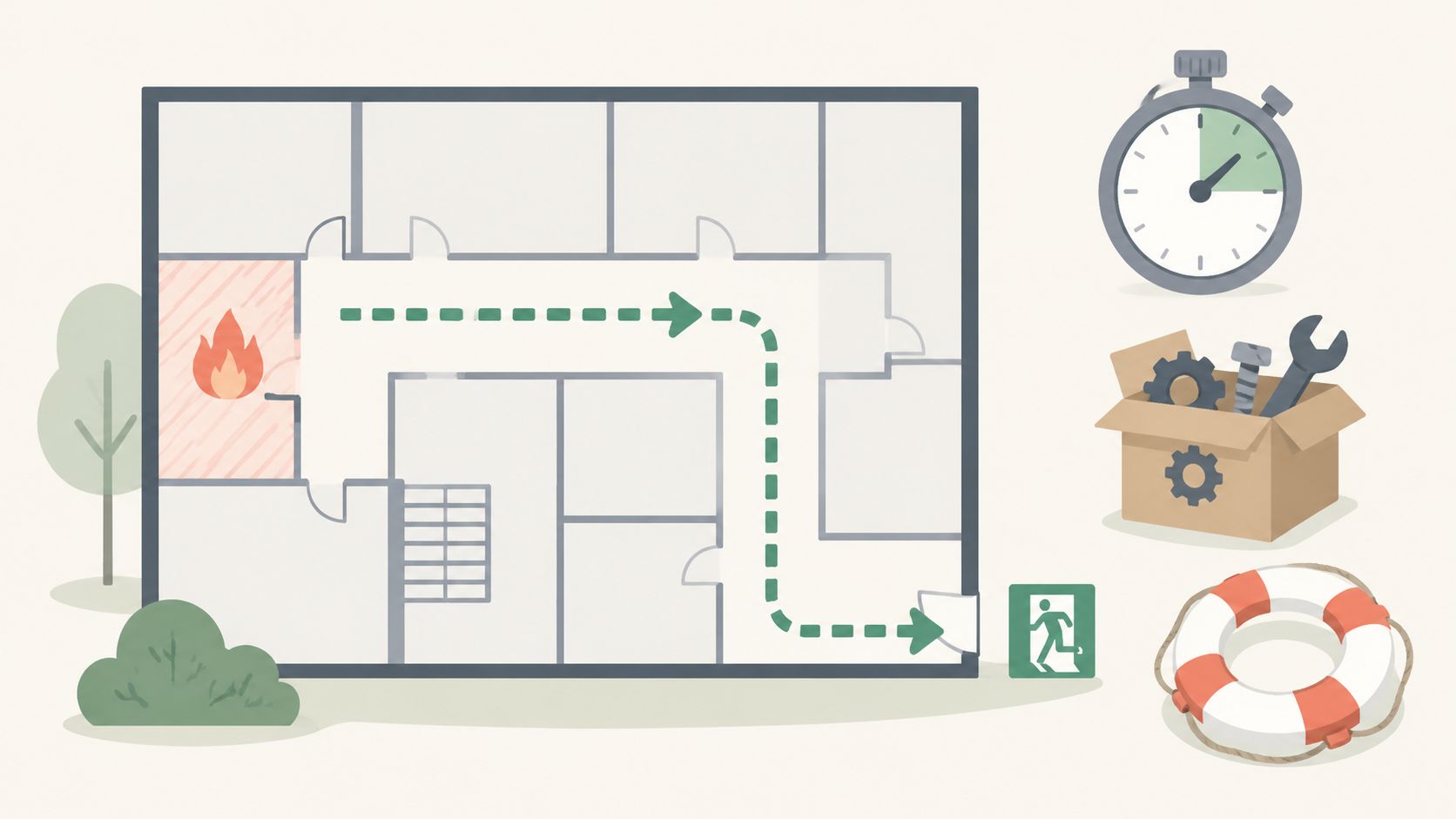
Alt text: Emergency continuity planning visual for best practices for risk management in facility doors and access routes.
Prepare for failure before failure happens
The most useful plans answer three questions fast:
- Who decides: Name the person authorized to shut down, reroute, or approve emergency spend.
- Who responds: Keep current contacts for service partners, internal maintenance, security, and operations leaders.
- What continues: Identify the minimum operations that must keep moving, even if the normal route is down.
A hospital entrance, airport gate, or food distribution dock can't wait for committee discussion in the middle of an incident. Pre-vetted emergency procedures matter. So do posted instructions near critical equipment, especially for manual override, lockout, and alternative access.
If your continuity plan depends on one supervisor remembering every step from memory, you don't have a continuity plan. You have a vulnerable person.
Cross-training helps more than often assumed. The operator on shift, the maintenance lead, and the site manager should all know the basics of what happens when a critical opening fails. In practice, that's what keeps downtime contained.
4. Maintain Rigorous Compliance and Regulatory Documentation
A lot of facilities do the work but lose the audit because they can't prove it. In risk management, undocumented compliance often fails the same way as non-compliance. That's especially true around fire doors, egress routes, accessibility features, and safety testing tied to critical openings.
Generic advice often stops at “do assessments.” The operational reality in Canada is more demanding. Federally regulated workplaces must complete and document workplace risk assessments under occupational health and safety rules, while provincial regimes add their own requirements. That gap between broad governance talk and actual site execution is exactly why many teams struggle to keep records aligned across locations, as noted in this discussion of Canadian workplace risk-assessment obligations and multi-site operational gaps.
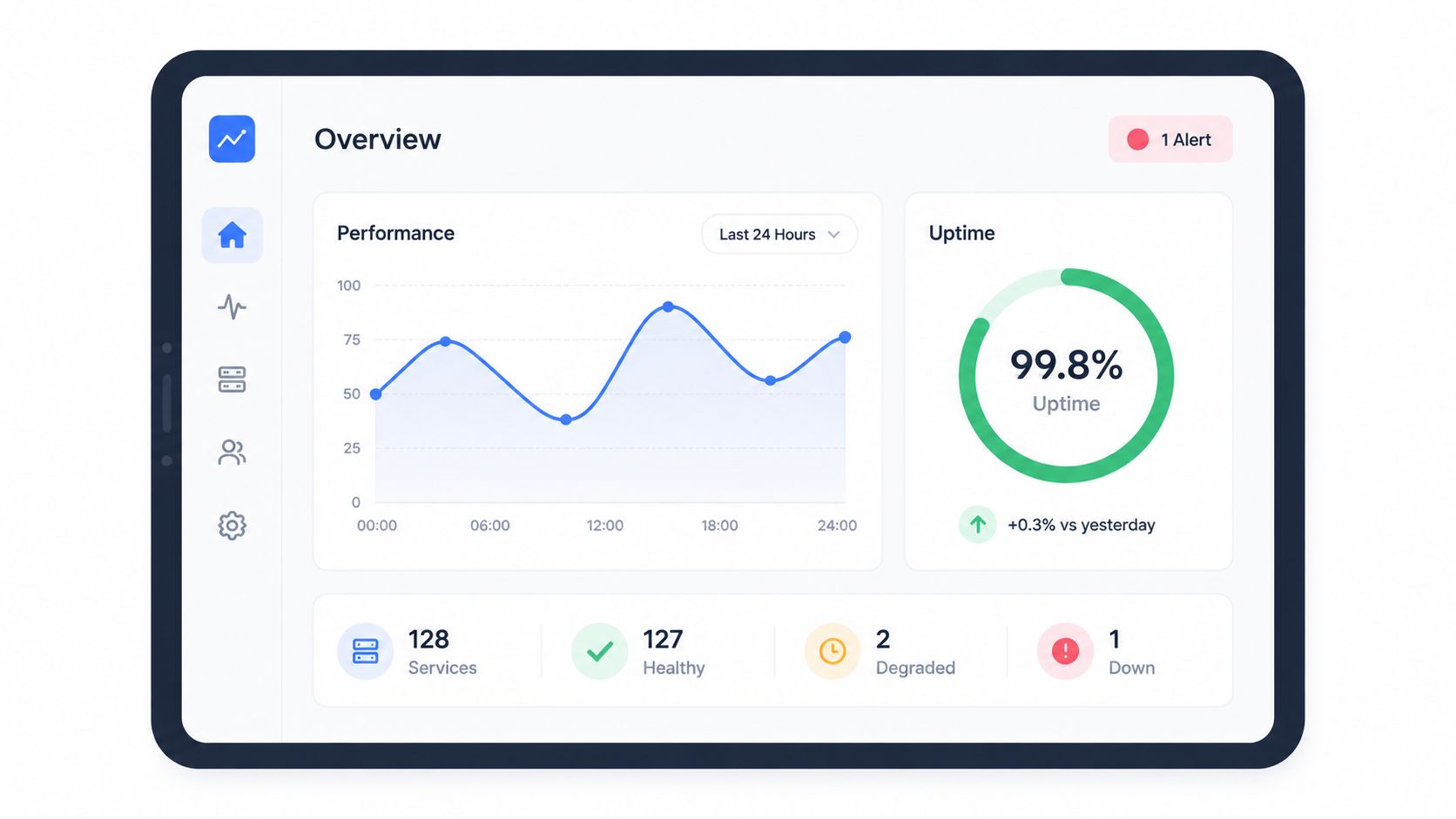
Alt text: Compliance dashboard for best practices for risk management in commercial doors, docks, and fire-rated openings.
Keep your proof inspection-ready
For critical access equipment, your documentation should be easy to retrieve and easy to understand. That includes service records, inspection reports, deficiency notes, corrective actions, and any required certifications or labels.
Fire-rated assemblies deserve special attention because they sit at the intersection of life safety, maintenance, and inspection readiness. Teams responsible for those openings should understand the basics of fire door ratings and related fire door requirements, especially if they manage multiple buildings with different occupancies.
Useful records usually include:
- Inspection history: What was checked, when, and by whom.
- Deficiency tracking: What failed, what temporary action was taken, and when permanent correction is due.
- Change records: When a door operator, release device, or access-control component was altered.
- Site-specific evidence: Documents tied to the exact opening, not a generic file folder for the whole building.
The trade-off here is administrative effort. But compliance work gets much cheaper when your records are organised before an inspector, insurer, or internal auditor asks for them.
5. Implement Strong Supplier and Vendor Risk Management
Your vendors carry part of your risk whether you acknowledge it or not. If a subcontractor handles access control, a dock contractor services restraints, or a third party touches systems tied to tenant or facility data, their weak process becomes your problem fast.
The strongest programs don't stop at onboarding paperwork. Independent guidance on third-party risk stresses due diligence plus ongoing control verification, including review of vendor policies, access controls, incident response procedures, and continued monitoring through the third-party risk management practices described by ProcessUnity.
What to verify before it matters
For facility operations, that means asking practical questions. Who can access the site after hours? Who has credentials for networked gate or access systems? How are service calls escalated if a life-safety or security opening fails? If a vendor stores any facility, tenant, or security-related data, what evidence do they provide for access restriction and system protection?
A good vendor review should look at more than price and availability:
- Role clarity: Confirm who does emergency response, routine service, compliance testing, and reporting.
- Control evidence: Ask for documentation, not verbal assurance, when systems involve digital access or sensitive data.
- Escalation path: Make sure there's a defined route for urgent failures and after-hours events.
- Fit for environment: A partner for a low-cycle office entrance may not be the right one for a high-volume distribution dock.
If you manage several sites, consistency matters. A useful starting point is a documented vendor management approach for facility partners that standardises expectations across locations.
What doesn't work is relying on familiarity. “They've always serviced our doors” isn't a risk control.
6. Invest in Continuous Safety Training and Competency Management
A well-designed door is still dangerous in untrained hands. The same goes for a dock leveler, vehicle restraint, automatic operator, or manual release on a fire-rated opening. Most equipment incidents don't begin as engineering failures. They begin as routine shortcuts.
Training has to match the task. Dock staff need to know proper leveler use, trailer communication, and restraint checks. Maintenance staff need to know lockout, adjustment limits, and when a door defect moves from nuisance to shutdown issue. Supervisors need to know when to stop operation instead of asking people to “just get through the shift.”
Train by role, not by poster
The strongest safety training is specific to the equipment and environment. A warehouse with high-speed doors, dock seals, and trailer traffic needs hands-on operating guidance that looks different from a healthcare site managing automatic pedestrian entrances and clean movement between controlled areas.
Good competency management usually includes:
- Operator training: Safe use, visual inspection, emergency stop, and reporting of abnormal behaviour.
- Supervisor training: Incident escalation, shutdown authority, and temporary controls.
- Technician training: Mechanical, electrical, and safety procedures for the equipment on site.
- Refresher training: Updates after incidents, layout changes, new equipment, or recurring misuse.
Field insight: The safest facilities make reporting easy. They don't punish someone for flagging a binding door, a damaged track, or a restraint that “doesn't sound right.”
What doesn't work is one-time orientation followed by silence. Risk changes as equipment changes, and people forget steps they don't practise. Training has to be renewed in the same way maintenance is renewed.
7. Utilize Performance Monitoring and Key Performance Indicators
Annual reviews miss too much. A door can go from minor drag to repeated entrapment issue long before year-end. A dock leveler can show a pattern of delayed response, operator complaints, and frequent resets before it ever becomes a shutdown event. If nobody tracks those signals, the site stays blind until failure is obvious.
That's why modern best practices for risk management rely on continuous monitoring with thresholds and escalation rules. Risk guidance from Protecht highlights key risk indicators, automated notifications when thresholds are breached, dashboards for real-time visibility, and regular review workflows in this overview of continuous risk monitoring and KRI-based escalation.
Pick indicators that change decisions
For facility access points, useful indicators are the ones that force action. Don't build a dashboard full of data nobody uses. Start with operational signals tied to reliability, safety, and response.
Examples include:
- Mean time to repair: Useful when one site or asset keeps consuming emergency service.
- Preventive maintenance completion rate: Helpful for spotting sites that are slipping into reactive mode.
- Contractor response adherence: Important when after-hours delays create security or shipping exposure.
- Repeat failure count: A strong signal that repair activity is treating symptoms, not causes.
A practical benchmark for Canadian organisations is to use quantified, ongoing assessment rather than annual review only. Guidance summarized by AlertMedia points to identifying critical assets, evaluating likelihood and impact, assigning ownership, updating treatment plans, and turning risks into measurable indicators through ongoing quantified risk assessment and recurring review.
The trade-off is discipline. Once you define thresholds, you have to act when they're breached. Monitoring without escalation is just decoration.
8. Implement Strategic Capital Planning and Asset Lifecycle Management
Some assets are expensive to maintain long before they become impossible to maintain. You see it in old dock levelers that need repeated service, aging sectional doors that no longer seal well, or obsolete operators that create parts delays every time they fail. If replacement planning starts only after a breakdown, the budget decision is already late.
Lifecycle planning puts risk, cost, and operational need in the same conversation. Instead of asking whether a door can be repaired one more time, ask whether the asset still fits the facility's demands, compliance needs, and service environment.
Replace based on exposure, not frustration
A useful capital plan looks beyond age alone. Condition, service history, downtime impact, and code or performance gaps all matter. A manufacturing plant might phase out a high-maintenance mechanical leveler in favour of hydraulic equipment if reliability and safety are driving too many workarounds. A property portfolio might prioritise replacing older access systems that make audits and credential control harder.
This is also where estimating discipline matters. For larger replacements, budgeting is stronger when scope is tied to opening type, controls, electrical work, shutdown timing, and site constraints. Tools such as Exayard construction estimating software can support planning when teams are comparing retrofit options across multiple facility assets.
The biggest mistake is treating capital planning as separate from risk management. It isn't. Deferred replacement is often a deliberate decision to accept more operational risk. That may be reasonable for a low-use gate. It's rarely reasonable for a critical dock position or a life-safety opening.
9. Adopt Root Cause Analysis for Continuous Improvement
If the same door keeps failing, the part usually isn't the whole story. Replacing a roller, hinge, limit switch, or lip actuator without asking why the failure repeats is how maintenance budgets get drained while risk stays in place.
Root cause analysis works because it slows people down. It separates the immediate fix from the underlying reason. A dock leveler may appear to have a mechanical problem, but the pattern could point to improper loading practice, poor trailer positioning, water intrusion, missed maintenance, or damage from mobile equipment.
Ask better questions after every incident
A useful RCA process should include the people closest to the event. Operators often know the behaviour that changed first. Technicians know what looked abnormal inside the equipment. Supervisors know whether production pressure encouraged shortcuts.
Focus your review on a few questions:
- What failed first: The component, the process, or the decision?
- What condition made it possible: Wear, misuse, missed inspection, environment, or design mismatch?
- What control failed: Training, maintenance interval, guarding, reporting, or shutdown authority?
- What must change: Repair action, operating procedure, replacement plan, or accountability?
A recurring overhead door impact is a simple example. If the team only replaces bottom panels, they've repaired damage. If they adjust traffic flow, retrain forklift operators, improve sightlines, and inspect the track and operator for hidden stress, they've reduced recurrence.
The point of RCA isn't to find someone to blame. It's to make the same failure harder to repeat.
That mindset matters across sites. One lesson learned in a busy distribution centre can prevent the same incident in every building using similar equipment.
10. Use Insurance and Financial Risk Transfer Strategically
Insurance belongs at the end of the list for a reason. It helps absorb loss. It doesn't prevent a door from failing open, a dock from going offline, or an access point from creating a security issue during a storm. If a team leans on insurance before tightening maintenance, documentation, and operating controls, it's using the wrong tool first.
That said, financial risk transfer still matters. Some losses are bigger than a site should carry on its own. Property coverage, business interruption coverage, warranties, and liability policies all have a place when they match the facility's real exposures and the organisation's documented risk tolerance.
Match coverage to actual site conditions
Review policy fit against your opening systems and operations. A public-facing property with automatic pedestrian doors has different liability concerns from a manufacturing site with high-cycle dock doors and yard traffic. A site in a weather-exposed region may need closer attention to exclusions tied to flood, water ingress, or deferred maintenance.
Continuity planning and insurance should meet. If a critical access failure could interrupt operations for days, your coverage review should reflect that. If outside contractors are working on doors, docks, and gates, their insurance and your own contractor-related protections should also be reviewed. For a plain-language look at this angle, see My Policy Quote's contractor coverage guide.
The practical trade-off is cost versus tolerance. Higher coverage can reduce financial shock, but it won't replace disciplined maintenance records, clear emergency procedures, and site-level controls. Insurers may pay a claim. They won't run your dock tomorrow morning.
Top 10 Risk Management Best Practices Comparison
| Practice | 🔄 Implementation complexity | ⚡ Resource requirements | 📊 Expected outcomes | 💡 Ideal use cases |
|---|---|---|---|---|
| Establish a Proactive Preventive Maintenance Program | Moderate, scheduling, documentation, vendor coordination | Moderate–High, trained techs, parts inventory, digital tracking | Reduced failures, extended asset life (≈20–40%), predictable costs | Facilities with continuous operations, compliance needs, high-use equipment |
| Conduct Comprehensive Risk Assessments and Asset Inventories | High initially, data collection and ongoing updates | Moderate, survey teams, mobile/cloud tools, photos, mapping | Clear asset visibility, prioritized risks, informed CAPEX decisions | Multi‑site or legacy facilities, capital planning, audit preparation |
| Develop a Robust Emergency Response and Continuity Plan | Moderate, plan creation, drills, vendor agreements | Moderate, emergency partners, spare parts, communications, training | Faster recovery, maintained operations, reduced extreme downtime costs | Critical operations (pharma, hospitals, food distribution), high‑risk sites |
| Maintain Rigorous Compliance and Regulatory Documentation | Moderate, scheduling tests, tracking regulations, inspections | Moderate, compliance officer/software, third‑party inspections, records | Reduced fines, audit readiness, lower liability exposure | Facilities under strict codes (fire, accessibility), frequently audited sites |
| Implement Strong Supplier and Vendor Risk Management | Moderate, vetting, SLAs, periodic audits | Low–Moderate, procurement time, vendor management tools, scorecards | Improved service reliability, clearer accountability, backup coverage | Outsourced maintenance models, multi‑site operations needing consistency |
| Invest in Continuous Safety Training and Competency Management | Low–Moderate, program design, assessments, refresher scheduling | Moderate, trainers, time for training, recordkeeping systems | Fewer injuries, better equipment operation, reduced damage and claims | High‑turnover or equipment‑intensive sites, workplaces with regulatory training needs |
| Utilize Performance Monitoring and KPIs | Low–Moderate, metric selection, dashboard setup, data integration | Moderate, monitoring software/sensors, analytics, data governance | Early warnings, measurable ROI, trend insights for improvements | Continuous improvement programs, sites preparing for predictive maintenance |
| Implement Strategic Capital Planning and Asset Lifecycle Management | High, forecasting, multi‑year planning, approvals | High, finance involvement, condition data, procurement processes | Planned replacements, controlled budgets, long‑term cost and energy savings | Aging asset portfolios, long‑term operations, sustainability/efficiency goals |
| Adopt Root Cause Analysis for Continuous Improvement | Moderate, investigation frameworks, CAPA tracking, culture change | Low–Moderate, trained investigators, documentation tools, meetings | Fewer repeat failures, systemic fixes, institutionalized lessons learned | Recurring failures, safety incidents, quality improvement initiatives |
| Use Insurance and Financial Risk Transfer Strategically | Low–Moderate, policy reviews, gap analysis, renewals | Moderate, broker engagement, asset valuations, premium costs | Financial protection from catastrophic losses, business interruption coverage | High financial exposure, capital‑intensive facilities, risk‑transfer strategies |
Partnering for Reliability and Your Next Step in Risk Management
The best practices for risk management aren't abstract when you run a facility. They show up in whether trucks can load, whether staff can move safely, whether a fire-rated opening is ready for inspection, and whether a security gate works when the weather turns or power conditions change. Doors, docks, and access systems are operational assets, but they're also risk points. Managing them well changes the whole tone of a building.
The pattern across all ten practices is simple. Strong risk management is documented, assigned, reviewed, and updated. It doesn't live in a binder that only appears during audits. It lives in maintenance schedules, emergency call trees, technician reports, vendor reviews, KPI dashboards, training records, and capital plans. That's what turns risk management from a policy exercise into a working operating system.
The most common failure I see in facilities is not lack of effort. It's fragmented effort. One team handles maintenance. Another handles compliance. Security manages access. Operations deals with downtime. Finance owns insurance. Everyone is working, but the information doesn't connect. When those pieces come together around the actual access points that keep a site moving, risk becomes easier to see and easier to control.
That matters even more in Canada, where facilities often operate across multiple provinces, service environments, and weather conditions. A living risk register, clear ownership, and ongoing monitoring are more useful than annual box-checking. The goal isn't to create more paperwork. The goal is to reduce avoidable disruption and make the remaining risks visible enough to manage intelligently.
If you're reviewing your current approach, start with the openings that would hurt the most if they failed today. Look at their maintenance history, their operational role, their compliance status, and the realism of your response plan. That exercise usually reveals the next priorities quickly.
Wilcox Door Service Inc. is one relevant option for organisations that need support with commercial and industrial doors, docks, access systems, planned maintenance, fire door testing, and emergency repair. For many facilities, the next practical step is to schedule an inspection, review critical assets, and close the gaps that keep forcing reactive decisions.
For support from Wilcox Door Service Inc., book a service inspection, discuss a planned maintenance program, or review your highest-risk doors, docks, and access points with a team that understands Canadian facility operations.