


Choosing, installing, and maintaining aircraft hangar doors is a critical decision for any Canadian aviation facility. These massive systems are more than just openings; they are essential operational assets that protect multi-million dollar aircraft, ensure personnel safety, and drive the efficiency of your entire operation. This guide will walk you through everything you need to know, from comparing different door types to understanding the crucial long-term value of professional maintenance.
In this guide, you will learn how to evaluate the primary types of hangar doors—like bi-fold, sliding, and hydraulic systems—and understand their practical applications. We'll simplify complex topics such as structural loads, wind codes, and the thermal performance necessary to withstand Canada's diverse climate. By the end, you'll have the confidence and knowledge to partner with an expert, minimize operational downtime, and ensure your hangar's access points are secure, compliant, and built for lasting performance.
What You Will Learn in This Guide
This guide breaks down complex topics into straightforward sections, giving you a clear path from the initial idea to the final installation and ongoing care. You’ll get a solid understanding of these key areas:
- Door Types and Operation: We’ll compare the most common systems—bi-fold, sliding, hydraulic, and vertical lift—explaining in simple terms how they function and which applications they suit best.
- Structural and Code Requirements: Learn about the non-negotiable design factors like wind load ratings, fire codes, and building integration that ensure your door is both safe and fully compliant.
- Performance and Efficiency: We'll show you how insulation, seals, and modern operators contribute to significant energy savings and operational reliability—a must for any facility facing Canadian winters. For example, a well-insulated door can prevent massive heat loss, much like sealing drafts in a large warehouse.
- Maintenance and Longevity: Understand why a Planned Maintenance Program (PMP) is crucial for preventing expensive downtime and maximizing your return on investment. While the principles are similar to those for commercial overhead doors, the scale and stakes are significantly higher.
As your respected partners in the industry, we believe an informed client makes the best decisions. Our goal is to provide clarity, helping you look beyond the initial price tag to see the total cost of ownership and long-term performance. "Respected Partners, Reliable Service" isn't just a tagline; it's our commitment to you.
Choosing the right partner is just as critical as choosing the right door. We will also offer guidance on how to select a service provider who can deliver reliable, 24/7 support. Let’s get started by exploring the different types of hangar doors on the market.
Comparing the Core Types of Hangar Doors
Choosing the right type of aircraft hangar door is one of the most critical decisions you'll make for your facility. Each design comes with its own set of trade-offs affecting everything from available space and opening speed to structural needs and your bottom line.
Let's walk through the most common systems out there: bi-fold, sliding, hydraulic, and vertical lift doors. We'll break down how they work in the real world, focusing on practical applications for Canadian facilities, so you can get a clear picture of what each door means for your hangar's design and day-to-day operations.
Hangar Door Type Comparison
To get a quick overview, it helps to see these doors side-by-side. Each system operates differently and shines in certain situations. Think about your hangar's physical constraints and how you plan to use the space.
| Door Type | How It Works | Key Advantage | Best For |
|---|---|---|---|
| Bi-Fold | Two horizontal panels fold in the middle and lift upward, stacking in a wedge shape under the door's top frame (header). | Creates a useful canopy when open, providing a sheltered outdoor workspace. | Private hangars, hangar homes, and facilities where interior wall space is a premium. |
| Sliding | Multiple door panels slide horizontally along top and bottom tracks, stacking on one or both sides. | Extremely stable in high winds and puts minimal stress on the building's header structure. | Very large openings, windy locations, and retrofits on older buildings not built for heavy overhead loads. |
| Hydraulic | A single, solid panel is hinged at the top and swings outward and upward, powered by hydraulic cylinders. | Provides a completely clear opening with no loss of headroom and forms a large, solid canopy. | Modern hangars, facilities needing maximum clear height, and situations where a sleek aesthetic is desired. |
| Vertical Lift | Multiple horizontal sections lift straight up into a pocket in the ceiling or a housing above the door. | Saves the most space, as it requires almost no side room or interior projection. | Specialized MRO facilities, buildings with gantry cranes, and hangars for high-tailed aircraft. |
This table gives you the basics, but the real devil is in the details. Let's look closer at what makes each of these doors tick.
The Accordion Fold: Bi-Fold Doors
Bi-fold doors work a lot like a giant, powerful accordion. They’re built from two large horizontal sections that fold in half as they rise, tucking themselves into a neat wedge just below your building’s header. The header is the main horizontal support beam above the door opening.
This design is a workhorse, popular for both new builds and retrofits thanks to its simple mechanics and reliability. Because the door folds upward, it needs very little side room inside the hangar. That makes it a great pick for facilities on tight lots or with several hangar bays lined up next to each other.
- How It Works: An electric motor turns a system of lift cables or straps, which smoothly pull the two panels up until they are stacked securely.
- Key Advantage: One of the best perks of a bi-fold door is the canopy it creates when open. This gives you a shaded and sheltered spot right outside the hangar, perfect for protecting aircraft and staff from sun or rain during pre-flight checks.
- Best For: Private hangars, hangar homes, and commercial operations where you need to make the most of your interior wall space. Their straightforward design often means fewer maintenance headaches down the road.
The Classic Solution: Sliding Doors
Sliding doors—also known as rolling or multi-panel doors—are the traditional, heavy-duty solution for truly massive openings. They use a series of individual door panels that roll along tracks at the top and bottom, sliding past each other to stack up on one or both sides of the hangar entrance.
Picture a huge set of closet doors. Since they don’t swing out or lift up, they are exceptionally sturdy in high winds, even while opening or closing. The main trade-off, however, is the significant "stacking room" they demand along the hangar's interior or exterior walls.
Key Consideration: The structural integrity of sliding door systems is a major plus. The door's entire weight rests on ground-level tracks, so it puts almost no load on the building's header. This can simplify the design of a new building and makes them an ideal choice for retrofitting older structures that can’t support a heavy overhead door. For example, an older military hangar from the 1960s might not have a header strong enough for a modern bi-fold door, making sliding doors the perfect upgrade solution.
The Powerful Swing: Hydraulic Doors
For a sleek, modern look and impressive power, single-panel hydraulic doors are tough to beat. The system is just one solid door panel, hinged at the top of the opening. It swings outward and upward, driven by a pair of brawny hydraulic cylinders mounted on each side of the frame.
When it's fully open, the door panel becomes a large, solid canopy extending straight out from the building. This design delivers a stunningly clear opening with absolutely no loss of headroom, as the door itself is stored completely outside the hangar's vertical clearance.
This infographic helps simplify the decision by highlighting the main factors—your aircraft, your building, and your climate—that point toward the best door type for you.
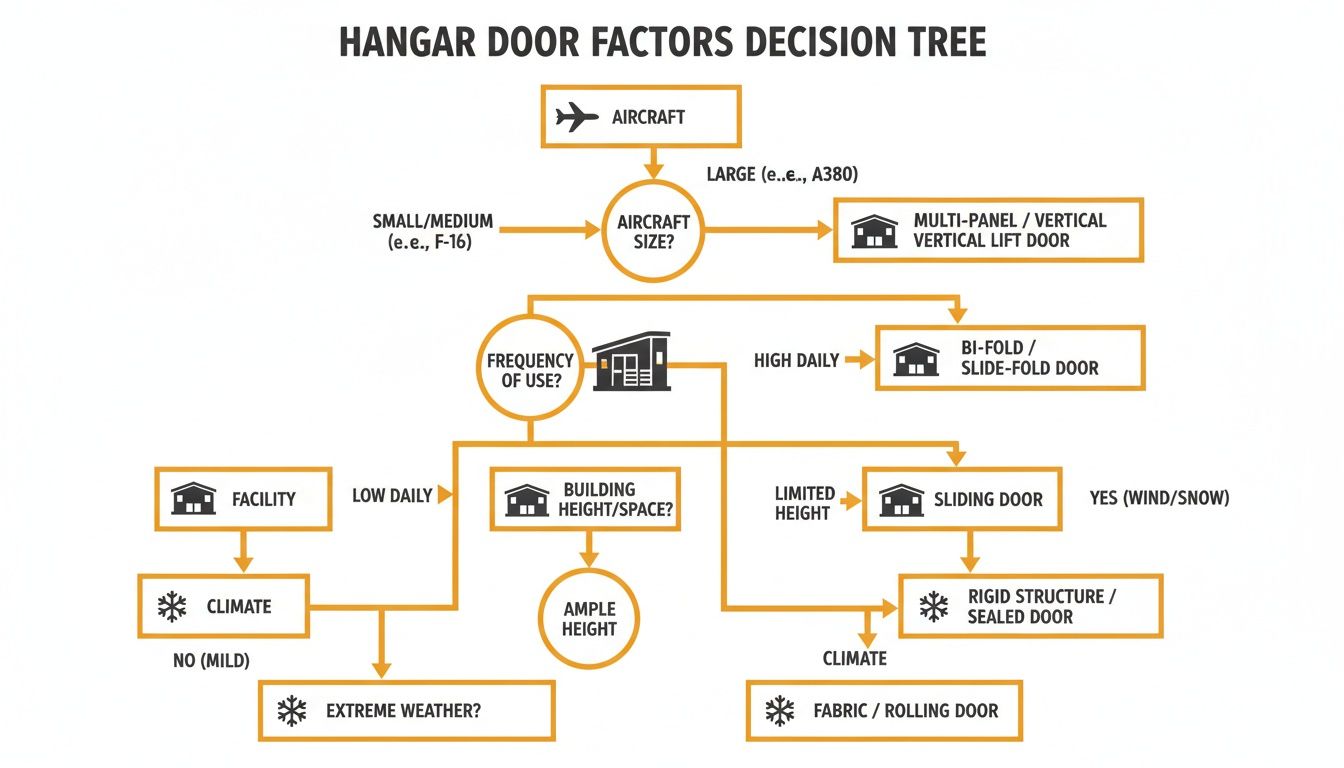
Alt text: Decision tree illustrating factors for selecting aircraft hangar doors based on aircraft size, frequency of use, building, and climate.
As you can see, the process often starts with the size of your aircraft and the structural limits of your hangar, which quickly helps narrow down your options.
The Space-Saver: Vertical Lift Doors
Vertical lift doors are a highly engineered solution built for complex situations where side room and overhead space are both at an absolute premium. Comprised of several horizontal sections, the door rises straight up into a "pocket" built into the ceiling or a housing above the opening.
The concept is similar to the sectional doors you'd find on a loading dock, just scaled up for an aircraft. You can explore more about the fundamentals of commercial overhead doors to see how these principles apply across different industrial settings.
This system is the ultimate space-saver, perfect for hangars that need to preserve every inch of width and height. By moving vertically, these doors don't interfere with overhead gantry cranes, tall-tailed aircraft, or other equipment inside the building. This makes them a top-tier choice for specialized maintenance, repair, and overhaul (MRO) facilities.
Understanding Critical Design and Structural Factors
An aircraft hangar door isn't just something you attach to the building; it’s a massive, moving part of the structure itself. Getting the design and engineering right from the start is absolutely critical for safety, code compliance, and the long-term health of your facility.
We’re going to walk through the essential factors you need to consider. We’ll look at how immense forces—like the door’s own weight and powerful winds—are transferred to your building. You’ll also see how building codes dictate strength, why fire ratings are so important for safety, and how the right insulation can make a huge difference to your energy bills during a harsh Canadian winter.
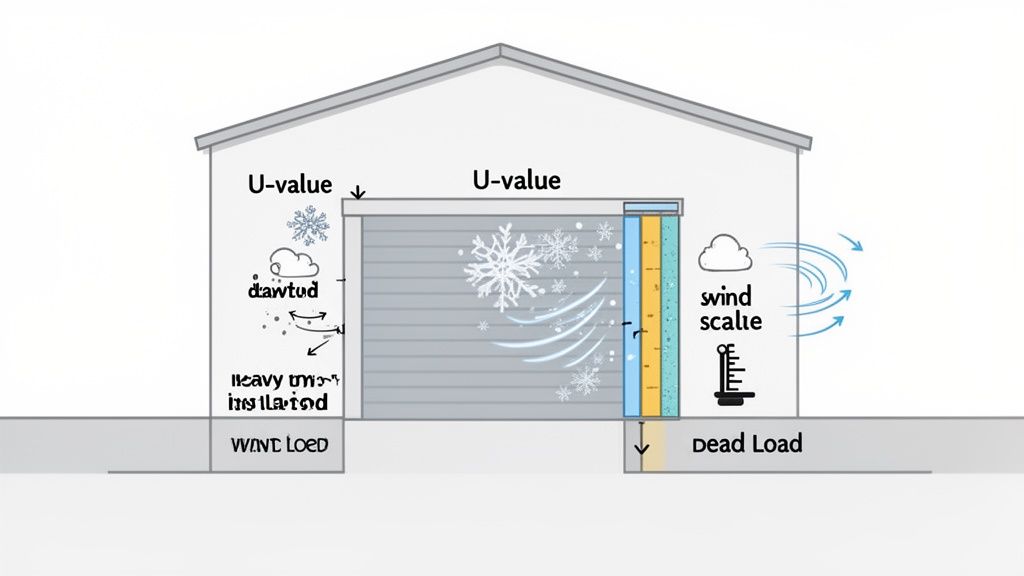
Alt text: Diagram of a 'Photor Safety Edge' system showing a control panel, motor, and red light sensors.
Wind Loads and Dead Loads
Two of the most important forces your hangar and its door must be built to handle are dead loads and wind loads. They sound technical, but the concepts are straightforward.
- Dead Load: This is simply the static, constant weight of the door system itself. A huge steel hangar door can weigh many tonnes, and your building’s header and frame must be engineered to support that massive weight without bending or failing.
- Wind Load: This is the force the wind exerts on the door. A hangar door has a huge surface area, acting like a giant sail in a storm. The National Building Code of Canada specifies exactly what wind loads your door must withstand, based on its geographic location.
For example, a hangar on the coast of British Columbia or out on the Alberta prairies will face much higher wind forces and require a stronger wind load rating than one in a sheltered, inland area. This isn't just about the door surviving a gale; it's about ensuring the force is transferred safely to the building structure.
Fire Safety and Code Compliance
In any aviation facility, fire safety is non-negotiable. Hangar doors often serve as a vital part of the building's fire protection plan, acting as a massive barrier to slow the spread of fire and smoke.
Fire-rated hangar doors are specifically engineered and tested to hold back a fire for a set amount of time (e.g., 60, 90, or 180 minutes). It’s crucial that these doors integrate perfectly with the building's fire alarm and suppression systems.
In the event of a fire, an automated signal can trigger the fire-rated door to close, compartmentalizing the area and protecting valuable assets and personnel. This is a critical consideration for MRO facilities where flammable materials are common. Our experts can help you navigate these complex requirements and ensure your systems, including any rolling fire doors within the facility, are fully compliant.
Thermal Performance and Energy Efficiency
Heating a massive, high-ceilinged hangar is a major operating cost, especially in Canada. An uninsulated door is like having a giant window wide open all winter, letting your heating dollars fly right out. This is where thermal performance becomes a critical part of your door’s total cost of ownership.
We measure a door’s thermal efficiency with a U-value—put simply, the lower the U-value, the better the door is at keeping heat inside. This is achieved with high-quality insulation panels filling the door structure and, just as importantly, robust weather seals around the entire perimeter to stop drafts.
A properly insulated door can cut your heating costs by up to 30%, offering a clear return on your investment. This is especially relevant as Canada's aviation sector grows, with the hangar market projected to hit $45.61 USD million by 2032. Much of this growth involves new infrastructure in northern regions, where energy-efficient, reliable doors are essential for protecting aircraft from extreme cold. As seen in market analysis from Market Growth Reports, upgrading to doors that combine structural integrity with top-tier thermal performance is simply a smart financial move.
Beyond saving money, an energy-efficient door also creates a more stable and comfortable work environment for your maintenance crews. You can see how these same principles apply to other large openings when you look into our solutions for loading dock equipment.
How Operators and Controls Optimize Performance
Modern aircraft hangar doors aren't just massive panels of steel; they're sophisticated systems. The operators and controls are the brains behind the brawn, giving these enormous structures the precision, safety, and efficiency needed for daily operations.
From the motors delivering raw power to the sensors that prevent costly accidents, understanding these components is crucial to getting the most out of your hangar. A clunky, manual door system isn't just inefficient—it's a liability. Upgrading to a modern operator and control setup brings immediate benefits, cutting down on labour, boosting safety, and providing reliable performance every single time.
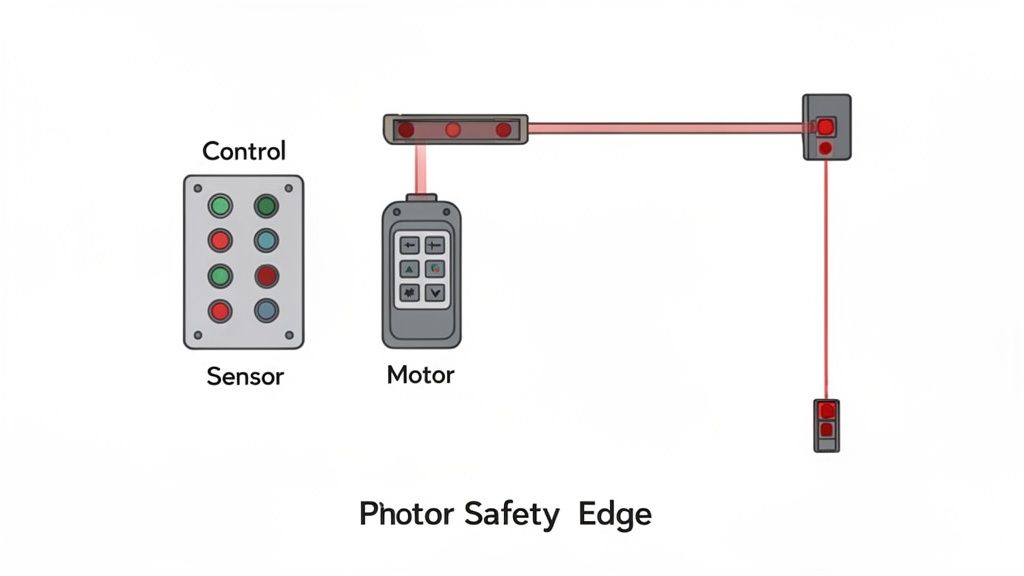
Alt text: Diagram illustrating factors affecting an aircraft hangar or garage door's thermal performance in cold, windy conditions.
Comparing Hangar Door Operator Types
The operator is the workhorse of your door system—the motor that drives its movement. The two main players are electromechanical and hydraulic, and each has its place depending on your operational demands.
- Electromechanical Operators: These are the most common choice, and for good reason. They use an electric motor with gears, chains, or straps to lift or slide the door. Think of it as a super-sized, heavy-duty version of a residential garage door opener. They’re known for being reliable, relatively quiet, and offering smooth, controlled motion.
- Hydraulic Operators: When you need to move an incredibly heavy door, hydraulics bring the muscle. Used primarily for single-panel hydraulic doors, these systems use fluid-filled cylinders to powerfully push the door open. While unmatched in strength, they can be more complex to maintain and require regular checks on hydraulic lines and fluid levels.
Your decision here will come down to a practical balance of door size, how fast you need it to open, and what your maintenance team can comfortably handle.
The Brains of the Operation: Control Systems
Control systems have come a long way from a simple up-and-down button. Today’s options offer a whole spectrum of convenience and integration that can transform your workflow.
Basic Controls
The industry standard is a simple three-button station (Open, Close, Stop) mounted right by the door. This gives you direct, no-fuss control and is essential for manual operation or during maintenance checks.
Advanced Controls
To really boost efficiency, many facilities are stepping up to more advanced options:
- Remote Controls: Handheld remotes empower ground crews or even pilots to operate the door from a distance, shaving off valuable time during aircraft movements.
- Keypad Access: A secure keypad lets you restrict door operation to authorized personnel, adding a simple but effective layer of security.
- Automated Systems: The most advanced setups can be tied directly into a building's management software. This allows for central control room operation and can even link the door’s status to lighting and HVAC systems for greater energy efficiency.
The push toward automation is undeniable. Facility managers at Canadian airports are increasingly adopting fully-automatic hangar doors, a segment projected to capture 52.1% of the market revenue by 2026. Across Canada's over 1,500 airports, these systems—often straight-sliding types holding 25.7% market share—can reduce labour by 50% and dramatically cut accident risks. With the overall Canadian hangar door market forecast to hit USD 14.26 million, driven in part by aviation expansion in the north, the trend is clear.
Essential Safety Features
With doors this large and heavy, safety isn’t just a feature; it’s a necessity. Modern operators are packed with redundant safety systems designed to protect both your people and your multi-million-dollar aircraft.
Think of these features as your door's "senses." They are constantly monitoring the opening for obstructions and can stop or reverse the door's movement instantly to prevent an accident. A real-world example is a photo-eye sensor stopping a closing door because a service cart was accidentally left in its path, preventing thousands of dollars in damage.
Here are the key safety components you’ll find:
- Photo-Eye Sensors: These project an invisible beam of light across the door opening. If anything—a person, vehicle, or piece of equipment—breaks that beam, the door will immediately stop or reverse.
- Reversing Safety Edges: This is a pressure-sensitive strip running along the bottom edge of the door. If it makes contact with an object while closing, it instantly signals the operator to reverse direction.
- Warning Systems: Flashing lights and audible alarms are non-negotiable. They activate whenever the door is in motion, giving everyone in the vicinity a clear alert to stand clear.
These features aren't optional extras. They are a critical part of any modern aircraft hangar door system, essential for maintaining a safe work environment. Ensuring they are properly installed and regularly tested should be a cornerstone of any responsible maintenance plan. If you'd like to take a deeper look into the motor systems themselves, check out our guide on choosing an automatic door operator.
Planning for Installation, Retrofitting, and Maintenance
The long-term safety and performance of your aircraft hangar doors boil down to two things: a flawless installation and consistent, professional maintenance. A world-class door system will fail if it's installed poorly, but even a standard door can operate reliably for decades with the right care.
This is your guide to getting both parts right, whether you're breaking ground on a new facility or upgrading an existing one. We'll walk through what a professional installation actually involves, the common hurdles of retrofitting older hangars, and how to build a rock-solid Planned Maintenance Program (PMP). Getting this lifecycle right protects your investment, guarantees uptime, and keeps your team and aircraft safe.
The Foundation of Reliability: Professional Installation
Installing a modern aircraft hangar door isn't just another construction task—it's a specialized discipline. These are massive, engineered systems that must be perfectly aligned with the building's structure to work correctly. A single mistake during installation can cause operational headaches, premature wear, and even structural damage to your hangar.
A professional installation is a meticulous process, not a rush job. It always follows a few key stages:
- Structural Verification: Before a single part is lifted, the crew confirms the building’s header, columns, and foundation perfectly match the door's engineering specs. No assumptions.
- Component Assembly: The door sections, whether it’s a massive hydraulic panel or a multi-leaf sliding system, are assembled on-site with precision tolerances.
- System Integration: This is where the operator, drive system, lift cables or hydraulic lines, and all the controls and safety devices are installed and connected.
- Commissioning and Testing: In this final, critical phase, the door is run through dozens of cycles. Technicians test its balance, speed, and every safety feature, fine-tuning limit switches and calibrating sensors until it all works as one seamless system.
Think of it like certifying an aircraft engine. Every component has to be installed to exact specifications by a certified technician for the whole system to be considered airworthy. The same principle applies here; only an expert team can make your door "facility-worthy."
Navigating the Challenges of Retrofitting
Upgrading an older hangar with a new door is a fantastic way to boost efficiency and safety, but it’s rarely a simple swap. Retrofitting is an adaptation project. It's about making a modern door work with a structure that wasn't designed for it.
For instance, if you replace old, ground-supported sliding doors with a new top-hung bi-fold system, the entire load distribution changes. The building’s header, which once carried very little weight, now has to support the full dead load of the new door. It will almost certainly need to be assessed and reinforced by a structural engineer.
Common issues we see in retrofit projects include:
- Structural Upgrades: Reinforcing the existing steel frame to handle the weight and dynamic forces of the new door type.
- Electrical and Control Integration: Running new power and integrating modern, code-compliant controls into the building's older electrical system.
- Accommodating Door Footprints: A bi-fold needs different headroom than a hydraulic door. A sliding door needs different side room. The building itself may need to be modified to make it fit.
An experienced partner like Wilcox Door Service specializes in these complex projects. Our team can perform a thorough site assessment to spot these challenges upfront and engineer a solution that makes the new door feel like it was there all along.
The Non-Negotiable: A Planned Maintenance Program
Once your door is in and commissioned, the job shifts to proactive care. A Planned Maintenance Program (PMP) is the single best way to prevent catastrophic failures, avoid expensive downtime, and get the maximum possible lifespan out of your hangar door. You wouldn't skip scheduled maintenance on your aircraft, and your hangar door is no different.
A comprehensive PMP inspection should be done at least once a year by a certified door technician. This is not a quick visual once-over; it's a deep dive that covers dozens of checkpoints on the health of your door system. A true maintenance visit always concludes with a detailed report outlining findings and clear recommendations.
A proper PMP checklist will always include:
- Structural Components: Checking all welds, fasteners, and panels for signs of metal fatigue, stress, or corrosion.
- Mechanical Systems: Inspecting lift cables for fraying, lubricating all moving parts like rollers and hinges, and checking track alignment.
- Operator and Drive System: Verifying motor performance, checking fluid levels in gear reducers, and ensuring proper drive chain tension.
- Safety Devices: Function-testing every single safety feature, from photo-eyes and reversing edges to emergency horns and strobes.
Protecting your investment and ensuring your operation never stops because of a door problem starts with a commitment to professional maintenance. To see what this level of care looks like for large-scale doors, you can learn more about our approach to industrial door repair and service.
Choosing a Partner and Evaluating Total Cost of Ownership
Picking the right aircraft hangar doors is a huge decision, but it’s only half the story. The partner you choose to install and service those doors is just as critical. It's tempting to go with the lowest quote, but a low initial price can hide a world of future headaches, from shoddy installation work to unreliable service and costly downtime.
The smart move is to shift your focus from the sticker price to the Total Cost of Ownership (TCO). TCO isn't just the purchase price; it's the sum of every cost over the door's entire life. This includes everything from energy bills and routine maintenance to emergency repairs and the massive financial hit of unexpected downtime. A cheaper door that bleeds heated air or breaks down constantly is no bargain in the long run.
Vetting Your Service Provider
You're not just looking for a vendor; you're looking for a true partner—a team that functions as an extension of your own. This requires a bit of digging. Don't let a low bid distract you; you need to verify their qualifications and experience.
Look for a company with a long, proven history in the field. Ask them for case studies or to speak with some of their other aviation clients. A track record of successful hangar door projects proves they get the unique demands of an airport environment, from stringent security protocols to safety-critical operations.
A respected partner isn't just selling you a door; they're providing a long-term asset. Their commitment to reliable service and certified expertise ensures your multi-million-dollar investments—both the door and the aircraft behind it—are protected. This aligns with our core message of “Respected Partners, Reliable Service.”
Key Criteria for a Reliable Partner
When you’re talking to potential service providers, you need to measure them against a solid set of standards. This is how you find a team that can support your operation today and for years to come.
Here are the non-negotiables:
- Certified Technicians: Are their technicians factory-trained and union-certified to work on these massive, complex door systems? This isn't a place for on-the-job training. Certification guarantees they follow the highest safety and quality standards.
- National Coverage: If your organization operates hangars at multiple airports across Canada, you need a partner with a national service footprint. This means you get consistent service standards and a single point of contact, no matter where your facilities are.
- 24/7 Emergency Service: A hangar door failure isn’t going to wait for business hours. A partner offering 24/7 emergency repair is absolutely essential. A door that won't open can ground an entire fleet, and every minute of downtime costs you money.
- Comprehensive Service Offerings: Look for a provider that handles the entire lifecycle: design, installation, planned maintenance, and eventual retrofits. Having one company responsible for everything prevents miscommunication and ensures someone is always accountable.
Thinking about the full lifecycle of your door system will naturally lead you to a partner who values long-term performance over a quick sale. By asking the right questions, you can build a relationship that keeps your most critical assets secure and operational for decades.
Hangar Door Questions Answered
When you’re managing an asset as large and critical as an aircraft hangar door, a few questions always come up. Here are our straight-to-the-point answers to some of the most common ones we hear from facility and operations managers.
How Often Should My Hangar Door Be Serviced?
We recommend a thorough, professional service inspection at least once per year. Think of it as an essential check-up. This should be part of a Planned Maintenance Program (PMP) to keep everything on schedule.
However, if your hangar is a high-traffic hub or located in a harsh environment—like coastal areas with salt spray or northern regions with ice and snow—bumping that up to semi-annual inspections is a smart move. This proactive care keeps safety systems, motors, and structural parts in top working order and helps you avoid sudden, costly downtime.
What Is the Lifespan of a Hangar Door?
With professional installation and a consistent maintenance routine, a quality aircraft hangar door can serve you reliably for 25 to 30 years, sometimes even longer. The final number really depends on the door type, how often it’s used, and what kind of weather it has to stand up to.
The single biggest factor in getting the most life out of your door is regular, professional upkeep. Neglecting maintenance can easily cut a door's functional life in half and lead to premature, expensive failures.
Can an Old Manual Hangar Door Be Automated?
Absolutely. In nearly all cases, an existing manual hangar door can be retrofitted with a modern operator and control system. This is one of the most common and effective upgrades we perform, and it makes a huge difference in daily efficiency, safety, and convenience.
Before any work begins, a qualified technician needs to do a full site assessment. This step is critical. They'll evaluate your specific door type, its weight, and your building’s structure to choose the right motor, drive system, and safety controls. This ensures the new automation system integrates perfectly with the door you already have.
At Wilcox Door Service Inc., our goal is to provide lasting value through our commitment to being “Respected Partners, Reliable Service.” If you have more questions or need expert guidance on a hangar door project, our team is ready to help.
Ready to find a partner who understands the total cost of ownership? Contact us today to schedule a consultation or service inspection.