


Choosing between a fiberglass door versus steel door for your commercial facility? This guide cuts through the technical jargon to give you a clear, practical comparison focused exclusively on sectional overhead doors. You will learn the key differences in durability, environmental resistance, lifecycle costs, and thermal performance. By the end, you’ll understand which material is the right long-term investment for your specific industry—from a high-traffic warehouse to a corrosive car wash environment.
Understanding Your Commercial Door Options
Selecting the right commercial sectional overhead door is a long-term investment in your facility’s efficiency, security, and operational budget. The classic debate between fiberglass and steel isn’t about which is “better” overall, but which is better for your specific application. The door that excels on a busy distribution centre’s loading dock might fail within years in the damp, chemical-heavy environment of a food processing plant.
This guide will walk you through a detailed analysis to help you make an informed decision that goes beyond the spec sheet. We’ll cover:
- Durability and Impact Resistance: How each material stands up to the daily grind of forklifts, carts, and equipment.
- Environmental Resilience: Performance when facing moisture, harsh chemicals, and extreme Canadian weather.
- Lifecycle Costs: A look past the initial price to the total cost of ownership, including ongoing maintenance and repair needs.
- Thermal and Acoustic Insulation: How each door can contribute to energy savings and a quieter, more controlled workplace.
Quick Comparison: Fiberglass vs. Steel Commercial Sectional Doors
To start, here’s a high-level summary of the key characteristics of commercial fiberglass and steel sectional doors. Think of this as a quick-reference guide to understand the fundamental differences.
| Attribute | Steel Doors | Fiberglass Doors |
|---|---|---|
| Primary Strength | Impact resistance and security | Corrosion and chemical resistance |
| Best For | Warehouses, manufacturing, high-traffic docks | Car washes, food processing, coastal areas |
| Durability | High, but susceptible to dents and rust if scratched | High, resists dents, scratches, and moisture |
| Initial Cost | Generally lower | Generally higher |
| Maintenance | Requires paint touch-ups to prevent rust | Low; requires occasional cleaning |
Understanding these trade-offs is the first step toward choosing a door that truly enhances your facility’s productivity and longevity.
Steel doors are a dominant force in the commercial market, and for good reason—their strength and security are hard to beat. The growth of the steel door market highlights their popularity in applications where toughness is the top priority. This is especially true in Canada, where stringent building codes and a focus on durability drive demand.
As your “Respected Partners, Reliable Service,” we’re here to help you determine if steel’s strengths are the right fit for your needs, or if fiberglass offers better long-term value for specialized applications, like our dedicated food and beverage doors.
Comparing Durability and Impact Resistance
When you’re choosing a commercial sectional door, the first question is always: how well will it stand up to daily operations? The fiberglass door versus steel door debate begins here. Each material offers a different type of toughness, and selecting the right one depends entirely on your operational environment.
Let’s break down how each material performs in a busy commercial facility—from a direct forklift impact at the loading dock to the slow, creeping threat of rust in a damp environment. We’ll look past the marketing claims to see how their core properties translate into real-world performance and long-term value.

alt=”A large, durable commercial steel sectional door on a modern industrial building, showing its strength and security features.”
Steel Doors: High Tensile Strength
There’s a reason steel is synonymous with strength. Its defining advantage for commercial doors is its high tensile strength—a technical term meaning it’s extremely resistant to being pulled or torn apart. In a real-world scenario, this is the material you want when a forklift operator misjudges a turn at a busy loading dock.
Where a lesser material might crack or shatter, a heavy-gauge steel door will likely only dent. A dented door is usually still a functioning door, which means you avoid a costly operational shutdown. This resilience makes steel the default choice for environments where heavy machinery and high traffic are part of the daily routine. A door’s protective coating, like durable powder coating finishes, is also critical. A quality finish shields the steel from the elements, locking in its structural integrity.
Fiberglass Doors: Resilience and Flexibility
Fiberglass brings a different kind of toughness to the table. As a composite material (made from glass fibres locked in a polymer resin), it has a remarkable blend of flexibility and resilience against smaller, repetitive impacts.
For example, imagine a food distribution centre where carts and dollies constantly bump into the doors. A steel door would quickly accumulate dings and scratches. A fiberglass door, however, often absorbs these minor impacts without showing damage, maintaining its clean, professional appearance for much longer.
Key Takeaway: The choice comes down to the type of impacts you expect. Steel is king for resisting single, high-force events. Fiberglass excels at handling frequent, low-force bumps without denting or scratching.
Corrosion and Chemical Resistance
In this category, fiberglass has a massive advantage. At its core, steel is an iron alloy, which means it will always be vulnerable to rust if its protective coating is compromised.
Modern steel doors use galvanization (a protective zinc coating) and high-quality paints to fight corrosion, but a deep scratch can expose the raw steel to moisture and start the rusting process. This is a critical consideration for facilities with high humidity, chemical exposure, or salty coastal air.
- Car Washes: Constant exposure to water and cleaning agents makes fiberglass the only logical choice. A steel door would likely show significant corrosion in just a few years.
- Food Processing Plants: Strict sanitation protocols require frequent washdowns with caustic chemicals that can strip steel coatings. Fiberglass is chemically inert, meaning it doesn’t react with these substances.
- Coastal Warehouses: Salty sea air is incredibly corrosive. Fiberglass doors offer a maintenance-free solution, eliminating the need for constant paint touch-ups to keep rust at bay.
Fiberglass simply doesn’t rust or corrode. It doesn’t react with water, salt, or most industrial chemicals, which prevents delamination (where material layers separate) and guarantees a longer, more reliable service life in harsh settings.
Security and Fire Rating Considerations
When security is the top priority, steel doors generally come out on top. Their inherent strength and rigidity make them far more resistant to forced entry. A determined intruder will have a much harder time breaching a heavy-duty, reinforced steel door.
Fire safety is another area where steel often has the edge. As a non-combustible material, many commercial steel doors can be constructed to meet specific fire ratings, such as 90-minute or 3-hour certifications. This means they are proven to block flames and smoke for a set period—a critical requirement for building codes in certain applications, like firewalls separating a warehouse from an office. While some specialized fiberglass doors can achieve fire ratings, steel offers a wider range of high-performance options for fire safety compliance. This is an area where expert guidance is crucial, and our team at Wilcox Door can provide clarity through our fire door inspection and testing services.
Analyzing Thermal and Acoustic Performance
Controlling your facility’s internal environment is about more than just comfort; it directly impacts operational efficiency and energy costs. The choice you make in the fiberglass door versus a steel door debate plays a significant role in managing everything from heating bills to workplace noise. A sectional door isn’t just an entryway—it’s a critical component of your building’s thermal and acoustic barrier.
This section breaks down the practical differences, explaining how each material helps with temperature control and sound dampening in a commercial setting.
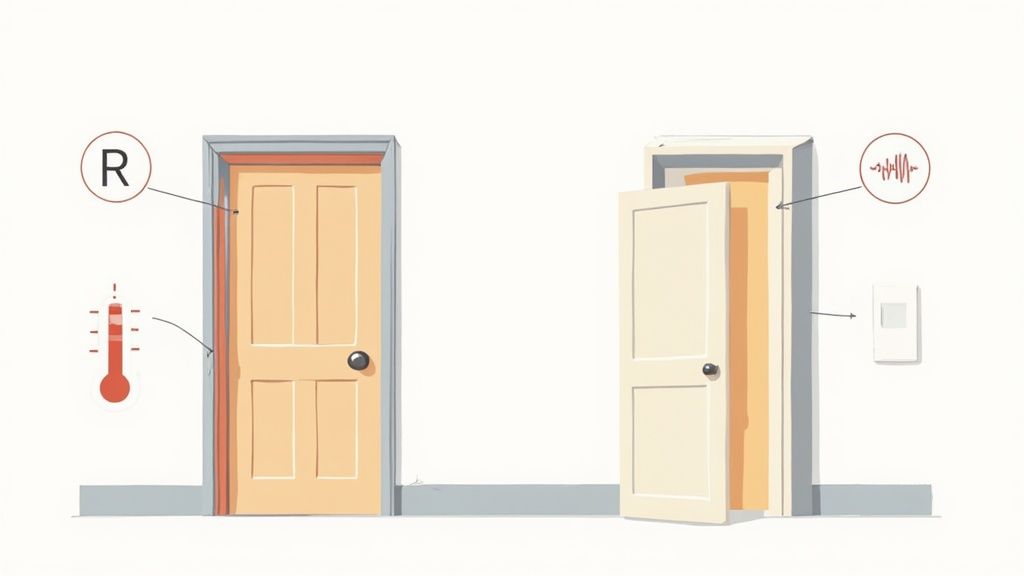
alt=”An insulated commercial sectional overhead door in a climate-controlled warehouse, showing its thermal efficiency.”
Understanding Thermal Insulation and R-Value
When we discuss a door’s insulating capability, the key metric is its R-value. In simple terms, R-value measures how well a material resists heat flow. A higher R-value means better insulation, which translates to lower heating and cooling costs.
For any commercial sectional door, the R-value is determined by its construction—specifically, the insulation injected into its core. Both steel and fiberglass doors can be insulated, but the way they are built makes a real difference in their thermal performance.
Comparing Insulation in Steel and Fiberglass Doors
Modern insulated steel doors are formidable when it comes to energy efficiency. They are typically constructed with a thick core of polyurethane foam injected between two steel skins. This high-density foam is an excellent insulator, allowing premium steel doors to achieve R-values of R-16 or even higher.
However, fiberglass has a natural advantage because the material itself is a better insulator than steel. Steel is a conductor, meaning heat and cold travel through it easily. This can cause thermal bridging—a phenomenon where the cold outside literally transfers through the door’s steel frame, reducing its overall insulating effectiveness.
Key Insight: Fiberglass’s inherent resistance to thermal bridging gives it an edge. That said, modern insulated steel doors are highly competitive, often featuring thermal breaks (barriers within the door’s structure) to stop heat transfer, making them an excellent option for climate-controlled spaces.
The demand for energy-efficient building components is growing, especially in Canada’s demanding climate. This trend is a major driver behind the growth of the commercial door market.
The Role of Insulated Doors in Your Facility
A well-insulated door does more than save on utility bills; it helps create a stable and comfortable work environment. This is critical in facilities like cold storage warehouses or food processing plants where precise temperature control is mandatory. You can learn more about the long-term benefits in our guide to enhancing durability and efficiency with insulated overhead doors.
Consider a large distribution centre during a harsh Ontario winter. An uninsulated steel door becomes ice-cold, radiating that chill onto the loading dock and forcing the heating system to work overtime. An insulated door, whether steel or fiberglass, acts as a powerful barrier against the elements.
Analyzing Acoustic Performance and Noise Reduction
Beyond temperature, your commercial doors are on the front line of noise management. In a busy industrial setting, the sound from machinery, trucks, and daily operations can be more than a distraction—it can be a safety issue.
Here’s how steel and fiberglass compare for soundproofing:
- Steel Doors: The sheer density and mass of steel make it excellent at blocking sound. Specially constructed, acoustically rated steel doors can achieve very high Sound Transmission Class (STC) ratings, making them the perfect choice for separating a noisy manufacturing floor from an office area.
- Fiberglass Doors: While fiberglass offers some natural sound dampening, it typically cannot match the performance of steel in blocking low-frequency industrial noise. Its composite structure is less dense, allowing more sound vibrations to pass through.
For applications where noise control is a top priority—like a performance venue or a sensitive laboratory—an acoustically engineered steel door is almost always the right choice.
Evaluating Lifecycle Cost and Maintenance Needs
When assessing a major facility asset like a commercial sectional door, the initial price tag is just the start. A true cost analysis in the fiberglass door versus steel door debate must consider the total cost of ownership over the door’s entire service life. This includes routine maintenance, repairs, and eventual replacement. Often, the cheapest option today is not the most cost-effective long-term solution.
A door’s lifecycle cost is the sum of every expense from installation to decommissioning. This perspective is vital for facility managers who need to justify capital spending and manage operational budgets. A door with a low upfront cost but high maintenance needs can quickly become a financial liability.

alt=”A facility manager inspecting a commercial sectional overhead door’s tracks and springs, illustrating preventative maintenance on fiberglass and steel doors.”
Steel Door Maintenance Realities
Steel doors often have a lower initial investment, making them an attractive choice. However, their maintenance needs can be more demanding, especially in challenging environments. The primary concern is protecting the steel from corrosion.
Though modern steel doors are well-protected by galvanization and durable factory paint, this shield is not invincible. A deep scratch from a forklift or a bump from a pallet jack can breach the protective layers, exposing raw steel to moisture. Once rust begins, it can spread under the paint, compromising the door’s structural integrity and appearance.
- Routine Touch-Ups: Scratches and dings must be cleaned, primed, and repainted promptly to stop rust. In high-traffic loading docks, this can become a recurring task.
- Dent Repair Challenges: While steel resists major impacts, dents are common. Repairing a dent to match the factory finish is difficult and often leaves a visible imperfection, detracting from your facility’s professional image.
The Low-Maintenance Advantage of Fiberglass
Fiberglass doors typically have a higher initial price, but they often pay for themselves through significantly lower maintenance demands. As a composite material, fiberglass is inherently resistant to the problems that plague steel doors.
This material does not rust or corrode. This makes it an ideal “set it and forget it” solution for facilities with high moisture, chemical exposure, or salty air. A car wash, for example, can install a fiberglass door and eliminate the ongoing labour and material costs associated with rust prevention.
Lifecycle Insight: Over a 15-year lifespan in a corrosive environment, a fiberglass door can offer a significantly lower total cost of ownership than a steel door, even with a higher purchase price. The savings on repainting, rust repair, and potential early replacement add up.
A 15-Year Lifecycle Cost Scenario
Let’s consider a hypothetical 15-year cost comparison for a sectional door at a food distribution centre that requires frequent high-pressure washdowns.
- Steel Door: The lower initial cost is quickly offset by the need for complete repainting every 5-7 years to maintain its integrity. Add the labour for annual inspections and touching up scratches, and the total cost climbs steadily. A major rust issue could even force a premature replacement around the 10-year mark.
- Fiberglass Door: The higher upfront investment is followed by minimal maintenance. Besides routine inspection of mechanical parts like springs and rollers, the door panel itself requires very little attention. It withstands washdowns and chemical cleaners without degrading, ensuring it lasts its full intended lifespan.
Taking this long-term view is essential for smart facility management. By understanding these lifecycle costs, you can make an investment that serves your operational and financial goals. For a deeper dive, explore our guide on reducing the total cost of ownership.
Matching The Right Door to Your Industry
The final decision in the fiberglass door versus steel door debate comes down to context. The “better” door is the one that aligns with your industry’s unique challenges and daily operational demands. A door that’s a champion in one setting could be a constant maintenance headache in another.
To make this practical, we’ve broken down the best applications for each material based on real-world performance. This is a strategic guide to matching the right asset to the right job, ensuring your investment pays off.
When Steel is the Undisputed Champion
Steel’s defining trait is its raw strength. That makes it the go-to choice for environments where durability and security are non-negotiable. If your facility deals with heavy equipment and high traffic, steel is almost always the right answer.
Here’s where commercial steel sectional doors excel:
- Distribution Centres and Warehouses: Loading docks are high-impact zones. A heavy-gauge steel door can take an accidental collision from a forklift that would shatter other materials, preventing costly downtime.
- Manufacturing Plants: In heavy industrial settings, doors face machinery, constant traffic, and security risks. The brute strength of steel provides a tough barrier against both operational wear and potential theft.
- High-Security Facilities: For operations needing enhanced security, like pharmaceutical storage, a reinforced steel door is the best defence against forced entry.
In these applications, the risk of a dent is a small price to pay for a door that remains functional and secure after taking a hit.
Where Fiberglass Delivers Unbeatable Value
Fiberglass shines where its unique properties solve problems steel cannot. Its complete immunity to rust makes it the clear winner for any facility battling moisture, chemicals, or salt.
Consider fiberglass the ideal solution for these specialized industries:
- Car Washes and Vehicle Service Bays: The constant exposure to water and cleaning agents would cause a steel door to rust within years. Fiberglass is completely inert in this environment, offering a low-maintenance, long-lasting solution.
- Food and Beverage Processing Plants: Strict sanitation rules require frequent, high-pressure washdowns with harsh chemicals. A fiberglass door stands up to this regimen without degrading or corroding, helping maintain a hygienic facility.
- Coastal Buildings and Marine Facilities: Salt-laden air is incredibly corrosive. Fiberglass is unaffected by salt spray, making it perfect for any operation in a coastal region.
The market reflects this growing appreciation for lifecycle value. According to industry market research, the global fiberglass door market is projected to grow significantly as more businesses prioritize long-term performance over initial cost in harsh environments.
Expert Insight: The decision often boils down to a simple question: Is the primary threat to your door impact or corrosion? Answering that honestly will point you directly to the right material.
Industry Application Guide: Steel vs. Fiberglass
To simplify your choice, this quick-reference table matches common applications with the recommended door material.
| Industry/Application | Recommended Material | Key Reason |
|---|---|---|
| Warehousing & Distribution | Steel | Superior impact resistance against forklifts and heavy traffic. |
| Heavy Manufacturing | Steel | Maximum durability and security in high-wear industrial settings. |
| High-Security Areas | Steel | Unmatched strength and resistance to forced entry. |
| Car Washes & Vehicle Bays | Fiberglass | Complete immunity to rust and corrosion from constant moisture. |
| Food & Beverage Processing | Fiberglass | Withstands harsh chemical washdowns without degrading. |
| Coastal & Marine Facilities | Fiberglass | Unaffected by corrosive salt air, preventing rust and deterioration. |
| Chemical Storage/Processing | Fiberglass | Resistant to a wide range of corrosive chemicals and fumes. |
| Cold Storage/Refrigeration | Steel (Insulated) | High R-value and structural integrity for temperature control. |
This table provides a solid starting point, but every facility has its own nuances. For a deeper look at our process, explore this recent Toronto sectional door install where we matched a specific solution to the client’s operational needs. As your Respected Partners, Wilcox Door Service provides the expertise to help you select, install, and maintain the perfect door for your application.
Making Your Final Decision With Confidence
Choosing between fiberglass and steel for your commercial sectional door ultimately comes down to your facility’s primary needs. The fiberglass door versus steel door debate isn’t about finding a single “best” material—it’s about matching the right solution to your specific environment and operational challenges.
If your biggest concerns are moisture, corrosive chemicals, or salty air, fiberglass is the clear choice. It offers a corrosion-proof solution that demands little maintenance. On the other hand, if you manage high-traffic areas where impacts and security are top priorities, nothing beats the raw strength of steel.
This decision tree simplifies the core trade-off.
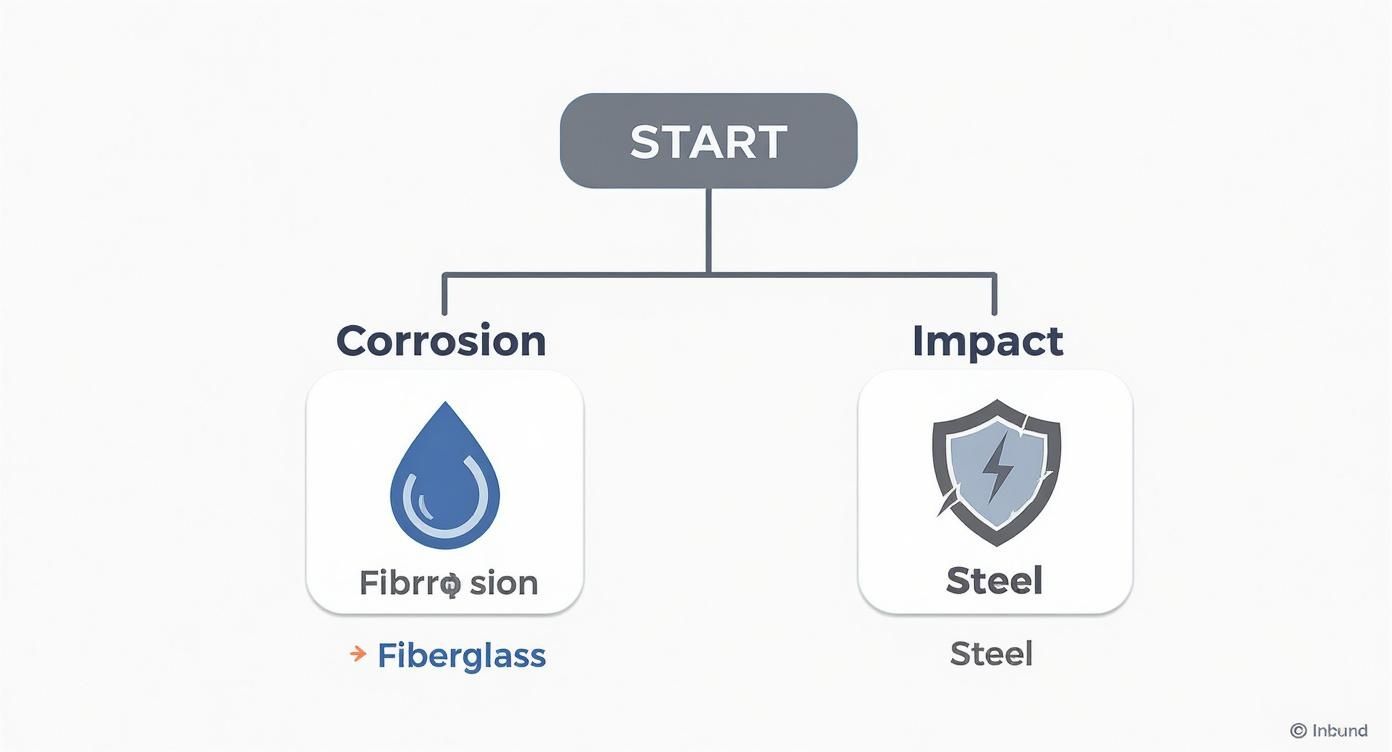
alt=”A decision tree infographic helping users choose between a fiberglass or steel sectional door based on their priority: corrosion resistance or impact strength.”
As the graphic shows, if corrosion is your main enemy, fiberglass is your champion. If it’s all about withstanding physical abuse, steel is the default choice.
As “Respected Partners, Reliable Service,” our goal is to provide a complete solution that fits your facility’s real-world demands, ensuring your investment delivers long-term value and peak performance.
Getting this choice right from the start means better safety, improved efficiency, and a lower total cost of ownership. From expert installation to proactive preventative maintenance programs, Wilcox Door Service provides the support you need to operate with confidence.
Ready to find the perfect commercial sectional door for your building? Contact us today for a personalized consultation and let our experts guide you to the right solution.
Still Have Questions? Let’s Clear Things Up.
Even after a side-by-side comparison, facility managers often have specific questions when deciding between a fiberglass or steel sectional door. Here are straight-to-the-point answers to the most common ones we hear.
Can You Paint a Commercial Fiberglass or Steel Door?
Yes, you can paint both, but the reasons and methods are completely different.
Steel doors often need repainting to cover scratches and, more importantly, to stop rust from forming where the factory finish has been compromised. A proper repair requires sanding, priming, and using a tough, industrial-grade paint.
With fiberglass doors, painting is almost always for aesthetic reasons, like matching a company’s branding. Since they don’t rust, you’re not fighting corrosion. The key is using paint specifically formulated for fiberglass; standard exterior paint will likely peel or flake off the composite surface because it won’t adhere properly.
Which Door Type Is Better for High-Wind Areas?
For facilities in areas prone to high winds or severe weather, steel doors are generally the stronger contender.
Their natural rigidity allows them to be engineered to meet strict wind-load requirements. A properly reinforced commercial steel door can handle significant wind pressures without buckling, which is critical for protecting the building during a storm and ensuring code compliance. While fiberglass doors are tough, heavy-gauge steel provides the next level of structural resistance needed for high-wind certifications.
How Do Repair Processes Differ for Steel Versus Fiberglass Doors?
The repair methods for these two materials are vastly different.
- Steel Door Repairs: A small dent on a steel door is often left as is, as attempting to hammer it out can worsen the appearance. Deeper scratches must be sanded, primed, and painted immediately to prevent rust. If a panel is severely damaged, the most effective solution is a full sectional panel replacement to restore the door’s function and appearance.
- Fiberglass Door Repairs: Minor surface damage like scratches or gouges on a fiberglass door can often be spot-repaired using an epoxy or resin kit, similar to automotive bodywork. This allows for localized fixes that are less intrusive and often more cost-effective than replacing an entire panel.
Making the right call means thinking about these practical, long-term factors. The team at Wilcox Door Service provides expert guidance based on your facility’s unique challenges. Explore our complete lineup of commercial door solutions or get in touch for a personalized assessment.