


Understanding your facility’s fire safety can feel overwhelming, but it doesn’t have to be. This guide simplifies the essential role of the fire door, a critical life-safety system designed to protect people and property. We will break down complex technical terms into plain English, explain your legal responsibilities as a property owner in Ontario, and provide practical steps for maintaining these crucial assets.
By the end of this guide, you will know exactly how a fire door works, what the different fire ratings mean, and why the legally required annual drop test is non-negotiable for protecting your facility and avoiding serious liability.
What You Will Learn in This Fire Door Guide
This guide is a clear, no-nonsense roadmap for commercial and industrial facility managers navigating the world of fire door safety. We’re cutting through the technical jargon to get to what really matters: the vital role these doors play in protecting people, property, and your operations.
Our goal is to give you practical, actionable knowledge. We see ourselves as Respected Partners providing Reliable Service, and that begins with sharing what we know. By the time you’re finished here, you’ll have a solid grasp of fire door systems and your responsibilities as a facility manager or property owner.
Key Topics We Will Cover
- Understanding the System: We’ll break down how a fire door assembly works as a complete unit to contain a fire—a concept called compartmentation.
- Decoding the Labels: You’ll learn what fire ratings like “45-minute” or “3-hour” actually mean in a real fire and how they connect to Canadian building codes.
- Your Legal Obligations in Ontario: We’ll walk you through the mandatory annual inspection and drop-testing requirements under the Ontario Fire Code and talk about the serious liabilities of falling out of compliance. For a wider look at the regulatory duties involved in property management, a comprehensive landlord compliance guide can be a helpful resource.
- Proactive Maintenance: You’ll get a hands-on checklist for in-house inspections, helping you spot potential problems before they become critical failures.
- Choosing the Right Partner: We’ll offer guidance on how to select a certified provider for the installation, testing, and repair of your commercial and industrial door solutions.
This guide is designed to help you shift from simply checking a box on regulations to building a proactive safety culture that genuinely protects your facility.
How a Fire Door Really Works to Save Lives
A fire door is so much more than just a heavy slab of wood or steel; it’s a precisely engineered life-safety system. Its one and only job is to save lives and protect your property when the worst happens.
To really get it, stop thinking of your building as one big open space. Instead, picture it as a series of connected boxes, or compartments. This design strategy is called compartmentation, and it’s the foundation of modern fire safety.

alt=”Illustration showing fire in one compartment and smoke spreading through a partially open fire door used for safety.”
When a fire breaks out, a properly working fire door assembly automatically seals off the affected “box.” This does two critical things at once: it contains the flames where they started and—just as important—it stops the spread of toxic smoke, which is often the biggest killer in a fire.
By choking off the fire’s access to oxygen and fuel, compartmentation buys everyone precious time. Time for people to evacuate safely, and time for first responders to arrive and take control.
The Science of Containment
The secret to a fire door’s effectiveness isn’t just one thing—it’s the entire assembly working together. These doors are complex systems built to perform under unimaginable stress.
- Core Materials: The inside of a fire door is usually filled with materials like gypsum or other fire-retardant composites. These are chosen specifically for their ability to resist heat and hold their shape when temperatures soar.
- Intumescent Seals: Look around the edges of the door and its frame, and you’ll find special strips called intumescent seals. When exposed to heat, they swell up dramatically—think of a fast-acting foam—to completely block the gap between the door and frame. This creates a powerful barrier against smoke and hot gases.
- Durable Construction: The door itself is built from materials like steel, solid-core wood, or specialized composites to ensure it won’t warp, burn through, or fail under the intense pressure of a fire.
A fire door assembly is a sum of its parts. Every component—the door, the frame, the hinges, the latch, and the seals—must work together perfectly. If even one element is damaged, missing, or incorrect, the entire system’s ability to stop a fire is compromised.
The stakes are incredibly high. Over a recent ten-year period, Canada saw over 439,000 fires, which tragically resulted in 1,733 deaths. Structural fires are a huge part of that statistic. Properly maintained fire doors are directly proven to reduce casualties and property damage, making them one of the most critical safety features in any commercial building.
Why Propping a Fire Door Is a Critical Mistake
We’ve all seen it: a fire door propped open with a wedge, a chair, or even a fire extinguisher. It’s a common sight, but it’s also dangerously misguided.
That single action completely defeats the door’s purpose. An open fire door is no better than having no door at all. It creates a wide-open highway for flames and smoke to travel through your building, making your entire compartmentation strategy useless.
This is why fire codes are so strict. They mandate that these pathways are kept clear and that doors are either kept shut or are fitted with an approved automatic-closing device that releases when the fire alarm sounds. The same principle applies to every protected opening, as we cover in our guide on the importance of a compliant fire shutter window. Ensuring every opening is ready to perform is the cornerstone of facility safety.
Decoding Fire Ratings and Canadian Building Codes
Let’s be honest, navigating the world of fire door regulations can feel like trying to read a legal document written in another language. You’re hit with terms like “fire-resistance rating” and “opening protective,” and it’s easy to get lost in the technical jargon. My goal here is to cut through the noise and break these critical codes down into practical, plain-English knowledge you can actually use.
We’ll look at what ratings like 45-minute, 90-minute, and 3-hour really mean when the worst happens. More importantly, we’ll connect these numbers to the key standards that govern safety here in Canada, giving you the confidence to know your facility isn’t just compliant, but genuinely safe.
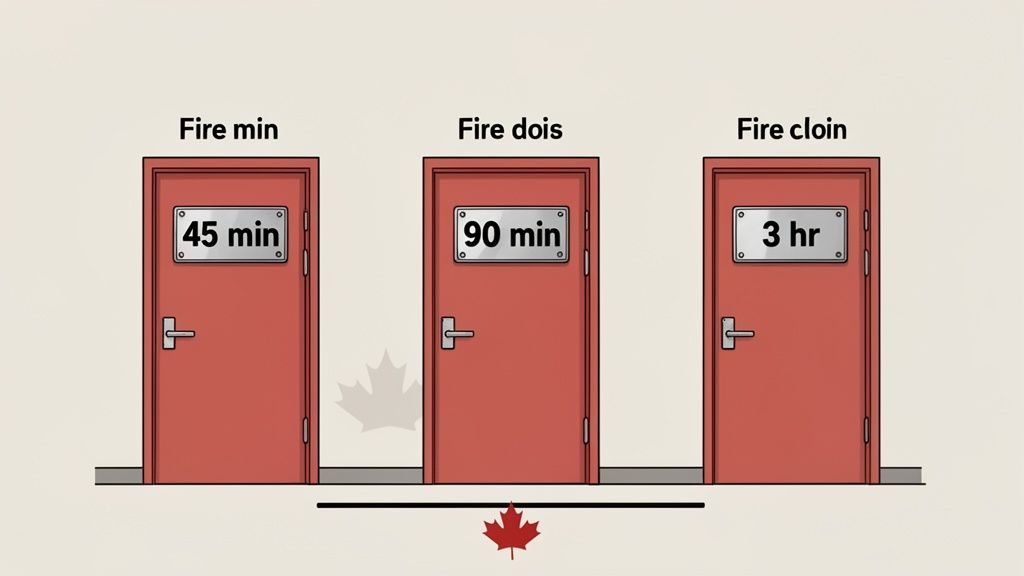
alt=”Three red fire doors showing different fire resistance ratings: 45 min, 90 min, and 3 hours for commercial buildings.”
What Fire Ratings Really Mean
A fire door’s rating isn’t some arbitrary number pulled out of a hat; it’s a performance guarantee that’s been earned through intense, rigorous testing. Think of it this way: the rating tells you the absolute minimum amount of time that the entire door assembly—not just the slab—can hold back a fire and stop it from spreading.
So, when you see a 90-minute rated fire door, it means an accredited lab has put that exact model through its paces, proving it can contain a fire for at least an hour and a half. This containment is everything. It buys precious time for people to evacuate safely and for first responders to arrive and manage the situation.
And remember, we’re talking about the entire system. The rating applies to the door, the frame, the hinges, the latch, and any glass (called glazing). Every single piece has to be rated to work together as a complete, fire-resistant assembly.
Connecting the Codes from NFPA to Canada
The bedrock for nearly all fire door standards in North America is NFPA 80, the Standard for Fire Doors and Other Opening Protectives. This is the definitive rulebook that lays out the nitty-gritty details on how fire-rated assemblies must be installed, inspected, tested, and maintained.
Here in Canada, we take these world-class standards and bring them to life through our own building codes.
- National Building Code of Canada (NBCC): This is the master blueprint. It sets the technical requirements for new construction and major renovations nationwide, dictating where fire separations are required and how strong they need to be.
- Ontario Building Code (OBC): Provinces adapt the NBCC to their specific needs. The OBC is the legally binding version for Ontario, giving designers, contractors, and facility managers the exact rules they must follow.
Simply put, the NBCC and OBC tell you what level of fire separation you need in a wall. NFPA 80 then gives you the detailed playbook on how a fire door in that wall must be installed and cared for to meet that requirement.
Practical Applications of Different Fire Ratings
The fire rating required for a door is tied directly to the fire-resistance rating of the wall it’s sitting in. It’s a simple concept: a stronger, more critical wall needs a stronger door to maintain the integrity of that fire separation. You can’t have a weak link in the chain.
Here is a quick reference guide to see where different ratings are typically used in commercial and industrial settings.
Common Fire Door Ratings and Their Applications
| Fire Rating | Typical Location | Primary Purpose |
|---|---|---|
| 20-Minute | Corridor doors, office-to-hallway separations | Contains smoke and drafts, offers minimal fire resistance. |
| 45-Minute | Room-to-corridor walls, some fire partitions | Confines fire within a room, protecting escape routes. |
| 90-Minute | Stairwell enclosures, elevator shafts, fire barrier walls | Protects critical evacuation routes and vertical openings. |
| 3-Hour | Firewalls separating buildings or dividing a large building | Compartmentalizes a building to prevent total fire spread. |
This table helps illustrate the strategic thinking behind fire code requirements.
- 20/45/60-Minute Doors: You’ll see these most often in corridor walls or separating individual rooms from a main hallway. Their main job is to bottle up a fire in a smaller space, like a single office, to keep escape routes clear of smoke and flames. Understanding the best interior fire-rated door options is key to matching the right product to the specific risk.
- 90-Minute (1.5-Hour) Doors: These are your workhorses for protecting stairwells. This is absolutely non-negotiable, as stairs are the primary way out during an emergency. Keeping them clear is priority number one. You’ll also find them in walls surrounding elevator shafts.
- 3-Hour (180-Minute) Doors: These heavy-hitters are reserved for the most critical separations. Think of a firewall that divides one massive building into two smaller, separate fire areas, or a wall separating two completely different buildings.
Each rating is a deliberate choice, not a suggestion. It’s a specific, engineered requirement based on your building’s layout, its use, and a strategy to create a robust defence against the spread of fire.
Once you understand the logic, it’s easy to see why getting this right is so important. Every fire door has a specific, life-saving job to do, and having the correct rating ensures it’s up to the task when it matters most.
Your Legal Duty: The Mandatory Annual Fire Door Drop Test
For any facility manager or building owner in Ontario, the annual inspection of a fire door isn’t just a suggestion—it’s the law. If your property contains fire doors or fire separation walls, you are legally liable for ensuring they are tested annually. This is not just a best practice; it is a mandatory legal obligation under the Ontario Fire Code.
This critical procedure is called a fire door drop test. It’s a formal, documented process that proves the door will close completely and securely when activated by a fire alarm or the melting of a heat-sensitive fusible link. Think of it as the ultimate proof that your life-safety system will actually do its job when lives are on the line.
Understanding the Ontario Fire Code Requirement
The Ontario Fire Code doesn’t mince words. It places the legal responsibility squarely on the building owner to maintain all fire separations, including fire doors, so they function as intended. For rolling and sliding fire doors, the annual drop test is the only way to verify this.
Ignoring this responsibility comes with severe consequences that go far beyond a simple slap on the wrist.
- Steep Financial Penalties: Non-compliance can lead to significant fines from the fire marshal, and they get worse with repeat offences.
- Operational Shutdowns: In cases of serious neglect, authorities have the power to shut down parts of your facility until violations are fixed, leading to expensive downtime.
- Voided Insurance Coverage: If a fire occurs and an investigation reveals that mandatory inspections were missed, your insurance provider could deny the claim, leaving you to cover the full cost of the damage.
- Immense Liability: Most importantly, if a fire door fails during an emergency and leads to injury, loss of life, or greater property damage, your organization faces massive legal liability.
The annual drop test is your official record of due diligence. It provides documented, third-party proof that you’ve taken the necessary steps to maintain a safe environment and comply with provincial law, protecting your business from legal and financial ruin.
Why This Test Is So Critical
The logic behind the mandatory drop test is simple: these are complex mechanical systems that can fail over time. Debris can get into the door’s tracks, components can wear out, and a minor bump from a forklift can cause damage that isn’t visible to the untrained eye. Without a formal test, a door could be broken for months or even years, and you’d never know until it was too late.
Fire statistics show why these rules are so strict. Canada sees tens of thousands of fire incidents each year—there were 39,047 reported in 2021 alone—with Ontario being a major contributor. You can explore the official data on reported fire incidents in Canada to see the scale of the risk. This high rate of incidents is precisely why provincial codes mandate inspection schedules; they directly address the equipment failures that can turn a small fire into a catastrophe.
Partnering with a Certified Provider for Compliance
The annual fire door drop test isn’t a job for an in-house maintenance team without specific training. It must be performed by a qualified person or agency with the expertise to not only conduct the test properly but also to spot potential issues and document everything correctly.
A certified provider like Wilcox Door Service ensures the entire process is handled right. Our union-certified technicians follow a detailed checklist to test, inspect, and reset your fire door systems. Afterwards, you receive a formal certificate for your records, which serves as your proof of compliance for fire marshals, insurance agents, and any legal needs. This documentation is a cornerstone of responsible facility management, as we cover in our complete guide to fire door drop testing in manufacturing facilities.
By entrusting this critical task to a professional, you gain the peace of mind that comes from knowing your facility is not only safe but also fully compliant with Ontario law.
Your Practical Fire Door Inspection and Maintenance Checklist
The mandatory annual drop test is a non-negotiable legal requirement in Ontario, but true facility safety is an everyday commitment. Think of it this way: the annual test is like a car’s safety certification, but proactive, in-house checks are like your regular oil changes and tire pressure checks. They’re essential for catching small issues before they snowball into critical failures.
This isn’t about replacing the professional inspection. It’s about complementing it. This section gives your team a simple, actionable checklist for monthly or quarterly visual inspections, turning your staff into the first line of defence in your fire safety plan.
The In-House Visual Inspection Checklist
A consistent in-house inspection program ensures that from one professional test to the next, your fire doors remain ready to do their job. Just like a loading dock plate gets knocked out of alignment from daily use, a fire door suffers from wear and tear that can silently compromise its function.
Here’s a practical checklist your maintenance team can follow:
- Check the Door and Frame for Damage: Look for any dents, bends, or holes in the door or its frame. Damage from forklifts, carts, or other equipment can stop a door from closing properly and creating a tight seal. Even what looks like minor warping can be a major problem in a fire.
- Confirm Latches and Closers Operate Smoothly: Open the door all the way and just let it go. It should close and latch firmly on its own, without needing an extra push or pull. If it slams shut or closes too slowly, the closing mechanism needs an adjustment. Remember, a door that doesn’t latch is not a fire door.
- Inspect Seals and Gasketing: Take a close look at the intumescent seals around the door frame. These are the strips designed to expand with heat and block smoke. They must be completely intact—no cracks, peeling, or missing sections. A damaged seal is a critical failure point.
- Ensure the Area is Clear: The path of the fire door must be 100% free of obstructions. That means no pallets, no equipment, and no stray debris stored in the doorway. An object blocking the door renders it completely useless in an emergency.
This straightforward process helps maintain a baseline of safety between your official inspections.
Documenting Your Efforts
Keeping a simple log of these in-house checks is a best practice that really pays off. It demonstrates due diligence and helps you track potential issues over time. Your log should note the date of inspection, the door’s location, the inspector’s name, and any observations or concerns.
This documentation becomes a valuable part of your overall safety record, reinforcing your commitment to compliance. It can even help streamline the annual professional test, as you can point out specific areas of concern to the certified technician.
A proactive maintenance culture is built on small, consistent actions. Regular visual inspections empower your team to take ownership of safety, transforming compliance from a once-a-year event into a daily priority.
The infographic below illustrates the official annual process that your in-house checks directly support.

alt=”Flowchart of the annual fire door drop test process: Test, Document, and Comply, for legal compliance.”
This visual shows the seamless flow from professional testing and documentation to achieving full legal compliance. By adding your own regular checks, you ensure your equipment is always ready for that official test. Integrating these inspections into a planned maintenance program ensures nothing ever gets overlooked.
Choosing a Reliable Partner for Fire Door Service
When it comes to your fire door installation, inspection, and repair, the partner you choose has a direct impact on your facility’s safety and your legal standing. This isn’t just about hiring another contractor; it’s about building a relationship you can count on, one built on genuine trust and deep expertise.
Your choice here determines the reliability of your life-safety systems and the quality of the documentation you need to prove compliance. This is where our guiding principle of “Respected Partners, Reliable Service” is more than a slogan—it’s a commitment.
A true partner gives you transparent communication, meticulous records for your compliance binder, and a focus on long-term safety, not just quick fixes. That approach delivers real peace of mind, knowing your facility is in expert hands.
Why Certified Expertise Is Non-Negotiable
When you’re selecting a provider for mandatory work like the annual fire door drop test, certifications aren’t a “nice-to-have”—they’re absolutely essential. Technicians must be formally trained and qualified. They need to understand the complex mechanics of different fire door assemblies and the precise requirements of standards like NFPA 80.
Working with experienced, union-certified technicians guarantees the job gets done right and safely. These pros are constantly training on the latest code updates and manufacturer specs, ensuring your equipment stays compliant. An unqualified technician could easily miss a critical issue or perform a “fix” that unknowingly voids the door’s fire rating, creating a massive liability for you.
Key Questions to Ask Any Potential Vendor
Before you sign any service agreement, you need to vet your potential partners thoroughly. How they answer these questions will tell you everything you need to know about their professionalism and experience. It’s also a good idea to review their range of various building services to see if they can meet your facility’s broader needs.
Here are the essential questions you should be asking:
- What are your technicians’ certifications and training? Look for specifics, like union certification or manufacturer training related to fire door inspection and repair.
- What does your documentation process look like? A reliable partner provides detailed, formal certificates after every annual drop test, clearly outlining the results for your records. No shortcuts.
- What is your emergency service availability? A fire door malfunction can’t wait. A provider offering 24/7 emergency service shows a real commitment to your facility’s safety and operational continuity.
- Can you provide references from facilities similar to mine? Experience in your specific industry—whether it’s manufacturing, property management, or healthcare—is a strong sign they understand your unique challenges.
A partner’s value is measured not just by the service they perform, but by the peace of mind they provide. They should act as an extension of your safety team, offering proactive advice and ensuring every detail is managed for compliance.
This is especially critical as external risks evolve. Canada sees over 8,000 wildfires on average each year, a growing threat that highlights just how important robust building compartmentation is. Properly maintained fire-rated doors are a facility’s first line of defence against ember intrusion, making expert service more vital than ever.
Got Questions About Fire Door Compliance?
When you’re managing a facility, the rules around fire doors can seem like a maze. To cut through the confusion, we’ve put together some straight answers to the questions we hear most often. Think of this as your quick-reference guide to staying compliant, safe, and ready for anything.
How Often Do Our Fire Doors Need to Be Tested in Ontario?
This is probably the most critical question, and the Ontario Fire Code is crystal clear on this one. All your fire separations, which absolutely include your fire-rated doors, must be inspected and tested by a professional at least once a year.
If you have rolling or sliding fire doors, that annual inspection has to include a “drop test.” This isn’t just a quick check; it’s a formal procedure that has to be done by a certified technician. They’ll give you the official paperwork you need to satisfy inspectors and your insurance provider.
Can My In-House Team Handle Fire Door Repairs?
It’s a great idea for your team to do regular visual checks, but when it comes to actual repairs, the answer is a firm no. A fire door isn’t just a door; it’s a precisely engineered life-safety system.
Any change you make—drilling a new hole for a sign, swapping out a latch, or using a part that isn’t fire-rated—can instantly void the door’s certification. To keep that door compliant and effective, every repair must be done by a trained technician using certified parts. It’s the only way to protect the integrity of the entire fire separation.
How Do I Know if a Door Is Actually a Fire Door?
At first glance, a fire door might look just like any other heavy-duty commercial door. The giveaway is the label. Look on the edge of the door (usually near the hinges) or on the frame for a small metal tag or sticker.
This certification label tells you everything you need to know:
- The manufacturer’s name
- The third-party agency that tested and certified it (like UL or Warnock Hersey)
- The door’s fire-resistance rating (e.g., 90-minute)
If that label is missing, painted over, or unreadable, you can’t prove it’s a compliant fire door. End of story.
What Happens if a Fire Marshal Finds a Problem?
If an inspector from the local Authority Having Jurisdiction (AHJ) flags one of your fire doors, you’ll get a violation notice. This isn’t just a slap on the wrist; it can come with hefty fines and a strict deadline to get the door professionally repaired or replaced.
The easiest way to sidestep these penalties—and more importantly, to keep your people safe—is to be proactive. A documented annual testing schedule and a solid planned maintenance program are your best defence.
Staying on top of compliance isn’t just about avoiding fines; it’s about protecting lives and your property. At Wilcox Door Service, we provide certified annual fire door inspections and expert repairs to make sure your facility is buttoned up and meets every legal standard.
Schedule your annual fire door inspection today to ensure your facility is safe and compliant.