


Commercial replacement garage door cost in Canada typically ranges from CAD 3,500 to 7,200 for a standard commercial sectional overhead door. That’s the right starting number for budgeting, but it’s only the beginning of a sound business decision.
If you're reading this because a warehouse door is stalling, a loading area is exposed, or a tenant is pushing for an urgent replacement, the pressure is real. A failed door affects shipping schedules, site security, worker safety, and budget approvals all at once. The mistake many teams make is treating the quote like a simple product purchase. It isn’t. It’s an operating asset decision.
A commercial door replacement touches labour, compliance, traffic patterns, insulation, controls, and future maintenance. In a distribution environment, the wrong choice can leave you with a door that technically works but still creates avoidable downtime. In a climate-controlled facility, a cheaper door can steadily increase heating costs for years. In government and airport work, procurement rules can affect the total net cost as much as the hardware itself.
This guide is written for facility managers, operations leaders, and project teams who need a usable number today and a defensible decision tomorrow. It focuses on the commercial side only, not residential price lists. If you’re also reviewing broader access-point planning across a warehouse, this pallet rack buyer's guide is a useful companion because storage layout, lift traffic, and door placement often affect each other.
For teams comparing door types, operators, and service scope, it also helps to review a provider that works specifically in commercial and industrial door systems.
Your Guide to Commercial Door Replacement Costs in 2026
A replacement decision usually lands on your desk at the worst time. A truck is waiting at the dock, a tenant wants an answer before month-end, or a failed overhead door has turned a routine day into a security and scheduling problem. In that situation, replacement garage door cost is not just a line item. It is a facility continuity decision.
For commercial and industrial sites, the useful budget question is simple: what will this opening cost over its service life, and what will it cost the operation if it keeps failing? Purchase price matters, but so do cycle demands, operator sizing, thermal performance, code requirements, and installation conditions. A low quote can still become the expensive option if it creates repeat service calls, heat loss, or unplanned downtime.
That is why facility managers should frame door replacement as an asset decision tied to uptime, safety, and procurement strategy.
A sound early discussion starts with four checks:
- Cycle demand: A door that opens a few times a day can use a different spring, track, and operator package than a shipping door that runs constantly across multiple shifts.
- Operational impact of failure: Some openings are inconvenient when down. Others stop receiving, dispatch, sanitation separation, or secure access.
- Building performance: In cold storage, washdown, and heated warehouse environments, insulation value and perimeter sealing affect utility spend and interior conditions year after year.
- Project conditions: Site access, after-hours work, union labour, lift requirements, electrical upgrades, and compliance testing often shape installed cost as much as the door itself.
If your team only compares door leaf pricing, you are not comparing the true project cost.
This commercial guide stays focused on what matters to industrial owners and facility teams. It does not repeat residential price lists that ignore cycle life, loading patterns, and compliance scope. It also considers strategic buying paths. For public sector and airport projects in Canada, procurement routes such as PSIB can change net cost and buying speed in ways that deserve attention early.
If you are reviewing the opening as part of a larger warehouse upgrade, this pallet rack buyer's guide is a useful companion because rack layout, forklift travel, and door placement often affect each other.
For teams also comparing providers, Wilcox Door Service Inc. is one example of a company focused on commercial and industrial door systems.
Deconstructing the Price of a Replacement Commercial Door
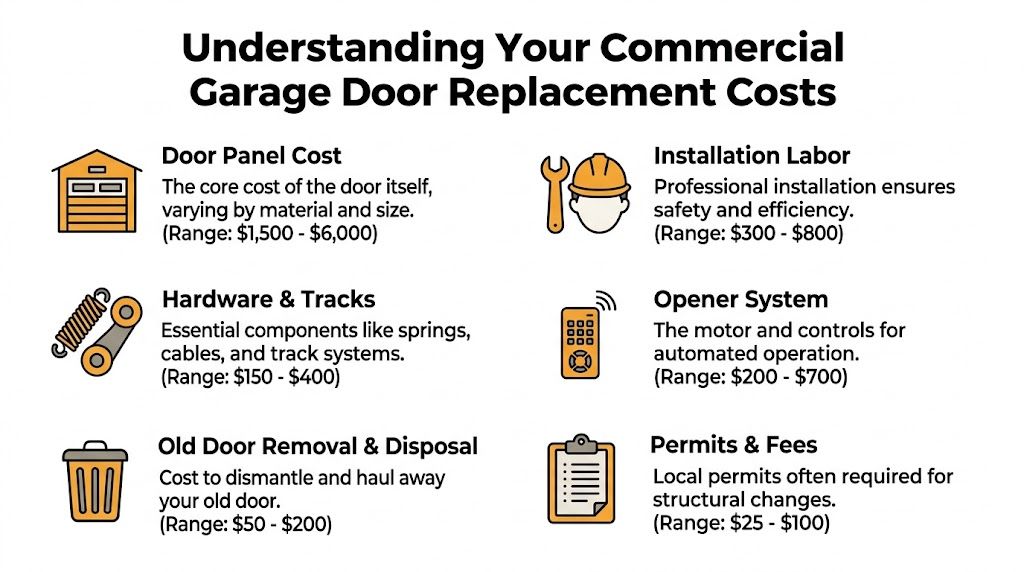
A facility manager usually sees the full cost difference when two quotes sit side by side and both say "replacement door," but one includes a complete operating system and the other covers only the visible door leaf. On a busy commercial opening, that difference shows up later as service calls, shorter spring life, slower traffic flow, or another shutdown.
Door size and usage set the price floor
The base number starts with two questions. How large is the opening, and how hard will the system work?
A wider or taller opening needs more steel or aluminum, heavier reinforcement, a larger spring assembly, and hardware that can control more weight safely. Usage changes the specification just as much. A door at a seldom-used maintenance bay can be built very differently from a shipping door that opens all day across multiple shifts.
That is why replacement pricing can vary so sharply even when two doors look similar from the parking lot.
What the quote is really buying
Commercial door replacement cost usually falls into three buckets.
| Cost component | What it covers | Why it matters |
|---|---|---|
| Door panels | The sectional panels or curtain, insulation, reinforcement, finish | Affects impact resistance, thermal performance, and service life in the actual environment |
| Track and hardware | Tracks, rollers, hinges, cables, drums, shaft, springs, brackets | Carries the load and controls how reliably the door runs every cycle |
| Operator and controls | Motor, control station, safety devices, activation equipment, logic controls | Determines operating speed, traffic handling, and how well the system fits the opening's daily use |
Procurement teams often focus on panel construction because it is easy to compare on paper. In the field, avoidable failures usually start in the springing, hardware package, or operator selection.
A commercial door should be specified around use conditions first and appearance second.
Cost drivers that separate a basic replacement from a durable one
The details inside the scope drive long-term value.
- Spring cycle rating: High-cycle torsion springs cost more upfront and reduce replacement frequency on busy openings.
- Operator duty rating: A lightly rated operator may work on day one and struggle within a year at a high-traffic dock or production entrance.
- Track layout and headroom configuration: Standard lift, high lift, vertical lift, and low-headroom hardware all change equipment cost and installation complexity.
- Wind load and reinforcement: Wider openings, exterior exposure, and local code requirements can push the package into heavier construction.
- Insulation and perimeter sealing: In heated warehouses, food facilities, and washdown areas, the panel core and seal package affect utility spend and interior conditions.
- Control and safety package: Photo eyes, sensing edges, motion activation, pull cords, timers, and interlocks should match the traffic pattern, not just meet the minimum.
If the opening is tied to forklifts, trailers, or frequent pedestrian crossover, the operator and control package deserves closer scrutiny than the finish color.
The quote comparison mistake that drives change orders
The biggest pricing mistake is treating every bid as equal scope.
One contractor may price a like-for-like swap using the existing track layout and a basic operator. Another may include new tracks, upgraded springs, proper safety devices, and controls suited to the actual traffic pattern. The second quote often looks expensive until you price the service calls, downtime, and retrofit work that follow an underspecified installation.
Older openings create this problem all the time. Once crews remove the existing door, they may find patched jamb conditions, worn shafting, obsolete controls, or hardware that was never right for the opening's duty level. A clear proposal should identify those assumptions before work starts and separate base scope from possible extras.
If you want a better sense of how installed scope expands beyond the door itself, this guide to commercial garage door installation cost in Canada is a useful companion.
Budgeting for Labour Installation and Compliance Costs
A replacement door project can look on budget right up to the day the crew arrives. Then the electrician is not ready, the existing steel is out of plane, the opening has to stay live for shipping, and the install shifts into overtime. For facility managers, labour and compliance costs usually decide whether the project stays controlled or turns into a string of change orders.
Installed cost reflects much more than hanging panels and setting an operator. Commercial openings involve removal, rigging, alignment, electrical coordination, safety checks, and handover requirements that vary by site. A practical reference point is this guide to commercial garage door installation cost in Canada, but your budget should be built around your opening conditions, traffic pattern, and compliance obligations.
Why labour costs swing from one site to another
Two doors with the same size and model can produce very different labour invoices.
An uncomplicated swap in an open warehouse bay is one thing. A replacement over an active dock door, beside pedestrian traffic, or under a restricted shutdown window is another. Crews may need lifts, spotters, lockout coordination, off-hours scheduling, or phased work to keep the facility operating.
Existing conditions also drive labour hours. Old anchors strip out. Track supports are found to be undersized. Operator mounts are misaligned. Previous field modifications often save money for the first owner and cost money for the next one.
That is why experienced estimators spend time on the opening before they price the work.
Compliance costs are part of the job, not a surprise add-on
Residential price guides rarely cover the items that matter on commercial sites. Industrial and institutional openings may require documented testing, fire door drop testing, access control coordination, electrician sign-off, site-specific safety orientation, or permit administration. If the door serves a rated wall, secures a controlled area, or sits in a public-facing facility, paperwork and commissioning can take real labour time.
Those costs are easy to miss during early budgeting because they do not always appear in the door package itself. They still hit the project cost.
If the opening affects fire separation, security, sanitation, or public safety, require the vendor to define testing, documentation, and turnover requirements in writing before approval.
Common cost items that get missed
Short proposals often leave out work that still has to happen on site. The usual gaps include:
- Removal and disposal: Existing panels, springs, hardware, operators, and debris have to be dismantled and hauled away safely.
- Opening repairs: Jambs, mounting steel, backhang, or framing may need correction before the new system can be installed properly.
- Electrical coordination: Operators, disconnects, control stations, and safety devices often require a site electrician or separate permit scope.
- Access and scheduling premiums: After-hours work, tenant coordination, lift rentals, and restricted access windows increase labour cost fast.
- Commissioning and documentation: Testing, training, turnover records, and compliance sign-off add time even when the installation itself is straightforward.
Each item looks manageable on its own. Together, they change the budget meaningfully.
What to demand in an installation quote
A usable quote should tell you what is included, what is excluded, and what assumptions could trigger extra cost. If that detail is missing, the number is only a placeholder.
Ask every bidder to spell out:
- Removal scope and disposal method
- Labour assumptions, including standard hours versus shutdown or off-hours work
- Allowance for repairing existing mounting conditions
- Electrical scope, including who supplies power, wiring, disconnects, and final connections
- Operator, controls, and safety device installation details
- Testing, commissioning, and required documentation
- Permit and compliance responsibilities
A clean scope comparison protects more than the purchase price. It protects uptime, maintenance planning, and the total cost of ownership over the life of the door.
How Material and Insulation Choices Affect Your Total Cost
A facility replaces a failed dock door with the cheapest panel package available. Six months later, the opening is still a problem. Forklift traffic has dented the skin, perimeter seals are leaking air, and the heated space beside the dock is harder to control. The invoice looked good. The ownership cost did not.
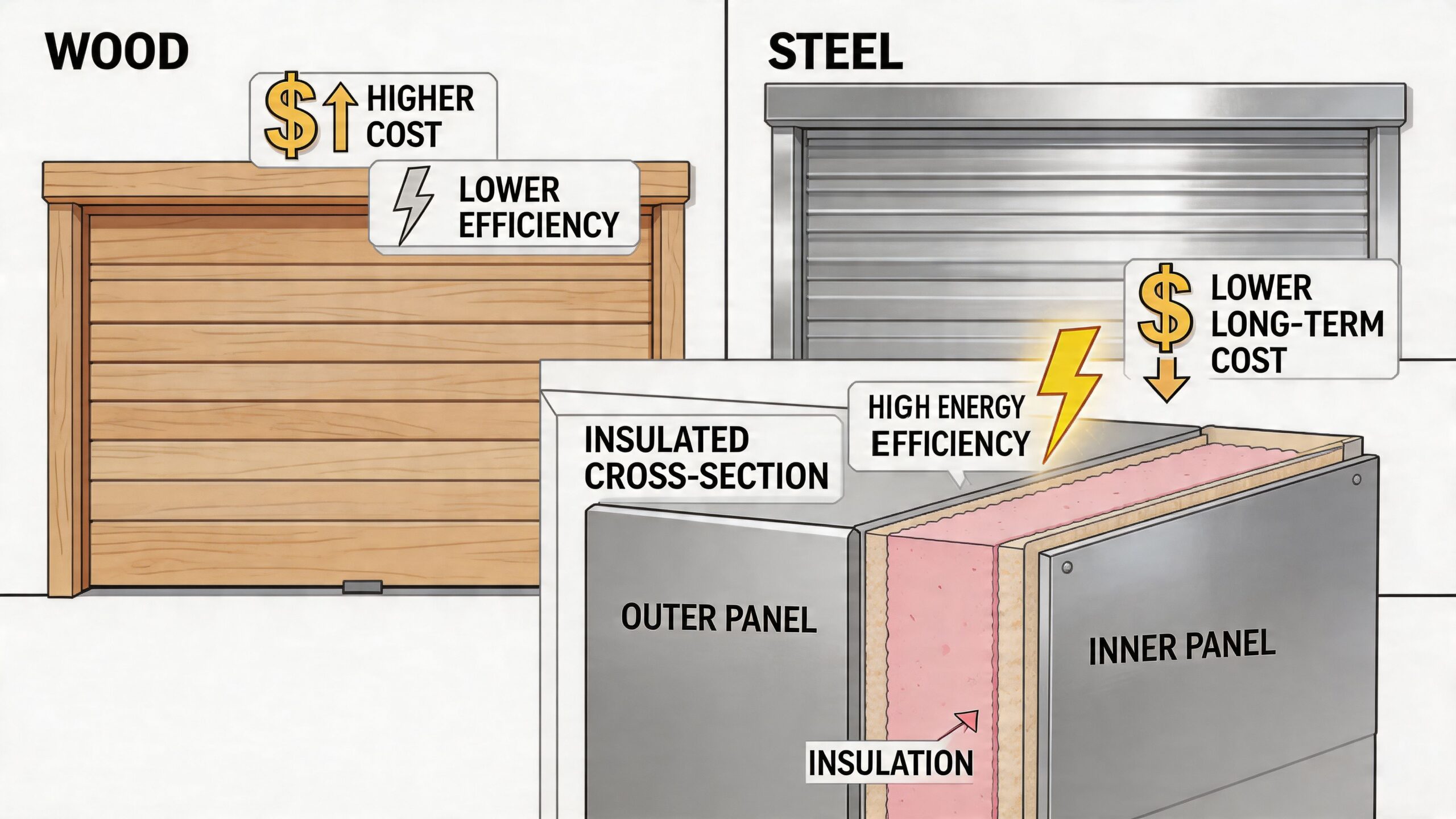
Material and insulation choices drive more than the purchase price. They affect service life, repair frequency, energy loss, and how well the door holds up to the actual abuse level at the opening. For commercial and industrial sites, those factors usually matter more than appearance.
Comparing common commercial door materials
Material selection should follow the opening conditions. Traffic volume, moisture exposure, impact risk, and temperature control requirements all matter.
According to a material cost comparison from Angi, steel doors commonly run from $650 to $3,200 per door, aluminum from $600 to $2,900, with premium aluminum configurations reaching $2,500 to $5,000+, and composite or faux-wood options from $650 to $4,800.
| Material | Typical use case | Cost and performance notes |
|---|---|---|
| Steel | Warehouses, distribution, manufacturing | Usually the strongest value for high-use openings. Steel is durable, widely available, and easier to repair than many specialty materials. |
| Aluminum | Food facilities, washdown areas, humid or corrosion-prone sites | Higher material cost can make sense where rust resistance matters more than dent resistance. |
| Composite and faux-wood | Customer-facing commercial properties, appearance-sensitive sites | Better suited to locations where curb appeal matters and abuse levels are lower. Usually not the first pick for hard-working dock or plant openings. |
Steel remains the practical default for many facilities because it gives buyers the broadest range of panel construction, insulation packages, and replacement parts. Aluminum earns its keep in corrosive environments. Composite is a niche choice. It can fit the right building, but it rarely wins on lifecycle cost in high-abuse industrial service.
For teams comparing panel materials more closely, this guide to fiberglass vs steel doors is useful where appearance, corrosion exposure, and maintenance expectations all need to be weighed together.
Insulation and R-value in plain language
R-value measures resistance to heat flow. Higher R-value means the door slows heat transfer more effectively.
That matters most at openings connected to heated warehouses, conditioned production space, service bays, and areas with frequent trailer movement. A poorly insulated door does not just waste energy. It can also create cold spots, condensation around the opening, and more strain on nearby HVAC equipment.
Single-layer steel doors typically sit around R-2 to R-3, while triple-layer door constructions can reach R-10 to R-14, according to the same Angi comparison. On a busy commercial opening, that spread is large enough to affect operating cost over the life of the door.
Where insulation pays off
The upgrade from an uninsulated steel door to an insulated multi-layer door often looks modest on a quote and significant over years of operation. Angi reports a typical range of $750 to $1,500 for uninsulated steel and $1,000 to $2,500+ for triple-layer insulated steel. The same source notes a typical payback window of 3 to 5 years and cites annual energy savings of 15 to 25% in the right conditions.
Those numbers are directionally useful, but the ultimate decision comes down to the opening itself. A low-cycle detached storage building may not justify the upgrade. A shipping bay that opens all day beside conditioned space usually does.
The bigger the temperature difference across the opening, and the higher the cycle count, the more insulation starts acting like an operating-cost control rather than an upgrade.
What usually pencils out
For many commercial buildings, the best long-term value is a multi-layer insulated steel door matched to the opening’s traffic level and environment, with the right seals and hardware package for daily use.
Buyers either save money over time or create repeat service calls. A light-duty door on a forklift route will not stay inexpensive for long. An underinsulated door on a heated facility will keep charging the building every month.
Choose the door for the work the opening does. That is how replacement cost turns into a sound capital decision instead of a recurring maintenance problem.
Calculating the True ROI of Your New Commercial Door
A receiving door fails at 6:45 a.m., and the cost of the opening changes fast. Trucks queue, staff reroute product, conditioned air spills out, and maintenance is forced into reactive mode before the first shift settles in. That is the context for replacement garage door cost in a commercial facility. The purchase price matters, but the operating consequences matter more.
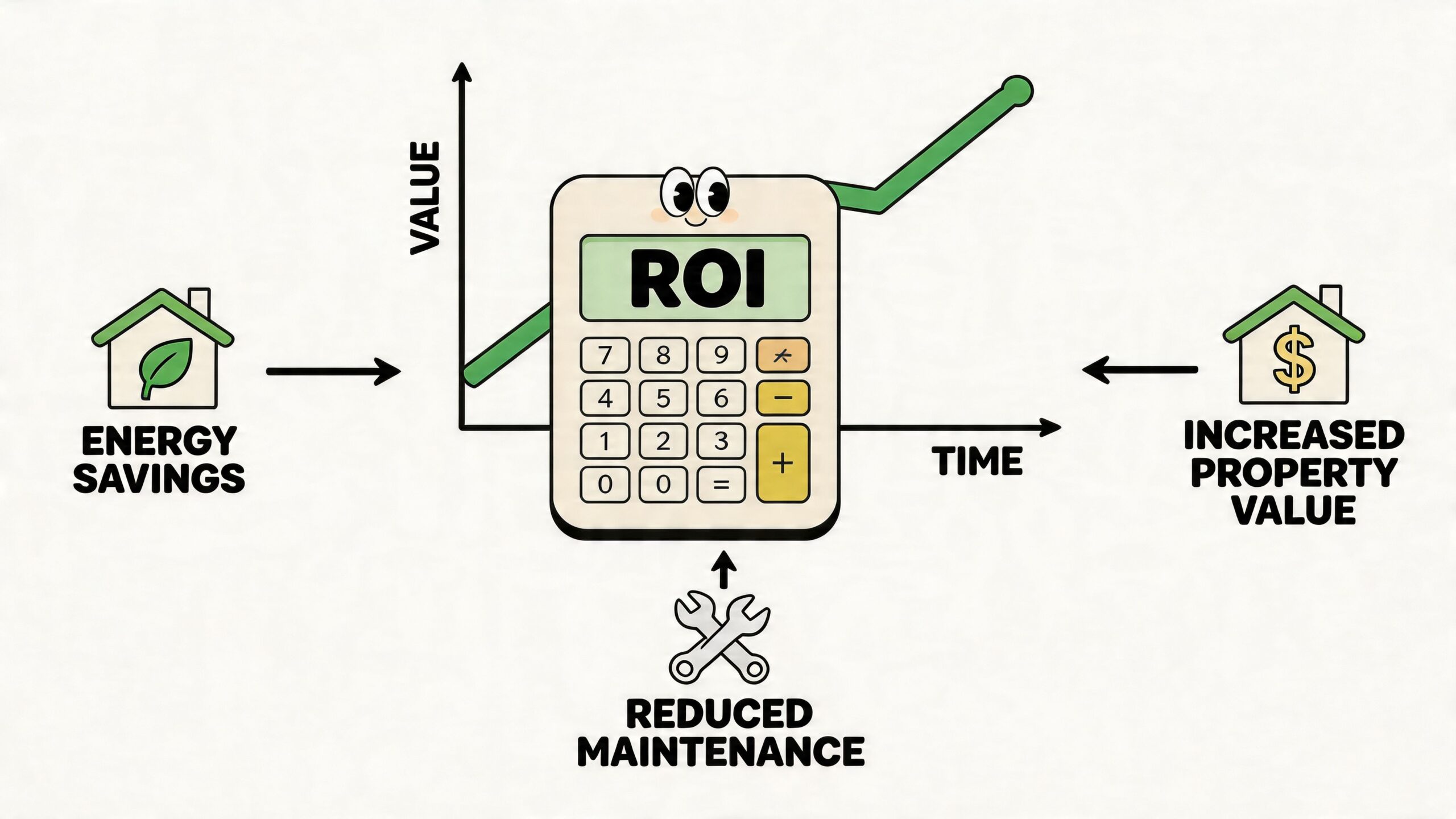
A proper ROI review should start with the opening’s job. A door serving a busy dock, secure service bay, food plant, or heated warehouse is part of the operating system of the building. If it is slow, unreliable, or no longer suited to the traffic level, the financial drag shows up across operations, maintenance, and energy spend.
An often-overlooked ROI component is avoided disruption
Facility managers usually see the invoice for repairs. They do not always get a clean report showing the labour delays, shipping interruptions, overtime, and temporary workarounds caused by an unreliable opening.
That missing cost matters.
A replacement earns its keep when it reduces problems such as:
- Dock and production delays: A failed door can hold up inbound materials, outbound shipments, or internal traffic.
- Extra service spend: Repeated calls for springs, rollers, tracks, operators, or controls add up quickly on an aging system.
- Safety exposure: Worn hardware and inconsistent door travel increase risk for staff, vehicles, and product.
- Security and environmental loss: Doors that do not close properly can create after-hours risk and allow dust, weather, or outside air into controlled areas.
A new commercial door pays back in hours recovered, calls avoided, and disruptions that never hit the floor.
ROI is stronger when the specification matches the opening
Many capital projects go wrong here. A door can be new and still be the wrong asset.
A light-duty sectional door on a high-cycle forklift route will create service costs long before the accounting team has depreciated it. A slow operator on a busy shipping lane can keep labour waiting several times a day. A door package without the right controls, impact resistance, or sealing strategy may solve one problem and leave three others in place.
The better approach is to measure ROI against the opening’s actual duty cycle and business function. Ask practical questions. How many cycles per day does it see? What does one hour of downtime cost that department? Is the opening tied to temperature control, sanitation, or secure access? Those answers usually point to a different decision than the lowest bid.
A simple operating example
Consider a facility with an older dock door that needs frequent service, closes inconsistently, and forces staff to monitor it during peak receiving hours. Replacing that door can improve several cost lines at once. Maintenance spends less time chasing repeat faults. Operations gets a predictable opening. Supervisors stop building workarounds into the day. The building loses less air during each cycle.
The savings are rarely confined to one budget code, which is why door ROI can be underestimated during procurement.
For facilities looking at utility incentives as part of the business case, Wilcox outlines that opportunity in its post on Enbridge gas incentives for commercial door upgrades.
For a visual explanation of how commercial door systems affect facility performance, this walkthrough is worth a quick look:
Replacement becomes the better financial choice when repairs stop restoring reliability
There is a point where another repair is just keeping a weak asset alive. I usually see that point when the opening has recurring failures, outdated hardware, poor parts availability, or a design that no longer fits the building’s traffic and environmental demands.
At that stage, replacement is less about getting a new door and more about restoring dependable access. Facilities often prefer a provider that can handle installation, planned maintenance, and emergency service under one operating relationship. Wilcox Door Service Inc. offers that model for commercial and industrial door systems across Canada. The advantage is continuity of service and clearer accountability over the life of the asset.
Getting Accurate Quotes and Leveraging Procurement Programs
A good quote starts with a good request. If the RFQ is vague, every vendor will make different assumptions, and your numbers won’t be comparable. That’s where many replacement projects go sideways before anyone sets foot on site.
What to include in your RFQ
Ask bidders to price the same scope against the same site conditions. The clearer you are, the fewer surprises you’ll see later.
Include these details:
- Opening size and door type: State whether you need sectional overhead, rolling steel, high-speed, or a fire-rated assembly.
- Use pattern: Describe if the opening is occasional-use, shift-based, or constant traffic.
- Thermal requirement: Note whether the area is heated, cooled, washdown, or temperature controlled.
- Operator expectation: Specify manual, motorised, or integration with existing controls.
- Site constraints: Include height restrictions, access windows, occupied work zones, and security clearance requirements.
A site visit is usually worth insisting on. Commercial openings often look straightforward on paper and turn out to have framing issues, power constraints, or clearance conflicts once a technician inspects the area.
Ask for apples-to-apples detail
A quote should answer practical questions, not just present a lump sum.
Use a checklist like this when reviewing bids:
- Does the quote identify the exact door construction?
- Are springs, track, and operator all listed, or are some parts assumed?
- Is removal of the old system included?
- Are testing, handover, and documentation included?
- Are exclusions clearly written?
If one vendor includes upgraded hardware and another doesn’t, you’re not comparing price. You’re comparing scope.
Procurement programs can change the net cost
For government, airport, healthcare, and some publicly funded projects, procurement strategy can materially affect the budget. Canada’s Procurement Strategy for Indigenous Business (PSIB) mandates that 5% of federal contracts go to certified firms, and eligible projects can reduce net costs by 15 to 25% through set-asides and grants, according to this summary of Canadian Indigenous procurement and retrofit incentives. The same source notes that the Green Buildings Retrofit Program can offer up to CAD 50,000 per door for qualifying energy-saving upgrades.
That matters because a project that looks expensive under standard purchasing rules may look very different once procurement and incentive pathways are considered. For public-sector and quasi-public facilities, this is often one of the most overlooked levers in the entire replacement process.
A useful companion resource is this guide on facility efficiency incentives and energy upgrade funding, especially if your project includes insulation or other energy-related improvements.
Eligible organisations shouldn’t wait until after vendor selection to ask about procurement eligibility. By then, they may have limited their options unnecessarily.
Your Decision Checklist for a Smart Door Replacement
A smart replacement decision usually comes down to asking better questions before the order is placed. The list below helps keep the project focused on operating fit, not just purchase price.
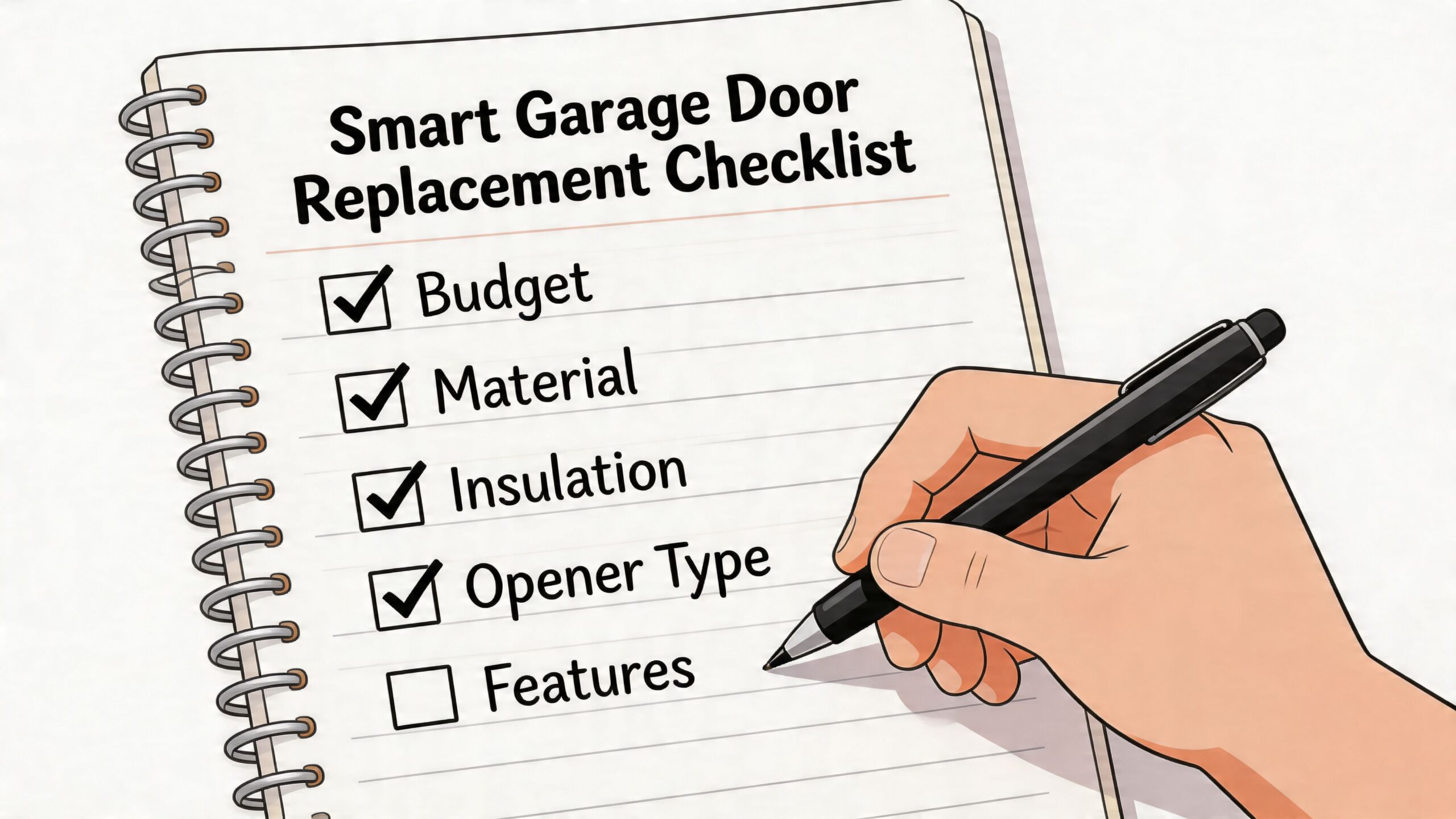
Check the opening against real use
Don’t approve a new door based only on the dimensions of the old one.
- Confirm traffic intensity: Is the opening lightly used, or does it serve a busy loading position all day?
- Review vehicle interaction: Forklifts, pallet jacks, trailers, and pedestrian routes all affect the right hardware and control setup.
- Match speed to operation: Slow doors create bottlenecks in active facilities even when they’re technically functional.
Check the building conditions
A strong door on a poor opening won’t perform well for long.
| Question | Why it matters |
|---|---|
| Is the framing sound? | Weak or damaged support conditions can shorten system life and complicate installation |
| Is there enough headroom and backroom? | Operator type and track layout depend on available space |
| Does the opening need better sealing? | Air leakage and weather infiltration often come from perimeter conditions, not just panel choice |
Check the lifecycle, not just the quote
Many projects' financial success or failure is decided at this stage.
- Compare insulation to your energy goals: A conditioned space should be priced with thermal performance in mind.
- Ask how the door will be maintained: New equipment lasts longer when inspections and adjustments are scheduled.
- Review compliance obligations: Fire-rated, secure, or regulated openings need more than a standard installation assumption.
- Clarify warranty scope: Know what covers panels, hardware, operators, and labour separately.
Check the vendor response quality
The proposal process often tells you how the job will run.
If the quote is vague, exclusions are unclear, and site questions go unanswered, expect friction later. If the vendor asks detailed questions about traffic, controls, access, and compliance, that usually signals a more reliable planning process.
The right replacement isn’t the cheapest door. It’s the door that fits the opening, supports the operation, and doesn’t create the next problem.
When you review replacement garage door cost this way, the decision becomes easier to defend internally. You’re not just buying a new door. You’re protecting uptime, controlling operating cost, and setting the opening up to perform properly for years.
Meta description: Replacement garage door cost in Canada for commercial sites. Learn pricing, labour, insulation ROI, and procurement savings.
Suggested image alt text
- Infographic on replacement garage door cost breakdown for commercial doors
- Comparison image of insulated steel options affecting replacement garage door cost
- ROI calculator graphic for commercial replacement garage door cost decisions
- Checklist image for planning replacement garage door cost and installation scope
Need a project-specific number instead of a generic range? Contact Wilcox Door Service Inc. for a site review, a complete commercial quote, or a service inspection that helps you plan the work with fewer surprises. Respected Partners, Reliable Service.
Frequently Asked Questions
How much does it cost to replace a commercial garage door in Canada?
Commercial replacement garage door cost in Canada typically ranges from $3,500 to $7,200 for a standard sectional overhead door, though pricing varies with size, insulation, and automation.
What factors affect commercial garage door replacement cost?
Cost is driven by door size, insulation level, controls and automation, labour, and site conditions — climate-controlled facilities should also weigh long-term heating cost impact, not just upfront price.
Is replacing a commercial garage door just a product purchase?
No — it’s an operating asset decision that touches labour, compliance, traffic patterns, insulation, and future maintenance, not simply a hardware swap.
Does Wilcox Door provide quotes for all makes and models?
Yes — Wilcox Door provides accurate replacement quotes for all makes and models of commercial garage doors across Canada.