


If you're managing a warehouse, plant, or multi-site portfolio, you already know how the day can go sideways. A sectional door sticks during outbound rush. A dock leveler hesitates before extending. Someone reports a fire door that doesn't close cleanly. The maintenance plan you thought was under control suddenly becomes the only thing anyone wants to talk about.
That's why building maintenance work matters so much. In practice, it isn't just repair work. It's the system you use to keep critical assets safe, compliant, and available when operations need them most. For facilities with busy access points, that means paying close attention to doors, docks, operators, seals, restraints, and the people who inspect and service them.
The managers who stay ahead of problems don't rely on luck. They choose a maintenance philosophy, track the right numbers, build useful checklists, and know when to involve specialist support. That's how you move from constant reaction to controlled execution.
The Foundation of Efficient Facility Operations
A lot of facility managers get introduced to maintenance the hard way. The call usually comes at the worst time. A truck is waiting, production is behind, and a loading dock door won't cycle. At that point, building maintenance work stops being an abstract line item and becomes an operations problem.
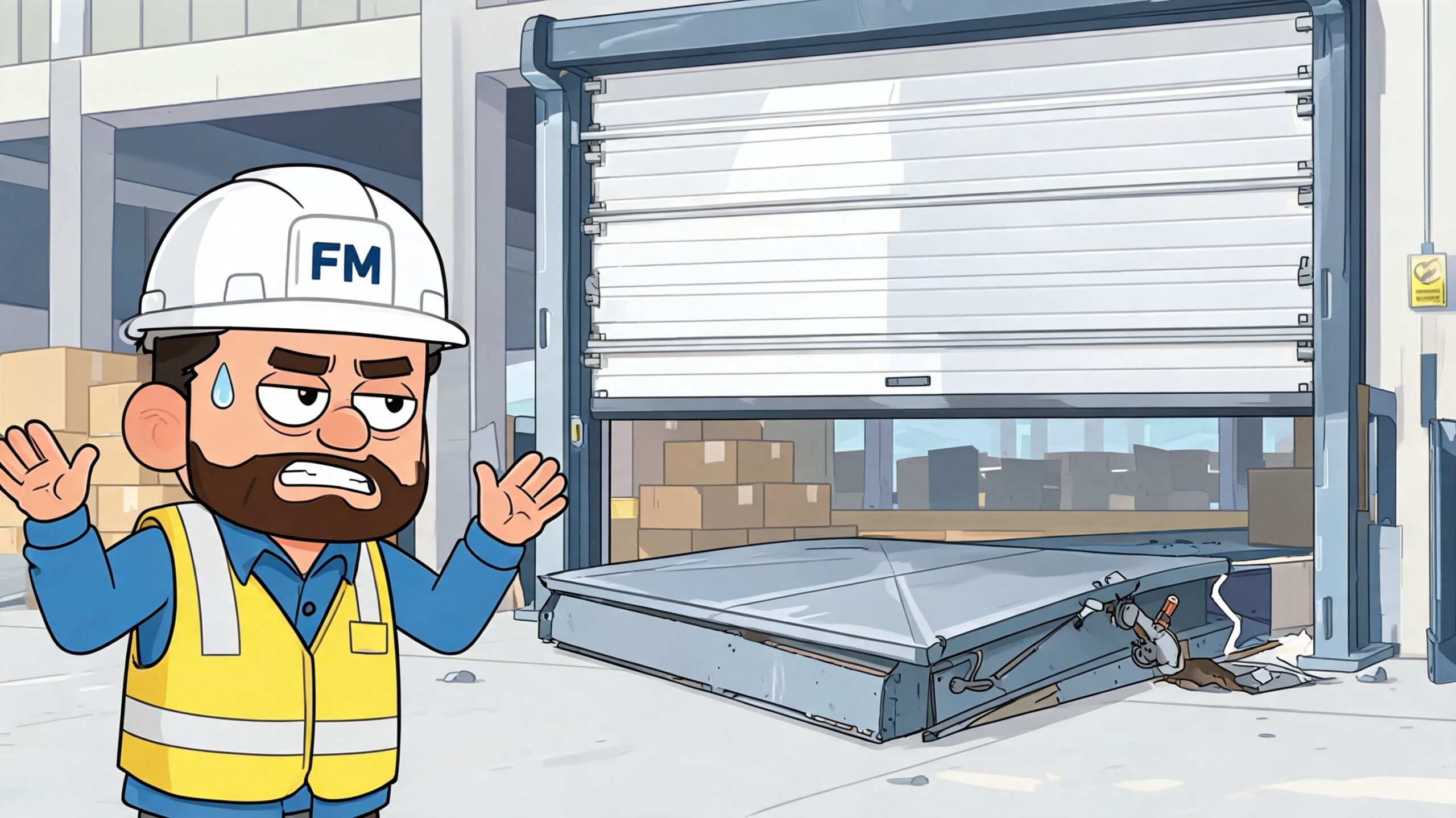
In a practical sense, building maintenance work is the organised effort to keep a facility functioning as intended. That includes routine inspection, planned servicing, repairs, testing, documentation, and replacement planning. It covers obvious systems like doors and loading docks, but also the decision-making around who does the work, how often, and under what safety rules.
The pressure is real. Equipment reliability was identified as the primary challenge by 39.9% of Canadian building maintenance managers, and reactive maintenance rates sit at 25%, more than double the world-class benchmark, according to maintenance KPI data reviewed by Dynaway. If you're always waiting for the failure call, you're not managing the facility. The failure is managing you.
What solid maintenance work looks like
A dependable maintenance operation usually has a few things in place:
- Critical assets are ranked: Doors at shipping lanes, dock levelers at key bays, and fire doors in life-safety zones get more attention than low-impact items.
- Daily checks are simple: Staff know what to look for, such as unusual noise, slow travel, oil leaks, damaged panels, or loose hardware.
- Specialist work is separated: In-house teams handle housekeeping and basic observation. Certified technicians handle high-risk adjustments, code-driven testing, and complex repairs.
- Records are usable: You can pull service history fast and see repeat faults instead of guessing.
Practical rule: If a failed asset can stop trucks, block egress, create injury risk, or trigger non-compliance, it needs a planned maintenance standard, not an informal “we'll keep an eye on it.”
For newer managers, it helps to look beyond your own site. A broader service perspective can sharpen your approach to response planning and routine support. One useful example is Securitec's commercial servicing expertise, which shows how structured servicing models are applied in other commercial environments.
Choosing Your Maintenance Philosophy
Not all maintenance strategies are equal. Some protect uptime. Some only restore it after damage is done. Most facilities end up using a blend, but the mix needs to be intentional.
A simple way to think about it is vehicle care. You can wait until the engine fails. You can service the vehicle on a schedule. Or you can use sensors and performance data to catch wear before the breakdown happens. Buildings work the same way.
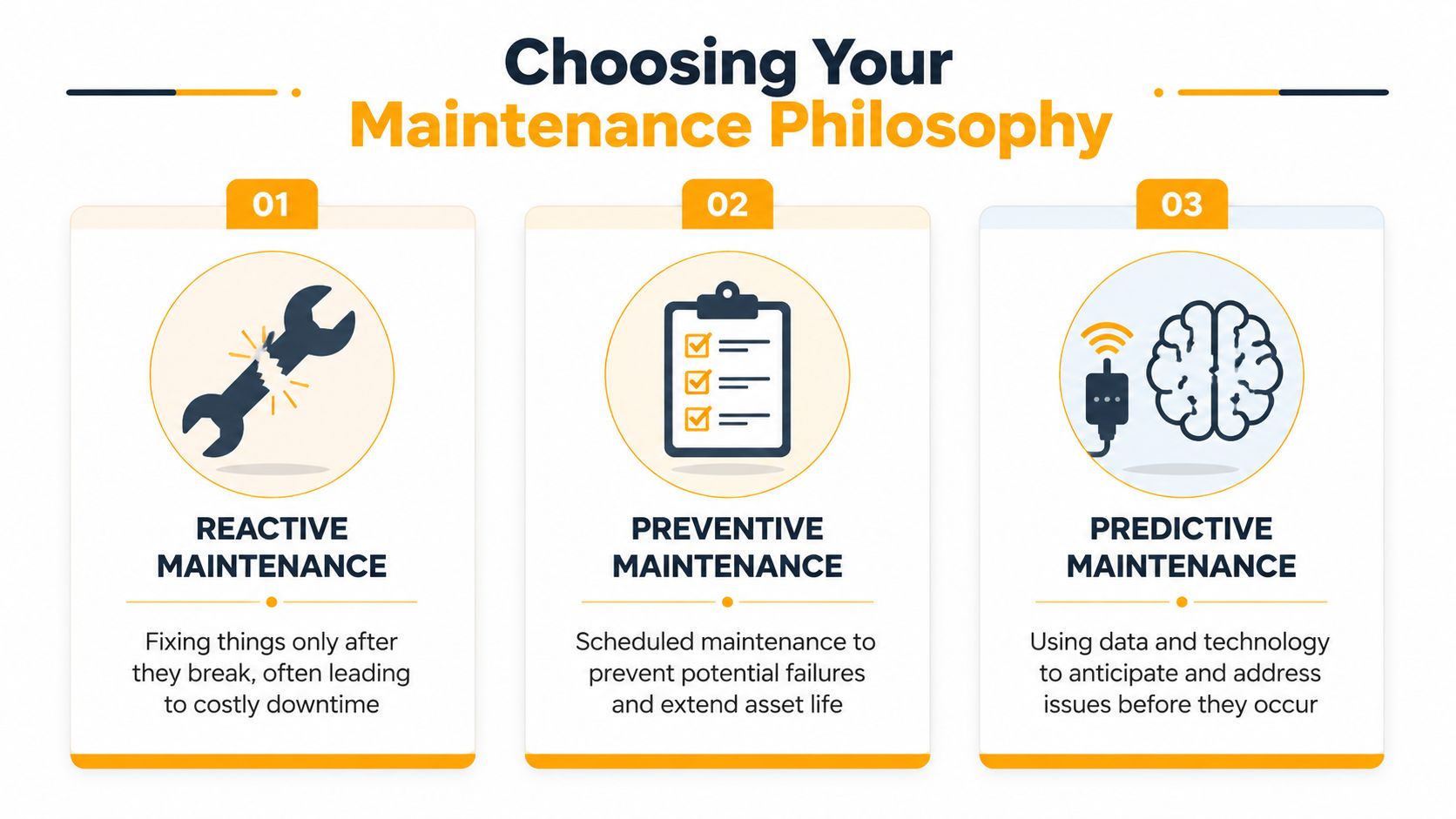
Comparison of Maintenance Philosophies
| Strategy | Approach | Primary Goal | Example (Loading Dock) |
|---|---|---|---|
| Reactive maintenance | Repair after failure | Restore operation quickly | Fixing a dock leveler only after it won't raise |
| Preventive maintenance | Service on a schedule | Reduce failure likelihood | Lubricating hinges, checking fluid, tightening hardware during planned visits |
| Predictive maintenance | Monitor condition and trends | Intervene before failure | Using sensor data to flag abnormal cycle speed or pressure changes |
Reactive maintenance
Reactive work feels cheaper until the bill arrives in a different form. Labour gets rushed. Freight gets delayed. Staff improvise around failed equipment. In some cases, the damage spreads because one worn part takes another with it.
Reactive maintenance still has a place. If a forklift clips a door track, you repair the damage. If a spring breaks, you respond. But running a whole facility this way usually leads to repeated disruption and poor control over costs.
Preventive maintenance
Preventive maintenance is the backbone of most well-run facilities. You inspect, adjust, clean, lubricate, and test equipment before visible failure shuts the line down. On doors and docks, that often means checking rollers, hinges, cables, seals, operators, leveler structure, hydraulic condition, and safety devices.
This approach works well because many failures aren't sudden. They announce themselves first. A high-speed door starts tracking rough. A dock lip extends more slowly. An operator sounds strained. Preventive work gives you a chance to catch that early.
Good preventive maintenance doesn't mean touching everything constantly. It means touching the right assets at the right interval.
Predictive maintenance
Predictive maintenance adds data to the decision. Instead of servicing only by calendar, you monitor equipment condition and use patterns to spot developing faults. For critical doors and docks, that can include cycle count, speed changes, temperature, pressure behaviour, or repeated fault codes.
The benefit is precision. You avoid both extremes. You're not waiting for breakdown, and you're not over-servicing equipment that still has useful life left. The trade-off is complexity. Sensors, software, alarms, and interpretation all need support from people who understand what the data means in the field.
What usually works best
Most facilities benefit from a layered model:
- Reactive for true surprises: impact damage, sudden component failure, storm-related issues
- Preventive for most assets: scheduled servicing for overhead doors, dock equipment, operators, seals, and restraints
- Predictive for critical points: high-cycle openings, temperature-sensitive areas, and bays where downtime has a direct operations cost
The mistake is choosing one philosophy as ideology. The better approach is choosing the mix that matches asset criticality, staffing, and risk.
Budgeting and Measuring Maintenance Success
Maintenance budgets get approved more easily when they solve business problems, not just maintenance problems. If you present maintenance as overhead, you'll get pressure to cut it. If you present it as protection against downtime, asset loss, and compliance risk, leadership listens differently.
That matters in Canada, where maintenance, repair, and alterations for non-residential buildings reached $12.5 billion in 2022, and commercial building owners typically allocate 2% to 4% of replacement value annually, or about $1.50 to $3.00 per square foot for industrial buildings in provinces like Ontario, according to Statistics Canada reporting cited here.
Build the budget from asset risk
Start with the assets that interrupt operations when they fail. In many warehouses and plants, that means:
- Shipping and receiving doors: failures affect throughput immediately
- Dock levelers and restraints: failures create both safety and scheduling issues
- Fire-rated openings: failures introduce life-safety and compliance exposure
- High-speed or temperature-sensitive doors: poor performance affects energy control and process stability
Then separate costs into three buckets:
| Budget area | What belongs in it | Why it matters |
|---|---|---|
| Planned work | scheduled inspections, lubrication, adjustments, testing | stabilises reliability |
| Corrective work | repairs from wear, impact, or identified defects | prevents small faults from growing |
| Specialist services | code-required testing, advanced diagnostics, outside technicians | fills skill and certification gaps |
A useful way to explain this internally is by comparing systems. Boiler servicing, for example, is easier to budget when the scope is predictable, which is why references like pricing for annual boiler check-ups can help frame planned service as normal facility practice rather than exceptional spend.
Track the numbers that change decisions
Don't drown yourself in metrics. A few indicators matter more than a dashboard full of noise.
- MTBF: Mean Time Between Failures. This tells you how long an asset runs before failing again.
- MTTR: Mean Time To Repair. This tells you how long you stay down once a problem happens.
- Planned versus reactive ratio: This shows whether your team is controlling the workload or chasing it.
- Repeat fault rate: If the same bay keeps failing, the issue may be incomplete repair, poor parts selection, or misuse.
A door that fails three times in a quarter is not a bad luck problem. It's a data point.
If you're moving away from spreadsheets, a dedicated software setup helps tie work orders, asset history, and recurring schedules together. This overview of building maintenance software options is a useful starting point for structuring that process.
Navigating Safety and Compliance Requirements
Maintenance shortcuts don't stay small for long. On access equipment, the gap between “still working” and “safe to operate” can be much wider than people think. A door can open and close every day and still fail a required test, expose workers to risk, or put your facility offside with code expectations.
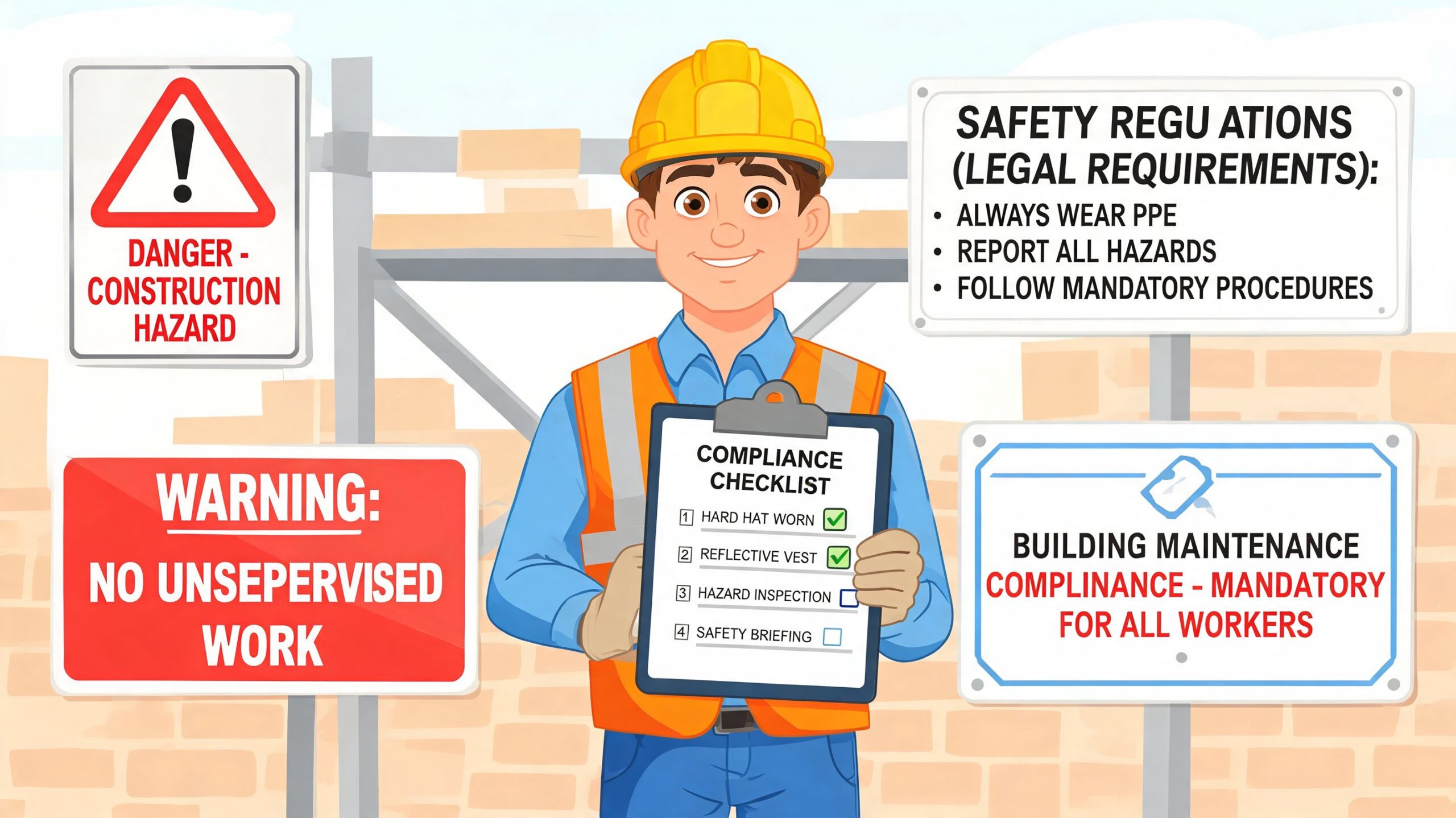
Fire doors are the clearest example. They often sit in the background until an inspection or an emergency puts them under real demand. By then, deferred maintenance becomes visible all at once.
Fire doors fail in ordinary ways
Expert inspections show that 68% of fire door failures during annual drop tests are caused by worn or improperly adjusted fusible links and closing mechanisms, and facilities that implement quarterly visual inspections and bi-annual professional drop tests can reduce non-compliance fines by 75% and extend fire door life from 10 to over 20 years, according to this maintenance checklist reference.
That failure pattern is important because the parts involved are not exotic. They're exactly the kinds of items people overlook when the door still appears functional. Worn links, sticky mechanisms, accumulated debris, and poor adjustment don't usually announce themselves with a dramatic breakdown. They subtly erode compliance.
What managers should check regularly
A practical compliance routine for fire-rated openings includes:
- Visual condition: damaged guides, bent bottom bars, missing labels, blocked travel path
- Closing path: no obstructions, no stored material, no field modifications that interfere with descent
- Hardware condition: links, release devices, and closing components should show no obvious wear or misalignment
- Documentation: inspection dates, corrective work, and technician records should be easy to retrieve
For facilities that need a more detailed understanding of code-driven testing, this article on fire door drop testing in manufacturing facilities outlines the operational reasons these inspections can't be treated as a formality.
If a fire door only gets attention during an annual inspection, you're already late.
The same mindset applies to docks. A leveler with slow response, leaking hydraulics, or inconsistent lip movement isn't only a maintenance issue. It's a worker exposure issue. Safety and compliance improve when inspection routines are tied to real use conditions, not just to the calendar.
A short refresher like the one below can help align operations and maintenance teams on why compliance tasks need proper execution, not paper completion.
Your Daily and Seasonal Maintenance Checklists
The best checklist is the one your team can use on the floor. If it takes too long, gets too technical, or reads like a manufacturer manual, people stop using it. Daily checks should be fast and visual. Seasonal checks should be more deliberate and often involve a trained technician.
For doors and docks, the point isn't to turn operators into mechanics. It's to catch early warning signs before they become failures.
Daily checks for doors and docks
Have staff look for simple issues during normal traffic periods.
- Door travel: watch for jerking, hesitation, uneven closing, or rubbing on guides
- Noise: listen for grinding, slapping, or operator strain that wasn't there before
- Visible damage: check panels, tracks, weather seal, bottom edge, and control stations
- Dock area condition: keep pits, hinges, and approach zones free of debris and product wrap
- Hydraulic warning signs: look for oil residue, wet fittings, or drips near cylinders and hoses
A short daily checklist catches a surprising amount. Bent track after impact. Torn perimeter seal. Damaged photo eye. Loose fastener on a control box. None of those should wait for a major service call.
Seasonal work needs more depth
Seasonal maintenance should reflect the environment. In Canadian facilities, winter and shoulder seasons are hard on critical access points. Cold affects seal compression, door speed, lubrication behaviour, and hydraulic response. Moisture and dirt make things worse.
For a broader property view, checklists like this guide to business HVAC maintenance are useful because they show the same principle across another essential building system. Routine observation handles the obvious. Seasonal service deals with the technical adjustments.
For door and dock equipment, seasonal service should include:
- Lubrication: use the right product for hinges, rollers, and moving connection points
- Fastener inspection: verify mounting points, brackets, and hardware remain tight
- Operator review: check controls, limits, safety devices, and response consistency
- Seal and shelter condition: inspect wear, tears, compression loss, and drafts
- Weather readiness: confirm bottom seals, side seals, and dock components are ready for cold exposure
Dock levelers deserve their own checklist
Hydraulic dock levelers fail in predictable ways when service gets deferred. Preventive maintenance can cut unplanned downtime by 52%, and hydraulic fluid degradation can cause a 30% viscosity loss in 6 months, leading to unsafe operation. Scheduled service under CSA B335-15 extends MTBF to over 18 months, compared with a 9-month national average for unmaintained units, based on dock maintenance data referenced here.
That should change how you treat them. A leveler isn't just a platform. It's a moving safety device exposed to shock loads, moisture, debris, and constant timing demands.
A practical dock leveler checklist should include:
Check fluid condition
Look for contamination, darkening, or signs of moisture. Poor fluid condition affects response and seal life.Observe lip extension
If the lip hesitates, extends unevenly, or retracts inconsistently, don't ignore it.Inspect hoses and fittings
Small leaks often show up before larger hydraulic problems.Review structural points
Check hinge areas, weld zones, and impact points for wear or deformation.Test return and holding behaviour
The leveler should move predictably under normal operating conditions.
For facilities that need a more formal schedule before winter demand ramps up, this planned maintenance programme for doors and docks shows how to organise that work around seasonal risk.
The Future In-House Teams AI and Expert Partners
Most maintenance departments aren't choosing between old methods and new methods. They're trying to make both work together. You still need people who can hear a chain drive struggling or spot impact damage on a door frame. But increasingly, you also need systems that can flag problems before those symptoms become shutdowns.
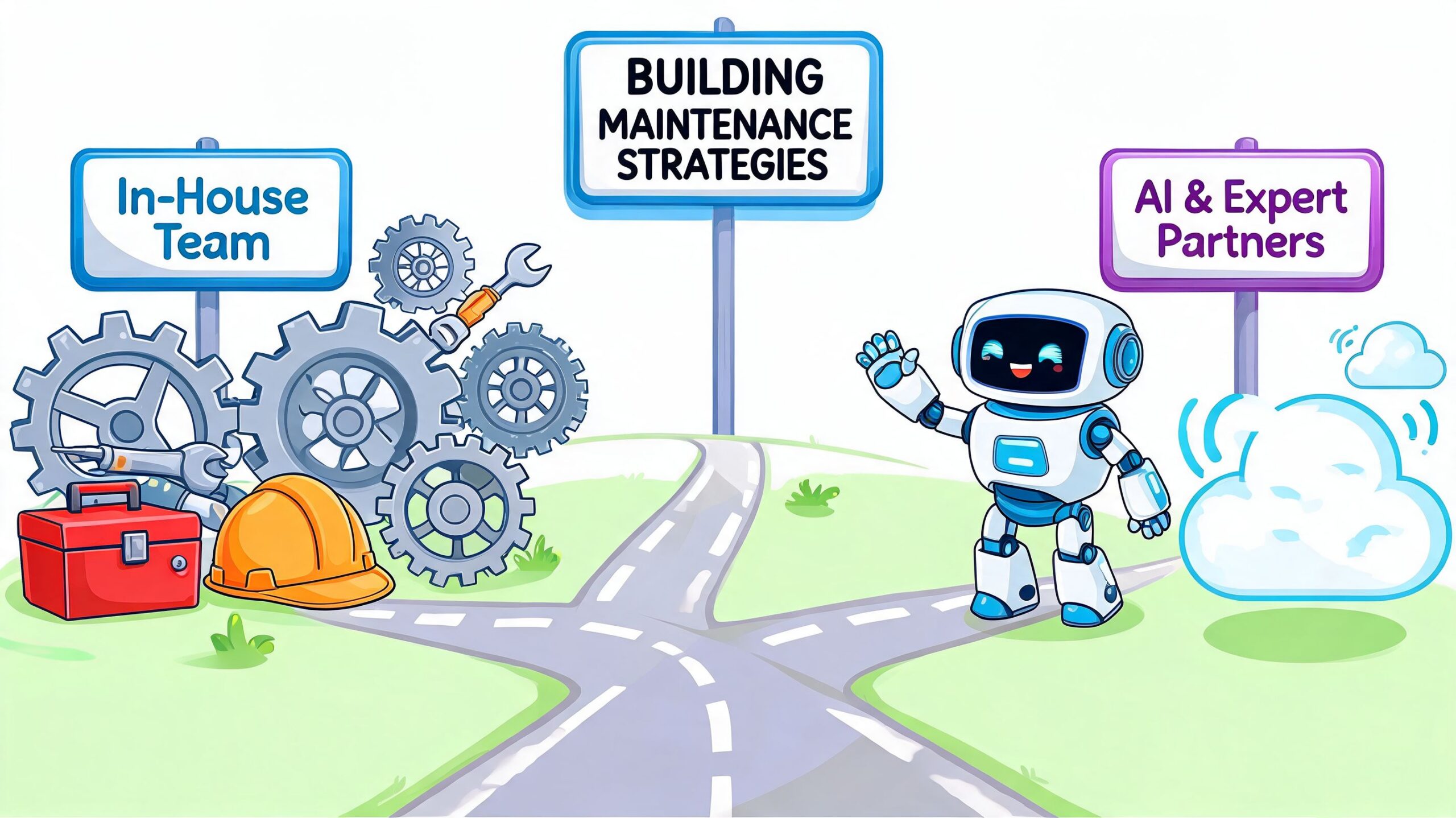
Canadian facilities are feeling the pressure. Warehouse downtime from door and dock failures increased by 18% in the past year due to extreme weather, and modern setups using IoT sensors with AI analytics can detect issues up to 72 hours in advance, prevent an estimated 40% of emergency calls, and reduce non-compliance fines by 50%, according to this maintenance technology reference.
Where in-house teams fit
In-house teams are valuable for:
- Routine observation and first response: they know the site, traffic patterns, and recurring trouble spots
- Basic corrective tasks: cleaning sensors, reporting damage, isolating unsafe equipment
- Work order discipline: documenting symptoms early and escalating properly
Where in-house teams can struggle is specialist work. Fire door testing, advanced operator troubleshooting, hydraulic diagnostics, and code-sensitive repairs often require tools, training, and certifications that general maintenance teams don't carry day to day.
Where AI and specialist partners fit
AI and sensor-based maintenance are strongest when they support judgement, not replace it. A sensor can tell you a high-speed door is slowing down across repeated cycles. It can't tell you whether the cause is ice buildup, track damage, poor adjustment, or a motor issue without skilled interpretation.
That pushes many facilities toward a hybrid model:
| Need | In-house team | Specialist partner |
|---|---|---|
| Daily checks | strong fit | limited role |
| Emergency site triage | strong fit | support role |
| Code-heavy testing | limited fit | strong fit |
| Advanced diagnostics | moderate fit | strong fit |
| Predictive data review | moderate fit | strong fit |
A specialist option in this space is Wilcox Door Service Inc., which provides planned maintenance, emergency repair, fire door testing, and service support for commercial doors and loading dock systems across Canada. That kind of arrangement makes sense when the asset is critical, the compliance burden is high, or downtime carries operational cost.
The smartest outsourcing decision isn't “Can my team do this once?” It's “Can my team do it safely, repeatedly, and with proper documentation?”
Build a Resilient Facility with a Reliable Partner
Strong building maintenance work isn't about doing more work. It's about doing the right work before failure forces the issue. The facilities that stay stable usually have the same habits. They know which assets are critical, they budget for planned service, they treat compliance as an operating requirement, and they don't ask general staff to carry specialist risk.
Doors and docks deserve that level of attention because they sit right at the intersection of safety, uptime, and energy control. When they fail, everyone feels it. Shipping slows down. Staff take workarounds. Supervisors start making calls they didn't plan to make.
There's also a strategic side that newer managers often discover later than they should. The right mix of daily checks, seasonal service, sensor data, and expert support gives you more than fewer breakdowns. It gives you better forecasting, better documentation, and fewer surprises during inspections and peak periods.
That is where the brand promise matters. Respected Partners, Reliable Service isn't just a tagline when it's backed by disciplined maintenance practice. It's what a facility needs from the people and systems responsible for its critical access points.
If your current programme still depends too much on emergency calls, start with an asset review. Identify the doors, docks, and safety systems that would hurt the operation most if they failed. Then build your plan from there.
If you need help assessing high-risk access points, planning inspections, or tightening up your maintenance approach, contact Wilcox Door Service Inc. to schedule a facility review or service discussion.