


If you manage a commercial facility, you know that space is money and reliability is everything. This guide will show you how a garage door opener jackshaft—a powerful, wall-mounted operator—can solve common challenges with overhead space, door configuration, and operational efficiency. You will learn what a jackshaft opener is, how it differs from traditional models, its key benefits for commercial use, and what’s required for a safe, professional installation.
A garage door opener jackshaft is a powerful, space-saving operator that mounts right on the wall beside your garage door, instead of on the ceiling. This side-mount design is a huge advantage for commercial facilities because it turns the door’s torsion bar directly to lift and lower it, freeing up that valuable overhead space.
Understanding the Garage Door Opener Jackshaft
When most people think of a garage door opener, they picture the long rail running down the centre of the ceiling—that’s the traditional trolley system. The garage door opener jackshaft takes a completely different approach.
Instead of pulling the door open along a track, it applies rotational force straight to the torsion bar. For those who aren’t familiar, the torsion bar is the spring-loaded rod above your door that does all the heavy lifting. Think of it this way: a traditional opener is like pulling a heavy wagon with a long rope, while a jackshaft is like turning the wagon’s axle directly with a powerful wrench. This direct-drive mechanism is incredibly efficient and opens up a world of possibilities for facilities with unique layouts.
Key Characteristics of a Jackshaft Opener
For facility managers and maintenance teams, grasping the fundamental differences is crucial. A jackshaft system is defined by a few core traits that set it apart from its overhead cousins. These features directly impact how you can use the space in your loading dock, warehouse, or service bay.
- Wall-Mounted Design: The entire unit is installed on the wall next to the garage door, completely eliminating the need for any ceiling-mounted hardware.
- Direct-Drive Mechanism: It connects directly to the torsion bar, providing smooth, reliable power without a chain, belt, or long rail.
- Space Optimization: Its primary benefit is freeing up the overhead area, which is critical in commercial settings where every square foot counts.
This design makes the jackshaft opener a perfect solution for buildings with high, sloped, or obstructed ceilings. For example, a distribution centre can now install taller pallet racking closer to the door, or an auto service shop can finally fit in a vehicle lift without an opener getting in the way.
The benefits go beyond just space, too. The direct-drive operation often results in quieter performance and less vibration, creating a better working environment. It’s why our team at Wilcox Door Service frequently recommends these systems for applications needing both durability and spatial efficiency.
To help you see the differences at a glance, here’s a quick comparison.
Jackshaft Opener vs Traditional Trolley Opener
This table breaks down the core distinctions between a side-mount jackshaft and a conventional overhead trolley opener, helping you see which might be a better fit for your facility’s needs.
| Feature | Garage Door Opener Jackshaft (Side-Mount) | Traditional Trolley Opener (Overhead) |
|---|---|---|
| Mounting Location | On the wall, next to the door | On the ceiling, in the centre of the door |
| Mechanism | Direct-drive; turns the torsion bar directly | Pulls/pushes the door along a rail using a chain or belt |
| Overhead Space | Completely clear; frees up space for storage, lifts, or high ceilings | Occupied by the motor unit and rail, limiting vertical space |
| Ideal for | High-lift, vertical-lift, or standard-lift doors; obstructed ceilings | Standard-lift doors with clear, unobstructed ceiling space |
| Common Applications | Warehouses, auto shops, fire stations, facilities with vehicle lifts | Residential garages, commercial bays with standard ceiling heights |
| Installation & Power Requirements | Requires an electrical outlet near the side of the door | Requires an electrical outlet on or near the ceiling, usually toward the back |
| Maintenance | Fewer moving parts (no long chain/belt); generally lower maintenance | Chain/belt may require tension adjustments and lubrication over time |
As you can see, the choice really comes down to your building’s structure and how you use your space. While both get the job done, the jackshaft offers a unique advantage where overhead room is at a premium.
For more complex setups, getting professional guidance on garage door opener installation is essential for safety and compliance. As “Respected Partners, Reliable Service,” we believe in empowering you with clear information. To see how these systems could fit into your operations, explore our commercial door solutions. If your facility relies on other operator types, understanding the mechanics of a belt drive garage door opener can also provide valuable context.
How a Jackshaft Opener Powers Your Door
If you’re used to seeing a long rail running down the centre of a garage, a garage door opener jackshaft might look a bit unusual. Instead of pulling the door open from above with a chain or belt, a jackshaft gets the job done by directly turning the door’s torsion bar. This direct-drive approach delivers incredibly smooth, reliable power without any need for that bulky, ceiling-mounted hardware.
Think of it like using a high-torque wrench to turn a big bolt—that’s the basic principle here. The motor mounts right on the wall beside the door and applies rotational force straight to the torsion bar. As the bar spins, it lifts the door up or guides it down. It’s a simple, powerful, and clean solution.
The Core Components at Work
To really get a feel for how a jackshaft operates, it helps to know its key parts. Each component has a specific role, and together they form a tough system built for the long haul, especially in demanding spots like a busy loading dock or high-cycle parkade.
- The Motor Unit: This is the brains and the brawn of the operation. It’s a compact unit that contains the electric motor, gearing, and logic board, all designed to deliver consistent torque right where it’s needed most.
- The Drive System (Sprocket and Chain): A short roller chain connects a sprocket on the motor to a bigger one on the torsion bar. When the motor turns, this system transfers that rotational power to the bar, causing it to spin and operate the door.
- The Torsion Bar: This is a crucial part of your whole door system. The jackshaft opener works with the torsion bar, turning it to wind or unwind the lift cables on their drums. A properly balanced door and healthy torsion springs are absolutely essential for the opener to work correctly and avoid strain.
This infographic breaks down the core features of a garage door opener jackshaft at a glance.
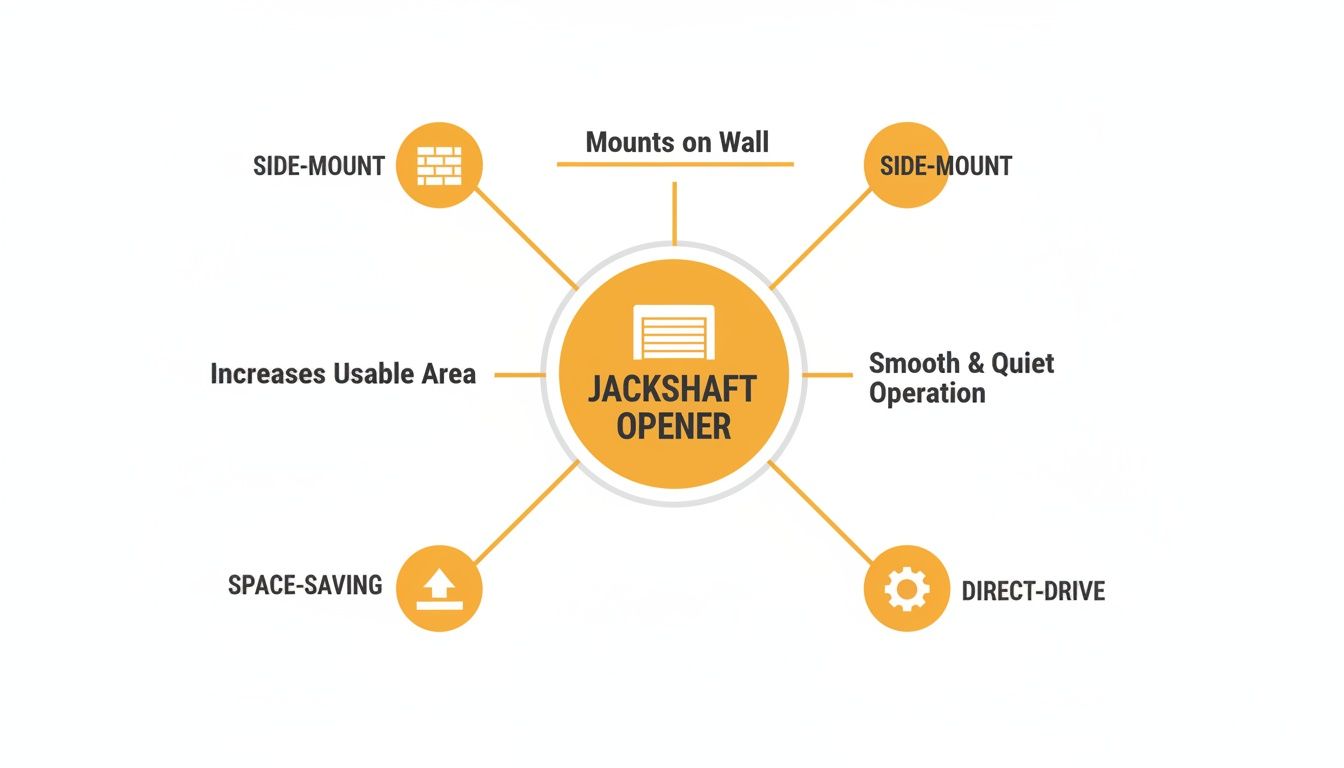
alt text: Infographic illustrating key features of a jackshaft garage door opener, including its space-saving side-mount design and direct-drive mechanism.
As you can see, the side-mount, direct-drive design is what makes its biggest benefit possible: maximizing usable overhead space.
Direct-Drive Power and Efficiency
The direct-drive mechanism is what truly sets the jackshaft apart from the rest. Because it isn’t pulling a heavy door from a distance along a trolley, there are far fewer moving parts to wear out, break down, or maintain. This translates to less energy loss and a much more efficient transfer of power from the motor to the door.
This efficiency is a key reason why jackshafts are so durable in high-use settings. The absence of a long, overhead rail means no risk of the rail bending or the trolley wearing down, which are common failure points in traditional systems.
This direct power application also makes for a quieter-running door. You won’t hear a long chain rattling or a belt humming across the length of your bay. The design’s simplicity and power make it a true workhorse. For a facility manager, that means less downtime, fewer service calls, and more predictable operations. When you’re looking at different operator types, you might also want to read our guide on the mechanics of a belt drive garage door opener to see how the technologies compare.
Top Advantages for Commercial Facilities
For any busy commercial facility, the design of a garage door opener jackshaft can bring some serious advantages. If you’re a facility manager, knowing what these operators bring to the table is crucial for improving workflow, safety, and your overall efficiency. Its unique wall-mounted design isn’t just an alternative to an overhead opener; it’s a smart upgrade for modern industrial spaces.
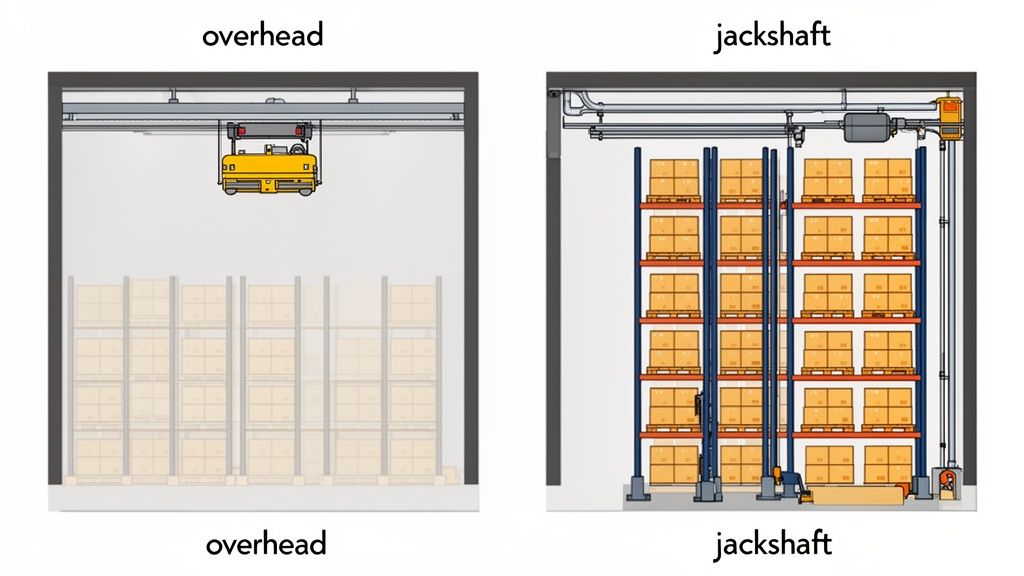
alt text: Diagram comparing a warehouse with a traditional overhead garage door opener and a space-saving garage door opener jackshaft.
The most obvious benefit is how much overhead space you get back. A traditional trolley opener takes up a huge amount of room on the ceiling, creating a dead zone that eats into your usable height. A jackshaft opener gets rid of that obstruction completely, opening up all that valuable vertical space right up to the ceiling.
Maximize Your Vertical Cube
In a warehouse or distribution centre, every cubic foot counts. By getting rid of the central rail and motor, a jackshaft operator lets you:
- Install Taller Storage Racks: You can run your pallet racking much closer to the door opening, boosting your storage capacity without having to expand the building.
- Accommodate Vehicle Lifts: Auto service bays can install two-post or four-post lifts without worrying about the opener getting in the way of a raised vehicle.
- Simplify Overhead Systems: It clears the way for complex HVAC ductwork, fire suppression systems, or overhead conveyor lines without anything getting in the way.
This one change can make a huge difference. For a real-world example, we recently worked with a client in the food and beverage industry who was able to add an entire extra level to their racking near the loading docks after switching to jackshaft operators, dramatically improving their inventory density.
Unmatched Versatility for Unique Doors
Commercial buildings often have specialized doors that a standard trolley opener just can’t handle. This is where a jackshaft opener really shines, offering flexibility that other systems can’t match.
It’s the go-to operator for high-lift and vertical-lift sectional doors. These are common in buildings with high ceilings, where the door tracks run straight up the wall. A jackshaft’s direct-drive system is built to power these doors efficiently. For any business thinking about a jackshaft opener, a reliable power source and a compliant installation are non-negotiable. Professional Commercial Electrical Services can make sure your system meets all operational demands and safety codes.
The ability to adapt to non-standard door configurations makes the jackshaft opener a problem-solver for architects and builders. It removes design constraints, allowing for more efficient and purpose-built facility layouts from the ground up.
Enhanced Security and Quieter Operation
It’s not just about space and flexibility. A jackshaft system also delivers real security and operational improvements. Because it connects directly to the torsion bar, the door is much harder to force open manually.
For an even higher level of protection, many commercial jackshaft models are compatible with a power lock deadbolt. This feature automatically slides a physical bolt into place every time the door closes, adding a critical layer of security for any area with high-value assets. It’s a simple feature that helps secure your facility and gives managers peace of mind.
On top of that, with no long chain or belt rattling overhead, the operation is significantly quieter and smoother. The reduced vibration and noise create a better, less disruptive work environment for employees working near loading docks or service bays.
Ready to see how a jackshaft could transform your facility? Contact Wilcox Door Service today for a professional assessment of your operational needs.
Ideal Applications for Jackshaft Openers
So, what’s the right situation for a garage door opener jackshaft? Its side-mount design is a natural problem-solver, making it the perfect choice for buildings where a standard overhead trolley opener just won’t work.
Knowing where these openers shine helps facility managers see exactly how a jackshaft can improve operations. It’s not just about opening a door; it’s about making the entire space more efficient, from maximizing storage to enabling specialized work.
Warehouses and Distribution Centres
In any logistics operation, every inch of vertical space counts. For warehouses and distribution centres, a jackshaft opener is a game-changer because it completely clears the overhead area around the loading dock door.
- Taller Pallet Racking: With no central rail in the way, you can install taller racks much closer to the door. This boosts inventory capacity without needing a bigger building.
- Unobstructed Forklift Paths: The open overhead space gives forklifts and other equipment unrestricted access, which improves safety and speeds up loading cycles.
- Integration with Dock Equipment: It won’t interfere with dock seals, shelters, or other essential loading dock equipment, helping create a perfect seal between the dock and the trailer.
For a warehouse manager, this translates directly into more product storage, faster truck turnarounds, and a safer environment for the team.
Facilities with Low Ceilings or Obstructions
Many commercial buildings, especially older ones or underground parking garages, don’t have enough ceiling height for a traditional trolley operator. A garage door opener jackshaft solves this problem by mounting cleanly on the wall right beside the door.
This is also a huge advantage in manufacturing plants or maintenance depots cluttered with overhead systems. A standard trolley opener can easily conflict with:
- Overhead cranes
- HVAC and ventilation ductwork
- Complex fire suppression sprinkler systems
- Conveyor belts
By moving the operator to the side, the jackshaft ensures all these essential systems can run without interference, so the facility’s core operations are never compromised.
High-Cycle and Specialty Environments
The tough, direct-drive design of a jackshaft makes it incredibly durable. That’s why it’s a go-to choice for high-cycle applications where doors fly open and shut hundreds of times a day. The design has fewer points of failure, which means greater reliability and less downtime.
A key benefit in these demanding settings is the reduced maintenance burden. With fewer moving parts like long chains or belts, there are fewer components to stretch, break, or require frequent adjustment, which is a major advantage in 24/7 operations.
You’ll often find them in these types of environments:
- Car Washes: They can handle the constant open/close cycles and damp conditions without skipping a beat.
- Emergency Service Bays: Fire stations and ambulance depots need doors that work flawlessly, every single time.
- High-Traffic Parkades: The durability of a jackshaft keeps traffic flowing smoothly for thousands of vehicles.
As “Respected Partners, Reliable Service,” we help facilities find the right operator for their specific challenges. If your operations run into any of these scenarios, a jackshaft system could be the perfect solution.
Ready to explore how a jackshaft could optimize your facility? Contact our team today for a professional consultation.
Installation and Safety Requirements
Getting the installation right is the absolute bedrock of a safe, reliable, and high-performing garage door opener jackshaft. This isn’t a straightforward weekend DIY project. Setting up a commercial-grade operator involves precise mechanical and electrical work where there’s simply no room for error. We’ll break down the key requirements so you can understand what a professional installation truly entails.
A successful jackshaft installation starts with the health of your door system. Because the operator works by turning the torsion bar directly, the entire system has to be in excellent shape. This isn’t just a friendly suggestion; it’s a non-negotiable prerequisite for both safety and performance.
Structural and Mechanical Prerequisites
Before a technician even opens the box, they’ll conduct a thorough assessment of your existing door and the surrounding structure. A single weak link in any of these areas can lead to premature wear, total operational failure, or a serious safety hazard.
- Solid Mounting Surface: The jackshaft motor generates significant torque. It absolutely must be anchored to a solid structural surface, like a concrete block wall or heavy-duty wood framing, to handle those rotational forces without vibrating loose over time.
- Sufficient Side-Room: Since the unit is installed on the wall right next to the door, clearance is key. There must be enough space—typically at least 20 cm of side-room and 7.5 cm above the torsion bar—to mount the operator securely.
- Properly Balanced Door: This is hands-down the most crucial requirement. A technician will disconnect any existing opener and test the door by hand. It should stay put when halfway open and lift with minimal effort. An unbalanced door puts immense, unsustainable strain on the jackshaft motor, leading to rapid failure.
- Healthy Torsion Spring System: Remember, the torsion springs do the actual heavy lifting; the opener just controls the ride. The springs must be correctly sized for the door’s weight, properly tensioned, and free of any rust or damage. A jackshaft cannot and will not compensate for weak or broken springs.
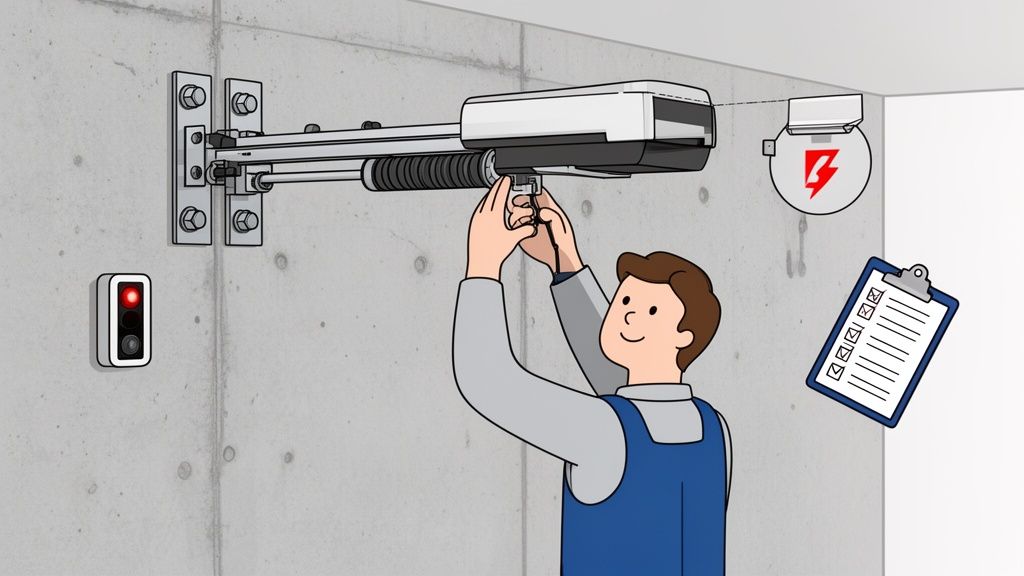
alt text: A professional technician performs maintenance on a garage door opener jackshaft system mounted on a facility’s concrete wall.
Essential Safety Standards and Compliance
Modern commercial door operators are packed with multiple safety features mandated by law. A professional installation guarantees these systems are correctly installed, calibrated, and tested to protect your people, products, and property. These aren’t optional add-ons; they are core, legally required components of a safe system.
Ensuring these safety mechanisms are functional isn’t just about ticking a compliance box; it’s about fostering a genuinely safe work environment. A malfunctioning safety sensor can turn a multi-ton door into a significant liability.
Here are the key safety components you’ll find:
- Photo-Eye Sensors: These electronic eyes project an invisible infrared beam across the door opening. If anything—a person, a forklift, a pallet—breaks that beam while the door is closing, the operator must immediately stop and reverse. Proper alignment and routine testing are vital.
- Reversing Mechanism: The opener’s internal logic board is always monitoring the force needed to close the door. If it detects an obstruction, it’s programmed to automatically reverse direction to prevent a crushing incident.
- Emergency Release: In case of a power outage or an emergency, there has to be a way to disconnect the opener and operate the door by hand. For a jackshaft, this is usually a quick-disconnect lever or, for heavier doors, a chain hoist.
- Power Lock: Many jackshafts come with an automatic deadbolt that physically locks the door shut when it closes. This provides a much higher level of security against forced entry compared to just relying on the motor’s resistance to hold the door closed.
Given these strict mechanical and safety requirements, professional installation is the only way to ensure your garage door opener jackshaft is safe, compliant, and reliable from day one. Our commitment as “Respected Partners, Reliable Service” means we never, ever cut corners on safety.
If you’re considering a new operator, our comprehensive guide on garage door opener installation provides further valuable information.
Jackshaft Opener Maintenance and Troubleshooting
A garage door opener jackshaft is a workhorse, but like any heavy-duty equipment, it needs regular attention to perform its best. A simple, proactive maintenance routine is your first line of defence against unexpected downtime.
By empowering your facility team with a basic checklist, you can extend the life of your equipment and catch small issues before they become major headaches. Think of it as a partnership: your team handles the day-to-day checks, and you know exactly when to bring in the experts for the heavy lifting.
A Simple Preventative Maintenance Checklist
These are straightforward visual and functional checks your team can perform regularly to keep your jackshaft operators running smoothly.
- Visual Inspection: Give the whole system a good look-over. Check for any loose bolts or mounting hardware on the operator and where it connects to the torsion bar. Make sure the drive chain has the right tension and isn’t showing signs of rust or significant wear.
- Lubrication: The drive chain and sprockets need love, too. A periodic application of a high-quality lubricant designed for garage doors will keep things moving quietly and reduce friction.
- Listen for Trouble: Operate the door and just listen. Any new grinding, scraping, or squealing noises are early warning signs. These sounds often point to a developing problem with the motor, bearings, or even the door itself.
- Test Safety Features: This is non-negotiable. Place a block of wood or another sturdy object on the floor, directly in the path of the photo-eye sensors. When you try to close the door, it must immediately stop and reverse. This simple test confirms your primary safety system is working as it should.
Basic Troubleshooting for Jackshaft Openers
When an opener acts up, a few quick checks can often pinpoint the problem, helping you decide if it’s a simple fix or time for a service call. For common issues, this table can be a great starting point for your on-site team.
| Symptom | Potential Cause |
|---|---|
| The Door Won’t Move at All | Power Interruption: Is the unit plugged in? Has a breaker tripped in your electrical panel? Error Code: Check the motor unit for a flashing LED light. This is often an error code pointing to a specific problem (consult your owner’s manual). Safety Sensor Misalignment: This is the most common culprit. A blinking light on one of the sensors is a dead giveaway. |
| Door Moves a Few Inches, Then Reverses | Obstructed Photo-Eyes: The beam between the safety sensors is likely blocked or misaligned. Check for anything in the path, clean the sensor lenses, and ensure the sending and receiving eyes are pointed directly at each other. Binding or Obstruction: The door itself might be hitting something or binding in the tracks. |
| Opener Makes Noise but Door Doesn’t Move | Disengaged Trolley/Carriage: The door may have been manually disconnected from the opener. Broken Drive Component: The drive chain could be broken or may have slipped off the sprocket. |
| Remote or Wall Button Not Working | Remote Control Issue: The remote battery might be dead. Try a new battery or use the wall control to isolate the problem. Wiring Problem: For the wall control, there could be a loose or disconnected wire between the button and the motor unit. |
If your door starts to close but then shoots back up, it’s almost always a problem with the safety reversal system. You can learn more about how to check and align these critical devices in our guide to sensors for garage doors.
These simple diagnostics can save you from an unnecessary service call. However, it’s crucial to know where to draw the line.
When to Call a Professional
While your team can manage basic maintenance, some jobs are strictly for the pros. For the safety of your staff and the integrity of your door system, always call a certified technician for problems involving:
- The Torsion Spring System: This is the most dangerous part of the door. Torsion springs are under extreme tension and can cause serious injury or death if handled improperly. Adjusting or replacing them is a job only for a trained professional.
- The Motor Itself: If you suspect an internal failure in the motor or gearbox, it’s time to call for service. Don’t attempt to open the motor housing.
- Electrical Problems: Any issues with the main power supply, internal wiring, or the logic board require a qualified technician to diagnose and repair safely.
As your “Respected Partners, Reliable Service,” we’re here when you need us. For comprehensive care, we recommend scheduling a planned maintenance inspection with our technicians to ensure your operations continue to run safely and efficiently.
Common Questions About Jackshaft Openers
When you’re looking at new equipment for your facility, it’s only natural to have a few questions. Facility managers often ask us about the real-world implications of switching to a garage door opener jackshaft. We’ve gathered the most common questions we hear and answered them directly to help you make a confident, well-informed decision for your operations.
Our goal here is to give you clarity, reinforcing our commitment as your “Respected Partners, Reliable Service.”
Can a Jackshaft Be Installed on My Existing Door?
In most situations, yes—a jackshaft opener can be retrofitted onto an existing commercial sectional door. But it’s not a simple swap. A professional technician first needs to confirm that a few key requirements are met.
The door must be perfectly balanced, the torsion spring system needs to be in excellent shape, and you’ll need enough side-room (typically at least 20 cm) on the wall next to the door to mount the unit.
The success of any retrofit comes down to the condition of your existing door system. A jackshaft relies on healthy, correctly tensioned springs to do its job safely. It can’t make up for a worn-out or poorly maintained door.
For instance, if the torsion springs are old or weren’t sized correctly for the door’s weight, they have to be replaced before the jackshaft can go in. This ensures the new operator isn’t put under excessive strain, which would lead to premature failure.
Are Jackshaft Openers More Expensive?
While the upfront purchase price of a garage door opener jackshaft can be higher than a standard trolley operator, it’s vital to look at the total cost of ownership. Over the long run, jackshafts often deliver far greater value.
Here’s a quick breakdown of the cost factors:
- Reduced Maintenance: With fewer moving parts like long chains or belts, there’s less to wear out, adjust, or lubricate. This translates to fewer service calls and less downtime for your facility.
- Increased Durability: Their direct-drive mechanism is built tough, making them a great fit for high-cycle environments and reducing how often they need to be replaced.
- Space Value: The overhead space a jackshaft frees up has real monetary value. For a warehouse, this could mean adding an entire row of pallet racking, directly boosting your storage capacity and revenue potential.
When you factor in these long-term savings and operational gains, that initial investment often proves to be very cost-effective.
How Secure Is a Jackshaft System?
A jackshaft system offers security that is head and shoulders above traditional openers. Because the motor directly engages and holds the torsion bar, it’s much harder for someone to force the door open from the outside.
For the ultimate protection, many commercial jackshaft models come equipped with an automatic power lock deadbolt. This feature drives a solid steel bolt into the door track every single time it closes, physically barring it shut. It’s an essential layer of defence against forced entry, protecting your facility’s valuable assets around the clock.
This makes the jackshaft opener an excellent choice for any application where security is a top priority.
Making the right choice for your facility’s access points is critical for safety, efficiency, and security. A garage door opener jackshaft offers a unique solution for optimizing space and improving reliability. As “Respected Partners, Reliable Service,” Wilcox Door Service is here to help you assess your needs and find the perfect solution.
If you believe a jackshaft opener is right for your facility, the next step is a professional consultation. Contact us for a professional consultation and quote to have one of our experts evaluate your site and provide a detailed recommendation.