


Choosing the right industrial ceiling fans is a strategic decision that impacts your facility year-round. In this guide, you’ll learn how these powerful tools do more than just cool your space in the summer—they also drastically reduce heating costs in the winter. We’ll walk you through assessing your facility’s needs, understanding the key technical components, and the critical importance of professional installation, all to help you make a smart, long-term investment in your operational efficiency.
More Than Just a Breeze: The Year-Round Value of Industrial Ceiling Fans
Most facility managers see fans as a solution for sweltering summer months. While that’s a key benefit, the true return on investment (ROI) comes from what these fans accomplish in the winter. They are powerful tools for air circulation that directly impact your operational costs and team productivity, season after season. It’s not just about comfort—it’s about creating a stable, efficient, and more cost-effective environment.
How Industrial Fans Deliver Year-Round Savings
The strategic value of industrial fans becomes clear when you see how they tackle both cooling and heating challenges.
- Summer Cooling: In warmer months, High-Volume, Low-Speed (HVLS) fans create a powerful evaporative cooling effect. This is a technical term for the wind-chill effect you feel on your skin, which can make the air feel up to -13°C (8°F) cooler. This takes a massive load off your HVAC system, potentially reducing air conditioning costs by up to 30%.
- Winter Heating: During the cold season, these fans solve a costly problem called thermal stratification. This is when the expensive heated air you’re paying for rises and gets trapped at the ceiling, leaving the floor cold. By running the fans slowly in reverse, they gently push that warm air back down to where your team works, which can dramatically slash your heating expenses.
As industry experts, we’ve seen that one of the biggest misconceptions is viewing fans as a summer-only tool. In our experience, the most significant financial impact often comes from winter destratification. It directly cuts down on heating fuel consumption and makes the entire building more energy-efficient.
A Market Driven by Smarter Operations
The push for energy-efficient facility management has created huge demand for smart ventilation. The U.S. industrial ceiling fan market was valued at around USD 1,036.6 million in 2023 and is growing steadily. This isn’t just a trend; it shows a widespread industry recognition that industrial ceiling fans are essential equipment for any modern warehouse or industrial plant. Find out more about the growth of the industrial fan market.
For a real-world example, consider a busy distribution center where high temperatures near the loading docks can slow down operations. Installing a network of HVLS industrial fans doesn’t just improve employee safety and morale; it leads to a measurable drop in energy consumption. This is the kind of tangible business outcome driving facility managers to adopt better ventilation solutions.
At Wilcox Door Service, our message is simple: “Respected Partners, Reliable Service.” We’ve seen time and again that a well-planned fan system isn’t an expense—it’s an investment that pays for itself.
How to Assess Your Facility’s Airflow Needs
Before selecting a fan, you need a solid grasp of your space’s requirements. A fan that works perfectly in a wide-open distribution center might be ineffective in a manufacturing plant with complex machinery. Let’s walk through a practical way to evaluate your facility’s unique airflow dynamics.
First, let’s explain a key technical term: CFM, which stands for Cubic Feet per Minute. It’s simply a measure of the volume of air a fan can move. While a higher CFM means more air movement, the real goal is to match the fan’s power to your building’s volume (length x width x height) and your specific operational challenges.
Start with a Facility Walk-Through
A proper assessment begins on the floor. Take a walk through your entire space during a typical shift and make detailed notes. You’re looking for spots where the air feels heavy or where temperatures change dramatically. This hands-on approach helps identify problem zones that a simple square-footage calculation would miss.
- Heat-Generating Areas: Pinpoint locations with machinery, compressors, or welding stations constantly producing heat. These spots need targeted airflow to pull that warmth away and keep your team comfortable.
- High-Traffic Zones: Observe the movement of people and equipment. Busy forklift aisles and staging areas near loading docks have different airflow needs than stationary workstations.
- Employee Workstations: Where do your teams spend most of their day? Areas for manual packing, assembly, or quality control need consistent, gentle air movement—enough to improve comfort without becoming a disruptive wind tunnel.
I often see facility managers attempt a one-size-fits-all solution. But a plant with a hot metalworking zone on one side and a cool assembly area on the other needs a zoned approach, not a blanket solution.
Calculating Your Basic Airflow Requirements
Once you’ve mapped your critical zones, you can start putting numbers to your needs. While we always recommend a professional assessment for a precise plan, you can get a solid baseline by looking at your building’s layout.
A warehouse with 30-foot ceilings and wide-open spans is a perfect candidate for large-diameter High-Volume, Low-Speed (HVLS) fans. These are designed to move massive columns of air without creating a hurricane. Conversely, a facility with lower ceilings or obstructions like conveyor systems might be better served by several smaller, strategically placed fans.
For a deeper dive into the technical side of fan specs, including how CFM connects to blade span and fan size, check out this helpful guide on choosing ceiling fan sizes, blade span, and CFM.
Estimating CFM Needs by Facility Type
This table is a quick reference guide to help estimate the required Cubic Feet per Minute (CFM) based on your building’s primary function.
| Facility Type | Common Ceiling Height | Key Considerations | Estimated CFM Range (per fan) |
|---|---|---|---|
| Warehouse/Distribution Centre | 25-40 ft | Open floor plans, high racking, loading dock doors, moderate employee density. | 150,000 – 300,000+ CFM |
| Manufacturing Plant | 20-35 ft | Heat-generating machinery, complex layouts, specific work zones, higher employee density. | 100,000 – 250,000 CFM |
| Automotive Shop/Garage | 15-25 ft | Vehicle exhaust, tool heat, large bay doors, need for spot cooling. | 75,000 – 180,000 CFM |
| Gymnasium/Fitness Centre | 20-30 ft | High occupancy, need for consistent air circulation and moisture control. | 90,000 – 200,000 CFM |
Keep in mind, these are just starting points. The right fan for your space will depend on the specifics of your operation.
A Real-World Example in Action
Let’s apply this to a 150,000-square-foot manufacturing plant. The west side has three large CNC machines generating significant heat. The east wall is lined with loading docks where bay doors frequently open, letting in outside weather. In the middle, employees work at stationary assembly tables.
- CNC Machine Zone: This area needs powerful airflow to pull heat away from operators. A large HVLS fan placed directly overhead would be most effective.
- Loading Dock Zone: The goal here is to create an “air curtain” effect to minimize how much outside air gets in. This helps maintain a stable indoor climate, especially when paired with quality commercial doors.
- Assembly Zone: This area requires gentle, consistent air circulation for comfort without blowing papers or small parts off workstations.
This is where the year-round value of a well-planned system shines.
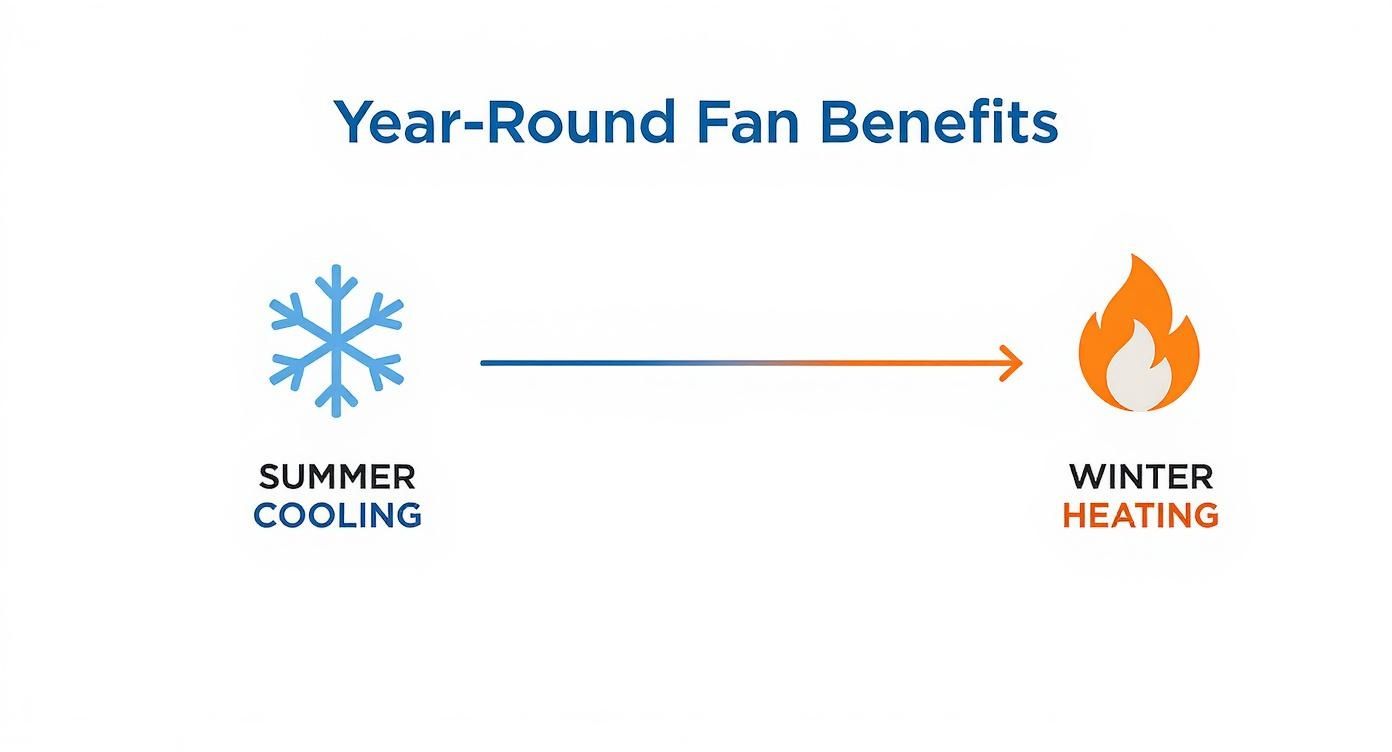
As you can see, the same fan system that creates a cooling breeze in summer can be reversed in winter to push warm air trapped at the ceiling back down to the floor, significantly reducing your heating bills.
By breaking down your facility into functional zones, you can build a more effective airflow strategy. This detailed self-assessment provides the critical information needed for a productive conversation with an installation expert. With a clear picture of your facility’s unique challenges, you’re ready to look at specific solutions.
Choosing the Right Industrial Ceiling Fan
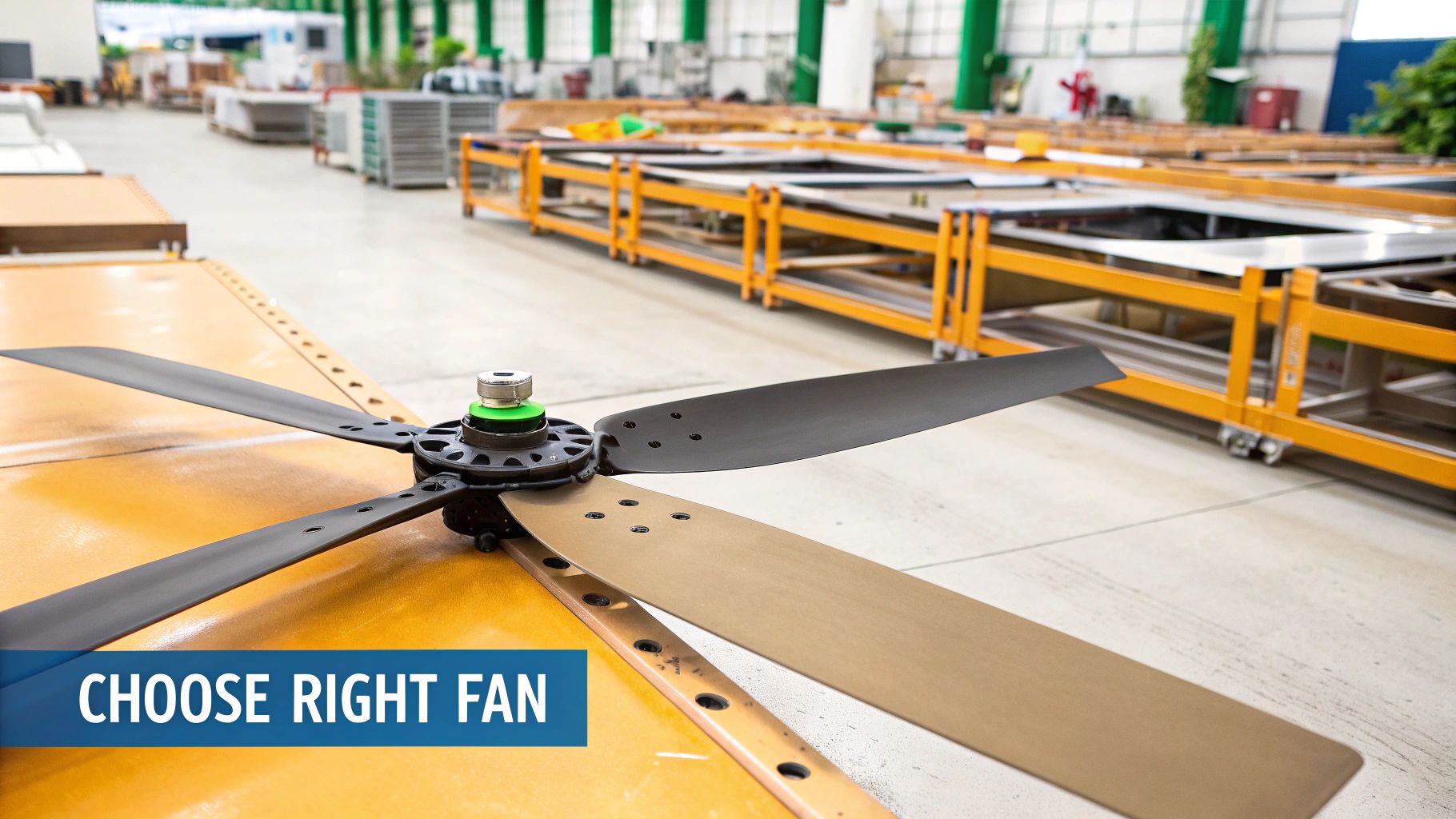
Picking the right industrial ceiling fans is about more than size. The components you don’t always see—blade shape, motor type, and controls—determine a fan’s performance and longevity in your specific environment. Getting these technical details right is key to making a smart investment.
Decoding Blade Design: Airfoil vs. Flat Paddle
A blade’s shape is about performance, not just aesthetics. It determines how quietly and efficiently it moves air.
- Airfoil Blades: Inspired by an airplane wing, these blades are engineered to slice cleanly through the air with minimal resistance. They push a huge column of air down at a slow speed, creating a wide, gentle breeze that cools people without kicking up dust.
- Flat Paddle Blades: This is an older, more straightforward design. They move air with brute force, which means they must spin faster, use more energy, and create more noise to achieve a similar cooling effect.
For nearly any large space, airfoil blades are the clear winner for keeping energy costs low and your team comfortable.
The Heart of the Matter: Motor Technology
The motor is your fan’s engine, and your choice impacts noise, maintenance, and reliability. The two main options are direct drive and gearbox motors.
A gearbox motor is the traditional style, using a mechanical transmission to reduce the motor’s high speed to the slow speed needed for the blades. While effective, the moving parts wear out, requiring periodic oil changes and eventual replacement.
In contrast, a direct drive motor connects straight to the fan’s hub—no gears, no transmission. These newer motors are incredibly efficient, operate almost silently, and are virtually maintenance-free. This “set it and forget it” reliability is perfect for busy facilities. Our guide on when you need an HVLS industrial fan digs deeper into how this technology benefits different industrial settings.
Controls: From Simple Dials to Smart Systems
How you control your fans is just as important as the hardware. The right system simplifies management and maximizes energy savings.
- Basic Wall Controls: A simple variable-speed dial is a reliable way to manually control a single fan or a small group.
- Centralized Controllers: For facilities with many fans, a central panel allows your team to manage entire zones from one spot.
- Building Management System (BMS) Integration: For ultimate efficiency, you can tie your fans into your building’s automated climate control system. This allows fans to react automatically to temperature sensors, timers, or occupancy.
A practical example: a warehouse with consistent, all-day activity might be fine with manual controls. However, a facility with large temperature swings near the loading docks could achieve significant energy savings by letting fan speeds adjust automatically based on real-time conditions.
Matching the Fan to the Environment
Finally, consider the environment where the fan will operate. A dusty woodworking shop has different needs than a sterile food processing facility.
For the woodworking shop, a motor with a high IP (Ingress Protection) rating is essential. This rating tells you how well the motor’s housing is sealed against dust and moisture.
In a food-grade facility, blade material is critical. Anodized aluminum blades resist corrosion and are easy to clean, which is vital for meeting hygiene standards. One study found that commercial fans in California run for about 897 hours annually, so picking a durable model built for your specific conditions is vital.
Thinking through these key elements will help you select an industrial ceiling fan that’s genuinely right for your facility.
Getting Your Fan Installed: The Non-Negotiable Safety Checks
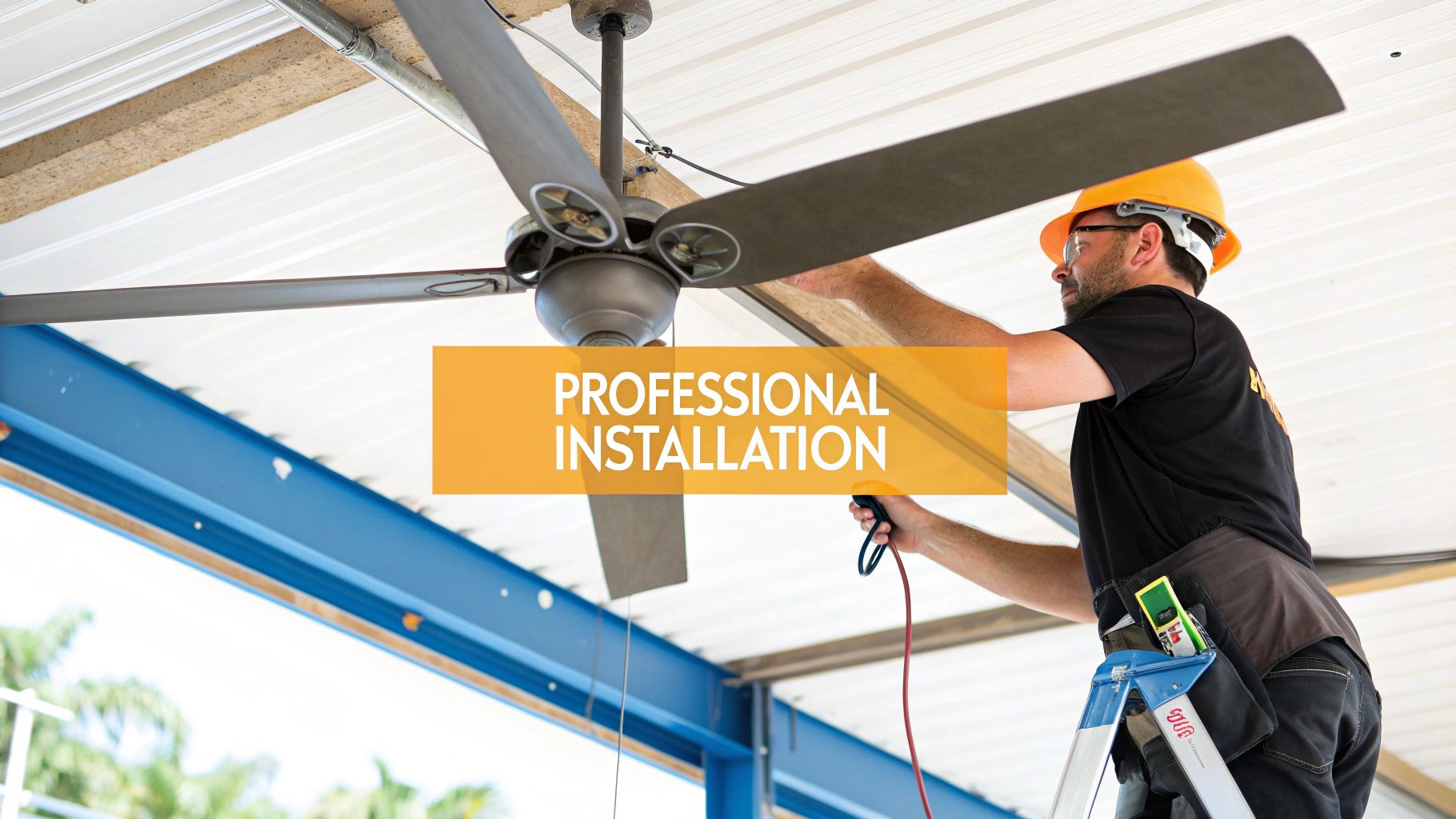
An industrial ceiling fan is a serious piece of equipment, weighing hundreds of pounds and spinning high above your team and machinery. This is why professional installation isn’t just a good idea—it’s an absolute must for safety, performance, and long-term reliability. A DIY job or an inexperienced installer simply isn’t worth the risk. This section outlines what a proper, professional installation involves.
Verifying Structural Integrity
Before a fan is lifted, a professional will ensure your building can handle it. This is more than just finding a sturdy beam; it’s a professional assessment to prevent a worst-case scenario.
- Load-Bearing Capacity: Your ceiling joists must support not just the fan’s weight (static load) but also the forces of its constant motion (dynamic load). This is a critical calculation for a seasoned installer.
- Secure Mounting: The mounting hardware must be correct for your building’s structure, whether steel I-beams or wood trusses. Using the wrong hardware can lead to loosening from vibrations, creating a major safety hazard.
- Obstruction Clearance: An installer will map out the fan’s placement to ensure ample clearance from light fixtures, sprinkler heads, and pallet racking to prevent severe damage.
Meeting Electrical Requirements
The electrical work is just as crucial as the structural mounting. Incorrect wiring can lead to poor performance, a fried motor, or even a fire.
- Voltage and Phase: An electrician will confirm your facility’s power supply matches the fan’s specifications, whether it’s single-phase or three-phase power. A mismatch can destroy the motor.
- Dedicated Circuits: Each fan should run on its own dedicated circuit to prevent overloads and protect other essential equipment.
- Compliance with Codes: All wiring must meet local and national electrical codes, including using the right gauge of wire and ensuring proper grounding. Our team can even help you navigate available energy-saving programs and compliance standards.
I’ll never forget a service call from a facility that attempted an in-house installation. They mounted a massive fan to a support beam not rated for dynamic loads. Within weeks, the constant vibration caused a terrifying wobble and cracked the mounting bracket. This costly and dangerous mistake would have been easily prevented by a professional assessment.
Prioritizing On-Site Safety Protocols
A professional installation from a partner like Wilcox Door Service always includes strict safety protocols. When installing these large units, working at heights safety is the top priority.
- Safety Cables and Guy Wires: These are mandatory backups. A primary safety cable is attached from the fan directly to the building structure as a failsafe, while guy wires stabilize the fan to prevent excessive swaying.
- Precise Fan Balancing: Each blade is individually weighed and balanced to ensure the fan runs smoothly. An unbalanced fan puts immense stress on the motor and mounting hardware.
- Thorough Commissioning: After installation, the fan undergoes a complete operational test to check for odd noises and ensure the control system works flawlessly before the job is considered complete.
Trusting certified experts to install your industrial ceiling fans is an investment in safety and peace of mind.
Using Smart Controls to Maximize Energy Savings
Once your industrial ceiling fans are installed, the next step is making them work smarter. By adding smart controls, you can automate your fans based on real-time conditions in your facility, ensuring you only use the energy you need. This is about creating an intelligent, responsive climate control system that actively reduces operating costs.
For example, when a large loading dock door opens on a hot day, temperature sensors can tell nearby fans to ramp up, creating an air curtain that keeps conditioned air inside. When the door closes, the fans can automatically power down. This level of automation removes human guesswork and ensures your fans always run at the most efficient speed.
Automating for Peak Efficiency
The key to these savings is connecting your fans to sensors and, for advanced setups, a Building Automation System (BAS). A BAS acts as the central nervous system for your facility, allowing all your equipment to work in harmony.
- Temperature Sensors: Program fans to turn on or speed up when the temperature in a zone rises above a set point, delivering cooling exactly where it’s needed.
- Humidity Sensors: In facilities where moisture is an issue, fans can increase circulation when humidity levels rise to prevent condensation.
- Occupancy Sensors: For areas with sporadic traffic, occupancy sensors ensure fans only run when people are present, eliminating wasted energy.
The biggest efficiency gains come from making your system proactive. When you automate fans to respond to temperature or occupancy, you remove the burden from your team and guarantee you’re capturing every possible energy-saving opportunity.
The Growing Trend of Smart Integration
This shift toward automated systems is a major trend in facility management. Integrating smart ceiling fans with building automation is particularly prevalent in energy-conscious regions. Projections show that if just 15% of the market adopted automated fans linked with communicating thermostats, the annual savings across California would be staggering: around 736 gigawatt-hours of electricity.
That translates to roughly $125 million in cost savings and a reduction of 537 million pounds of CO2 emissions. You can discover more about these energy-saving projections to see the massive impact of this technology.
Calculating Your Return on Investment
Seeing the payback period helps justify the upfront investment in smart controls. While a precise ROI calculation requires a detailed site assessment, you can create a quick estimate.
- Determine Current Energy Costs: Start with the annual electricity cost for your current HVAC heating and cooling.
- Estimate Fan Energy Use: Calculate the energy your new fan system will consume. A large HVLS fan uses far less power than multiple small, high-speed fans.
- Project HVAC Savings: In winter, the destratification effect can reduce heating costs by 15-30%. In summer, the cooling effect can lead to a 10-20% cut in A/C costs.
- Find the Payback Period: Subtract your projected annual savings from the total system cost. For many facilities, the system pays for itself in just 1-3 years.
Local and provincial incentives can further accelerate your ROI. It’s worth exploring these incentive and energy savings programs.
Common Questions About Industrial Ceiling Fans
After covering the technical details, most facility managers have a few practical questions. Here are answers to common queries we hear from partners like you, based on our years of hands-on experience.
How Many Industrial Ceiling Fans Does My Warehouse Need?
There’s no magic number. The right quantity depends on your facility’s layout, ceiling height, and operational flow. The goal is to create overlapping airflow zones for complete coverage without dead spots. A massive, open 100,000-square-foot warehouse might need 8 to 12 large-diameter fans for proper circulation. However, obstacles like tall pallet racking or machinery require a professional airflow assessment to map out the most efficient fan placement.
Can Industrial Fans Really Help With Heating Costs?
Absolutely. This is one of the biggest yet most overlooked benefits of an HVLS fan system. The process, called thermal destratification, tackles a major source of energy waste in buildings with high ceilings. Warm air produced by your heating system naturally rises and gets trapped at the ceiling. By running your fans slowly in reverse during winter, you gently push that trapped heat back down to the floor. This evens out the temperature, so your HVAC system works less hard, potentially cutting heating bills by as much as 30%.
We consistently see clients achieve significant savings through destratification. It’s a simple, low-cost operational change that transforms your fans from a seasonal cooling tool into a year-round energy-saving asset. This is a core part of the strong ROI we help our partners build.
What Is the Typical Maintenance for an Industrial Fan?
Modern industrial fans, especially direct-drive models, are built for minimal upkeep. However, a proactive maintenance plan is key to ensuring safety and longevity. We recommend a professional inspection at least once a year.
A thorough check-up should include:
- Safety Component Inspection: Verifying the tension of all guy wires and safety cables.
- Hardware Tightness Check: Confirming all mounting bolts are torqued to spec.
- Blade and Motor Review: Inspecting blades for damage and testing the motor and controls.
- Regular Cleaning: Keeping blades clean is crucial for maintaining balance and optimal airflow.
A planned maintenance program is the most reliable way to protect your investment.
Are These Fans Going to Be Loud?
This is a common concern, but high-quality, modern industrial ceiling fans are engineered to be surprisingly quiet. The secret is their design philosophy: move a massive volume of air at a very low speed. Unlike small, high-velocity fans that create disruptive noise, an HVLS fan’s large airfoil blades generate a gentle breeze with minimal sound. In most industrial settings, the sound from a direct-drive fan is well below the ambient noise level of daily operations.
Your facility’s efficiency and safety are our top priorities. As “Respected Partners, Reliable Service,” Wilcox Door Service Inc. is ready to help you design, install, and maintain the perfect airflow solution.
Explore our HVLS Fan solutions or contact us for a professional assessment today.