


In an emergency, ensuring a fast, safe, and intuitive exit for everyone in your building is non-negotiable. This guide will provide facility managers and business owners with a clear understanding of panic bar doors—what they are, the different types available, and how they function. You will learn about Canadian code requirements, best practices for installation and maintenance, and how to integrate this critical safety hardware with modern access control systems, all to ensure your facility remains safe, compliant, and secure.
Getting to Grips with Panic Bar Doors
When every second counts, an exit door has to be intuitive. That’s the core principle behind panic bar doors. Also known as crash bars or exit devices, this hardware features a horizontal bar that, when pushed, immediately retracts the door’s latching mechanism. This simple, single-motion action allows people to exit quickly without fumbling with a traditional knob or handle, even in low visibility or crowded conditions. This hardware isn’t just a convenient feature; in many commercial settings across Canada, it’s a legally required safety system.
For facility managers, a solid understanding of these systems is crucial for both safety compliance and operational peace of mind. Many managers use a detailed commercial building inspection checklist to make sure every part of their building is up to code, and panic bars are always a high-priority item on that list. A failure here can have serious consequences.
Why Are They Called Panic Bars?
The name itself tells a powerful story. “Panic hardware” was developed in response to tragic fires where people were trapped inside buildings because doors were locked, blocked, or too complex to open under extreme stress. The design is brilliant in its simplicity: the same natural motion you use to exit—pushing forward—is what unlatches the door.
The Real-World Benefits for Your Facility
Having the right panic hardware installed is about more than just checking a box on a compliance form. As your trusted service partner, we believe it’s important to understand the practical advantages they bring to your building every day.
- Unmatched Occupant Safety: This is the primary benefit. Panic bars provide a fast, clear exit path, which is proven to reduce injuries and save lives during an evacuation.
- Meeting Code Requirements: Properly installed panic bars ensure your facility meets the strict demands of the National Building Code (NBC) and local fire codes, helping you avoid fines and liability.
- Enhanced Accessibility: The push-to-open design is far easier to use than a traditional handle, especially for individuals with disabilities, children, or anyone carrying items. To see how this hardware fits into a broader accessibility plan, check out our insights on commercial door solutions.
- Operational Peace of Mind: Knowing your exit doors are secure against unauthorized entry but instantly operable for escape gives you confidence that your facility is prepared for any situation. It’s about protecting both people and property.
A reliable exit device acts as a silent guardian, working quietly in the background until the moment it’s needed most. Understanding how it functions is the first step toward creating a truly safe environment.
Understanding the Different Types of Panic Bar Systems
When it’s time to choose panic bar doors for your facility, it’s crucial to know that they aren’t a one-size-fits-all solution. The right hardware depends on the door’s type, its location, and the level of security you require. Just as you wouldn’t use the same tool for every job on the loading dock, you can’t install the same exit device on every doorway and expect optimal performance.
The easiest way to understand exit devices is to break them down into three main categories. Each one secures the door differently while guaranteeing that crucial quick-and-easy exit. Your choice directly impacts both day-to-day use and your team’s safety in an emergency.
Rim Style Exit Devices
The most common type you’ll encounter is the rim style exit device. Think of it as a straightforward, surface-mounted lock. The entire mechanism, including the latch, is contained in a single case mounted directly on the inside face of the door. When pushed, the latch retracts from a strike plate mounted on the door frame.
Because its design is simple and self-contained, a rim device is incredibly reliable and easy to install. This makes it the go-to solution for most single doors, especially in high-traffic areas like warehouse exits or employee entrances where durability and consistent function are key.
Mortise Style Exit Devices
For doors that demand a higher level of security, a mortise style exit device is often the best choice. Unlike the surface-mounted rim style, a mortise lock body is installed inside a pocket—or mortise—that’s cut directly into the edge of the door. This integrated design makes it far more resistant to tampering and forced entry.
You can think of a mortise panic bar as a heavy-duty, built-in lockset, similar to what you’d find on a secure exterior door. It provides robust security from the outside while still allowing for that single-motion escape from the inside. This balance makes it ideal for main entrances or sensitive areas that need to be secure but also fully compliant with fire codes.
The infographic below gives you a clear look at the basic components that make these systems work.
As you can see, the simple push of the bar is what activates the latch—the core principle that applies across all types of panic hardware.
Vertical Rod Exit Devices
What about double doors? That’s where vertical rod exit devices come into the picture. These systems are essential for securing a pair of doors that don’t have a central post (known as a mullion) between them. They work by latching the door at both the top and bottom of the frame simultaneously.
You’ll find two main variations:
- Surface Vertical Rods (SVR): With SVR devices, the rods are visible on the interior face of the door, making them easy to inspect and maintain.
- Concealed Vertical Rods (CVR): Here, the rods are hidden inside the door itself. This provides a cleaner, more polished look, often preferred for spaces like a main lobby or office suite.
Think of a vertical rod system as a set of dual bolts that retract at the same time with one push of the bar, instantly clearing the entire opening. This function is vital for creating large, unobstructed exit paths in venues like auditoriums, school gymnasiums, or convention centres.
Comparison of Panic Bar Door Types
To help you visualize which device works best where, we’ve put together a quick comparison. Each type has its own strengths, and matching the device to the door’s purpose is key.
| Device Type | Primary Application | Mechanism Explained | Security Level | Ideal For |
|---|---|---|---|---|
| Rim Style | Single doors, high-traffic exits | Surface-mounted latch engages with a strike on the door frame. | Standard | Warehouse exits, employee entrances, stairwell doors. |
| Mortise Style | Single doors needing high security | Lock body is recessed into the door edge, integrating with the panic bar. | High | Main entrances, secure perimeter doors, computer rooms. |
| Vertical Rod (SVR/CVR) | Pairs of doors (double doors) | Rods extend to latch at the top and bottom of the frame. | Moderate to High | Double doors in lobbies, auditoriums, large assembly areas. |
Ultimately, the goal is to find the perfect balance between accessibility, security, and code compliance for every single exit in your building.
Key Takeaway: The type of exit device you choose—rim, mortise, or vertical rod—must match the door’s construction and its role in your building’s egress plan. An expert assessment ensures you achieve the right balance of safety, security, and code compliance.
This focus on reliability is deeply embedded in Canadian safety standards. Since the mid-20th century, the National Building Code has required panic bars on exit routes in public buildings. The specific Canadian standard, CAN/ULC-S132, even requires rigorous testing of the push bar at three separate points over 100,000 cycles to ensure it functions flawlessly in high-traffic facilities. You can learn more about the history of panic hardware compliance.
Choosing the correct hardware is the first step. Next, it’s crucial to understand how these devices align with Canada’s specific building codes.
Feeling unsure about which panic bar system is right for your facility? Our experts can help you select and install the perfect code-compliant solution. Contact Wilcox Door Service today.
Navigating Canadian Building Codes and Compliance
Staying on the right side of Canadian building and fire codes isn’t just about avoiding fines; it’s the foundation of your responsibility to keep every person in your facility safe. While the National Building Code of Canada (NBC) can seem complex, its core principles for exit safety are straightforward. We’ll translate the regulations you need to know into practical, actionable advice.
For any facility manager, the rules governing panic bar doors and other exit hardware are non-negotiable. These regulations are designed to guarantee one simple thing: in an emergency, anyone can get out quickly and without a second thought. As your partners in reliable service, we believe a clear understanding of these codes is the first step toward a truly secure facility.
Decoding the Language of Egress
Two key concepts from the NBC drive almost every decision about your exit doors: occupant load and means of egress. Understanding these terms will clarify why certain doors require specific hardware.
- Occupant Load: In simple terms, this is the maximum number of people expected to be in a specific room, area, or the entire building. The higher this number, the more people will be trying to exit at once in an emergency, which demands more exits and more intuitive hardware.
- Means of Egress: This refers to the entire escape route. It’s the clear, unobstructed path someone takes from anywhere inside your building to a safe place outside. It includes not just the door itself, but also the hallways and corridors leading to it.
These two factors work together. The NBC uses the occupant load to determine how many exits a space needs and how wide they must be. For example, a massive distribution centre with a high occupant load and sprawling layout will require multiple, wide exit doors equipped with panic bars. In contrast, a small electrical room designed for one person might only require a standard lockset.
The When and Why of Panic Hardware Requirements
So, when does the NBC actually mandate a panic bar? While local rules can have some variations, the general requirement is tied directly to how a building is used and its occupant load.
Panic hardware is typically mandatory in:
- Assembly Occupancies: Places like theatres, auditoriums, and large company cafeterias where people gather.
- Educational Occupancies: This includes schools, colleges, and daycare centres.
- High-Hazard Industrial Occupancies: Any facility handling flammable or explosive materials needs the fastest possible escape route, making panic bars essential.
The trigger is usually when the calculated occupant load for these spaces reaches a certain threshold, often 50 or 100 people, depending on the specific use case. A door’s fire rating is also a critical piece of the puzzle. You can learn more about how fire door ratings impact your hardware choices in our detailed guide. Using properly rated hardware is non-negotiable for maintaining the integrity of a complete fire door assembly.
Compliance for Specialized Systems
Many modern facilities use advanced systems like electromagnetic locks (maglocks) for access control. These must also follow strict egress codes to ensure they don’t become a trap in an emergency. The rules here are very precise.
A key Canadian regulation from Employment and Social Development Canada (ESDC) specifies that electromagnetic locks on exit doors must release when the fire alarm is activated or when a force of no more than 90 N (about 20 pounds of force) is applied continuously for 3 seconds, with the total release time not exceeding 15 seconds. This ensures a quick escape, which is critical in places like warehouses and manufacturing plants. You can read the full details on these regulations from the Government of Canada.
Navigating these requirements is crucial for keeping your facility safe and compliant. Partnering with a knowledgeable service provider ensures your panic bar doors and any integrated systems are installed correctly, work reliably, and meet every Canadian code.
If you’re unsure whether your exit doors meet current Canadian building codes, our team can provide a professional compliance assessment. Schedule an inspection with Wilcox Door Service to ensure your facility is safe and up to standard.
Installation and Preventive Maintenance Best Practices
A panic bar is only as good as its installation and the care it receives over its lifetime. Proper setup and routine maintenance are not just suggestions—they are fundamental to ensuring these critical safety devices function flawlessly in an emergency.
This section serves as a practical roadmap for keeping your panic bar doors reliable, from professional installation to simple checks your team can perform daily. By understanding common points of failure and learning how to spot trouble early, you can prevent dangerous malfunctions and avoid costly emergency repairs.
Why Professional Installation Is Non-Negotiable
Installing a panic bar is a precise task with a direct impact on your building’s safety and code compliance. An incorrect installation can instantly void a door’s fire rating, cause the hardware to fail prematurely, and—most critically—prevent the door from opening when needed.
Here’s why you should always trust a certified technician:
- Code Compliance: Professionals are experts in the National Building Code of Canada. They know the exact requirements for factors like clear width, door swing, and hardware mounting height, ensuring everything is compliant.
- Manufacturer Specifications: Every exit device is different and has its own installation rules. A certified installer follows the manufacturer’s instructions perfectly, protecting your warranty and guaranteeing the hardware functions as designed.
- Door and Frame Integrity: Drilling in the wrong location or mounting hardware incorrectly can permanently damage a door or its frame. A professional ensures the entire assembly remains structurally sound.
A common issue we see in the field is hardware that is slightly misaligned. For instance, a latch that is just a few millimetres off can cause the door to bind, putting unnecessary stress on the mechanism and leading to premature failure.
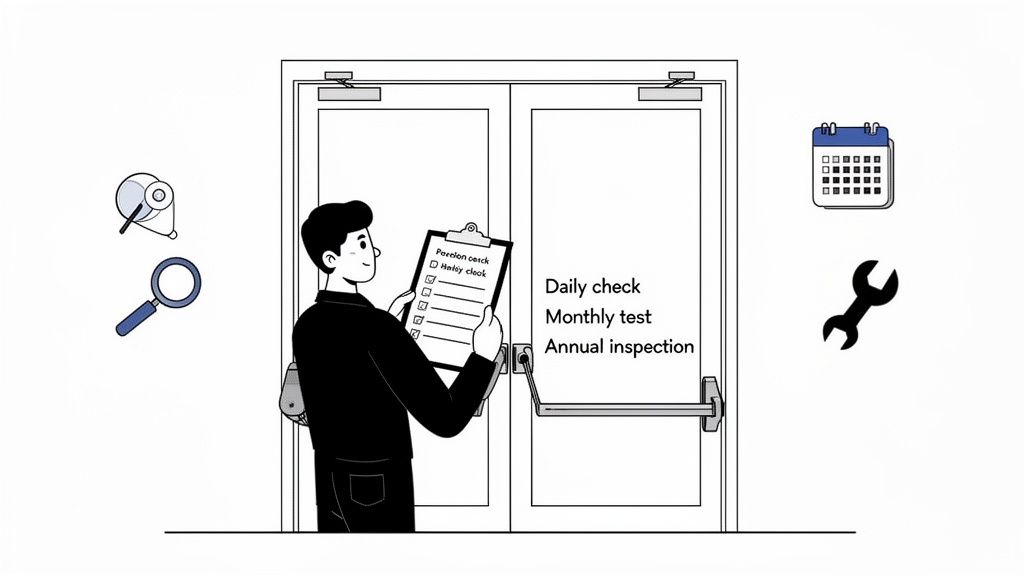
A Practical Preventive Maintenance Checklist
Once your panic bars are properly installed, a proactive maintenance routine is your best defense against failure. Think of it like the daily checks on a forklift or loading dock leveller—a few minutes of prevention can save hours of downtime and expensive repairs.
A solid plan includes daily and monthly checks your team can handle, along with an annual deep-dive from a qualified professional. For a closer look at building a comprehensive, year-round upkeep strategy, our guide on a planned maintenance program for commercial doors offers valuable insights.
Panic Bar Door Preventive Maintenance Checklist
| Frequency | Inspection Task | What to Look For | Recommended Action |
|---|---|---|---|
| Daily | Visual Inspection & Path of Egress | Obstructions blocking the door, unauthorized chains or locks, visible damage to the bar or latch. | Clear any and all obstructions immediately. Remove unauthorized locks. Report any visible damage to the facility manager. |
| Daily | Hardware Check | Loose or missing screws on the push bar, end caps, or strike plate. Any signs of tampering. | Note any loose fittings for the monthly check. Immediately report signs of tampering. |
| Monthly | Operational Test | The push bar should depress smoothly without excessive force. The latch should retract with a distinct “click.” | Push the bar to ensure it operates smoothly. Listen for the latch mechanism engaging and disengaging properly. |
| Monthly | Latching & Closing Test | The door should close and latch securely on its own without needing a push or pull. | Open the door fully and let it go. Verify it self-closes and latches firmly in the frame every time. |
| Monthly | Hardware Tightening | Any looseness or “wobble” in the push bar or its mounting points. | Gently tighten any accessible screws. Be careful not to overtighten, as this can cause binding. |
| Annual | Professional Component Inspection | Internal wear on springs, dogging assemblies, and latch bolts. Signs of metal fatigue or stress fractures. | A certified technician should disassemble, inspect, and assess all critical internal components for wear. |
| Annual | Lubrication & Adjustment | Dry or grinding parts, misalignment between the latch and the strike plate on the frame. | Technician to lubricate all moving parts per manufacturer specs and make micro-adjustments for perfect alignment. |
| Annual | Full Code Compliance Verification | The entire assembly (door, frame, hardware) must still meet current fire and life safety codes. | The technician will verify all aspects, including fire rating labels, door clearances, and hardware function, against codes. |
By adopting this simple maintenance schedule, you transform your panic bar doors from a potential point of failure into a reliable safety asset.
Integrating Panic Bars With Modern Access Control Systems
In any modern facility, safety and security must work in perfect harmony. While a panic bar guarantees a fast exit, an access control system manages who gets in. Integrating these two critical systems allows your building to be both safe and secure.
We’ll walk through how it works, from electrified hardware that allows keycard access to specialized systems that help prevent theft without compromising an emergency escape. We’ll also clarify the crucial difference between ‘fail-safe’ and ‘fail-secure’ locks so you can make the right choice for your facility.
Blending Egress With Controlled Entry
The core challenge is simple: an exit door must always let people out, but you can’t allow just anyone to enter. This is precisely what electrified hardware for panic bar doors is designed to solve.
Instead of a standard key, these systems use an electrical signal to control the outside lever or trim. When an employee swipes a keycard or enters a code, the system sends a signal to unlock the exterior handle for a moment, allowing them inside.
From the inside, however, the panic bar remains purely mechanical. It will always override the electronic lock. A simple push guarantees an immediate, unhindered exit, regardless of the access control system’s status.
Specialized Systems For Enhanced Security
Beyond controlling entry, integrated panic bars can offer sophisticated security features designed for specific needs. These solutions add an extra layer of protection while adhering to strict life safety codes.
Two of the most common and effective setups are:
- Alarmed Exit Devices: This is a straightforward integration where the panic bar is fitted with a built-in alarm. When someone pushes the bar, a loud, local siren activates, alerting staff that the door has been used. This is an excellent deterrent against theft in retail stockrooms or to prevent unauthorized exits from a distribution centre.
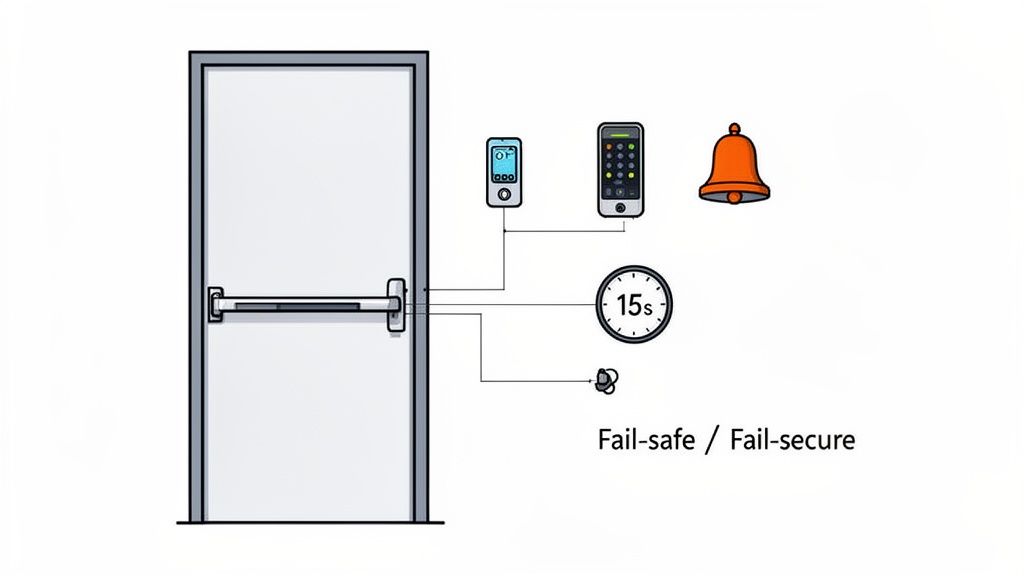
- Delayed Egress Systems: For higher-security zones, this system adds a time delay. When someone pushes the bar, the door remains locked for a set time—usually 15 seconds—while an alarm sounds. This gives security personnel a chance to respond before the door unlocks. Critically, these systems are designed to release instantly if the building’s fire alarm is activated, ensuring they never impede a real emergency evacuation.
Fail-Safe vs. Fail-Secure: What You Need To Know
When you introduce electronics to locks, you must decide what the door should do in a power failure. This is the fundamental difference between “fail-safe” and “fail-secure” hardware, and choosing the right one is critical for both security and compliance.
- Fail-Safe: The lock disengages (unlocks) when power is lost. This prioritizes life safety, ensuring an exit path is always available.
- Fail-Secure: The lock engages (locks) when power is lost. This prioritizes security, keeping an area secure even during a power outage.
Key Takeaway: ‘Fail-safe’ unlocks when power is lost, prioritizing life safety. ‘Fail-secure’ locks when power is lost, prioritizing security. Your choice depends entirely on the door’s location and purpose.
For example, a main building exit along a designated egress path must be fail-safe to ensure people can always get out. In contrast, a computer server room would likely use a fail-secure lock to keep valuable assets protected during a blackout. Understanding the nuances of different locking mechanisms is key, and our guide on magnetic locks for doors digs deeper into these principles.
This focus on reliable egress is more important than ever. Statistical trends highlight the critical role of code-compliant panic bar doors in Canadian facilities, especially as natural disasters become more frequent. Over the past 25 years, these events have spiked, leading to $3.12 billion in uninsured losses in 2022 alone. For warehouse and facility managers, this data reinforces the need for evacuation systems that function flawlessly every time. Find out more about how disaster risk is evolving in Canada on PublicSafety.gc.ca.
Balancing modern security needs with unwavering life safety can feel complex, but with the right hardware and expert guidance, it’s entirely achievable.
Confused about which access control integration is right for your facility? Contact Wilcox Door Service for a professional assessment and secure, code-compliant solutions.
Troubleshooting Common Issues and When to Call an Expert
Even the most robust hardware shows signs of wear over time. For facility managers, learning to spot the early warning signs of a failing panic bar can mean the difference between a quick fix and a serious safety liability. A simple visual and functional check can tell you everything you need to know about the health of your panic bar doors.
This knowledge empowers you to act decisively, ensuring your exit doors remain safe, compliant, and ready for anything.
Identifying Telltale Signs of Failure
Keeping a close eye on your exit devices during routine walkthroughs will help you catch problems before they escalate. Be on the lookout for these common red flags:
- A “Spongy” or Loose Push Bar: The bar should feel solid and spring back into position immediately after being pushed. If it feels mushy, hangs loosely, or returns slowly, internal springs or mechanisms are likely worn out or broken.
- The Door Fails to Latch: When the door closes, you should hear a distinct, solid “click” as the latch bolt engages the strike plate on the frame. If the door swings shut without securely latching, you have a major security and fire safety problem.
- Excessive Force Required: An exit device is designed for one-push, no-effort operation. If staff report having to lean into the bar or jiggle it to open the door, it’s a clear signal that something is binding or misaligned.
Any hesitation in a panic bar’s operation is a failure. In an emergency, that split-second delay could be the difference between a safe exit and a dangerous situation. It’s a non-negotiable performance standard.
The Risks of DIY Repairs and When to Call Us
While tightening a loose screw may seem harmless, attempting complex repairs on panic hardware is extremely risky. One wrong adjustment can void the door’s fire rating, violate building codes, and cause a total failure during an actual emergency. This is not the place for trial-and-error maintenance.
You should always call a certified technician if you notice:
- Any issues with the latching mechanism.
- The integrated alarm or access control system is malfunctioning.
- The push bar itself feels compromised, cracked, or broken.
Remember, we’re your partners in keeping your facility safe and operational. For professional diagnostics and repairs that guarantee safety and compliance, don’t hesitate to schedule a service inspection with Wilcox Door Service.
Your Panic Bar Questions, Answered
As experts in commercial doors, we hear many questions from facility managers about panic bar doors. Let’s clear up some of the most common ones with practical, straightforward answers.
Can I Just Install a Panic Bar on Any Door?
While it’s tempting to retrofit a panic bar onto any commercial door, it’s not that simple. You must consider the door’s material (hollow metal, wood, etc.), its fire rating, and its overall structural integrity.
A critical point: installing non-rated hardware on a fire-rated door assembly instantly voids that door’s certification. This is a major violation of Canadian building codes and compromises the integrity of your fire separation. A professional assessment is essential to confirm the door can support the device and that the chosen hardware matches the door’s specifications.
What’s the Real Difference Between a “Panic Bar” and an “Exit Device”?
In daily conversation, these terms are often used interchangeably. Technically, however, there is a distinction. A “panic device” is specifically designed and tested for high-occupancy areas where a true panic situation could occur, like a school auditorium or theatre. An “exit device” may be rated for fire safety but not necessarily for the extreme stress of a panicked crowd.
For practical purposes, “panic bar” has become the common name for all push-style exit hardware. What truly matters isn’t the name, but ensuring the device you install meets the specific code requirements for your building’s use and occupant load.
How Often Do Panic Bar Doors Need to Be Inspected in Canada?
The National Fire Code of Canada states that all exit doors must be inspected regularly to ensure they are operable. While it doesn’t specify a rigid daily or weekly checklist, industry best practice—which aligns with NFPA 80 standards—is to have a formal, thorough inspection performed by a certified professional annually.
Your best defense against liability is a professional annual inspection. It’s how you catch hidden wear on internal components before they cause a catastrophic failure.
In addition, facility staff should perform quick functional tests monthly. Simply push the bar to ensure it moves smoothly and listen for the “click” to confirm the door latches securely when it closes. The most reliable way to stay on top of this is with a planned maintenance program, which ensures consistent safety and compliance.
Your facility’s safety is our top priority. For expert advice or to schedule a professional inspection of your panic bar doors, trust the team at Wilcox Door Service Inc.
Contact us today to ensure your facility is safe, compliant, and secure.