


When a trailer arrives at your loading dock, those seemingly simple wedges placed behind its wheels are one of the most critical safety devices in your entire facility. As industry experts, we can tell you that tire chocks for trailers are your first and most fundamental defence against unplanned trailer movement—the kind of movement that leads to costly damage, serious injuries, and catastrophic accidents.
In this guide, we’ll explain exactly why this tool is a non-negotiable part of any safe and efficient loading dock. You will learn how to select the right chocks for your specific needs, the correct procedures for placing and removing them, and how they integrate into a modern, layered safety system to protect your team and your assets.
The Unseen Dangers at the Loading Dock
A busy loading dock is a place of constant motion, and with that motion comes inherent risk. It’s easy to assume a parked trailer is secure, but in reality, multiple forces are always at play, threatening to create a dangerous gap between the trailer and your dock.
This is where tire chocks for trailers come in. They are specifically designed to prevent two high-risk events: trailer creep and premature departure.
Understanding Trailer Creep
One of the most common hazards we see is “trailer creep,” a simple term for when a trailer slowly inches away from the dock. This happens due to the constant back-and-forth momentum of a forklift entering and leaving the trailer. Each trip transfers a small amount of force, and over dozens of loading cycles, these small movements can open up a significant and treacherous gap. A forklift operator might not notice this gap until a wheel drops into it, leading to a serious accident.
Preventing Premature Departure
The second major risk is premature departure. This is when a truck driver mistakenly pulls away while your team is still loading or unloading. It can happen in a split second and is often the result of a communication breakdown. The consequences are severe, potentially causing a forklift and its operator to fall from the dock. Properly placed tire chocks act as a powerful physical barrier, holding the trailer firmly in place even if a driver attempts to leave too soon.
At its core, a tire chock is your first line of defence against gravity and momentum. It’s a simple mechanical solution to a complex and dangerous problem, making it an indispensable part of any dock safety protocol.
Real-World Consequences of Chock Failure
Imagine a busy distribution centre during a harsh Canadian winter. A driver backs in, but the ground is slick with a thin, barely visible layer of ice. The dock attendant, rushing to meet a deadline, grabs a worn-out chock that can’t get a good grip on the icy surface.
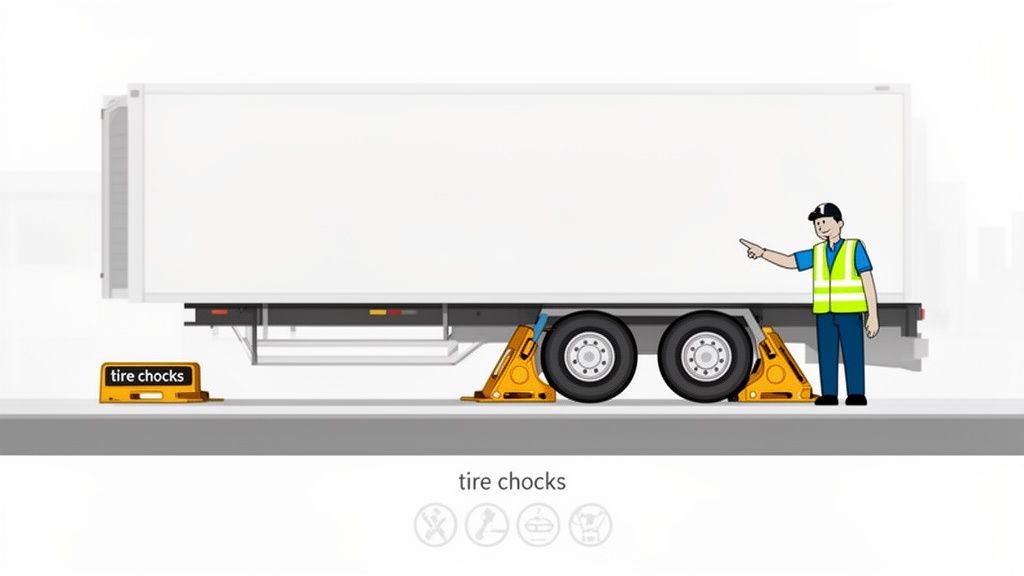
Alt text: A loading dock worker inspects yellow tire chocks properly secured against a trailer’s wheels, ensuring dock safety.
As a forklift moves a heavy pallet into the trailer, the trailer shifts just enough for the dock leveller—the ramp connecting the dock to the trailer—to lose its purchase and slip. The result is equipment damage, lost product, and a serious injury. This isn’t a hypothetical scenario; incidents like this happen, and they underscore why selecting and using the right chocks is so critical.
While modern equipment like dock lip safety barriers adds another crucial layer of protection, the safety process always begins with securing the wheels. At Wilcox Door Service, our experience as “Respected Partners, Reliable Service” has shown us that overlooking this basic step can undermine even the most advanced safety systems. Proper chocking is the foundation upon which all other dock safety measures are built.
How to Select the Right Tire Chocks for Your Operation
Choosing the right tire chocks for trailers isn’t as simple as grabbing the nearest wedge. The wrong chock is almost as dangerous as using no chock at all because it creates a false sense of security. As your partners in safety, we want to ensure you make the right choice.
To do this right, you must match the chock to your specific operation. This means looking closely at the chock’s material, its design, the gross vehicle weight (GVW) of the trucks you service, and the unique surface conditions at your dock. Getting these factors right is key to selecting equipment that not only meets compliance but performs when it counts.
Material Matters: Rubber vs. Urethane
Your first decision is the material. Most chocks are either rubber or urethane, and each has strengths tailored to different facility needs.
- Rubber Chocks: Often made from recycled materials, these are heavy-duty and durable. They offer incredible grip, especially on concrete and asphalt. For the heaviest applications, look for laminated rubber chocks—they’re built in layers and are extremely robust.
- Urethane Chocks: These are much lighter than rubber, making them easier for your team to handle throughout the day. Urethane is also highly resistant to oils, fuels, and solvents, and it won’t rot or splinter. Though lightweight, high-quality urethane chocks are engineered to handle extreme loads.
For example, a fully loaded refrigerated trailer on a wet, sloped dock needs the unyielding grip of a heavy-duty laminated rubber chock. Conversely, a lightweight urethane chock is perfectly suitable for smaller delivery vans on a level, dry surface.
Comparing Tire Chock Materials for Commercial Trailers
Here’s a quick comparison to help you choose the best tire chock material based on trailer weight, dock surface, and durability.
| Material Type | Best Use Case | Pros | Cons |
|---|---|---|---|
| Laminated Rubber | Heavy-duty trailers (40+ tonnes), high-traffic docks, concrete/asphalt surfaces. | Excellent grip, highly durable, cost-effective. | Heavy to handle, can degrade with chemical exposure. |
| Molded Rubber | General purpose, light to medium-weight vehicles on standard surfaces. | Good all-around performance, good friction. | Can crack over time, heavier than urethane. |
| Urethane | Operations where handling ease is key, exposure to chemicals/oils, various surfaces. | Lightweight, resistant to chemicals, long lifespan. | Higher initial cost, may offer less grip on slick surfaces. |
| Urethane with Cleats | Gravel, dirt, or icy/snowy conditions where extra bite is needed. | Superior grip on loose or slippery surfaces. | Can damage soft surfaces, higher cost. |
Factoring in Vehicle Weight and Tire Size
This part is non-negotiable. A chock rated for a 10-tonne truck will fail spectacularly under the force of a 40-tonne tractor-trailer. You must check the manufacturer’s specifications to ensure the chock’s load capacity exceeds the Gross Vehicle Weight (GVW)—the total weight of the vehicle including its cargo—of the heaviest vehicles you service.
Tire size is just as critical. The chock must fit snugly against the curve of the tire.
A good rule of thumb is that the chock should be roughly 25% of the tire’s height. Anything smaller risks being rolled over by the tire, rendering it useless.
Surface Conditions and Chock Design
The surface of your loading dock approach can make or break a chock’s effectiveness.
- Smooth Concrete: Both rubber and urethane work well, though rubber often has a slight edge on friction.
- Asphalt: The natural texture of asphalt gives most chock materials a solid grip.
- Gravel or Dirt: Here, you need chocks with cleats or a heavily textured base that can dig in and anchor themselves.
- Ice and Snow: This is the ultimate challenge. Chocks with built-in steel teeth are a must, but they should be part of a larger safety system. We explore this further in our guide on integrating chocks into a modern dock safety system.
The chock’s design also matters. Pyramid-style chocks provide stability, while sloped designs contour to the tire. For any industrial use, look for features like integrated handles or ropes that make placement and removal safer and easier for your staff.
Facility managers should pay close attention to guidelines from organizations like the Actsafe Safety Association, which stress using chocks in pairs to secure un-hitched trailers. This practice has been shown to significantly cut accident rates. Real-world data confirms that mismatched chocks fail more often on slopes, a common feature in many distribution centres. For more detail, you can explore the full findings on wheel chock usage to learn about these vital regulations.
While our focus is commercial trailers, these principles apply everywhere. You can find helpful info on choosing the best RV wheel chocks to see how these ideas adapt. For more on proactive safety, see how a planned maintenance program can keep all your dock equipment in peak condition. Getting your tire chocks right is a foundational task. By carefully evaluating your vehicles, surfaces, and daily demands, you give your team tools that provide real security.
Mastering Correct Chock Placement and Removal
Placing a tire chock is a precise safety procedure, not just a matter of tossing a block near a wheel. Getting it wrong creates a false sense of security at your loading dock—a high-risk area where mistakes are costly. Let’s walk through the exact process your team should follow to ensure those tire chocks for trailers are effective every single time.
It starts with clear communication. Before anyone approaches the trailer, the truck driver must confirm their parking brake is fully engaged. This is a non-negotiable first step. Only then should your dock crew move in to place the chocks.
This flowchart breaks down the thinking behind choosing the right chocks—a critical step that happens long before a trailer arrives.

Alt text: A flowchart diagram showing the selection process for trailer tire chocks, considering tire size, vehicle weight, and surface conditions.
The Art of Correct Chock Placement
Once the brakes are confirmed, the placement sequence begins. The objective is to position the chocks snugly against the centre of the tire tread. Placing them at an angle or just touching the sidewall dramatically reduces their holding power.
Here’s the practical, step-by-step approach we teach:
- Pick the Right Wheel: Always choose the rearmost axle on the trailer. For tandem axles, chock the very last wheel for the most stable anchoring point.
- Clear the Ground: Kick away any loose gravel, ice, or other debris that could prevent the chock from making flat, solid contact with the ground.
- Position Firmly: Place one chock on the front side and another on the backside of the same tire. Push them in tight against the tread so there is no gap.
This “in-and-out” method on a single tire creates balanced resistance, stopping the wheel from rolling in either direction. A common mistake is chocking two different tires on the same side of the trailer, which does not create the stable, locked-in position needed.
Critical Mistakes to Avoid During Placement
Simple mistakes can render chocks useless. It’s vital to train your team to avoid these common slip-ups we frequently identify during facility safety audits.
One common error is using a standard chock on a sloped surface without ensuring it’s designed for that grade. Another is using damaged equipment. A chock with a missing chunk or a warped base has lost its structural integrity and cannot be trusted.
A tire chock is only as effective as the surface it grips. Placing a perfectly good chock on a patch of oil, loose gravel, or a sheet of ice is the equivalent of not using one at all.
The Importance of a Safe Removal Process
The removal process is just as critical as placement. Taking chocks away too soon can lead to disaster. For example, a facility we consulted with had an employee remove chocks the moment the loading light turned green. The forklift operator was still backing out of the trailer. The truck driver, seeing the green light, started to pull away. This created a dangerous gap, and only the operator’s quick reflexes prevented a serious fall.
The rule must be absolute: chocks are the last thing off after all loading or unloading is complete and the dock door is closed. A clear “all-clear” signal must be given by the dock supervisor before the chocks are retrieved. This final step reinforces that tire chocks for trailers are part of a larger system that depends on both process and equipment. For more on how these pieces fit together, you can explore our insights on loading dock truck restraints.
Integrating Chocks into a Modern Dock Safety System
While tire chocks for trailers are the bedrock of loading dock safety, they should never work alone in a modern facility. True safety comes from an integrated ecosystem where chocks are one crucial part of a layered defence, working alongside advanced vehicle restraints and communication systems. Think of it as a “belt and suspenders” approach to securing a trailer. This layered system creates a mandatory sequence of operations that protects your people, products, and equipment.
When Primary Systems Fail, Chocks Are Your Failsafe
Let’s walk through a common scenario. A trailer backs into a dock equipped with an automated vehicle restraint. The restraint engages, the light inside turns green, and the forklift operator gets the signal to proceed.
But what if, due to a mechanical issue or an odd trailer configuration (like a damaged rear impact guard, also known as an underride bar), the restraint doesn’t get a truly secure lock? This is where a properly placed set of tire chocks proves its worth.
As the forklift moves onto the trailer, the vehicle begins to creep forward. The primary restraint system has failed, but the chocks hold firm, stopping a dangerous gap from opening. They become the last line of defence, turning a potential catastrophe into a simple operational pause. This is why we, as your reliable service partners, always insist that even the most advanced systems need this fundamental manual backup.
An integrated safety system acknowledges that no single piece of equipment is infallible. Tire chocks serve as the ultimate mechanical failsafe, providing steadfast protection when automated components encounter unforeseen issues.
The Communication Between Dock Components
In a truly modern setup, your equipment communicates to create a logical, safe workflow that reduces human error.
- Vehicle Restraints: These primary systems, once engaged, send a “safe” signal to other dock components.
- Dock Levellers: Many modern levellers won’t operate until they receive a signal from the restraint, preventing deployment into an unsecured trailer.
- Signalling Lights: A simple red/green light system inside and outside the dock clearly communicates the trailer’s status. Green inside means “safe to enter.”
This interconnectedness forces a proper sequence of events, taking the guesswork out of the equation and reinforcing safe habits.
A Holistic View of Trailer and Dock Safety
A holistic approach to safety includes the vehicle before it even arrives. This means the driver has diligently performed a comprehensive pre-trip inspection, ensuring the truck is in safe working order.
Transport Canada data consistently shows that improper trailer securing contributes to dock accidents, particularly on icy or gravel surfaces—a common Canadian reality. This data powerfully underscores why you need modern restraints working alongside traditional chocks.
By combining the unwavering physical barrier of tire chocks with the intelligence of modern dock equipment, you create a robust, multi-layered system. This proactive approach is the difference between simply meeting compliance and truly building a culture of safety. If you’re considering upgrading your dock’s safety features, learning more about loading dock truck restraint replacement is an excellent next step.
A Practical Guide to Chock Inspection and Maintenance
Your tire chocks for trailers are under incredible pressure every day. They are subjected to brutal weather, constant handling, and the immense weight of fully loaded trailers. Ignoring their condition is the same as ignoring a fundamental safety protocol.
A damaged chock provides a false sense of security, which is more dangerous than using no chock at all. Let’s walk through a straightforward approach to inspecting and maintaining your chocks to ensure they remain a reliable part of your dock safety system.
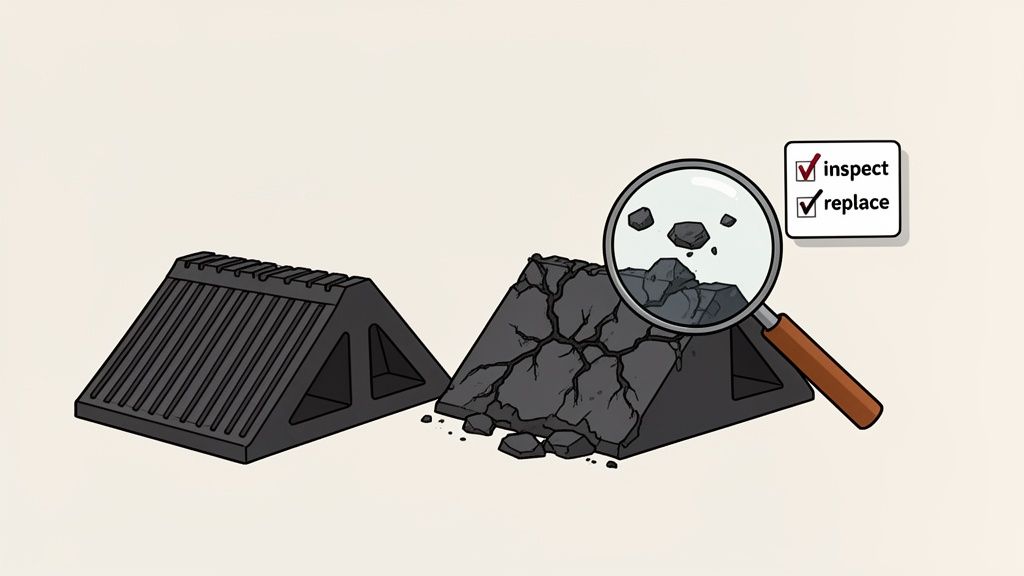
Alt text: An illustration comparing a new, intact trailer tire chock with a damaged, cracked one, highlighting the need for regular inspection.
Creating a Routine Inspection Checklist
Consistency is key to effective maintenance. Chocks should get a quick visual check daily, followed by a more thorough inspection weekly or monthly by a supervisor. Your team needs to know exactly what to look for and feel empowered to pull a bad chock from service immediately.
Here’s a simple checklist:
- Stress Cracks and Fractures: Look over the entire body. Even a small fracture can compromise its structural integrity under a trailer’s weight.
- Missing Chunks of Material: Pay close attention to the face that contacts the tire. If chunks of rubber or urethane are missing, you’ve lost critical gripping power.
- Worn-Down Gripping Surfaces: The bottom of the chock must bite into the pavement. If the textured surface is worn smooth, it will slide—especially on wet or icy ground.
- Corrosion or Bending: For chocks with metal parts, look for rust that weakens the structure or any bending that prevents it from sitting flat.
The Impact of Canadian Weather
Canadian weather is notoriously tough on outdoor equipment. The constant freeze-thaw cycles can make rubber brittle and prone to cracking. On top of that, road salt and de-icing chemicals are highly corrosive and will accelerate wear and tear. A chock that looked fine in August could show serious damage after one tough winter.
A damaged tire chock is no longer a safety device; it’s a liability waiting to happen. Any chock that has been run over, shows visible cracks, or has significant wear must be removed from service immediately.
Establishing a Quarantine and Replacement System
You need a simple but strict system to ensure damaged equipment doesn’t find its way back into use. Designate a specific, clearly marked “quarantine” area—like a red bin or a tagged shelf—for any chock that fails inspection. This prevents someone from accidentally grabbing a compromised unit during a busy shift.
This system should feed into a proactive replacement schedule. By tracking the age and condition of your chocks, you can budget for and order replacements before they fail. This forward-thinking mindset is at the core of a strong safety culture and mirrors the structured approach detailed in our guide on the benefits of a planned garage door maintenance program.
Got Questions About Trailer Tire Chocks? We’ve Got Answers.
Even with the best training, questions always come up in daily loading dock operations. To provide clear guidance, we’ve compiled the most common questions our team gets about tire chocks for trailers.
Are Tire Chocks a Legal Requirement at Every Canadian Loading Dock?
While specific wording may differ provincially, Canada’s occupational health and safety acts share a common principle: employers must do everything reasonably possible to protect their workers. In loading docks, using tire chocks is considered a fundamental part of that responsibility.
Authorities like WorkSafeBC and Ontario’s Ministry of Labour, Immigration, Training and Skills Development consider chocking a standard, expected practice. If an incident occurs and chocks were not used, you could face serious fines. The bottom line is that regulators and the industry expect to see chocks in use—they are a non-negotiable part of a safe dock.
Can I Get Away With Just One Tire Chock on a Flat Surface?
Absolutely not. This is a dangerous shortcut based on a misunderstanding of the forces at play. Industry best practices are clear: always use chocks in pairs, one in front and one behind the same tire.
Even on a seemingly level surface, the massive weight shift of a forklift can cause a trailer to “creep.” A single chock doesn’t offer balanced resistance; it becomes a pivot point, allowing the trailer to shift. It’s a recipe for disaster.
Always use two chocks on one wheel. This locks the trailer in place by preventing both forward and backward movement. It’s a simple step that provides a level of security a single chock just can’t match.
How Do I Know When It’s Time to Replace Our Chocks?
Tire chocks are safety gear, and they wear out. Your team should be trained to give them a quick visual inspection every time they’re used. If they spot any of these red flags, the chock must be pulled from service immediately:
- Deep Cracks or Splits: Any fracture compromises the chock’s structural integrity.
- Missing Chunks: If pieces are missing from the face or base, it can’t grip the tire or ground properly.
- Rounded Edges: The edges that meet the tire need to be sharp; if rounded, the chock is likely to slip.
- Obvious Warping: A chock that doesn’t sit completely flat on the ground is unstable.
Additionally, if a chock has been run over by any vehicle, replace it. The internal damage may not be visible, but its ability to handle pressure has been compromised. Making chock replacement part of your planned maintenance program is smart facility management.
How Well Do Tire Chocks Actually Work in Snow and Ice?
This is a major issue for any Canadian facility. The friction that makes chocks work disappears on snow and ice, making them far less effective. Some heavy-duty models have metal teeth for a better bite, but you should never rely on them as your only defence in harsh weather.
This is why an integrated safety system is so important. A primary vehicle restraint system combined with chocks is the gold standard. In icy conditions, clear away as much snow and ice as possible before placing the chocks, and always treat them as a secondary safety measure, not the primary one.
Your loading dock is the heart of your operation, and its safety relies on having the right equipment and procedures. At Wilcox Door Service, we are committed to being your “Respected Partners, Reliable Service” in creating a secure and efficient facility.
If you have more questions or need expert guidance on outfitting your docks with the right tire chocks for trailers and integrated safety systems, our team is here to help. Contact us today to schedule a comprehensive facility safety assessment.