


This guide will provide a comprehensive understanding of window fire shutters and their critical role in your building’s life safety system. You will learn what they are and how they work, how to select the right type for your facility, what Canadian fire codes require, and the importance of professional installation and maintenance. By the end, you’ll have the knowledge to ensure your facility is both safe and compliant.
When an emergency hits, every second counts. That’s why window fire shutters aren’t just another piece of hardware—they are a critical part of your building’s life safety system. Think of them as automated guardians, designed to instantly divide a building into compartments to contain fire, smoke, and heat right where they started.
Understanding Your First Line of Defence in a Fire
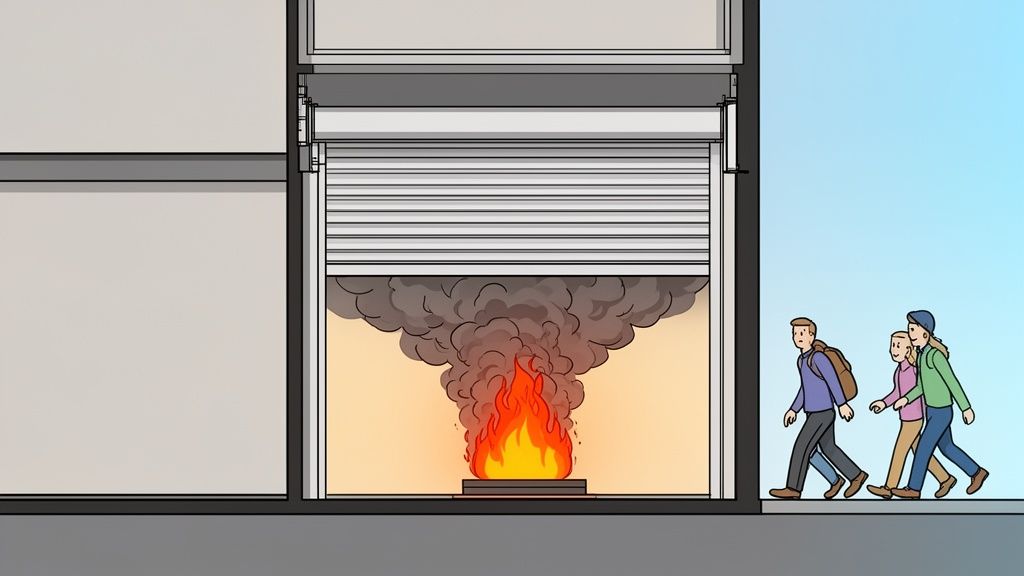
{: alt=”A window fire shutter containing a fire inside a commercial building, protecting the exterior.”}
In any commercial or industrial building, from a busy warehouse to a hospital, protecting people and property is the top priority. Window fire shutters play a vital, often overlooked, role in achieving this. They are essentially pre-installed, automatic firewalls that stand ready to protect vulnerable openings in your fire-rated walls.
Without them, an opening like a service window or a pass-through counter becomes a dangerous weak point. It’s an open invitation for fire to spread rapidly, compromising evacuation routes, putting lives at risk, and leading to catastrophic property damage. As your respected partners in reliable service, we ensure these critical assets function flawlessly.
The Core Function of Fire Containment
The main job of a fire shutter is compartmentation. In simple terms, this means dividing a building into smaller, fire-resistant zones to slow or completely stop a fire from spreading. By automatically closing in an emergency, these shutters achieve several crucial safety objectives:
- Contain the Blaze: They create a physical barrier that holds back flames, preventing a small incident from turning into a full-blown disaster.
- Block Lethal Smoke: Smoke inhalation is a leading cause of fire-related deaths. Fire shutters help seal off areas, keeping toxic smoke from spreading throughout the facility.
- Protect Egress Routes: By isolating the fire, they help keep escape routes like hallways and stairwells clear so people can evacuate safely.
- Minimize Property Damage: Containing a fire to its room of origin drastically reduces the financial impact of lost equipment, inventory, and structural damage.
For a practical example, imagine a fire starting in the kitchen of a commercial cafeteria. A properly functioning window fire shutter over the service counter will drop automatically, sealing the kitchen off from the dining area. This single action protects everyone in the dining hall and gives sprinklers and first responders the critical time they need to get the situation under control.
How Do They Activate?
Activation is what makes these shutters so effective, and it’s designed to be both immediate and fail-safe. The most common trigger is a fusible link, which is a small, heat-sensitive mechanical device that holds the shutter in the open position. When the surrounding temperature rises to a set point (typically around 74°C or 165°F), the link melts and breaks. This releases the shutter, which then closes automatically under the force of gravity.
More advanced setups can be tied directly into a building’s central fire alarm system. The moment a smoke detector is triggered anywhere in the facility, a signal is sent to the shutter’s operator, causing it to close. This provides an even faster response, often well before intense heat even reaches the opening. This kind of integration is essential in high-risk environments like hospitals or facilities that handle sensitive materials.
As long-time partners in facility safety, we know these systems are non-negotiable. You can explore our commercial rolling fire doors to see how this robust protection is built.
Choosing the Right Window Fire Shutter for Your Facility
Picking the right window fire shutters for your building isn’t a one-size-fits-all job. The best choice comes down to your facility’s daily operations, its specific environment, and your long-term safety goals. By understanding the key differences in activation mechanisms and materials, you can make an informed investment that will reliably protect your facility for years to come.
Not all fire shutters are built the same, and their components directly impact how they perform when you need them most. Making the right choice from the start ensures your facility is not just compliant, but genuinely secure.

{: alt=”Illustrations of different window fire shutter materials: galvanized steel, stainless steel, and insulated.”}
Understanding Activation Mechanisms
The trigger that makes a fire shutter close is one of its most critical features. It determines how quickly and reliably the shutter deploys once a fire is detected. In commercial and industrial settings, you’ll generally find two main types of activation systems.
- Fusible Link Activation: This is the classic, time-tested method. A fusible link is a small, heat-sensitive device that holds the shutter open. When the temperature around it hits a specific point (usually 74°C), the link melts and breaks. This releases the shutter, allowing it to close automatically with gravity. It’s a simple, purely mechanical system that works even if your building’s power goes out, making it incredibly reliable.
- Integrated Fire Alarm Activation: For a faster, more proactive response, shutters can be wired directly into your building’s central fire alarm system. The moment any smoke or heat detector goes off, an electrical signal tells the shutter’s operator to close immediately. This approach is ideal for large facilities or high-risk areas where every second of containment counts.
For instance, a fusible link might be perfectly suitable for a parts counter window in a distribution centre. However, in a hospital corridor, an integrated system that drops shutters at the very first sign of smoke is non-negotiable for keeping evacuation routes clear and protecting vulnerable occupants.
Expert Insight: Connecting your window fire shutters to a central alarm system creates a coordinated, building-wide response. This integration can deploy shutters, notify emergency services, and trigger other safety systems all at once, providing a much higher level of protection for both people and property.
Selecting the Right Shutter Material
The material your fire shutter is made from dictates its durability, maintenance requirements, and suitable applications. Each option has distinct advantages, so it’s crucial to match the material to the job. At Wilcox Door Service, we guide facility managers through a range of high-performance options, reflecting our commitment to reliable service.
Window Fire Shutter Material Comparison
Choosing the right material is a balancing act between environmental demands, durability, and budget. This table breaks down the most common options to help you decide.
| Material | Ideal Environment | Durability | Corrosion Resistance | Initial Cost |
|---|---|---|---|---|
| Galvanized Steel | General industrial, warehouses, exterior openings | High | Good | $$ |
| Stainless Steel | Food processing, clean rooms, chemical areas | Excellent | Excellent | $$$$ |
| Insulated Steel | Climate-controlled areas, exterior walls | High | Good | $$$ |
Ultimately, the best material is the one that meets your specific operational and safety needs without requiring excessive maintenance in its environment.
Galvanized Steel Shutters
Galvanized steel is the workhorse of the fire shutter world. It’s steel that has been coated with a protective layer of zinc, giving it excellent defence against rust and corrosion.
- Best For: General industrial use, warehouses, manufacturing plants, and exterior applications where it might be exposed to the elements.
- Benefit: It strikes a superb balance between strength, longevity, and cost-effectiveness. The galvanized coating ensures it can handle typical moisture and environmental wear without losing its integrity.
Stainless Steel Shutters
When hygiene and serious corrosion resistance are top priorities, stainless steel is the undisputed champion. Its non-porous surface is easy to clean and sanitize, and it naturally resists rust and chemical damage.
- Best For: Food processing plants, pharmaceutical facilities, clean rooms, and commercial kitchens where you must meet strict sanitation codes.
- Benefit: Unmatched durability and hygiene. It can handle harsh cleaning agents and frequent washdowns without breaking down, ensuring a clean and compliant environment. You can learn more about our specialized commercial door solutions built for these demanding industries.
Insulated Fire Shutters
For openings on exterior walls or in climate-controlled areas, insulated shutters provide both fire protection and thermal efficiency. These shutters have slats filled with insulating material to reduce heat transfer.
- Best For: Loading docks, exterior service windows, and any opening separating areas with different temperature requirements.
- Benefit: They help lower energy costs by minimizing heat loss or gain while still providing a certified fire barrier. This dual function makes them a smart investment for any energy-conscious facility.
By carefully considering both the activation system and the material, you can ensure the window fire shutters you choose are perfectly suited to protect your facility. Proper selection is the first step in a solid fire safety strategy.
Navigating Canadian Fire Codes and Compliance
Staying compliant with fire codes isn’t just about passing an inspection. It’s about ensuring your safety systems will perform perfectly when a fire breaks out. Let’s simplify the practical side of Canadian fire codes, especially what the National Building Code (NBC) requires for fire-rated openings like window fire shutters.
Proper compliance is the bedrock of any solid life safety plan. Non-compliance can lead to failed inspections, fines, and—worst of all—a safety system that might not perform in a real emergency.
Decoding Fire-Resistance Ratings
Have you ever seen a fire shutter with a label like “45-minute,” “90-minute,” or “3-hour”? Those aren’t arbitrary numbers. That’s a fire-resistance rating, and it tells you exactly how long that shutter was tested to withstand fire and extreme heat without failing.
This rating is a critical piece of your building’s overall fire safety puzzle. The National Building Code of Canada (NBC) dictates the required rating for an opening based on the fire-resistance rating of the wall it’s in. For example, a wall with a 2-hour fire rating typically requires a shutter or door with at least a 90-minute rating. To dive deeper, check out our detailed guide on understanding fire door ratings.
These ratings ensure your building’s fire compartments hold up as designed, containing a fire long enough for everyone to evacuate safely and for first responders to arrive. It’s a complete system, and every part must work together.
The Annual Fire Door Drop Test
If there’s one non-negotiable task for any facility with window fire shutters, it’s the annual fire door drop test. Mandated by standards like NFPA 80, which Canadian fire codes reference, this is a hands-on, operational test to prove your shutter will close automatically and completely when triggered.
Why It’s Mandatory: The annual drop test isn’t just paperwork. It’s a physical check to confirm the shutter’s closing mechanisms are in perfect working order, with no obstructions or wear-and-tear that could cause it to fail during an actual fire.
This test must be performed by a qualified technician and documented thoroughly. Those records are your proof of compliance for the local fire marshal or the Authority Having Jurisdiction (AHJ).
Preparing for a Fire Marshal Audit
Let’s apply this to a real-world example. Imagine you’re managing a large manufacturing plant, and the fire marshal is scheduled to visit next week. They’ll be looking closely at all your fire-rated openings, including the service window shutters between the production floor and the quality control office.
Here’s how you’d prepare:
- Schedule the Drop Test: You would call a certified company like Wilcox Door Service to perform and document the annual drop test for every single shutter.
- Gather Your Paperwork: You would compile all test and inspection records from the past year, ensuring they are complete, signed, and dated. This includes any notes on repairs or maintenance.
- Do a Walk-Through: Before the audit, you would walk the floor yourself. You’re looking for any visible damage, ensuring the areas around the shutters are clear of clutter, and checking that fusible links are intact.
- Check the Labels: You would confirm the fire-rating labels on the shutter and its frame are legible. This is how an inspector quickly verifies that you have the correct shutter for that specific wall.
In Canada, the National Building Code has very specific fire resistance standards for doors and glazing. This includes window fire shutters and rolling fire doors. For ratings over 20 minutes, the code allows a maximum temperature rise of 250°C—which is quite different from the 140°C limit in European codes or the 121°C in ASTM E119 standards. This is a critical detail for facilities in provinces like Ontario and British Columbia, where industrial plants depend on compliant shutters to contain fires. Companies like Wilcox Door Service Inc., with over 100 years of expertise, specialize in installing these code-compliant rolling fire doors and shutters and conduct the rigorous fire door drop tests to ensure they work when needed. You can learn more about Canadian fire-rated glass and safety standards on safti.com.
By taking these proactive steps, you ensure the audit is a smooth process. More importantly, you demonstrate a real commitment to safety, turning a regulatory task into a cornerstone of a reliable safety program.
Professional Installation and Proactive Maintenance
A high-quality fire shutter is a fantastic safety asset, but it’s only as good as the team that installs and maintains it. Professional installation of window fire shutters isn’t just a good idea—it’s a critical investment in your building’s safety. Without it, even the best-rated shutter could fail when you need it most.
A proper installation by certified technicians ensures every component, from the guide tracks to the release mechanism, works exactly as designed. This is not a handyman job; it’s a precise process that covers everything from confirming the wall can handle the shutter’s force to ensuring the tracks are perfectly aligned for a smooth, fast drop.
The Importance of a Professional Installation
A flawless installation is the bedrock of reliable fire protection. Union-certified technicians, like our team at Wilcox Door Service, follow a strict protocol to guarantee performance every time.
Here’s a glimpse into what that process involves:
- Structural Verification: We first confirm the wall can support the full weight and operational force of the shutter assembly. No guesswork.
- Precise Alignment: The guide rails and shutter curtain must be perfectly aligned. Even a slight misalignment can cause a jam or hesitation during deployment—the last thing you want in an emergency.
- System Integration: If applicable, we correctly connect the shutter to your building’s fire alarm or smoke detection system, ensuring it activates automatically.
- Initial Drop Test: Immediately after installation, we perform and document the first operational drop test. This is required by code and serves as the official certification that your shutter is ready for service.
This level of professional oversight removes uncertainty, ensuring your life safety system is fully compliant and ready from day one.
Building a Proactive Maintenance Program
Once installed, your shutters need consistent care to remain in a constant state of readiness. A proactive maintenance program is the best way to extend the life of your equipment and ensure it functions perfectly. Just like any other critical system in your building, understanding the value of a comprehensive maintenance plan is key to ensuring long-term reliability.
A Critical Takeaway: Proactive maintenance isn’t about fixing what’s broken; it’s about preventing failures before they happen. Regular checks can spot minor issues like debris in the tracks or a worn-out component, ensuring a clear path for the shutter to deploy instantly in an emergency.
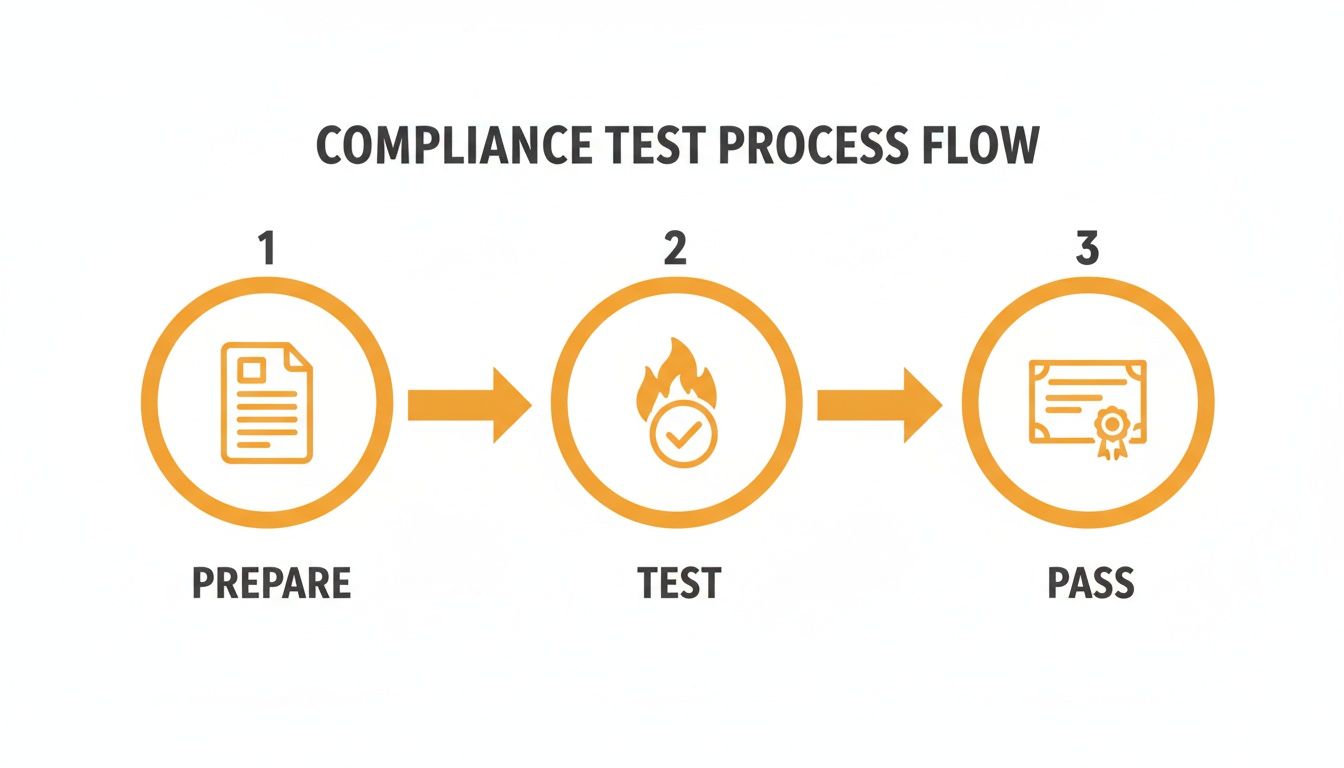
This flowchart breaks down the simple, repeatable process for keeping your fire shutters compliant and ready.
{: alt=”A three-step flowchart for window fire shutter compliance: Prepare, Test, and Pass.”}
Following these steps—thorough preparation, certified testing, and documented passing—gives you a clear and defensible record of compliance for any fire marshal audit.
A solid maintenance plan doesn’t have to be complicated. It should involve routine visual checks you can easily perform yourself, alongside the mandatory annual professional inspection.
Your routine checklist should include:
- Visual Inspection: Regularly scan for any signs of physical damage to the shutter curtain, guide rails, or hood. Dents or warping can impede operation.
- Clearance Check: Make sure the area around the shutter is always free of obstructions. A misplaced storage rack or piece of equipment could prevent the shutter from closing completely.
- Fusible Link Check: If your shutter uses a fusible link, visually confirm it’s intact and hasn’t been accidentally painted over or damaged.
The Annual Certified Drop Test
The cornerstone of any fire shutter maintenance program is the annual drop test. This is a mandatory, hands-on test required by NFPA 80 and local fire codes to verify that the shutter’s automatic closing mechanism works correctly. A certified technician must perform this test, which involves intentionally triggering the shutter to simulate an emergency, ensuring it closes completely and at the proper speed.
During the test, the technician will inspect all mechanical and electrical components, lubricate moving parts, and make necessary adjustments. Afterward, they will reset the shutter and provide you with detailed documentation. This record is your official proof of compliance for fire inspections. For a detailed look at the procedure, we break it down in our guide on what to expect during a fire door drop test.
Integrating Shutters with Your Overall Safety Ecosystem
Effective fire protection is never about a single piece of equipment. It’s about building a smart, responsive system where every component works together. Window fire shutters are a powerful tool for containing a blaze, but they truly shine when integrated into your facility’s broader life safety ecosystem. Thinking of them as standalone hardware misses the big picture—real safety comes from synergy.
When your shutters are tied in with other systems, they become part of a coordinated, automatic response that protects your people and property with incredible efficiency. This approach turns separate safety features into a unified team.
The Synergy Between Shutters and Sprinkler Systems
One of the most effective pairings in fire safety is the combination of fire shutters and sprinkler systems. While the shutter’s job is to contain the fire, the sprinklers actively cool its surface. This cooling action is crucial for maintaining the shutter’s structural integrity when facing the intense heat of a blaze.
By keeping the shutter from warping or failing, the sprinkler system helps it hold its position and contain the fire for a much longer duration. This partnership effectively extends the shutter’s fire-resistance rating in a real-world scenario, buying precious time for emergency responders.
This isn’t just theory. Research from the National Research Council Canada (NRCC) at the National Fire Laboratory demonstrated that sprinkler-protected window assemblies could withstand intense fire exposure for extended periods. In these tests, drenchers provided at least 45 minutes of protection in larger furnace scenarios and up to 120 minutes in smaller ones, as long as a continuous layer of water covered the glass. These results highlight the powerful synergy between shutters and sprinklers, especially in demanding industrial environments.
Connecting to a Central Fire Alarm Control Panel
The ultimate step in creating an integrated safety ecosystem is connecting your window fire shutters to the building’s central fire alarm control panel (FACP). The FACP is the brain of your entire fire safety operation, receiving signals from smoke detectors, heat sensors, and manual pull stations across the facility.
When your shutters are wired into this central hub, the time between detection and response becomes almost instantaneous.
A Coordinated Response in Action: Imagine a fire starts in a storage area of a large warehouse. A single smoke detector sends a signal to the FACP. Instantly, the panel triggers a building-wide alarm, alerts the fire department, activates the relevant sprinkler zones, and sends a command to deploy all fire shutters, creating fire-rated compartments throughout the facility.
This level of automation eliminates human delay and ensures a consistent, building-wide response every single time. It’s a seamless process that maximizes safety by ensuring every component works in perfect harmony. This integrated approach is a core element of modern fire safety design, a topic we explore further in our guide to fire door systems.
This integration doesn’t just make your facility safer; it makes it smarter. By ensuring your fire shutters communicate with your other safety systems, you build a resilient defense that is ready to act decisively at the first sign of danger.
Ensuring Your Facility’s Safety with an Expert Partner
Selecting, installing, and maintaining the right window fire shutters is a significant responsibility. The process requires precision and expertise at every stage—from initial site assessment to annual inspections—to ensure these critical safety systems are ready to perform at a moment’s notice.
This is where having a reliable partner makes all the difference. An expert team can transform a complex list of requirements into a straightforward, stress-free safety plan, giving you confidence that the job is done right.
The Wilcox Advantage: Respected Partners, Reliable Service
At Wilcox Door Service, we live by our promise of “Respected Partners, Reliable Service.” We manage every aspect of your fire shutter needs, freeing you to focus on your core business with complete peace of mind. Our union-certified technicians serve as your single point of contact for everything from consultation to 24/7 emergency repairs.
Our services are designed to provide end-to-end reliability:
- Initial Consultation and Site Assessment: We begin by helping you select the ideal fire shutter for your specific needs, ensuring it meets both operational goals and all fire code requirements.
- Professional, Code-Compliant Installation: Our certified technicians guarantee a flawless installation, from verifying structural supports to seamlessly integrating the shutters with your existing fire alarm systems.
- Certified Annual Fire Door Drop Testing: We perform and meticulously document the mandatory annual drop tests, keeping your facility compliant and prepared for any fire marshal inspection. You can learn more about our specialized commercial door and gate services that keep facilities safe and operational.
- 24/7 Emergency Repairs: Equipment doesn’t fail on a 9-to-5 schedule. Our technicians are on call around the clock to address any issue, minimizing downtime and restoring your protection immediately.
Partnering with a dedicated service provider is about more than just owning safety equipment; it’s about actively managing a robust life safety program. This proactive approach is what defines a truly secure and compliant facility.
Investing in high-quality window fire shutters is a crucial first step. But it’s the expert installation, maintenance, and testing from a trusted partner that truly guarantees they will perform when it matters most. We are committed to being that partner for you.
Take the next step in securing your facility. Contact the Wilcox Door Service team today to schedule a site assessment, a compliance audit of your existing rolling fire doors, or to get a quote for a new installation.
Frequently Asked Questions About Window Fire Shutters
To conclude, let’s address some of the most common questions we hear from facility managers about window fire shutters. Getting clear, straightforward answers is the best way to make confident decisions that keep your building safe, compliant, and prepared.
These are the essentials—from mandatory testing schedules to the real-world differences between shutter types—that will provide you with the practical knowledge you need.
How Often Must My Window Fire Shutters Be Tested?
The answer is clear and non-negotiable: annually. Canadian fire codes, which reference NFPA 80 standards, mandate that every fire-rated shutter must undergo a professional inspection and a full “drop test” once per year. This is a mandatory verification to prove the automatic closing system will function correctly in an emergency.
A certified technician must perform the test and maintain detailed records of the inspection. Those records are what a fire marshal or the local Authority Having Jurisdiction (AHJ) will require. It is a critical verification of your building’s life safety system.
Can an Existing Window Be Retrofitted with a Fire Shutter?
Absolutely. Retrofitting is a common and effective way to enhance a building’s fire safety. The process begins with a professional assessment of the existing wall to ensure its fire-resistance rating and structure can support the complete shutter assembly.
Once approved, certified technicians can install the guide tracks, curtain, and housing, converting a standard window opening into a code-compliant, fire-rated barrier. This is an excellent strategy for bringing an older facility up to modern safety standards without requiring a major structural overhaul.
Expert Insight: Retrofitting provides a direct path to compliance and improved safety. It allows you to address vulnerabilities in your fire containment plan one at a time, focusing on high-risk areas first to make an immediate impact.
What Is the Main Difference Between a Fire Shutter and a Security Shutter?
While they may look similar, their functions are completely different, and they are not interchangeable. A window fire shutter is specifically engineered and tested to withstand extreme heat and stop the spread of fire and smoke for a certified period. Its entire purpose is life safety, which is why it has an automatic closing feature, like a fusible link, that triggers in a fire.
A security shutter, on the other hand, is designed for physical protection. It’s built to prevent break-ins and resist forced entry, protecting property from theft or vandalism. It does not have a fire rating and lacks the automatic closing mechanisms required for a fire-rated opening. While we’re focused on fire-rated solutions here, you can also explore frequently asked questions about glass and window products for a broader perspective.
Your facility’s safety is our top priority. As respected partners providing reliable service, Wilcox Door Service Inc. offers expert installation, certified annual drop testing, and 24/7 emergency repairs for all your window fire shutter needs. Contact us today to ensure your facility is protected. https://www.wilcoxdoor.com