


Food Processing Facility Doors in Ontario: Repair, Hygiene Compliance, and Maintenance Plans
Doors in food processing plants work harder and fail more expensively than doors anywhere else in a facility. They cycle hundreds of times per shift, take daily pressure washing and chemical sanitizer, separate zones that cannot cross-contaminate, and sit under audit scrutiny from CFIA, SQF, BRC, and customer inspectors. When one fails, the cost is not just a repair. It is a production line waiting, a zone breach, or a failed audit finding.
Wilcox Door Service supplies, installs, repairs, and maintains doors and dock equipment in Ontario food processing facilities — including hygienic high-speed doors at production zone boundaries, washdown-rated hardware, and door systems specified for food-safety audit compliance. Call 1-800-528-4131 ext. 1.
Wilcox Door Service has been in business since 1912 and supplies, installs, and maintains doors in Ontario food processing facilities, including hygienic high-speed doors at production zone boundaries in Mississauga. This guide covers what makes food-grade doors different, why high-speed doors keep derailing, and how a maintenance plan stops the repeat failure.
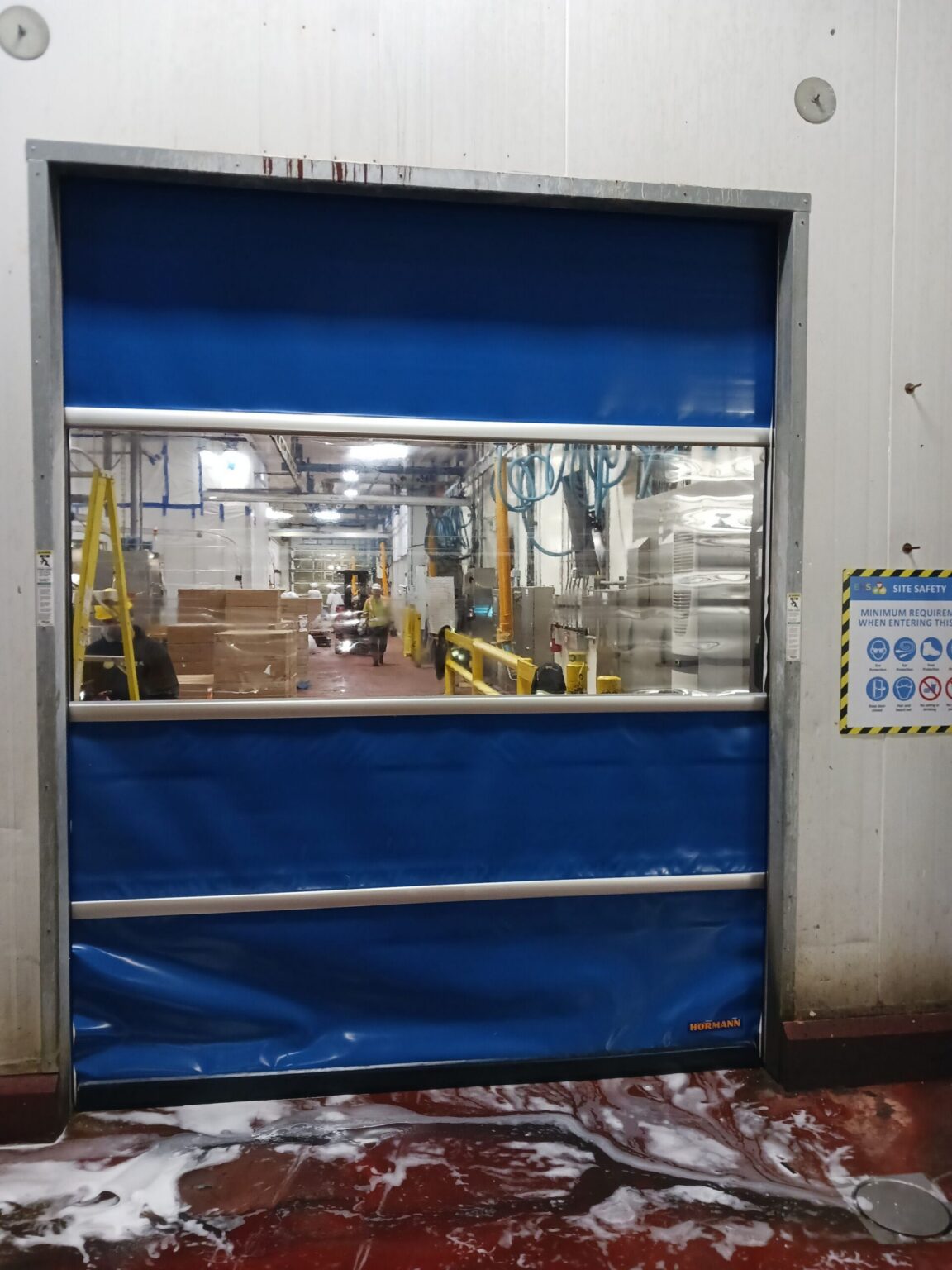
Why High-Speed Doors Keep Derailing
If a high-speed roll-up door in your plant keeps coming off its track every few months, repeated repairs will not fix it. Derailing is a symptom, and the cause is almost always one of these:
- Impact damage that was never fully corrected. A forklift or cart strike bends a guide track or knocks the curtain edge out of its channel. The door works for weeks, then derails when the misalignment finally exceeds tolerance.
- Worn or damaged guide channels and wear strips. Washdown and sanitizer degrade track components faster than in dry environments.
- Bottom bar or breakaway wear. A worn bottom edge no longer re-seats cleanly after a minor strike, so every impact risks a derail.
- Drive and encoder drift. If limit settings creep, the curtain over-travels or under-travels and stresses the track on every cycle.
- Corrosion and buildup. Product residue, ice, or sanitizer film in the guides adds friction until the curtain binds and jumps the track.
A proper repair finds and fixes the root cause. A patch puts the curtain back in the track and waits for the next failure.
What Makes a Door Food-Grade
A door at a production zone boundary has to meet requirements that standard commercial doors do not:
- Cleanable construction. Smooth surfaces and minimal ledges and crevices where product and bacteria collect. Stainless components where chemical exposure demands them.
- Washdown rating. Sealed drives, protected electrics, and curtains designed to survive daily foam cleaning and pressure washing.
- Fast cycling. Short open time limits airflow between zones, which protects temperature control and reduces cross-contamination risk.
- Visibility. Vision panels let forklift and pedestrian traffic see across the opening, which prevents the collisions that cause most door damage in the first place.
- Documentation. Installation and service records that stand up to audit review.
We installed this exact combination at a Mississauga food processing facility: a Hörmann hygienic high-speed door with a vision panel at the production-to-non-production zone boundary. For another example of food facility work, see our food production facility expansion, which paired insulated sectional exterior doors with high-speed interior doors.
A Maintenance Plan That Stops the Cycle
Doors that keep failing are doors that are repaired but never maintained. A planned maintenance program for a food plant should cover:
- Guide track, wear strip, and curtain edge inspection on every high-speed door, on a schedule matched to your cycle counts
- Bottom bar and breakaway function testing
- Drive, encoder, and limit setting verification
- Safety sensor and photo-eye testing
- Corrosion and buildup checks on guides and hardware
- A written report after each visit so audit records stay current
Our planned maintenance programs are built around this approach, and our crews service all makes and models, so you do not need separate vendors for each door brand in your plant.
Frequently Asked Questions
Why does my high-speed door keep coming off its track?
Repeated derailing usually means an underlying problem was never fixed: bent or worn guide tracks from past impacts, worn bottom bar or breakaway components, drifting drive limit settings, or buildup in the guides. A proper repair identifies the root cause instead of resetting the curtain.
Do you service high-speed doors from other manufacturers?
Yes. We service all makes and models of high-speed, sectional, and rolling steel doors, so one vendor can handle every door in your plant.
What should a food plant maintenance plan include?
Guide track and wear strip inspection, bottom bar and breakaway testing, drive and limit verification, safety sensor testing, corrosion checks, and a written report after every visit to support audit records.
Can you work around production schedules?
Yes. Planned maintenance is scheduled around your shifts and sanitation windows, and emergency service is available 24/7 at 1-800-528-4131.
Talk to a Technician About Your Plant
Specifying doors for a food facility?
We’ll survey the openings, zone boundaries, and sanitation requirements, then specify to the environment.
Deciding whether a program is worth the cost? Read our guide to commercial door and dock maintenance agreements.