


A dock door that won't open at the start of a shift doesn't stay a door problem for long. It becomes a shipping problem, a labour problem, a safety problem, and very quickly, a customer problem.
That's why replacement garage door openers need to be treated differently in commercial and industrial facilities than they are in residential guides. In a warehouse, plant, distribution centre, or multi-tenant commercial property, the opener is part of the operating system of the building. If it's undersized, poorly matched, badly installed, or already near end of life, uptime suffers.
Commercial replacement decisions also carry more constraints. You have to think about door weight, duty demands, electrical supply, safety devices, code requirements, remote compatibility, and how the operator fits into dock traffic and facility workflow. The right replacement restores motion. The better replacement improves reliability and reduces future disruption.
Why Your Commercial Door Operator is a Mission-Critical Asset
At 5 a.m., the inbound trailer is backed in, the crew is on site, and the main dock door won't move. In a commercial facility, that failure doesn't just inconvenience one person. It can stall receiving, delay outbound orders, and create congestion at other openings as teams try to work around a single failed access point.
That's why the operator above a sectional door, beside a rolling steel door, or mounted at a high-use service bay should be treated as a mission-critical asset. It controls a route your business depends on every day. If you're reviewing options for commercial garage opener systems, the first step is recognising that replacement isn't a commodity purchase. It's an uptime decision.
Downtime spreads fast in working buildings
Commercial doors sit in the path of other systems. Forklift movement, dock scheduling, product flow, security procedures, and temperature control often depend on them. When an operator starts hesitating, drifting out of adjustment, or failing intermittently, staff usually compensate before anyone raises a capital request.
That compensation is costly even when nobody puts a dollar figure on it. Teams reroute traffic. Drivers wait. Maintenance staff get pulled from planned work to emergency troubleshooting. Supervisors start managing around a bad asset instead of fixing the root issue.
Practical rule: If a door is important enough that you need a backup procedure when it fails, its operator is important enough to replace proactively.
Commercial replacement is not residential replacement
Most online advice about openers assumes a single homeowner, a light door, and relatively low daily use. That advice breaks down quickly in industrial settings.
Commercial replacements have to account for:
- Higher use intensity: A busy door may cycle repeatedly through a shift, not just a few times a day.
- Different operating environments: Dust, cold, moisture, vibration, and traffic all affect operator selection.
- More stakeholders: Operations, maintenance, safety, and property management all need the replacement to work from day one.
- Integration demands: Operators may need to work with access control, safety devices, or specialised door systems.
A good replacement plan starts with the role of the opening. Is it a primary shipping door? A secure service entrance? A temperature-sensitive opening? A fire-rated assembly with strict compliance needs? Those answers shape everything that follows.
Decoding Commercial Operator Types Trolley Jackshaft and Hoist
Commercial operators aren't interchangeable. The right one depends on the door design, the room around it, and how hard the system has to work. Choosing the wrong style can create avoidable service issues even when the motor itself is new.
A simple way to think about it is this. Different operator types are like different drivetrains. Each is built for a certain job. Some are general-purpose workhorses. Others are meant for tight spaces or heavy industrial loads.
What each operator type is built to do
Trolley operators are commonly used on standard sectional doors. They move the door along a track and suit many straightforward commercial openings where overhead space and door travel are typical.
Jackshaft operators mount on the wall beside the door and turn the torsion shaft directly. They're useful when overhead space is limited or when the ceiling area needs to stay clear for lights, sprinklers, conveyors, or other building systems. For facilities assessing wall-mounted options, jackshaft garage opener applications are often the right place to start.
Hoist operators are intended for heavier-duty applications, including larger industrial doors and certain rolling steel or high-load assemblies. They're selected when the door and operating demands move beyond what lighter-duty systems handle well.
Commercial Operator Comparison
| Operator Type | Best For | Key Advantage | Consideration |
|---|---|---|---|
| Trolley | Standard sectional doors with typical headroom | Familiar layout and dependable operation for many common openings | Needs overhead space and isn't ideal where ceiling congestion is a problem |
| Jackshaft | Sectional doors where side mounting is practical | Frees overhead space and often suits cleaner, quieter operation | Requires correct shaft setup and careful compatibility review |
| Hoist | Large, heavy, or specialised industrial doors | Built for demanding door loads and tougher applications | Usually involves more specialised installation and control planning |
What works in practice
In many facilities, the wrong choice shows up as a layout problem before it shows up as a mechanical problem. A trolley unit might technically fit, but interfere with overhead piping or future racking changes. A jackshaft unit might solve the space issue, but only if the shaft condition, door balance, and electrical setup are right. A hoist operator may be the proper industrial answer, but it can be excessive for a lighter opening.
The best operator is the one that matches the door, the building, and the traffic pattern at the same time.
When facility teams call for “a new opener,” the more useful question is, “What is this door being asked to do every day?” That leads to better replacement decisions than choosing by price or familiarity alone.
Essential Selection Criteria for Your Facility
A dock door that misses cycles during a busy shift does more than inconvenience the crew. It backs up trailers, leaves conditioned air pouring out of the building, and turns a simple operator replacement into an uptime problem.

Commercial operators should be selected around service conditions, not just door size. Key questions involve how often the opening runs, how costly a failure is during operating hours, and what safety and code requirements apply to that specific door system. Residential buying guides rarely address those points well because a warehouse bay, service shop, or distribution opening lives under a very different workload.
Duty cycle should be one of the first filters
Duty cycle is the operator's expected workload over the day, not its peak performance in a short test. A door at a seldom-used storage room and a door at an active loading position may look similar on paper, but the operator requirements are completely different if one cycles a few times a day and the other runs constantly across multiple shifts.
That is where replacements often fail early. The motor may have enough lifting capacity, but the operator was never built for frequent starts, stops, and sustained use. Heat builds up, components wear faster, and nuisance shutdowns start showing up at the worst time.
For high-cycle openings, ask for the rated duty classification, not just the model number.
Horsepower is only one part of sizing
Horsepower still matters because it helps confirm the operator is in the right range for the door. According to garage door opener horsepower guidance, common sizing maps 1/2 HP to 125 to 300 lb, 3/4 HP to 300 to 400 lb, and 1 1/4 HP to 400 to 500 lb.
Use that as a starting point, not a final answer. In commercial work, I treat heavier insulated sectional doors, worn spring systems, and frequent-cycle openings cautiously because a replacement that looks acceptable on paper can still run hot or wear prematurely in the field. That is why many facilities choose more motor capacity than the bare minimum, especially where downtime is expensive.
A properly balanced door with healthy springs can reduce operator strain significantly. A poorly balanced door will make even a correctly selected operator work harder than it should.
Four checks that prevent expensive mismatches
- Door condition and construction: Insulated steel sectional doors, full-vision aluminum doors, grilles, and rolling service doors all load the operator differently. The replacement should match the actual door assembly, not just the opening dimensions.
- Cycle frequency and operating pace: At some sites, a few extra seconds of travel time do not matter. At refrigerated spaces, dispatch lanes, and active docks, slower operation can affect traffic flow and energy loss.
- Safety and code requirements: Photo-eyes, monitored entrapment protection, reversing functions, and proper control station setup are required parts of the system. Fire-rated or smoke-rated openings may also require release devices, alarm interface, and code-specific testing.
- Power and controls: Voltage, phase, control wiring, and integration with building systems need to be confirmed before ordering. Many replacement delays come from electrical mismatch, not the operator itself.
Specify the operator as part of the whole opening. That includes the door, springs, shaft, controls, safety devices, and any connected life-safety functions.
Site conditions change what reliability looks like
Environment matters in commercial buildings because operator failure is often tied to conditions, not just age. Cold storage can affect lubrication and control response. Washdown areas call for components and enclosures that tolerate moisture. Dusty production spaces can shorten the life of switches, sensors, and moving parts if the unit is not suited to that setting.
I always prefer an on-site review before a facility commits to a replacement. Spec sheets help narrow choices. Actual field conditions decide what will stay in service with the least disruption.
Modernizing Your Access Retrofit and Upgrade Options
A dock door fails at 5:30 a.m., the first trucks are already queued, and the operator still "works" well enough that nobody wants to touch the rest of the opening. That is usually the point where facilities miss a good upgrade opportunity. In commercial buildings, operator replacement is often the best time to improve uptime, control, and compliance without replacing the full door system.
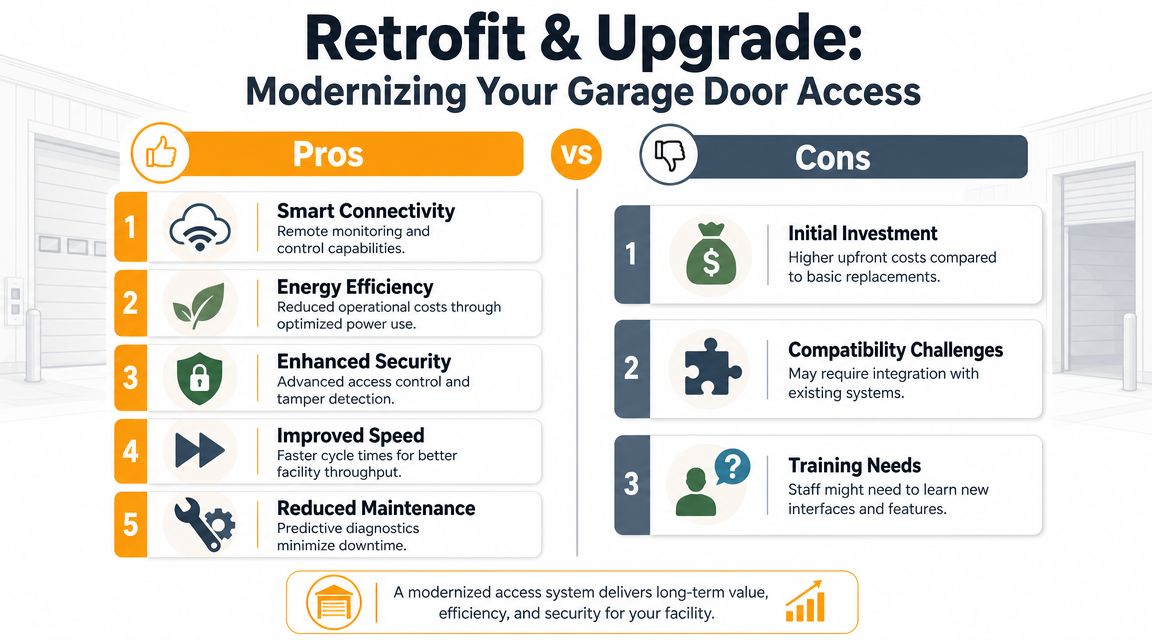
Older operators were selected mainly to raise and lower a door. Current commercial systems are often expected to report status, tie into site security, support monitored safety devices, and handle heavier daily cycling with fewer service interruptions. For an industrial facility, that matters more than consumer-style convenience features. A primary question is whether the replacement will reduce lost time and give the site better control over a critical opening.
Upgrades that solve operating problems
The best retrofit options address a specific weakness in the current setup.
- Remote status and monitoring: Useful for distribution sites, property managers, and multi-building operations that need to confirm whether a door is open, closed, or faulted without sending someone across the site.
- Access control integration: Helps standardize credentials and event tracking across overhead doors, gates, and man doors, which is often important in mixed-use or tenant-controlled facilities.
- Advanced presence detection: Light curtains and other monitored devices can improve protection at openings with frequent forklift and pedestrian crossover.
- Higher-performance operation: Faster or more application-specific operator setups can reduce wait time at active lanes and limit temperature loss in conditioned spaces.
- Control station standardization: Replacing a patchwork of added receivers, timers, and mismatched push buttons with a consistent layout makes training easier and troubleshooting faster.
Some retrofits are simple. Others are not.
A standalone operator swap may be enough if the door, controls, and safety devices are already in good order. If the opening has years of add-ons, disconnected features, or undocumented wiring changes, the smarter path is usually a coordinated upgrade that brings the system back to a known standard.
Here's a short look at a modern operator in action:
Where modernisation pays off
Modernization pays back fastest where operator problems keep interrupting work. A shipping manager cannot verify that an exterior door was secured after the night shift. A busy receiving lane loses throughput because the opening cycle is too slow for the traffic level. A multi-tenant building needs cleaner access records and fewer workarounds from different occupants. Those are operating issues, not cosmetic upgrades.
There are trade-offs. Added connectivity can mean more setup time, more coordination with security or building automation vendors, and more commissioning steps before the opening is ready for daily use. Some facilities do not need every feature available, and adding unnecessary complexity can create its own maintenance burden.
The right retrofit package is the one that fits the site's duty cycle, risk profile, and staffing reality. If a door is already due for operator replacement, it makes sense to decide whether the next unit should only restore motion or also improve visibility, accountability, and recovery time when something goes wrong.
Professional Installation Versus an In-House Approach
A warehouse door that will not close at shift change is not a minor install mistake. It can stop outbound loads, leave inventory exposed, and create an immediate life-safety issue if the opening also serves as part of a rated or secured path.
That is why the decision is larger than labor cost. Commercial operator replacement ties together power requirements, mounting loads, control stations, entrapment protection, and site-specific code obligations. Residential how-to guides rarely cover that mix because they are not written for high-cycle doors, dock traffic, or multi-tenant facilities.
Start with accountability, not just install capability
An experienced in-house team may be fully capable of replacing some equipment. The question is whether they should own the full commissioning and turnover risk on a mission-critical opening.
Commercial operators are often supplied in voltages and phase configurations that do not match the existing branch circuit. By comparison, residential replacement garage door openers in Canada are typically specified for 120V AC, 60Hz line power, according to Chamberlain electrical specifications. On a commercial site, power verification has to happen before the unit is ordered or mounted, not after the operator is hanging and the lift is already on site.
That is a common failure point. The mechanical install goes fine, then the project stalls because the selected operator needs a different supply, a disconnect change, or additional electrical work.
Installation risk sits in commissioning
Mounting the operator is only one part of the job. The higher-risk work is setting limits correctly, verifying force settings, confirming control wiring, testing photo eyes or other safety devices, and making sure the door itself is in condition to be operator-driven. A new motor will not correct a heavy door, bad balance, worn springs, or track issues. It will usually expose them faster.
For commercial openings, I advise clients to treat these checks as part of the install scope, not post-install cleanup:
- Verify power before delivery: Match voltage, phase, overcurrent protection, and disconnect requirements to the selected operator.
- Inspect the door first: Check balance, hardware wear, alignment, and any condition that will overload the new operator.
- Test all control functions: Confirm open, close, stop, limit travel, and reversing behavior under normal operating conditions.
- Validate safety devices and code-related functions: Make sure sensors, monitored devices, and any required accessories are wired and working as intended.
- Train site users at turnover: Operators, supervisors, and maintenance staff should know the new controls, lockout points, and fault symptoms.
Professional installation usually makes sense when uptime matters, the opening has high cycle counts, the door ties into access control or fire and security systems, or the facility needs one party accountable for startup and follow-up. Teams comparing labor and scope can use this guide to commercial garage door opener installation cost to frame the budget side against the operational risk side.
Facilities also benefit from a single service path after startup. If the operator starts faulting a week later, or a safety device needs adjustment after live use, one accountable provider can address the problem faster than splitting responsibility across maintenance, electrical, and a separate door vendor. That is one reason many sites pair replacement work with a provider that can also support 24/7 emergency repair for commercial doors.
Planning for Lifecycle and Long-Term ROI
A shipping door that fails at 6:30 a.m. does more than create a repair ticket. It backs up trailers, pulls staff off other work, and can turn a small operator problem into a missed receiving window or a production delay. That is why commercial replacement planning has to start with uptime, not sticker price.
Commercial operators should be budgeted like other high-use mechanical assets. The question is not only what the next unit costs. The real question is how long it will carry the door load, how often it will cycle, what safety devices and controls it depends on, and what a failure will cost your site in labor and disruption.
Use age and cycles to time replacement
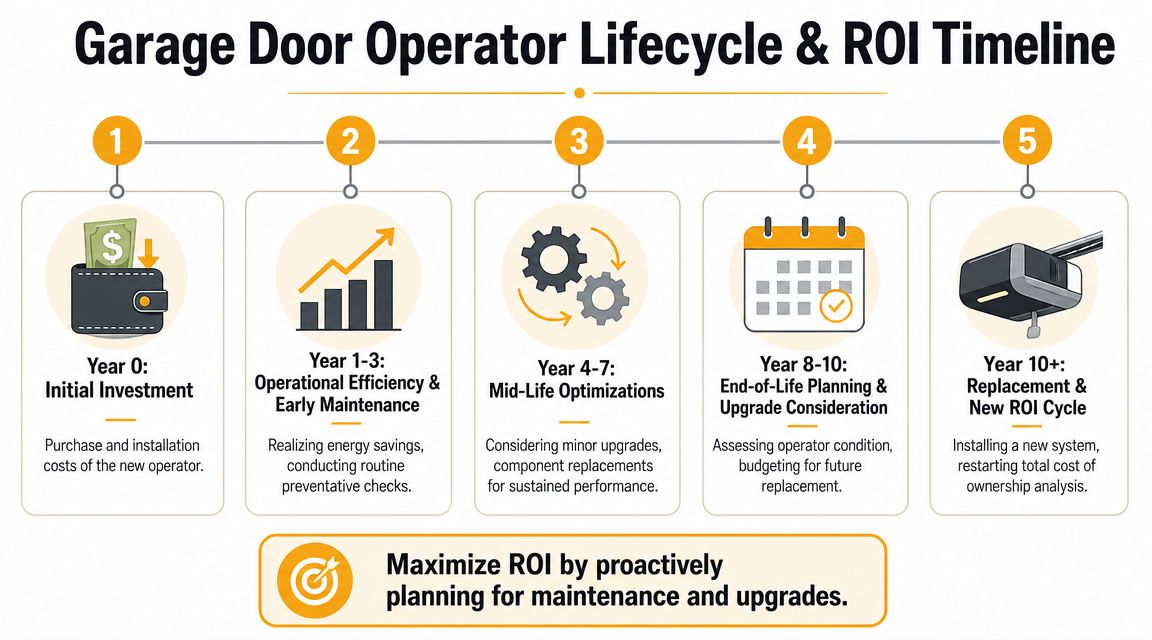
Residential lifespan guidance often cites 10 to 15 years and about 1,500 open-and-close cycles per year, or roughly 15,000 to 22,500 cycles over the unit's life, as noted in garage door opener replacement cost and lifespan guidance. For commercial facilities, those numbers are a floor, not a planning target. Many warehouse, service, municipal, and multi-tenant openings see far more use than a home garage, and the wear shows up faster in brakes, limit systems, drivetrains, and control components.
In practice, an operator near the 10-year mark deserves a closer review if it serves a busy opening, has a history of intermittent faults, or supports access control, security, or life-safety functions. Waiting for a hard failure usually means the replacement is made under pressure, with fewer equipment choices and more downtime.
Compare repair spend against replacement value
Cost still matters, but it needs context. The same source cited above lists chain-drive units at about $250 to $400, belt-drive units at $300 to $500, and wall-mount or jackshaft systems at $600 to $900, with smart or Wi-Fi upgrades adding $50 to $200 and battery backup adding $75 to $150, from the same garage door opener replacement cost and lifespan guidance source.
Those ranges are useful as a baseline, but commercial decisions should go further. A lower-cost operator is not a bargain if it is undersized for the door, poorly matched to the duty cycle, or likely to create repeated service calls. I usually advise clients to compare three numbers side by side: recent repair spend, expected downtime cost, and the installed cost of a properly specified replacement. That comparison makes the choice clearer than unit price alone.
Build a lifecycle plan around risk, not just age
A workable plan usually includes:
- Asset inventory: Track operator type, age, location, control setup, and the door's actual use pattern.
- Criticality ranking: Flag the openings that affect shipping, secure access, temperature control, tenant operations, or fire door function.
- Budget forecasting: Use installed cost assumptions, not equipment-only pricing. A detailed view of commercial garage door opener installation cost factors helps when setting capital and maintenance budgets.
- Replacement triggers: Set clear thresholds for action, such as repeated service calls, obsolete controls, unavailable parts, or rising downtime impact.
- Planned maintenance: Schedule inspections to catch brake wear, limit drift, entrapment device faults, and door conditions that overload the operator.
This approach gives facility teams a better ROI than running operators to failure. It also reduces one of the biggest commercial risks: replacing a unit too late, after the door has already become a reliability problem for the operation.
One practical option is a planned maintenance agreement with a commercial service provider. For example, Wilcox Door Service includes planned maintenance support for operator and door systems, which can help facilities identify at-risk units before they become emergency calls.
Building Resilience with Emergency and Continuity Planning
A dock door operator usually fails at the worst possible time. A truck is waiting, a shift is changing, the opening is needed for security or temperature control, and the only plan is to call for service. In a commercial facility, that delay affects shipping, labor, tenant operations, and sometimes life safety requirements tied to the opening.
Build the plan before the failure
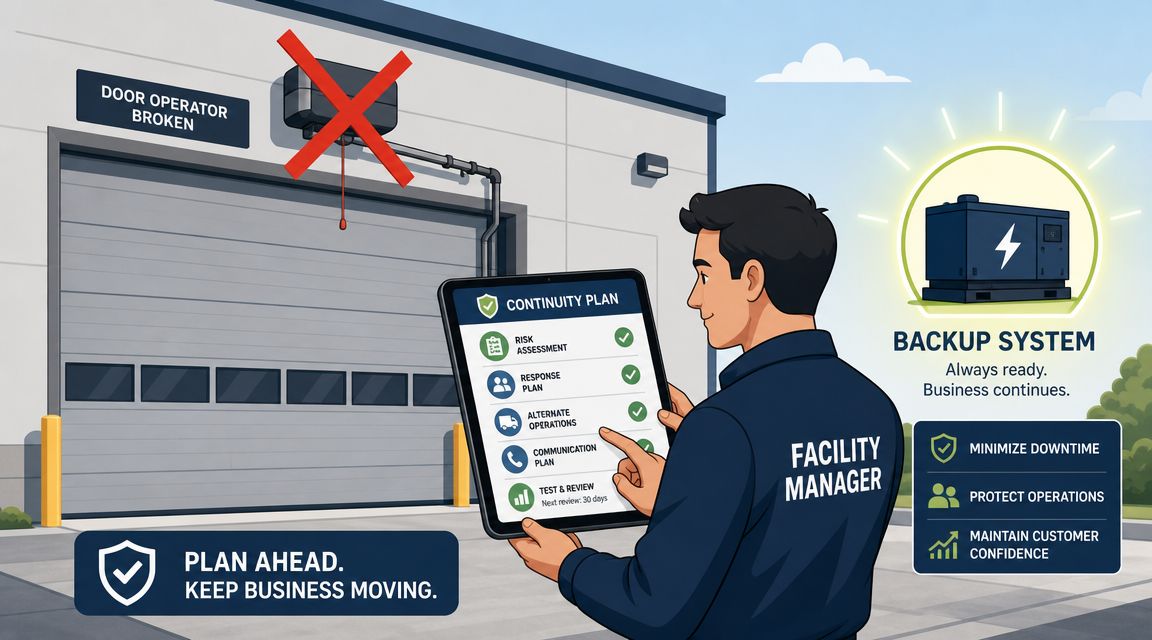
Emergency planning starts with the doors that cannot be down for long. On most sites, that includes the primary shipping opening, the secured after-hours entry, doors supporting freezer or conditioned spaces, and any fire or smoke door with operator controls that have to perform as designed.
Write down the response path and keep it current:
- Who authorizes service and who gets called first
- Which openings get priority if more than one door is down
- What manual operation method is available and who is trained to use it safely
- Which controls, transmitters, receivers, and accessories are specific to that opening
- How dispatch, warehouse staff, tenants, or carriers will be notified
That list does more than speed up a service call. It prevents unsafe improvisation, such as forcing a door open, bypassing controls, or using an opening in a way that conflicts with site security or code requirements.
Compatibility problems often show up after the operator is installed
Replacement work in commercial buildings often involves more than swapping the motor unit. The new operator has to work with the existing control station, safety devices, access credentials, interlocks, and any site-specific operating sequence. If that review happens too late, the door may run, but the facility still cannot use it the way it needs to.
As noted in a video discussion of garage door remote and receiver compatibility, a new replacement garage door opener may not work with older remotes. In a commercial setting, that can interrupt access for drivers, supervisors, maintenance staff, or after-hours personnel unless those devices are reviewed during scope and commissioning.
Ask these questions before installation day: Will existing remotes stay in service? Does the receiver need to be replaced? Are keypads, card access inputs, loop detectors, photo eyes, and monitored entrapment devices compatible with the new operator and current code requirements?
Mixed equipment generations make this harder. I see it often in multi-tenant buildings and acquired facilities where one opening was upgraded years ago and the next one still runs on older controls. A technically correct install can still create downtime if the handoff ignores how people gain access to the building.
Resilience depends on visibility and trained response
Good continuity planning includes current operator records, a clear manual-release procedure, and a realistic backup method for high-priority openings. For some facilities, that means redirecting traffic to another door. For others, it means stocking specific control parts or keeping a qualified technician on an established response agreement.
The commercial standard is simple. Know which openings protect revenue, security, and compliance. Know how each door can be operated during a failure. Know who owns the decision when normal operation stops.
If you're reviewing aging operators, planning a retrofit, or trying to reduce avoidable downtime, Wilcox Door Service Inc. can help assess your openings, prioritise replacements, and build a practical service plan around uptime, safety, and compliance.