


A truck is backing in, the dock is booked solid, and one leveler or door chooses that moment to fail. Every facility team knows that kind of disruption. The repair itself is only part of the problem. The bigger issue is the scramble around safety, shipping delays, building security, temperature control, and upset tenants or operations staff.
That's where what is predictive maintenance stops being a technology question and becomes an operations question. For doors, docks, and access points, it means spotting the signs of trouble early enough to plan the repair before the failure turns into an outage.
A lot of maintenance teams already live between two imperfect models. One is reactive maintenance, where you fix equipment after it breaks. The other is preventive maintenance, where you service equipment on a fixed interval whether it needs it or not. Predictive maintenance sits in the middle. It uses equipment condition and operating signals to tell you when an asset is drifting toward failure.
Beyond the Calendar What Is Predictive Maintenance
A high-speed door doesn't usually fail out of nowhere. A dock leveler doesn't suddenly become unreliable without warning. Most critical access equipment gives signals first. The problem is that those signals are often subtle, easy to miss during a walk-through, or buried between scheduled service visits.

Predictive maintenance is a condition-based maintenance strategy. Instead of servicing equipment only after a breakdown or strictly by the calendar, you monitor how the asset is behaving. Major industry providers describe it as using historical and real-time data to forecast equipment health, and IBM notes that in Canada, 18.7% of manufacturing businesses were using the Internet of Things in 2022, which is one of the key building blocks that makes this approach practical.
What it means in plain language
For a facility manager, predictive maintenance means:
- Watching condition, not just dates. You look at signals like vibration, temperature, pressure, cycle count, or operating strain.
- Finding change early. The goal isn't to admire data. It's to catch deterioration before staff and customers feel it.
- Creating planned work from early warnings. If a door operator starts running hotter than normal, or a hydraulic system begins losing pressure, the team can book repair time before a shutdown forces the issue.
Reactive maintenance says, “Call when it stops working.”
Preventive maintenance says, “Check it every month.”
Predictive maintenance says, “This asset is changing. Deal with it now, while you still control the schedule.”
Practical rule: The best maintenance strategy for access equipment is the one that gives you enough warning to act during business planning, not during an emergency.
For many facilities, predictive maintenance isn't a replacement for routine service. It's an upgrade to the decision-making behind that service. Teams that already use planned maintenance programmes for commercial doors and docks are often already partway there. They're inspecting, documenting, and looking for wear patterns. Predictive maintenance pushes that one step further by turning those observations into continuous condition tracking.
The End of Unplanned Downtime Key Benefits of PdM
The biggest benefit of predictive maintenance isn't that it sounds modern. It's that it helps a facility stay operational when a door, dock, or access point is under real load.
Fewer interruptions where uptime matters most
A dock door that fails during a quiet period is inconvenient. The same failure during a receiving rush can stall trucks, create congestion in the yard, and force staff to reroute product through less efficient openings. Predictive maintenance reduces those surprises by identifying assets that are drifting out of normal operating condition before they stop service altogether.
For facilities focused on business continuity, the thinking is similar to the broader discipline of unlocking uptime for Calgary businesses. The systems are different, but the lesson is the same. Planned intervention is cheaper and calmer than emergency recovery.
Better safety at the opening itself
Doors and dock systems are moving equipment. They carry impact, weight, speed, and repeated cycles. When components wear unevenly, the risk isn't only downtime. It can also be unsafe operation.
A few examples show where PdM helps:
- High-speed doors can develop operator strain, alignment issues, or unusual resistance before a full malfunction.
- Dock levelers can show hydraulic or structural problems before the deck stops performing consistently.
- Truck restraints can drift into unreliable operation through wear, contamination, or electrical faults.
- Air curtains and seals can lose effectiveness gradually, which affects environmental control and can contribute to unsafe floor conditions around entrances.
A maintenance team can manage wear. It struggles when wear stays hidden until the asset fails in service.
Lower long-term cost, even without chasing every asset
PdM doesn't mean putting sensors on everything. It means using condition monitoring where failures are expensive, disruptive, or safety-sensitive. A mission-critical shipping door deserves a different maintenance strategy than a lightly used interior opening.
That's why software matters. A useful platform doesn't just collect alerts. It helps the team connect signal changes to work orders, service history, and recurring fault patterns. For teams sorting that data flow, facility maintenance software for doors and docks can help centralise asset records and response planning.
Why teams stick with it
Operational gains usually show up in areas teams feel every day:
- Less emergency dispatching because repair windows are scheduled earlier
- Smarter parts use because components are replaced closer to actual need
- More reliable staffing because overtime pressure drops when the work becomes more planned
- Longer useful service life because assets aren't being run to failure
Predictive maintenance works because it gives maintenance teams time. In facility operations, time is often the difference between a routine repair and a service event that disrupts the entire building.
How Predictive Maintenance Technology Works
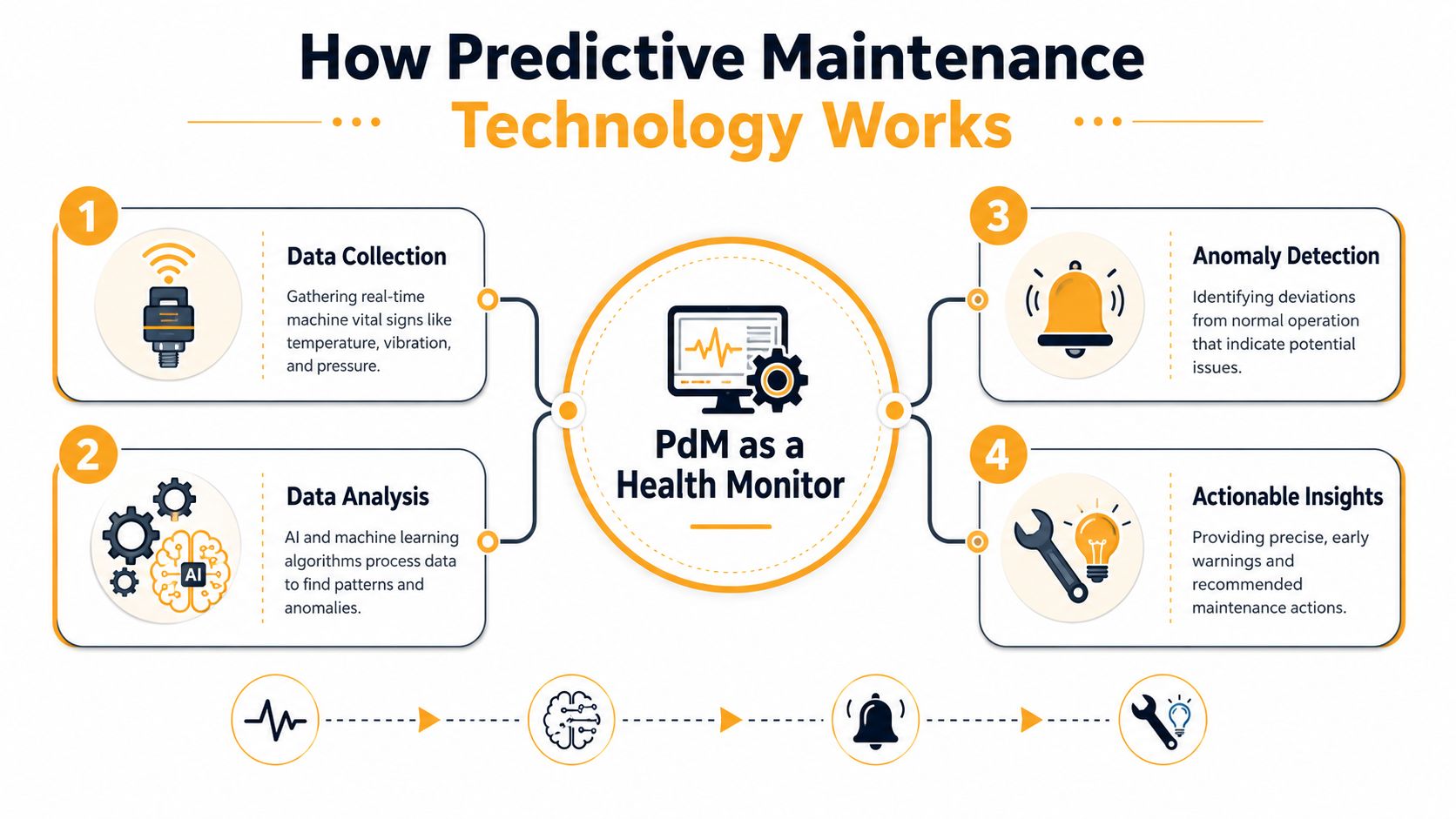
Predictive maintenance isn't magic, and it doesn't require a black-box view of “AI” to be useful. In essence, it works a lot like a health monitor. You establish what normal looks like, then you watch for meaningful changes.
Step one is reading the asset
A door operator, leveler pump, or restraint motor gives off signals while it works. Those signals can include vibration, temperature, pressure, electrical load, run time, or sound. According to TMA Systems' explanation of predictive maintenance, the core task is to monitor variables like vibration, temperature, or pressure and use analytics to spot anomalies that match known wear patterns.
For example, a rotating component often shows a fault first through abnormal vibration or a temperature rise. That matters because the earliest warning sign rarely looks dramatic on the floor. It looks like a small change in behaviour.
Step two is building a baseline
The system needs to know what normal operation looks like for that specific asset. A clean, properly aligned operator will sound and behave differently than one that is binding, overheating, or compensating for mechanical drag.
That baseline can include:
- Operating rhythm for opening and closing cycles
- Temperature range during normal duty
- Pressure behaviour in hydraulic equipment
- Vibration signature for motors, gearboxes, and rotating parts
Step three is classifying the change
Analytics are essential. The system compares live readings against the historical baseline. If the change is large enough, consistent enough, or linked to a known failure mode, the platform flags it.
On the floor, the useful question isn't “Is the reading unusual?” It's “Is this unusual reading tied to a failure mode we care about?”
A rising temperature on a motor, by itself, is just a signal. Combined with increased vibration and cycle stress, it becomes a maintenance indicator.
A short visual summary helps:
| Workflow stage | What happens at the door or dock |
|---|---|
| Data collection | Sensors read operating condition |
| Baseline comparison | Software checks live values against normal patterns |
| Anomaly detection | The system flags a change linked to wear or fault risk |
| Maintenance action | The alert becomes an inspection or repair task |
A practical example is a service alert generated before the opening fails. If a monitored asset shows abnormal behaviour, the team can route that issue into scheduled diagnosis instead of waiting for a shutdown that requires commercial door sensors and related monitoring components or larger repair work.
Later in the process, the video below gives a useful visual overview of the concept in operation.
The Core Components for Your Facility
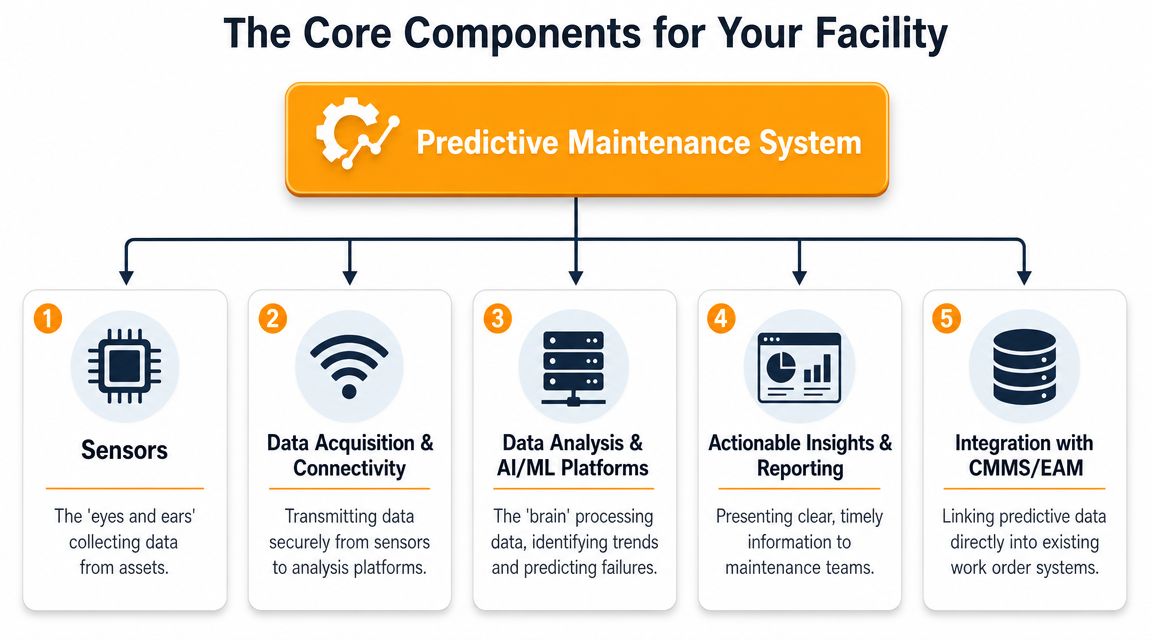
A predictive maintenance setup for doors and docks doesn't need to be overbuilt. It does need the right pieces connected in the right order. If one part is weak, the whole system becomes noisy, confusing, or hard to trust.
Sensors matched to the failure mode
A common misstep in many rollouts involves teams selecting a sensor merely because it's available, rather than because it matches the specific problem they need to detect.
SAP's guidance on predictive maintenance notes that matching the sensor to the asset matters because vibration analysis suits many rotating components, infrared thermography is strong for air leaks, and acoustic analysis can fit slower-moving equipment. For facility access equipment, that matters a lot because failures don't all look the same.
A few practical pairings:
- Vibration sensing fits motors, gearboxes, and operator assemblies.
- Thermal imaging helps detect heat build-up, electrical strain, or leakage around seals and openings.
- Acoustic monitoring can catch grinding, scraping, or air leakage before staff can hear it clearly.
- Pressure monitoring suits hydraulic levelers and other fluid-driven equipment.
- Cycle counters add context by showing duty level and wear exposure.
Data collection and connectivity
Sensors still need a path to somewhere useful. That usually means a gateway, controller, or connected monitoring point that gathers readings and sends them onward.
In a facility setting, the practical requirement is reliability. If data drops out or arrives inconsistently, the maintenance team won't trust the alert stream. Clean collection matters more than flashy dashboards.
The analytics layer
This is the decision engine. It takes incoming signals, compares them to baseline behaviour, and determines whether the change is routine variation or a maintenance issue.
Good analytics should answer three questions:
- Is the asset operating outside its normal pattern?
- Is that change persistent enough to matter?
- What action should the team take next?
Some operations use enterprise tools. Others start with simpler threshold and trend logic for high-risk openings. That's often the better path for doors and docks, because the most useful systems are the ones technicians can act on.
CMMS or EAM integration
An alert that sits in a separate dashboard has limited value. An alert that becomes a work order changes behaviour.
That's why integration matters. The system should connect predictive signals to service history, technician notes, parts use, and inspection follow-up. If a dock leveler repeatedly trends toward the same fault, the maintenance team needs that history in one place.
Field lesson: Better data only matters if it changes the timing and quality of the work order.
For facilities assessing equipment at the opening, this usually includes dock hardware such as hydraulic systems, restraints, seals, and mechanical interfaces. In those cases, it helps to review the asset classes together with the broader loading dock equipment and service options already in place.
People and process still matter
Technology doesn't remove judgement. It supports it. Someone still has to review alerts, decide what gets scheduled, and confirm whether the signal points to a real fault or a temporary condition.
That's why the strongest PdM programmes don't start with “buy more sensors.” They start with “which opening causes the most pain when it fails, and what signal would warn us early enough to act?”
Predictive Maintenance in Action Real-World Examples
The easiest way to understand predictive maintenance is to see how it changes a maintenance decision before the breakdown happens. For doors and docks, the value shows up in small signals that lead to timely work.
High-cycle warehouse door with a developing operator fault
A high-cycle door opens hundreds of times through the day. Staff notice nothing obvious except that the operator sounds a little rougher than usual during the last part of travel. That kind of comment often gets lost because the door is still working.
An acoustic trend or vibration reading picks up a growing irregularity in the operator assembly. The signal suggests a bearing or gearbox issue rather than a one-off noise event. Instead of waiting for the operator to seize during a production shift, maintenance schedules a planned repair window after hours.
The difference is control. The facility chooses the downtime instead of inheriting it.
Loading dock leveler with a slow hydraulic leak
A hydraulic leveler can remain functional while its condition worsens in the background. The deck still raises. The lip still extends. But the system starts showing behaviour that isn't normal, such as pressure drift when idle or a slower recovery pattern under repeated use.
That kind of signal points a technician toward the hydraulic side before the unit fails under operating load. In practice, the maintenance response might be a seal replacement, hose inspection, or a closer check on the power unit and cylinders.
The best save in a dock environment is often the failure that never reaches the shipping team.
Predictive maintenance earns credibility with operations staff. It doesn't ask them to care about analytics. It prevents an out-of-service bay.
Cold storage door with worsening seal performance
Cold storage and temperature-sensitive spaces often expose a blind spot in traditional maintenance. A door can still open and close on command while steadily losing performance at the perimeter.
A thermal check may show an area where the seal is no longer holding evenly. Pressure behaviour, cycle pattern, or operator strain can add more context. Over time, that small gap becomes an energy loss issue, a frost problem, or a condition that affects environmental control.
The fix may be straightforward. Realign the door, replace worn seal material, correct hardware strain, or address a closing-force issue. The key is that the maintenance team sees the problem while it's still a maintenance task, not after it grows into a building performance issue.
Where these examples usually succeed
The strongest results tend to come from assets with three characteristics:
- They fail in a way that disrupts operations. Shipping doors, dock positions, security openings, and cold storage doors fit this profile.
- They show measurable signs before failure. Heat, pressure change, abnormal sound, and vibration all count.
- The facility can act on the alert. If the team can't schedule service, source parts, or assign ownership, the data won't help much.
Not every opening needs predictive monitoring. But the openings that affect throughput, environmental separation, or safety are often good candidates because the operational consequences of failure are so immediate.
Is It Worth It? Measuring ROI and Avoiding Pitfalls
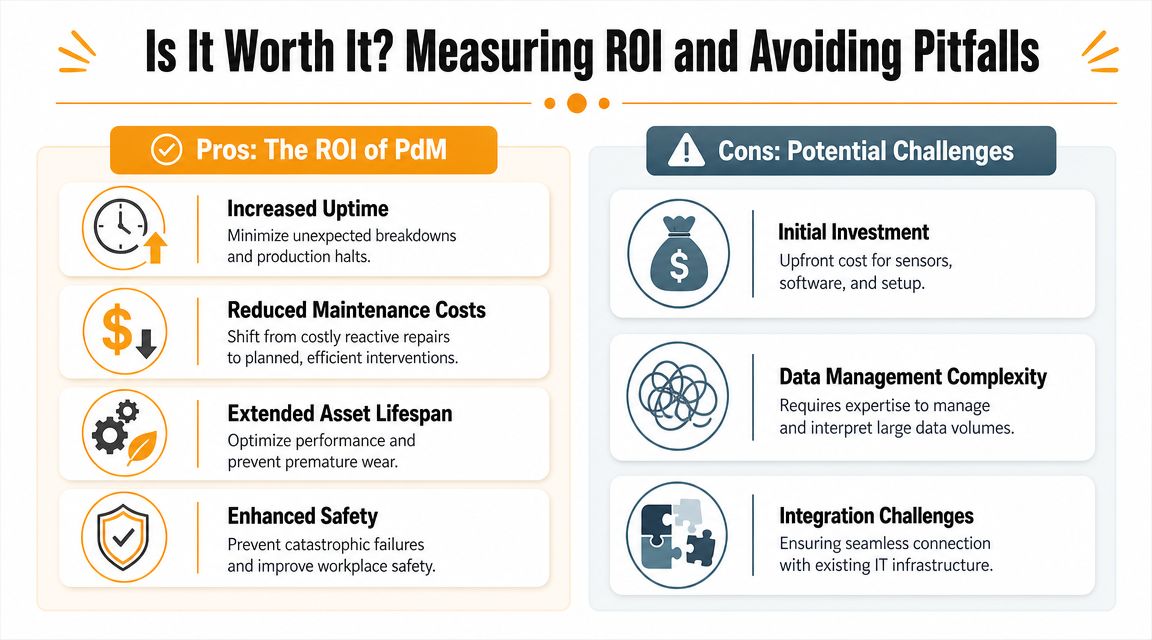
The honest answer is that predictive maintenance is worth it in some places and unnecessary in others. The right question isn't whether PdM is impressive. It's whether the asset justifies the effort.
How to judge the return
Ansys makes the point clearly in its overview of predictive maintenance. PdM is most valuable when failure cost, downtime risk, and available data justify the upfront investment and workflow change. That's the right lens for facility access systems.
A practical review usually looks at:
- Emergency call frequency for a specific door, dock, or operator
- Operational consequence of failure such as blocked shipping, lost security, or temperature drift
- Repair pattern that shows repeated issues instead of isolated events
- Whether the failure mode is detectable early through sound, heat, pressure, vibration, or cycle behaviour
If an opening is inexpensive, lightly used, and simple to replace, preventive maintenance may be enough. If failure affects throughput, safety, compliance, or energy control, PdM becomes easier to justify.
Common mistakes that waste the investment
Teams usually run into trouble for process reasons, not technical reasons.
Starting with too many assets
A small pilot on the most disruptive opening usually teaches more than a facility-wide rollout. Start where failure hurts most.
Collecting data no one can use
If alerts don't tie back to a technician action, teams stop paying attention. The system has to fit the work order process.
Using the wrong sensor
A poor sensor match creates noisy data and weak confidence. Doors and docks fail through mixed mechanical, hydraulic, electrical, and environmental causes. The sensing method has to reflect that.
Ignoring team buy-in
If technicians see the platform as extra admin work, adoption drops. If they see it as earlier notice and better-planned repairs, it sticks.
Bottom line: Predictive maintenance works best as a decision tool for critical assets, not as a badge that says your facility uses smart technology.
For many buildings, the right answer is a hybrid model. Keep scheduled inspections where they make sense. Add condition-based monitoring where the cost of failure is high.
If you're assessing whether predictive maintenance fits your doors, docks, or other critical access points, Wilcox Door Service Inc. can help you review asset risk, maintenance history, and service options. It's a practical next step for facilities that want fewer surprises, better planning, and the kind of support that reflects Respected Partners, Reliable Service.