


Using wheel chocks for a trailer isn’t just a box to tick on a safety checklist; it’s a fundamental practice that prevents catastrophic, costly accidents during loading and unloading. This guide will explain why securing a trailer is a non-negotiable safety requirement, especially under regulations in Canada and Ontario. You will learn about the dangers of an unsecured trailer, how to choose the right wheel chocks, the correct placement procedures, and how advanced systems like truck restraints can eliminate risks like “trailer creep.”
The Unsung Hero of Loading Dock Safety
Every day at loading docks across Canada, a simple, often overlooked tool is the only thing standing between a smooth operation and a serious accident. That tool is the humble wheel chocks trailer combination. Securing a trailer isn’t just a good idea—it’s a critical safety requirement mandated by provincial regulations, including those in Ontario.
We’re going to uncover the hidden dangers of unsecured trailers, walk you through selecting the right chocks for your facility, and lay out the correct procedures to keep your team safe. This guide is built on Wilcox Door Service’s hands-on experience in creating safer work environments, providing the practical knowledge you need to stop accidents before they happen.
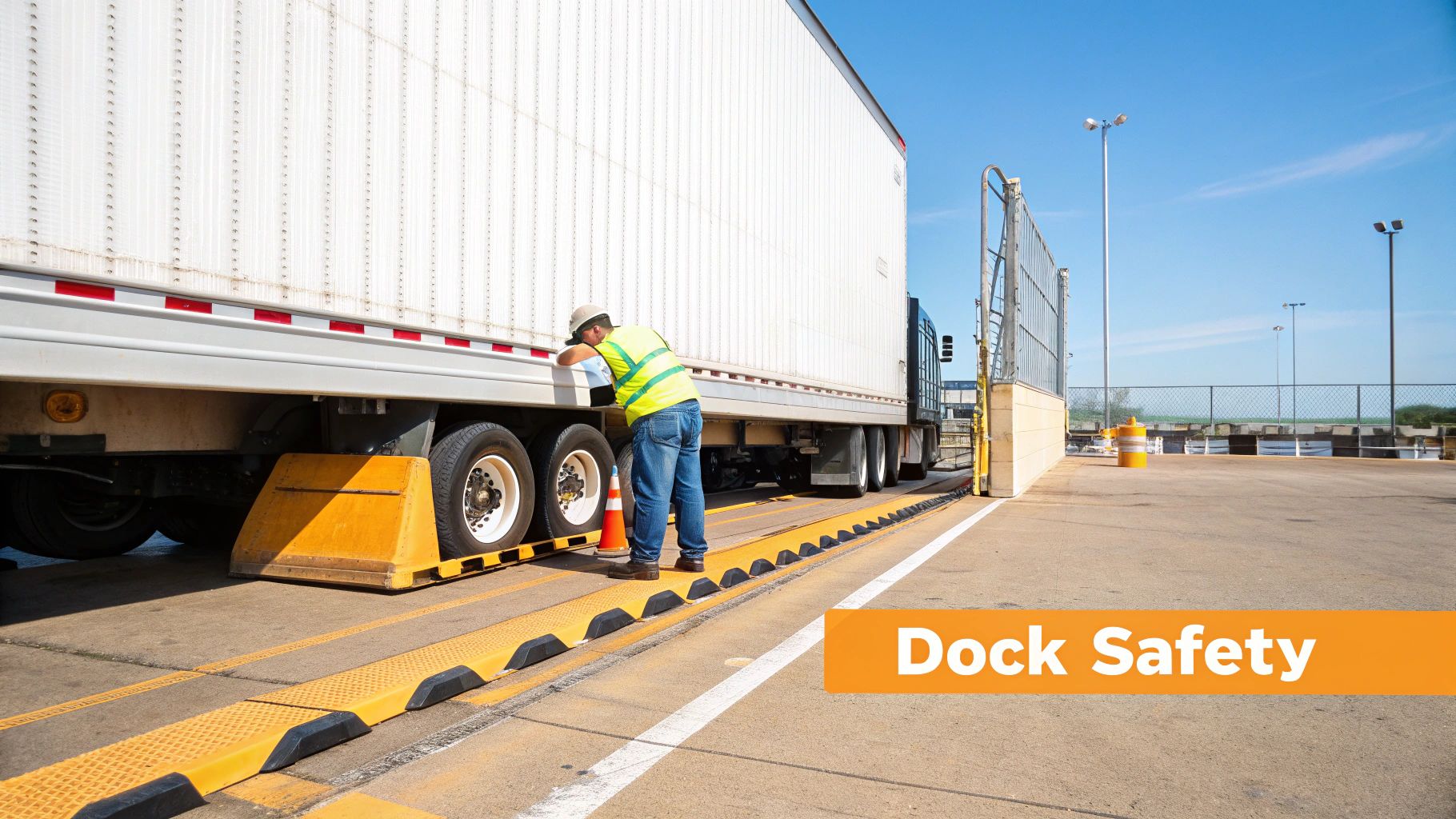
Alt text: A yellow wheel chock for a trailer tire, securely positioned at a commercial loading dock to ensure safety.
Why Every Loading Dock Needs a Safety Plan
An unsecured trailer is a ticking time bomb. One of the most common—and dangerous—scenarios is “trailer creep.” This is the slow, almost unnoticeable separation of the trailer from the dock edge. What causes it? The constant momentum of a forklift driving in and out, which can eventually create a treacherous gap.
A rock-solid safety plan is built on a few key pillars:
- The Right Gear: Your first line of defence is always using the correct wheel chocks for the specific truck and the ground conditions at your dock.
- Clear, Consistent Procedures: Everyone, from the truck drivers pulling in to the warehouse staff on the floor, must understand and follow the wheel chocking protocol. Every. Single. Time.
- A Layered System: Safety measures should never exist in a vacuum. Beyond chocks, things like effective warehouse floor marking guidelines are essential for keeping the entire loading dock orderly and safe.
Advanced Solutions for Enhanced Security
While a good set of manual chocks gets the job done, Wilcox Door Service offers solutions that create a more complete safety ecosystem. Our Wheel Chocks Safety Packages bundle high-quality chocks with chains, wall-mounted storage brackets, and instructional signs to make sure the equipment is always where it needs to be and is used correctly.
For high-traffic facilities, you might want to consider an even higher level of security with automated truck restraint systems. These systems physically lock a trailer to the building, offering a nearly foolproof defence against both trailer creep and premature departure. For more on that, check out our guide on how to choose the best dock lock.
A well-secured trailer is the foundation of a safe loading dock. It’s a non-negotiable step that protects your people, products, and equipment from preventable harm.
As Respected Partners providing Reliable Service, we’re here to help you build that foundation.
Ready to enhance your loading dock safety? Contact Wilcox Door Service today for a consultation on the right safety solutions for your facility.
Understanding the Dangers of an Unsecured Trailer
Picture a transport truck parked on a slight incline, held in place only by its brakes. It’s a disaster waiting to happen. An unsecured trailer at a busy loading dock poses a similar, if not greater, threat. Forgetting to immobilize a trailer isn’t just a small mistake; it’s a critical safety breakdown that can lead to devastating consequences. Let’s dig into what can go wrong and why using wheel chocks for a trailer is a non-negotiable part of dock safety.
At the core of these dangers is a sneaky phenomenon known as “trailer creep” or “dock walk.” This is the slow, almost unnoticeable separation of the trailer from the dock’s edge. It’s caused by the back-and-forth momentum of a forklift. Each time the forklift enters or exits, it nudges the trailer forward by just a few millimetres. After dozens of trips, those tiny movements create a dangerous gap between the trailer floor and the dock leveler.
 Alt text: A forklift entering a trailer at a loading dock, an action that can cause dangerous trailer creep if wheel chocks are not used.
This gap is precisely where a routine day can turn tragic. A forklift operator, concentrating on their load, might not see the widening space until a wheel drops off the edge. This can cause a sudden, violent tip-over, endangering the operator’s life and causing massive damage to the forklift, the trailer, and the goods being moved.
The Chain Reaction of Loading Dock Accidents
When a trailer isn’t properly secured, it sets off a chain reaction of potential accidents. The fallout from one incident can ripple through your entire operation.
- Personnel Injury: The most severe risk is serious injury or even a fatality. A forklift operator or another dock worker could easily fall into the gap created by a creeping trailer.
- Equipment Damage: Forklifts are heavy, expensive machines. A tip-over can mean thousands of dollars in repairs and significant downtime, throwing your workflow into chaos.
- Product Loss: Spilled or crushed goods are a direct hit to your bottom line, affecting your inventory and ability to fulfill customer orders.
- Structural Damage: The force of an accident can damage the loading dock itself, the trailer, and even the building, leading to expensive and complicated repairs.
These aren’t just hypotheticals. The transportation and warehousing industry is one of the highest-risk sectors for workplace incidents, and a huge number of these are linked to unsecured vehicles during loading and unloading. Shockingly, for every major accident at a loading dock, there are an estimated 600 near misses, which just goes to show how often these risks are present.
Trailer Creep and the Role of Truck Restraints
While a wheel chocks trailer setup is the essential first line of defence, “trailer creep” shows the specific problem they’re designed to solve. The constant jarring from forklift traffic also affects the trailer’s suspension, making it bounce and shift. This up-and-down motion, combined with the horizontal creep, creates a seriously unstable bridge for the forklift to cross.
This is where a more advanced solution, like a truck restraint system, provides an even higher level of safety. Unlike chocks that just passively block the wheels, a truck restraint actively grabs the trailer’s rear impact guard (RIG) and physically locks it to the building. This prevents both horizontal and vertical movement, effectively stopping trailer creep and accidental departures in their tracks. A rigorous pre-trip inspection is crucial for both drivers and dock staff to ensure all these safety measures are in place and working correctly.
In Canada, and particularly under Ontario’s health and safety regulations, employers are legally obligated to take every reasonable precaution to protect their workers. Making sure a trailer is completely immobilized is a fundamental part of that duty. At Wilcox Door Service, we provide the solutions you need to meet and exceed these standards, from heavy-duty rubber wheel chocks to fully automated restraint systems.
Ready to secure your loading dock? Explore our wheel chocks and safety packages or contact us for a professional safety assessment.
How to Choose the Right Wheel Chocks
Choosing the right wheel chocks for a trailer is one of those critical decisions that directly impacts the safety of your entire loading dock. It’s not about grabbing the first block you see; it’s about making a deliberate choice that matches the chock to the truck, the dock surface, and the unique demands of your operation. Get it right, and your first line of defence against unexpected trailer movement is rock-solid.
This section will walk you through the key factors in selecting the perfect wheel chocks. We’ll compare the pros and cons of different materials, explain how to size a chock to your tires, and talk about why grip is so important—especially with the kind of weather we get here in Canada. By the end, you’ll know exactly what to look for to boost your facility’s safety and efficiency.
Material Matters: Choosing Your Chock
The material a wheel chock is made from determines its toughness, its grip, and how it performs day in and day out. Each type has its own strengths, making it a better fit for certain jobs. Getting to know these differences is the first step toward making a smart choice.
Here’s a breakdown of the most common materials you’ll find:
- Laminated Rubber: A very popular choice, and for good reason. They offer fantastic grip on all sorts of surfaces. Because they’re made from recycled tire rubber, they’re heavy and incredibly durable, giving them a firm hold on asphalt or concrete.
- Moulded Rubber: Often seen as the go-to, cost-effective option. These solid chocks can take a real beating from daily use and keep on working. They are the dependable workhorse in countless loading dock environments.
- Urethane: When you need something that stands up to oils, chemicals, and brutal weather, urethane is the top-tier choice. They are surprisingly light but incredibly strong, making them perfect for tough industrial settings.
- Aluminum: The biggest selling point for aluminum chocks is how lightweight they are, which makes them easy for drivers and dock workers to handle. They often have aggressive teeth designed to bite into surfaces like gravel or ice for an unshakeable hold.
The right material for you comes down to balancing things like your loading bay surface, the kinds of trailers you service, and of course, your budget. A facility that handles chemical transport, for example, would probably lean toward urethane chocks for their corrosion resistance.
Think of it like choosing tires for your car. You wouldn’t put summer tires on for a blizzard. In the same way, your wheel chock’s material has to match your loading dock’s conditions to give you the best possible grip and safety.
To help you decide, here’s a quick comparison of the most common wheel chock materials. This table breaks down the key advantages and considerations for each, making it easier to select the best option for your trailers and loading dock environment.
Comparison of Wheel Chock Materials
| Material Type | Key Advantages | Best For | Considerations |
|---|---|---|---|
| Laminated Rubber | Excellent grip on most surfaces, highly durable, made from recycled materials. | Standard concrete or asphalt loading docks, general-purpose use. | Can be heavy, which may be a handling consideration for some staff. |
| Moulded Rubber | Very durable and cost-effective, resistant to wear and tear. | High-traffic docks where budget and durability are key priorities. | Grip may be slightly less effective on very slick or icy surfaces. |
| Urethane | Lightweight yet extremely strong, resistant to oils, fuels, and chemicals. | Industrial settings, chemical plants, or where harsh weather is a factor. | Typically a higher initial investment compared to rubber options. |
| Aluminum | Very lightweight and easy to handle, excellent grip on soft or icy ground. | Gravel lots, icy conditions, or when portability is a top concern. | Can be susceptible to bending or damage from extreme impact. |
Each material offers a unique set of benefits. By reviewing this table, you can align the material’s strengths with the specific challenges of your loading dock, from surface type to weather conditions.
Sizing and Grip for a Secure Fit
Once you’ve settled on a material, the next critical details are the chock’s size and its grip. A chock that’s too small or one that can’t hold its ground is a major safety failure waiting to happen. The chock needs to be big enough to physically block the wheel while fitting snugly against the tire’s tread.
A good rule of thumb is that the chock’s height should be about 25% of the tire’s diameter. This ensures it creates a big enough barrier to resist the trailer’s forward momentum. Always double-check the manufacturer’s specs, as they’ll list a recommended tire size range for each model.
Grip is a huge deal for any Canadian operation, where docks can be wet, icy, or covered in snow. Laminated rubber chocks really shine in these conditions because of their high friction. Aluminum chocks with built-in spurs are also great on icy surfaces. The design of the chock’s base—whether it’s ribbed, textured, or spurred—is what stops it from sliding under pressure.
At Wilcox Door Service, we provide a variety of high-quality wheel chocks trailer solutions designed for the rigours of Canadian commercial and industrial environments. Our experts can help you assess your needs and select the perfect option, ensuring you have the right equipment to keep your team safe and your operations compliant.
Need help choosing the right wheel chocks? Explore our wheel chock options and safety packages here or schedule a consultation with our safety experts.
Proper Wheel Chock Placement for Maximum Safety
Having the right wheel chocks is a great start, but knowing exactly how to use them is what keeps your people and your facility safe. Even the toughest, most expensive chock is useless if it’s not positioned correctly. It’s a simple, non-negotiable step that ensures the chock can do its one critical job: stopping a multi-tonne trailer from moving when you least expect it.
This is about more than just handing out equipment. It’s about building a safety-first culture on the loading dock, where every action is deliberate. We’ll walk through a straightforward checklist for your dock crew and drivers, and point out the common—and dangerous—mistakes we see all too often.
The infographic below breaks down the key things to look for when choosing your wheel chocks in the first place, zeroing in on material, size, and grip.
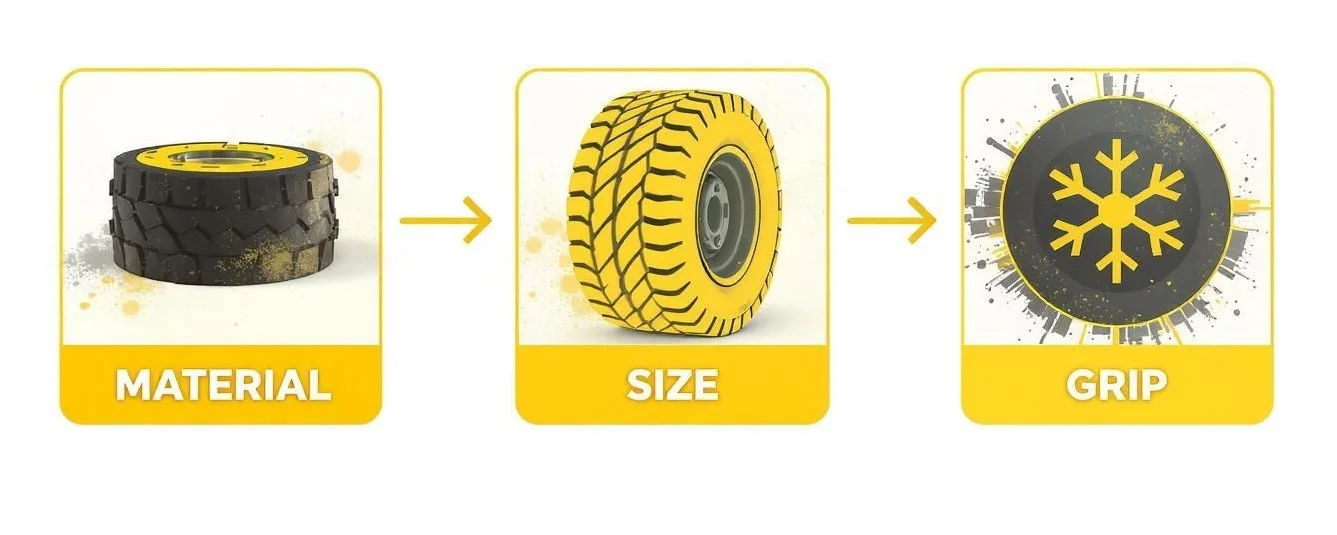
Alt text: An infographic detailing key factors for selecting wheel chocks for a trailer, including material, size, and grip.
Think of this as step one. Getting the right chock for your specific trailers and dock conditions is the foundation for safe and effective placement.
The Correct Placement Checklist
For a wheel chock to actually work, it has to be positioned to absorb and counteract the force of a tire that wants to roll. Make sure your team follows this simple checklist every single time a trailer pulls in.
- Choose the Correct Side: Always chock the wheels on the side of the trailer closest to the loading dock building itself. This placement offers the most direct resistance against “trailer creep,” that gradual, dangerous drift away from the dock.
- Position on the Outermost Wheels: Put the chocks on the wheels of either the rearmost or frontmost axle. Your goal is to stop the trailer from rolling either forwards or backwards, and these wheels provide the best leverage.
- Place on Both Sides of a Single Tire: The gold standard for security is to “nest” one of the tires. Place one chock in front of the tire and another behind it. This locks it in place, preventing any movement at all.
- Centre and Snug Fit: Don’t just toss it near the wheel. The chock needs to be placed squarely in the centre of the tire’s tread and then pushed in firmly until it’s snug, with no gaps. A loose chock might as well not be there at all.
Common and Dangerous Mistakes to Avoid
Even with good intentions, mistakes can happen on a busy dock. Knowing what not to do is just as important as knowing the right steps. Watch out for these common errors that can lead to a catastrophic failure.
- Placing on Slippery Surfaces: Never put a chock down on a patch of grease, oil, ice, or even loose gravel. The chock won’t be able to get a grip and can slide right out from under the tire.
- Using Damaged Equipment: A chock that’s cracked, warped, or worn down has lost its structural integrity. It can’t be trusted. Inspect your chocks regularly and get rid of any that look compromised.
- Not Ensuring a Snug Fit: This is the most common mistake. Simply dropping the chock in the general vicinity of the wheel does nothing. It has to be pushed in tightly to be effective.
In many places, proper wheel chock use isn’t just a good idea—it’s the law. For instance, Cal/OSHA regulations require that trailers are secured with chocks or an equivalent restraint system before any forklift activity can begin. This makes it a shared responsibility between the driver and the dock workers.
A properly placed wheel chock is a clear, universal signal at the dock. It tells everyone—forklift operators, supervisors, other drivers—that the trailer is secured and it’s safe to begin loading or unloading. It’s a fundamental communication tool in a busy, high-risk environment.
By creating and enforcing a simple, repeatable process for wheel chock placement, you’re building a culture where safety is automatic. This same principle of procedure is what makes advanced systems like truck restraints so effective. For more on that, take a look at our guide on when to consider a loading dock truck restraint replacement.
Ensure your team is trained in correct safety procedures. Contact Wilcox Door Service to discuss safety packages and training support.
Upgrading Your Dock with Advanced Safety Systems
While manual wheel chocks for a trailer are the absolute cornerstone of dock safety, modern loading docks can take their safety protocols to the next level with more integrated and automated systems. These advanced systems don’t replace chocks; they work hand-in-hand with them to build a safer, more efficient, and fully compliant environment.
At Wilcox Door Service, we view this as a natural evolution. It all starts with getting the basics right.
Creating a Complete Chocking System
Let’s be honest: a loose wheel chock often becomes a lost wheel chock. To make sure this vital piece of equipment is always where it needs to be, we’ve developed comprehensive Wheel Chocks Safety Packages. These aren’t just about handing you a chock; they’re about creating an organized, impossible-to-ignore system.
Our packages are built to keep things simple and reliable:
- High-Quality Wheel Chocks: We use durable materials like laminated rubber or urethane that can stand up to heavy use and harsh Canadian weather.
- Secure Chains: These chains tether the chock directly to the dock wall. This simple step prevents chocks from being misplaced, lost under a trailer, or accidentally run over.
- Wall-Mounted Storage Brackets: Every chock gets a designated home. This keeps it off the ground, eliminating a trip hazard and ensuring staff can find it instantly.
- Clear Instructional Signage: Bold, easy-to-read signs act as a constant reminder for drivers and dock staff about mandatory chocking procedures, reinforcing your safety-first culture.
This complete system turns a simple tool into a reliable process. It’s a core part of our “Respected Partners, Reliable Service” commitment—making sure your team has what they need, where they need it, every single time.
The Next Level of Protection: Truck Restraints
For high-traffic facilities or anyone aiming for the highest standard of safety, the next logical step is an automated truck restraint system. While a chock passively blocks a wheel, a truck restraint takes a more active approach: it physically locks the trailer to the building itself.
Here’s an easy way to think about it: a wheel chock is like setting your car’s parking brake. A truck restraint is like putting a boot on the wheel—that vehicle isn’t going anywhere. These powerful systems grab onto the trailer’s Rear Impact Guard (RIG) and hold it tight against the dock bumpers.
This provides a nearly foolproof defence against some of the most dangerous loading dock hazards. Most importantly, it completely stops trailer creep—that slow, dangerous separation caused by the back-and-forth movement of a forklift. It also prevents unscheduled departures, where a driver mistakenly pulls away while a forklift is still moving between the dock and the trailer. The consequences of that can be catastrophic.
Integrating a truck restraint can also work in tandem with other safety gear, like dock lip safety barriers, which are crucial for preventing forklift rolloffs.
An automated truck restraint doesn’t just prevent movement; it communicates safety. Integrated light systems—green outside for the driver, red inside for the forklift operator—give clear, unmistakable visual cues. Everyone knows when it’s safe to work and when it’s not.
The financial toll of preventable vehicle accidents is staggering. While not specific to loading docks, a report on vehicle backing incidents in California revealed repair costs topping $5.45 million over a decade. This data, which you can read in the full report on preventative measures in transport safety, highlights how investing in simple preventive tools can lead to massive savings and, more importantly, prevent injuries.
Deciding between a robust manual system and an automated restraint comes down to your facility’s traffic, risk profile, and long-term safety goals. Our team is here to help you analyze your operations and find the right fit.
Ready to upgrade your dock’s safety? Contact Wilcox Door Service to discuss our Wheel Chocks Safety Packages or to get a quote on a new truck restraint system.
Understanding Canadian and Ontario Safety Regulations
Running a safe, compliant, and reliable operation isn’t just good business—it’s your legal responsibility. In Canada, and especially in Ontario, loading dock safety rules are not mere suggestions. They are legal requirements designed to protect your team from harm. This section will cut through the regulatory landscape, focusing on Ontario’s Occupational Health and Safety Act (OHSA) and what it means for using wheel chocks for trailers.
We’ll translate the legal-speak into plain English, explaining an employer’s core duty to keep the workplace safe and how immobilizing a vehicle is a critical part of that. The goal is to give you, as a facility manager, the confidence to not just meet but exceed compliance standards, protecting your people and your business.
The Employer’s Duty Under Ontario’s OHSA
In Ontario, the OHSA doesn’t list every single piece of equipment you must use by name. Instead, it places a broad, powerful responsibility on employers through what’s known as the “general duty clause.” Found in Section 25(2)(h), this clause states an employer must “take every precaution reasonable in the circumstances for the protection of a worker.” This is the bedrock principle of workplace safety in the province.
So, what does that mean for your loading dock? While the Act might not have a line item saying, “you must use a wheel chock,” the Ministry of Labour, Training and Skills Development interprets this duty to include preventing any unexpected vehicle movement during loading and unloading. A trailer that could roll away or “creep” forward is a textbook example of a preventable hazard. Therefore, using wheel chocks or a similar restraint is considered a “reasonable precaution” and is the standard industry practice to meet your legal duty.
Beyond the Basics: Trailer Creep and Due Diligence
One of the biggest reasons regulations are so laser-focused on keeping vehicles still is the very real danger of trailer creep. As a forklift zips in and out, the trailer can slowly inch away from the dock, creating a dangerous and potentially deadly gap. A simple set of rubber wheel chocks is an incredibly cost-effective and direct way to stop this from happening and show you’ve done your due diligence.
But for facilities buzzing with high traffic, just having chocks lying around might not be enough. A more robust safety strategy often involves a complete system that proves you’re taking safety seriously. This could include:
- Integrated Solutions: Our Wheel Chocks Safety Packages are designed to create a complete system. They bundle chocks with chains, brackets, and clear instructional signs. This creates an organized, repeatable process that makes it far easier to enforce your safety rules and prove you’ve taken those “reasonable steps.”
- Advanced Restraints: For the highest level of protection, nothing beats a truck restraint system. These systems physically lock the trailer to the building, offering a virtually foolproof way to immobilize it. This kind of technology often goes above and beyond the baseline expectations of safety regulations and provides an even stronger defense against trailer creep.
By proactively putting these measures in place, you’re doing more than just ticking a compliance box; you’re building a resilient safety culture. You are sending a clear message that you’re committed to worker protection—a message that will stand up to any scrutiny from Ministry of Labour inspectors.
As your respected partner, Wilcox Door Service provides solutions specifically designed to help you meet and exceed these critical Canadian safety standards. Our equipment is built to give you confidence, knowing you’ve taken every reasonable precaution to manage your loading dock safely.
Unsure if your facility meets Ontario’s safety requirements? Contact Wilcox Door Service today for a professional safety assessment and compliance consultation.
Your Questions About Trailer Wheel Chocks, Answered
Having the right gear is only half the battle; knowing exactly how and why to use it is what truly keeps people safe. To help clear up any questions and reinforce your team’s knowledge, we’ve put together answers to the most common things we get asked about wheel chocks for a trailer. Think of this as a quick, no-nonsense guide to making your loading dock safer and fully compliant.
Our goal here is to build your confidence by explaining not just the what, but the why behind these absolutely critical safety steps.
Are Wheel Chocks a Legal Requirement in Ontario?
In a practical sense, yes. While you might not find the specific words “wheel chocks” in Ontario’s Occupational Health and Safety Act (OHSA), the act is crystal clear on one thing: employers must take every reasonable precaution to protect their workers. A huge part of that is making sure vehicles don’t move unexpectedly during loading and unloading.
Ministry of Labour guidelines and decades of industry best practices all point to the same conclusion: a trailer must be securely immobilized. Using wheel chocks, or a comparable truck restraint system, is the universally accepted way to meet this fundamental safety and legal duty.
How Do I Choose the Right Size Wheel Chock?
This is where a lot of people get it wrong, and it’s a dangerous mistake. Sizing is everything. A chock that’s too small for the tire is a massive failure point just waiting to happen. The right size is directly tied to the diameter of the tire it’s meant to hold.
As a solid rule of thumb, the height of the wheel chock should be about 25% of the tire’s total height. This makes sure it’s big enough to create a real physical barrier against the tread, not just a minor speed bump.
Always, always check the manufacturer’s specs, as they’ll list the recommended tire size range for their product. Grabbing an undersized chock is one of the riskiest shortcuts you can take.
Can a Truck Restraint System Replace Wheel Chocks?
For most modern commercial loading docks, absolutely—and it’s often a better choice. A professionally installed truck restraint system is widely seen as a superior safety solution because it actively grabs and locks the trailer to the building itself. This prevents both the back-and-forth movement known as Trailer creep and the up-and-down bouncing that can create dangerous gaps.
Safety authorities across Canada generally agree that these systems meet or even exceed the requirement for vehicle immobilization. Some facilities, however, go for a “belt and suspenders” approach and use both for maximum redundancy. The best way to know what’s right for your dock is to have an expert take a look. A Wilcox Door Service pro can assess your specific operations and risk profile to find the perfect fit. We offer everything from comprehensive Wheel Chocks Safety Packages to advanced restraint systems to make sure your dock is locked down tight.
At Wilcox Door Service, we are your Respected Partners in building a safer, more compliant facility. We provide the reliable service and expert guidance you need to protect your team and your operations.
2026 Update: Enforcement & Best Practices at Canadian Loading Docks
Ontario’s Ministry of Labour has increased loading dock safety inspections as part of its broader industrial workplace safety initiative. Here’s what’s changed and what facility managers need to know heading into 2026:
- Written procedures are now expected: MOL inspectors are increasingly asking for documented trailer securement procedures. A written policy on wheel chock placement and truck restraint use is no longer optional — it’s expected.
- Trailer creep enforcement: Incidents involving trailer separation during loading continue to be a leading cause of dock injuries. Facilities without mechanical truck restraints are being flagged during audits.
- Chock material standards: Rubber chocks rated for loads up to 30,000 lbs remain the minimum recommendation for standard 53′ trailers. For heavy haul applications, steel-core chocks are the current best practice.
- Integration with dock management systems: Modern truck restraints now integrate with door interlock systems — the dock leveler won’t release until the restraint is engaged. Wilcox installs and services these integrated systems across Ontario.
Need a dock safety audit or restraint system upgrade? Talk to our team.
Ready to enhance your dock safety? Contact Wilcox Door Service today for a professional assessment and to explore our full range of safety solutions.
Frequently Asked Questions
Are wheel chocks legally required at loading docks in Canada?
Yes — securing a trailer with wheel chocks is a critical safety requirement mandated by provincial regulations, including those enforced by Ontario’s Ministry of Labour, and Transport Canada rules.
What is ‘trailer creep’ and why is it dangerous?
Trailer creep is the gradual, unintended movement of a trailer away from the dock during loading, which can create a dangerous gap and lead to forklift or personnel accidents — advanced truck restraint systems help eliminate this risk.
What’s the difference between wheel chocks and truck restraint systems?
Wheel chocks are manually placed devices that block wheel movement, while truck restraint systems are mechanically engaged devices that lock onto the trailer’s rear impact guard for a more secure, hands-free hold.
How often should wheel chock procedures be reviewed?
Wheel chock procedures should be reviewed regularly against current Ontario MOL and Transport Canada regulations, since enforcement trends and best practices are updated periodically.