


This guide provides facility and operations managers with a clear roadmap for navigating a commercial garage door opener replacement. You will learn how to identify critical warning signs that your current opener is failing, understand the different types of commercial operators we offer to find the perfect fit for your needs, and see how a modern system can directly improve your facility’s safety, efficiency, and bottom line.
Why Your Commercial Garage Door Opener Matters More Than You Think
That motor humming away on the wall does a lot more than just open and close a door. It’s the gatekeeper to your productivity, the first line of defence for your security, and a major player in keeping your workplace safe. When it’s working, you don’t even notice it. When it fails, shipments get delayed, operations grind to a halt, and your site’s security is instantly compromised.
A strategic garage door opener replacement isn’t just a repair—it’s an investment in keeping your business moving.
At Wilcox Door Service, we’ve seen it all, and we know that for a busy facility, downtime is the most expensive cost of all. An aging or mismatched opener can quickly become a serious liability, causing disruptions that ripple through your entire workflow. Think of it as the central nervous system for your building’s access points; one small glitch can have massive consequences.
Alt text: A smart commercial garage door opener system illustrated with building and checklist icons, demonstrating modern facility management.
The Core of Your Facility Operations
A modern, properly specified opener does more than just move the door. It directly influences several critical areas of your business, which is why the decision to upgrade is so important. Recognizing this connection is the first step toward making a smart investment that pays for itself.
Here’s what we’ll cover in this guide:
- Key Warning Signs: We’ll go beyond total failure and look at the subtle clues—like strange noises or slow response times—that signal your opener is on its last legs.
- Modern Opener Technology: We’ll break down the different types of commercial operators we offer and how to match them to your specific needs, whether you’re running a high-cycle warehouse or a temperature-controlled facility. You can learn more about the differences in our guide to jackshaft garage door openers.
- Business Impact Analysis: See exactly how a new opener can improve your bottom line through better energy efficiency, stronger safety compliance, and less operational downtime.
A proactive replacement strategy is the best way to minimize business disruptions. Waiting for a catastrophic failure is a reactive approach that almost always costs more in emergency repairs and lost productivity than a planned upgrade.
Take a distribution centre, for example. If it’s using an underpowered opener for a heavy, insulated door, that motor is going to burn out prematurely. The result? Trucks are stuck at the loading dock, unable to load or unload, creating a costly bottleneck that backs up the entire supply chain. Our team specializes in assessing these kinds of operational risks.
By the end of this guide, you’ll have the insights to move forward confidently, backed by our promise of “Respected Partners, Reliable Service.” We’re here to provide more than just equipment; we deliver peace of mind with durable solutions and expert guidance, ensuring your facility’s access points remain reliable assets, not potential liabilities.
Decoding the Signs You Need an Opener Upgrade
Waiting for a commercial garage door opener to give up the ghost completely is a gamble that can shut down your operations in an instant. The best approach is a proactive garage door opener replacement strategy, which starts with learning to spot the subtle—but critical—warning signs that your current unit is on its last legs.
Knowing these tells allows you to plan for an upgrade on your schedule, not react to an emergency breakdown in the middle of a busy shift. We’ll look past the obvious failures and get into the specific symptoms every facility manager should be watching for.
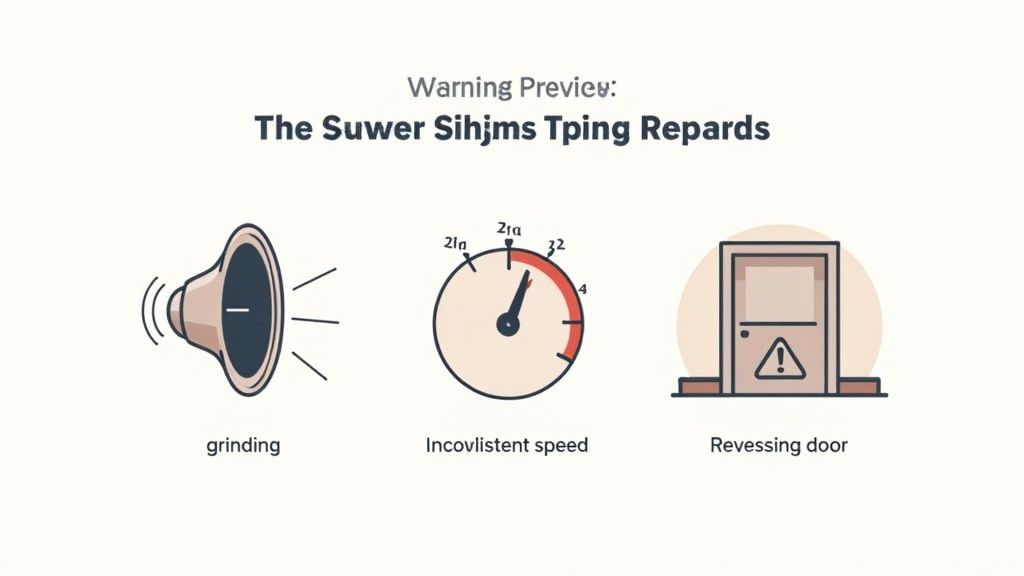
Alt text: Icons showing warning signs for a commercial garage door opener replacement: grinding gears, inconsistent speed, and reversing.
Unmistakable Operational Symptoms
Your opener is always communicating its health through sound and motion. You just have to know what to listen for. Any new or unusual noises are often the first hint of internal wear and tear.
- Grinding or Straining Sounds: A healthy opener has a consistent, steady hum. If you start hearing grinding, squealing, or straining noises, it’s a red flag. This often points to worn-out gears, a failing motor, or poor lubrication, forcing the entire unit to work much harder than it should.
- Inconsistent or Slowed Speed: If your door hesitates, moves slower than it used to, or seems to shudder on its way up or down, the motor or drive mechanism is likely failing. That inconsistency isn’t just inefficient; it’s a safety concern.
- Erratic Reversing: Sure, a door that reverses for no clear reason might just have a blocked safety sensor. But it can also signal a much bigger problem: a failing logic board. That’s the opener’s “brain,” and when it goes, the whole system is compromised.
Think about it in real terms. A loading dock door that strains to open creates a small delay for every single truck. Multiply that by dozens of cycles a day, and you’re looking at a significant loss in productivity and a real increase in operational costs.
The Hidden Costs of Ignoring the Signs
These symptoms are far more than minor annoyances. They represent direct threats to your budget, your safety protocols, and your operational uptime. An aging opener brings along less obvious, but equally damaging, consequences.
An older, inefficient motor can consume significantly more electricity than a modern unit, leading to a steady increase in your facility’s utility bills. This slow drain on your budget often goes unnoticed until the costs have accumulated over months or even years.
On top of that, trying to find parts for obsolete models turns into a costly and time-consuming scavenger hunt. When a part fails, you could be facing extended downtime while a technician tries to track down a compatible component—if one can even be found. It’s a common headache for facilities, much like how older homes eventually need modern electrical or plumbing upgrades. Industry data shows that 70% of calls to local pros now involve openers, with replacement costs for modern motors ranging from $250 to $950 as older homes are updated. You can learn more about this trend in this insightful industry report.
Safety and Compliance Risks
Maybe the most critical reason to upgrade is safety. Older openers might not meet current UL 325 safety standards, which mandate features like monitored photo-eyes and reliable reversing mechanisms. Operating a non-compliant opener exposes your business to huge liability if an accident happens. A timely replacement ensures your facility is protected by the latest safety technology.
A proactive upgrade isn’t just a maintenance task; it’s a smart business decision. By catching these signs early, you can schedule a replacement with one of our expert technicians, dodging costly emergency repairs and keeping your operations running smoothly and safely.
Ready to assess your current opener’s health? Contact Wilcox Door Service today to schedule a professional inspection and get a clear picture of your system’s performance.
Choosing the Right Commercial Opener for Your Operations
Picking the right commercial opener isn’t just about motor strength. It’s about matching the machine’s mechanics and duty cycle to the real-world rhythm of your facility. Get it wrong, and you’re setting yourself up for premature breakdowns and painful, costly downtime. This is your practical guide to understanding the different types of operators we work with every day, ensuring you get the perfect fit.
We’ll break down what each type of operator is built for, using simple, straightforward terms. Just think about the difference between a zippy, lightweight door at a car wash versus a heavy, insulated industrial door at a cold storage warehouse. Each one needs a totally different kind of muscle to automate it. One size definitely does not fit all here.
Wilcox Commercial Opener Options
Each operator is engineered for a specific job, taking into account things like the door’s size, its weight, how often it needs to open and close, and the physical space available around the opening. At Wilcox, we offer a range of industrial-grade operators to meet these diverse needs.
- Trolley Operators: These look a lot like the opener in your home garage, just built tough for commercial use. A motor powers a trolley along an overhead rail to pull the door open or push it closed. They’re the go-to for standard sectional doors where you have plenty of room overhead. For instance, they are perfect for a standard loading dock door in a low-traffic warehouse.
- Hoist Operators: Built for the heavyweights. Hoist operators use a powerful chain and sprocket system to lift massive industrial doors. Their key feature is a floor-level chain hoist for manual operation during a power outage—an absolute must-have for keeping your business running when the lights go out. These are essential for large, heavy doors found in manufacturing plants or municipal vehicle bays.
- Jackshaft Operators: These clever units mount right on the wall beside the garage door, turning the torsion bar directly. This design is a lifesaver in facilities with high ceilings, obstructions, or lift systems that get in the way of a standard trolley rail. They are an incredibly versatile choice for automotive service centres or facilities with car lifts that need clear overhead space.
- Slide Operators: Just like the name implies, these are for doors that move sideways. They use a chain drive to pull sliding doors or gates open and closed horizontally, making them essential for security gates and large single-panel sliding doors common in secure compounds or specialized industrial settings.
For buildings with unique space challenges, jackshaft openers are a game-changer. By getting rid of the overhead rails, they free up priceless vertical space that can be used for tall vehicles, conveyor systems, or high-stack storage. We dive deeper into their advantages in our guide to understanding jackshaft garage door openers.
How to Select the Right Operator for Your Facility
Making the smart choice comes down to taking a hard look at your daily operations and the physical layout of your space. A loading dock door that cycles hundreds of times a day has completely different demands than a fire door that only opens in an emergency. Factors like door weight, cycle frequency, and available clearance are non-negotiable.
The single most important factor is the operator’s duty cycle—how many times it can open and close per hour without burning itself out. If you install a light-duty operator in a high-traffic spot, it’s going to fail fast, forcing an expensive and completely avoidable garage door opener replacement.
To help you sort through the options, we’ve put together a simple comparison based on the factors that matter most to any facility manager.
Commercial Garage Door Opener Comparison
This table breaks down the primary commercial opener types to help you match the right technology to your operational needs.
| Opener Type | Best For | Key Advantage | Consideration |
|---|---|---|---|
| Trolley | Standard sectional overhead doors in low to medium-traffic areas. | Cost-effective and reliable for standard applications. | Requires significant overhead clearance for the rail system. |
| Hoist | Heavy, large industrial doors, including vertically-lifting and high-lift doors. | Provides exceptional lifting power and a manual override for power outages. | Generally slower operation speed compared to other types. |
| Jackshaft | Facilities with limited overhead space or high-lift track systems. | Frees up ceiling space and offers a clean, efficient installation. | The wall next to the door must have sufficient structural support. |
| Slide | Horizontal sliding doors, rolling grilles, and security gates. | Specifically engineered for sideways motion and heavy-duty security. | Only suitable for sliding applications, not for overhead doors. |
At the end of the day, a garage door opener replacement is a chance to finally align your equipment with your operational reality. A careful review of these factors, with guidance from our experienced team, makes sure your investment delivers the performance and reliability your business truly depends on.
The Business Case for a Modern Opener
Thinking about upgrading your commercial opener? It’s far more than just another repair on the maintenance list; it’s a strategic investment that delivers a clear, measurable return for your business. While the technical specs are important, the real payoff comes from the tangible advantages a modern system brings to your facility. A new garage door opener replacement is the difference between reacting to problems and proactively boosting performance.
This shift has a direct impact on your bottom line. We’re not just talking about the cost of a single breakdown. A modern, high-efficiency motor can genuinely lower your monthly utility bills, contributing to a greener and more cost-effective operation.
Maximizing Uptime and Operational Flow
Every minute a loading dock door is stuck, your business is losing money. It’s that simple. A reliable new operator is one of the best forms of insurance you can get against costly disruptions to your shipping and receiving schedules. An unexpected failure creates bottlenecks that can bring your entire workflow to a screeching halt, delaying deliveries and frustrating staff.
A planned upgrade, on the other hand, puts you back in control. Instead of scrambling for an emergency fix at the worst possible time, you can schedule the replacement during off-peak hours. This ensures a seamless transition that keeps your operations moving without a single hiccup. It’s the difference between an operational crisis and a smart business decision.
The infographic below can help you visualize the key decision points when selecting a new opener, guiding you toward a choice that actually fits your specific operational demands.

Alt text: A flowchart guide for commercial garage door opener replacement, factoring in door weight and usage frequency.
This decision tree cuts through the noise by focusing on the critical factors like door weight and how often it’s used, ensuring the opener you choose can handle the daily grind of your facility.
Enhancing Safety and Reducing Liability
Beyond just keeping things moving, a modern opener is a cornerstone of a safer workplace. Today’s systems come equipped with advanced safety features—like monitored photo-eyes and sophisticated entrapment protection devices—that are lightyears ahead of older models. These aren’t just nice-to-haves; they’re essential for meeting current safety standards.
Investing in a modern, compliant opener is one of the most effective ways to reduce your facility’s liability. By ensuring your equipment meets or exceeds safety regulations, you create a safer environment for your team and protect your business from potential legal and financial risks associated with workplace accidents.
This investment pays dividends in other ways, too. In California’s competitive real estate market, a modern and reliable commercial door system adds significant value. The Pacific region, including California, sees an incredible 251% return on investment for garage door projects—blowing the national average out of the water. A modern opener that prevents common issues like sticking or shaking boosts both safety and curb appeal, making any property more attractive. You can find more insights on this powerful return in the 2024 Cost vs. Value report.
Ultimately, a garage door opener replacement delivers a powerful return on investment through better reliability, energy savings, and enhanced safety. It’s a calculated move that strengthens your operations and reinforces your commitment to a secure, efficient facility.
By partnering with Wilcox Door Service, you get expert guidance to ensure your new opener is perfectly suited to your operational needs. Our commitment to “Respected Partners, Reliable Service” means we help you make an investment that pays off for years to come.
Ready to explore how a modern opener can benefit your facility? Contact us today for a professional assessment and start building your business case for an upgrade.
Understanding the True Cost of Your Investment
When you’re planning a commercial garage door opener replacement, just looking at the initial price tag is like seeing only the tip of the iceberg. A truly smart investment means taking a deeper look at the Total Cost of Ownership (TCO)—the complete financial picture over the equipment’s entire service life. This way of thinking helps you see the real cost and justify a high-quality system that delivers far better long-term value.
The upfront investment, which covers the operator itself and professional installation, is just the starting point. It’s the long-term, often hidden, expenses that really show whether your decision was cost-effective. Things like energy consumption, scheduled maintenance, and warranty coverage will be shaping your budget for years to come.
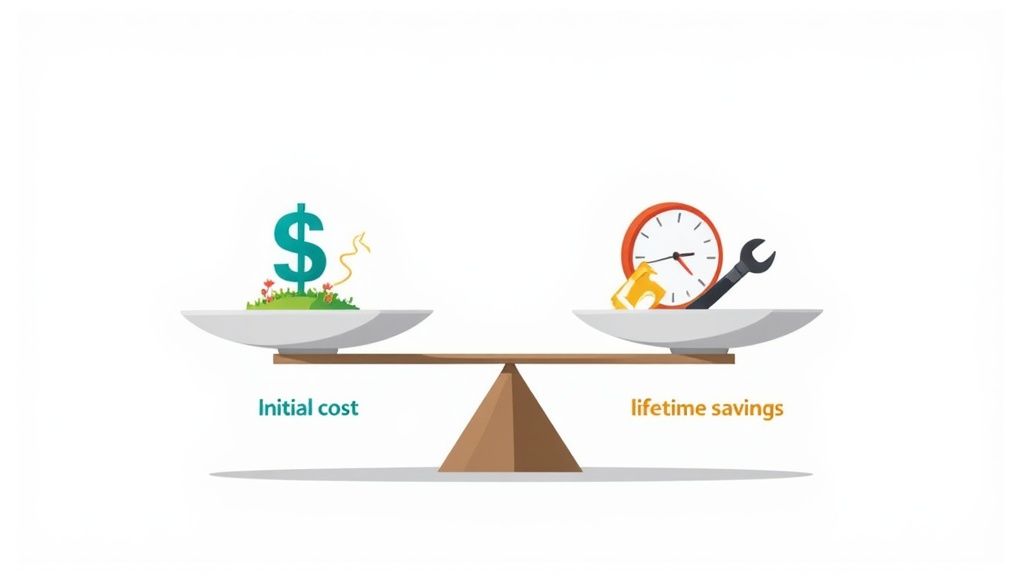
Alt text: A scale weighing initial cost vs. lifetime savings, illustrating the value of a quality garage door opener replacement.
Beyond the Initial Purchase Price
Thinking in terms of TCO shifts the conversation from, “How much does it cost today?” to “How much will this save us over the next decade?” A cheaper, lower-quality opener might feel like a win at first, but it often ends up costing you more in operational headaches and expenses down the road.
Think about these long-term financial factors:
- Energy Efficiency: Modern, high-efficiency motors use a lot less electricity. Over a 10- or 15-year lifespan, those small daily savings really add up, making a noticeable dent in your facility’s utility bills.
- Maintenance and Repairs: A tough, well-engineered operator just needs less babysitting—and less costly maintenance. It’s built to handle the daily grind of a busy commercial environment, which means fewer emergency repair calls interrupting your workflow.
- Operational Uptime: The biggest hidden cost of a cheap opener is downtime. Every single hour a loading dock is out of service because of a failed opener, your business is losing money. Reliability is a direct contributor to your bottom line.
Once you see how these pieces fit together, it’s much easier to make the case for investing in a system that’s truly built to last. For a deeper dive into this financial framework, check out our guide on reducing the total cost of ownership for your facility’s doors.
The Real Cost of Labour and Longevity
Installation and labour costs are a big part of any replacement project. For instance, in some of North America’s busiest commercial hubs, the average cost to replace a commercial garage door opener can run anywhere from $217 to $537. A big chunk of that is professional labour, with local installers often charging $65 to $85 per hour. A typical four-hour job can tack on $260 to $340 just for the skilled work.
The true value of a premium garage door opener isn’t just in its day-to-day performance, but in its longevity. Investing in a durable, high-cycle model means you won’t be repeating this whole expensive exercise every few years, ultimately saving you serious capital and installation costs over time.
This kind of analysis lets you move past the sticker price. When you can show how a higher-quality system leads to fewer emergency calls, more consistent operations, and better overall value, you can confidently invest in a solution that actually supports your business goals. It’s a core part of our “Respected Partners, Reliable Service” philosophy—giving you solutions that aren’t just effective, but financially smart for the long haul.
Partnering with Wilcox for a Seamless Replacement Process
Picking out the right equipment is only half the job; the real success comes from partnering with an installation team that makes sure your investment actually pays off. At Wilcox Door Service, our entire garage door opener replacement process is built on a simple promise: “Respected Partners, Reliable Service.” We know that for any commercial facility, a new installation isn’t just about getting something that works—it needs to be a smooth, efficient process that fits perfectly into your day-to-day operations.
We don’t start by showing you a product catalogue. We start with a conversation and a thorough visit to your site. We need to understand your world. How many times a day does your busiest door cycle? What unique challenges does your environment present, like corrosive materials or extreme temperatures? Answering these questions lets us recommend a solution that’s genuinely right for you, not just a generic box off the shelf.
Our Proven Installation Methodology
A great replacement comes down to careful planning and expert execution. Our certified technicians aren’t just installers; they’re career professionals who know how to navigate the complexities of commercial and industrial settings. They bring a level of precision and safety that minimizes disruption to your business and maximizes the long-term reliability of your new equipment.
Our installation process is designed to be clear and efficient:
- Comprehensive Site Evaluation: First, we dive deep into your current setup, door specs, and workflow. This helps us pinpoint the ideal operator and identify any structural or electrical tweaks needed for a perfect fit.
- Safety-First Execution: Our team establishes a secure work zone, follows all safety protocols, and ensures the entire installation is fully compliant with current standards like UL 325.
- Precision Installation and Calibration: We professionally mount the new operator, connect all the wiring, and meticulously calibrate the whole system. This includes setting travel limits, aligning safety sensors, and testing reversing mechanisms for flawless performance right from day one.
- Operational Hand-Off and Training: We don’t just pack up and leave when the job is done. We walk your team through the new system, explain key features, and answer every question to make sure your staff feels confident and capable.
This structured approach guarantees every installation is done correctly, safely, and with the least possible impact on your productivity.
Long-Term Support Beyond Installation
Our partnership doesn’t stop once the new opener is running. We’re committed to protecting your investment for its entire lifecycle. Right after installation, we provide comprehensive support and all the documentation you need to manage your new asset effectively. But the real value is in our proactive support.
A new garage door opener is a critical piece of equipment. Protecting it with a planned maintenance program is the single most effective way to prevent unexpected downtime, extend its operational life, and ensure it continues to perform safely and efficiently for years to come.
We believe in building relationships that last. By scheduling regular check-ups and service, we can catch and fix minor issues before they turn into expensive emergency repairs. This forward-thinking approach is the cornerstone of our service philosophy and a key reason why so many facilities trust us as their long-term partner. The dedication of our technicians is what truly sets us apart, a commitment you can learn more about by meeting the experts in our service department spotlight.
Choosing Wilcox means choosing a partner dedicated to your facility’s success. Let’s start the conversation about your next garage door opener replacement.
Ready to ensure your facility’s access points are in expert hands? Contact Wilcox Door Service today to schedule a professional assessment and discover the right solution for your operations.
Still Have Questions About Commercial Opener Replacement?
Making the final call on a commercial garage door opener replacement means sorting through a lot of details. To help clear things up, here are a few of the most common questions we hear from facility managers just like you.
How Long Should a Commercial Garage Door Opener Last?
The lifespan of a commercial opener really comes down to its duty cycle, the environment it operates in, and how well it’s been maintained. A well-cared-for unit in a moderate-use setting can easily last 10 to 20 years.
But in a high-volume facility like a distribution centre, where doors are cycling hundreds of times a day, its effective life is going to be on the lower end of that range. Hands down, consistent, planned maintenance is the single best way to get the most out of your opener and stop unexpected failures from shutting down your operations.
Can I Just Add Smart Features to My Old Opener?
It’s tempting to think you can just bolt on some smart technology to an older operator, but it’s rarely the most reliable or cost-effective solution. Trying to pair modern electronics with an aging motor and worn-out mechanical parts is a recipe for compatibility issues and unpredictable performance.
Even more importantly, a simple retrofit probably won’t bring the entire system up to current UL 325 safety standards. A complete garage door opener replacement ensures every single component—from the motor right down to the safety sensors—is engineered to work together perfectly. That gives you far better safety, reliability, and peace of mind.
What Is a Duty Cycle and Why Does It Matter So Much?
Think of an opener’s duty cycle as its operational stamina. It’s a technical rating that tells you how many times a door can open and close within a set period (like an hour or a day) before it overheats and starts to fail prematurely.
In a commercial setting, this rating is non-negotiable. A light-duty opener might be rated for only 10-15 cycles a day, while a heavy-duty industrial operator is built for non-stop, continuous use. Matching the duty cycle to your facility’s traffic is the most critical factor in preventing burnout and making sure your new opener delivers long-term, dependable service.
Choosing an operator with the wrong duty cycle is a guaranteed way to end up with frequent breakdowns and another replacement far sooner than you planned. Our experts help you analyze your operational needs to select an opener with the right stamina for the job, ensuring your investment is built to last.
A reliable and efficient access system is the backbone of any productive facility. At Wilcox Door Service, we provide the expert guidance and professional installation you need to ensure your commercial garage door opener replacement meets your operational demands and boosts your facility’s safety and efficiency.
Ready to find the right solution? Explore our commercial and industrial door services to learn how we can support your business.