


Can you turn a normal door into a fire door in Canada? Usually no. When a fire-rated opening is required, the compliant answer is normally a tested assembly rated for 45 minutes, 60 minutes, or 90 minutes, not a standard door with added coating or new hardware.
That gap matters because many people focus on the door leaf and miss the actual code issue. In Canadian practice, fire protection is judged as a complete assembly made up of the door, frame, hardware, seals, glazing where applicable, and installation. If one part is wrong, the opening may no longer perform as intended in a fire.
Facility managers run into this all the time in corridors, service rooms, stair enclosures, warehouses, and mixed-use commercial buildings. A maintenance team sees a wood door, adds a closer, swaps some hinges, maybe applies an intumescent product, and assumes it's now “fire rated.” That's where projects drift into risk. A life safety opening isn't close enough if it fails to close, latch, or hold its shape under heat.
On the topic of can you turn a normal door into a fire door, the Canadian answer is stricter than much of the generic online advice. The usual path to compliance is replacement with a labelled, code-appropriate assembly that can be documented, inspected, and maintained over time. That's the standard facility teams should work from if they want a safe building and a clean conversation with the authority having jurisdiction.
Meta description: Can you turn a normal door into a fire door in Canada? Learn when retrofit may work, why it usually doesn't, and what code-compliant facility managers should do.
The Short Answer and The Important 'Why'
The practical answer for Canadian facilities is simple. A normal door may only be adaptable in limited, tested cases, but the default compliance path is replacement with a labelled fire door assembly, because the NBCC framework expects a tested and listed system.
That distinction is where most misunderstandings start. A fire door assembly is not just a door slab with a product applied to its face. It is the full opening working as one unit under fire conditions, including the frame, hinges, latch, closer, glazing, seals, and the way the assembly meets the surrounding wall.
What makes a standard door different
A standard interior door is built for privacy, traffic control, or sound separation. It is not necessarily built to stay stable when exposed to heat. Many regular hollow-core or lightweight doors can warp, twist, delaminate, or leave gaps too quickly to function as a life safety barrier.
A rated assembly is different by design. It's built, tested, and installed so the opening remains closed and functional long enough to do its job in the building's fire strategy.
Practical rule: If the code requires a rated opening, start by asking for the assembly rating and label evidence, not for a coating or hardware shortcut.
Why good enough fails in fire protection
In day-to-day facility work, “good enough” can sometimes keep operations moving until a proper repair is scheduled. Fire doors are not in that category. If a corridor door doesn't self-close, if the latch doesn't engage, or if the frame is damaged, the opening can fail exactly when the building needs it most.
That's why the conversation in Canada should always begin with these questions:
- What rating is required here: The opening may need 45 minutes, 60 minutes, or 90 minutes depending on its application.
- Is there a label on the door and frame: Without that trail, proving compliance gets harder.
- Has the opening been modified: Even well-meaning field changes can create problems if they aren't part of a tested arrangement.
For facility managers, the takeaway is operational as much as technical. A fire door protects egress routes, compartments, and protected openings. If you need one, you need a certified fire door.
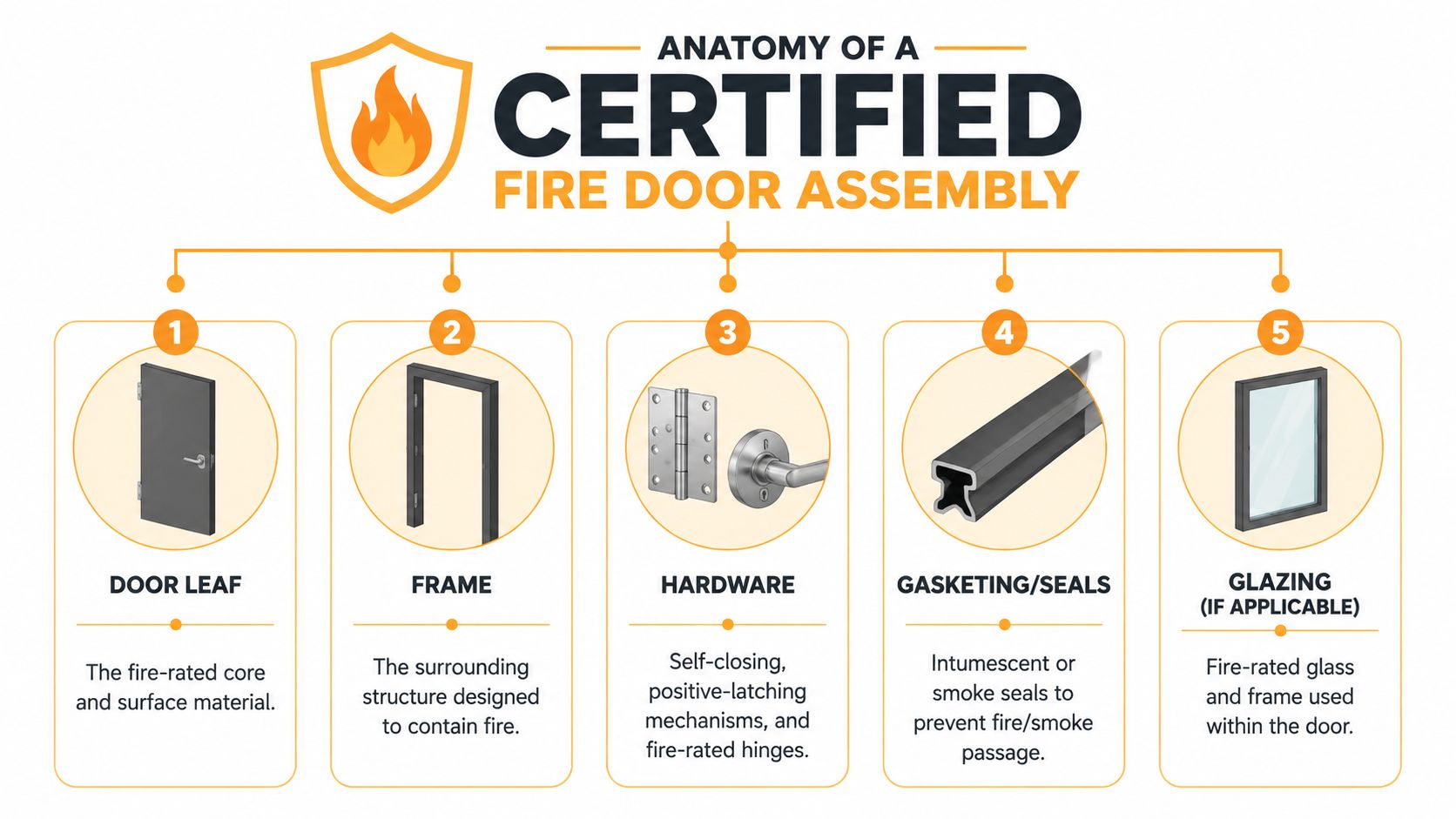
Anatomy of a Certified Fire Door Assembly
A certified opening works like a chain. The rating only holds if every link does its job.
The door leaf is only one part
The door leaf is the swinging panel typically noticed first. But even if that panel is substantial timber or another fire-rated construction, it still doesn't make the opening compliant by itself. Fire performance depends on whether that leaf was tested with the matching components around it.
The frame matters just as much. If the frame is bent, loose, damaged, or incompatible with the leaf, the opening may not control fire or smoke as intended. In older buildings, that's often where retrofit ideas break down. The door may look serviceable, while the frame condition tells a different story.
For facilities reviewing replacement options, steel fire rated doors are one common route when a full listed assembly is needed for commercial or industrial use.
Hardware has to perform under pressure
The hardware package is where many openings succeed or fail in service.
- Closer: The door must return to the closed position reliably.
- Latch: The door must positively latch, not bounce back or sit ajar.
- Hinges and pivots: These have to support the leaf without sagging or binding.
- Coordinator or sequence hardware where required: On pairs, the closing sequence has to work correctly.
A strong-looking door with weak or mismatched hardware is still a weak opening. In the field, this is a familiar problem in busy warehouse corridors and service areas where carts strike the frame, closers get disabled, or latch alignment drifts over time.
Later in the section, this video gives a useful visual overview of fire door function in practice.
Seals and glazing are not accessories
Intumescent seals expand under heat. Smoke seals help limit leakage. If the assembly includes glass, the glazing and glazing frame must also be part of a rated arrangement.
That system view matters beyond doors. Building teams dealing with penetrations in ceilings face a similar coordination problem, which is why resources like choosing the right fire rated downlights are useful. The principle is the same. Fire protection depends on tested components working together, not on isolated upgrades that look right on paper.
A door opening can look solid in normal use and still be the weak point in a fire separation.
Understanding Canadian Fire Codes and Labels
Canadian compliance is strict for a reason. Fire door practice developed around testing, labelling, inspection, and maintenance, not around ad hoc site modifications, and modern guidance treats fire doors as managed life-safety assets rather than one-time construction items.

What facility managers need to know
The National Building Code of Canada provides the framework, while provinces and local authorities apply and enforce requirements through their own processes. In practical terms, your local authority having jurisdiction, often called the AHJ, decides what documentation and evidence will satisfy approval for a specific opening.
The key document on the opening itself is the label. That label connects the installed door or frame to a tested product and a known rating. If a facility team removes the label, paints over it, or alters the assembly beyond what the listing permits, proving compliance becomes much harder.
That's why “it looks upgraded” doesn't carry much weight. The question isn't whether someone did tidy work. The question is whether the opening can be shown to meet the required listing and rating for that location.
Ratings are application-specific
Canadian practice commonly uses 30-minute, 45-minute, 60-minute, and 90-minute assemblies, depending on where the opening sits in the fire separation and what the code requires for that wall or barrier. A warehouse utility room next to an exit route and a corridor door inside an office area don't always demand the same protection.
For facilities with multiple sites, code variation is one reason generic online advice causes trouble. Even outside Canada, building teams have to track jurisdiction-specific changes. A broader example is this NC building code update 2026 homeowners guide, which shows how location changes the compliance conversation. In Canada, that same principle applies with even more urgency on fire doors because labels, listings, and inspections sit so close to life safety.
For a plain-language overview of ratings and applications, fire rating door information is useful as a starting point before you review a specific opening with your installer or inspector.
If the label is missing and the opening has been modified, the burden shifts to documentation, evidence, and AHJ acceptance. That's not a position most facility managers want to be in during an audit or incident review.
Retrofit Methods and Their Strict Limitations
There are upgrade products on the market. That's the part many articles stop at. The hard part is knowing when those products are relevant and when they create false confidence.
A retrofit can only be defended if the existing door is the right type of construction and the full opening can be upgraded as a tested or assessed assembly. Guidance consistently warns that thin, hollow-core, and lightweight doors are generally unsuitable because they deform too quickly and lose the seal line under fire exposure.
What retrofit products can and cannot do
You may see products such as intumescent paint, intumescent varnish, edge seals, smoke seals, upgraded hinges, and self-closing hardware. Those products may have a place, but they do not automatically convert a regular opening into a code-compliant fire door.
Their success depends on conditions such as:
- Base door construction: A suitable timber leaf may be considered. A hollow-core office door usually is not a serious candidate.
- Frame condition: A damaged or oversized frame can defeat the upgrade before the door ever swings.
- Glazing details: Unprotected vision panels can be a deal-breaker.
- Hardware compatibility: The closer and latch have to work together every time.
Clearance and latching are non-negotiable
For an upgrade to be technically defensible, it must preserve the assembly's tested behaviour. Guidance on fire door upgrades notes that door-to-frame gaps typically need to stay within a 2 mm to 4 mm range to help control smoke and flame leakage, and the door must also be self-closing and positively latched according to this fire door upgrade guidance.
That one point eliminates many field “upgrades.” In older facilities, the door may drag on the floor, spring open off the latch, or sit with inconsistent margins along the frame. No coating fixes poor geometry.
A fire-rated opening doesn't pass because the leaf looks heavier. It passes because the assembly closes, latches, seals, and stays stable within its tested limits.
Standard door vs upgraded door vs certified assembly
| Feature | Standard Interior Door | Attempted Upgrade | Certified Fire Door Assembly |
|---|---|---|---|
| Construction basis | Built for everyday use | Depends on whether the existing door is suitable timber construction | Built and listed as a rated assembly |
| Fire rating evidence | None | May be unclear unless tied to tested evidence | Labelled and tied to tested rating |
| Frame compatibility | Often unknown | Must be evaluated with the door | Part of the assembly |
| Gap control | Variable | Must be kept within tested tolerances | Designed and installed to assembly requirements |
| Closing action | May not have a closer | Must self-close reliably | Required as part of assembly function |
| Latching | May be privacy or passage hardware | Must positively latch | Positive latching is integral |
| Glazing and seals | Often non-rated or absent | Can be a limiting factor | Specified as compatible rated components |
| AHJ acceptance | Unlikely for rated opening | Depends on evidence and listing | Most straightforward path to compliance |
The trade-off is straightforward. Retrofit may be possible in narrow cases, but replacement is usually cleaner, easier to document, and less risky for the owner.
The Ongoing Duty of Inspection and Maintenance
Even a properly installed fire door can drift out of compliance through ordinary use. Forklift vibration, building settlement, repeated traffic, poor repairs, missing screws, painted-over labels, and disabled closers all show up in the field. That's why a fire door should be treated as an active life safety asset, not a passive building finish.
One of the biggest mistakes in this discussion is assuming the job ends once a new opening is installed. It doesn't. Modifying a door can void its certification unless the retrofit is part of a tested listing, and Canadian code compliance relies on certified ratings rather than workmanship alone, as outlined in this Canadian fire door compliance discussion.
What ongoing maintenance actually includes
For a facility manager, inspection isn't just a quick glance down the corridor. It means checking whether the door still behaves like a rated assembly.
- Operate the door fully: It should close from the open position without sticking.
- Watch the latch engage: A door that nearly closes is not enough.
- Inspect the frame and hinges: Sagging, rubbing, and loose fasteners all matter.
- Check seals and glazing: Missing or damaged components can compromise the opening.
- Confirm no improper alterations: Field cuts, added holes, or non-compliant hardware can create issues.
In industrial settings, this maintenance mindset extends to rolling fire doors as well. Loading dock and service openings need scheduled testing because those systems often stay open for operations and only perform their life safety role during an alarm or release event. For facilities with rolling fire doors, fire door drop testing is one service option used to verify performance under controlled conditions.
Why this matters in real buildings
In a distribution centre, a fire door may sit in the path of pallet traffic all day. In a healthcare or government site, staff may wedge a door open for convenience. In a commercial tower, a tenant fit-out may introduce hardware changes no one documents properly.
Those are ordinary operational habits. They also create ordinary paths to non-compliance.
Decision Checklist and Your Next Steps
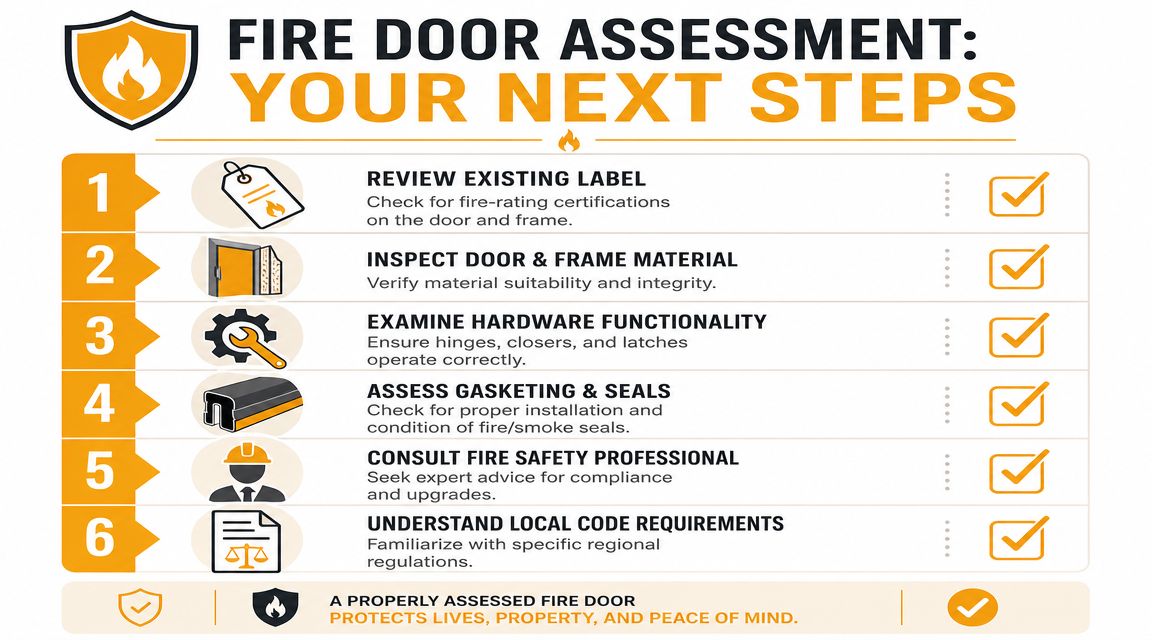
If you're deciding whether an existing opening can stay, be upgraded, or needs replacement, use a practical filter. Don't start with the finish. Start with evidence, condition, and code need.
Ask these questions before approving any work
Is there a visible label on the door and frame
If not, you may have a documentation problem before you even assess condition.What rating is required at this location
The answer depends on the fire separation around the opening, not on what's currently installed.What is the door made of
A suitable timber leaf may be considered in limited situations. Hollow-core and lightweight doors are usually poor candidates.Does it close and latch every time
If it doesn't self-close and positively latch, stop there. That needs correction before anything else.Are the gaps controlled and consistent
Oversized or uneven clearances often tell you the assembly won't perform as required.Has anyone modified the opening
Extra holes, changed hardware, altered glazing, field cuts, and missing labels all affect the compliance picture.
The responsible conclusion
If the opening is in a code-required fire separation, the safest default is to assume replacement with a labelled assembly until a qualified professional confirms otherwise. That approach avoids the common trap of spending money on an upgrade that still won't satisfy the AHJ.
Experienced commercial door contractors, inspectors, and building officials add value. They can review the opening as a system, not just as a door leaf.
For most Canadian facility teams, that's the answer to can you turn a normal door into a fire door. Sometimes, in tightly limited conditions, an upgrade may be possible. Most of the time, the compliant path is a proper rated assembly that can be inspected, maintained, and defended on paper.
If you need help assessing an existing opening, planning a replacement, or scheduling testing for rated doors, contact Wilcox Door Service Inc.. Their team supports commercial and industrial facilities across Canada with code-focused door service, inspections, and fire door solutions that align with the brand promise of Respected Partners, Reliable Service.