


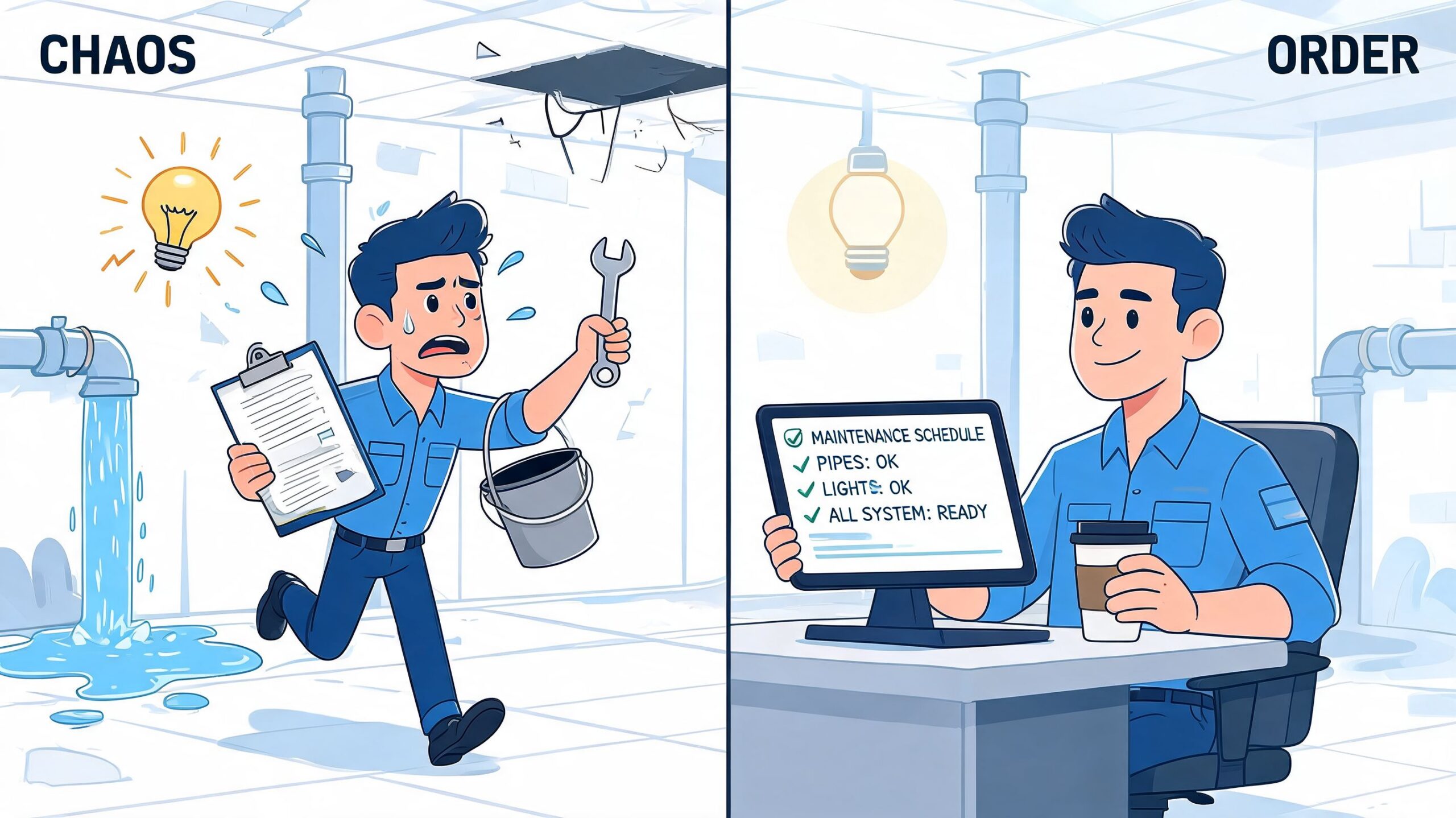
A lot of facility managers live in one of two modes.
In the first, the radio never stops. A dock leveler is down before the morning trucks arrive. An overhead door starts jerking halfway open. A fire door inspection is coming up, but the paperwork is scattered across emails and service slips. The day becomes a chain of urgent decisions.
In the second, the same building runs with fewer surprises. Service visits are scheduled. Known wear points are tracked. Loading dock equipment, operators, seals, and access systems get attention before they interrupt operations. The manager still deals with problems, but not every problem becomes an emergency.
That difference is what facility maintenance services are really about. They're not just repairs. They're the systems, inspections, service routines, records, and response plans that keep a building safe, usable, and predictable. For warehouses, plants, airports, healthcare sites, and multi-site portfolios, that matters most at critical access points like commercial doors and loading docks, because those assets directly affect flow, safety, security, and energy control.
The Foundation of a Smoothly Run Facility
A smooth facility doesn't happen by luck. Someone has identified which assets matter most, how they fail, how often they should be inspected, and who responds when something goes wrong. That's the practical foundation behind facility maintenance services.
At the broad market level, this isn't a small operational niche. The global facility management services market was valued at USD 1.75 trillion in 2024 and is projected to reach USD 2.33 trillion by 2033 according to Grand View Research's facility management services market report. That scale helps explain why more owners and operators now treat maintenance as part of business continuity, not just building upkeep.
What facility maintenance services include
In plain language, facility maintenance services are the organised work required to keep a site functioning properly. That usually includes:
- Routine inspections to catch wear before equipment fails
- Preventive service such as lubrication, adjustment, testing, and replacement of worn components
- Corrective repairs for issues discovered during inspections
- Emergency response when a critical asset fails unexpectedly
- Documentation and reporting so managers can track condition, risk, and recurring issues
For doors and docks, that can mean inspecting rollers, hinges, tracks, cables, weather seals, sensors, restraints, levelers, and operator settings. A small alignment issue on a high-cycle overhead door may seem minor at first, but it can turn into downtime if it isn't corrected early.
A facility usually feels “well run” when the maintenance work is mostly invisible. Trucks move, doors open, audits go smoothly, and staff don't have to think about the assets doing their job.
Why new facility managers often underestimate doors and docks
Many teams focus first on HVAC, lighting, plumbing, and janitorial scopes. Those are important. But critical access points often get treated as isolated equipment instead of operational infrastructure.
That's why practical training matters. A manager who understands how a dock leveler, truck restraint, high-speed door, and fire door each affect uptime and compliance will make better planning decisions. Wilcox offers facility maintenance classes for building teams that help bridge that gap between general FM knowledge and asset-specific action.
The Four Types of Facility Maintenance Explained
If facility maintenance services seem broad, it helps to break them into four common types. The easiest way to understand them is to compare them to car ownership.
You don't wait for every issue to become a breakdown. Some work is scheduled. Some is based on warning signs. Some repairs happen after an inspection finds a problem. And some happen when the vehicle stops working at the worst possible moment.
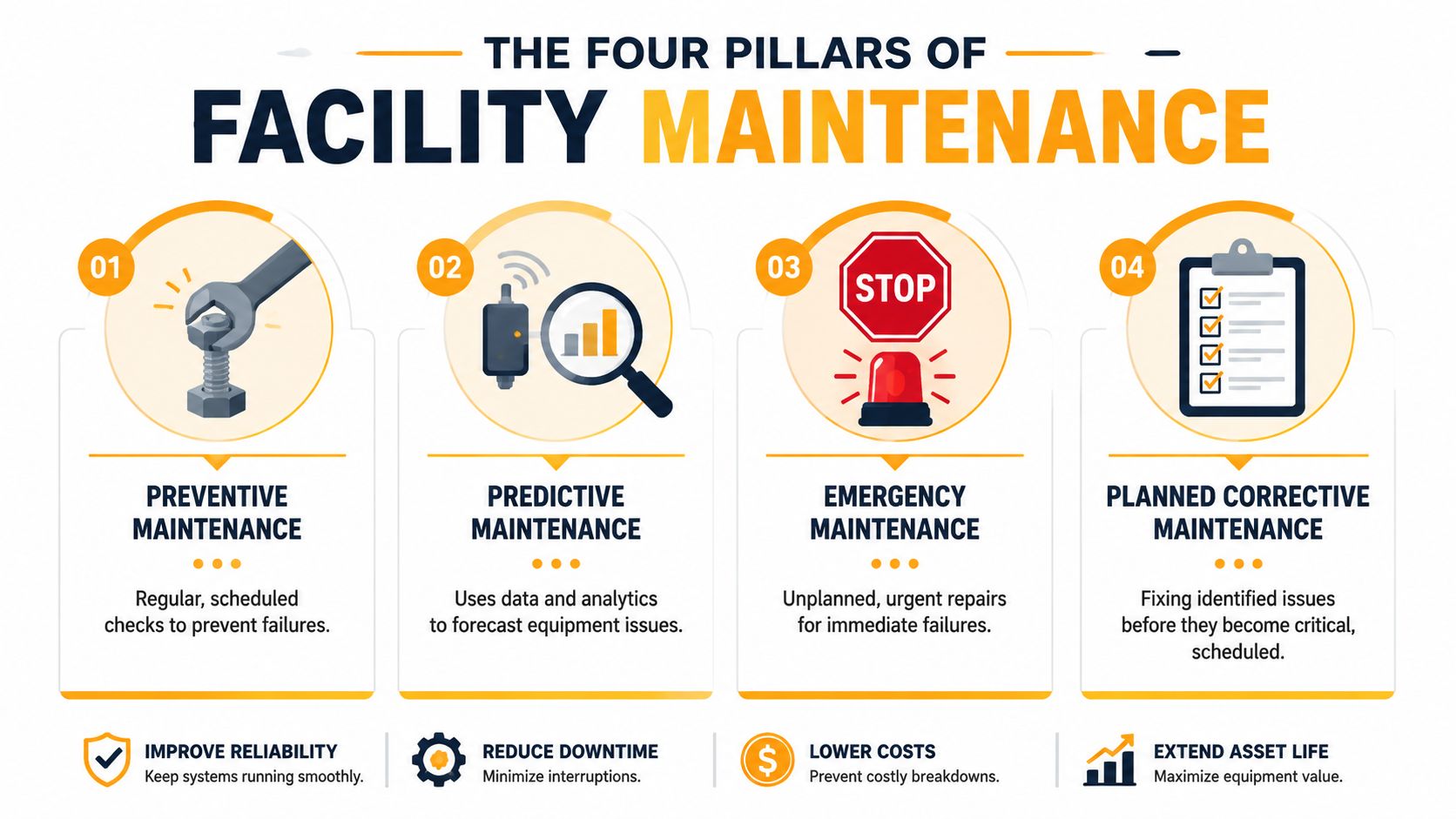
Comparison of Maintenance Service Types
| Maintenance Type | Goal | When It's Performed | Example (Overhead Door) |
|---|---|---|---|
| Preventive maintenance | Prevent failure before it starts | On a schedule | Lubricating moving parts, checking spring tension, inspecting track alignment |
| Predictive maintenance | Act on early warning signs | When data or condition shows change | Reviewing repeated sensor faults or unusual operator behaviour to investigate before failure |
| Emergency maintenance | Restore operation fast | After an unexpected breakdown | Repairing a door that won't open at the start of a shipping shift |
| Planned corrective maintenance | Fix a known issue in a controlled way | After inspection identifies a problem, before it becomes urgent | Replacing worn bottom seal or damaged rollers during a scheduled service window |
Preventive maintenance
This is the baseline maintenance that operations should establish before anything else. It is the functional equivalent of changing the oil, checking the brakes, and rotating the tires before a vehicle experiences mechanical trouble.
For a commercial door, preventive work may include tightening hardware, checking safety devices, inspecting cables, adjusting limits, testing auto-reverse functions, and reviewing weather seals. For loading docks, it can include inspecting leveler lips, hydraulic components, bumpers, restraints, and dock seals.
The value is simple. Planned work is less disruptive than failure response.
Predictive maintenance
Predictive maintenance uses condition and history to decide when attention is needed. In a car, the dashboard warning light is the clue. In a facility, the clues might be repeat service calls, a slower open cycle, recurring sensor misalignment, or unusual wear on the same component.
This approach depends on records. If one high-speed door keeps getting the same callout in winter, that pattern tells you something. It may point to environmental stress, traffic impact, or a part that's reaching the end of its useful life.
Practical rule: If the same asset keeps failing for similar reasons, stop treating each work order as a separate event. Look for the pattern.
Emergency maintenance
Emergency maintenance is break-fix work. It's necessary, but it's the most disruptive type because the asset has already failed.
A dock door that won't close when operations wrap up for the day can create a security problem. A failed operator on a busy shipping lane can delay trailers and staff. Emergency service has its place, but no facility wants it to become the default maintenance strategy.
Planned corrective maintenance
This type often confuses new managers because it sounds similar to preventive maintenance. The difference is timing.
Preventive maintenance is routine work performed whether a problem is visible or not. Planned corrective maintenance happens after someone has already found a problem, but before it has caused a shutdown. For example, a technician may discover a cracked hinge, a worn dock seal, or a damaged photo eye bracket during inspection and then schedule the repair during a controlled window.
That's still proactive. You're fixing a known defect on your terms, not during an operational crisis.
Benefits That Go Beyond the Fix
The strongest maintenance programs don't just fix equipment. They protect operations.
That matters most with doors and docks because these assets sit right where movement, people, product, vehicles, and weather all meet. When they fail, the consequences spread fast across the building.
Uptime and flow
In logistics-heavy environments, the operational cost of failure is often larger than the repair itself. As noted by Triangle Services' facilities services overview, a failed dock leveler or high-traffic industrial door can halt freight flow, compromise temperature control in cold storage, and create safety hazards.
That's why a loading dock should never be viewed as just another repair line item. If one leveler is down, trucks queue. If one fast-moving door sticks open, conditioned air escapes and internal traffic changes. If a restraint won't engage properly, the entire loading sequence becomes riskier.
Safety and compliance
Safety gains from maintenance are often quiet. Nothing dramatic happens, and that's the point.
A rolling fire door that drops and resets properly is doing exactly what it should. A pedestrian access door that latches correctly helps with building security. A dock plate that sits level and stable reduces trip and vehicle interface risks. Inspections, adjustments, and testing all reduce the chance that a known weakness turns into an incident.
Here are four practical ways maintenance adds value beyond the repair itself:
- Keeps shipping lanes moving: A properly serviced overhead door opens at the expected speed and closes reliably, so forklifts and trailers aren't delayed.
- Protects staff at transfer points: Dock equipment that's aligned and functioning properly supports safer loading and unloading.
- Reduces avoidable energy loss: Worn seals, damaged shelters, and doors that don't close fully let outside air into conditioned spaces.
- Supports audit readiness: Service records, inspection notes, and test documentation make it easier to show that critical assets were maintained.
If a facility depends on access points to move goods, control temperature, or secure the site, those access points deserve the same planning discipline as any other core system.
Budget control through fewer surprises
Reactive spending feels expensive because it arrives at the wrong time. It often interrupts labour, freight, tenant satisfaction, or production schedules, then adds repair cost on top.
Proactive maintenance changes the conversation. Instead of asking, “Why did this fail today?” managers can ask, “What do we know about this asset, and what's the most sensible next step?” That shift improves planning, even when budgets are tight.
How to Design a Proactive Maintenance Program
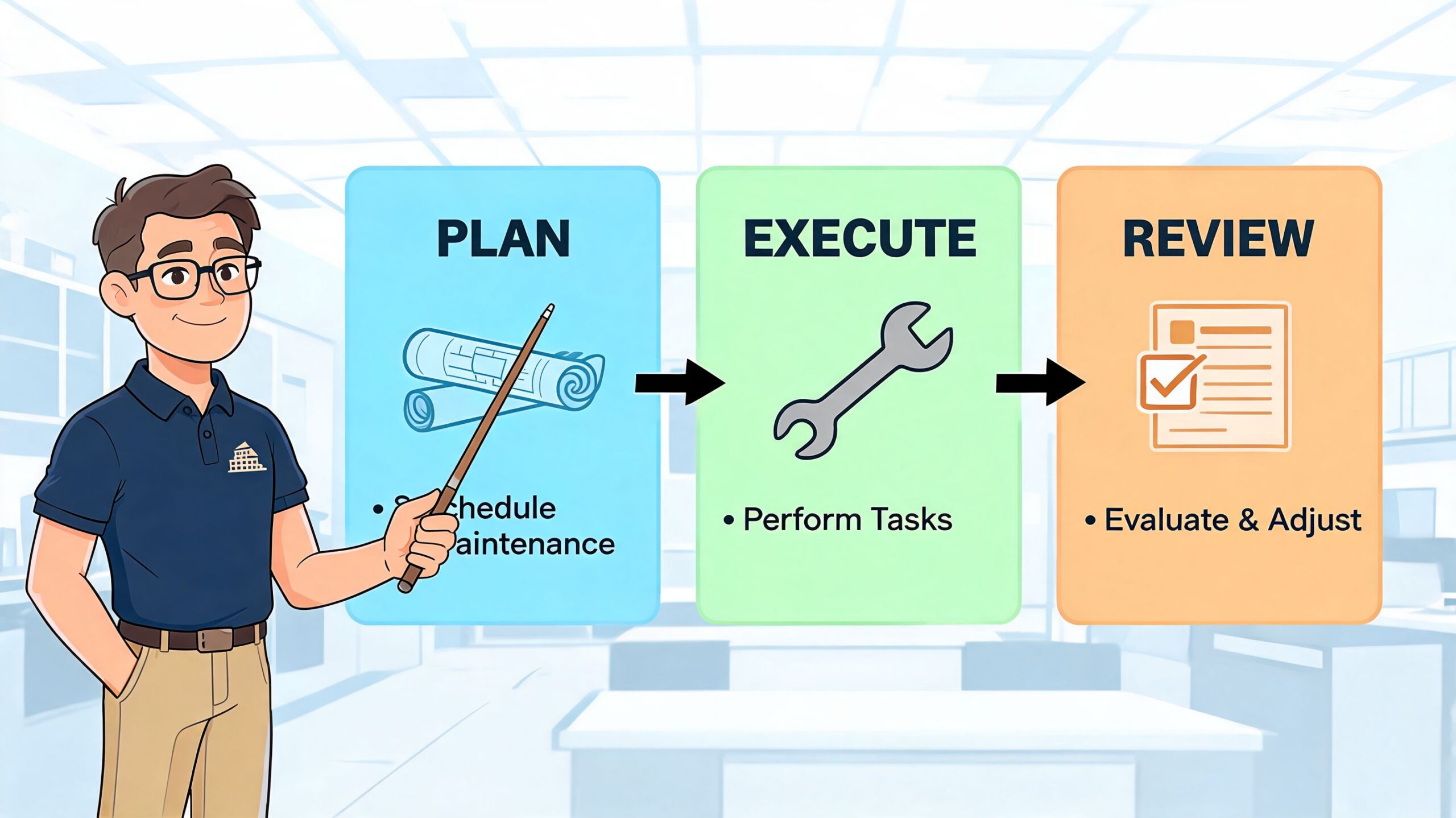
A proactive maintenance program doesn't have to start with complex software or a perfect asset database. Start with the assets that can hurt operations fastest if they fail.
In Canada, maintenance teams are being pushed to do more with the same resources. ASHE benchmarking notes that 22% of respondents reported managing increased square footage, which helps explain why planned inspections and preventive programs have become so important for budget control and stability in real operations, as outlined in ASHE's operations and maintenance benchmarks report.
Step one is build your asset list
You can't manage what you haven't listed. Create a basic register of the equipment that matters most.
For doors and docks, include the opening number or location, asset type, make if known, operating environment, and whether the opening is mission-critical. A main shipping door, a freezer opening, and a fire-rated opening shouldn't all sit in the same priority bucket.
A practical starter list often includes:
- Overhead and sectional doors
- High-speed fabric or rubber doors
- Rolling steel and fire doors
- Hydraulic or mechanical dock levelers
- Truck restraints
- Dock seals and shelters
- Operators, sensors, and access controls
Step two is rank assets by criticality
Criticality means, “How much trouble does this cause if it fails?”
A warehouse may tolerate a problem at a rarely used storage room door for a short time. It usually can't tolerate failure at the main receiving dock or a cold-storage high-speed door. The maintenance plan should reflect that difference.
Use simple questions:
- Does failure stop operations?
- Does failure create a safety or compliance issue?
- Does this asset face heavy cycles, impact, or weather exposure?
If the answer is yes to more than one, that asset should get tighter inspection intervals and faster follow-up on defects.
For teams building formal schedules, the benefits of a planned garage door maintenance program provide a useful model for how recurring service reduces breakdown risk and supports longer asset life.
Step three is budget for planned work, not just repairs
A common mistake is treating maintenance budget as an emergency fund. That keeps the site reactive.
A better approach is to separate routine inspection and service from major repair and replacement decisions. That lets you plan labour windows, reduce disruption, and identify recurring failure points earlier.
This walkthrough gives a practical visual of what that looks like in the field:
One option for specialised door and dock scopes is Wilcox Door Service Inc., which provides planned maintenance support for commercial doors and loading dock equipment. The key point isn't the brand name. It's choosing a service model that fits the assets you rely on.
Choosing Your Ideal Maintenance Service Partner
The wrong service partner creates a second maintenance problem. The paperwork is incomplete, response is inconsistent, and technicians arrive without the right scope for the equipment on site.
The right partner helps you reduce uncertainty. That doesn't mean flashy promises. It means clear capability, dependable process, and relevant experience.
What to check before you sign
Use this as a working checklist when reviewing facility maintenance services providers:
- Emergency response capability: Can they support urgent failures outside normal hours if a critical opening goes down?
- Asset-specific experience: Do they regularly work on the actual equipment you have, such as rolling steel doors, fire doors, hydraulic levelers, truck restraints, and high-speed doors?
- Inspection and documentation discipline: Will they leave clear service records, deficiency notes, and follow-up recommendations your team can act on?
- Multi-site coordination: If you manage several buildings, can they support consistent service standards across locations?
- Safety practices and technician qualifications: Do they operate with strong safety procedures for powered doors, dock systems, and access equipment?
Questions that reveal the real fit
A provider may sound capable until you ask specific questions.
Ask how they handle repeat failures on the same opening. Ask what information appears on a completed service report. Ask whether they distinguish between emergency repair, preventive service, and planned corrective work. Ask how they manage parts for older or mixed-equipment facilities.
Good maintenance partners don't just close work orders. They help your team understand what failed, why it failed, and what should happen next.
Insurance is another practical screening point that many managers overlook. If you're comparing vendors or building an RFP, it can help to review how insurance programs for facility maintenance companies are structured, because that context helps you ask better questions about coverage, operational risk, and contractor readiness.
Choose for reliability, not just availability
A provider that can show up isn't always a provider that can support your operation well. For critical access systems, the better question is whether they can help you move from repeated disruption to controlled maintenance.
That's where “Respected Partners, Reliable Service” means something practical. You want a partner your staff can trust, not just a name on an invoice.
Measuring What Matters KPIs and Reporting
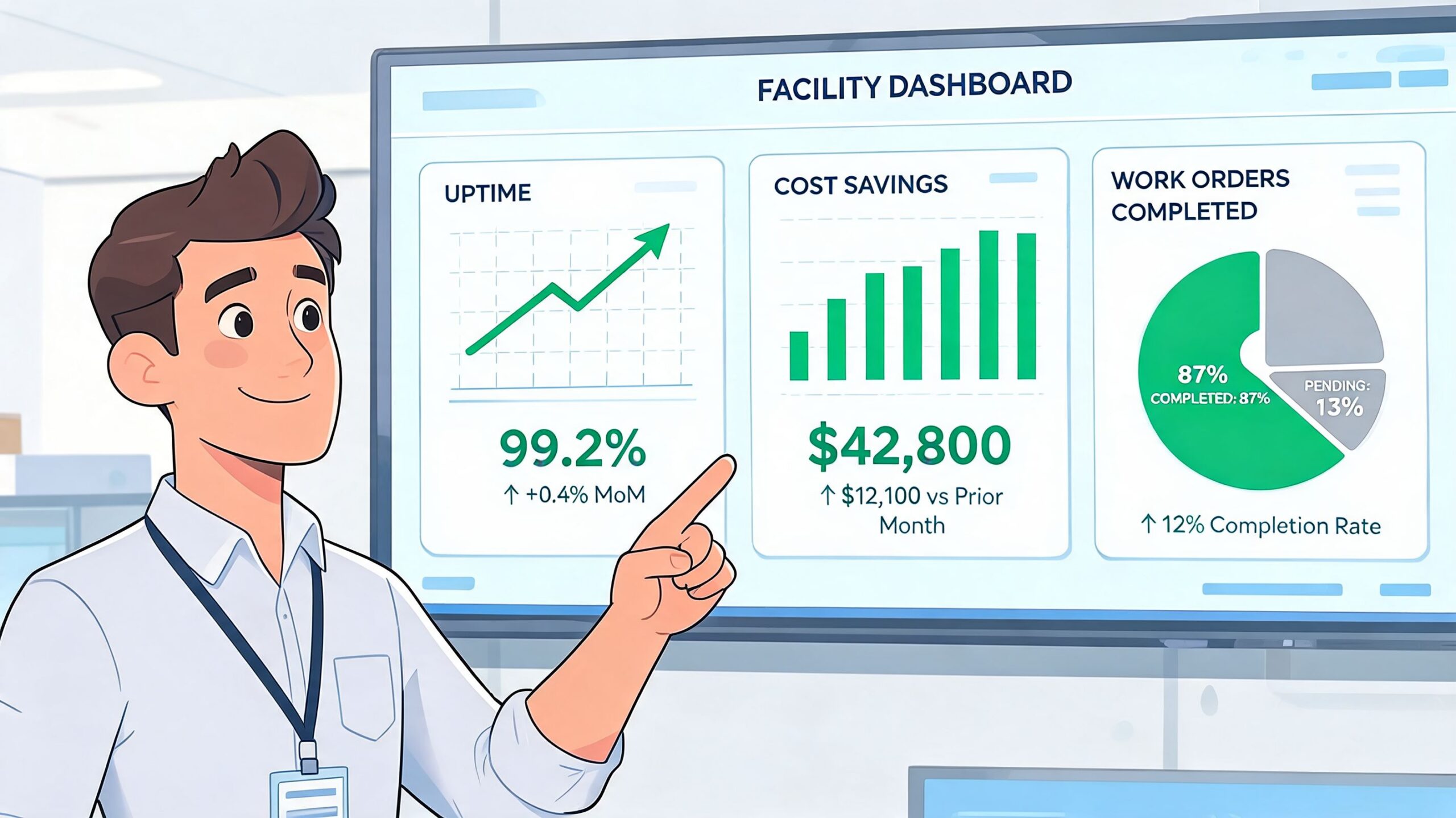
Many maintenance programs stall because managers collect work orders but don't turn them into decisions. The fix is to track a small number of useful indicators and review them consistently.
For doors and docks, the right KPI set should help you answer three questions. Are we doing enough planned work? Which assets keep causing trouble? Where should we spend next?
Planned Maintenance Percentage
One of the clearest measures is Planned Maintenance Percentage, or PMP. It is calculated as planned maintenance labour hours ÷ total maintenance labour hours, as explained in ServiceChannel's maintenance metrics guide.
A high PMP usually tells you the team is spending more of its labour on scheduled work instead of emergency fixes. For a door and dock program, that often means more inspections, lubrication, testing, and adjustments are happening before failures interrupt the building.
Work order history and repeat failures
Another strong reporting habit is reviewing asset history, not just monthly totals. Guidance on CMMS-based maintenance analytics from CallMSI's data-driven facility maintenance article highlights the value of tracking work-order completion rates, response times, maintenance costs, repair costs, and service intervals by asset.
That matters because repeat callouts usually tell a story. If the same truck restraint appears again and again, you may be looking at misuse, alignment issues, worn components, or environmental stress. If one overhead door keeps generating sensor faults, the issue may not be the sensor alone. It may be vibration, impact, track condition, or operator settings.
A simple KPI set for doors and docks
You don't need a complicated dashboard at the start. A practical reporting set includes:
- PMP: Shows how much labour is planned versus reactive
- Repeat callouts by asset: Flags chronic problems and weak points
- Response times: Helps separate urgent failures from normal service needs
- Service interval history: Shows whether inspection frequency matches real-world wear
- Maintenance and repair cost by opening or dock position: Helps justify repair versus replacement decisions
For teams that want better visibility, facility maintenance software for service tracking and reporting can make it easier to see trends across sites, asset classes, and recurring defects.
Numbers only help when they change action. If one opening keeps consuming labour and parts, the data should trigger a different maintenance plan, not just another identical repair.
Build a More Resilient and Reliable Facility
Good facility maintenance services create order where buildings naturally drift toward disorder. Parts wear out. Traffic patterns change. Weather adds stress. Small defects become larger ones if nobody catches them early.
For many facilities, the biggest opportunity is hiding in plain sight. Commercial doors, dock levelers, restraints, seals, shelters, and access systems are often treated as secondary equipment. In practice, they influence uptime, safety, energy control, and compliance every day. When managers plan around those access points instead of reacting to them, the whole building runs better.
That is the true shift. Maintenance stops being a string of interruptions and starts becoming an operational discipline.
If you're reviewing your current program, start with one question: which openings or dock positions would hurt the operation most if they failed tomorrow? Build your inspection, reporting, and service priorities from there. Facilities that do this well usually aren't chasing perfection. They're reducing surprises, protecting workflow, and making smarter use of limited resources.
If you'd like a practical review of your doors, docks, and access equipment, contact Wilcox Door Service Inc. to discuss an inspection, planned maintenance options, or support for a multi-site facility program.