


You're probably here because someone asked for a budget number. Maybe it's for a freezer replacement, a new cooler opening, or a retrofit in a food plant where the old door has started leaking air and icing up around the frame. The question sounds simple: what's the cold storage door price?
The honest answer is that a useful number depends on more than the door leaf. In cold environments, the door is part of the refrigeration strategy, the traffic flow plan, and the maintenance workload. A cheap quote can become an expensive mistake if the door leaks, freezes, gets hit by lift trucks, or slows down operations at the opening.
Facility managers usually get better results when they treat cold storage doors like operating equipment, not like a basic construction item. The right spec can reduce nuisance service calls, keep temperatures stable, and limit the hidden costs that show up every day in compressor load, frost buildup, and lost time at the opening.
Why There Is No Simple Answer to Cold Storage Door Price
A new facility manager often starts with a simple request from finance or operations: get a budget number for the cold room door. Then the quotes come back far apart, even when every supplier is looking at the same opening size. That gap usually comes from specification, not confusion.
Cold storage door price depends on the job the door has to do over years of service. A door at a low-traffic cooler opening has a very different cost profile from a freezer door that opens all day, takes forklift exposure, and has to hold a tight seal in wet, washdown conditions. If you buy on leaf size alone, you miss the costs that show up later in energy use, repairs, icing, and downtime.
That is why two doors that look similar on a drawing can be priced very differently.
What drives the price spread
The biggest budgeting mistake is treating cold storage doors like standard construction items. In practice, they are operating equipment. The door affects infiltration, temperature stability, traffic flow, sanitation, and maintenance hours. Those factors change the build.
A basic pedestrian cooler door may only need moderate insulation, standard hardware, and manual operation. A forklift-access freezer opening may require thicker insulated construction, heated frame components, tighter gasketing, impact-resistant hardware, and controls built for high cycle counts. Each upgrade raises purchase price, but it can also prevent losses that cost far more over the life of the opening.
This is where total cost of ownership matters. A lower quote can look good at approval time and still become the expensive option if the door leaks air, ices up, gets hit repeatedly, or needs frequent service calls. I have seen facilities spend more correcting poor door selection than they would have spent specifying the right unit from the start.
Practical rule: If the opening affects temperature control, forklift movement, sanitation, or shift productivity, evaluate the door by operating cost and service life, not by upfront price alone.
What a new facility manager should confirm first
Before asking suppliers to price the opening, pin down the operating conditions:
- Room condition: Cooler, freezer, or deep-freeze application
- Traffic pattern: Pedestrian traffic, pallet jacks, carts, or forklifts
- Cycle demand: Low-use opening or frequent daily cycling
- Opening layout: Space for a sliding door, or only room for a swing door
- Downtime impact: Minor inconvenience, or a bottleneck that disrupts production or storage
Those answers shape both price and ROI. They also help suppliers quote the same scope, which is the only way to compare bids fairly.
Typical Price Ranges by Door Type
A facility manager sees a hinged door listed online for under €1,000 and assumes the opening will be an easy budget item. Then the scope shows up. Freezer hardware, heat, installation labor, freight, and commissioning can push the project into a very different range.
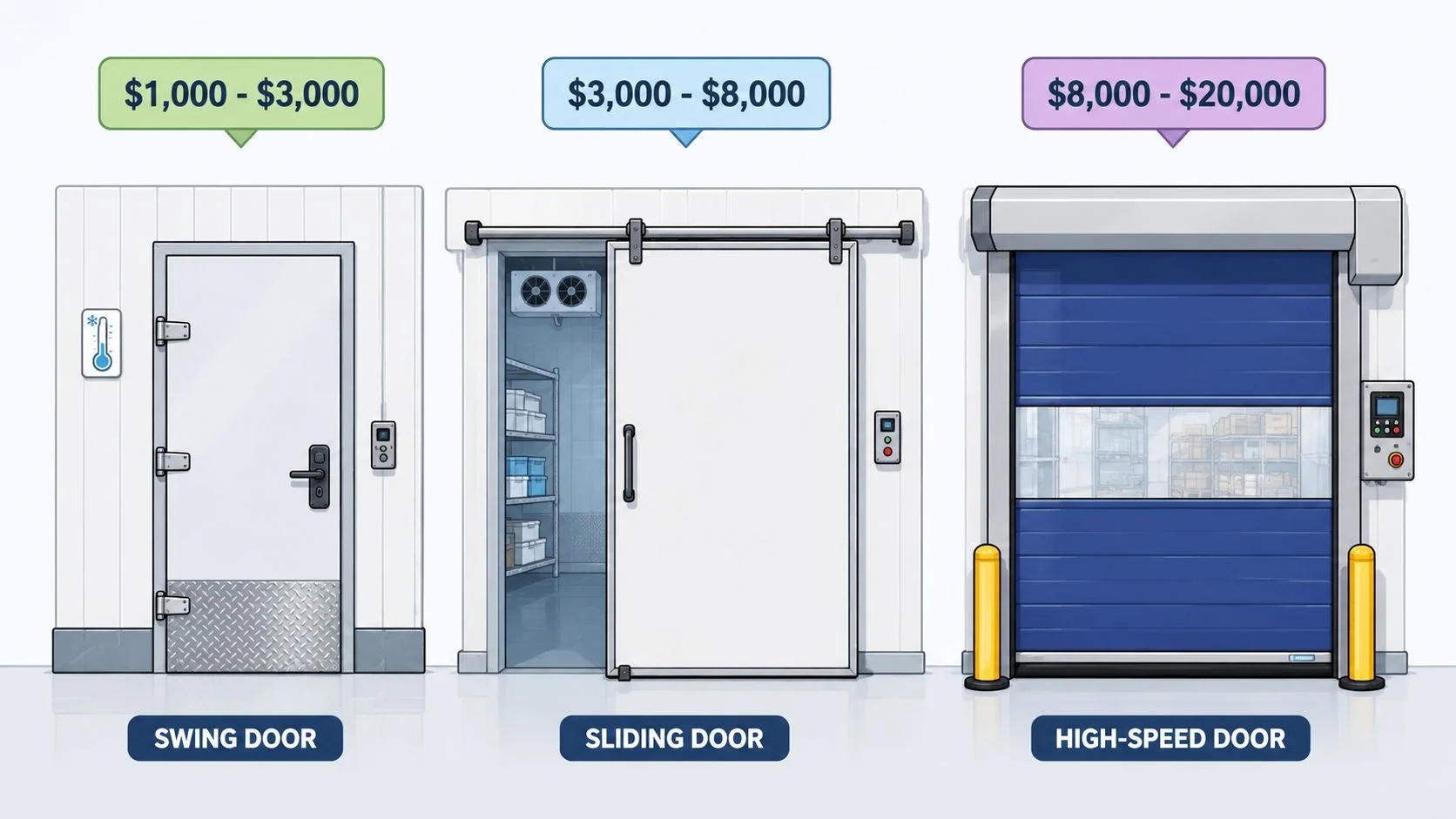
Public pricing still has value if you use it correctly. It helps separate low-complexity pedestrian openings from heavier-duty traffic doors and specialty assemblies. It does not tell you what the opening will cost to buy, install, and run in a Canadian facility.
Hinged doors
Hinged cold-room doors are usually the entry point for smaller openings, staff access, and lower daily cycle counts. Public examples from sources like Ricambi Grossclima cold room door listings show hinged doors around €894 to €988, while broader market examples in other regions range from roughly ₹7,000 to ₹185,000 per unit depending on size and application.
That spread matters. A basic hinged door can be a sensible buy where traffic is light and the opening is not mission-critical. In a busy cooler or freezer, the cheaper hinged option can lose its advantage fast if the leaf gets hit, seals wear early, or staff leave it open longer because it slows traffic.
I usually treat hinged doors as the lowest first cost, not automatically the lowest ownership cost.
Sliding doors
Sliding doors are often the better fit for pallet traffic, tighter aisle layouts, and openings where a swing path would interfere with work. They also tend to support better control of the opening when the seal system, track, and hardware are matched to the room condition.
Online product pages rarely give a dependable budget number for a sliding system because the door slab is only part of the cost. Track support, wall strength, clearance, bottom guide details, and optional operators can change the quote substantially. For that reason, sliding doors should be budgeted as a system purchase, not as a panel with hardware attached.
The return can be strong in the right application. Better traffic flow, fewer impact events, and less air infiltration often justify the higher initial spend.
Larger and specialty openings
Larger manual doors, high-cycle powered doors, freezer-rated traffic doors, and specialty openings sit in a different pricing tier altogether. Public listings often group these products together, which makes online comparisons misleading. A small manual cooler door and a larger automated freezer opening may both be labeled "cold room doors," but they solve very different operating problems.
This category is where buyers get into trouble by focusing on unit price alone. If the opening serves forklifts, staging pressure, or sanitation-sensitive production, downtime and temperature loss usually cost more than the difference between a basic door and a properly specified one.
Online prices are useful for rough orientation. Procurement decisions should be based on installed cost, expected service life, energy performance, and the operational cost of failure.
How to read public pricing without getting burned
- Useful: Comparing broad categories such as hinged versus sliding, or manual versus specialty openings.
- Useful: Asking what is included in the listed price, such as frame, threshold, heater options, controls, and freight.
- Risky: Treating product-only listings as an installed project budget.
- Risky: Comparing a basic cooler door to an automated freezer door as if the ownership cost will be similar.
Key Factors That Determine Your Final Door Cost
Most cold storage door quotes move up or down because of a handful of specification choices. Some are obvious, like size. Others are buried in hardware, controls, and thermal details that only show up after installation if they were overlooked.
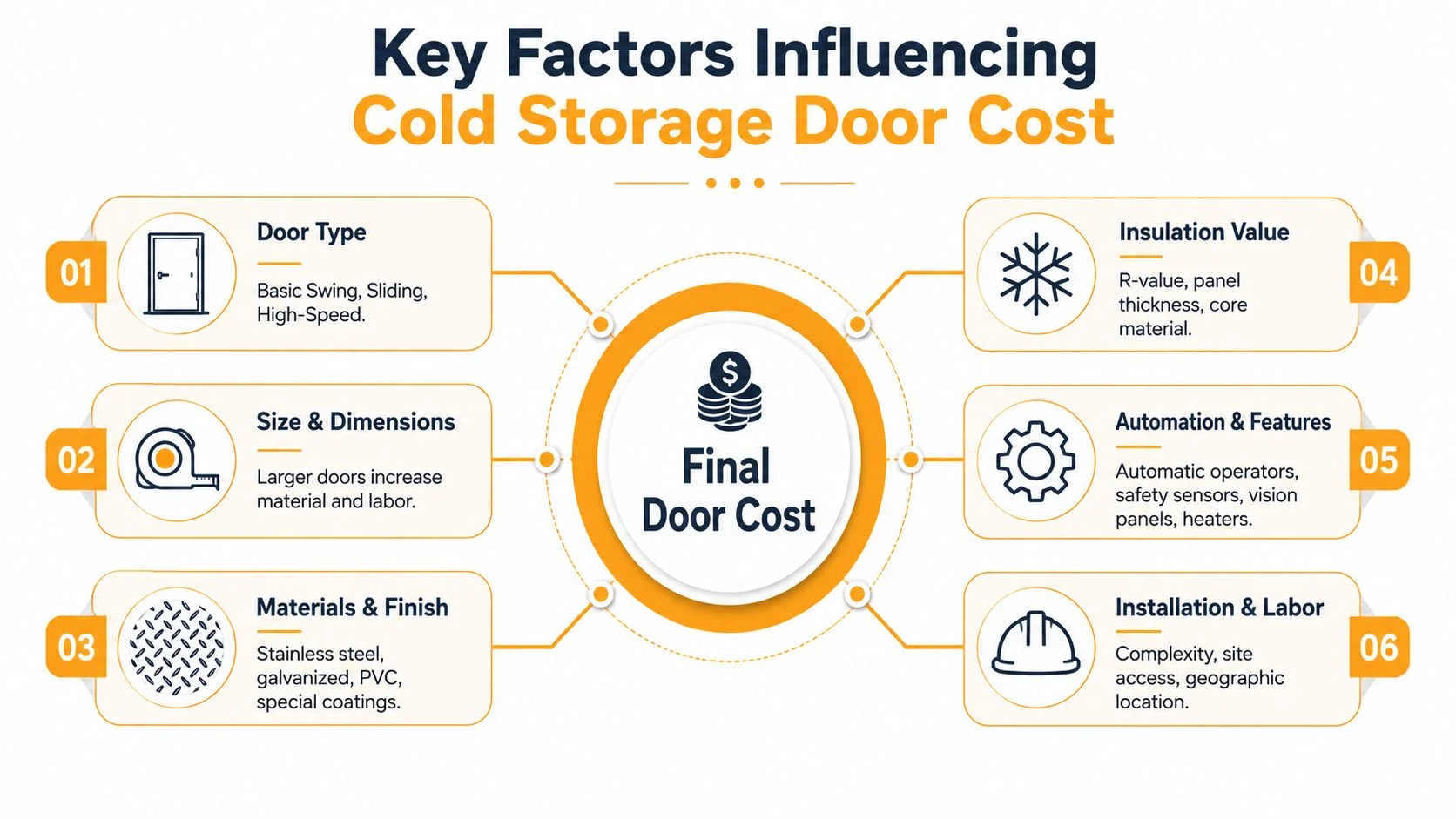
Breakdown of Cold Storage Door Cost Drivers
| Cost Driver | Description | Impact on Price |
|---|---|---|
| Size and dimensions | Clear opening width, height, and wall thickness | Larger openings raise material, hardware, and installation demands |
| Insulation value | Thermal performance required for cooler or freezer service | Higher insulation levels increase panel and assembly cost |
| Materials and finish | Galvanized, stainless, washdown-ready, or corrosion-resistant components | More durable finishes usually raise upfront pricing |
| Automation and operators | Manual use versus powered operation | Motors, controls, and safety devices add cost |
| Hardware durability | Hinges, rollers, tracks, latches, and seals matched to cycle rate | High-cycle components cost more but last longer in busy openings |
| Installation and site work | Structural prep, electrical work, access equipment, and commissioning | Site complexity often changes the final quote significantly |
One visual overview is useful before the details. This short video gives a helpful look at cold-storage door systems in practice.
Size doesn't scale neatly
A larger opening doesn't just use more material. It also puts more load on the frame, track, seals, and hardware. That's why pricing often rises faster than people expect.
Industry guidance and public comparisons note that door pricing can scale nonlinearly with size. One cited example shows a 900 mm × 2100 mm door listed at ₹5,034.24 to ₹7,948.80, while a 1200 mm × 2100 mm version is listed at ₹32,500 to ₹35,000, meaning widening the opening can multiply the listed price by roughly 4 to 6 times, as discussed in this cold-room door size example from Prefabkart.
If you're widening an opening for forklifts, don't assume the price will rise in a straight line. It usually won't.
Insulation and R-value change the whole build
R-value is a simple way to describe how well a door resists heat transfer. Higher R-value means better thermal resistance. In plain terms, the door does a better job of keeping warm air out and cold air in.
Industry guidance states that R-32 is appropriate for cooler rooms, while R-48 is preferred for freezers, according to Traffic Swinging Doors guidance on cooler and cold storage doors. Freezer doors usually need thicker insulation and better thermal breaks, so they cost more than cooler doors that look similar from a distance.
A freezer-rated door that seals properly will usually outperform a cheaper cooler-grade door that has been pushed into freezer service. The difference shows up later in ice, service calls, and compressor runtime.
Materials, operators, and heated details
At this point, many quotes separate.
A light-duty galvanized assembly may be fine in a dry interior cooler with moderate use. In a corrosive, washdown, or food-processing setting, stainless or upgraded finishes may be the right choice. The upfront cost rises, but so does service life.
Automation also changes the budget quickly. A manual door may suit a small room with limited traffic. If forklifts are running through the opening all day, a powered door with proper activation and safety devices usually makes more sense. The controls cost more, but they also reduce impact damage and operator frustration.
Then there are the details people forget to ask about:
- Heated perimeters or thresholds: Used to reduce icing at freezer openings.
- Vision panels: Helpful where traffic visibility matters.
- Emergency release hardware: Important for safety and serviceability.
- Seal design: Basic gasketing and premium sealing are not the same thing.
- Duty-rated hardware: High-cycle openings need stronger components.
If you want comparable quotes, every bidder needs the same specification language. Otherwise, one supplier may be pricing a basic door and another is pricing a complete freezer-ready system.
Budgeting Beyond the Purchase Price Installation and Maintenance
Even when the product spec is right, the door itself is only part of the project cost. Installation can change the budget more than expected, especially in retrofit work.
A straightforward opening in a new wall is one thing. A replacement in an active facility is another. Existing jamb conditions, damaged panel edges, uneven floors, refrigeration line locations, and limited lift access all affect labour time. Powered doors add electrical scope and commissioning requirements. If the opening needs structural correction before the frame can be set square, that work has to be priced somewhere.
Installation costs are part of the real number
This is why comparison shopping often fails. One quote may include removal, disposal, frame correction, heater wiring, and startup. Another may cover the door only. If you're also reviewing general overhead door work at your site, Wilcox has a useful reference on garage door installation cost that helps frame how installation scope can affect final pricing.
Maintenance is not optional in cold environments
Cold openings punish weak seals, neglected hardware, and misaligned doors. Once a door starts dragging, leaking, or icing, small issues become recurring service calls. That's why a planned maintenance approach usually saves money over the life of the opening.
Good maintenance for cold storage doors usually includes:
- Seal inspection: Worn gaskets are one of the fastest ways to lose thermal performance.
- Hardware adjustment: Hinges, rollers, tracks, and latches need regular inspection before they fail under load.
- Heater and control checks: On freezer doors, failed heated components often show up as icing complaints first.
- Impact review: Forklift contact that looks minor can shift alignment enough to create ongoing air leakage.
There's also a wider facility lesson here. Teams that already think about refrigeration and air movement as operating costs tend to make better door decisions. This practical guide to business HVAC cost reduction strategies is useful because it reinforces the same discipline. Preventive maintenance protects efficiency better than reactive repair.
A neglected cold storage door doesn't fail in one dramatic moment. It usually fails by degrees, then starts charging you for it every day.
Calculating Total Cost of Ownership and ROI
The purchase price matters. It just doesn't tell you enough.
Total cost of ownership, or TCO, means adding together the costs that follow the initial purchase: installation, energy impact, maintenance, repairs, and the operational disruption that comes when the door no longer performs properly. In cold storage, that approach is more realistic than comparing quotes on upfront price alone.
Why lifecycle cost matters more in refrigerated facilities
The broader cold-chain environment has been dealing with cost pressure for years. In the refrigerated-warehousing sector, the Producer Price Index for refrigerated warehousing and storage in the U.S. reached 170.215 in April 2026, and industry commentary cited alongside that context states that temperature-controlled warehousing construction commonly ranges from USD 150 to USD 250 per square foot, with refrigeration systems accounting for 25% to 35% of that total. The same discussion notes that the initial system cost is only 15% to 20% of total lifetime expenditure, which is why the industry has shifted toward total-cost-of-ownership pricing, as reflected in the FRED refrigerated warehousing producer price index reference.
In plain language, the building keeps charging you long after the invoice is paid. Doors influence those charges because they affect infiltration, frost, and equipment runtime.
A practical comparison
Consider two options for the same freezer opening.
Door A has the lower upfront price. It meets the minimum requirement on paper, but it has lighter hardware, a simpler seal package, and less effective thermal detailing.
Door B costs more at the start. It has a stronger insulated build, tighter sealing, and hardware selected for repeated cycles in a colder, harsher opening.
Door A may still be the right choice if the room sees low traffic and limited exposure. But if the opening is active, Door B often wins over time because it tends to:
- reduce warm air infiltration
- limit frost buildup around the frame and threshold
- cut nuisance maintenance
- hold alignment better under regular use
- reduce the chance of disruptive failure during production hours
That's the return on investment. Not just energy. Uptime.
How to think about ROI without guessing
You don't need invented payback numbers to make a sound decision. You need a disciplined comparison. Ask each bidder to explain:
- What sealing system is included
- Whether the assembly is cooler-grade or freezer-grade
- What parts are expected to wear first
- How the operator and safety system handle your traffic pattern
- What maintenance tasks the door will require in the first years of service
A useful mental model comes from another part of the property world. This article on how a new roof increases home value is about residential property, but the logic carries over. Buyers don't value a roof only by material cost. They value reduced risk, longer service life, and avoided future expense. Cold storage doors work the same way in commercial facilities.
If you want a structured way to evaluate options, this guide on reducing total cost of ownership is a useful reference point. It aligns the buying decision with service life and operating impact, which is how most experienced facility teams eventually learn to buy.
Your Procurement and Specification Checklist
Most quoting problems start before the first supplier call. If your internal team hasn't defined the opening clearly, every bidder fills in the blanks differently. That leads to quotes that look comparable but aren't.
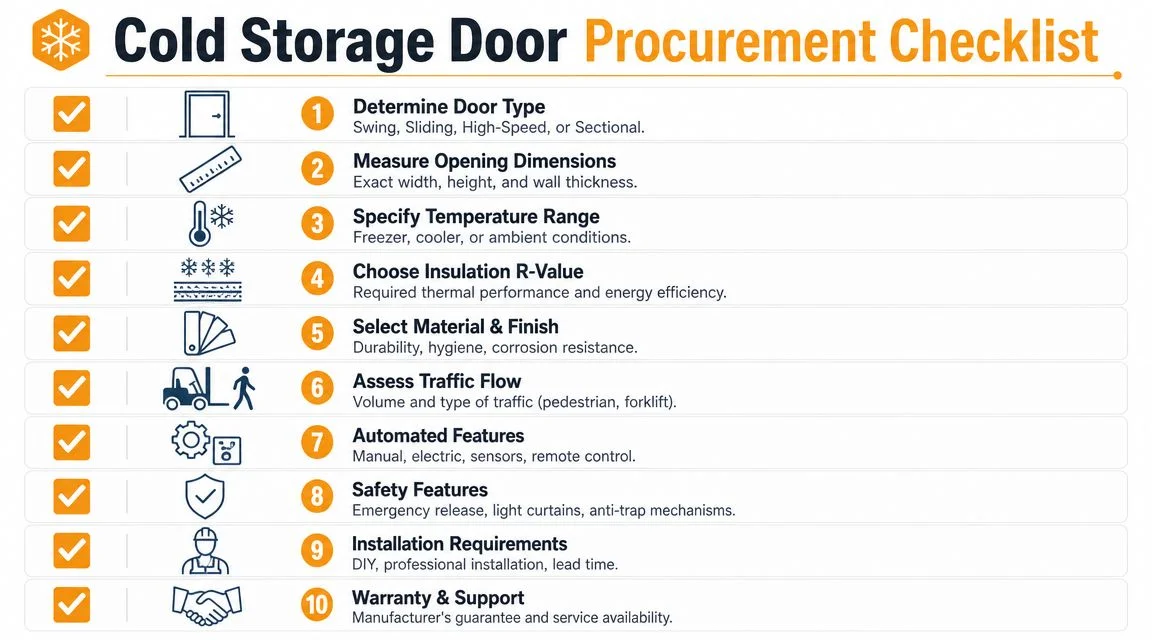
What to gather before requesting a quote
Use this checklist before you ask for pricing:
- Opening size: Record clear width, clear height, and wall thickness.
- Room condition: Identify whether the opening serves ambient, cooler, or freezer space.
- Temperature range: Give the expected operating condition, especially if the room runs below standard cooler temperatures.
- Traffic type: Note pedestrian traffic, pallet jacks, carts, or forklifts.
- Cycle demand: Estimate whether the door opens occasionally or repeatedly throughout the day.
- Door style constraints: Confirm whether you have room for a swing path or side clearance for a sliding system.
- Power availability: Powered doors and heated features need the right electrical service nearby.
- Safety needs: Include emergency egress, visibility, sensors, and any concerns around mixed pedestrian and vehicle traffic.
- Sanitation or corrosion exposure: Washdown and food-processing environments may require upgraded materials and finishes.
- Service expectations: Decide whether you want a basic install only or support tied to a maintenance plan.
Questions that improve quote quality
Ask each supplier these practical questions:
- What exactly is included in the price?
- Is the frame package complete for this wall condition?
- Is the quoted assembly matched to cooler or freezer duty?
- What site work is excluded?
- Which parts are considered wear items?
- What would you change if this opening had heavier traffic next year?
One more comparison helps at the planning stage. If your project team is also weighing other industrial door types at nearby openings, this overview of sectional vs rolling steel doors can help clarify when a cold storage opening needs a purpose-built insulated solution instead of a more general industrial door.
Good procurement isn't about getting more quotes. It's about getting quotes built on the same assumptions.
How to Get Accurate Quotes and Partner for Success
A bad quote usually starts with a bad assumption. The supplier prices a standard opening, your site has freezer conditions, the electrical scope is missing, and the low number on page one turns into change orders, delays, and a door that never performs the way operations expected.
Good quoting starts with a clear bid package and a tighter process. Give each supplier the same opening details, temperature conditions, traffic pattern, control requirements, and wall construction. Require them to break out door cost, installation, electrical, controls, and excluded site work. If one quote includes heated accessories and another does not, you are not comparing price. You are comparing two different risk profiles.
Ask for one base quote and one alternate. That is one of the simplest ways to make a better capital decision. A base model may look attractive on first cost, but an alternate with better sealing, upgraded hardware, or faster actuation can reduce energy loss, service calls, and forklift delay over the life of the opening. That is where TCO becomes useful. The right quote shows what you pay now and what you are likely to spend later.
Supplier selection matters as much as specification. A cold storage door is not a one-time purchase. It is an operating asset with wear parts, controls, safety devices, and service needs. Ask who handles startup, who stocks replacement parts, what the warranty covers, and how service calls are dispatched. I have seen facilities save a small amount upfront, then lose far more waiting on parts or troubleshooting support during a production week.
Financing or leasing can make sense on larger upgrades tied to energy performance, throughput improvement, or a broader cold-chain project. The decision should come down to cash flow, cost of downtime, and expected maintenance burden, not just whether the monthly payment fits the budget.
The strongest procurement teams buy clarity. They choose a supplier that can price the actual opening, explain the trade-offs, and support the door after installation.
If you're budgeting a cooler or freezer opening and want a quote that reflects real operating conditions, contact Wilcox Door Service Inc.. Their team works with facility managers across Canada on commercial and industrial door, dock, and access solutions, with support for specification, installation, service, and long-term maintenance.