


If you're trying to improve output while your dock keeps backing up, service calls keep interrupting shifts, and heating costs keep leaking out around doors, you're not dealing with an abstract efficiency problem. You're dealing with a facility problem.
That distinction matters. A lot of advice on how to improve operational efficiency is written for offices, software teams, or generic business workflows. It tells you to automate tasks, reduce waste, and track KPIs. None of that is wrong. It just doesn't go far enough when your real bottlenecks are a slow overhead door, a damaged dock seal, an unreliable leveler, or a recurring shutdown at the busiest bay in the building.
At warehouses and industrial sites, efficiency lives at the points where product, people, and equipment move. Doors and docks control throughput. They affect safety, energy use, labour flow, trailer turn time, and maintenance workload. When those assets perform well, the entire building runs better. When they don't, delays spread fast.
Introduction A Practical Guide for Facility and Operations Leaders
One dock position drops out at 8:15. By 9:00, trailers are stacked in the yard, forklift routes are longer, shipping is asking for updates, and maintenance has abandoned planned work to deal with the interruption. That is what operational inefficiency looks like in a warehouse. It shows up first at the doors and docks, then spreads across labour, energy use, schedule performance, and customer service.
For facility and operations leaders, improving efficiency starts with physical flow. Generic advice about productivity can help at the margins, but it does not solve a slow overhead door, a leaking dock seal, a failed restraint, or a leveler that turns every busy shift into a workaround. At industrial sites, those assets decide how smoothly product moves, how much conditioned air stays in the building, and how often the maintenance team gets pulled into preventable calls.
The biggest gains are usually found in equipment that gets used hard and overlooked because it is familiar. I have seen sites spend months discussing software while losing time every day to a door that cycles too slowly or a dock bay that operators avoid because it never works quite right. The trade-off is straightforward. Capital projects get attention, but disciplined fixes at the dock often pay back faster because they reduce downtime immediately.
Focus on the points below first:
- Door reliability: Doors that bind, drift out of alignment, or close inconsistently create delays on every shift.
- Dock equipment condition: Levelers, restraints, seals, and shelters affect trailer turn time, safety exposure, and temperature control.
- Preventive maintenance execution: Sites that run to failure spend more on disruption, rush parts, and overtime.
- Energy containment: Gaps around openings raise heating and cooling costs and make working conditions harder to manage.
- Operator use: Poor loading practices and rough equipment handling shorten asset life and create repeat damage.
Some teams also review office systems and reporting workflows while they tighten up plant performance. If that is part of your scope, this guide on improving business operations with technology works as a useful companion to the facility-side actions covered here.
Start with recurring friction. If the same bay, the same door, or the same failure keeps disrupting the day, treat it as an operating problem with measurable cost, not background noise.
Diagnosing Inefficiency Beyond the Obvious
Most sites can name their biggest headache. Fewer can prove where time is being lost.
That gap is why many efficiency projects stall. Teams buy new equipment, add software, or change staffing before they understand the flow through the building. The better approach is to start with a baseline-and-bottleneck audit, then map the workflow before automating anything. Process mapping is useful because it shows exactly where delays occur, and it prevents you from digitising waste or hidden rework (Manifestly on process mapping and operational efficiency).
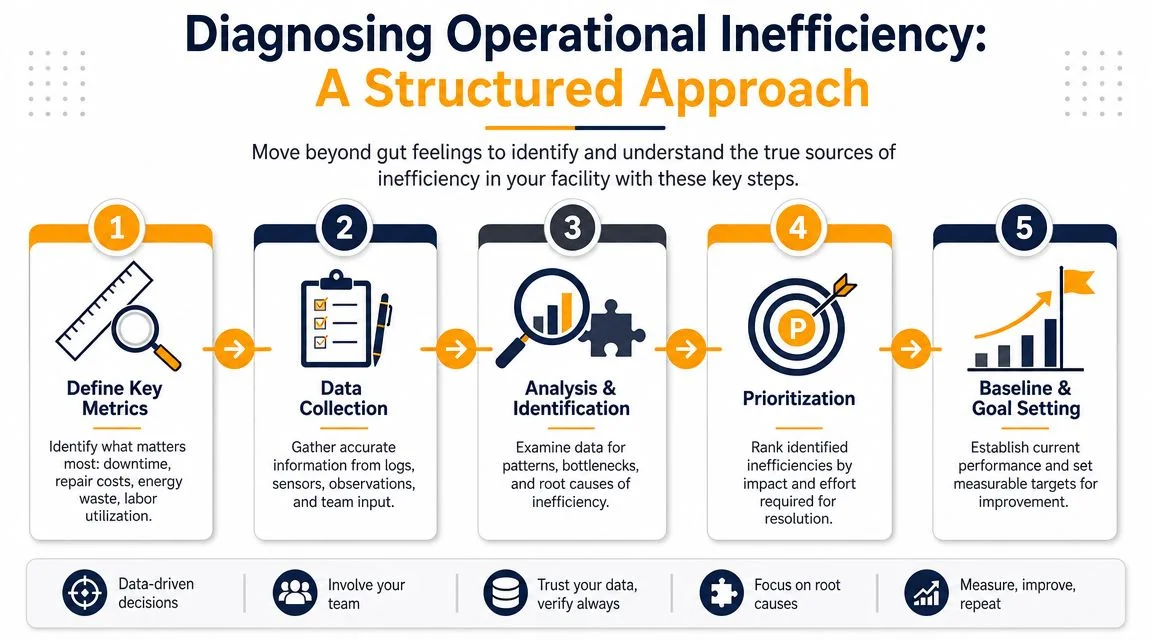
Map the actual flow, not the ideal one
At a warehouse, start with one common movement. A truck arrives. It checks in. It waits for a door. The trailer is positioned. The restraint is engaged. The dock door opens. The leveler is deployed. Product moves. The trailer is cleared. Equipment is reset. The truck departs.
Write down each step exactly as it happens on the floor. Include delays, handoffs, exceptions, and workarounds.
Look for questions like these:
- Where do drivers wait: Is the delay at yard communication, door assignment, or equipment readiness?
- Where do operators pause: Are they waiting on a door cycle, a restraint confirmation, or a damaged leveler?
- Where does maintenance get dragged in: Is the same opening or dock position generating repeated interruptions?
- Where do safety steps break down: Are people bypassing process because the approved sequence takes too long?
Choose KPIs that reflect physical work
Office metrics won't tell you enough about a shipping bay. A facility needs operational KPIs that match the equipment and flow being managed.
A simple working set might look like this:
| KPI | What it tells you | Why it matters |
|---|---|---|
| Dock turn time | Time from trailer arrival to departure | Reveals flow delays and bay congestion |
| Door cycle count | How often a door opens and closes | Helps match maintenance to real usage |
| Equipment uptime | Time doors and dock assets are available | Shows operational reliability |
| Repeat repair events | Recurring faults on the same asset | Flags root-cause issues, not just symptoms |
| Delay by location | Where queues form most often | Helps prioritise the highest-impact openings |
Don't overbuild the dashboard. If the team can't review it weekly or monthly, it becomes wallpaper.
A slow dock door doesn't only waste seconds at the opening. It also affects forklift routing, staging space, trailer dwell, and supervisor attention.
Build the baseline before you spend
Walk the facility with operations, maintenance, and a supervisor from shipping or receiving. Compare what each group says is causing delay. When those answers differ, that's usually where the audit gets valuable.
Use a short baseline period and document current conditions:
- Record recurring service issues by opening, dock position, and shift.
- Observe traffic patterns at peak periods, not only during quiet hours.
- Note temporary fixes such as blocked-off bays, manual overrides, and repeated resets.
- Flag exception paths where staff bypass normal equipment or process.
- Set target vs actual review points on a weekly or monthly cadence.
The goal isn't to create paperwork. It's to identify the few constraints that affect the rest of the building. Once you know that, spending gets easier to defend and much harder to waste.
Building a Foundation of Proactive Maintenance
Reactive maintenance feels cheaper right up until a critical opening fails at the worst possible time.
A dock leveler can limp along for months with a worn lip, a leaking hydraulic component, or inconsistent operation. An overhead door can keep cycling with damaged rollers, a tired spring system, or a drifting bottom seal. The site adapts. People work around it. Then one busy morning, the asset stops being inconvenient and starts controlling the day.
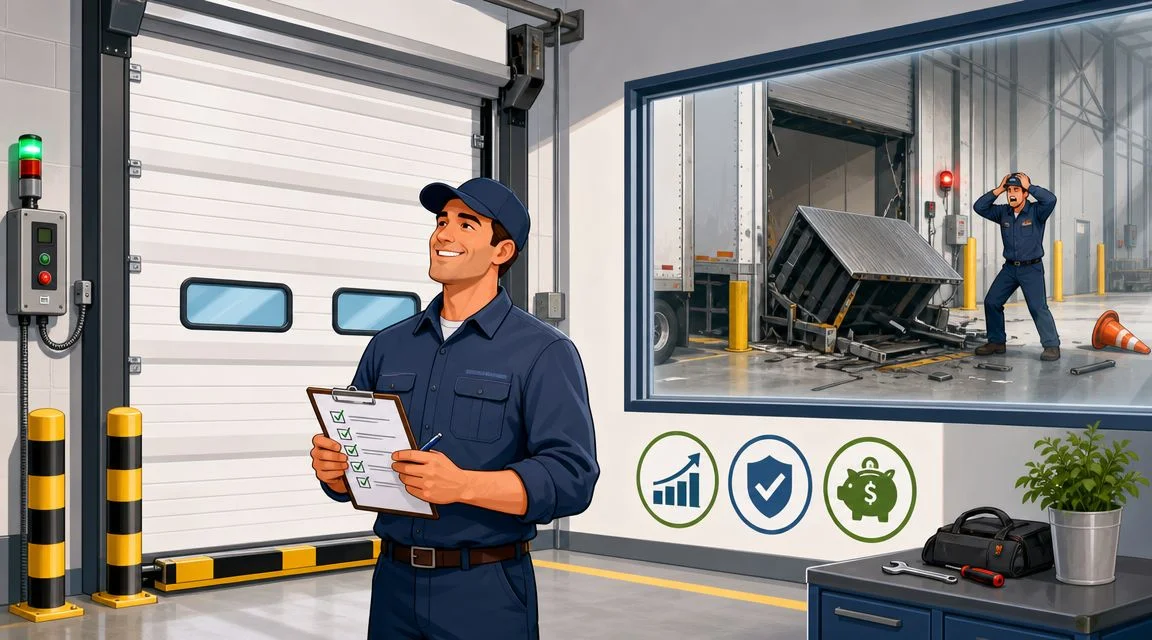
Why reactive sites stay stuck
When a facility runs on break-fix maintenance, three things usually happen at once:
- Downtime clusters: Failures don't happen on a convenient schedule. They hit during peak traffic.
- Repair scope grows: Parts that could have been adjusted or replaced early often damage neighbouring components.
- Planning disappears: Labour gets pulled from scheduled work into emergency response.
That cycle is hard to break because emergency work feels urgent and visible, while prevention feels easy to postpone. But operational efficiency depends on reducing avoidable stoppages and standardising the way assets are maintained over time.
Statistics Canada reported that Canadian manufacturers' labour productivity rose 0.8% in 2023 after a 1.9% decline in 2022 (reference via JUZ Solutions). On the ground, that reinforces a practical point: productivity recovery isn't magic. It comes from tracking output, downtime, and throughput, then reducing the bottlenecks that keep dragging performance back down.
What a planned maintenance programme actually changes
A proper planned maintenance approach does more than schedule inspections.
It creates a repeatable routine for checking springs, cables, hinges, rollers, operators, photo eyes, track condition, restraint engagement, leveler function, seals, shelters, and safety devices before failure turns into disruption. It also gives you a record of asset condition by opening and dock position, which makes replacement timing far more rational.
If you're formalising that process, a planned maintenance programme also benefits from better recordkeeping and service visibility through maintenance software.
What works in the field
The best maintenance plans are specific to usage, not just calendar dates.
- High-cycle doors need attention based on how often they run, not just the season.
- Busy shipping bays deserve tighter inspection discipline than overflow positions that see occasional use.
- Recurring faults should trigger root-cause review instead of the same temporary fix.
One useful development in larger operations is the use of condition-based monitoring and AI predictive maintenance solutions to help identify patterns before visible failure. That doesn't replace inspection. It helps maintenance teams focus on the assets most likely to interrupt operations next.
For a quick visual on the value of planned upkeep, this overview is worth a look:
Field observation: The cheapest repair is often the one you make before operations notices there's a problem.
The trade-off most teams underestimate
Trade-off isn't maintenance cost versus no maintenance cost. It is planned intervention versus unplanned disruption.
A short scheduled service visit during a controlled window is manageable. A failed door during a shipping rush isn't. Add in safety exposure, rushed part sourcing, supervisor time, and recovery effort, and the reactive model starts looking expensive fast.
Using Automation and Controls to Streamline Flow
Automation at a loading dock doesn't need to be complicated to matter. It just needs to remove friction without creating new failure points.
The first mistake many sites make is thinking automation means a major system overhaul. In practice, some of the highest-value upgrades are straightforward. Faster doors. Smarter operators. Better sensors. Interlocks that prevent unsafe or out-of-sequence dock activity.
Start with the opening that slows everyone down
If a manual or slow-cycling sectional door sits on a high-traffic route, it's often acting as a choke point. Forklift operators wait. Conditioned air escapes. The door takes repeated impact. People start forcing the pace, which usually means more wear and more safety risk.
A better fit in those locations is often a high-speed door that opens and closes quickly, resets more easily after impact, and supports cleaner traffic flow. The point isn't novelty. It's reducing delay at an opening that cycles all day. For facilities comparing options, high-speed fabric doors are one of the clearest examples of automation improving both throughput and environmental control.
Match controls to the task
Not every door needs the same level of control logic. A pedestrian opening, a forklift route, a refrigerated area, and a busy shipping dock all have different demands.
Use this practical comparison:
| Application | Better control approach | Main efficiency gain |
|---|---|---|
| Forklift traffic lanes | Motion or presence activation with safety sensors | Reduces stop-and-wait movement |
| Clean or temperature-sensitive zones | Fast close timing and reliable sealing | Limits air exchange |
| Loading dock positions | Sequenced dock controls and interlocks | Improves flow and safer operation |
| Security-sensitive openings | Controlled access with audit visibility | Reduces delays from manual access handling |
Use interlocks where sequence matters
At the dock, the safest and most efficient process is usually a controlled one. For example, a truck restraint should be engaged before the door opens and before loading begins. That type of sequencing reduces unsafe shortcuts and lowers the chance of damage from premature movement.
What doesn't work is layering controls onto a bad process. If trailers queue because of poor assignment or slow staging, adding more electronics won't fix the root cause. Automation works best after the flow has already been mapped and simplified.
Faster equipment only helps when the surrounding process is stable enough to benefit from that speed.
That is the main decision test. Upgrade the assets that support flow. Don't automate confusion.
Turning Energy Waste into Operational Savings
A leaky loading dock is an operations problem disguised as a utility problem.
When dock doors don't seal properly, when shelters are torn, or when bottom sections and perimeter gaps are left unaddressed, the building pays in more ways than one. Heating and cooling systems work harder. Employees feel the temperature swings. Dust, moisture, and outdoor air get where they shouldn't. In some facilities, product quality and sanitation conditions also get harder to control.
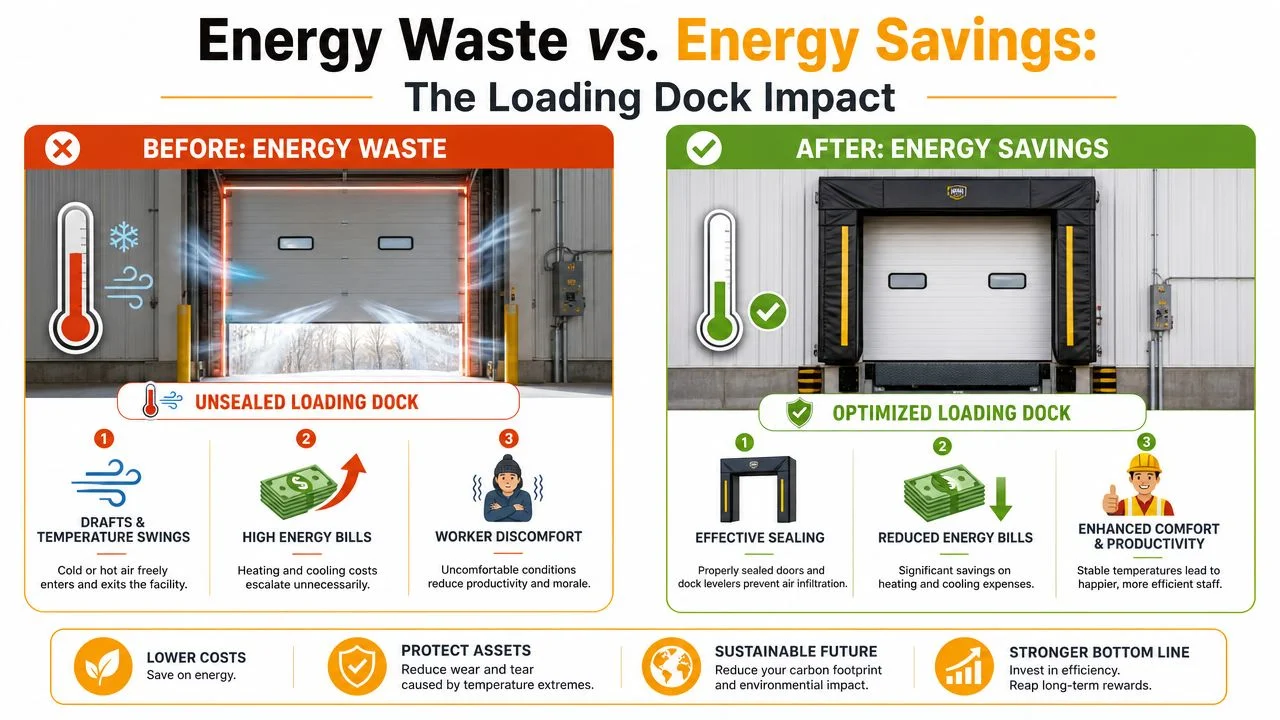
Compare the same dock before and after proper sealing
An older dock position often shows the same pattern. The trailer backs in, but the contact points aren't tight. Light shows through the perimeter. Air moves freely around the trailer edges. The overhead door opens into a gap that keeps exchanging inside and outside air the whole time the bay is active.
A better-configured dock feels different immediately. Properly specified seals or shelters create close trailer contact. The opening is controlled. Air curtains or insulated doors can support environmental separation where needed. Staff notice the difference because the bay is more stable, not because someone posted a memo about efficiency.
Measurement comes first
Energy management gets stronger when facilities stop treating it as a vague overhead number and start measuring where waste sits. For Canadian operations, Energy Star data cited by CohnReznick notes that verified energy-management systems are associated with 2% to 8% annual energy savings, and that submetering helps identify inefficiencies and outliers across sites (Energy Star Canada summary via CohnReznick).
That matters because the dock is rarely the only issue. But it is often one of the clearest places to act once measurement shows where load loss is occurring.
What to upgrade first
If you're prioritising improvements, start with the assets that affect both energy containment and daily operation:
- Dock seals and shelters: These reduce uncontrolled air exchange around trailers.
- Insulated overhead doors: Best suited to climate-controlled areas where the opening itself is part of the thermal envelope.
- Air curtains: Useful where traffic volume makes full closure difficult but air separation still matters.
- Damaged perimeter seals and bottom astragals: Small defects create constant loss.
For sites focused on this area, energy cost reduction upgrades are easiest to justify when they are tied to uptime, comfort, and maintenance planning, not just utilities alone.
Sealing a dock opening is one of the few improvements that can support comfort, energy control, equipment performance, and building cleanliness at the same time.
Optimizing Your Team Through Training and Safety
At a busy dock, efficiency often breaks down in the same place. Not in the budget. Not in the software. It breaks down at the bay when a new operator forces a leveler lip, skips trailer restraint verification, or keeps cycling a door that is already showing a fault.
New equipment helps, but it does not fix poor habits. Doors and docks run well when crews follow the right sequence under real shift pressure, especially during peak receiving and outbound windows. At warehouses and industrial sites, that is the difference between smooth turnover and a string of avoidable delays, impact damage, and service calls.
Training should be tied to the equipment your team uses every day, at the actual opening where the work happens. Generic safety talks do not change dock behavior. Hands-on instruction does.
Focus training on the failure points that cost the most in downtime and repairs:
- Truck restraints: Show crews how to confirm engagement, what a failed capture looks like, and when the bay must be taken out of service.
- Dock levelers: Train for correct positioning, safe operating sequence, and the warning signs of bent lips, slow hydraulic response, or uneven movement. Teams that understand how dock levelers should match trailer and traffic conditions make fewer costly mistakes at the bay.
- Overhead and high-speed doors: Teach operators what normal travel, alignment, and closing speed look and sound like so they can report trouble before a breakdown stops traffic.
- Manual operation and lockout: Make it clear who can use overrides, when lockout applies, and when maintenance has to step in.
This is operational control. A trained operator usually catches problems earlier, handles equipment with less force, and creates fewer repeat calls for the same opening.
Safety discipline also improves flow. A dock that runs by a standard sequence turns trailers faster because operators are not improvising, supervisors are not correcting basic mistakes, and maintenance is not spending the day on damage that should never have happened.
You can usually see the effect on the floor before it shows up in a report:
| Signal on the floor | What it usually means |
|---|---|
| Fewer forced operations | Staff understand equipment limits and stop before causing damage |
| Cleaner defect reporting | Teams recognise early warning signs and report them clearly |
| Less impact damage | Forklift traffic and door use are better controlled |
| More consistent bay turnover | The process is being followed the same way across shifts |
One trade-off is real. Pulling crews off the floor for training costs time in the short term. Skipping that training usually costs more later through damaged panels, bent track, unsafe loading conditions, and emergency calls during busy hours. The better approach is short, repeatable instruction built into onboarding, shift refreshers, and post-incident reviews.
Keep it plain. Train on the actual equipment. Show the correct method, the common shortcut, and the consequence of each. Then make defect reporting easy and fast, because teams will work around problems they expect to be blamed for reporting.
Good training protects people, but it also protects uptime. At doors and docks, those two outcomes usually rise or fall together.
Your Door and Dock Efficiency Implementation Plan
Efficiency work gets traction when it turns into a sequence, not a wish list. Most facilities already know they need better uptime, fewer emergency calls, and tighter control of energy loss. The sticking point is deciding what to do first and how to justify it.
That pressure is real. Statistics Canada reported that businesses' operating expenses increased faster than revenues in several sectors during 2024 (reference via ClearFuze). When costs rise faster than output, upgrade decisions need to be tied to labour impact, uptime, and avoided shutdowns. Broad promises aren't enough.
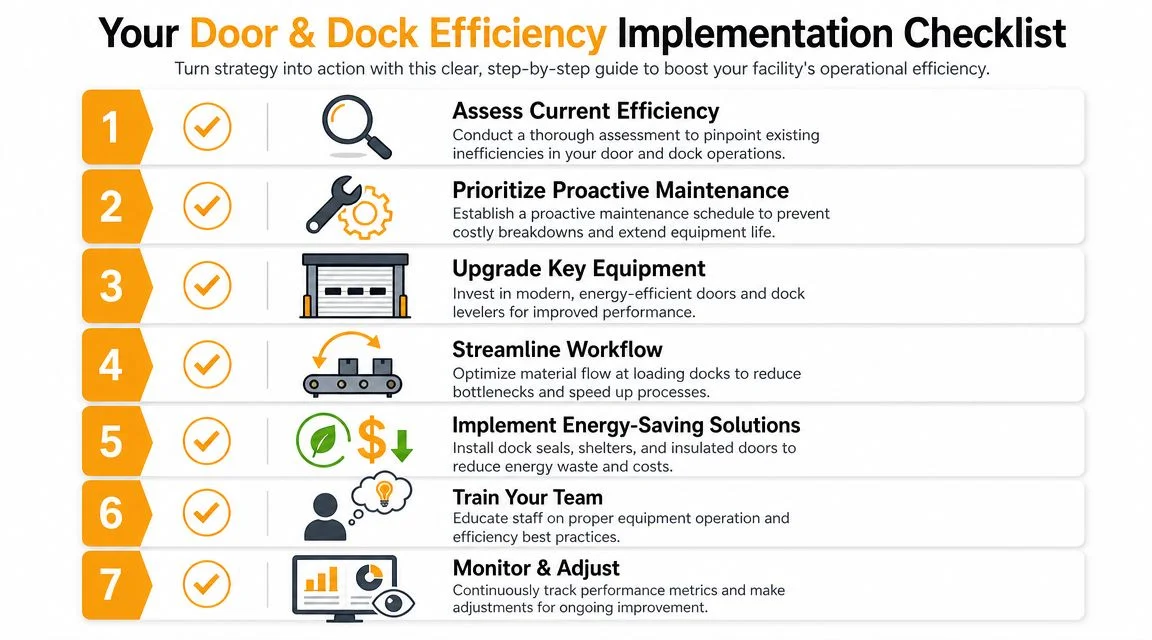
A practical checklist you can use on site
Work through this in order:
Audit the highest-friction openings
Start with the doors and dock positions that create the most delay, service calls, or complaints.Separate chronic issues from isolated failures
A single broken component is one thing. The same fault pattern across shifts is a system issue.Match maintenance to asset criticality
Your busiest bays should never be maintained with the same priority as low-use openings.Upgrade the bottleneck, not the whole building
If one high-cycle route is slowing movement, fix that route first.Tighten the building envelope at active docks
Address gaps, worn seals, shelters, and damaged insulated door components.Retrain on the exact sequence that protects flow
Standard work at the dock pays back by reducing both misuse and delay.Review performance regularly
Keep the KPI set small and useful. If a number doesn't support action, drop it.
A simple ROI framework for upgrade decisions
You don't need a complex model to build a sound business case. You do need discipline.
For any proposed door or dock upgrade, calculate value in these categories:
- Downtime avoided: How often does this asset interrupt operations now?
- Labour disruption reduced: How many people wait, reroute, or recover when it fails or slows down?
- Energy waste reduced: Does this opening leak conditioned air or affect climate control?
- Repair frequency lowered: Are you repeatedly paying to keep an ageing asset alive?
- Safety and compliance risk reduced: Does the current setup invite shortcuts, damage, or unsafe work?
Then compare those operational gains against the total installed and ongoing maintenance cost of the new solution. If the opening is tied to a core route or a high-volume dock position, the answer is usually clearer than teams expect.
A good example is dock equipment selection. Choosing the wrong leveler can lock in years of avoidable maintenance and poor fit. This guide on choosing the right dock leveler for your loading dock is a useful reference when you're trying to align equipment choice with real operating conditions.
What to do next
Pick one area. One door. One dock bank. One traffic route.
Measure its current performance, document the delays around it, and decide whether the right fix is maintenance, training, controls, sealing, or replacement. That is how to improve operational efficiency in a way that sticks. Not through slogans, but through better-performing assets at the points where your operation moves.
If you want a second set of eyes on door and dock performance, Wilcox Door Service Inc. can help assess critical openings, maintenance gaps, and upgrade priorities so you can improve uptime, control energy loss, and keep operations moving. Respected Partners, Reliable Service.