


A loading dock door always seems to fail at the worst possible time. A truck is waiting, the crew needs the bay open, and the operator suddenly strains while the door barely moves. In many of those calls, the opener gets blamed first. The spring system is usually the actual problem.
That matters because a garage door installation spring isn't just a part you replace when it breaks. In a commercial facility, it's a core asset that affects uptime, staff safety, service planning, and repair spend. When the spring is sized correctly, installed correctly, and maintained on schedule, the whole door system runs with less strain. When it's neglected, the door becomes unpredictable.
Facility managers don't need a DIY winding lesson. They need a practical way to manage risk, avoid surprise shutdowns, and make better replacement decisions before a spring failure turns into a dock bottleneck or a security issue. That's the lens here.
Your Guide to Commercial Garage Door Spring Systems
In a busy facility, spring failure rarely shows up as a neat maintenance event. It shows up as disruption. A shipping door won't open for the morning carrier. A storage bay door slams down harder than usual. A site team hears a loud snap and suddenly has a door that's unsafe to use until a technician arrives.
That's why commercial spring systems need to be treated like operational hardware, not background parts. The spring carries the door's weight every time the opening cycles. If it's underspecified, worn out, corroded, or badly matched to the door, every other component starts working harder. The opener strains. Cables wear faster. Rollers and hinges take abuse. Staff start forcing a door that should never be forced.
Practical rule: If an overhead door feels heavy, jerky, or inconsistent, assume the counterbalance system needs attention before you blame the motor.
For a facility manager, the main job is to control three things:
- Safety exposure. Springs hold stored energy. When they fail, people can get hurt and doors can become unstable.
- Operational continuity. One down door can slow shipping, receiving, waste handling, maintenance access, or tenant operations.
- Lifecycle cost. A cheap spring choice on a high-use opening often becomes an expensive habit.
Commercial spring management gets easier when you look at the door as a system. You need to know what type of spring is installed, how hard the opening works in daily service, what warning signs your team can spot, and when proactive replacement makes more sense than waiting for a breakdown.
That's the practical side of being Respected Partners, Reliable Service. Good spring decisions protect people first, but they also protect schedules, budgets, and the rest of the door assembly.
Understanding Commercial Door Springs The Heart of the System
A facility usually notices springs only after a door starts dragging at shift change or an operator begins tripping under load. By then, the spring system has already been affecting door speed, motor strain, and service life across the opening.
A commercial overhead door is counterbalanced first and motor-driven second. The operator starts and controls movement. The spring system offsets the door's weight so the opening can travel in a controlled, repeatable way instead of forcing the operator to pull the full load.
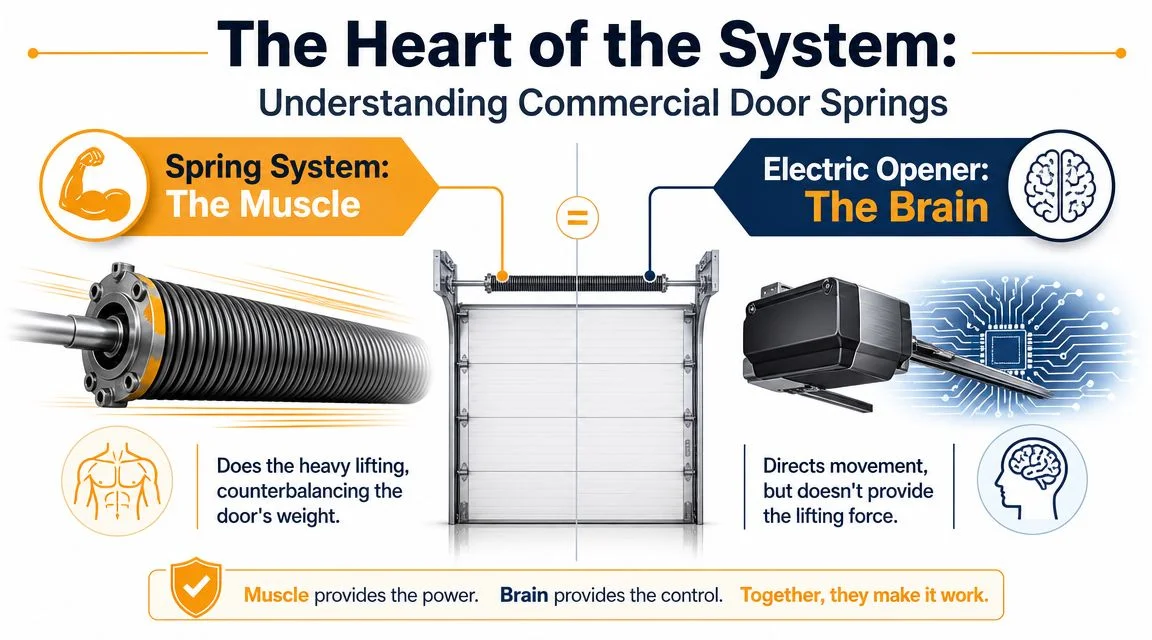
Torsion springs and extension springs
In commercial service, you'll usually be dealing with torsion springs. They mount on a shaft above the opening and store energy as the door closes. That energy turns the shaft through the cable drums as the door opens, which gives you better control of balance across the full travel.
Extension springs work by stretching along the horizontal tracks. They still show up on some older or lighter-duty doors, but they are less common on busy commercial openings because they offer less precise control and tend to be a poorer fit for heavier doors, frequent cycling, and tighter uptime expectations.
That distinction matters to a facility manager because spring type affects service planning, parts availability, and failure behavior, not just installation layout.
Why correct sizing is an asset decision
Spring replacement is not a simple parts swap. A technician has to match the spring to the actual door system, including inside diameter, wire size, length, wind, door dimensions, track setup, and drum configuration. A spring can look close enough on paper and still leave the door out of balance in the field.
That bad match shows up fast. The operator runs harder than it should. Limit settings drift. Cables can lose even tension. Wear increases on rollers, hinges, and bearings because the counterbalance is doing the wrong job.
If you oversee multiple openings, good records prove their worth. Keep the spring specifications, door weight, cycle demands, and prior service history tied to each opening. If your team needs a baseline on failure symptoms and service scope, Wilcox Door outlines the practical issues in its page on commercial garage door spring repair.
Cycle life is the number that drives cost
For a facility manager, cycle life is usually the most useful spring metric. One cycle is one full open-and-close action. The question is not whether a spring fits the door. The question is whether it fits the workload.
A low-use storage bay and a shipping door may carry similar door weights but need very different spring strategies. On a loading dock or warehouse traffic lane, paying more for a higher-cycle spring often reduces emergency calls, protects operators, and lowers interruption costs over the life of the opening.
| Opening type | Better spring strategy | Why |
|---|---|---|
| Low-use storage bay | Standard commercial sizing may be enough | Wear builds more slowly |
| Loading dock door | Higher-cycle torsion spring | Frequent cycling shortens spring life |
| Warehouse traffic lane | High-cycle spring with tighter service oversight | Downtime usually costs more than the upgrade |
| Critical access opening | Spring selected for uptime first | Failure affects operations, safety, and access |
A spring should match the opening's duty cycle, not just its dimensions.
That is where many avoidable costs begin. The hardware fits, the door runs, and the opening still ends up too expensive to own because the spring package was chosen for purchase price instead of service life.
Why Springs Fail and The Inherent Safety Risks
Spring failure is rarely random. Most failures come from predictable causes that were either missed, deferred, or built into the original hardware choice.
Metal fatigue is the most common one. Every cycle bends and loads the steel. Over time, that repeated stress weakens the spring until it cracks. Corrosion speeds that process up. So does poor installation, wrong spring sizing, or a door system that was never properly balanced in the first place.
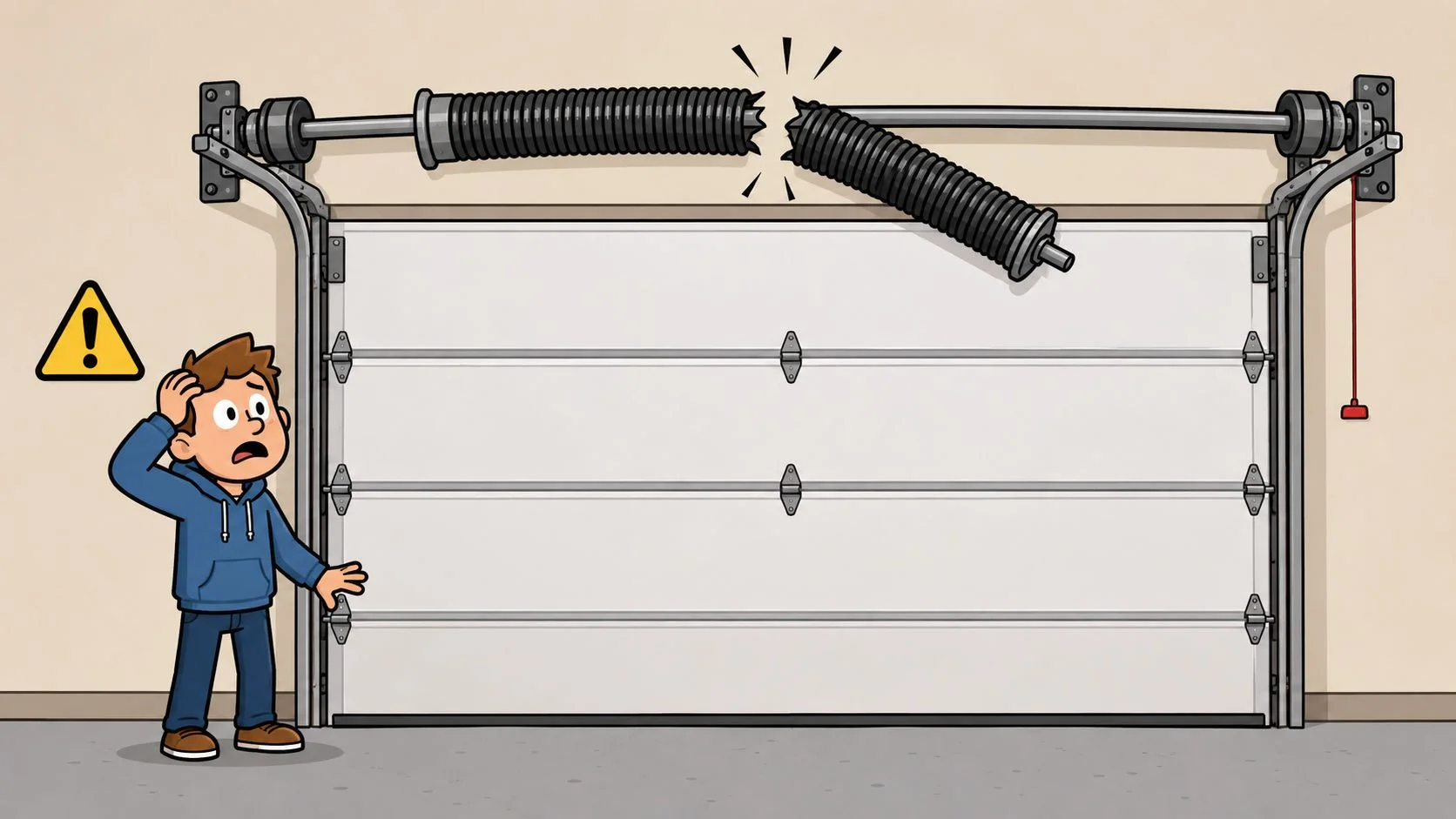
What makes a broken spring dangerous
A torsion spring stores a large amount of energy. That's the whole point of the system. The same energy that helps lift a heavy door becomes a hazard when the spring breaks, slips, or is handled badly.
The risk isn't only the spring itself. The whole door can become unstable. A door that was balanced yesterday can become heavy, crooked, or fast-dropping today. Cables can lose proper tension. Operators can be overloaded. Staff may try to keep using an opening that should be locked out immediately.
Most online material stays focused on DIY steps, but facility managers need the opposite perspective: what happens after installation, how to spot warning signs, and how to control risk around active openings. The overhead-door trade involves serious struck-by, caught-in, and stored-energy hazards, as noted in this overhead door spring safety guidance.
The business impact is usually worse than the part cost
For a commercial property, a broken spring can create a chain of problems:
- Dock interruption. Trucks queue up while one bay is down.
- Security exposure. A door stuck open leaves product or equipment exposed.
- Safety concerns. Staff may be tempted to force the door or work around it.
- Emergency repair pressure. You're buying speed under bad conditions, not planning under controlled ones.
That last point matters. Emergency service almost always comes with more pressure, less flexibility, and harder operating decisions. A planned spring replacement can be scheduled around traffic. A failed spring makes the schedule for you.
Warning signs that shouldn't be ignored
Most spring failures give clues first. Common ones include:
- A visible gap in a torsion spring after it breaks
- A door that suddenly feels heavy in manual operation
- Uneven travel where one side seems to lag
- A louder-than-normal bang from the header area
- An opener that strains or stops
If the opener is working harder but the door is moving worse, stop using the opening until the counterbalance is checked.
When these signs appear, the right move is to shut the door down, isolate the area if needed, and call a qualified spring repair technician. If you need dedicated repair support for this type of issue, commercial spring repair service is the relevant category to look for.
Your Proactive Spring Maintenance and Inspection Guide
At 6:15 a.m., the first truck is backing into the dock, the operator hits the wall station, and the door hesitates. That is the moment a neglected spring stops being a maintenance item and starts affecting throughput, labor, and site safety. Spring management works best when you treat each opening like an asset with a service history, an expected cycle life, and a clear inspection routine.
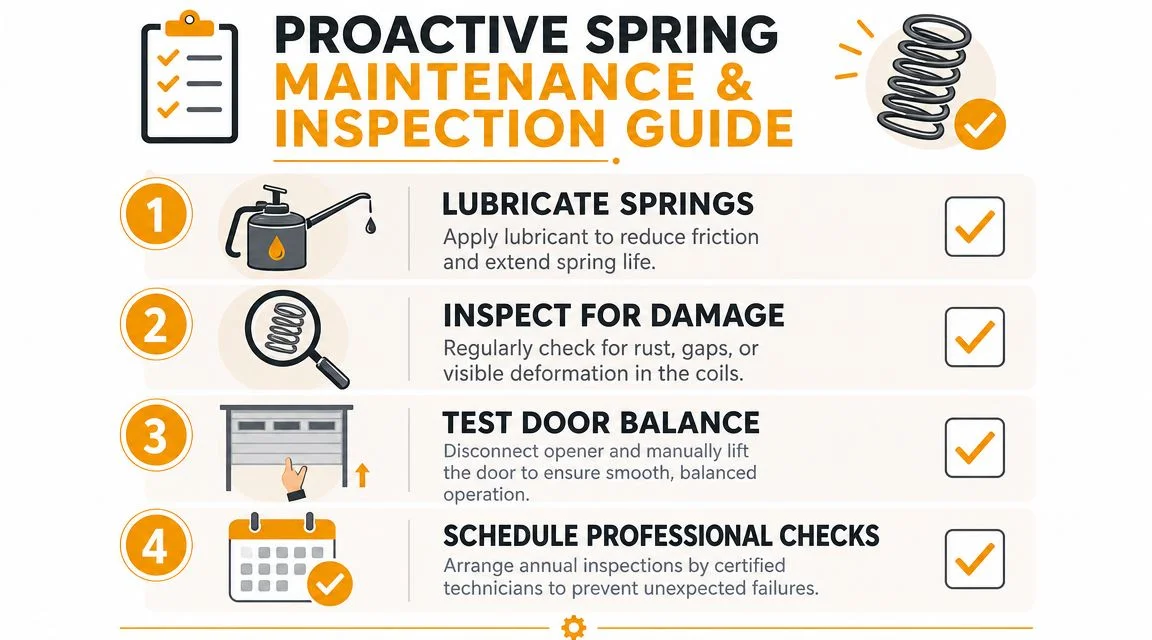
The practical split is simple. Site staff watch for condition changes during normal operation. Qualified technicians handle balance testing, adjustment, measurements, and any work on the counterbalance assembly. That division keeps your team safe and helps you catch problems before they become outage calls.
What on-site staff can check safely
A facility team can spot a lot without touching a spring, shaft, or winding cone. The goal is early reporting, not field repair.
- Look for visible spring defects. Rust, coil separation, gaps, or misshapen coils mean the assembly needs service review.
- Watch the full door cycle. The door should travel evenly and without twisting, jerking, or hanging up at one point in the opening.
- Listen for a change in sound. Popping, snapping, scraping, and grinding noises often show up before a full failure.
- Pay attention to operator behavior. If the motor sounds strained or the door slows down under power, the counterbalance may no longer be carrying its share of the load.
- Check nearby components. Frayed cables, loose bearing plates, worn rollers, and bent track often appear with spring wear, not separately.
Keep the rule clear. Eyes and ears only.
That matters because well-meaning staff often cross the line from inspection into adjustment. On a commercial door, that is where injuries happen.
A safe balance check matters
Balance is one of the best indicators of spring condition, but it is still a controlled inspection task. It should be done by trained personnel under site safety procedures, with the opener disconnected correctly and the area kept clear.
Before showing your team that process, it helps to review a visual example of routine overhead door inspection and maintenance basics:
A properly balanced door should move smoothly by hand and stay reasonably steady when positioned partway open. If it drops, shoots upward, feels unusually heavy, or takes extra force to start moving, the spring system needs technician attention. That does not always mean immediate replacement, but it does mean the opening should be evaluated before you put it back into normal service.
Never ask untrained staff to adjust torsion spring tension. Observation is safe. Spring work is not.
What requires a certified technician
Commercial spring service depends on more than replacing a broken part with one that looks similar. The technician has to confirm spring dimensions, wind, door size, lift path, drum setup, shaft condition, bearing wear, cable fit, and how the opening is used. A door that cycles a few times a day should not be managed the same way as a dock door that runs hard across every shift.
That workload question gets missed all the time. I have seen doors fitted with springs that technically matched the opening but did not match the use pattern. The result is short service life, more calls, and more disruption than the original savings ever justified.
A good technician also documents what was found, what was adjusted, and what is approaching end of life. For a facility manager, that record matters as much as the repair itself because it gives you something to plan around instead of reacting opening by opening.
Planned maintenance beats guesswork
If you manage multiple doors, informal checks are not enough. You need inspection intervals, service records, lubrication points, condition notes, and a way to identify which openings are becoming risk points. A planned garage door maintenance programme gives you that structure and helps turn spring replacement into scheduled work instead of emergency work.
Wilcox Door Service Inc. offers that kind of structured commercial support for facilities that need consistent inspection records and service planning across one site or a larger portfolio. That approach improves uptime, gives you cleaner budgeting decisions, and reduces the odds that a spring problem shows up at the worst possible hour.
Budgeting for Spring Replacement and Lifecycle Costs
Spring budgeting goes wrong when buyers focus only on the invoice for the next repair. The better way is to budget by total cost of ownership. That means looking at the spring, the labour, the expected use of the opening, and the cost of the failure mode if you wait too long.
National pricing benchmarks show garage door spring replacement typically averages around $250, with most jobs falling between $150 and $350, and labour for commercial-grade springs can add $150 to $300 per job according to Angi's garage door spring replacement cost guide.
Why the cheapest spring can become the expensive option
On a low-use door, a basic replacement may be perfectly reasonable. On a high-cycle loading dock door, that same decision can backfire.
If the opening runs hard every day, a lower-cycle spring may force more frequent replacement intervals. Each replacement brings more labour, more scheduling, more service administration, and more chances for unplanned downtime. The part price may be lower, but the operating cost is not.
A better budgeting conversation asks:
| Budget question | What it tells you |
|---|---|
| How critical is the opening? | A failure on a key dock or secure opening has bigger operational consequences |
| How often is it used? | Higher use often supports a higher-cycle spring strategy |
| Can replacement be scheduled? | Planned service is usually easier to control than a breakdown response |
| What else is wearing with it? | Cables, bearings, and operators may also need attention |
Planned replacement usually gives you more control
Commercial spring labour can add meaningful cost to each job. That's exactly why proactive replacement during scheduled service often makes more sense than paying for the same work under urgent conditions.
This isn't only about reducing spend. It's also about choosing when a door goes offline. A facility that plans spring work can stage labour, reroute traffic, notify tenants or shipping teams, and avoid the pressure that comes with same-day failure.
For multi-door properties, grouping spring work can also simplify purchasing and service coordination. You're dealing with one controlled maintenance event instead of several separate failures scattered across the year.
Build the budget around door role, not just door count
Two doors in the same building can deserve very different spring strategies. A little-used maintenance bay and an active shipping lane are not equal assets. Treating them the same usually leads to either overspending on one or underprotecting the other.
Budget spring work by opening criticality, daily use, and downtime impact. That gives you a truer cost picture than a flat per-door allowance.
If you're trying to compare repair versus replacement planning, a commercial door repair cost guide can help frame the discussion in broader maintenance terms.
Partnering with a Professional for Installation and Service
Spring work is where technical judgement, safety practice, and facility liability all meet. That's why choosing a service partner isn't just a procurement exercise. It's a risk decision.
A contractor who can physically install a spring isn't necessarily giving you the right answer for the opening, the site conditions, or the compliance context around the building. Commercial facilities need more than a generic replacement. They need the right counterbalance strategy for the door's environment, duty level, and safety requirements.
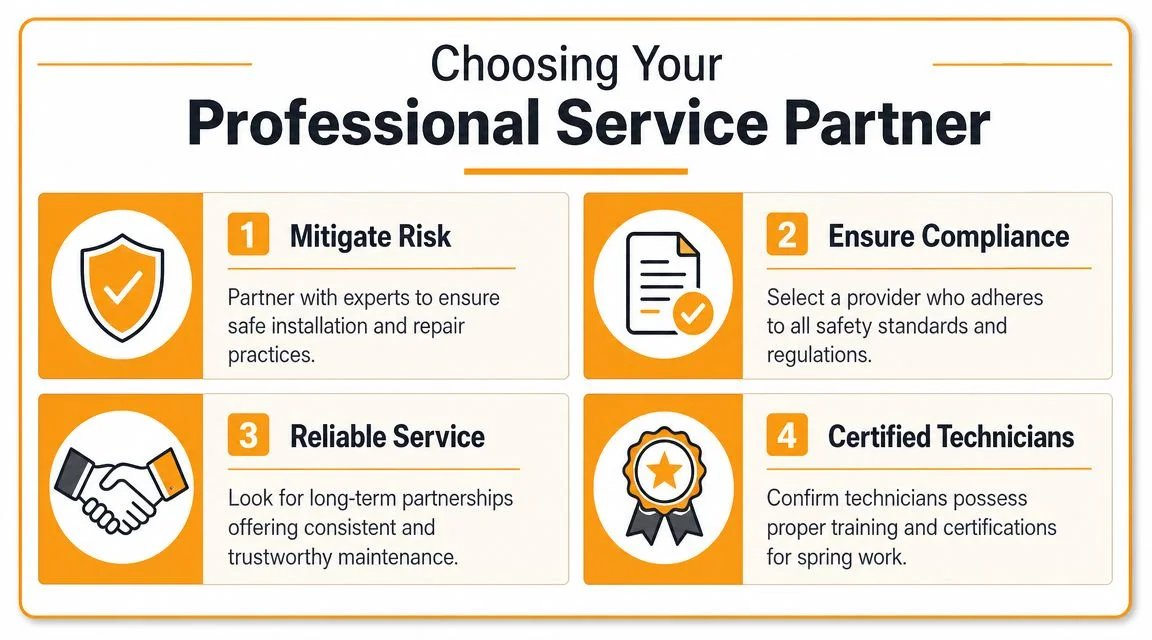
Regional conditions change the right answer
The correct garage door installation spring setup can vary by local conditions. In coastal environments, corrosion protection matters more. In heavy industrial settings, contamination and abrasive dust can shorten component life. In high-traffic logistics buildings, cycle demand changes what counts as an acceptable spring specification.
Building requirements matter too. As U.S. Department of Energy guidance on building energy codes notes, building codes increasingly prioritise energy performance, which makes proper door sealing and reliable counterbalance systems more important. A spring decision affects how consistently a door closes, seals, and operates within the rest of the opening.
What to ask before you hire
A reliable commercial door partner should be able to answer practical questions without hand-waving.
- How do you size the replacement spring? They should talk about full door-system measurements, not just “matching what's there.”
- How do you handle safety around stored energy? They should have clear procedures for lockout, controlled service, and reopening.
- Can you support planned maintenance as well as emergency calls? You want both.
- Do your technicians regularly work on commercial and industrial openings? Experience with loading docks, sectional doors, and high-cycle environments matters.
- Can you identify related wear while the spring system is open? Good service catches cable, drum, bearing, and balance issues at the same time.
The value is in risk transfer and consistency
A professional partner helps transfer risk away from your internal team. That includes safer service execution, better documentation, better replacement decisions, and fewer situations where staff feel pressured to improvise around a compromised door.
That consistency matters most in multi-site portfolios and critical operations. You want the same inspection logic, the same service standard, and the same reporting language from one facility to the next.
Good spring service doesn't end when the door works again. It includes knowing why it failed, what else was affected, and when the next intervention should happen.
If your operation depends on dock flow, secure access, or scheduled tenant service, that level of support isn't a luxury. It's part of responsible asset management. The right partner brings technical skill, safety discipline, and a service model that fits how your building runs.
If you need help evaluating a garage door installation spring issue, planning a proactive replacement, or setting up a maintenance schedule across commercial openings, contact Wilcox Door Service Inc. to discuss your facility's requirements and next service step.