


A typical commercial door repair service call often starts in the $250 to $500 range for labour before parts, travel, or emergency premiums are added. For many facilities, though, the true door repair cost isn't the invoice alone. It's the cost of a bay door stuck open during a shift change, a rolling fire door that won't pass inspection, or a dock position that slows trailers because the opening can't be used safely.
That's the situation many facility managers face. The door itself is one asset, but the opening supports security, traffic flow, safety, energy control, and compliance all at once. When it fails, the repair decision becomes a business decision.
Generic residential price lists don't help much here. A warehouse sectional door, a high-speed fabric door, a rolling steel fire door, and a pedestrian access door all fail in different ways and create different consequences. The same hinge issue that is minor in an office can become urgent at a loading dock.
This guide looks at door repair cost the way commercial operators need to look at it. Labour, parts, dispatch fees, emergency response, compliance obligations, downtime risk, and the point where replacement becomes the smarter financial move.
Meta description: Commercial door repair cost explained for facility managers. Learn labour, parts, compliance, and maintenance strategies to control total cost.
Understanding Your Total Door Repair Cost
A door failure usually starts with a small symptom. The closer drifts. The latch stops lining up. The sectional door hesitates on the way up. Then someone forces it, the hardware wears faster, and a routine repair becomes an urgent one.
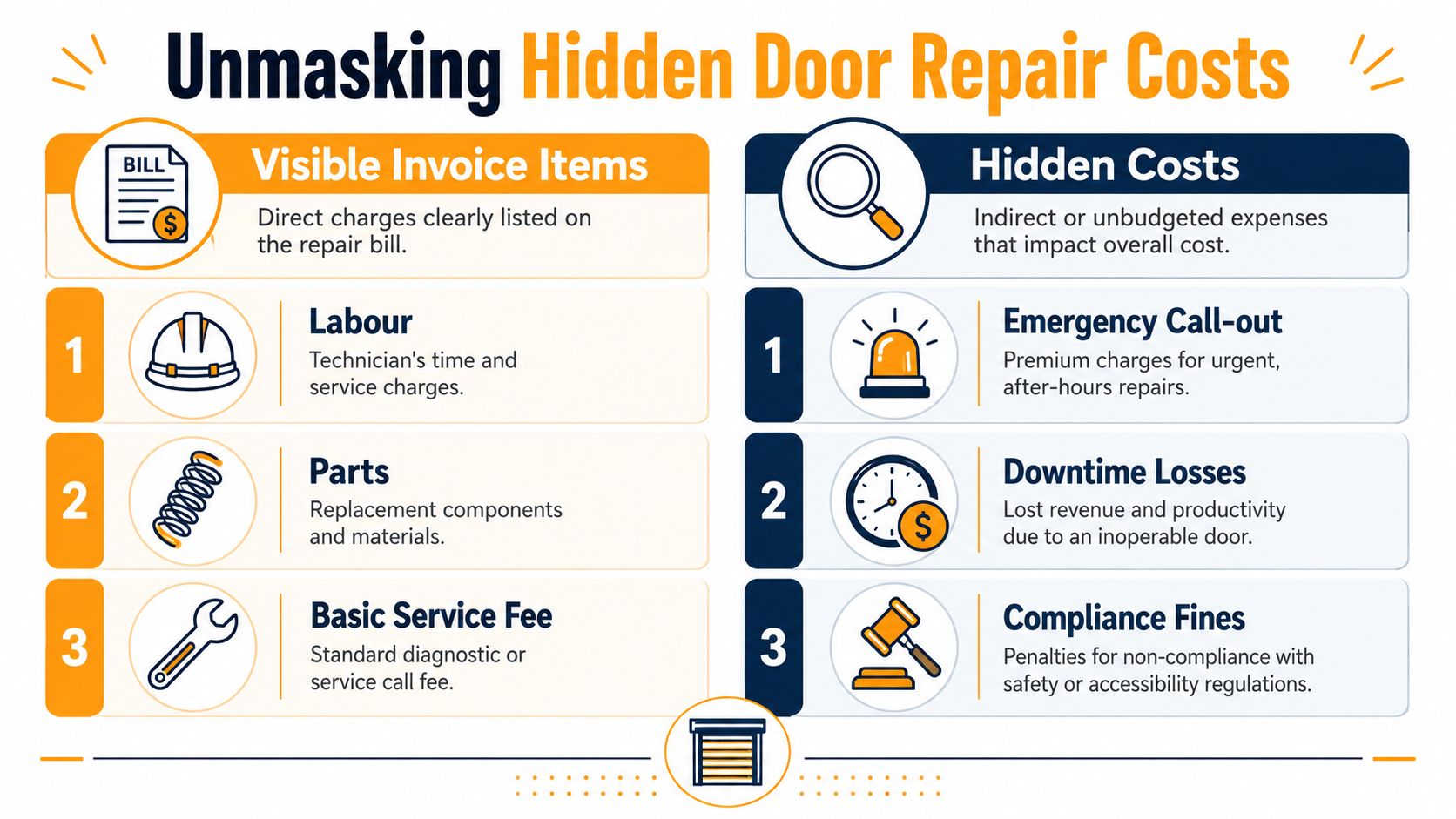
For budgeting, it helps to split door repair cost into two buckets. The first is the direct service cost. That includes the technician, replacement parts, and any dispatch or access-related charges. The second is the business cost. That includes delayed shipments, blocked routes, staff workarounds, temporary security exposure, and compliance risk if the opening is fire-rated or safety-sensitive.
The broader repair environment matters too. The Federal Reserve Bank of Philadelphia's 2025 briefing, using American Housing Survey repair-cost methodology, notes that common structural repairs, a category that includes doors, accounted for 54% of aggregate repair spending, and inflation-adjusted costs increased 13.3% between 2022 and 2024 (Philadelphia Fed briefing on home repair costs). That's a useful reminder that openings no longer sit in the “small maintenance item” category for many buildings.
What counts toward the real cost
- Direct invoice cost: Labour, parts, travel, lifts, and after-hours response.
- Operational cost: Delays at docks, rerouted traffic, added security coverage, or staff time spent babysitting a bad opening.
- Asset-life cost: Repeated small repairs on a failing door can cost more than one proper corrective job.
- Risk cost: A non-compliant fire door or unreliable egress opening creates exposure that won't appear on the technician's invoice.
Practical rule: If a door affects shipping, life safety, or controlled access, the cheapest repair quote is rarely the lowest total cost.
Facility teams that already budget for restoration and building recovery will recognise the same pattern in other trades. The logic behind understanding water restoration pricing is similar. The visible service invoice is only one piece of the total event cost.
Deconstructing the Repair Invoice Labour Parts and Other Fees
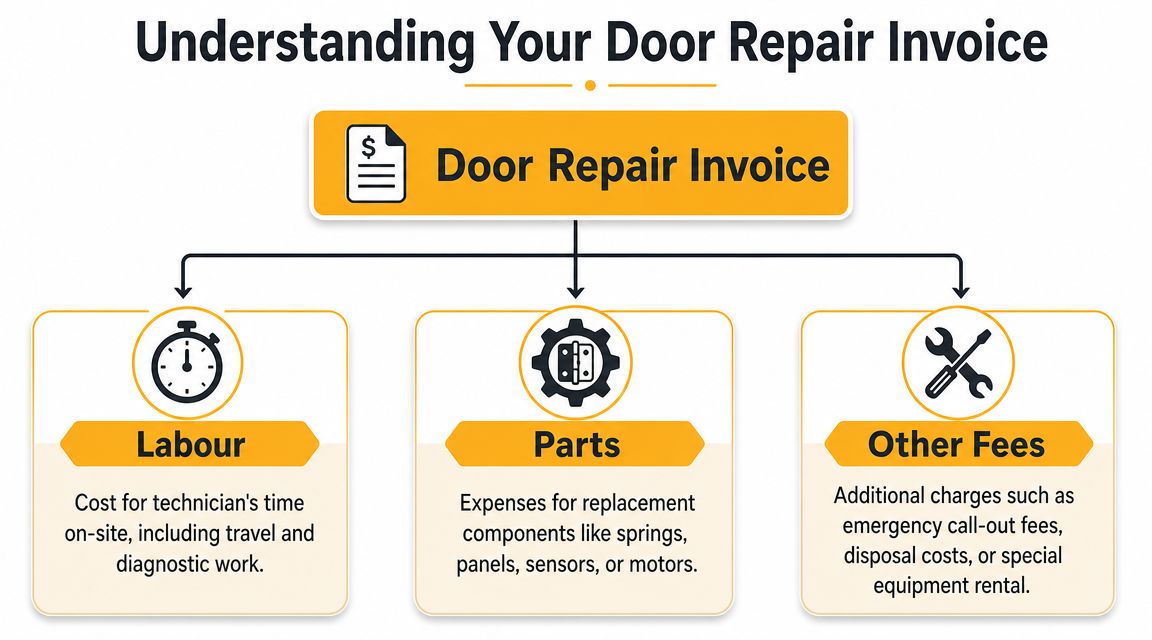
Most commercial repair invoices break into three parts. Labour is usually the biggest one. Parts come next. Then there are service-related charges that many buyers don't think about until the work order arrives.
Labour usually drives the invoice
In commercial work, you're not paying only for wrench time. You're paying for diagnosis, safe lockout, access setup, adjustment, testing, and confirmation that the opening cycles properly before the technician leaves.
That's why labour often dominates the cost of a commercial door repair. The underlying problems, such as alignment, closer adjustment, latch reset, and operator diagnostics, are more sensitive to technician time than to the price of the replacement part. U.S. wage data shows mechanical door repairers earn a median wage of $23.39 per hour and a median annual wage of $48,650, which fits specialised field service rather than general handyman work (BLS occupational wage data for mechanical door repairers).
A simple example makes this clear. Replacing a strike plate is cheap. Getting a commercial aluminium entrance door to latch correctly may still take time if the frame has shifted, the closer speed is off, and the weather seal is dragging. The hardware is minor. The diagnosis is not.
Parts don't tell the whole story
Parts pricing changes with the type of opening and the consequence of failure.
A hinge, roller, cable, photo eye, bottom seal, or closer is one thing. A rolling steel operator board, fire-door release component, specialty spring, or custom panel is another. OEM parts can improve fit and warranty alignment. Aftermarket parts can lower cost when they match the application properly. The wrong low-cost part often creates a second service call.
A cheap part that causes another shutdown next month wasn't cheap. It just delayed the full cost.
Other fees that affect the final number
Many buyers focus on labour and parts, then get surprised by the service line items around the job. Those charges usually exist for a reason.
- Dispatch or travel: Remote sites, multi-stop routes, and urban access delays all affect service economics.
- Equipment access: Some repairs need ladders, lifts, fall protection, or additional crew support.
- After-hours response: Nights, weekends, and plant shutdown windows usually cost more because labour scheduling is tighter.
- Return visits: If a specialty part isn't stocked locally, the first visit may diagnose and secure the opening, and a second visit finishes the repair.
How to read a quote properly
When you review a repair quote, look for these questions:
- What problem is being corrected? Symptom and root cause aren't always the same.
- Is the opening being restored to safe function or full performance? Those can be different scopes.
- Are parts identified clearly? Especially on operators, fire doors, and high-cycle applications.
- Is testing included? Commercial doors should be cycled and verified before closeout.
A clear invoice doesn't just tell you what you're paying. It tells you whether the problem is likely to stay fixed.
Typical Repair Costs for Commercial and Industrial Doors
Commercial buyers usually want a budgeting range, not a vague “it depends.” That's reasonable. The challenge is that consumer repair guides mostly describe residential situations, while commercial openings involve heavier hardware, access constraints, and higher business consequences.
Independent consumer data is still useful as a floor-level benchmark. Typical door repair jobs often average around $239, with a common range of roughly $132 to $372 for standard repairs, and more substantial frame-related work can run about $350 to $850, while replacement can move to $1,100 or more when damage is severe in a residential context (Angi door repair cost guide). Commercial and industrial jobs often land above those figures because the opening is larger, cycles harder, and requires specialised service conditions.
Estimated Commercial Door Repair Costs 2026
| Door Type & Repair | Typical Cost Range (CAD) |
|---|---|
| Pedestrian commercial door adjustment, latch alignment, or closer reset | $250 to $500 labour, plus parts if needed |
| Sectional overhead door cable, roller, or track correction | $350 to $900 |
| Dock door bottom seal, hardware correction, or minor panel-related service | $300 to $900 |
| Rolling steel door operator troubleshooting and control-related repair | $500 to $1,500+ |
| High-speed door sensor, curtain alignment, or reset service | $500 to $1,500+ |
| Fire-rated door corrective repair tied to inspection findings | $500 to $1,500+ |
| Major frame or opening-related corrective work | $700 to $1,500+ |
| Severe damage requiring partial rebuild or replacement planning | Often better assessed as repair-versus-replace |
These are planning ranges, not a price sheet. Actual cost depends on site access, urgency, the exact hardware, and whether the first visit can complete the repair.
What pushes a job to the low or high end
At the low end, the issue is isolated and the opening is accessible. Think of a closer that needs adjustment, a latch that needs realignment, or a sectional door that needs straightforward hardware service.
At the high end, the job gets more involved. The technician may need to correct damage caused by continued use after failure, work around occupied production areas, source special components, or test code-sensitive hardware before the opening can return to service.
A common warehouse example is a sectional overhead door that gets struck by a forklift. If the impact only knocks a roller out of the track, the repair may stay contained. If the track twists, the panel binds, and the operator keeps trying to run the door, the scope grows quickly.
Why door type matters
Different openings fail in different ways:
- Sectional overhead doors: Cables, rollers, tracks, hinges, springs, and operator settings are common service points.
- Rolling steel doors: End locks, guides, slats, tension, and operators can all be involved.
- High-speed doors: Sensors, curtain alignment, breakaway reset, control boards, and safety devices matter more than raw material cost.
- Pedestrian and access doors: Closers, pivots, latches, strikes, panic hardware, and frame alignment often drive labour.
If you're pricing a current issue on a warehouse or plant opening, a commercial-specific provider for overhead door repair will usually give a more useful estimate than any residential comparison tool.
If the opening is mission-critical, budget for the repair based on consequence, not just the hardware involved.
Hidden Costs Emergency Service and Compliance Mandates
A dock door fails at 5:10 p.m., the last outbound truck is waiting, and the opening will not close. The repair invoice matters, but the larger cost usually sits outside the invoice. Overtime starts, shipping slips, security coverage changes, and the facility pays for urgency.
Emergency service changes the economics
Emergency calls carry a different cost structure than scheduled work. The provider is reshuffling technicians, dispatch, vehicles, and stocked parts to restore access, secure the building, or keep freight moving. After-hours rates are only one piece of that premium.
The larger expense often comes from what the failed opening disrupts.
A jammed sectional door can reroute forklift traffic and slow loading. A rolling steel door stuck open can force temporary security measures. A failed entrance door can create access control problems, staffing headaches, and liability exposure if people start using a secondary route that was never meant to handle that volume.
I tell facility teams to price emergency repairs against consequence, not against a consumer average. If the opening protects inventory, supports production, or controls egress, delay is expensive even when the part itself is not.
Compliance costs follow business rules, not household repair math
Commercial door repairs often carry requirements that residential price guides ignore. Fire doors, egress doors, and controlled-access openings need to do more than operate. They need to perform correctly under code, manufacturer, and life-safety requirements.
That changes the scope of work. A closer adjustment on a rated opening may also require latch verification, hardware inspection, and records that show the assembly was returned to proper function. If someone cut in unapproved hardware, altered the frame, disabled a coordinator, or bypassed a release device, the repair can no longer be treated as a simple service call.
Documentation has a cost. So does failed documentation.
Teams dealing with recurring compliance issues often discover that repeated repairs on an aging asset are not the cheapest path. In those cases, it helps to compare the current repair burden against the cost to replace a commercial garage door and reset the lifecycle.
The hidden line item is proof
In a commercial setting, the job may include inspection logs, test results, adjustment records, and confirmation that the opening meets its intended function after service. That administrative work protects the owner just as much as the mechanical repair.
The same pattern shows up in other compliance work. ADA Compliance Pros on WCAG limitations makes the broader point well. Partial compliance leaves the underlying risk in place.
A door that partly meets the requirement still leaves the facility exposed.
Where delay gets expensive fast
Some issues can wait for a planned service window. Others should move to the top of the queue the same day.
Use a short response threshold for openings tied to:
- Fire separation: Rolling fire doors, fire shutters, and rated pedestrian doors
- Shipping and receiving: Dock doors, restraints, and high-cycle overhead doors
- Security: Exterior man doors, grilles, and doors serving controlled spaces
- Safe egress: Panic hardware, closers, and doors on occupant exit routes
Deferred action rarely stays cheap in these cases. A failed opening can trigger added labour, temporary operating procedures, compliance exposure, and larger repairs caused by continued use after the initial fault.
Repair or Replace A Lifecycle and ROI Analysis
The wrong question is “Can we repair it?” Most doors can be repaired. The better question is “Should we keep repairing this asset?”
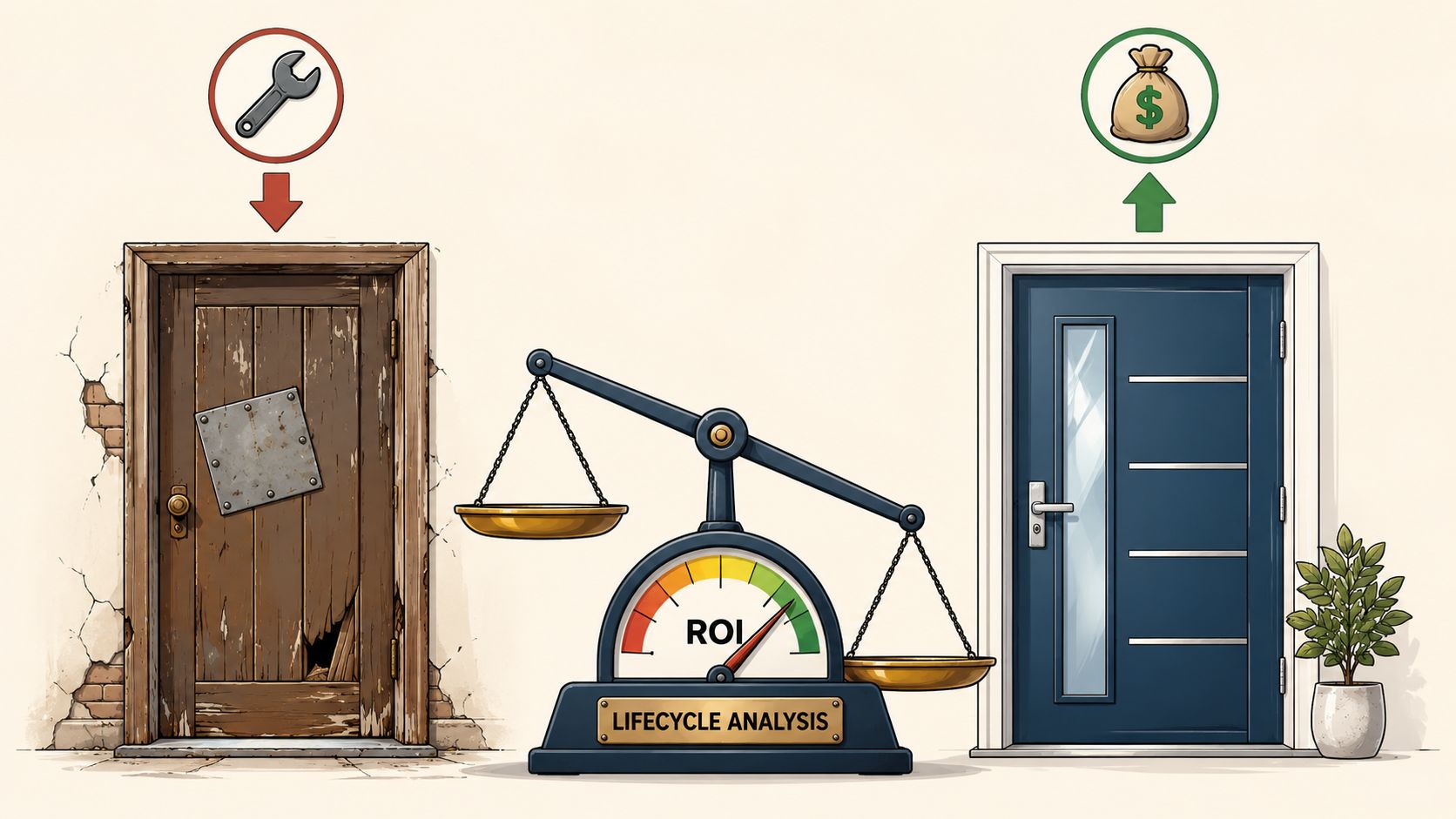
A repair decision based only on this month's invoice often leads to repeated spending on an opening that is already telling you it's nearing the end of its useful life. That's especially true with old rolling steel doors, poorly insulated sectional doors, and entrances with recurring frame or hardware misalignment.
Market data shows the economics are shifting. A 2025 market report says repair and maintenance services were expected to make up 46.2% of the garage door service market, while the average garage door replacement cost was estimated at $4,672 and resale value added was $12,507, implying 267.7% cost recoupment (2025 garage door market report). That's residential data, but the underlying lesson carries over. Replacement can create a stronger long-term financial case when the asset is structurally tired, inefficient, or expensive to keep in service.
Signs the repair cycle is no longer economical
A repair-first strategy stops making sense when the same opening keeps consuming labour, disrupting operations, or forcing temporary fixes.
Look closely when you see this pattern:
- Repeat service calls: The door works for a while, then the same symptom returns.
- Progressive damage: A hardware issue has started to affect track, frame, operator, or panel condition.
- Operational sensitivity: The opening serves a dock, clean area, cold storage zone, or security line where failures are costly.
- Outdated performance: The existing system no longer supports energy, safety, or traffic needs.
One practical way to think about the decision is the same way adjusters evaluate building loss settlement. The difference between patching today's issue and restoring long-term value is similar to understanding insurance claim valuations. The lowest immediate spend doesn't always protect the asset best.
A useful lifecycle test
Ask these five questions before approving another major repair:
- Is the door structurally sound? If the opening is out of square or repeatedly damaged, hardware replacement won't solve the root issue.
- How often does it fail? Frequency matters more than one isolated invoice.
- What happens when it's down? A non-critical storage room door is not the same as a dock or fire opening.
- Are parts becoming harder to source? Delays and workarounds raise future service costs.
- Would a newer system improve operations? Better sealing, insulation, speed, safety devices, and controls can reduce other building costs.
A commercial buyer comparing repair with new installation also needs a realistic replacement benchmark. For budgeting a larger capital decision, replacement garage door cost is a useful starting point.
A short video can help frame that decision in practical terms:
What usually works better in practice
For a newer door with isolated wear, repair is often the sensible move. For an older opening with recurring faults, replacement usually wins because it cuts repeat labour, reduces emergency exposure, and improves reliability.
“If your team is already planning around a door's next failure, you're no longer managing a repair. You're managing an underperforming asset.”
Hiring a Partner for Reliable Service and Cost Control
A dock door fails at 6:15 a.m., trucks are stacking up, operations wants it fixed before the next shift change, and the only number on file is whoever answered last time. That is how repair cost gets out of control. The invoice covers the technician's time, but the larger cost usually comes from delay, repeat visits, inconsistent parts, and no clear plan for the rest of the opening inventory.
What to ask before awarding the work
A commercial door contractor should be able to discuss risk, downtime, and asset history, not just quote an hourly rate.
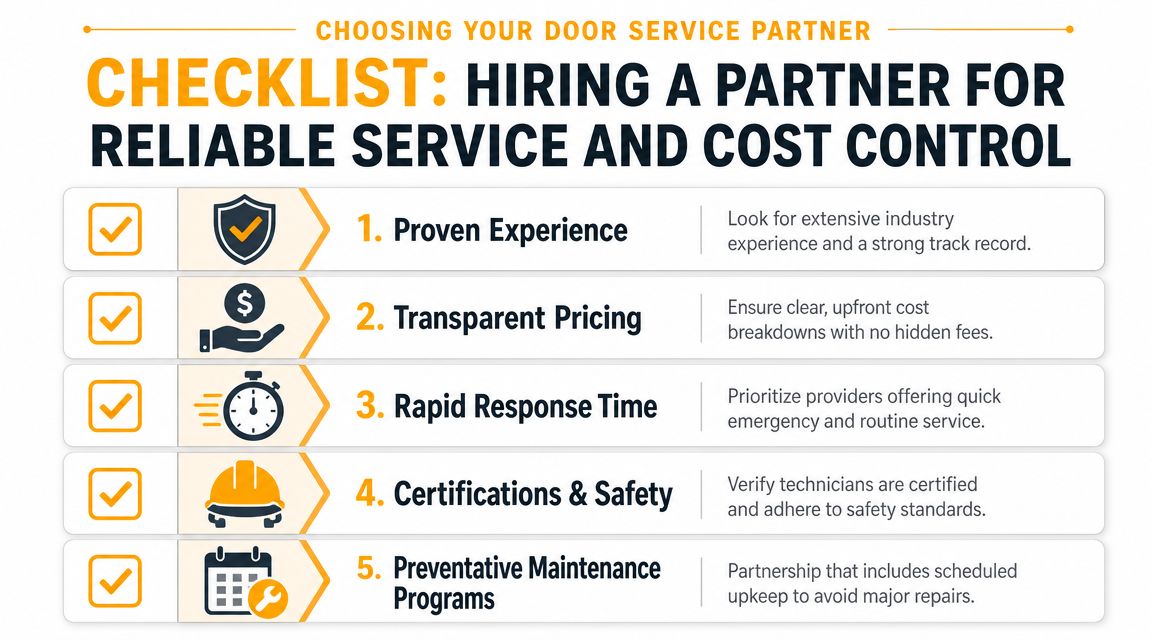
Use this checklist:
- Experience with your opening type: Ask whether they regularly service sectional doors, high-speed doors, rolling steel doors, dock equipment, fire doors, or pedestrian access systems like yours.
- Clear pricing structure: Ask how they bill labour, travel, after-hours response, diagnostics, and return trips.
- Safety and certification: Confirm technician training, site safety practices, and whether they can perform code-sensitive work correctly.
- Parts strategy: Ask whether they use OEM parts, approved substitutes, or application-based replacements, and how they handle obsolete components.
- Documentation: For fire-rated or compliance-related openings, ask what inspection records, deficiency notes, and service reports you will receive.
Why first-visit resolution affects total cost
A lower hourly rate does not help much if the technician misdiagnoses the problem, leaves to source parts, and returns the next day while the opening stays down.
Facility managers should judge providers on first-visit resolution, quality of diagnosis, and ability to spot related wear before it turns into another service call. Planned maintenance usually costs less than repeated emergency response because it shifts spend from premium dispatch to scheduled labour, and it reduces the chance that a small adjustment turns into a damaged operator, failed spring assembly, or bent track.
One avoidable breakdown at a shipping, security, or fire-rated opening can wipe out months of deferred maintenance savings.
The right provider manages assets, not isolated tickets
The strongest service relationships improve budget control because they organize repair decisions across the full door inventory.
A useful partner should help you:
- identify which openings carry the highest operational or compliance risk
- separate cosmetic issues from reliability and life-safety priorities
- track recurring failures by door, location, and component
- standardize hardware, records, and service history across sites where practical
For multi-site teams, a structured facility maintenance services program makes spending easier to forecast and easier to defend during budget reviews.
What creates avoidable cost in the field
Three patterns show up again and again:
- Using residential pricing assumptions for commercial or industrial openings
- Waiting on small adjustments until they create secondary damage
- Approving repairs without tracking asset history, part usage, and repeat failure points
Wilcox Door Service Inc. is one example of a commercial provider that offers emergency repair, planned maintenance, fire door testing, and broader door, dock, and access support for facilities that need one service record across multiple opening types. For many sites, that approach is more practical than calling separate trades for each symptom and trying to piece the history together later.
The goal is straightforward. Reduce breakdowns, reduce repeat labour, and keep door spend predictable enough to manage like any other building asset.
If you need a practical estimate for your facility's door repair cost, contact Wilcox Door Service Inc. for a quote or schedule a service inspection. A clear assessment now can prevent emergency spending later and keep your openings safe, compliant, and operational.