


The utility bill lands on your desk, and the total is higher again. You walk the floor, see lights, fans, forklifts, heaters, dock traffic, and a dozen moving parts, but the underlying cause still feels blurry. That's a common place for a new facility manager to start.
The good news is that energy cost reduction usually isn't a mystery. It's a process. In most facilities, the fastest progress comes from getting clear on where energy is going, tightening daily operations, and fixing the weak points in the building envelope, especially around commercial doors, loading docks, and air leakage.
A lot of teams start with the obvious targets like lamps and thermostats. Those matter. But in warehouses, plants, and distribution centres, the overlooked losses often happen where the building opens to the outside world. A worn dock seal, a misaligned sectional door, or an access opening that doesn't close properly can force your HVAC system to work all day to correct a problem the opening itself keeps creating.
Your Playbook for Sustainable Energy Cost Reduction
A practical energy plan starts by accepting one reality. Rising energy costs rarely come from one single failure. They usually come from a stack of small issues that have been tolerated for too long.
A dock door stays open during shift change. A weather seal has flattened out. A unit heater runs in a zone that no longer needs it. A shipping bay feels drafty, so someone turns up the heat instead of fixing the opening. None of those decisions look dramatic on their own, but together they drive operating costs up.
The six moves that matter
The facilities teams that make steady progress tend to follow a disciplined sequence:
- Build a baseline so you know where energy use is normal and where it isn't.
- Fix operational waste that can be addressed through habits, scheduling, and maintenance.
- Tighten doors, docks, and openings where air leakage drains money.
- Add controls and automation so savings don't depend on perfect staff behaviour.
- Test larger projects against ROI before you ask for capital.
- Run the work on a timeline with follow-up tracking, not as a one-time campaign.
That order matters. If you jump straight to equipment replacement without dealing with open doors, bad seals, or poor scheduling, you can spend money on a better system that still has to fight the same preventable losses.
Practical rule: Don't upgrade around waste. Remove the waste first, then decide what equipment still needs to be replaced.
What works and what usually disappoints
Some ideas sound efficient but don't hold up well in real operations.
| Approach | What works | What tends to fail |
|---|---|---|
| Bill review | Looking at monthly patterns and anomalies | Only checking total spend |
| Door management | Fast closing, good seals, regular service | Relying on staff reminders alone |
| Capital planning | Phasing projects after audit and review | Buying equipment before measuring the problem |
| Maintenance | Planned inspections on high-use openings | Waiting for breakdowns |
There's also a useful benchmark for teams that are just getting started. A Canada-focused industry resource says most Canadian businesses can cut energy costs by 5% to 10% annually through better data use and operational management, and that these improvements can be achieved without capital investment through stronger measurement and monitoring practices such as monthly bill review and trend analysis, as noted by 360 Energy's guidance on using monthly energy bills to drive cost reduction.
That should reassure any manager facing a first major initiative. You don't need to solve everything in one budget cycle. You need a sequence that produces early wins, supports better decisions, and keeps the facility moving.
Establish Your Energy Baseline with an Audit
If you can't see where energy is being used, you'll end up treating symptoms. The baseline audit is where guesswork stops.
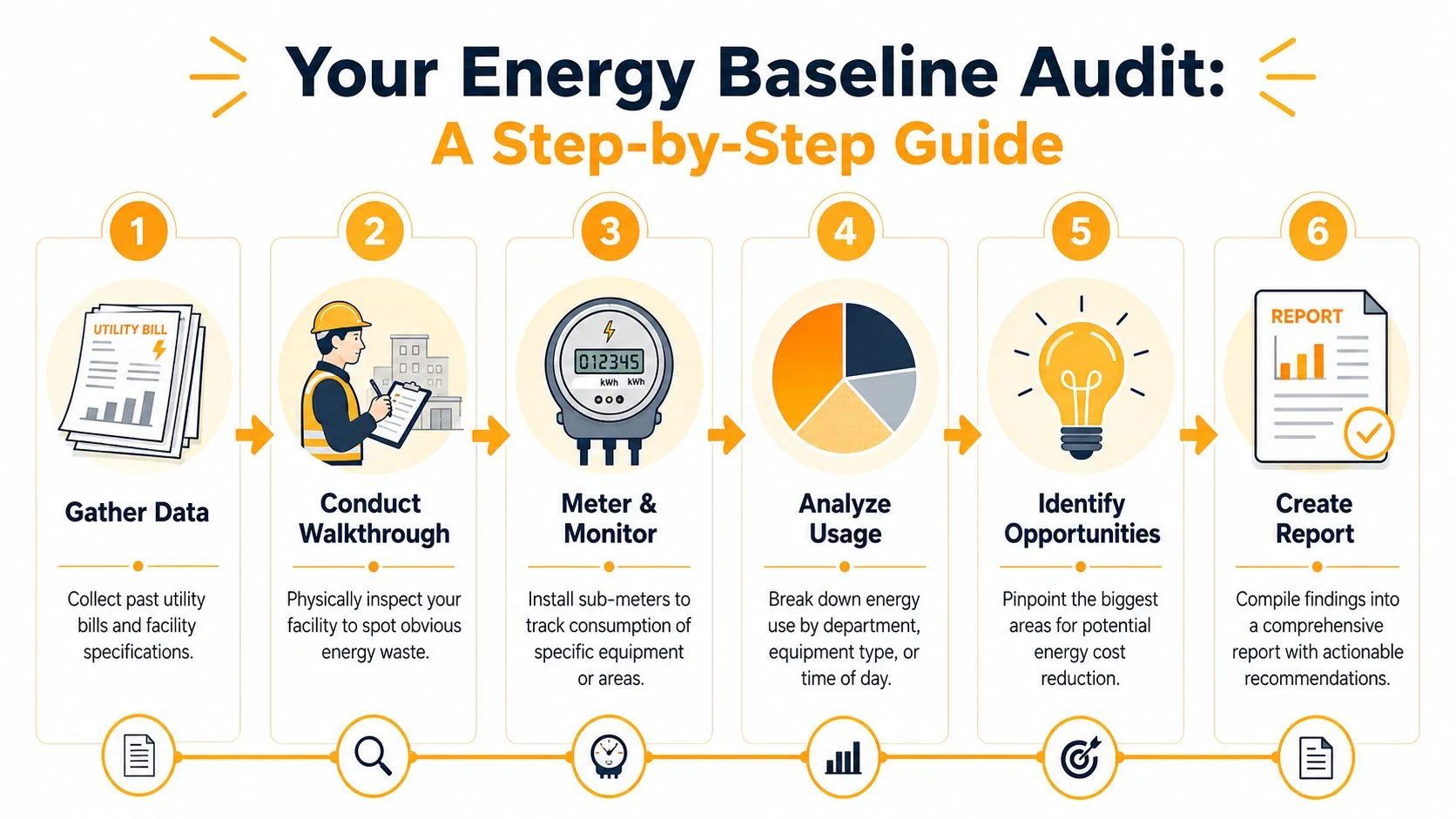
Most managers begin with the utility bill total. That's necessary, but it's not enough. The useful part is the pattern behind the total. Pull together at least a full year of bills, then line them up against seasons, occupancy, production volume, shipping activity, and any maintenance events that changed how the building operated.
What to collect first
Start with the basic record set:
- Utility history: Gather electric and gas bills in one place and note seasonal peaks, unusual spikes, and months where usage doesn't match activity.
- Facility details: Include square footage, operating hours, number of dock positions, heated and cooled zones, and major equipment lists.
- Maintenance records: Look for repeated service calls on doors, operators, dock levelers, air handling, or heating units near exterior openings.
- Site observations: Walk the building while it's busy, not when it's empty. You want to see how the facility behaves under load.
How to turn bills into a useful map
A strong audit doesn't stop at the meter on the building. It breaks the site into zones and asks sharper questions. Which areas stay conditioned with frequent door traffic? Which dock bays have the highest cycling? Which production areas draw power outside expected hours?
That's where sub-metering helps. A sub-meter is a smaller meter placed on a department, process, or equipment group so you can isolate what it consumes. In practice, that can mean tracking a refrigeration area separately from office space, or monitoring a shipping zone with high-speed doors and dock equipment to see what happens during heavy throughput.
Walk the floor with the bills in mind. If the data says use climbs at a certain time of year, there should be an operational reason you can point to.
A simple audit checklist from residential work can also sharpen your eye for leakage and obvious waste. For managers who want a plain-language way to think through openings, insulation, and HVAC interaction, this overview of Superior Home Improvement energy solutions is a useful companion resource, even though commercial sites need a more detailed review.
What your first audit should produce
By the end of this step, you should have:
- An energy baseline: What normal use looks like for your facility.
- A list of anomalies: Bays, systems, or schedules that deserve attention.
- A shortlist of suspects: Openings, poor seals, runtime issues, or areas with avoidable conditioning losses.
- A practical report: Not a binder for a shelf, but a working list of actions tied to operations.
That baseline becomes the standard for every future decision. Without it, every “energy-saving” project is just an opinion with a price tag.
Secure Quick Wins with Operational Fixes
The first savings often come from ordinary discipline. That's why quick wins matter. They reduce waste immediately, and they show your team that energy cost reduction isn't only about buying new equipment.
In real facilities, a surprising amount of loss comes from routine behaviour. Doors are propped open for convenience. Dispatch leaves bays exposed between trailers. Heating and cooling settings drift because no one owns them clearly. Exhaust and make-up air run longer than the workday requires. None of that needs a major capital request to correct.
The checklist to use this month
Focus on the fixes that are cheap, visible, and repeatable:
- Tighten door-closing habits: Train shipping and warehouse staff to avoid unnecessary door-open time. If a door has to stay open for process reasons, define when and why.
- Check opening condition: Inspect bottom seals, perimeter gaskets, glazing, thresholds, and frame alignment on frequently used exterior doors.
- Tune temperature settings: Confirm that setpoints still reflect actual occupancy and process needs, especially in mixed-use spaces.
- Review fan and exhaust schedules: Shut off equipment that's running by habit instead of demand.
- Repair compressed air leaks: These are easy to ignore and expensive to leave untreated.
- Create a dock inspection routine: Watch what happens when a trailer is at the bay. Gaps, daylight, and poor contact all matter.
Planned maintenance saves more than repair costs
A door that opens and closes is not automatically an efficient door. If the closing speed is off, the panel is damaged, the track is out of alignment, or the seal is worn, the opening may be functioning mechanically while still leaking conditioned air.
That's why planned maintenance belongs in an energy strategy. Servicing sectional doors, operators, and dock equipment on a schedule helps each component close properly, seal better, and stay in service longer. For exterior personnel doors and service doors, effective metal exterior door weatherstripping can address one of the most persistent sources of unnoticed air loss.
A noisy, slow, or uneven door isn't just a maintenance issue. It's often an energy issue that shows up later on the utility bill.
Where managers lose momentum
The common mistake is treating quick wins as one-off corrections. Someone reminds staff about doors for a week. Maintenance patches a seal once. Then priorities shift.
Instead, assign ownership:
- Operations owns behaviour at docks and shipping lanes.
- Maintenance owns inspection and repair cycles for openings and related equipment.
- Facilities or finance owns bill review and trend follow-up.
That structure turns “good ideas” into recurring practice. It also prepares the site for the next stage, which is where many of the highest-value savings are hiding.
Fortify Your Building Envelope at Doors and Docks
If a facility manager asks where to look for overlooked energy waste, my first answer is usually the same. Go to the loading dock.
That's where inside air meets weather, traffic, pressure differences, and repeated impact. Lighting upgrades may help. HVAC tuning matters too. But when a facility keeps bleeding air through doors, dock gaps, and transfer openings, the mechanical system is forced to compensate for a problem it didn't create.
Why openings deserve more attention than they get
The biggest bill savings often come from fixing building-envelope leakage at doors and docks. The U.S. Department of Energy analysis cited in its work on energy burden found that cost-effective upgrades such as insulation and more efficient lighting and appliances can reduce household electricity consumption by 13% to 31% across the contiguous states, which highlights the scale of savings that better air sealing can support, even though commercial facilities need site-specific evaluation, according to the U.S. Department of Energy energy burden report.
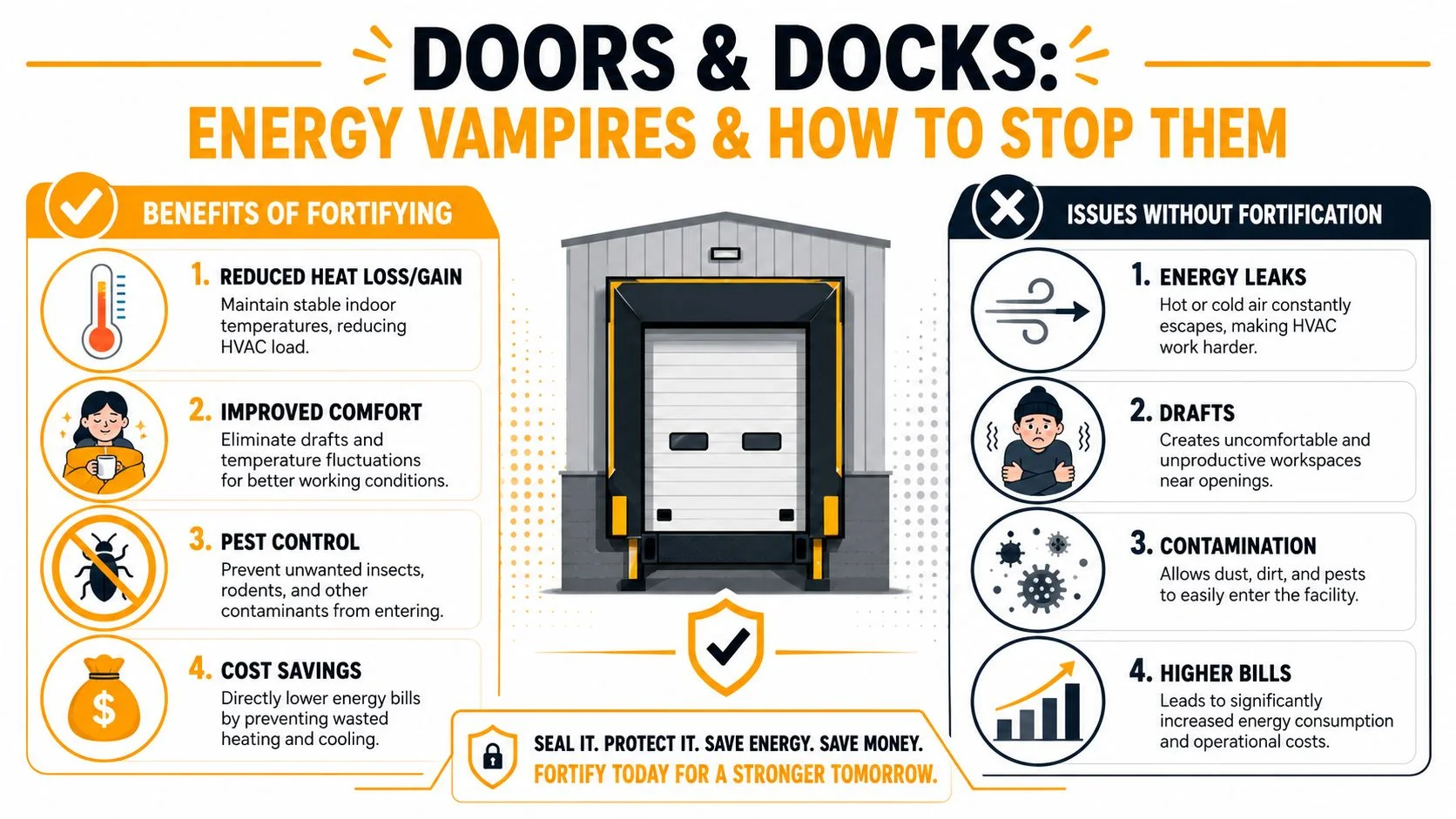
For a warehouse or industrial site, the principle is straightforward. Every poorly sealed opening increases uncontrolled air exchange. In winter, heated air leaves and cold air enters. In warmer months, humid outside air pushes inside and drives additional cooling demand. The HVAC system then runs longer to pull the building back toward setpoint.
The components that usually need attention
When managers inspect the envelope around loading activity, these are the usual weak spots:
- Dock seals and shelters: Worn pads, torn fabric, poor trailer contact, or the wrong style for your trailer mix.
- Sectional overhead doors: Panel damage, misalignment, slow travel, and compressed or missing perimeter seals.
- Personnel doors near shipping zones: Warped slabs, bad closers, damaged sweeps, and latches that don't pull the door tight.
- Pass-through openings: Service doors, transfer openings, and interior-exterior transitions that cycle all day.
- Air movement at dock levelers and pit edges: Less visible, but often easy to feel during cold weather.
What stronger envelope performance looks like
The right fix depends on traffic, temperature requirements, and trailer variation. Compression seals suit some applications. Inflatable shelters make more sense in others where a tighter trailer interface is required. High-speed doors can reduce open time dramatically where forklifts move constantly between zones.
For openings with persistent air intrusion, an air curtain with heater can also help create a controlled barrier at active doorways where a physical door can't stay closed during operations.
If a dock bay feels uncomfortable to stand near, the HVAC system is already paying for that discomfort.
The point isn't to buy every available product. It's to treat doors and docks as part of the conditioned building envelope, not as separate maintenance items. Once managers make that shift, they usually find a larger opportunity than they expected.
Implement Smart Controls and Scheduling
After the physical leaks are addressed, the next source of waste is runtime. Equipment that operates longer than needed can erase the gains you just worked for.
Controls earn their keep. A control is a way to make a system respond to real need instead of habit. That might be a programmable thermostat, an occupancy sensor, a timer, a door auto-close setting, or a building management system rule that links one piece of equipment to another.
Where controls make the biggest difference
Good control strategies are specific. They're not “smart” because they connect to an app. They're smart because they remove avoidable runtime.
Consider these examples:
- Warehouse lighting: Low-traffic aisles, storage mezzanines, and service corridors often benefit from occupancy-based operation.
- Heating and cooling schedules: Zones should reflect actual working hours, not historic assumptions.
- Exhaust and make-up air: Match runtime to process demand and shift patterns.
- High-speed and automated doors: Use close timers and sensor logic that shut the opening as soon as traffic clears.
A high-speed door that closes automatically after forklift passage does two jobs at once. It protects conditioned space and removes the variability of human behaviour. That's usually more reliable than relying on staff reminders, especially on busy shifts.
Keep the controls simple enough to survive
The best controls strategy is one your team will maintain. Overcomplicated schedules and poorly labelled overrides create confusion, and confused systems drift back into waste.
Use a short review table with operations and maintenance:
| System | Question to ask |
|---|---|
| Lighting | Is it on because someone needs it, or because no schedule exists? |
| HVAC | Does this zone follow occupancy or old assumptions? |
| Door operators | Is the opening closing fast enough after traffic clears? |
| Exhaust | Is this running for process need or for convenience? |
For managers who want a plain-language look at current thermostat features and control logic, this guide to smart thermostats for Canadian homes is a helpful reference point. Commercial systems are more complex, but the core lesson still applies. The right schedule and sensor logic can prevent waste before it starts.
A common mistake to avoid
Don't automate a broken process. If a door is slow because the operator needs service, adding rules won't solve the root problem. If a dock opening leaks badly, scheduling the nearby unit heater more carefully won't address the cause.
Controls work best when they sit on top of sound equipment, sound seals, and clear operating rules.
Plan Capital Projects with Clear ROI
Once the no-cost and low-cost fixes are in place, larger investments become easier to justify. The key is not to argue from frustration. Argue from cost-effectiveness.
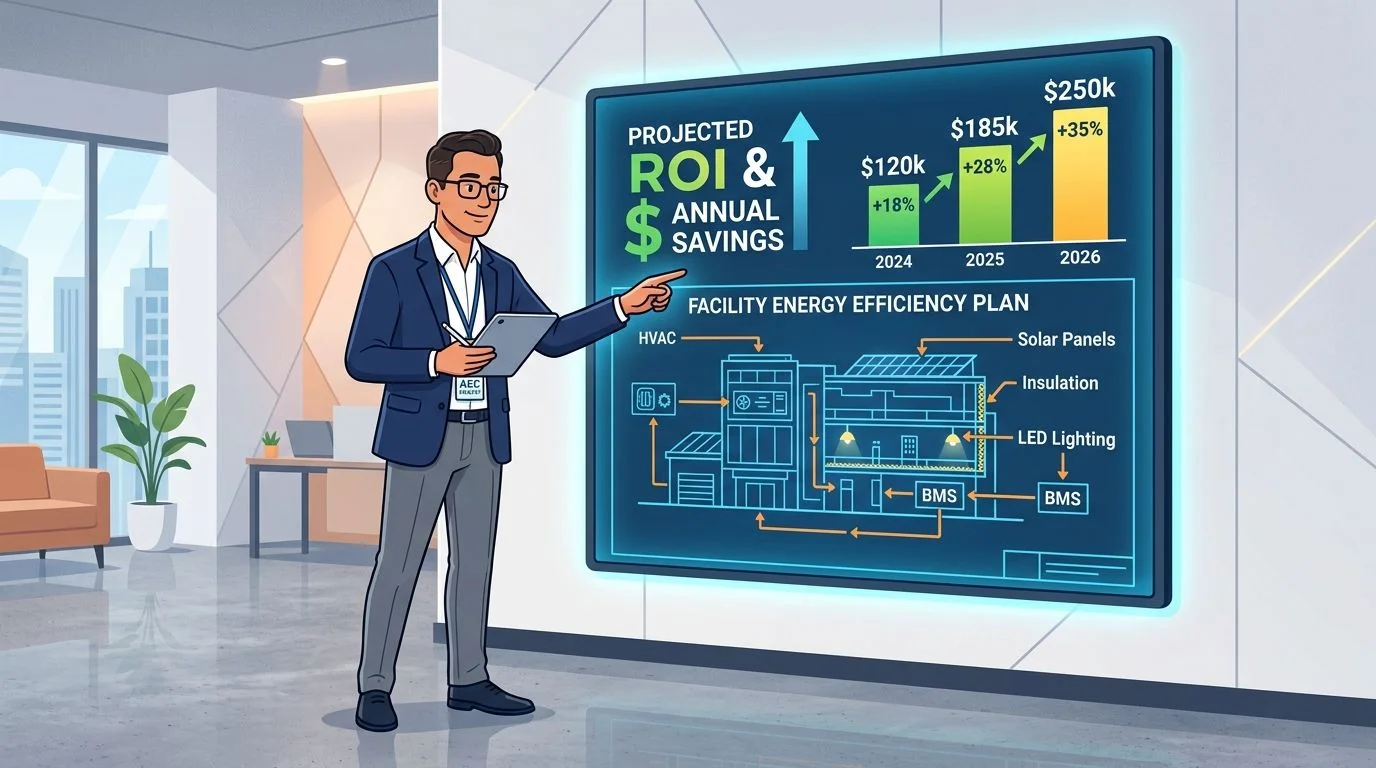
California's commercial energy-code process uses a practical three-step method to test cost-effectiveness: estimate energy and energy-cost savings, estimate the incremental cost of the measure, and compare lifecycle costs using a consistent economic test, as described in the U.S. energy code commercial methodology document. Facility managers can borrow that same structure when evaluating projects.
A simple way to frame the decision
For any proposed capital item, ask three questions:
What does the existing condition cost us now?
Include energy waste, maintenance frequency, downtime risk, comfort complaints, or process disruption.What changes after the upgrade?
Faster cycle time, better sealing, lower service burden, fewer temperature swings, or stronger process control.What does that look like across the full life of the asset?
A cheaper option can still be the more expensive choice if it fails early or leaves operating waste in place.
Here, many projects get approved or rejected. If you only present purchase price, management sees expense. If you present lifecycle impact, management sees an operating decision.
Good examples for door and dock projects
A few capital projects often rise to the top after audit work:
- High-speed fabric doors in high-cycle openings where open time is driving air exchange.
- Full dock shelter or seal replacement where trailer contact is poor across multiple bays.
- Operator upgrades where closing performance is inconsistent or too slow for traffic volume.
- Air separation solutions between conditioned and unconditioned zones.
- Extensive opening retrofits where the slab, frame, hardware, and sealing all contribute to loss.
One practical resource for managers comparing investment logic across energy projects is this Florida solar ROI guide. It focuses on solar, not doors and docks, but it does a useful job of showing how to think beyond sticker price and into total return.
Tie the project back to programmes and incentives
Some projects make more sense when they're aligned with available utility support or broader facility modernisation work. For example, teams considering envelope-related upgrades alongside other efficiency measures may want to review Enbridge gas incentives and Wilcox facility efficiency support as part of their planning.
The video below gives a useful visual frame for discussing project payback and facility efficiency planning with internal stakeholders.
Capital projects should solve verified problems. If the audit didn't identify the issue clearly, the project probably isn't ready for approval.
Create Your Implementation and Improvement Timeline
The facilities that keep reducing costs year after year don't treat energy as a one-time campaign. They run it like an operating discipline.
A practical workflow starts with an audit baseline, then sequences low-capex operational fixes before higher-capex equipment replacement. That order helps ensure major projects only move forward after feasibility and ROI review, as outlined in Usource's guidance on reducing energy consumption and cost.
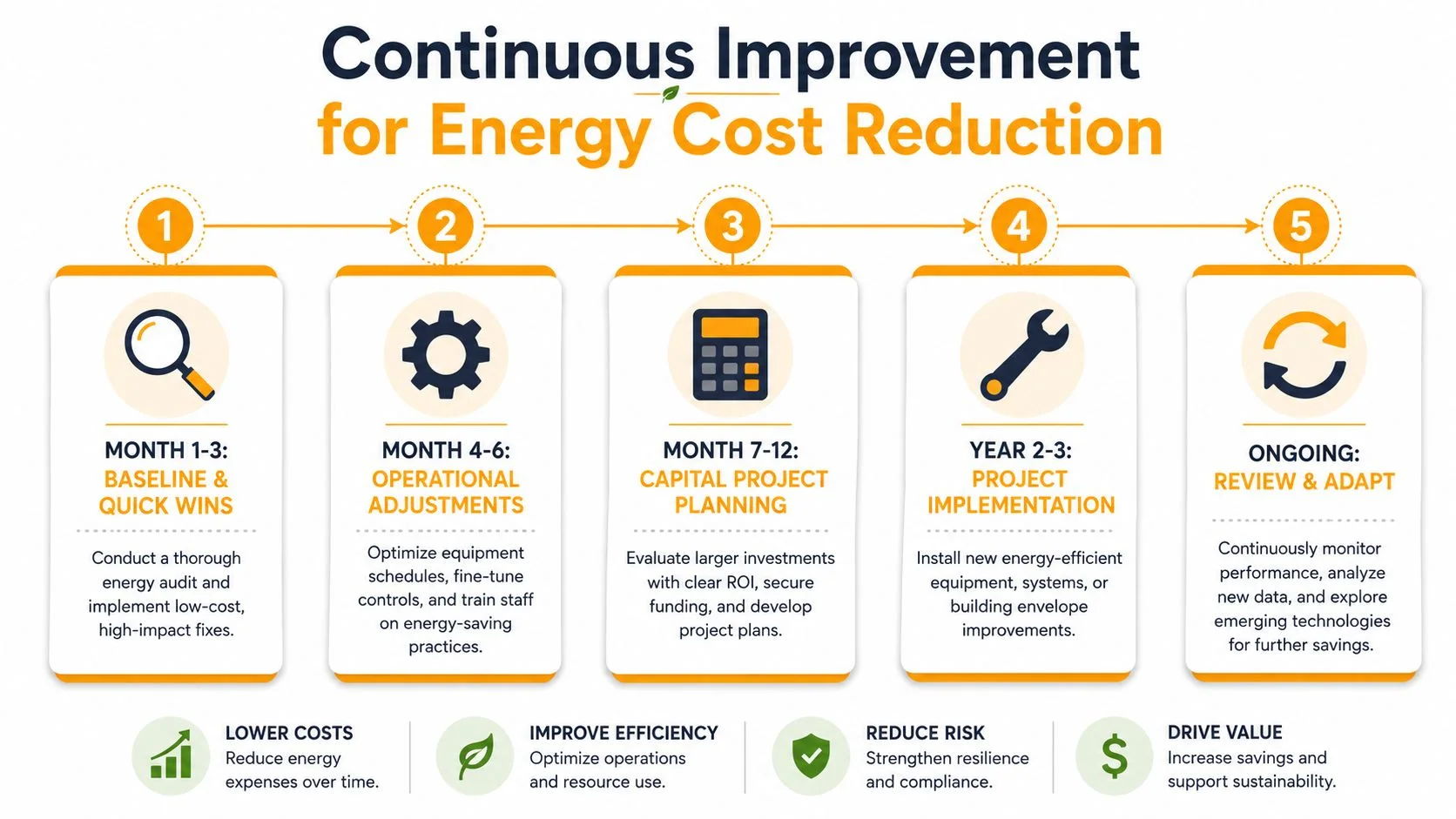
A workable sequence for a typical facility
Use a timeline that matches how budgets and maintenance windows work:
- Month 1 to 3: Audit the site, collect bills, inspect doors and docks, and fix obvious operational waste.
- Month 4 to 6: Adjust schedules, improve closing procedures, refine temperature control, and monitor whether early changes hold.
- Month 7 to 12: Scope larger door, dock, or control upgrades. Build the business case and align with the next capital cycle.
- Year 2 onward: Install approved upgrades, verify performance, and keep reviewing utility patterns for new opportunities.
What to review on an ongoing basis
The follow-up is what turns a project into a system.
- Track monthly utility results: Look for changes that match the work completed.
- Inspect high-cycle openings regularly: Doors and dock equipment drift out of adjustment with use.
- Revisit operating habits: Staff turnover can undo earlier gains.
- Update the project list: Once one source of waste is solved, the next one becomes easier to see.
The steady approach is usually the one that lasts. Facilities don't need a dramatic overhaul to make progress. They need a sequence, accountability, and enough technical support to fix the openings and equipment that affect the whole building.
If you're building your first serious energy cost reduction plan, start where the losses are often easiest to verify: your doors, docks, and perimeter openings. Wilcox Door Service Inc. can help you assess high-use access points, identify maintenance and sealing issues, and prioritise practical next steps that support safer, more efficient facility performance.