


If you're dealing with rising heating costs, doors that whistle in winter, or recurring issues around loading docks and personnel entrances, the seal around the door is often the actual problem. In commercial buildings, a worn or poorly fitted seal doesn't just create a draft. It affects energy use, staff comfort, compliance, cleanliness, and the service life of the door system itself.
This guide explains how to choose the right metal exterior door weatherstripping for Canadian commercial and industrial settings, how proper installation should be done, what to check before work starts, and when a facility should bring in a certified door technician. The focus is practical. What works on a warehouse man door is not always what works on a fire-rated opening, a food processing entrance, or a high-cycle dock door.
Why Your Commercial Door Seals Matter More Than You Think
A lot of facility managers first notice weatherstripping when someone complains about a cold draft. That's usually the smallest part of the problem.
In Canadian facilities, poor door sealing can drive a significant amount of building heat loss. Natural Resources Canada data indicates that poor door sealing contributes to 20-30% of commercial building heat loss in cold climates, and the same source notes carbon pricing was projected to rise 23% in 2025 under federal policy, adding more pressure to operating budgets. It also notes that 2025 National Building Code updates emphasise air barrier continuity, with BC warehouse pilots showing 25% energy savings through ASTM E283-tested metal kerf gaskets (best exterior door weatherstripping types for Canadian facilities).

That matters on more than the utility bill. In a warehouse, a failed seal at a side personnel door can create cold spots near pick lines and workstations. At a loading dock vestibule, gaps pull in dust and moisture. In food, pharma, and clean-process spaces, even a small breach at the perimeter can complicate sanitation and audit readiness.
Poor seals create multiple operating problems
A bad seal usually shows up in several ways at once:
- Higher heating demand: Your HVAC system has to compensate for air leakage at the opening.
- Comfort complaints near doors: Staff working close to entrances often feel the issue first.
- Dust, insects, and debris ingress: Door bottoms and threshold gaps are common entry points. If pests are part of the concern, this guide to preventing pests in commercial spaces is a useful companion resource because sealing and sanitation have to work together.
- Moisture at the threshold: Water intrusion accelerates wear at the frame, floor, and hardware.
- Premature door service calls: When a door has to fight a poor seal, hinges, closers, bottoms, and latching points wear faster.
Compliance is part of the decision
For commercial openings, weatherstripping isn't just a comfort accessory. It has to work with the opening as a system.
On fire-rated doors, the wrong gasket or bottom seal can interfere with latching, smoke control, and rating requirements. On industrial buildings, the seal contributes to the building envelope and air barrier continuity expected by code. On high-traffic sites, durability matters because frequent opening cycles quickly expose weak materials and poor installation.
Practical rule: If the opening is fire-rated, part of a conditioned envelope, or exposed to weather and traffic every day, treat weatherstripping as a building-performance component, not a handyman add-on.
A lot of property teams discover this only after repeated patch jobs fail. Adhesive foam may quiet a complaint for a short time, but it won't hold up on a busy steel entrance, and it won't solve alignment, threshold, or frame issues underneath. For facilities reviewing options, Wilcox's commercial door weather sealer solutions show the types of perimeter sealing systems typically used on commercial openings.
Choosing the Right Weatherstripping for Your Application
The right product depends on how the door is built, how often it cycles, what the floor condition looks like, and whether the opening is exposed to cold, moisture, washdown, wind, or contamination risk. A seal that works on a lightly used office side door may fail quickly on a warehouse exterior man door.
Professional installation of metal exterior door weatherstripping averages CAD $283 per door, with a range of CAD $131-$436, and metal types cost $2-$5 per linear foot. The same verified cost data notes that metal options are often chosen for their 50+ year service life, and NRCan's 2021 industrial energy efficiency program documented weatherstripping upgrades in 500+ Ontario warehouses reducing total building energy use by 12-18% (commercial weatherstripping installation cost data).
What usually works best in commercial settings
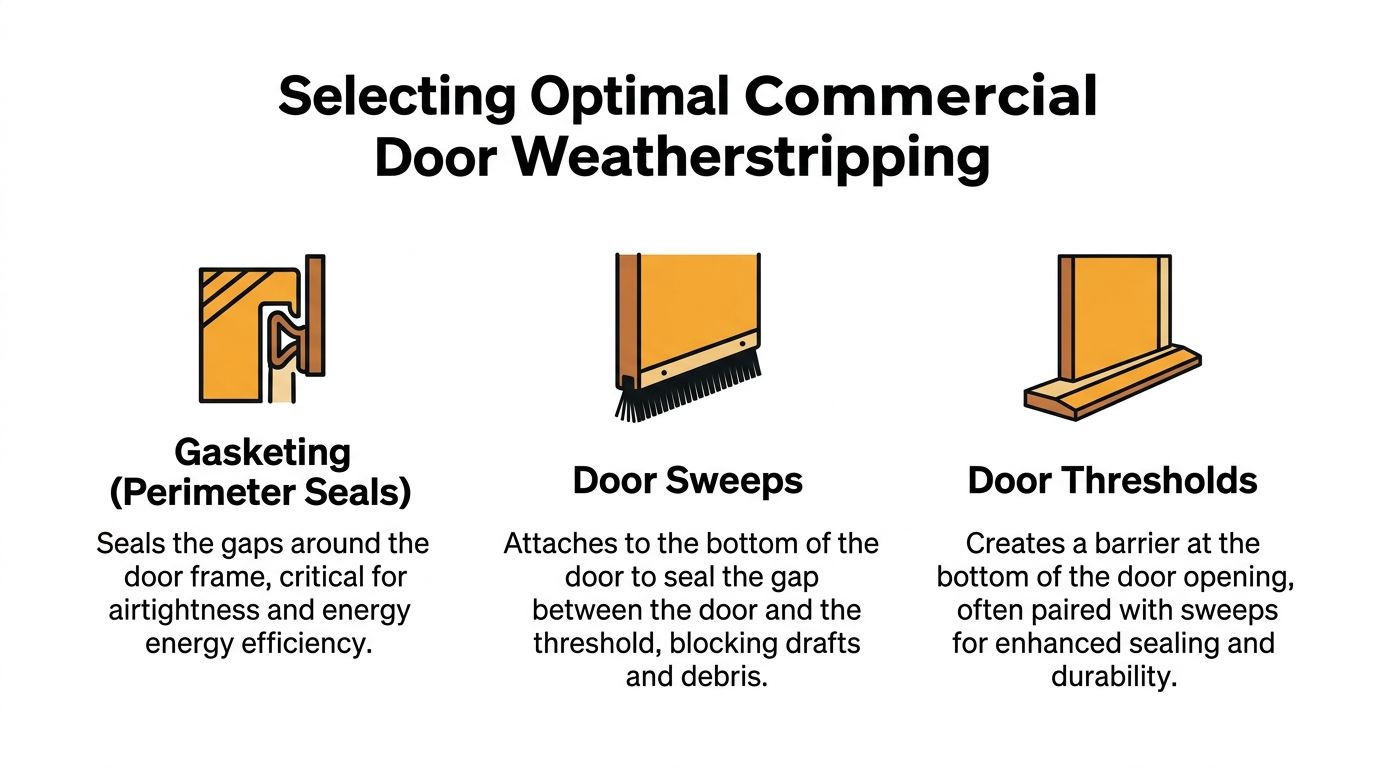
I look at commercial weatherstripping in three zones. Perimeter seals at the head and jambs. Bottom seals on the door. Thresholds at the floor. Strong results usually come from choosing the right combination, not a single product in isolation.
Interlocking metal weatherstripping
This is the premium choice for many high-value openings. One metal piece mounts to the frame, the mating piece mounts to the door, and the two engage when the door closes.
It suits facilities that need longevity, a tight seal, and a professional finish. It's especially useful on main personnel doors, older heavy steel doors, and applications where repeated replacement is more disruptive than the higher first cost.
Trade-off: installation precision is unforgiving. If the alignment is off, the door can bind or the seal won't engage evenly.
Spring metal or tension-seal weatherstripping
Spring bronze and similar tension seals work by pressing continuously against the door or frame. They can be highly effective where you want a durable mechanical seal without a bulky profile.
These are a strong fit on older metal doors and some retrofit conditions where a low-profile metal seal is preferred. They also stay useful in cold conditions because the seal relies on metal spring tension rather than a soft material that can fatigue.
Trade-off: they need accurate fitting and a reasonably true door edge.
Neoprene or gasketed perimeter seals
Where slight irregularities exist, a heavy-duty gasket can be more forgiving than metal-to-metal engagement. In facilities with mild frame variation, this type can provide reliable compression at the head and jambs.
Trade-off: on high-cycle openings, gasket wear is usually the limiting factor. The opening may still need threshold or bottom work to solve the full air leak.
Brush seals
Brush seals are practical where the bottom condition is uneven. That's common at loading dock doors, older slabs, rough thresholds, or entrances that see dirt and grit.
Trade-off: brushes are good at blocking debris and reducing air movement, but they generally don't give the same airtight performance as a properly fitted interlocking or compression-style system.
Thresholds and door bottoms
A lot of weatherstripping failures are really bottom-of-door failures. If light shows under the leaf, perimeter work alone won't fix it. In cold Canadian conditions, the threshold detail matters. A thermal break and a properly matched sweep or automatic door bottom often make the difference between a cosmetic improvement and a real one.
Commercial Weatherstripping Comparison
| Type | Material | Durability | Best Use Case | Cost |
|---|---|---|---|---|
| Interlocking metal | Bronze, zinc, stainless steel, aluminum | Very high | High-traffic personnel doors, secure exterior entries, long-life retrofits | Premium |
| Spring metal tension seal | Bronze or similar spring metal | High | Older metal doors, narrow-gap retrofits, cold-climate openings | Moderate to premium |
| Perimeter gasketing | Neoprene or similar gasket material in carrier | Moderate to high | Openings needing compression tolerance at head and jambs | Moderate |
| Door sweep | Neoprene, brush, or mixed assembly | Moderate | Bottom-of-door sealing, uneven thresholds, debris control | Moderate |
| Threshold system | Aluminum with thermal break and insert | High | Exterior doors where bottom sealing and thermal performance matter | Moderate to premium |
Match the product to the opening
Different environments call for different choices:
- Manufacturing entrance: Interlocking metal is often worth it where traffic is steady and downtime costs more than the material upgrade.
- Food processing or washdown-adjacent areas: Corrosion resistance matters, so metal selection and fastener choice should match the environment.
- Loading dock man door near a gravel yard: A durable bottom seal and threshold detail usually matter as much as the jamb seal.
- Multi-site property portfolio: Standardising seal types across similar openings makes inspection and replacement easier.
A cheap seal that needs repeated adjustment isn't cheap in an operating facility.
For teams trying to move from reactive fixes to lifecycle planning, a Planned Maintenance Program for commercial doors helps keep seals, thresholds, hinges, closers, and latching hardware aligned as one system.
For a broader overview of common seal formats used on exterior openings, Wilcox also has a useful page on types of exterior door weatherstripping.
Measuring and Preparing for Installation Success
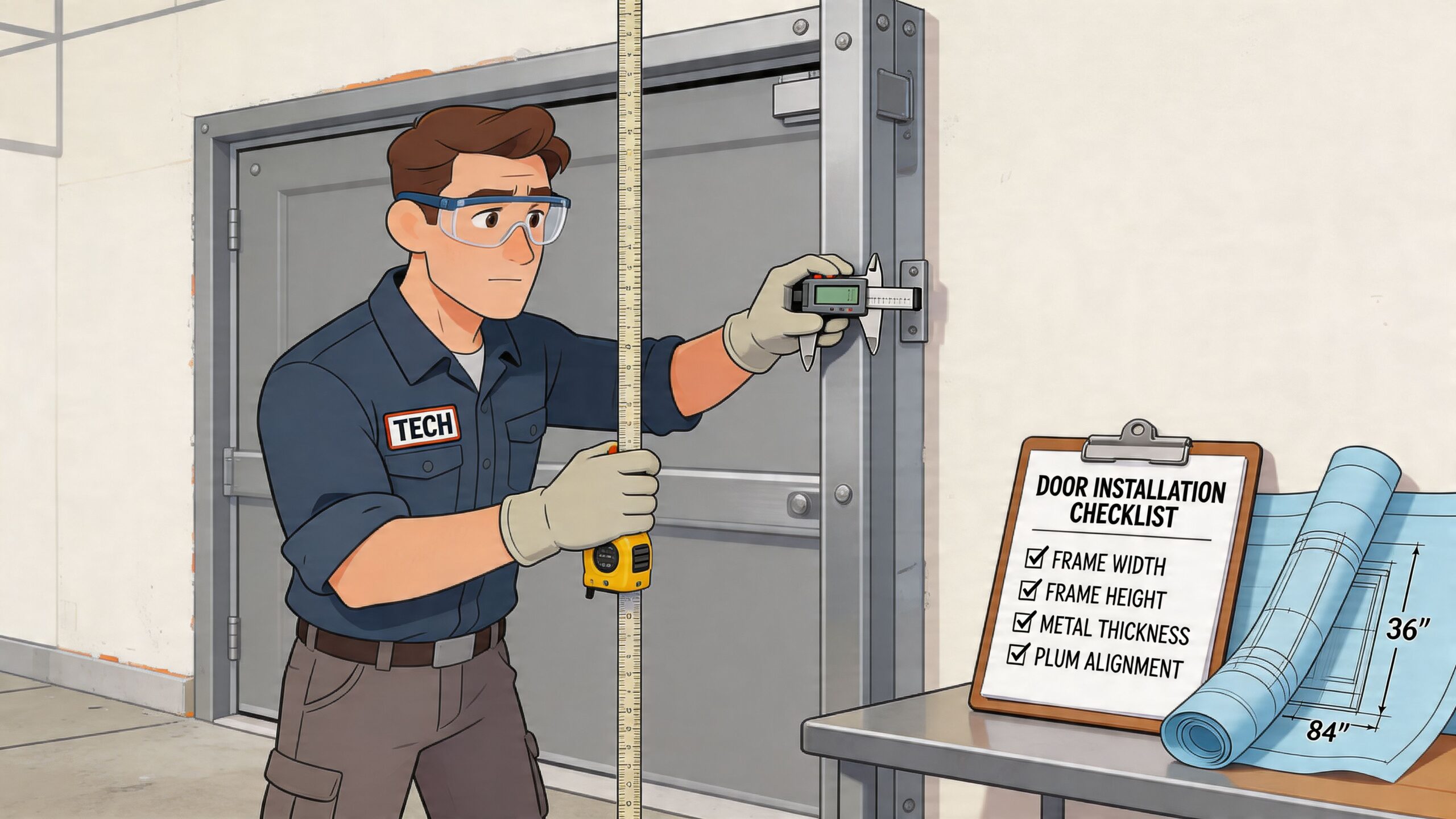
Good weatherstripping starts with measurement, not material. If the frame is out, the door is sagging, or the threshold is worn, even a high-grade metal seal will disappoint.
For interlocking metal systems on commercial and industrial metal doors, installation starts with a precise method. The verified methodology calls for measuring door frame gaps with a 0.050-inch (1.27 mm) feeler gauge at 12 points per jamb, with a target of less than 3 mm for NBC compliance, followed by selecting bronze or zinc L-shaped profiles and mortising the U liner into the door edge. The same field guidance notes that misalignment above 0.015 inch leads to a 40% failure rate in first-year reworks (interlocking metal weatherstrip installation details).
What to inspect before ordering material
Start with the opening itself. You need to know whether the leak is caused by worn weatherstripping, poor door alignment, threshold damage, frame movement, or all four.
Check these areas carefully:
- Head and jamb gap consistency: Measure multiple points. Don't rely on one spot.
- Door edge condition: Rust, dents, or previous fastener holes can affect mounting.
- Frame straightness: A bowed frame changes compression along the seal.
- Hinge condition: Sagging hinges create false gap readings.
- Threshold wear: If the threshold is cupped, cracked, or uneven, bottom sealing becomes guesswork.
- Latch performance: A door that doesn't pull fully into the frame won't compress the seal correctly.
Basic tools versus professional tools
A basic maintenance cart might carry a tape, drill, utility knife, and screwdriver. That works for light replacement work. It doesn't replace proper diagnostic tools when the opening is part of a commercial envelope or a rated assembly.
Professional preparation usually includes:
- Feeler gauges: For consistent gap measurement.
- Calipers or accurate rulers: For profile verification.
- Laser or long straightedge: To assess threshold and frame condition.
- Appropriate bits and fasteners: Stainless fasteners matter in corrosive or exterior environments.
- Surface prep supplies: Old adhesive, paint buildup, and debris have to be removed before installing new seals.
The best seal in the box won't compensate for a twisted frame or a threshold that's already failed.
Surface preparation is not optional
Rushed work often goes awry due to these factors. Old adhesive residue, oxidised metal, loose paint, and buried fasteners all interfere with fit and compression.
Before any new material goes on:
- Remove the old seal completely.
- Clean the mounting area so the profile sits flat.
- Repair minor irregularities or shim where needed.
- Confirm door operation before drilling or fastening.
- Dry-fit the material before final installation.
On many older commercial openings, preparation takes longer than the install itself. That's normal. It's also why a neat-looking replacement can still perform poorly if nobody corrected the opening first.
A Guide to Professional Installation Techniques
A quality installation should leave the door operating smoothly, latching fully, and sealing evenly on every side. If one of those conditions is missing, the job isn't finished.
Securing the jambs properly
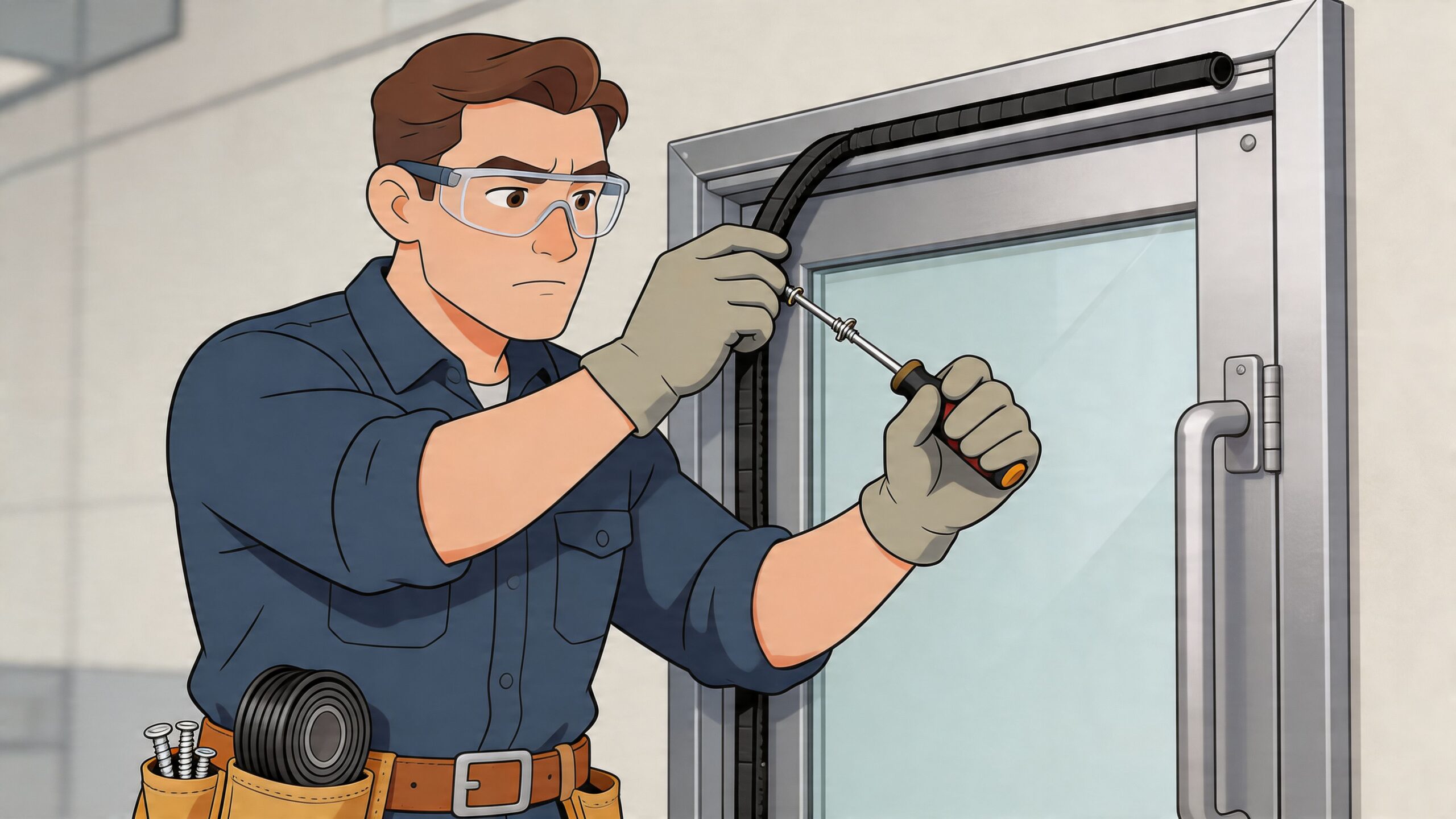
On interlocking metal systems, the jamb pieces need to be straight, level, and set for consistent engagement. Installers should dry-fit first, confirm reveal, and fasten in a way that avoids twisting the profile during tightening.
Screw placement matters. Too much pull at one point can distort the strip and create drag. Too little support leaves gaps between fasteners, especially on older frames that aren't perfectly true.
Corner treatment matters too. A clean meeting point at the head and jamb stops leakage at the very places where hurried installs often leave visible gaps.
Sealing the head without overcompressing
The top seal gets less abuse than the latch side or bottom, but it still needs the right contact pressure. Too loose, and the door leaks. Too tight, and the closer and latch have to fight the seal on every cycle.
A good installer adjusts for even contact, not maximum force. Commercial doors should close under normal hardware operation, not by asking users to shove the leaf into place.
For some facilities, this is also the stage where perimeter gasketing is added to complement a metal system at selected points. The opening dictates the method.
Installing the bottom and threshold as a system
Bottom sealing is where many retrofits either succeed or fail. A benchmark retrofit sequence includes assessing the undercut gap, removing old seals, installing an aluminum frost-brake threshold with an NBC-compliant thermal break of more than R-2.5, affixing a fire-rated neoprene sweep, and verifying the result with a smoke pencil test. In BC and Prairie facilities, NRCan trials in 2024 reported 88% success in achieving less than 0.05 cfm/ft² infiltration, cutting heat loss by 40% (benchmark retrofit approach for threshold and sweep upgrades).
The point isn't just to add a sweep. The threshold height, slope, and contact line all have to work together. A sweep that's set too low drags and tears. Too high, and the gap remains.
For uneven floors, a brush or neoprene solution may be the smarter choice than forcing a rigid profile to do a flexible job. On busy entrances, automatic door bottoms can also help where a fixed sweep would wear prematurely.
Here's a useful visual reference before comparing install quality across openings:
What a facility manager should look for after installation
You don't need to install the system yourself to judge whether it was done properly. Look for these signs:
- Even reveal and contact: No obvious daylight or loose corners.
- Smooth operation: The door shouldn't bind, scrape, or bounce back.
- Clean fastening: Fasteners should be consistent and appropriate to the opening.
- Tidy threshold integration: Bottom seal and threshold should meet without excessive drag.
- Complete clean-up: Old seal residue and removed hardware shouldn't be left behind.
If the door becomes harder to close after the new weatherstripping goes in, that isn't automatically proof of quality. It may mean the installer overcompressed the opening or ignored an alignment problem. If damaged frames, sagging hinges, or failed bottoms are discovered during the work, it often makes sense to address them through commercial door repair services before treating the seal as the final fix.
Testing, Troubleshooting, and Long-Term Maintenance
Installation is only half the job. The other half is proving the seal works and keeping it that way.
In cold Canadian conditions, that long-term view matters because metal exterior door weatherstripping can last over 100 years, compared with 2-5 years for foam and 5-10 years for rubber. Verified U.S. Department of Energy data used for similar cold-climate conditions also shows properly fitted tension-seal metal weatherstripping can reduce air infiltration by 75-90% (spring bronze and tension-seal performance details).
Test the seal right away
Two quick field checks tell you a lot.
The first is the light test. Close the door and inspect the perimeter from the dark side of the opening. Any visible light usually points to a gap, usually at corners, latch points, or the bottom edge.
The second is the smoke pencil test. Move the smoke slowly around the head, jambs, and threshold while the door is closed. If the smoke moves sharply through one location, that's where your troubleshooting should start.
A proper test gives you a map of the problem. It stops people from guessing and replacing the wrong part.
Troubleshoot by symptom
If the door doesn't close easily, look first at overcompression, hinge sag, latch adjustment, and threshold interference. If the drag is only at one point, the issue is usually alignment, not the whole seal.
If a draft remains at the bottom, check whether the threshold and sweep meet across the full width. A lot of service calls come from a good jamb seal paired with a poor bottom detail.
If the corner leaks, inspect cuts, joints, and head-to-jamb transitions. That's a common weak spot on rushed installs.
Build maintenance into your routine
Long-life metal seals still need inspection. Facility staff don't need to dismantle the opening, but they should include seal checks in seasonal rounds.
A simple routine works well:
- Clean the contact surfaces: Dirt and grit wear both metal and gasket components.
- Check for impact damage: Carts, pallets, and boots often damage bottom seals first.
- Inspect after major weather events: Wind-driven rain and freeze-thaw cycles expose weak points.
- Watch door operation: A seal issue often starts as a hinge, closer, or latch issue elsewhere in the opening.
For sites preparing for winter, a planned maintenance program for cold-weather door readiness helps catch those problems before they turn into emergency calls.
When to Call for Professional Weatherstripping Service
Some weatherstripping work is straightforward. A lot of it isn't.
If the opening is fire-rated, bring in a qualified commercial door technician. You can't treat a rated assembly like a basic exterior door. The seal, hardware, clearances, and door operation all have to remain compatible with the opening's certification and smoke-control role.
If the door or frame is visibly damaged, weatherstripping won't fix the root issue. Bent frames, rusted anchors, sagging hinges, failed closers, and worn thresholds have to be corrected before a new seal can perform properly.
Professional service also makes sense when you're dealing with:
- Multi-door retrofits across one or more facilities
- Openings with recurring drafts after previous repairs
- Air leakage problems at high-traffic warehouse entries
- Sanitation-sensitive or contamination-sensitive spaces
- Openings where downtime has to be controlled carefully
One practical option in Canada is Wilcox Door Service Inc., which installs and services commercial door, dock, and access solutions across industrial and institutional facilities. For facility managers, the important point isn't the brand name. It's having a contractor who understands door systems, code requirements, and how to keep operations moving while the work gets done.
On a commercial opening, the cheapest repair is usually the one that solves the whole problem once.
If you're unsure whether a door needs a seal replacement, threshold correction, alignment work, or a full rated-opening review, schedule a professional assessment. For rated openings in particular, a fire door inspection and testing service is a smart next step.
Frequently Asked Questions
| Question | Answer |
|---|---|
| Is metal exterior door weatherstripping always better than rubber or foam? | Not always. It's usually the right choice where durability, repeated cycling, and long service life matter most. On some openings, the best result comes from combining metal perimeter components with a suitable bottom seal or threshold detail. |
| What's the biggest installation mistake on commercial doors? | Poor measurement and alignment. If the opening isn't measured carefully and the profile isn't set correctly, the seal may bind, miss the door edge, or fail early. |
| Can weatherstripping fix a warped commercial door? | No. It can reduce leakage only if the opening is fundamentally sound. If the leaf, frame, hinges, or threshold are compromised, those problems need repair first. |
| Do loading dock personnel doors need different sealing than office doors? | Often, yes. Dock-area doors usually face more dirt, wind, moisture, and abuse. Bottom sealing and threshold design become much more important in those environments. |
| How do I know whether my door is leaking at the perimeter or the bottom? | Start with a light test and smoke pencil test. If leakage is concentrated near corners, latch side, or head, look at perimeter sealing. If you see daylight under the leaf or feel movement there, focus on the threshold and bottom seal. |
| Should facility staff handle replacement in-house? | For simple wear issues on non-rated openings, possibly. For fire-rated doors, complex interlocking metal systems, or recurring leak issues, professional service is the safer route. |
If your facility has drafty entrances, worn thresholds, or doors that no longer seal the way they should, contact Wilcox Door Service Inc. to schedule an inspection or request a quote. Respected Partners, Reliable Service.