


If you're planning a new warehouse bay, replacing an ageing overhead opening, or trying to stop a door from becoming a recurring maintenance problem, the question usually starts. Do you want one wide opening or two narrower ones?
That decision affects more than traffic flow. It changes how trucks and vans line up, how much heat you lose in winter, how often springs and operators cycle, what your retrofit will require structurally, and how much risk sits in your maintenance budget over the life of the asset. For Canadian facilities, that matters even more because door performance is tied directly to cold-weather reliability, code compliance, and operating cost.
For facility managers, the value of garage doors double isn't just in the opening width. It sits in the full lifecycle. The right system supports safer manoeuvring, better sealing, fewer disruptions, and a service plan that matches the way the building runs. The wrong system can leave you with frequent shutdowns, poor thermal control, and retrofits that looked cheaper on paper than they are in service.
What Facility Managers Need to Know About Double Garage Doors
A common scenario looks like this. A distribution centre has a two-bay opening, forklifts move steadily through the area, and the building team needs to choose between one double-width door or two single doors. On a retrofit, the same issue comes up when an older facility no longer suits modern fleet widths or current energy expectations.
The first thing to sort out is how the opening is used every day. If the bay handles larger vehicles, frequent in-and-out movement, or awkward turning conditions, a wide opening can make operations smoother. If the opening sees uneven traffic, or one side stays idle for long stretches, two singles can give you more control over airflow and wear.
Three questions usually drive the right answer:
- How tight is the approach path? If drivers are entering at an angle, the centre divider between two single doors can become a damage point.
- How often does the door cycle? High-cycle use changes operator selection, spring wear, and maintenance planning.
- How important is thermal control? In heated spaces, the opening strategy has a direct effect on utility cost and employee comfort.
Practical rule: Don’t choose a door layout by dimensions alone. Choose it by traffic pattern, climate exposure, and what downtime would cost your operation.
Facility teams also need to look past the door leaf itself. A full decision includes the structure above the opening, the track layout, the operator, safety devices, weather sealing, and the service support available after handover. Those pieces are what determine long-term value.
That’s where experienced planning pays off. The best specifications don’t just ask, “What fits the opening?” They ask, “What keeps this access point reliable for the next many years?”
Critical Sizing and Structural Considerations
A common failure point in procurement happens before the door is ordered. The opening gets measured, a width gets chosen, and the building team assumes the rest will sort itself out. On a Canadian facility, that shortcut can turn into structural rework, poor sealing in winter, operator strain, and service calls that keep coming back.
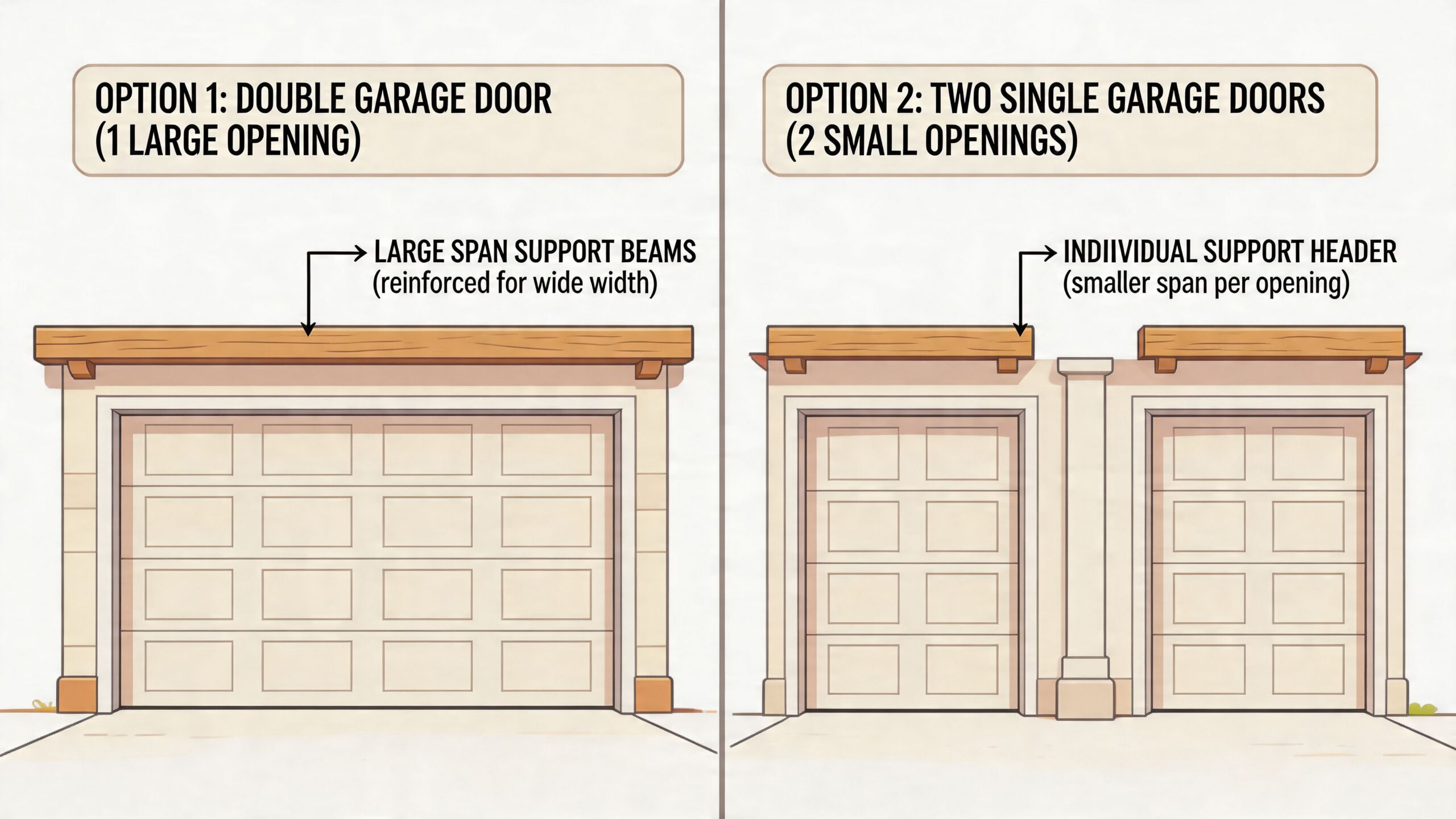
For commercial and industrial sites, double garage doors often fall in the 16-18 foot wide by 7-8 foot high range, while two single openings are commonly 8-9 feet each. The size itself is only the starting point. What matters more is whether that clear span matches the vehicles using the bay, the turning approach outside, and the amount of conditioned air the building can afford to lose every time the door cycles.
A wider uninterrupted opening gives drivers more forgiveness. In tight warehouse bays, service yards, and municipal fleet buildings, that extra lateral clearance can cut down on mirror strikes, track damage, and repeated hits on a centre post. That has a direct cost impact. One preventable impact can put a door out of alignment, damage panels, and leave the opening insecure until repairs are made.
One wide opening versus two separate openings
One double door usually fits better when the operation depends on access speed and clear entry.
- Vehicle clearance is tight. Vans, pickups, cube bodies, and equipment entering at less than a perfect angle benefit from one clear span.
- The approach path is awkward. If drivers turn in from a lane or loading court, a centre mullion often becomes the part that gets hit.
- Floor use changes through the year. One larger opening can make staging and occasional oversized movement easier.
Two single doors can make better financial sense over the full service life in other conditions.
- Traffic is split between users or departments. One door can stay closed while the other cycles.
- Heat retention matters more than full-width access. Opening only half the width reduces air exchange in heated spaces.
- Redundancy has operational value. If one opening is down for a spring, cable, or operator issue, the second may keep part of the facility working.
That trade-off matters more in Canada than many generic sizing guides admit. A door decision affects not only access, but also winter heating load, snow and ice management at the threshold, and whether the building can still function during an equipment failure in January.
What the structure has to carry
The structure around the opening determines whether the door will stay square, seal properly, and reach its expected service life.
- Header: The support above the opening. Wider spans usually require stronger structural support and closer coordination with the building engineer.
- Jambs: The vertical sides that carry the track, spring reaction, and hardware loads.
- Side room: The space beside the opening needed for tracks, spring assemblies, brackets, and service access.
- Headroom: The space above the opening required for track radius, door storage, and operator setup.
Replacing two singles with one double often means removing a centre support. That changes the load path. It can trigger steel work, lintel reinforcement, revised anchoring details, or a different mounting arrangement for the operator and track system. If that review happens after the door is ordered, costs rise quickly and schedules slip.
I see this most often on retrofit projects. The opening width may be available on paper, but the constraints are headroom blocked by mechanical services, insufficient side clearance for spring assemblies, or jamb conditions that will not hold anchors properly without repair.
The lowest door price rarely stays low if the opening was never checked for structure, clearance, drainage, insulation continuity, and operator support.
Sizing mistakes that cost money later
The expensive mistakes are usually small specification misses.
- Choosing width from the masonry opening alone. The right width should reflect the actual vehicle mix, mirror clearance, body style changes, and turning approach.
- Missing side clearance and headroom constraints. That can force field changes to track layout or operator type.
- Ignoring thermal breaks and perimeter sealing. In heated facilities, poor interface detailing around the frame can add ongoing energy loss and create ice at the sill.
- Forgetting drainage and slab condition at the threshold. Water infiltration and freeze-thaw cycles shorten the life of bottom seals and hardware.
- Leaving no room for future fleet changes. A door that fits today's vans may not suit the next vehicle replacement cycle.
For a practical planning reference, review these standard garage height dimensions and opening clearance guidelines.
A double door is usually the right call when access reliability depends on one clear opening. Two singles often win when selective opening, energy control, and partial redundancy carry more value over time. The better choice comes from balancing structural work, climate exposure, maintenance access, and the cost of downtime, not from width alone.
Choosing the Right Type of Double Garage Door
A double opening that looks fine on a plan can become the most expensive opening in the building if the door type is wrong. In Canada, that mistake usually shows up in winter. Heat loss climbs, ice builds at the bottom seal, operators work harder, and service calls start coming in during the worst weather.
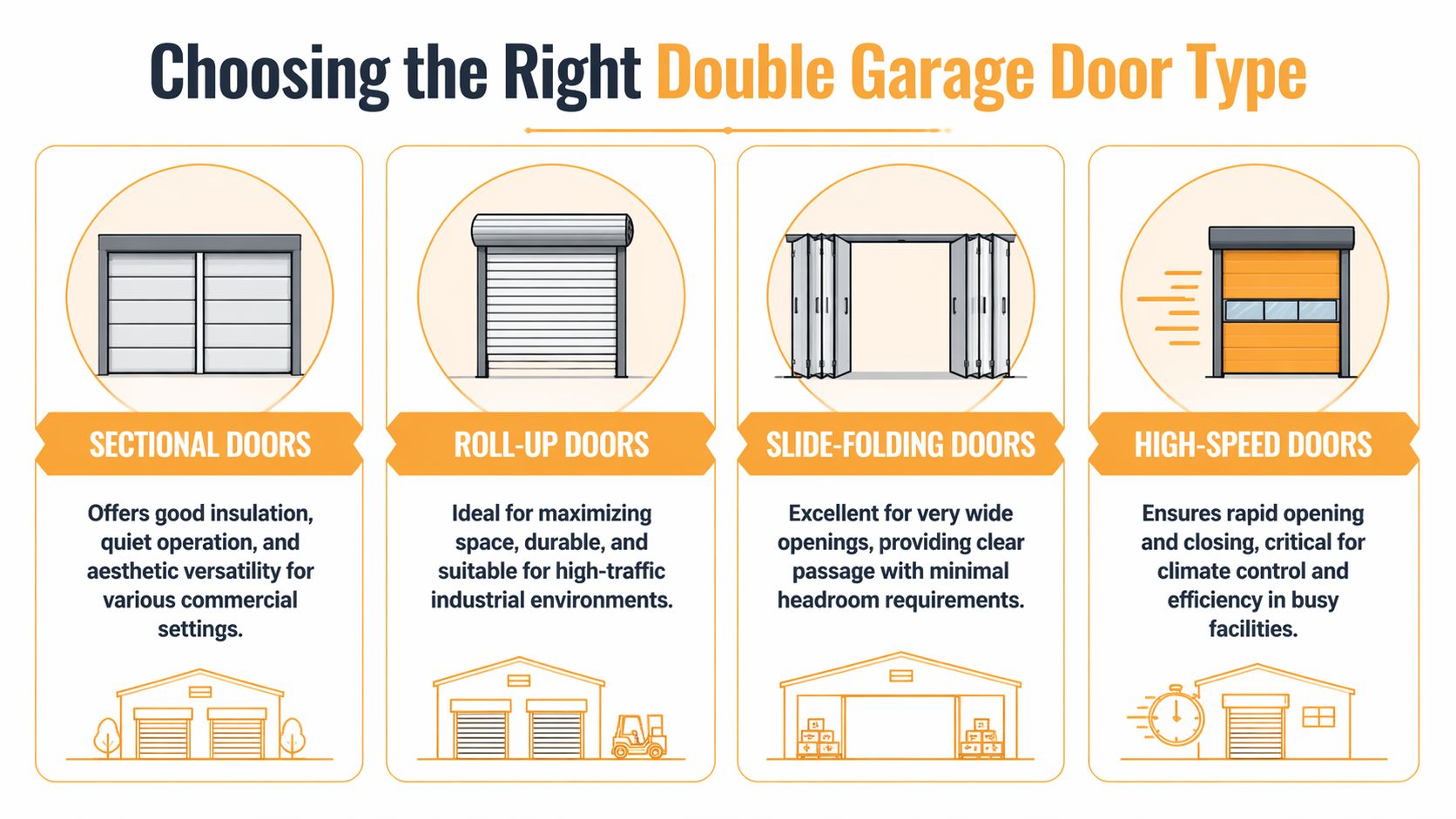
For many commercial facilities, a double garage door falls in the 16 to 18 foot width range, with heights that suit service bays, fleet storage, and light industrial access. The dimension is only the starting point. The better specification comes from matching the door type to cycle demand, wind exposure, insulation targets, security needs, and the cost of downtime if that opening fails.
Modern commercial doors are built for demanding use, often rated for repeated daily cycles over a long service life. A single operator setup can also reduce installation cost compared with two separate openings, but the savings only hold if that one opening does not create a bigger operational risk. In facilities that cannot tolerate a blocked bay, redundancy can be worth more than first-cost savings.
Sectional doors
Sectional doors are still the default choice for many Canadian facilities because they handle a wide mix of demands reasonably well. They provide good insulation options, replacement parts are widely available, and damaged sections can often be repaired without replacing the full door.
They fit warehouses, municipal shops, distribution buildings, and fleet service bays.
What they do well:
- Support thermal performance goals. Insulated sectional assemblies are often the practical choice for heated buildings where energy loss matters.
- Keep repair costs manageable. Rollers, hinges, springs, weather seals, and individual sections are usually serviceable.
- Offer specification flexibility. Glazing, vision panels, rib profiles, and panel thickness can be matched to the building use.
What to watch:
- Overhead space gets crowded fast. Track, lift type, sprinklers, lights, and ductwork all need to work together.
- Impact damage is common. Forklifts, cube vans, and plow-equipped trucks can dent panels and knock hardware out of alignment.
- Seal performance depends on installation quality. A good insulated door still loses value if the perimeter seal, jamb interface, and bottom weather seal are poorly detailed.
Rolling steel doors
Rolling steel doors store in a coil above the opening, which helps where ceiling space is limited or the opening needs a tougher security-focused curtain. They are often a strong fit for service counters, industrial compartments, parking structures, and exterior openings where abuse resistance matters more than appearance.
For a double-width opening, rolling steel can solve layout problems that a sectional door cannot. The trade-off is thermal performance. If the opening is part of a heated envelope, the assembly needs to be specified carefully. Slat profile, insulation, guides, hood design, and perimeter sealing all affect whether the door helps or hurts operating costs through a Canadian winter.
Rolling steel also changes the service picture. Access to the barrel, tension components, and guides needs to be planned so maintenance can be done safely without disrupting adjacent systems.
Slide-folding and similar specialty doors
Some buildings do not suit a conventional overhead system. Low headroom, unusual framing, crane runs, or overhead equipment can make sectional and rolling designs impractical. In those cases, slide-folding or bi-fold systems may be the right answer.
These doors can deliver a large clear opening without sending track deep into the building. They are useful in selected industrial and specialty applications, but they demand closer review of wind load, hardware wear points, hinge maintenance, and snow or ice exposure at the opening line. They are usually chosen because the building geometry leaves little room for standard options, not because they are the lowest-cost path.
Field experience matters here. Forcing a standard overhead door into a building that does not support it usually leads to recurring alignment problems, premature hardware wear, and harder service access.
High-speed doors
High-speed doors are chosen where opening time affects building performance. That includes temperature-controlled areas, washdown zones, pharmaceutical spaces, food facilities, and busy logistics routes where traffic delay adds labour cost.
For a double-width opening, high-speed systems are often specified to reduce air exchange and keep traffic moving. In the right application, that can lower energy loss and improve workflow. In the wrong application, they can become maintenance-heavy if the opening is exposed to frequent impact, poor drainage, wind pressure, or uncontrolled vehicle traffic.
Operator selection matters as much as curtain design. Facilities reviewing door speed, duty rating, and control compatibility should also review suitable commercial garage door opener options for industrial openings.
Commercial Double Door Comparison
| Door Type | Best For | Insulation (R-Value) | Headroom Required | Maintenance Level |
|---|---|---|---|---|
| Sectional Doors | Warehouses, service bays, general industrial use | Available with insulated options | Moderate to high | Moderate |
| Roll-Up Doors | Security-focused openings, tight overhead conditions | Varies by model and build | Low | Moderate |
| Slide-Folding Doors | Very wide openings, limited headroom conditions | Varies by system | Low | Moderate to high |
| High-Speed Doors | Climate-controlled areas, high-traffic operations | Available with insulated or specialised curtain/panel systems | Varies by design | Moderate with disciplined service |
Matching the door to the building
Door type should be chosen around the facility's real cost drivers.
- Sectional doors are often the best fit for general-purpose heated buildings that need a balance of insulation, repairability, and predictable service support.
- Rolling steel doors make sense where compact storage, security, or opening protection outweigh maximum thermal performance.
- High-speed doors earn their cost where fast closing protects conditioned space or supports heavy traffic flow.
- Specialty folding systems belong in projects where the building layout rules out standard overhead designs.
The long-term decision is rarely about the door panel alone. It includes service access, code compliance, winter operation, parts availability, and how much a failed opening will cost the facility in lost time.
Selecting Operators and Access Controls for Efficiency
A good door can still perform poorly if the operator is undersized, badly mounted, or paired with controls that don’t match the traffic pattern. The operator is the drive unit that opens and closes the door. In commercial work, it needs to match door weight, cycle demand, and the way people and vehicles use the opening.
Matching operator type to door duty
Three operator styles come up most often.
Trolley operators are common on lighter commercial applications with straightforward track layouts. They’re familiar and practical, but they aren't usually the first choice for heavier high-cycle industrial doors.
Jackshaft operators mount beside the door and drive the torsion shaft directly. These are often a strong fit where overhead space is crowded or where a cleaner ceiling layout is needed.
Gearhead operators are used where doors are heavier or the duty cycle is more demanding. They’re built for tougher work and are often selected for industrial openings with more frequent use.
The wrong approach is choosing by price alone. The right approach is asking how many cycles the opening sees, how quickly it needs to recover between uses, and what failure would do to operations.
Controls that support workflow
Controls should do two things at once. They should help people move efficiently, and they should prevent the opening from staying open longer than necessary.
A practical control package may include:
- Push-button stations for basic local control
- Radio controls for drivers or equipment operators
- Loop detectors that sense vehicles approaching or leaving
- Motion devices that trigger operation in defined paths
- Timers to close so the door shuts after traffic clears
- Integration with access systems when entry needs to be restricted or logged
In a busy bay, programming matters. If a forklift passes through and the door waits too long to close, you lose conditioned air and invite unnecessary exposure. If it closes too quickly, you create safety and traffic frustration.
The best control setup is the one operators stop noticing. It opens when they need it, closes when they don’t, and doesn’t create workarounds.
Reliability over gadget count
Not every opening needs advanced controls. Some sites benefit more from simpler hardware that can be serviced quickly. Others, especially multi-site portfolios, gain value from connected monitoring and standardised control logic across locations.
If you’re comparing operator types, this overview of commercial garage opener options is a useful place to start.
The operator and the controls should be specified together. When they’re treated as separate decisions, you often end up with a door that runs, but doesn’t really support the operation around it.
Navigating Safety Codes and Energy Savings
At 6:30 on a January morning, a shipping door starts cycling before the building has recovered overnight heat loss. If the opening is oversized, poorly sealed, or missing the right safety devices, the cost shows up fast. Drafts at floor level, frost around the jambs, nuisance service calls, and avoidable risk around people and equipment.
A double garage door affects more than access. In Canadian facilities, it can influence code obligations, heating load, condensation risk, and how safely traffic moves through the opening.
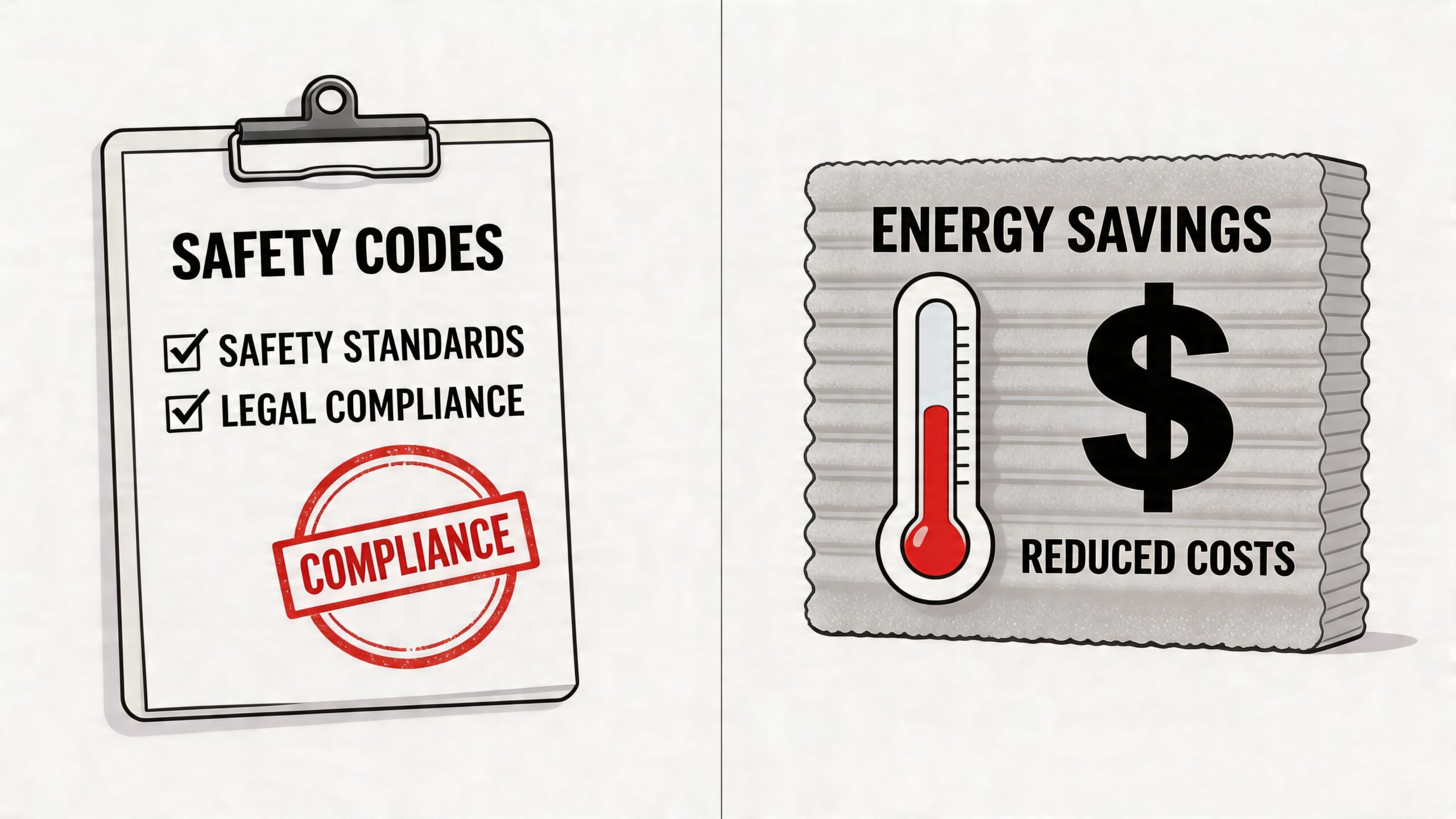
Well-insulated double doors, paired with effective perimeter sealing and sensible close timing, can cut uncontrolled air leakage in a heated building. High-performance models with low U-factors can also reduce annual energy use, but the actual result depends on traffic volume, interior setpoint, wind exposure, and how well the opening is sealed and maintained.
Safety devices that should never be treated as optional
A commercial opening needs a full safety package that matches the traffic and the hazard around it.
That usually includes:
- Photo-eyes that detect an obstruction across the opening and stop or reverse the closing door
- Reversing edges that react if the bottom edge contacts an object
- Emergency release systems so the door can be disengaged when required
- Proper signage and control placement so users understand where and how to operate the system
- Fire-rated assemblies and testing protocols where the opening forms part of a fire separation
Photo-eyes and reversing edges do different jobs. One protects the opening before contact. The other reacts at the point of contact. In mixed traffic areas with forklifts, pedestrians, and delivery vehicles, both matter.
Failures here are expensive. A damaged panel or bent bottom bar is one problem. An injury investigation, lost operating time, or a preventable claim is much worse.
Canadian compliance in plain language
Facility managers do not need to memorize every clause of the building or fire code. They do need to confirm how the opening is classified and what documentation the site needs to keep.
Start with these questions:
- Is the opening a standard service door or part of a rated assembly?
- Does the installed system require labels, certification records, or periodic testing?
- Do the insulation and air-sealing details affect the permit scope or energy code requirements for this project?
- Are there provincial or municipal requirements that change the specification, inspection, or recordkeeping process?
Fire-rated openings need extra discipline because the door is serving a life-safety function. If your facility has rated openings, schedule and document required inspection work, including fire door drop testing and certification.
Where energy performance is usually won or lost
The panel rating gets attention because it is easy to compare on a quote. Operating cost is often driven by the rest of the opening.
Look closely at:
- Panel construction suited to a heated Canadian facility
- Bottom weather seal that stays in contact with the floor across the full width
- Jamb and header seals that close the perimeter gaps
- Closing speed and timer settings that limit open time without disrupting traffic
- Air movement at the opening, especially in exposed yards or high-cycle bays
- Moisture and condensation conditions that can shorten seal life and affect door performance
For many retrofits, the fastest payback comes from fixing leakage at the perimeter. Worn vinyl, hardened rubber, and uneven floor contact can turn a decent insulated door into a constant heat loss point. If you are reviewing that part of the opening, include the right commercial door weather sealer components in the scope.
A door does not need to look damaged to cost money. Small gaps, poor floor contact, and delayed closing lead to increased heating costs and make the opening harder to keep safe and reliable through a Canadian winter.
Installation and Long-Term Maintenance Best Practices
A facility usually learns the full cost of a double garage door at the worst time. It is 6:30 on a January morning, trucks are queued, the opening is half-frozen, and the door starts binding under load. The purchase price is already forgotten. What matters now is whether the door was installed correctly, whether it was maintained to its cycle demand, and how fast the site can get back into service.
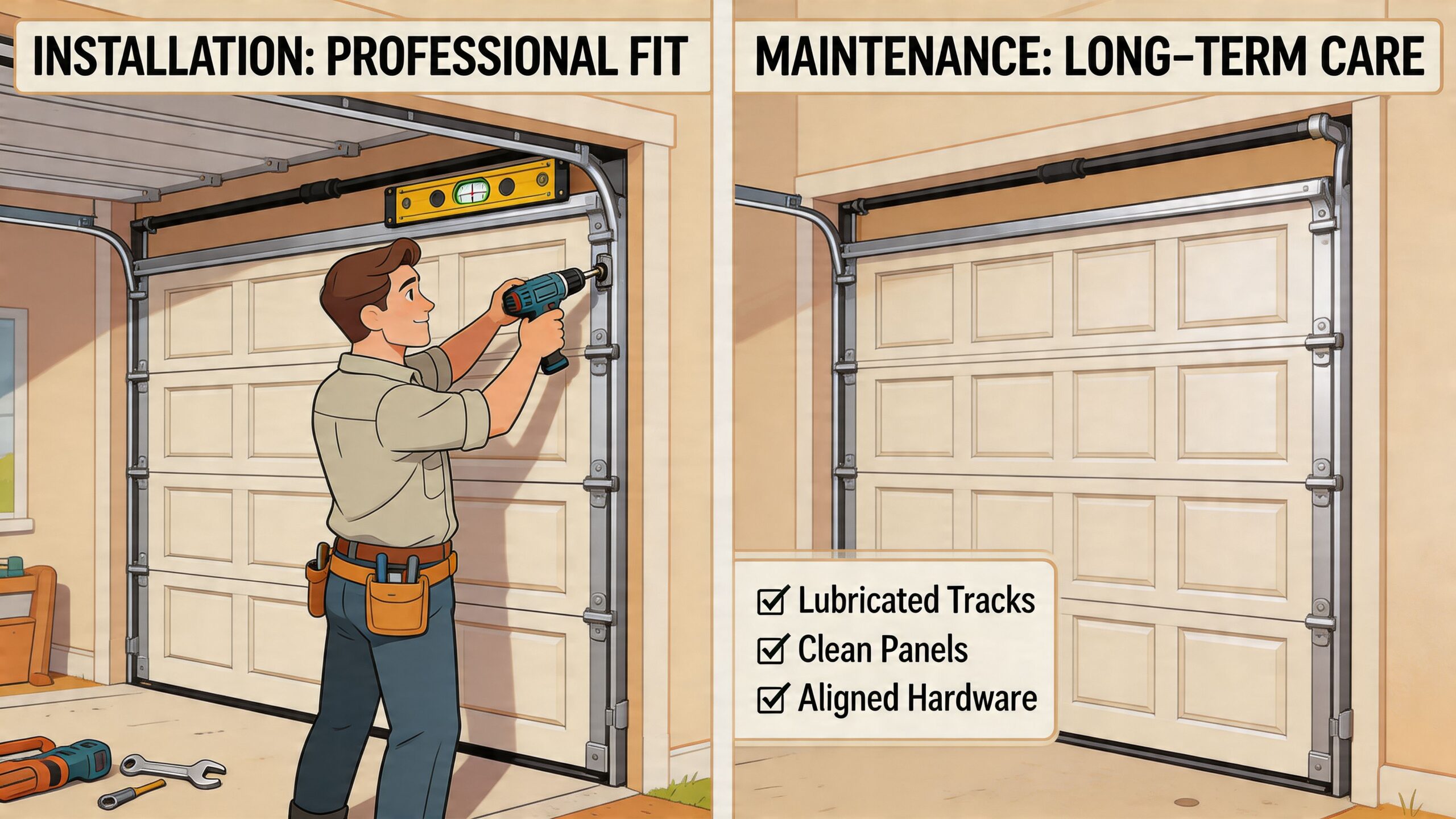
A double-width door puts more load into one opening, one operator system, and one set of moving components than many facility teams expect. In higher-traffic commercial use, that can mean thousands of cycles over time, faster wear at hinges, rollers, springs, seals, and operator drive components, and a larger operational hit when the opening is down. In some facilities, two smaller doors spread that cycle load and reduce the impact of a single failure. In others, one double door still makes sense because it simplifies traffic flow and envelope detailing. The right choice depends on use, not just opening width.
What good installation looks like
Good installation starts before the first track goes up. The opening, slab condition, steel support, electrical feed, and actual site use all need to be checked against the approved door system. On Canadian retrofits, the slab is often the hidden problem. A floor that has heaved, settled, or worn unevenly will affect seal contact, closing force, and winter performance from day one.
New construction gives the installer more control. Retrofits require more field judgment because the structure rarely matches the drawing exactly, and operations often continue while work is underway. That is where experienced crews protect long-term reliability. They correct for out-of-square conditions, confirm the door is balanced to its real installed weight, and make sure the operator is lifting a properly set door instead of fighting it every cycle.
The installation points that matter most are practical:
- Tracks are set plumb, level, and properly supported
- Spring tension matches the actual door weight and hardware configuration
- Operators are sized for the application, not used to mask poor balance
- Safety devices are installed, tested, and documented after commissioning
- Perimeter seals and bottom seal are fitted to the opening and floor condition
- Fasteners, brackets, and mounting points are suitable for the structure and environment
Corrosion control also deserves more attention than it usually gets, especially in coastal areas, wash bays, and facilities exposed to salt, moisture, or chemical residue. Surface rust on hardware, tracks, and bottom bars turns into premature replacement cost if it is ignored. For teams reviewing coating options and preventive treatment methods, this comprehensive guide on protecting metal from rust is a useful reference.
Planned maintenance beats reactive repair
The wear pattern on a commercial double door is usually visible before failure. The door gets louder. Travel slows. The bottom seal stops contacting evenly. Cables start to show wear, or the operator begins working harder than it should. Those are service calls to schedule, not symptoms to watch for another month.
A planned maintenance program should match how the opening is used. A low-cycle storage bay does not need the same service interval as a shipping door that opens through the day in winter. Facilities often overspend by applying one generic schedule to every opening, or underspend by treating a mission-critical door like a seldom-used one. Both approaches raise total ownership cost.
A useful maintenance visit should include inspection of:
- Springs, shafts, bearings, and brackets for wear, secure mounting, and balance
- Cables and drums for fraying, tension issues, and alignment
- Rollers, hinges, and track condition for wear, cracking, looseness, and damage
- Operator settings, limit travel, and control response for proper function
- Photo-eyes, reversing devices, and entrapment protection for safe closure
- Bottom seal, jamb seals, and header seal for air leakage, water entry, and cold-weather performance
If the door is important enough to stop shipping, production, or fleet access when it fails, it needs inspection intervals based on business risk.
Failure patterns that drive avoidable cost
Three habits create many of the expensive service calls I see in the field.
The first is delaying repair because the door still opens. A door can remain operational while running out of balance, dragging on worn rollers, or damaging its operator.
The second is increasing operator force or changing limits to push through a mechanical problem. That usually shifts cost into other parts, including the drive system, mounting points, and safety performance.
The third is treating impact damage or worn seals as minor. On a double door, a bent section, misaligned track, or poor floor contact affects more than appearance. It can change load on the hardware, increase heat loss, let in moisture, and shorten component life across the whole opening.
For active facilities, emergency response still needs to be part of the service plan. A preventive program reduces failures, but it does not eliminate forklift strikes, broken springs, control faults, or weather-related problems. Facilities that need rapid response can review 24/7 commercial door service options.
The strongest maintenance plan is tied to cycle demand, site conditions, and the cost of downtime at that specific opening.
Your Procurement Checklist for Vendor Selection
A weak RFQ usually shows up later as extras, schedule slips, and arguments over scope. On a double garage door, that gets expensive fast, especially in Canadian facilities where cold weather, air leakage, corrosion, and code requirements all affect lifecycle cost.
Good procurement starts by defining how the opening has to perform, not just how big it is.
What your RFQ should define
Set the baseline clearly so bidders are pricing the same job.
Opening dimensions and site conditions
List width, height, headroom, side room, backroom, floor condition, and structural limits. State whether the work is retrofit or new construction, and note any active operations that affect install access or shutdown windows.Door type and duty cycle
Identify the door system you want considered, such as sectional, rolling steel, or high-cycle applications. State expected daily use, traffic type, and whether the opening serves shipping, fleet movement, washdown, or temperature-controlled space.Thermal and weather-performance requirements
For heated buildings and conditioned spaces, ask for insulated construction, perimeter sealing details, and a clear explanation of how the assembly will manage air leakage, snow, water, and freeze-thaw conditions. Panel R-value alone does not tell you what the full opening will cost to operate.Safety, testing, and compliance scope
Define whether the opening is standard or fire-rated, what protection devices are required, and what documentation must be turned over at completion. If your facility has internal safety standards beyond minimum code, include them in the bid package.Operators, controls, and integration
Specify activation method, user groups, closing logic, vehicle detection, and any connection to access control, security, or building systems. This avoids pricing a basic operator when the site needs monitored, high-cycle control equipment.
Questions that separate strong vendors from risky ones
The best quotes usually come from vendors willing to be specific.
Ask who is doing the installation and service work. A subcontracted install can work, but you need clear accountability, technician qualifications, and a defined path for warranty and emergency response.
Ask what is excluded. Electrical, steel, lifts, permits, disposal, programming, after-hours work, and commissioning are common gaps. If they are not listed, they often come back as added cost.
Ask how the vendor supports the door after turnover. Double doors serving active fleet, warehouse, or production openings need a service plan that matches cycle demand and consequence of failure.
Ask whether they can support your footprint if you manage more than one site. Standardized equipment, shared parts strategy, and consistent service reporting matter more over ten years than a small difference in first cost.
Ask how they address corrosion risk. In salt-exposed, humid, or washdown environments, finish selection and exposed hardware protection affect service life. If your team is reviewing protective coatings for exposed metal components, this comprehensive guide on protecting metal from rust is a useful supplementary reference.
Add connected monitoring only where it fits the risk
Some facilities benefit from connected operators and sensor-based monitoring. Others do not.
The right question is whether early warning on cycle counts, fault history, or operator issues will prevent enough disruption to justify the added cost and system complexity. A vendor should be able to explain where connected monitoring makes sense, what data your team will use, and who responds when an alert comes in. For multi-site portfolios or openings where a failure stops shipping or fleet access, that discussion is worth having during procurement, not after breakdowns start.
Final evaluation points
Before award, check the vendor against the full service life of the opening.
- Clear written scope with stated exclusions
- Canadian code and site-condition awareness
- Ability to install safely in active facilities
- Real maintenance support after turnover
- Emergency response capability
- Standardization options across multiple sites
- Willingness to discuss operating cost, not just purchase price
Wilcox Door Service Inc. is one provider in this market, offering commercial and industrial door, dock, operator, and testing services across Canada. For facility managers, that matters because procurement is not only about buying a door. It is about buying an opening that can be installed properly, kept compliant, and serviced without avoidable disruption.
A good vendor helps tighten the specification before tender closes. That usually leads to cleaner bids, fewer disputes, and a double garage door package that holds up better in real operating conditions.