


A facility manager usually starts with one urgent question. What’s the garage door installation cost to get the opening working again?
That’s a fair question, but it’s rarely the right one on its own. If a dock door fails during a busy shift, the actual expense isn’t only the replacement quote. It’s delayed trailers, disrupted picking, extra strain on staff, safety exposure, and the risk of choosing a door that will keep causing problems.
For commercial and industrial sites, the smarter way to budget is to look at total cost of ownership. That means weighing the installed price against energy performance, maintenance demand, code requirements, and the operational impact of downtime. In Canada, a standard double-car sectional overhead door for commercial or industrial use typically falls in the CAD $2,000 to $6,000 range in 2025, with labour often accounting for 30 to 40% of the total, or about CAD $600 to $2,400 per project, according to this Canadian garage door cost guide for 2025.
That number matters. So does everything behind it.
A low quote can be the right choice for a lightly used opening in a mild environment. It can also be the wrong choice for a freezer room, a washdown plant, an airport service bay, or a distribution centre door that cycles all day. The same opening can demand very different hardware, insulation, controls, and commissioning work depending on how the building operates.
Introduction What to Expect from Your Commercial Door Project
Most door projects begin with a problem that can’t wait. A sectional door is binding, a rolling door won’t reset, or a dock opening has become a daily bottleneck.
At that point, many teams ask for a price and compare the bottom line only. That approach misses the bigger risk. A commercial door isn’t a decorative purchase. It’s part of your building envelope, your safety system, and your material flow.
A better question is this. What will this opening cost your facility over the life of the asset?
That’s where garage door installation cost becomes a management issue, not just a purchasing task. The quote covers the door, hardware, operator, and installation labour. The budget should also account for service access, expected wear, compliance testing, energy loss, and the cost of choosing a door that doesn’t match the opening’s duty cycle.
For many facilities, the door itself is only one line item in a larger operational picture:
- Warehouse doors affect trailer turnaround and shipping flow.
- Manufacturing doors affect contamination control, temperature stability, and production access.
- Property management portfolios need repeatable specifications that reduce surprise repairs across multiple sites.
- Government, healthcare, and airport openings often require tighter documentation and stricter life-safety controls.
Practical rule: If the opening is critical to operations, don’t buy it like a commodity.
The facilities that manage cost well usually do three things. They define the opening’s real use, they budget for compliance from day one, and they compare options based on lifespan instead of sticker price alone.
That’s the lens seasoned project teams use. It leads to fewer emergency calls, better uptime, and fewer unpleasant surprises after turnover.
The True Cost Equation Beyond the Initial Quote
The installed price is the part everyone sees first. It’s also the easiest part to misunderstand.
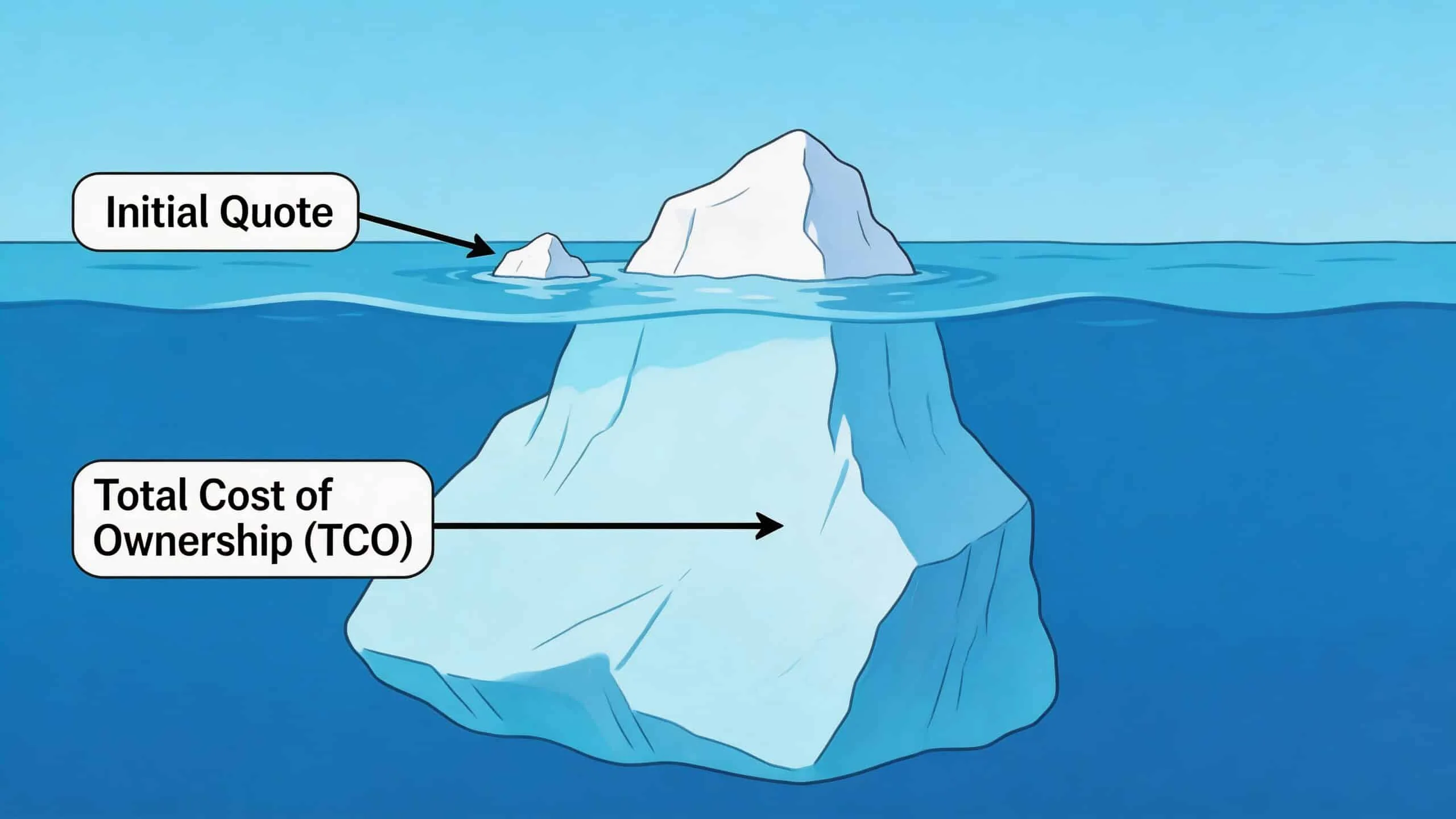
A commercial door quote is like the visible top of an iceberg. It shows the purchase price, the installation scope, and maybe a few options. Beneath that are the costs that hit your operating budget later. Those are the costs facility managers remember.
A practical TCO formula
Use a simple working model:
Total cost of ownership = Initial purchase and installation + Lifetime operating costs – Lifetime savings
That formula keeps the conversation grounded.
Initial purchase and installation is the easiest part to compare. It covers the door system, labour, operator, controls, and site work listed on the quote.
Lifetime operating costs are where bad decisions get expensive. These include unplanned service calls, worn springs and rollers, damaged panels, sensor faults, downtime during repairs, and energy escaping through a poorly insulated or slow-moving opening.
Lifetime savings come from choosing a door system that fits the opening. Better insulation can lower heating and cooling loss. Faster cycle speeds can reduce air exchange. Durable materials can reduce replacement frequency. Proper controls can improve traffic flow and cut operator misuse.
What hidden cost looks like in a facility
A low-cost sectional door might be completely reasonable at a lightly used storage bay. Put that same door on a high-traffic interior opening between conditioned spaces and the economics change fast.
The hidden costs usually show up in ways procurement teams don’t see on bid day:
- Downtime costs when a failed door stops outbound loads
- Energy costs when conditioned air escapes during each cycle
- Maintenance costs when hardware wears out under heavier use than planned
- Compliance costs when the opening needs fire-rating, testing, or documented commissioning
- Safety costs when controls, entrapment protection, or sightlines aren’t properly addressed
A short explainer on cost thinking can help align operations and procurement:
Why the cheapest quote often loses
The lowest quote often strips out features that protect uptime. It may omit upgraded insulation, higher-cycle components, corrosion-resistant finishes, or better control integration. Those omissions don’t always look serious on paper. They become serious when the opening is used hard.
A door that fails during peak receiving hours is never a low-cost door.
Experienced buyers shift from price comparison to asset management. They ask which option will hold alignment better, survive impact better, recover faster after service, and keep conditioned air where it belongs.
That mindset changes purchasing decisions. It also produces more reliable buildings.
Cost Breakdown by Commercial Door Type
Commercial openings don’t all need the same door. The right choice depends on traffic, environment, security needs, and what failure would cost your operation.
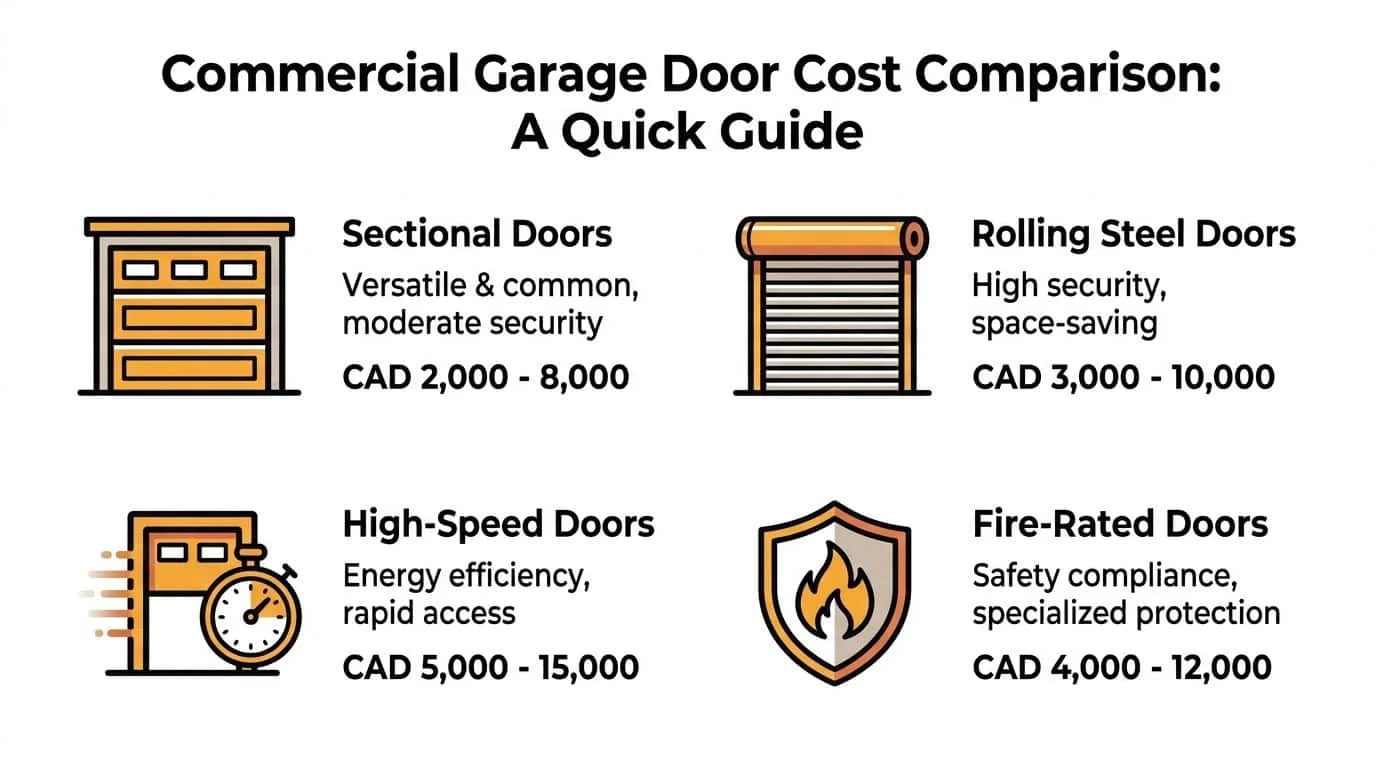
Commercial Door Type Comparison
| Door Type | Typical Installed Cost Range (CAD) | Best For | Key Benefit |
|---|---|---|---|
| Sectional doors | CAD 2,000 – 8,000 | Warehouses, service bays, general industrial use | Versatile and widely serviceable |
| Rolling steel doors | CAD 3,000 – 10,000 | Secure openings, tight headroom, back-of-house access | Compact coil and strong security |
| High-speed doors | CAD 5,000 – 15,000 | High-traffic interior or exterior openings | Faster cycles and better environmental control |
| Fire-rated doors | CAD 4,000 – 12,000 | Openings requiring compartmentation and code compliance | Life-safety protection |
Sectional overhead doors
Sectional overhead doors are the workhorses of many Canadian facilities. They suit shipping bays, fleet shops, service counters, and mixed-use industrial spaces. The panel design is familiar to maintenance teams, and parts are generally straightforward to source and service.
Their strength is versatility. You can configure them with insulation, windows, manual or motor operation, and impact-resistant hardware. They also pair well with many standard operators and dock layouts.
The trade-off is that they aren’t always the best choice for very high cycle counts or environments where fast opening speed is a priority. If your team needs a common, adaptable option, sectional overhead doors are often the baseline against which other systems are compared.
Rolling steel doors
Rolling steel doors fit where durability and security matter more than appearance. They store in a compact coil, which helps when headroom is limited or when interior space has to remain clear for racking, mechanical runs, or conveyors.
They’re often selected for service counters, secure storage areas, parking access, and industrial openings where abuse is expected. A properly specified rolling steel door can be a strong answer for harsh use.
Their trade-offs are practical. They may offer less daylight than glazed sectional doors, and they can be noisier in operation depending on the opening and the hardware package. They also need proper alignment and support details to avoid chronic service issues.
High-speed fabric doors
High-speed fabric doors solve a different problem. They are about movement, air control, and workflow.
In food processing, manufacturing, and distribution, an opening that cycles constantly can leak conditioned air and slow traffic if the door is too slow. High-speed systems reduce open time, which helps maintain pressure zones, temperature control, and cleaner traffic separation. They’re especially useful for forklift routes and interior divisions where traffic never really stops.
They do cost more up front. That higher initial spend often makes sense when the opening has frequent cycles or when air exchange is expensive. Facilities comparing options for those openings should look closely at high-speed fabric doors.
If a door opens all day, speed isn’t a luxury feature. It’s part of the operating model.
Insulated and cold-storage doors
Insulated doors matter most where temperature stability has direct financial consequences. That includes cold rooms, food and beverage facilities, pharmaceutical environments, and any conditioned space where the building has to protect product or process.
The most important discussion here isn’t style. It’s thermal performance, seal quality, and how often the opening cycles. A well-insulated door with the right perimeter sealing package can reduce unnecessary heat transfer and help equipment work less to maintain setpoints.
These doors also demand more attention to hardware selection. A good thermal panel can still underperform if tracks, thresholds, and seals don’t match the operating environment.
Fire-rated doors and security grilles
Some openings are governed primarily by life-safety or security requirements. Fire-rated doors protect openings that must maintain compartmentation in the event of a fire. Security grilles protect retail and public-facing spaces where visibility and ventilation matter after hours.
These are specialized systems. The selection process should start with code and occupancy requirements, not aesthetics.
For facilities with loading docks, security barriers, or integrated access points, the surrounding equipment matters too. The opening often performs better when it’s planned alongside loading dock equipment rather than treated as a standalone purchase.
How to choose without overbuying
A practical decision usually comes down to matching the door to the opening’s job.
- Choose sectional when you need a reliable general-purpose solution.
- Choose rolling steel when security and compact storage matter.
- Choose high-speed when traffic flow and environmental separation drive cost.
- Choose insulated specialty doors when temperature control affects operations.
- Choose fire-rated systems when code demands documented protection.
The expensive mistake isn’t always buying too much door. In busy facilities, it’s often buying too little.
Key Drivers of Material and Labour Costs
A facility manager usually sees the labour problem after the purchase order is cut. The door price looked reasonable. Then the opening needs steel reinforcement, the operator needs a dedicated power run, installation has to happen on a weekend, and the quote grows. That is why material and labour decisions should be reviewed as total cost of ownership items, not line items to trim in isolation.
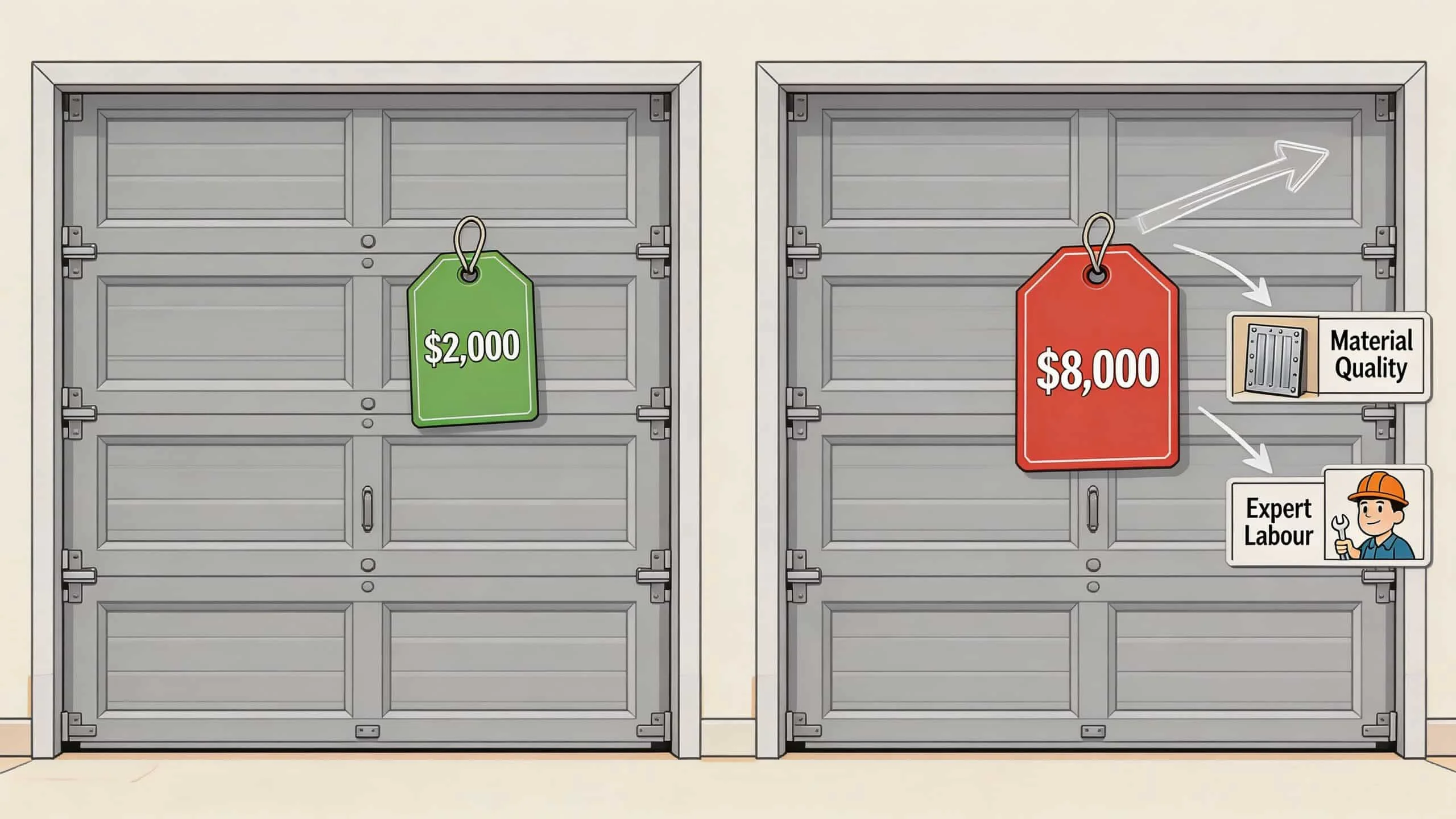
Material choices that move the price
Material specification sets more than the purchase cost. It affects impact resistance, service intervals, cleaning requirements, and how long the door keeps doing its job before panels, finishes, or hardware start failing in real operating conditions.
Steel remains a practical commercial choice for many openings because it balances durability, repairability, and predictable upkeep. NerdWallet’s garage door installation cost guide notes that steel garage doors typically cost less than wood and many custom options. In commercial settings, that matters less for aesthetics than for avoiding premature replacement and keeping parts availability straightforward.
Specification details often drive the total cost:
- Steel gauge affects resistance to dents, bowing, and abuse from carts, pallets, and vehicle traffic.
- Insulation construction changes thermal performance, panel stiffness, and noise control.
- Vision panels improve visibility but add more seals, more cleaning, and more components that can crack or loosen over time.
- Finishes and coatings matter in washdown, coastal, corrosive, and food-grade environments.
- Track, roller, and spring upgrades can reduce wear and service calls in high-cycle applications.
These are operating cost decisions. A door in a warehouse with light daily use can tolerate a simpler build. A door on a busy shipping lane usually cannot.
Insulation affects more than the utility bill
Insulation changes the cost picture in three places. Energy use is the obvious one. Condensation control and equipment protection are often just as important.
In conditioned buildings, a better-insulated assembly can help hold temperature at the opening, reduce strain on HVAC equipment, and limit moisture problems around the threshold and interior floor area. Those savings depend on the full assembly being specified correctly, including perimeter seals, bottom seal, and fit at the opening.
The operator package also affects daily performance and future service cost. A door that opens dozens or hundreds of times a day needs the motor, controls, and duty cycle matched to the application. If you are pricing the powered side of the system separately, this guide to garage door opener installation costs for commercial planning helps frame that part of the budget.
Labour is shaped by the opening, not just the door
Installation labour is rarely a flat number across projects. The same door can be simple in one facility and expensive in another because the opening condition, access, and coordination requirements are different.
A clean replacement in an accessible bay is one kind of job. A retrofit in an active plant is another. I have seen labour rise because the existing jambs were out of plumb, the slab had settled, overhead obstructions forced a different track layout, or production could only release the opening during a short shutdown window.
The labour scope often includes more than hanging panels:
| Labour factor | Why it changes cost |
|---|---|
| Existing door removal | Adds teardown time, hauling, disposal, and site protection |
| Framing or structural correction | Requires steel work, anchoring changes, or opening prep before installation can begin |
| Headroom and lift configuration | Changes equipment needs, track design, and alignment time |
| Electrical and operator setup | Adds wiring, commissioning, limit setting, and function testing |
| Occupied or active site conditions | Requires staging, permits, escorts, traffic control, or off-hours scheduling |
Complexity shows up later if it is missed early
Material and labour costs tend to rise together. Heavier doors need stronger hardware and more installation time. Specialty finishes may require more careful handling. Retrofit operators can trigger electrical work, control revisions, and extra testing before the opening is ready for service.
The expensive mistake is budgeting for a basic install when the site needs a project plan. Facilities pay for that gap through delays, repeat visits, rushed corrective work, and downtime at the opening.
The better quote makes assumptions visible. It identifies what is included, what site conditions were excluded, and which items are likely to affect long-term ownership cost after the door is in service.
Budgeting for Safety Compliance and Special Features
A facility manager usually feels this line item after startup, not at award. The door was priced as a basic opening, then operations adds pedestrian traffic, forklift movement, badge access, warning devices, or audit requirements. The change order arrives later. So does the downtime.
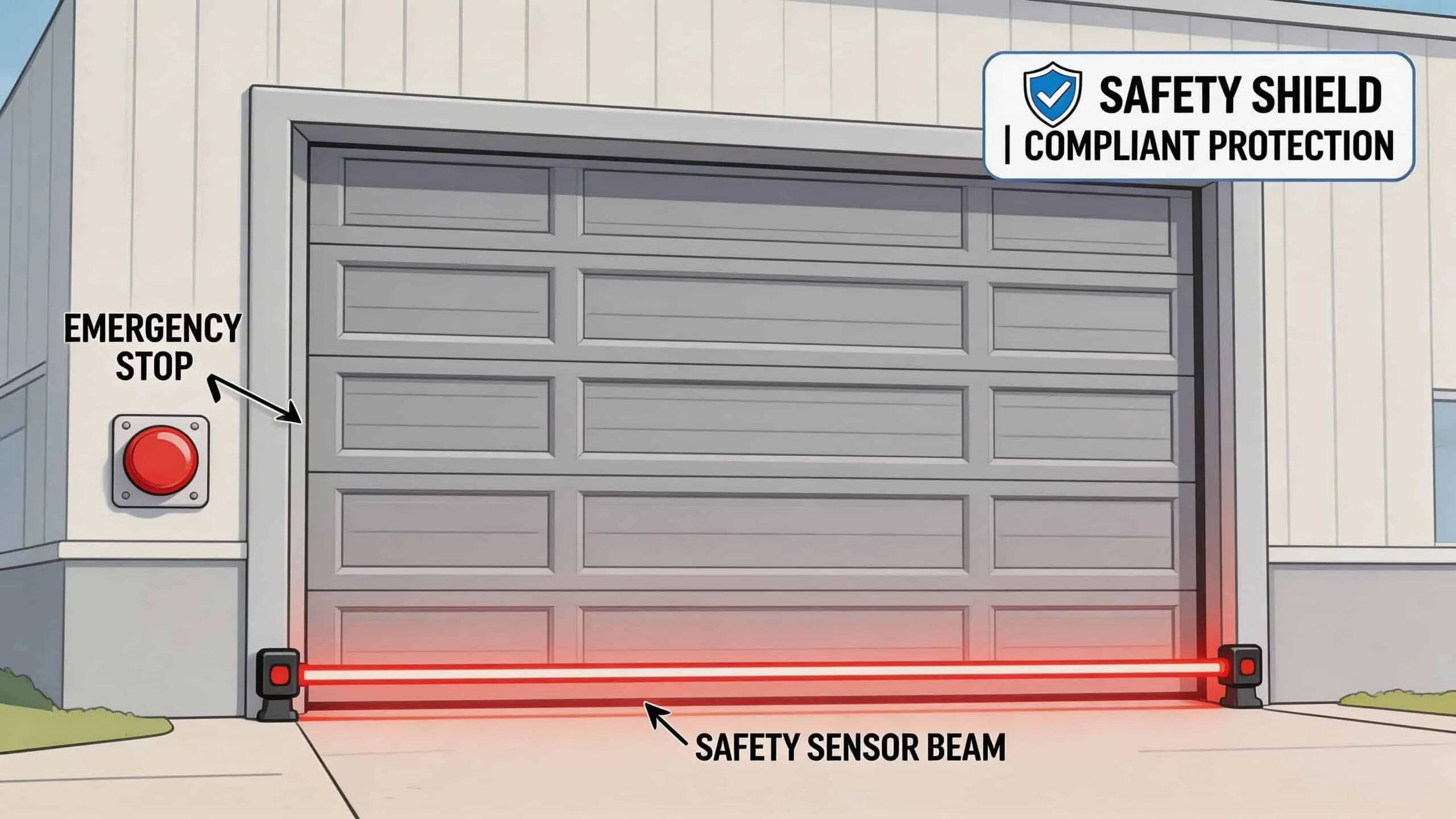
Safety systems should be budgeted with the opening
A commercial door is moving equipment. If it is motorised, high-cycle, or installed at a dock, secure area, or traffic crossing, the control package matters as much as the curtain or panels.
The practical question is simple. How will people, lift trucks, and vehicles interact with this opening every day? That answer drives cost far more accurately than a generic allowance for “extras.”
Typical budget items include:
- Photo-eye sensors to detect obstructions across the opening
- Reversing edges to stop or reverse door travel on contact
- Emergency stop stations near operating zones with higher risk
- Traffic lights or audible alerts where sightlines are poor
- Access controls such as card readers, motion devices, keypads, or loop detectors
These items add upfront cost, but they often lower ownership cost by reducing impacts, injury exposure, operator abuse, and unscheduled service calls.
Compliance affects installation, testing, and paperwork
Compliance costs do not sit only in the hardware column. They also show up in setup time, commissioning, documentation, and follow-up testing.
That is common on government, healthcare, food, transportation, and airport projects. A standard install may become a controlled shutdown, a witnessed test, or a documented turnover package with site-specific signoff requirements. Fire-rated doors add another layer because the opening must be installed, labelled, tested, and maintained to the applicable standard and the authority having jurisdiction.
Cheap scope definitions often create expensive projects. If the quote covers basic installation but your site requires interlocks, monitored devices, safety signage, electrical coordination, or formal commissioning records, the true project cost was never captured.
Special features should solve an operating problem
The right option earns its place by preventing a recurring cost.
At a loading dock, better sealing can reduce conditioned air loss, water entry, and product exposure. At a high-traffic service bay, the right activation method can cut panel strikes and operator wear. At a secured opening, access control tied to the operator can reduce misuse and help document who entered and when.
Facility teams should also budget around the opening, not just on it. Perimeter seals, bottom seals, dock shelters, restraints, bollards, and guard protection often determine whether the system performs well under daily abuse. For teams reviewing seal performance as part of that package, this guide to door weather sealer is a useful reference.
A compliant, well-protected opening usually costs less to own than one that fails inspections, gets hit repeatedly, or creates avoidable safety exposure.
Security integration belongs in the same conversation
Many commercial and industrial doors now sit inside a larger access strategy. That matters for budgeting because readers, monitored entry, alarm inputs, remote release, and operator logic need to work together from day one.
If your opening is part of a controlled facility, the door package should be reviewed alongside broader security systems for businesses. That helps prevent a common mistake: buying the door first, then paying later to retrofit controls, wiring changes, and access permissions that should have been planned together.
From a total cost of ownership standpoint, safety devices and special features are not side items. They are part of how the opening stays compliant, stays in service, and avoids expensive disruption over its working life.
Analyzing Lifecycle Costs and Energy Savings
The hardest garage door installation cost to explain is often the one that hasn’t happened yet. It shows up as future replacement, repeated service work, or energy loss that no one tied back to the opening.
Why replacement timing matters
Historical Canadian cost pressure makes delay expensive in its own way. This Canadian trend summary on garage door replacement costs states that garage door replacement costs in the Canadian region have risen by about 35% cumulatively since 2015. That same source notes that premium insulated doors for cold-storage facilities range from CAD $4,000 to $7,000, and with energy-saving upgrades they can reduce operational costs by 15 to 25% annually.
That doesn’t mean every site should rush into a premium specification. It does mean the “we’ll replace it later” strategy deserves scrutiny. If an opening is already draining energy or driving repair calls, postponing the decision can turn into a more expensive decision.
Energy savings are often easier to defend than repair savings
Repair savings are real, but they can be hard to forecast precisely. Energy loss is easier for many teams to understand because it shows up in monthly utility spend and temperature complaints.
A useful way to think about it is simple:
- Conditioned space + frequent opening cycles usually strengthens the case for insulation and faster operation.
- Unconditioned space + low cycle count may justify a simpler, lower-cost system.
- Temperature-sensitive operations such as cold storage or process-controlled areas often benefit from higher-performing assemblies even when the first cost is higher.
The most common mistake is evaluating insulation as a comfort upgrade only. In many industrial settings, it’s an operating-cost decision.
Lifecycle thinking changes procurement
A lifecycle review usually asks better questions than a bid review.
Instead of asking only what the installed price is, ask:
- How much service interruption can this opening tolerate?
- Does the door match the volume of traffic?
- Will a better insulated system lower avoidable energy loss?
- What happens if replacement is deferred and costs continue to rise?
Those questions tend to move a project away from bare-minimum hardware and toward a door package that supports the facility’s actual workload.
For cold-storage, clean manufacturing, and climate-controlled distribution, the payback case is often straightforward. For low-use utility openings, the lower-cost option may still be correct. Total cost of ownership isn’t about always spending more. It’s about spending where the building will keep paying you back.
Your Procurement Checklist for an Accurate Quote
A vague request produces a vague number. If you want comparable pricing, give each bidder the same operating reality.
Information every provider needs
Start with the opening itself. Measurements matter, but so does context.
Bring these details into the quote request:
- Opening dimensions including width, height, and any irregular conditions
- Headroom and sideroom so the provider can confirm track and operator fit
- Daily use pattern such as low-use storage, shift-change traffic, or constant forklift movement
- Environmental conditions including washdown, corrosion, cold storage, dust, or wind exposure
- Power and controls needs such as push button, pull cord, remote access, loop detection, or card access
- Safety requirements including pedestrian exposure, impact risk, and code-driven functions
- Existing condition notes such as damaged framing, worn tracks, or operator issues
Photos help. So do clear notes about what isn’t working today.
Questions worth asking before you compare quotes
Price alone won’t tell you whether two proposals are equal. Ask each provider the same practical questions.
- What exactly is included in removal, disposal, installation, testing, and commissioning?
- Who performs the work and what certifications or trade qualifications apply?
- What assumptions were made about framing, power supply, and structural support?
- What service response looks like after turnover if the opening goes down
- How warranty coverage works for parts, labour, and operator components
If you’re vetting local and regional providers, this article on garage door installers near me is a useful reference for what to check beyond proximity.
How to compare bids properly
A simple side-by-side review can prevent bad purchasing decisions.
| Quote item | Bid A | Bid B | Bid C |
|---|---|---|---|
| Door type and insulation | |||
| Operator and controls | |||
| Safety devices included | |||
| Removal and disposal | |||
| Testing and commissioning | |||
| Lead times and exclusions |
The cleanest quote isn’t always the lowest one. It’s the one that makes assumptions visible.
Good procurement is less about squeezing line items and more about reducing surprises. When a bidder understands your traffic, environment, compliance needs, and downtime risk, the price usually gets more accurate.
Partnering for Long-Term Value and Reliability
Commercial door buying goes better when the opening is treated as an operating asset instead of a simple building component. That perspective changes the whole discussion. It moves attention from first price to uptime, compliance, maintainability, and energy performance.
That also means the door provider often needs to coordinate with other trades. Operator power, access controls, warning devices, and commissioning can overlap with electrical scope, so project teams sometimes benefit from reading practical guidance from related specialists such as this overview of a commercial electrical contractor.
For facilities that want one source for commercial and industrial doors, dock equipment, service, and planned maintenance, Wilcox Door Service Inc. handles installation, repair, inspections, and related access solutions across Canada. That kind of continuity can simplify handoff from project stage to long-term support.
Reliable openings come from clear specifications, realistic budgets, and disciplined follow-through. That’s how respected partners deliver reliable service.
If you’re budgeting a new opening, replacement, or retrofit, contact Wilcox Door Service Inc. for a facility-specific review and quote built around uptime, safety, and long-term cost of ownership.
Frequently Asked Questions
How much does commercial garage door installation cost in Canada?
A standard double-car sectional overhead door for commercial or industrial use typically costs CAD $2,000 to $6,000 installed, with labour accounting for roughly 30-40% of the total.
Why should I look at total cost of ownership, not just the installation quote?
The installed price is only part of the picture — energy performance, maintenance demand, code compliance, and downtime risk all affect the true long-term cost of a garage door.
What drives labour costs in garage door installation?
Labour typically runs CAD $600 to $2,400 per project, driven by door size, site accessibility, structural modifications needed, and controls/automation integration.
Is a low-cost garage door always the wrong choice?
Not necessarily — a lower-cost door can be the right fit for a lightly used opening in a mild environment, but it can be the wrong choice for freezer rooms, washdown plants, or high-cycle industrial use.