


Meta description: Learn how to improve warehouse efficiency by fixing dock, door, layout, inventory, and maintenance bottlenecks that slow throughput.
Trucks are stacked in the yard. One overhead door is creeping open instead of cycling properly. Receiving has pallets waiting for putaway, while pickers keep crossing the same aisle and fighting congestion near packing. Most managers treat that as a staffing problem or a software problem. On the floor, it usually starts as a flow problem.
That's why the fundamental answer to how to improve warehouse efficiency isn't just “buy a better system” or “push labour harder.” Efficient warehouses move goods cleanly through a series of physical gateways. If one gateway slows down, everything behind it backs up. The dock, the door, the travel path, the slotting logic, the count discipline, and the maintenance routine all have to support one another.
On most sites, the biggest missed opportunity sits right at the building envelope. Teams spend months tuning pick logic and still lose time at a blocked bay, a misaligned leveler, a worn dock seal, or a slow high-cycle door. Those problems don't stay at the wall. They ripple into receiving delays, trailer dwell, rushed loading, temperature drift, overtime, and preventable safety exposure.
A practical fix starts with a baseline. Then it moves to layout, dock flow, inventory control, and planned maintenance. That sequence works because it follows the path of the product. It also gives you KPIs you can watch improve instead of relying on opinions from the lunchroom.
Introduction From Chaos to Control
A warehouse rarely becomes inefficient all at once. It slides there. One receiving lane gets used for overflow. A damaged door takes longer to cycle, so drivers queue at the next bay. Fast-moving SKUs stay in yesterday's locations while demand changes around them. The team adapts, then adapts again, until workarounds become the process.
That's when leaders start asking why output feels harder than it should. Orders still ship, but every shift burns more effort than necessary. Supervisors spend their day expediting. Maintenance gets called only after equipment fails. Pickers walk too far. Receivers wait on space. The dock team loses momentum every time a physical access point doesn't perform.
The good news is that most of this is fixable without guessing. On warehouse floors, the fastest gains usually come from restoring flow where goods enter, move, and leave. That means measuring the right KPIs, reorganising travel, tightening inventory discipline, and treating dock and door systems as throughput equipment instead of building accessories.
Practical rule: If your team is working hard but the building still feels jammed, the issue is usually process friction at a few key choke points, not effort.
On Canadian sites, that operational view matters even more. Weather, freight congestion, and energy performance put extra pressure on every opening in the building. A fast, reliable dock cycle protects more than schedule. It protects labour time, product condition, and the indoor environment.
Establish Your Baseline with Key Performance Indicators
If you want to improve a warehouse, stop asking where people feel busy and start asking where time and errors are accumulating. A baseline gives you that answer. Without one, layout changes become opinions and equipment upgrades become guesses.
The Institute for Supply Management notes that inventory accuracy should aim for at least 97%, while best-in-class order accuracy is about 99.87%. It also identifies dock-to-stock time, order cycle time, pick accuracy, fill rate, backorder rate, labour cost per order, labour utilization, and equipment utilization as core warehouse measures, and recommends data-backed slotting plus zone and batch picking to reduce travel and improve throughput in warehouse operations (Institute for Supply Management warehouse efficiency metrics).
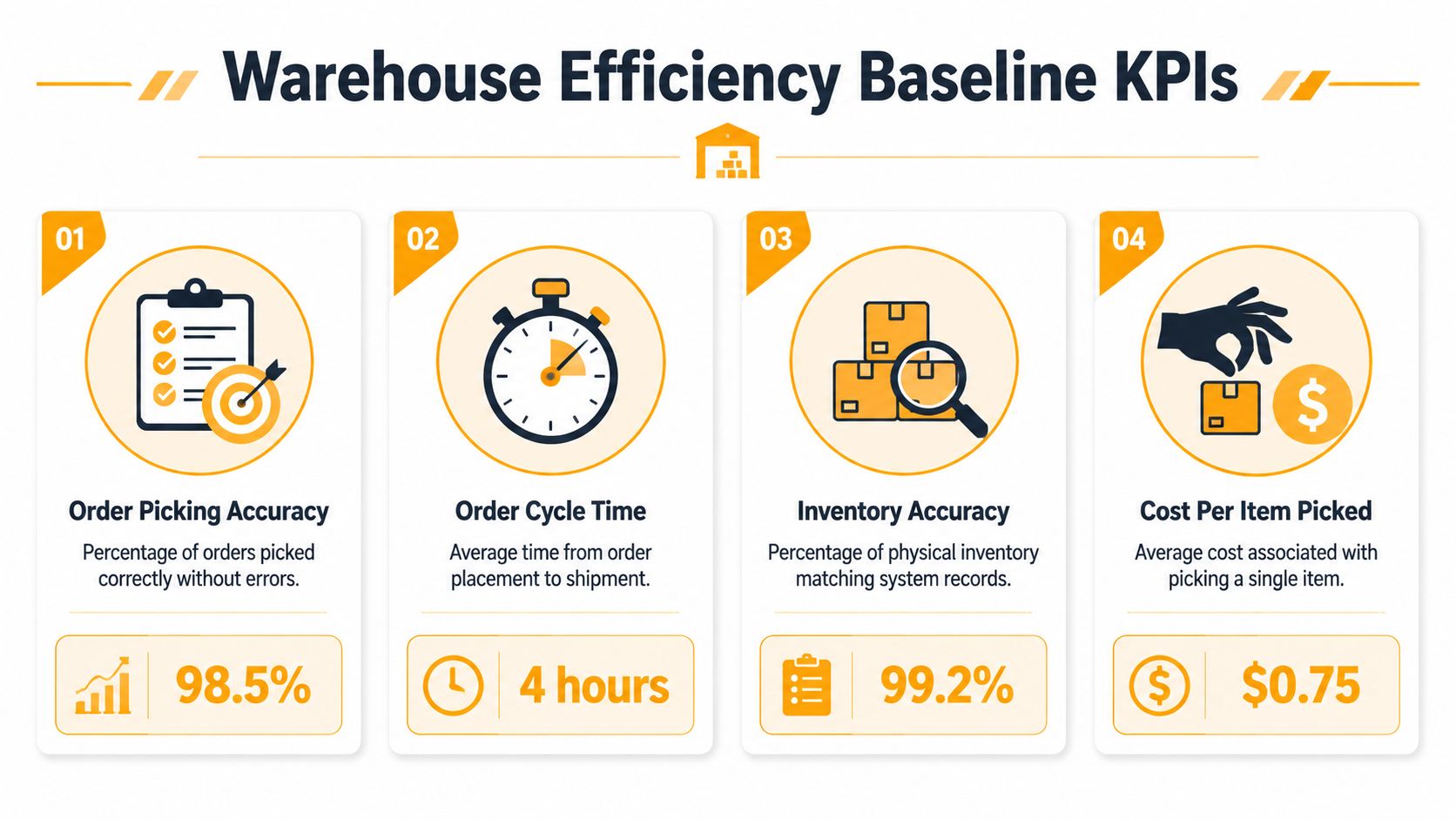
Start with the KPIs that expose bottlenecks
Not every KPI belongs on your daily dashboard. Start with the ones that tell you where flow breaks down:
- Dock-to-stock time means how long it takes for received goods to become available in the system and on the floor. If this drifts upward, receiving is congested, putaway is delayed, or inbound staging is poorly controlled.
- Order cycle time tracks the time from order release to shipment. It shows whether delays are happening in picking, packing, staging, or loading.
- Pick accuracy tells you whether speed is creating rework.
- Labour utilization shows whether people are spending their shift on productive movement or waiting, searching, and correcting errors.
These aren't abstract metrics. They point to physical causes. A poor dock-to-stock result can come from a busy inbound window with too few usable doors. Weak labour utilization often means too much travel or repeated touches.
Build a simple review rhythm
The best dashboards aren't complicated. They're visible, current, and tied to action. Review a small set of KPIs by area and by shift. Then walk the floor to confirm what the numbers suggest.
A practical baseline review looks like this:
| KPI | What it reveals | What to check on the floor |
|---|---|---|
| Inventory accuracy | Whether system records match reality | Barcode quality, location discipline, count errors |
| Dock-to-stock time | Receiving and putaway flow | Trailer wait, door availability, staging congestion |
| Order cycle time | End-to-end fulfilment speed | Pick path, pack queue, loading readiness |
| Labour utilization | How much effort is productive | Waiting time, extra travel, rehandling |
Numbers don't fix a warehouse. They tell you where to look first.
For managers asking how to improve warehouse efficiency, this is the foundation. Measure first. Then change one variable at a time and watch what happens to the KPI that should move.
Optimize Your Warehouse Layout and Flow
Most warehouses lose more time to walking and handling than managers realise. Not dramatic failures. Just constant extra movement. A picker doubles back for a common SKU. A replenishment driver cuts across pedestrian traffic. Packing fills up because fast-movers are stored too far from the outbound side.
That's why layout work pays off when it's based on actual transaction data instead of preference. Warehouse optimisation guidance consistently points to real-time visibility, analytics, and workflow data to redesign flow, standardise work, reduce travel, and track measures such as travel distance, throughput per person, cost per pick, and cycle times over time (data-driven warehouse optimization practices).
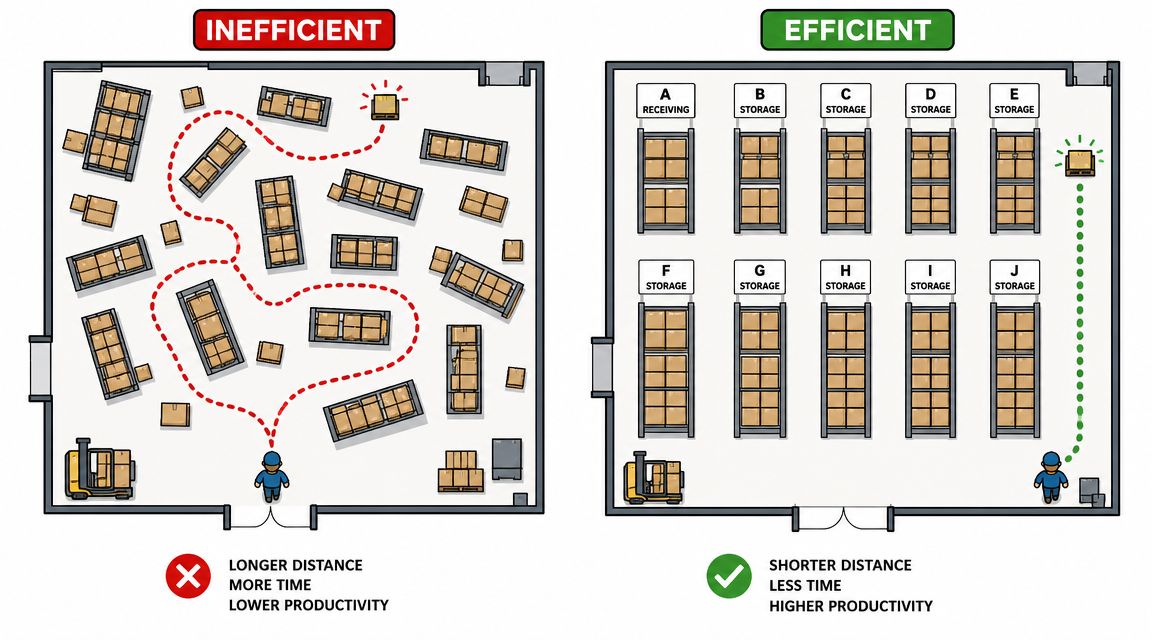
Re-slot by velocity, not habit
If you haven't reclassified SKUs recently, there's a good chance your warehouse is laid out for last season's demand. A practical method is ABC slotting. That means grouping products by how often they move, then putting the fastest-moving items closest to packing or shipping.
The sequence is straightforward:
- Classify SKUs by velocity. Separate high-frequency movers from medium and low movers.
- Relocate the fastest movers. Put the items touched most often in the shortest travel zone.
- Re-map pick paths. Don't stop at shelf moves. Adjust route logic so the new layout reduces walking.
- Re-measure performance. Watch travel time, pick rate, mis-picks, average pick distance, and labour hours per order.
One common mistake is treating slotting as a one-time event. It isn't. In seasonal or high-SKU-turnover environments, static slotting degrades quickly. Review it monthly or quarterly, especially when promotions or product mix shift.
Fix crossings and congestion
Travel reduction isn't only about where product sits. It's also about how people and equipment move through the building. One-way routes, cleaner replenishment timing, and better separation between pick, pack, and forklift traffic reduce friction fast.
A useful floor check includes:
- Cross-traffic points where pickers, lift trucks, and replenishment keep interrupting one another
- Dead-end aisles that force repeated backtracking
- Overflow zones that over time become permanent obstructions
- Packing queues caused by poor proximity between high-velocity storage and outbound staging
For teams reviewing ramps, dock approach, and transition points between trailer and floor, it's worth looking at warehouse dock ramp considerations as part of the wider flow picture.
The operational payoff is real. An Ontario Ministry of Labour-supported ergonomic intervention study found that redesigning material-handling work to reduce reach, lift, and travel contributed to a 28% reduction in musculoskeletal disorder risk and a 12% productivity gain after implementation (Ontario ergonomics and productivity findings).
Here's a useful walkthrough on warehouse layout thinking in practice:
A strong layout doesn't just shorten travel. It makes the next task obvious, which reduces hesitation, congestion, and training time.
Fortify Your Dock and Door Operations
Many efficiency plans spend pages on slotting and barely mention the dock. That's backwards. The loading dock is where outside variability meets inside workflow. If that interface is slow, unreliable, or unsafe, the rest of the warehouse can't perform consistently.
Recent Canadian logistics commentary highlights a blind spot here. Yard and dock-door bottlenecks are a hidden limit on throughput, and with congestion still affecting Ontario's manufacturing and warehousing clusters, downtime from a single blocked dock lane can interrupt the flow of goods and materially affect output (dock and yard bottleneck perspective).
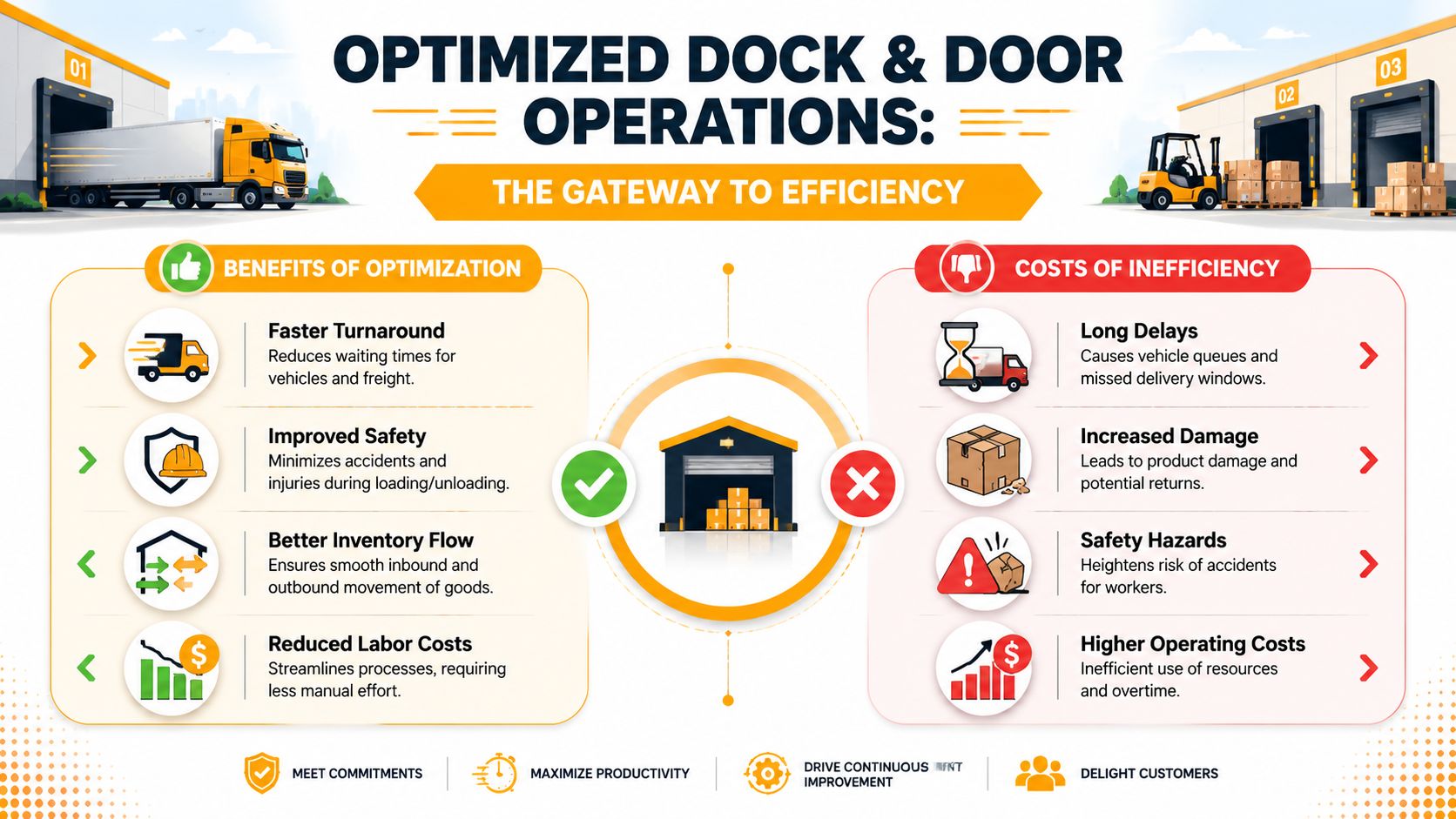
Treat each bay like production equipment
A dock door isn't passive building hardware. It controls the pace of inbound and outbound work. If a door opens slowly, sticks in winter, seals poorly, or can't support clean trailer transitions, labour stands around waiting. Forklifts queue. Drivers lose time. Supervisors start reshuffling trailers instead of moving freight.
Look at each bay through four questions:
| Dock element | What good looks like | What poor performance causes |
|---|---|---|
| Door speed and reliability | Opens and closes consistently during busy cycles | Waiting, trailer delays, indoor exposure |
| Leveler condition | Smooth, stable transition to trailer bed | Slow loading, jolts, safety risk |
| Seals and shelters | Tight trailer interface | Air loss, contamination, discomfort |
| Restraints and controls | Predictable securement and workflow | Unsafe loading, stop-start operations |
If one bay is regularly avoided by drivers or operators, don't treat that as a preference issue. It usually means the equipment is harder to use, slower to trust, or unreliable under load.
Focus on throughput, not just repair
The best dock upgrades reduce friction in several ways at once. High-speed doors shorten open time. Better seals reduce outside air intrusion. Reliable restraints support safer trailer engagement. Well-matched levelers keep forklifts moving smoothly instead of creeping over poor transitions.
That's also where the efficiency conversation becomes practical. If the warehouse team says receiving backs up every morning, check whether the issue is labour or whether the first trailers can't get turned fast enough because of slow cycling doors, damaged pit equipment, or unusable approach conditions.
When reviewing equipment options, a useful starting point is this guide on choosing the right dock leveler for your loading dock.
A few field signs usually tell you the dock is your real bottleneck:
- Trailers waiting for doors even when labour is available
- Frequent bay switching because one position is unreliable
- Product exposure near openings from poor separation between inside and outside conditions
- Repeated loading interruptions for resets, jams, or manual workarounds
When the dock runs badly, the warehouse doesn't have one problem. It has the same problem repeated at receiving, staging, loading, and labour planning.
On sites with frequent cycling, cold-storage exposure, or high trailer turnover, this is often where the biggest operational gain sits.
Leverage Technology for Smarter Inventory Control
Technology helps most when it amplifies a disciplined process. It hurts when it digitises confusion. That's the reality with warehouse management systems. A WMS can tighten receiving, putaway, picking, and replenishment, but only if item data, locations, and count routines are trustworthy.
Canadian guidance on inventory control puts the emphasis in the right place. Pairing a WMS with frequent cycle counts, exception reporting, and root-cause analysis improves accuracy and throughput more reliably than relying on annual physical counts, and mature inventory-control operations have reported inventory record accuracy above 95%, while weaker control often remains below 85%. That difference is associated with lower expedite costs and fewer stockouts (Canadian inventory-control benchmark).
Clean the data before you automate
The most expensive WMS mistakes usually begin before go-live. Item masters are inconsistent. Units of measure don't align. Legacy location labels remain on racks. Receiving shortcuts bypass scanning because the old process still lingers.
Get the sequence right:
- Standardise item master data so descriptions, pack sizes, and units of measure are consistent
- Clean up location codes so every slot is clear and scannable
- Apply barcode discipline at receiving, putaway, picks, and moves
- Set count frequency by risk with high-velocity and high-error SKUs counted more often
- Review exceptions weekly so recurring errors are traced to receiving, slotting, or process habits
A WMS should become your single operational record. It shouldn't become a faster way to spread bad data.
Use cycle counting to stop error cascades
Annual counts tell you what went wrong after the damage is done. Cycle counts catch drift while the operation is still moving. That matters because a single receiving or putaway error doesn't stay local. It becomes a short pick, then a search, then an expedited transfer, then a customer service issue.
For teams exploring process automation around scanning, exception handling, dashboards, and workflow orchestration, an AI automation agency can be a useful outside resource when the goal is to connect systems without forcing staff into more manual checks.
This is also where a service provider may fit into the physical side of the process. For example, Wilcox Door Service Inc. supports door, dock, and access equipment that affects how reliably goods enter and leave the inventory system in the first place. That's not a software layer, but it directly affects scan timing, receiving flow, and dock availability.
Good technology makes errors visible earlier. It doesn't remove the need for disciplined counting and correction.
Implement a Proactive Planned Maintenance Program
The smoothest warehouse is usually the one that looks boring. Doors cycle properly. Levelers settle where they should. Seals stay intact. Restraints work the first time. Nobody is building a shift plan around a piece of equipment they don't trust.
That reliability doesn't happen by accident. In Canada's climate, warehouse efficiency is directly tied to energy performance, and high-speed doors, effective dock seals, and rapid-cycle door maintenance are important for reducing envelope losses, preventing temperature drift, and supporting both labour flow and energy costs, especially in food, pharma, and cold storage environments (Canadian climate and warehouse energy performance).
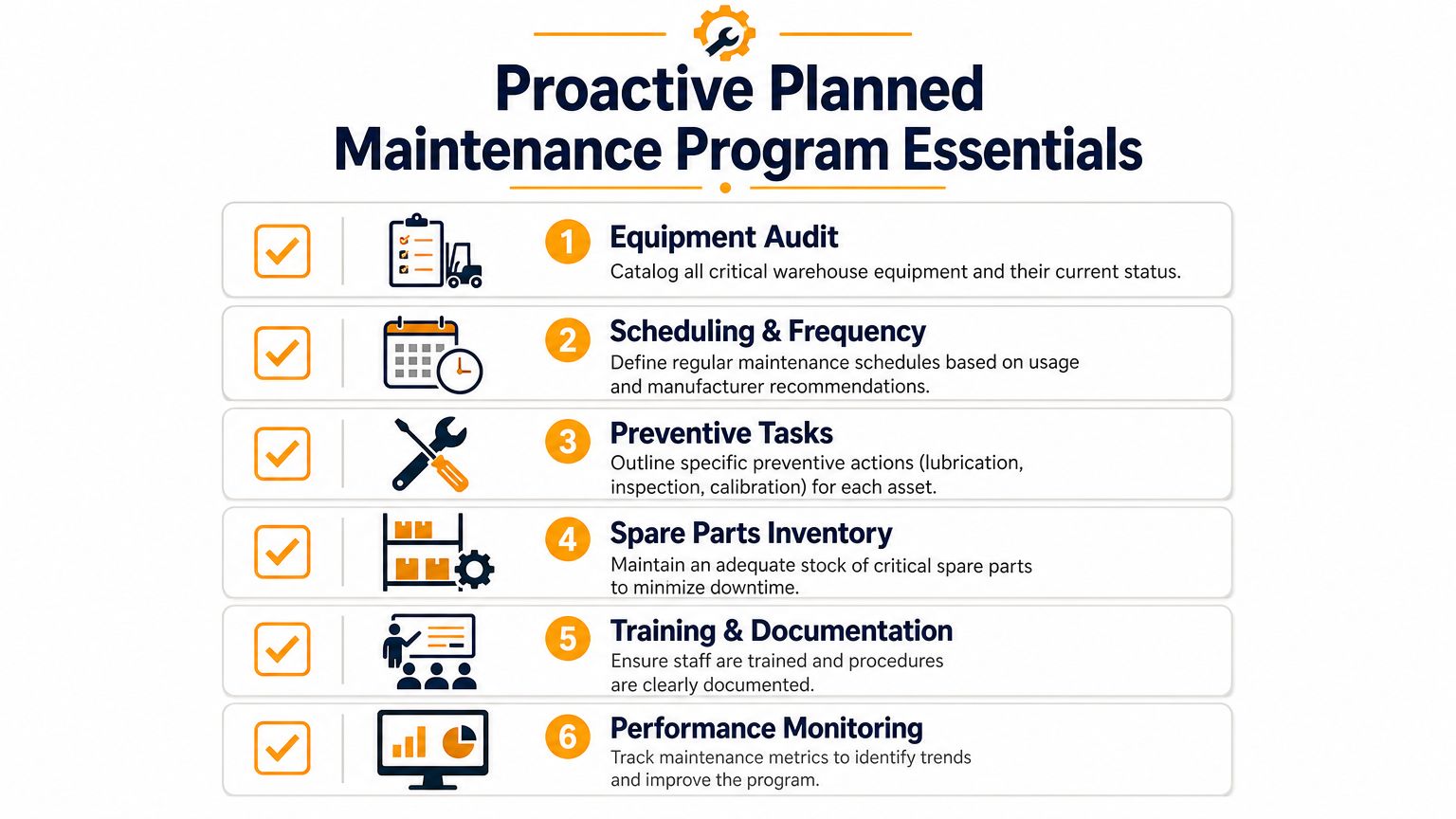
What a planned programme should cover
A maintenance programme needs to focus on the assets that interrupt flow when they fail. In warehouses, that usually means overhead doors, dock levelers, seals, shelters, operators, restraints, and related controls.
A practical checklist includes:
- Asset register with every critical opening and dock position identified
- Service frequency based on cycle count, environment, and manufacturer guidance
- Preventive tasks such as inspection, lubrication, adjustment, cleaning, and testing
- Spare parts planning for common wear items that create repeat downtime
- Documentation and trend review so recurring faults are visible instead of forgotten
For facilities with hydraulic dock equipment, outside references on effective hydraulic maintenance can help maintenance teams structure preventive routines around fluid power components and failure points.
Why reactive service costs more operationally
Reactive maintenance feels cheaper until the failure lands during peak volume. Then the cost shows up everywhere else. Labour waits. Trailers stack. Product gets exposed to weather. A safe loading sequence turns into a rushed one.
The argument for planned maintenance isn't theoretical. It's operational. You're paying to preserve uptime, reduce safety risk, and protect building performance. That's especially important where frequent door cycles and outside air intrusion can affect both process flow and temperature stability.
For managers building a structured service approach, Wilcox's guide to the benefits of a planned garage door maintenance program gives a useful framework for inspections, scheduling, and asset life planning.
Preventive maintenance is part of warehouse capacity planning. If a critical door or leveler is unreliable, your real throughput is lower than your schedule says it is.
Your Next Step Toward a More Efficient Warehouse
Warehouse efficiency improves when you fix the sequence of work, not when you chase isolated symptoms. Start with KPIs. Re-slot fast movers. Reduce wasted travel. Tighten dock and door performance. Clean up inventory data before adding more automation. Then protect the gains with planned maintenance.
If your operation still feels slower than it should, walk the building from the yard to shipping and look for the choke points at each opening. That's where delays usually start, and that's where practical improvements pay back fastest.
If your warehouse needs a clear view of dock, door, and access bottlenecks, contact Wilcox Door Service Inc. to schedule a facility inspection. As Respected Partners, Reliable Service, the team can help assess critical access points, maintenance risks, and upgrade opportunities that support safer flow and stronger uptime.