


If you're budgeting a door retrofit right now, the hardest part usually isn't picking the door. It's figuring out why one quote looks straightforward and the next includes frame work, hardware changes, after-hours labour, and compliance items nobody mentioned at the start.
That's the main issue with interior door installation cost in commercial and industrial settings. Most public pricing talks about residential replacements. Facility managers, property teams, and operations leaders need a different lens. An office corridor door, a warehouse personnel door, and a suite-entry door in a multi-tenant building don't carry the same risk, wear profile, or code requirements.
A realistic budget has to account for the whole opening. That means the door leaf, frame condition, trim, hardware, fire-rating requirements, accessibility, labour conditions, scheduling constraints, and the cost of disrupting active operations. In practice, the cheapest number on paper often produces the most expensive outcome on site.
Planning Your Commercial Door Project Budget
Commercial door budgeting usually starts with a simple request. Replace several worn interior doors. Improve appearance. Reduce service calls. Keep tenants or staff moving. Then the scope expands.
One opening needs a new frame because the old jamb is damaged. Another needs better hardware because traffic is heavier than expected. A corridor opening turns out to be part of a rated assembly. A healthcare or food facility asks for installation outside operating hours. The number you thought was a product number becomes a project number.
What belongs in the budget
A strong budget for interior door work should separate direct installation cost from operational cost.
- Door package: The leaf, frame if required, hinges, lever or lockset, closer if needed, and any seals or accessories.
- Opening condition: Existing wall condition, frame alignment, anchor points, and whether trim or casing can be reused.
- Compliance review: Fire-rating, life-safety hardware, accessibility requirements, and site-specific standards.
- Project delivery: Day work versus off-hours work, occupied-area protection, coordination with tenants, and cleanup expectations.
That structure matters because many quotes look comparable until you ask what's excluded. If one contractor prices only a slab change and another prices a full opening correction, the lower number doesn't mean lower project cost. It only means less scope.
Why commercial budgeting needs more discipline
Commercial retrofits also involve internal coordination. Operations wants minimal disruption. Procurement wants clean comparisons. Maintenance wants a durable result. Property management wants appearance and tenant satisfaction. Finance wants predictability.
Practical rule: Budget by opening condition and use case, not by “one average door price.”
For larger retrofit programs, consistency in scoping makes a major difference. Teams that standardise their assumptions and improve bidding with estimating software usually get cleaner bid comparisons because each vendor is pricing the same work, not a different interpretation of the same site walk.
A workable budget isn't just about what the door costs today. It's about what the opening will demand over the next several years.
Deconstructing the Average Interior Door Cost
A facility team approves what looks like a straightforward interior door replacement. Then the quote changes once the installer confirms the frame is out of plumb, the closer has to be replaced, and the opening needs to meet current fire and accessibility requirements. That is the gap between a consumer door price and a real commercial retrofit budget in Canada.
An interior door installation cost usually covers three cost buckets: the door or full opening assembly, hardware, and labour. The first budgeting decision is whether the project is a slab replacement or a full pre-hung assembly. That choice affects schedule, coordination, and the risk of callbacks later.
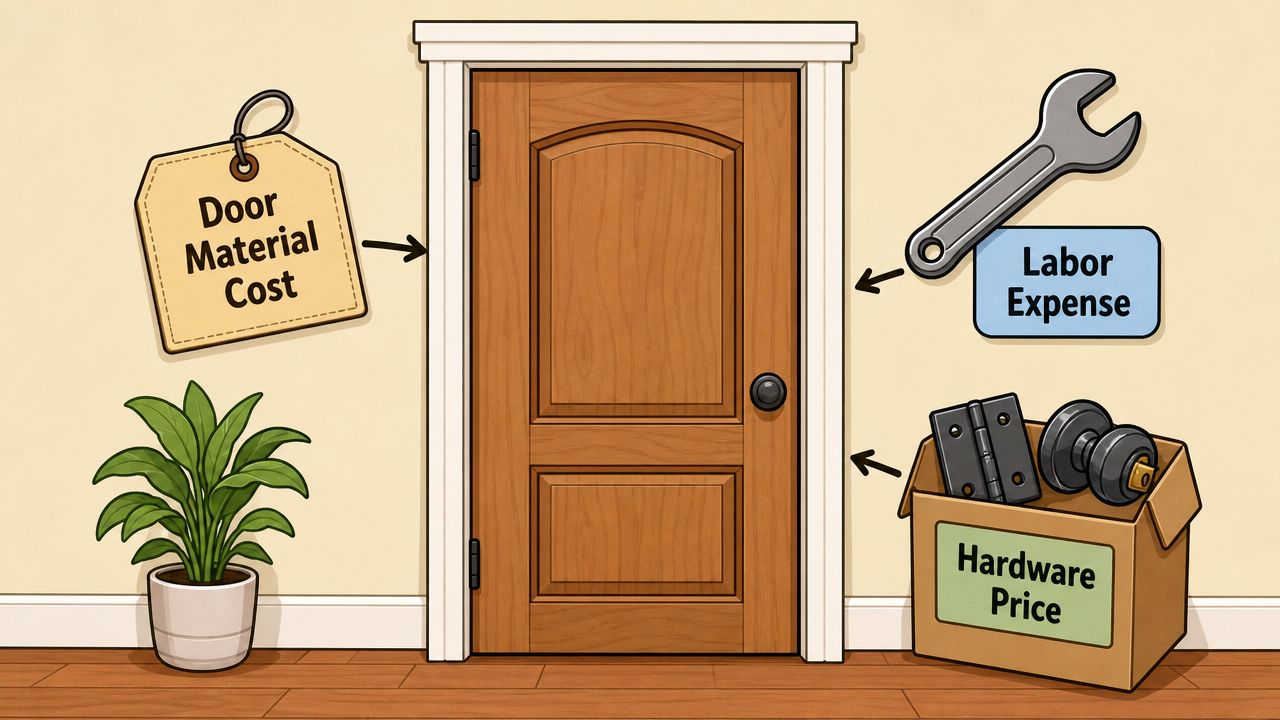
Slab versus pre-hung
A slab door is only the door leaf. It works when the existing frame is straight, the hinge prep aligns, clearances are acceptable, and the opening already performs the way it should.
A pre-hung door includes the frame. It is often the better decision when the existing frame is damaged, twisted, loose at the anchors, or incompatible with the required hardware. In commercial work, that added first cost can reduce labour risk and service calls because the installer is correcting the opening instead of forcing a new leaf into a bad frame.
This distinction matters more in commercial and industrial spaces than it does in a typical residential estimate. A door in a private office has different demands than a door at a corridor, staff room, warehouse office, or maintenance area. Traffic, abuse, cleaning routines, and code requirements all affect what the opening should be.
What the baseline usually misses
Published averages can help set expectations, but facility managers still need to know what is included in the quoted scope.
- Hardware scope: Hinges may be included. Closers, lock functions, kick plates, coordinators, electric strikes, and access-control prep often are not.
- Frame work: A basic install number may assume the frame stays in place and needs no correction.
- Finishing and patching: Paint touch-up, wall repair, casing replacement, and debris removal may be priced separately.
- Performance requirements: Fire-rating, smoke control, acoustic control, and accessibility can change both material and labour costs.
That is why a low number for a door package can be misleading. The door leaf is only one part of the opening. The actual cost lies in how much correction, hardware coordination, and compliance work the installer has to carry.
For facilities considering hollow metal doors for commercial interiors, the trade-off is usually clear. First cost may be higher than a light-duty wood assembly, but service life, abuse resistance, and compatibility with rated openings can make the total ownership cost lower over time.
A low quote for a door leaf is not the same thing as a complete price for a working opening.
Key Factors Driving Commercial Door Installation Costs
A retrofit budget can shift quickly after the site walk. The request may start as one interior door replacement. Then the field conditions show a twisted frame, worn hardware, clearance issues at the floor, or a security function that the existing opening never handled well. For Canadian facility teams, the installed cost is shaped less by the door leaf itself and more by how much work it takes to return that opening to reliable service.
One point causes confusion early. Commercial door pricing is rarely a simple product comparison. Two openings that look similar on a floor plan can carry very different costs once traffic level, abuse exposure, hardware function, and installation constraints are priced properly.
Material choice affects service life, maintenance, and replacement frequency
Door material should match the use of the space.
A light-duty private office may be fine with a basic wood or composite door if the frame is sound and the opening sees low traffic. A warehouse office, school corridor, healthcare back-of-house area, or maintenance room usually needs a stronger assembly. In those settings, the cheaper option often becomes the expensive option after repeated dents, edge damage, hinge failures, and finish wear.
That trade-off matters in operating budgets. Lower first cost helps only if the door lasts under actual use conditions.
Existing opening condition often decides the scope
The condition of the frame is one of the biggest cost drivers in a retrofit. If the frame is plumb, anchored well, and still suitable for the new hardware set, a slab replacement may be enough. If the frame is damaged, out of square, rusted, or poorly aligned, crews may need to reset or replace the full assembly.
That changes labour hours, material handling, patching, and sometimes the amount of time the room or corridor stays out of service.
Hardware changes the budget faster than many teams expect
Hardware is where many commercial budgets drift. A passage function is straightforward. A storeroom function, closer, coordinator, kick plate, electric strike prep, card-reader prep, privacy hardware, or high-abuse protection package adds both product cost and installation time.
It also adds coordination. The installer may need to confirm handing, backset, strike compatibility, closer mounting conditions, power transfer requirements, and how the opening is used by staff. If the door has to support access control or a rated assembly, the margin for error gets smaller. Teams reviewing whether an existing opening can be modified should understand the limits of turning a standard opening into a fire-rated door assembly.
Commercial Interior Door Type Comparison
| Door Type | Typical Cost Position | Best For | Key Benefit |
|---|---|---|---|
| Bifold | Lower installed cost range | Closets, low-demand storage areas | Lower-cost separation where durability demands are limited |
| Slab door | Lower to mid-range when frame stays in place | Openings with sound existing frames | Can reduce scope if frame and hardware prep are reusable |
| Pre-hung door | Mid to higher installed cost range | Damaged frames, full opening replacement | Better fit control because door and frame are installed together |
| Hollow-core door | Lower upfront product cost | Light-duty private offices or low-traffic rooms | Economical for low-abuse interior use |
| Solid-core door | Higher upfront product cost | Tenant areas, meeting rooms, higher-privacy spaces | Better durability and improved sound control |
| Hollow metal door | Higher upfront cost, stronger long-term value in demanding areas | Industrial, institutional, and high-abuse environments | Handles heavy use and supports heavy-duty hardware well |
Cost positions reflect common market patterns and earlier benchmark context, not a single Canadian price sheet.
Site conditions and building operations matter
Installation cost also depends on how easy the opening is to work on. An empty room on a ground floor is one thing. A tenant-occupied suite, healthcare setting, school, food facility, or secure area is another. After-hours work, dust control, restricted access, lift requirements, noise limits, and phased scheduling all add labour cost even when the door package stays the same.
Facility managers should budget for the opening as a working system. The right package should hold up to traffic, support the way the space operates, and reduce the odds of another service call six months after install.
The Impact of Fire Codes and Compliance on Your Budget
Code-related costs are where many retrofit budgets stop being optional. If an opening is part of a rated corridor, stair enclosure, service room, or another protected path, the door package has to match that use. You can't treat it like a standard office replacement.
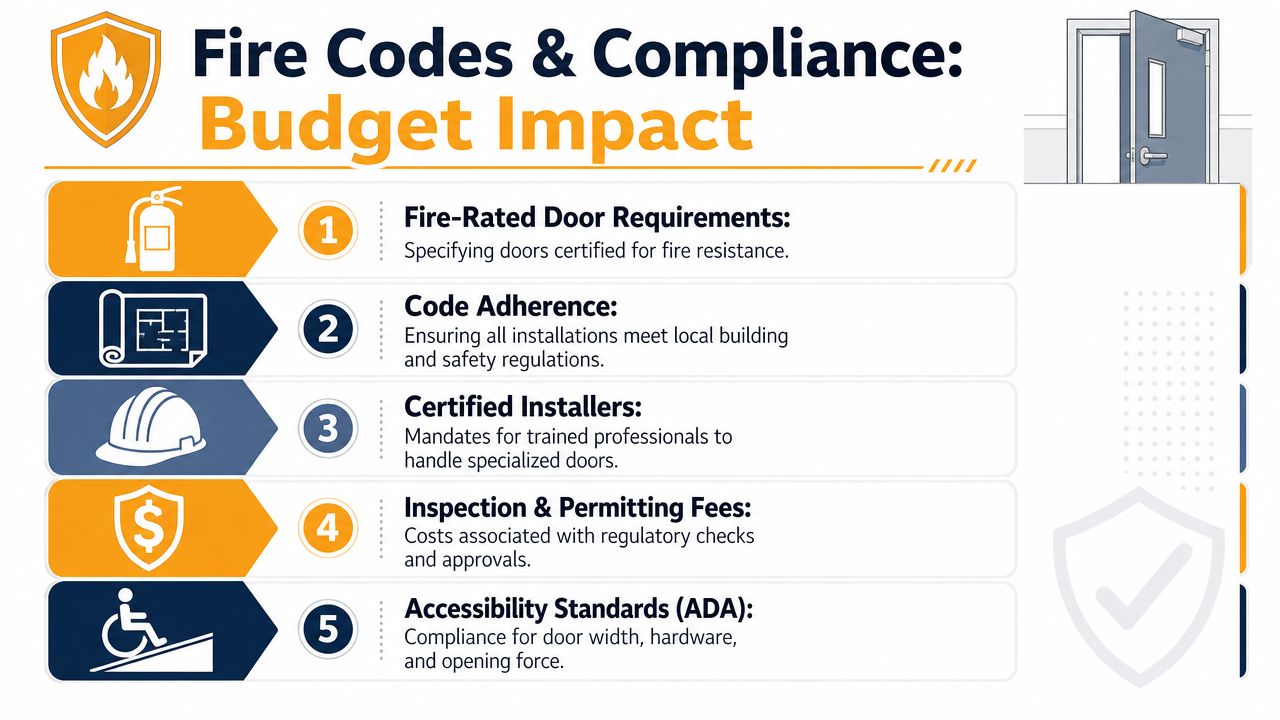
What compliance changes in the scope
A compliant opening may require:
- Rated components: The door, frame, glazing, seals, and hardware may all need to be compatible with the assembly.
- Specific closing behaviour: The door may need to self-close and latch properly every time.
- Label preservation: Modifying or replacing parts carelessly can create inspection issues.
- Accessibility coordination: Clear opening width, hardware usability, and opening force still need attention alongside fire protection.
That combination affects both product selection and installation method. A door that looks interchangeable may not be interchangeable once the opening is rated.
For building teams trying to understand whether an existing opening can be modified, this guide on turning a normal door into a fire door is a practical starting point. It helps frame the difference between a standard door replacement and a code-sensitive opening.
Why compliance costs rise after the site walk
The site walk often reveals issues not visible on a basic asset list. Labels may be painted over. Frames may have field modifications. Existing hardware may not support positive latching. Smoke control details may be missing. The wall condition around the frame may need correction before the assembly can perform as intended.
Those details add labour, coordination, and sometimes inspection steps. In active buildings, they can also change scheduling because rated openings often require a more controlled installation sequence.
A quick visual overview helps when aligning facilities, contractors, and safety teams on what tends to affect budget:
Fire-rated openings are assemblies, not standalone products. If one part changes, the rest of the opening has to be reviewed with that in mind.
The practical takeaway is simple. If there's any chance an opening is tied to life safety, budget for verification early. Rework after installation is far more disruptive than getting the specification right before materials are ordered.
Budgeting for Labour Timelines and Operational Disruption
Labour looks simple on a quote until the crew reaches the opening. Then actual conditions take over.
A basic interior swap is one type of job. A frame correction in an occupied corridor is another. If the wall is out of plumb, the frame is loose, the existing casing is damaged, or the door has to be installed while the facility stays fully operational, labour becomes the most variable part of the budget.
According to Mr. Handyman's door installation cost guide, a major gap in many price guides is whether a quote includes frame repair, trim or casing, or finishing work, and basic labour is often quoted at $40–$90 per hour. That's exactly why two bids can differ sharply even when they appear to cover the same opening.
What changes labour time
Some labour drivers are obvious. Others only show up once work starts.
- Simple swap: Reusing a sound frame and existing opening geometry keeps labour lower.
- Frame replacement: Removing and resetting a frame adds alignment work, anchoring, and finish repair.
- Occupied environment: Dust control, access management, security procedures, and work-hour limits slow production.
- Special facility rules: Hospitals, food environments, clean spaces, and secure sites often require extra protocols.
In commercial settings, the schedule itself can cost money. If work needs to happen before business hours, after tenant operations, or during a shutdown window, the crew may have less time per shift and more setup requirements.
The disruption cost that never appears on the product sheet
A poor schedule can create downstream issues that don't show up under “materials” or “labour.” Staff may have to reroute traffic. Tenant-facing spaces may need temporary barriers. Noise may interrupt meetings, patient flow, or customer service. Security and fire separation may need temporary management while an opening is out of service.
Field advice: Always ask how the installer plans to protect operations while the opening is offline.
Facility leaders should push for a scope that answers practical questions:
- What happens if the frame is damaged behind the casing?
- Who handles patching or touch-up after the install?
- Will the crew work in regular hours or off-hours?
- How long is each opening expected to be unavailable?
Those questions matter because a low labour number can only mean the quote assumes ideal conditions. Most retrofit openings aren't ideal. They're worn, adjusted, patched, painted, hit by carts, and expected to keep working in buildings that never really stop.
Calculating Long-Term Value and Cost-Saving Upgrades
The cheapest interior door rarely stays cheap in a commercial facility. That's the trap.
A low-cost door can work in the right room and the right traffic condition. But if the opening serves tenants, staff, shared corridors, washrooms, warehouses, or meeting spaces, the decision should be based on service life and operating performance, not just first cost.
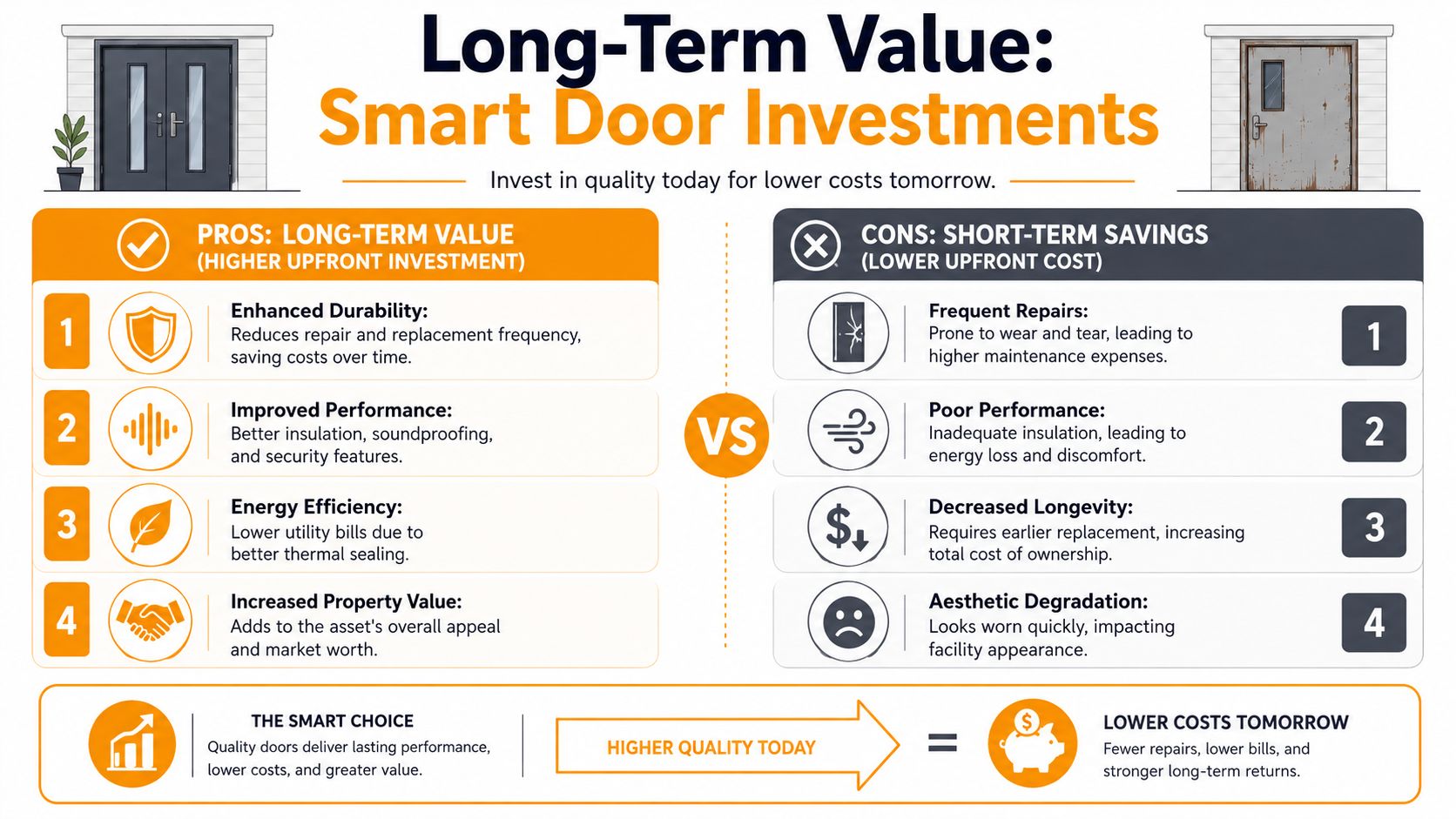
Where false economy shows up
NerdWallet's discussion of door replacement trade-offs points to an issue that matters even more in commercial buildings: the choice between a lower-cost hollow-core door and a higher-cost solid-core option is often discussed without addressing the operational payoff. In facilities where noise complaints, privacy, and durability affect occupant experience and maintenance budgets, the cheapest door can become expensive over its lifecycle.
That pattern is familiar in multi-tenant and high-use properties. A lighter door may look fine at handover, then quickly show edge damage, loose hardware, poor acoustic separation, or repeated alignment issues. Each one triggers another maintenance event.
Upgrades that usually earn their keep
Good upgrades aren't flashy. They solve recurring facility problems.
- Solid-core construction: Useful where privacy, sound control, and abuse resistance matter more than lowest purchase price.
- Better seals and sweeps: Helpful where draft control, odour separation, or corridor comfort is a recurring complaint.
- Heavy-duty hinges and closers: Worth considering for high-cycle openings that see constant use.
- Standardised hardware sets: Easier for maintenance teams to stock, service, and replace across multiple sites.
Planned maintenance also matters. If your team already runs scheduled service on loading docks, overhead doors, or access equipment, interior pedestrian openings should be folded into the same reliability mindset. A structured planned maintenance program for doors and equipment helps catch alignment issues, failing hardware, and wear before they become emergency calls.
The best door investment is usually the opening that stops generating work orders.
That's the total cost of ownership view. Buy for the opening's real use. Standardise where possible. Spend where failure creates friction. Save where the environment is forgiving.
How to Solicit and Evaluate Installation Bids
If you want comparable bids, give every bidder the same information. Vague scope creates vague pricing.
A solid RFQ for interior door work should identify each opening, current condition, expected function, required hardware, finish expectations, scheduling restrictions, and whether fire-rating or accessibility review is required. If you already know some openings need full replacement and others are slab-only candidates, separate them clearly.
What to compare beyond price
Use the bottom-line number last, not first.
- Scope clarity: Does the quote say whether frame repair, trim, hardware, disposal, and finishing are included?
- Installation approach: Does the bidder address occupied-area work, protection, and downtime management?
- Technical fit: Does the proposed door package match the opening's actual use?
- Service capability: Can the provider support adjustments, warranty work, and future maintenance after installation?
For teams replacing multiple openings across offices, warehouses, or mixed-use buildings, it also helps to review a contractor's experience with broader commercial systems. A provider that regularly handles commercial door installation in Toronto and surrounding facilities will usually ask better scoping questions than one focused only on residential replacements.
The right bid is the one that's complete, durable, and operationally realistic. Not the one that only looks cheapest on the first page.
For a detailed site review and a transparent quote specific to your facility, contact Wilcox Door Service Inc.. Their team supports commercial and industrial door retrofits across Canada with the practical mindset facility leaders need: Respected Partners, Reliable Service.