


Dock height, door size, leveler selection, bumpers, restraints and seals. The numbers that decide a dock before anything is ordered, from a company that has serviced docks across North America since 1912.

The short answer
Set dock height at 48–52 inches, size the door 9 ft wide by 9 or 10 ft high on 12 ft centres, choose a leveler of 30,000 lb minimum that is 6 to 8 ft long with a 16 inch lip, and put bumpers that project at least 4 inches. Everything else on this page explains how to check those numbers against your own trailers.
1. Start with the trailers, not the building
A dock is designed around the vehicles that visit it most. A captive fleet of identical trailers makes the choice simple. Most real docks serve a mix of carriers and suppliers, so the planning question is which trailer you see most often, then which unusual ones you must still be able to serve.
An elevating dock lifts the whole loading position to meet the trailer bed, removing the grade entirely.
The parts that matter: deck, lip, lip keeper, hydraulic cylinder and the maintenance strut that keeps anyone working under it alive.
Door height caps usable load height. An 8 ft door wastes the top of a trailer that can carry far more.
The same 8 ft 6 in trailer inside an 8, 9 and 10 ft door. Only the wider openings leave working space at the sides.
| Vehicle | Bed height | Overall height |
|---|---|---|
| Sea container | 56–62″ | 12’2″ – 13’6″ |
| Refrigerated trailer | 50–62″ | 12’6″ – 13’6″ |
| Double-axle semi-trailer | 44–52″ | 12’0″ – 13’6″ |
| City delivery truck | 44–48″ | 11’0″ – 12’6″ |
| High-cube van | 36–42″ | 13’0″ – 13’6″ |
| Furniture van | 24–36″ | 13’0″ – 13’6″ |
| Straight truck | 36–48″ | 10’6″ – 12’0″ |
| Step van | 20–30″ | 8’6″ – 10’0″ |
| Panel truck | 20–24″ | 8’0″ – 9’0″ |
| Flatbed | 48–60″ | n/a |
Facilities that take sea containers
Containers and refrigerated units can ride as high as 62 inches, while tailgate trucks and low-bed vehicles at the same facility can sit near 30 inches. That is a spread of roughly 30 inches on one dock face. Sites in that position usually need a mix of dock heights, a hydraulic leveler with extra working range, or an elevating dock on the doors that see the extremes.
2. Approach and apron space
Dock approach
The approach is the ground you reverse trailers over. It can be level, inclined (rising away from the building) or declined (falling toward it). The best design is a slight incline: trailers still position easily, and rain and melt run away from the building instead of toward the pit.
Required bumper projection rises steeply as the approach grade increases. A 6 inch projection is not enough once the yard falls away.
Drains away from the building and softens the hit when a jockey truck sets a trailer at an angle.
Straightforward positioning, but needs a raised dock to reach standard height.
Used when the floor is at grade. Harder snow removal and drainage, and the top of the trailer can strike the wall.
| Driveway grade | 0% | 1% | 2% | 3% | 4% | 5% | 10% |
|---|---|---|---|---|---|---|---|
| Bumper projection | 0″ | 2″ | 3″ | 4″ | 5″ | 6″ | 12″ |
Seals also have to match. On a declined approach the side pads need to be tapered to follow the trailer angle, or they will not seal and will wear out early. Restraints need enough projection to engage correctly.
Apron space
The apron is the manoeuvring area in front of the doors. A reliable rule: take the longest truck that will visit, double it, and add 5–10 ft. A 65 ft truck needs about 135 ft. Use overall vehicle length, and do not size it from a yard jockey truck, which turns far tighter than a highway tractor.
If the apron is asphalt, pour a concrete landing strip where trailers park, otherwise landing gear sinks into soft asphalt in summer. Size the strip to the longest trailer less 7 ft. Avoid gravel aprons entirely, since they create uneven and unsafe footing.
3. Door layout and spacing
The standard arrangement is a flush wall with doors on at least 12 ft centres. That spacing allows a 10 ft overall truck width including mirrors, leaves room for seals or shelters between doors, and gives space for dock signal lights. You can go tighter when space is short, but then plan for shared-member seals and shelters.
Doors in a straight wall. Simple, economical, easy to seal.
Wall set back in a zig-zag so trailers can angle in. Needs a canopy and costs interior floor space.
Trailers dock inside the building for climate, security or overhead lifting. Expensive, with exhaust to manage.
4. Dock height
Dock height sets the slope a forklift climbs or descends between the dock and the trailer. The working limits are about 10% for electric equipment and 15% for gas or diesel. Beyond that you get hang-ups, damaged equipment and spilled loads.
On a declined approach the trailer arrives nose-down and its rear frame strikes high on the wall, which is why the dock height and the yard grade have to be designed together.
Decide which vehicle you serve most often, then set the majority of your docks to suit it. 48–52 inches is the most common choice for exactly that reason. Large gaps between dock and trailer produce steep leveler grades, which shortens leveler life. Where a few doors face unusual trailers, a custom-length leveler or a different dock height on those doors is cheaper than compromising the whole building.
Every dock door is an exterior door, so it is insulated. In Canada that is not optional: a dock opening in a heated building is the single largest hole in the envelope, and an uninsulated door there pours heat out and pulls condensation onto the floor around the pit. Insulated sandwich sections are the baseline, and the seal or shelter is what stops the infiltration around it. Seals and shelters are not a substitute for an insulated door, and an insulated door will not fix a bad seal on its own.
5. Door sizes
An undersized door causes slow loading, product damage and costly rework. Choose it for the trailers you will see and the way you load them, and think about the next ten years, not only today.
Width
Most trucks on the road are at least 8 ft wide and a growing share are 8’6″. An 8 ft door works but leaves little room and punishes off-centre parking. A 9 ft door is the right match for 8’6″ trailers: side-by-side pallets are easier, damage drops, and many oversize loads still fit. Use 10 ft only for genuinely oversize freight. Legal trailer limits are 8’6″ wide by 13’6″ high in most jurisdictions.
Height
Trailers range from roughly 48 inches for flatbeds to 162 inches for closed vans measured from the ground, and the tallest internal loading height is about 114 inches.
| Door height | Best for | Watch for |
|---|---|---|
| 8 ft (96″) | General loading where stack height is not critical | Cannot support full floor-to-ceiling loading |
| 9 ft (108″) | The popular all-rounder, with tighter loads and less header damage | Low trailers leave a gap at the top that a seal or shelter must close |
| 10 ft (120″) | Every trailer up to high-cube and high-cube containers | Seal and shelter choice needs more thought; a shelter gives the clearest access |
For reference, a 48 inch dock with a 120 inch door gives an overall opening height of 168 inches, or 14 ft.
Send us your dock dimensions and trailer mix and we will recommend a size.
6. Dock levelers
A dock leveler is a fixed bridge between the building and the trailer. It has to carry very heavy loads, serve a wide range of bed heights, and compensate for trailers that sit tilted. There are two basic types, and the right one depends on how hard the dock works.
Mechanical
- Spring-assisted with a hold-down; operator pulls a chain to release, then walks the deck down
- Lower purchase price
- No electrical hookup, and keeps working through a power cut
- Needs regular lubrication and adjustment
- Suits the majority of ordinary applications
Hydraulic
- Push-button operation with no bending or pulling
- Higher purchase price, lower long-term running cost
- Best for heavy, frequent or harsh duty
- Can be interlocked with restraints, doors and inflatable seals
- Richer safety features as standard
Tilt and float
A good leveler floats up and down with the trailer as its suspension compresses, and tilts side to side because many trailers are loaded unevenly and sit canted. Without tilt the lip cannot lie flat on the bed, and a forklift reversing out of the trailer can damage its tyres, drivetrain and transmission.
Safety features worth specifying
Close the sides of the deck to remove the pinch point as it lowers. Standard on hydraulic units.
A velocity fuse on a hydraulic cylinder locks the deck if the trailer pulls away while a forklift is on it.
Returns a hydraulic deck to the parked position after the truck leaves, so there is no open gap in the dock floor.
Add an emergency deck stop (a red mushroom button) and the ability to interlock the leveler with the vehicle restraint, so the deck cannot operate unless the trailer is properly held. A key override covers the cases where a trailer cannot be restrained.
Installation style
Preformed pit
The majority of installs. The pit is formed in the concrete ahead of time, so the floor can be poured on the contractor’s schedule. Lower equipment cost but more time and cost to form the pit.
Pour in place
A notch is made in the foundation wall and the leveler sits on a slab before the floor is poured around it. Faster and cheaper to install, with less flexibility later.
Prefabricated steel pit kits bolt together on site to give a true square pit for less than wood forms, which gets most of the benefit of both approaches.
Width
Standard widths are 6 ft, 6.5 ft and 7 ft. The 6 ft unit is the most common and covers most work. As trailers widen and side-by-side pallets become normal, 6.5 and 7 ft are more popular. A 7 ft deck gives the best access for end-loading two pallets at once. A 6.5 ft deck is a sensible middle size.
Length
Choose length from the maximum height difference between the dock and the trailer. A longer leveler means a gentler slope, longer deck and tyre life, less spillage and a steadier workflow. Pit-style units come from 5 to 12 ft, and 8 ft is the most popular.
| Height difference | 6 ft long | 8 ft long | 10 ft long |
|---|---|---|---|
| 2″ | 2.6% | 2.0% | 1.6% |
| 4″ | 5.3% | 4.0% | 3.3% |
| 6″ | 8.0% | 6.1% | 4.9% |
| 8″ | 10.7% | 8.1% | 6.5% |
| 10″ | 13.3% | 10.1% | 8.1% |
| 12″ | 20.5% | 12.1% | 13.0% |
Lip length and options
- Lip length. The standard lip is 16 inches. Go to 18–20 inches or more where bumpers project beyond 4 inches, where the height difference is large, or where refrigerated trailers have a setback internal bed. If the lip rests on the step below the bed, every forklift pass hits the edge.
- Weather seals. Neoprene strips along the sides and rear improve climate control. Brush seals are preferred where rodents are a concern.
- Foam-insulated decks. Spray insulation under the deck stops condensation forming where warm and cold air meet.
- Galvanizing. Hot-dip galvanized components for corrosive products, salt exposure, and food plants with frequent wash-downs.
- Clean-pit design. No frame assembly, so the pit can be washed out completely. Common in food processing.
Edge-of-dock levelers
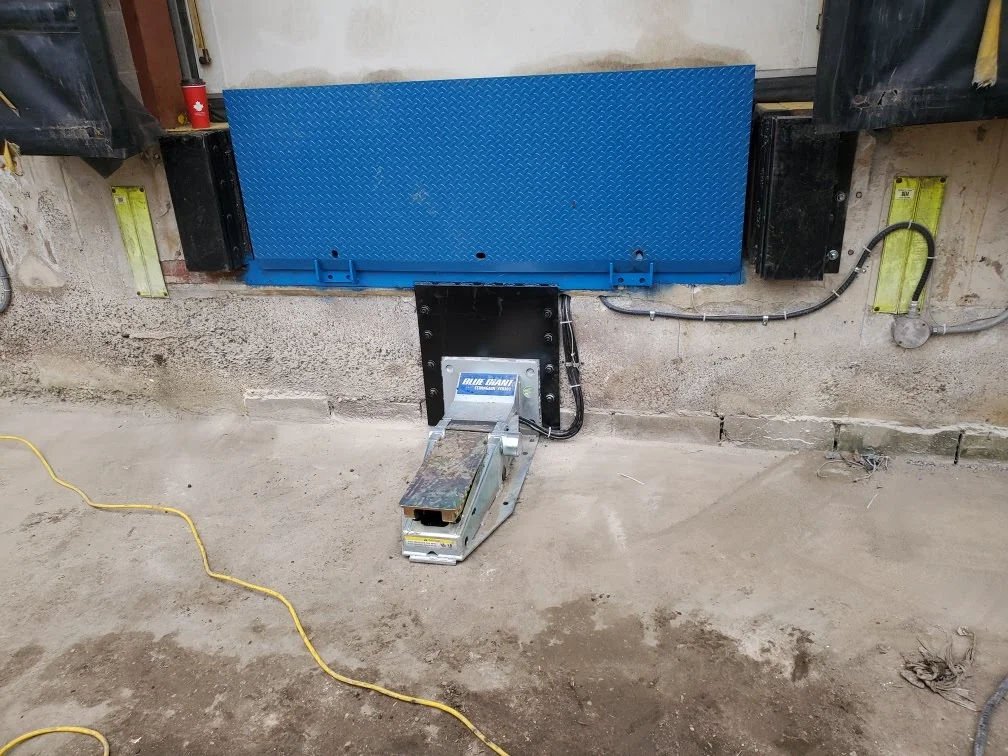
An edge-of-dock leveler mounts to the face of the dock and is a practical, economical alternative when the dock and trailer heights are close. It is not recommended for differences over 2 inches above or below dock level, and common capacities run to 30,000 lb. Widths of 66, 72 and 78 inches are typical, with 66 the most common. If you use hand pallet carts, keep the dock and trailer at the same level.
Vertical-storing levelers
These store upright and lower onto the trailer bed under control. They are common in food storage and processing because the pit is open and easy to clean, and because the overhead door can close right down to the concrete, which helps climate control, security and pest exclusion. The upright deck also shields the door from vehicle impact, and trailers can be positioned and their doors opened before the leveler is lowered. Typical lengths are 5 and 6 ft with capacities of 25,000 to 50,000 lb, usually with 4 inch run-off guards, a dual hydraulic and mechanical storage lock, and an emergency stop.
7. Choosing leveler capacity
Capacity is where specifications get confusing, because suppliers use different terms for rated load, dynamic capacity and rollover capacity. Work from your own equipment instead. Five questions decide it:
Capacity adds dead load, the lift truck plus its load, and an impact allowance for the drop onto the trailer bed.
- What is the configuration and gross weight of the loading vehicle? Count the wheels, their size and arrangement.
- What is the heaviest load you will ever move, however rarely?
- What is the height difference between the dock and the trailer?
- How fast do vehicles cross?
- How often does the dock work?
Vehicle gross weight + load gross weight, multiplied by 2.5. An 8,000 lb forklift carrying a 4,000 lb load is 12,000 lb, times 2.5, giving 30,000 lb. If that exact capacity is not offered, step up to the next size.
| Duty | Multiplier |
|---|---|
| Light to normal | 2.5× |
| Normal to heavy | 3–4× |
| High frequency, steep grade, higher speed | 4–5× |
The guideline holds when the grade is under 7%, speed is under 5 mph and the dock handles no more than about 8 trucks per door per day. Impact forces can be many times the static load because of speed. Three-wheeled trucks and narrow wheels concentrate load at a point and call for more capacity again. Treat 30,000 lb as the minimum regardless of calculated load, and size for at least ten years of service. When in doubt, go higher.
8. Dock bumpers
Every dock needs bumpers to protect the building. An approaching vehicle can generate up to 300,000 lb of impact force, so this is not a place to economise. For a normal level approach, specify projection of at least 4 inches. Recessed docks and declined approaches need more, or build-out blocks.
Fabric-reinforced rubber, moulded in one piece with bolt holes.
Layered rubber pads held between steel angles.
For high frequency or jockey-truck positioning, where the face would otherwise be bitten out of the rubber.
For the hardest wear, steel spring bumpers use formed spring steel on a backing plate to absorb impact and resist continual wear. Where an existing building cannot project the dock, use build-out blocks to push the bumpers forward.
9. Vehicle restraints and dock safety
Trailer creep, early departures and careless parking happen at every busy dock, and a single dock can see up to 100 opportunities a day for a serious forklift incident. A vehicle restraint is the answer. The most common is the face-mounted type, which engages the trailer’s rear impact guard (ICC bar).
A restraint hooks the rear impact guard and holds the trailer against the bumpers. A chock only stops roll.
Holds the trailer until the dock attendant releases it.
Stops the trailer drifting away under forklift traffic.
Keeps the leveler lip seated on the trailer floor.
Stops an unauthorised trailer removal.
Typical operating range is 12 to 30 inches of ICC bar height, and most units are rated to resist about 35,000 lb of pull-away force. Trailers with unusually low or high bars need a specialist solution. Restraints can be electro-mechanical, electro-hydraulic or manually positioned with a bar. Whatever type you choose, it has to be easy to use, because a restraint that is awkward is a restraint that gets skipped. Recessed pit restraints work but require an expensive additional pit, while face-mount units are simple to install, maintain and relocate.
Communication lights
A two-way light system pairs an outside signal light and instruction sign with an inside control panel. The rule is simple: load or unload on green only. Interlock the restraint to a hydraulic leveler so the deck will not operate until the trailer is held. If a trailer has no usable ICC bar, chock the wheels and use the key override with extra caution.
Barriers and wheel chocks
Barriers stop a forklift rolling off the end of the leveler onto the apron when no trailer is present. They are generally not designed to stop vehicles over about 4 mph, so check the rating. Wheel chocks are the oldest safety device and every dock should have them available, but relying on them alone has weaknesses: crews find them inconvenient, they get stolen, and placing them costs real labour time over a year.
Seal or shelter? How to choose
A seal and a shelter solve the same problem in opposite ways. A seal is a set of foam pads wrapped in fabric that the trailer physically compresses, closing the gap by contact. A shelter is a larger fabric structure the trailer backs into, leaving the rear frame clear so you keep full access to the opening and the trailer’s own doors.
Left: a seal closes the gap by compression. Right: a shelter encloses the opening while leaving the trailer frame accessible.
The trade-off is straightforward. Seals give the tighter closure and the better energy number, which is why cold storage and food facilities almost always use them. Shelters give better access, tolerate a wider spread of trailer sizes, and take more abuse without being destroyed. A facility that receives a mix of 102 inch vans and narrow straight trucks will fight a seal all day and be happier with a shelter.
Sizing a seal
Seals are sized off the door opening, not the door panel. The head pad spans the full opening width and the side pads run from the head pad to the floor. Measure the opening, then confirm the trailer’s rear frame will land inside the pad footprint with the trailer centred.
Seal dimensions are taken from the clear opening: head pad width, side pad height, and pad projection into the doorway.
Declined approaches change the number
When the yard falls away from the building, the trailer arrives nose-down and its rear frame rises. A seal cut square will crush at the bottom and gap at the top. The projection has to be reduced at the bottom and increased at the top so the crush is even across the whole frame.
A tapered seal compensates for a declined approach so the crush is uniform from top to bottom instead of pinching at the floor.
The working rule from field measurement: divide rise by run, multiply by the door height plus six inches, and that is the difference in projection between top and bottom. A nine foot door on a noticeable grade typically needs a few inches of taper, not a special-order pad.
| Facility type | Better choice | Why |
|---|---|---|
| Cold storage, food processing | Seal | Tighter closure, lower infiltration, protected by hygiene requirements |
| General warehousing, mixed fleet | Shelter | Tolerates trailer size spread and keeps full access |
| High-volume grocery distribution | Seal with rain gutter | Dock traffic is constant and the fleet is standardized |
| Facilities handling sea containers | Shelter | Container frames vary far more than van trailers |
11. Elevating docks
An elevating dock is a hydraulic lifting platform that adjusts to any trailer height, from ground level up to about 60 inches for pit-mounted units, and it gives forklifts ground-level access when needed. The trade-off is efficiency: it has to cycle up and down on every trip into and out of the trailer, which a leveler does not. Low-profile versions work without a pit and suit hand pallet trucks and low-volume traffic.
- Deck size. Base it on the vehicle’s turning radius and length. A load needing a 75 inch turn needs about an 84 inch deck. A 96 inch deck handles most side-by-side pallet loading, which can halve the number of trips. Common sizes run from 72 by 96 to 96 by 144 inches.
- Lifting capacity. Not subject to the dynamic loads a leveler sees, so size for the total vehicle and load weight. Overrate for heavy use such as 20 cycles a day, and check axle capacity, since some vehicles put about 80% of gross weight on one axle. Typical range is 3,000 to 25,000 lb and up.
- Lifting speed. Driven by the power pack. Aim for 20–30 seconds for a full lift, since an undersized pack saves money and costs efficiency every day.
Reefer trailers and the setback lip
Refrigerated trailers carry a refrigeration unit on the nose and a deeper rear frame than a dry van. The rear sill sits further forward and the frame is heavier, so a leveler that reaches a dry van cleanly can fall short of a reefer at the same dock.
A refrigerated trailer puts the working deck behind a deeper rear frame, so the leveler lip needs the setback version to reach the floor.
Two practical effects. First, specify a setback lip rather than a standard lip where reefers are part of the mix. Second, expect the seal to work harder: reefer frames are bulky and often damaged, and the pads compress unevenly. Facilities that run reefers seasonally and dry vans the rest of the year should size the lip for the reefer, because the reverse does not work.
Pits, foundations and drainage
The leveler is the visible part. The pit is what decides whether it lasts twenty years or leaks in year three. A pit is a formed concrete box set below the dock floor, sized so the leveler deck sits flush, with its own drainage provision and enough structural depth to carry the load.
Preformed pits arrive as a single welded unit. Pour-in-place pits are built and cured on site and tolerate odd dimensions better.
Preformed pits suit new construction where the dimensions are standard and the schedule is tight: one piece goes in, the concrete is poured around it, and the pour is sealed against the pit rather than the ground. Pour-in-place pits cost more in time and finishing but handle non-standard openings, sloped slabs and old buildings where nothing is square.
Drainage is the part that gets skipped. Water entering the pit has nowhere to go but into the subgrade, and freeze and thaw will find every seam. Anything with a pitched yard or no canopy needs a positive drain path before the pit is formed, not after.
Signal lights and safe dock practice
Most dock injuries happen at the two moments nobody is watching: a trailer pulling out while a lift truck is still inside, and a lift truck driving out of a door with no trailer at it. Both are prevented by the same thing done properly, a light system the driver and the dock hand both read.
Exterior and interior lights must agree. Red outside means stay out, green inside means the restraint is engaged and loading can start.
The rule that matters is the interlock: the interior light should not show green until the restraint is fully engaged and the leveler lip is seated in the trailer. A light wired to a switch lets someone defeat it, and someone always will. Wire it to the restraint and the leveler and it stops being a reminder and becomes a control.
- Mount the exterior light where a driver can see it in a mirror without leaving the cab.
- Put the interior light where a lift truck operator sees it before entering the trailer, not on the wall behind them.
- Keep the red/green sequence identical at every door, so a driver working multiple docks does not have to relearn it.
- Add wheel chocks as well where trailers are left briefly or the restraint is out of service.
Modernizing an older dock
Most of the docks we rebuild are not new buildings. They are loading docks that were sized for a different fleet and have been patched for thirty years: cracked pits, a leveler that has been re-welded twice, doors that no longer seal, and a yard that has been resurfaced enough times to fall away from the building.
The sequence that avoids wasted money:
- Survey before anything is ordered. Measure dock height, opening size, approach grade, apron depth and the trailer mix that actually arrives.
- Decide the trailer the dock must serve. Everything else follows from that one number.
- Check the pit. If the pit is sound, a leveler replacement is a fraction of the cost of a rebuild. If it is cracked or undersized, the leveler is only part of the job.
- Fix the opening before the seal. A seal or shelter cannot correct a door that is out of square or a wall that has shifted.
- Add the restraint and lights together. One without the other is a half measure that costs more later.
Dock survey checklist
Before you request a quote, gather these. The more we know, the more accurate the recommendation.
The vehicles
- Forklift type, weight and wheel count
- Heaviest load, maximum and average speed
- Trailer bed heights: maximum, minimum and average
- Inside trailer widths
- How much the bed floats as the forklift drives in
The dock
- Door width, height and spacing between doors
- Clearance above doors, foundation projection and dock height
- Bumper projection and condition
- Approach: level, inclined or declined
- Existing leveler pit width, depth and condition
Explore the equipment
Frequently asked questions
Does a loading dock door need to be insulated?
Yes, and in Canada it is not optional. A dock door is an exterior door, and a dock opening in a heated building is the largest single hole in the envelope. Insulated sandwich sections are the baseline, with the seal or shelter closing the gap around the door. A damaged insulated section loses value at the break, which is why bumpers and restraints take the impact instead of the door.
What is the standard loading dock height?
The most common dock height is 48 to 52 inches, which sits in the middle of the trailer bed range from about 44 to 52 inches for standard semi-trailers.
How wide should a loading dock door be?
A 9 ft wide door suits 8 ft 6 in trailers best and handles many oversize loads. An 8 ft door works but leaves little manoeuvring room. Space doors on at least 12 ft centres.
How do I choose a dock leveler capacity?
Add the vehicle gross weight and the load gross weight, then multiply by 2.5 for light to normal use, 3 to 4 for heavy use, and 4 to 5 for high frequency or steep grades. Treat 30,000 lb as the minimum.
What is the best dock leveler length?
Eight feet is the most popular length. Pick length from the maximum height difference between dock and trailer, because a longer leveler gives a gentler slope and a longer service life.
What is the difference between mechanical and hydraulic dock levelers?
Mechanical levelers are spring-assisted, cheaper, and work without power. Hydraulic levelers are push-button, cost more up front, cost less to run over time, and suit heavy, frequent or harsh duty.
How much apron space does a loading dock need?
Take the longest truck that will visit, double it, and add 5 to 10 ft. A 65 ft truck needs about 135 ft.
How much bumper projection do I need?
At least 4 inches on a level approach. Declined approaches and recessed docks need more, or build-out blocks.
Planning a new dock or fixing an old one?
Send us your trailer mix and door dimensions. We will tell you what fits, what it costs, and what to avoid.