


How a coiling door actually works, what carries the wind load, how the guides are mounted, and what to check before one fails.
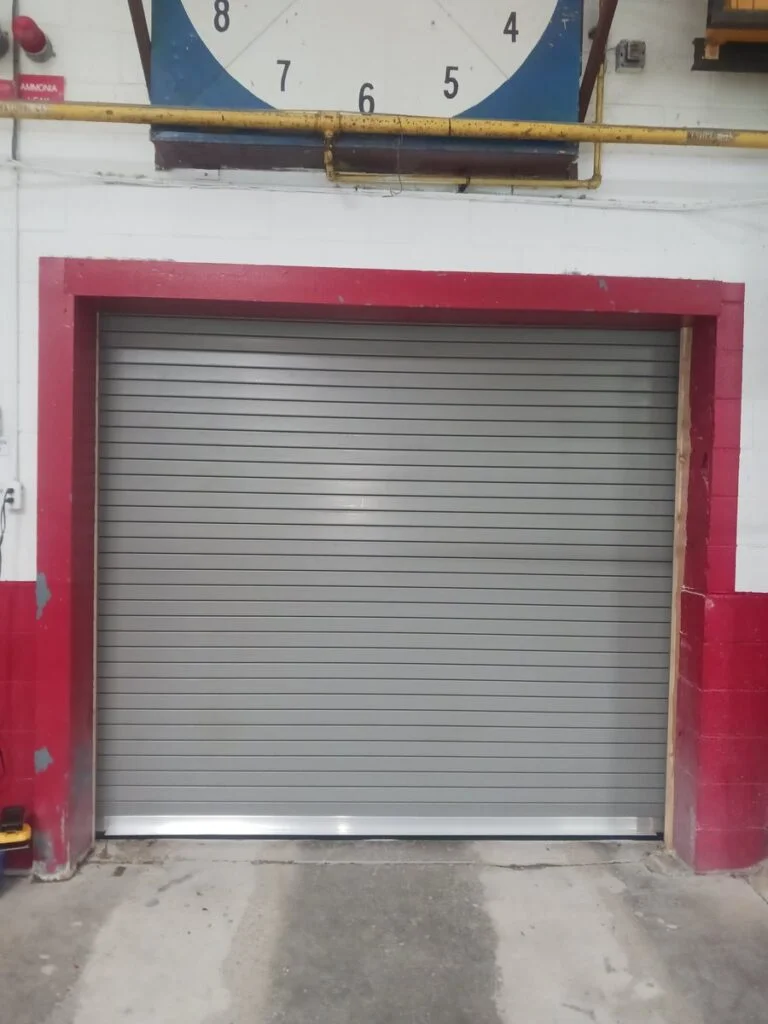
A rolling steel door coils upward instead of folding back, and that one difference solves problems a sectional door can’t: no track running into the room, no door hanging over the floor, and a much smaller footprint for the same opening. It’s also the door type most often specified wrong, because buyers compare panel thickness while ignoring guides, wind rating and cycle duty.
The short answer
Choose a rolling steel door where space is tight, cycles are high, or security matters. It needs headroom above the opening and sideroom for the guides, but almost no backroom. The guides and endlocks carry the wind load, not the curtain, so a door fitted with light guides on an exposed wall is a liability. Match the operator and springs to cycles, and on any powered door the entrapment protection is not optional.
1. What it is, and when it wins
The curtain is a set of interlocking steel slats that coils around a barrel above the opening. The barrel is held by brackets, the curtain runs in vertical guides on each side, and a hood covers the coil. When the door opens, the curtain disappears upward into the hood rather than folding back into the room.
That geometry decides when a rolling steel door is the right answer:
2. Anatomy of the door
Knowing these parts by name is the difference between reporting “the door is broken” and describing what actually failed. Most rolling door calls come down to four of them: the curtain, the guides, the bottom bar and the counterbalance.
The curtain coils into the barrel inside the hood. Guides hold it on both sides, and the bottom bar keeps the leading edge rigid.
| Part | What it does | How it fails |
|---|---|---|
| Curtain (slats) | Interlocking steel that forms the door surface | Dented or torn slats; doors that jump the guide |
| Guides | Hold the curtain vertical and take wind load | Worn or bent, letting the curtain ride out |
| Bottom bar | Rigid leading edge, holds the curtain taut | Impact damage; seals no longer meet the floor |
| Barrel | The drum the curtain coils around | Worn bearings, noisy operation |
| Counterbalance | Springs that offset the curtain weight | Door becomes heavy or drops; springs break |
| Endlocks / windlocks | Keep the curtain in the guides under load | Worn endlocks let the curtain leave the guide |
| Hood | Covers the coil, keeps out weather and debris | Rust, water onto the coil, debris jamming slats |
3. Between the jambs or on the face of the wall
There are two ways to hang the same door, and the choice is made by the building, not the door. Between the jambs puts the curtain and guides inside the opening, so the door is flush when closed. Face-of-wall bolts the guides to the wall and the door sits outside the opening, which is the usual answer where the opening has no structural jamb to fasten to, or where the wall above can’t carry the load.
Between-jamb mounting keeps the door inside the wall line. Face-of-wall mounting puts the guides on the wall surface, which also means the door stands proud of the opening.
Check the wall before the door, not after. A face-of-wall door hangs its entire dead load on the wall angles above the opening. Brick, block or a thin steel liner that was never designed for that load will tell you about it slowly, and then all at once.
4. Wind load, endlocks and guides
On an exterior opening, the wind load is carried by the curtain acting as a beam between the guides. The slats resist bending, the endlocks keep the curtain ends seated in the guides, and the guides themselves pass the load into the wall. That’s a system: uprate one part alone and you’ve moved the failure rather than removed it.
Three practical consequences:
- A door is rated for a pressure, at a size. A rating quoted for a 10 ft opening does not carry to a 16 ft one. Always confirm the rating against the actual opening.
- Windlocks matter on exposed walls. They engage the guide when the curtain deflects, and they’re the difference between a door that bellies in a storm and a door that leaves its tracks.
- Deeper guides are not a cosmetic upgrade. On a large or exposed opening, heavier guides and more frequent jamb fastening are what hold the rating.
Where a facility is on an exposed elevation, the honest advice is usually to specify the door for the exposure rather than to buy the standard door and hope. Replacing a curtain that has been pushed out of its guides repeatedly costs more than the uprated guides would have.
5. Operation: hoist, push-up or motor
Rolling doors can be operated by hand or by motor, and the choice follows two things: how big the door is and how often it moves.
Manual operation suits small, infrequently used doors. Anything with real traffic needs a motor, and a motor brings safety requirements with it.
| Operation | Suits | Watch for |
|---|---|---|
| Push-up | Small openings, low cycle, storage | Not for doors that staff can’t safely lift |
| Chain hoist | Large doors with no power, or as a standby | Hoist chain must reach a person’s safe standing height |
| Hand crank | Smaller manual doors, mounted at the side | Gear wear where it is used daily |
| Electric operator | Any door with regular traffic | Entrapment protection, correct duty rating, service access |
Every powered door needs entrapment protection. UL 325, the standard that governs door and gate operators, requires it: a means of detecting an obstruction and stopping or reversing the door. A photo eye that has been knocked out of alignment or wired around is the most common serious safety defect we find on rolling doors.
6. Cycles, duty and what wears out
Rolling doors are rated in cycles: one full open and close. A door rated for 10,000 cycles and one rated for 100,000 look similar on a quote and behave nothing alike after two years of a busy dock schedule.
| Daily openings | Annual cycles | What that means |
|---|---|---|
| Under 10 | About 3,000 | Standard duty is fine; maintenance is mostly inspection |
| 10 to 25 | About 6,000 to 9,000 | Standard to heavy duty; keep the guides clean and lubricated |
| 25 to 60 | About 9,000 to 22,000 | Heavy duty hardware, high-cycle counterbalance, planned service |
| 60+ | 22,000+ | Consider a high-speed door instead; the duty outruns the door type |
Wear concentrates in the same places. Guides and endlocks wear first on high-cycle doors, counterbalance springs next, then bottom bars from impact. A door that starts running rough is usually telling you about a worn endlock before it drops a curtain.
7. Rolling steel versus sectional
The two doors solve different problems, and the deciding question is what is behind the opening.
| Rolling steel | Sectional | |
|---|---|---|
| Space needed | Headroom and sideroom; no backroom | Headroom plus horizontal track behind the opening |
| Insulation | Limited; slat construction limits thermal value | Insulated sandwich sections give better thermal performance |
| Cycle duty | Strong at high cycle | Good, but hardware wears faster above roughly 25 cycles a day |
| Damage repair | Slats can be replaced individually | Sections are replaced as panels |
| Best use | Security, tight space, high traffic, service counters | Heated or cooled space where the door is part of the envelope |
We cover the selection logic for the other option in choosing a commercial sectional door, and the direct comparison in sectional versus rolling steel doors. The rolling steel product range is on our rolling steel doors page.
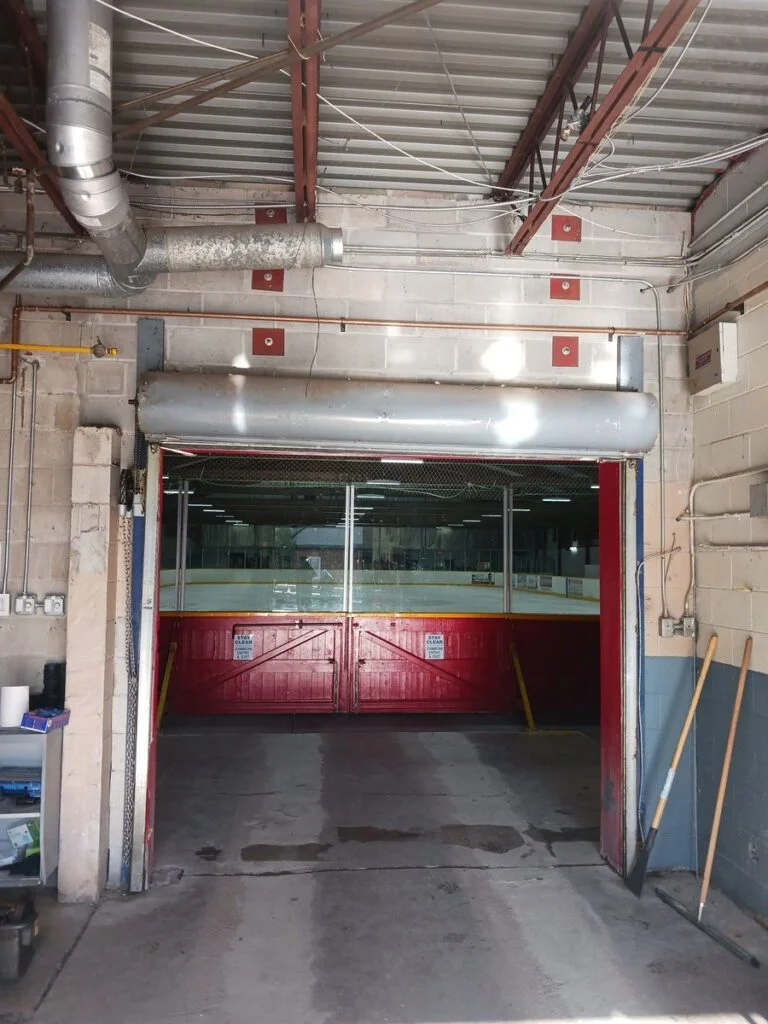
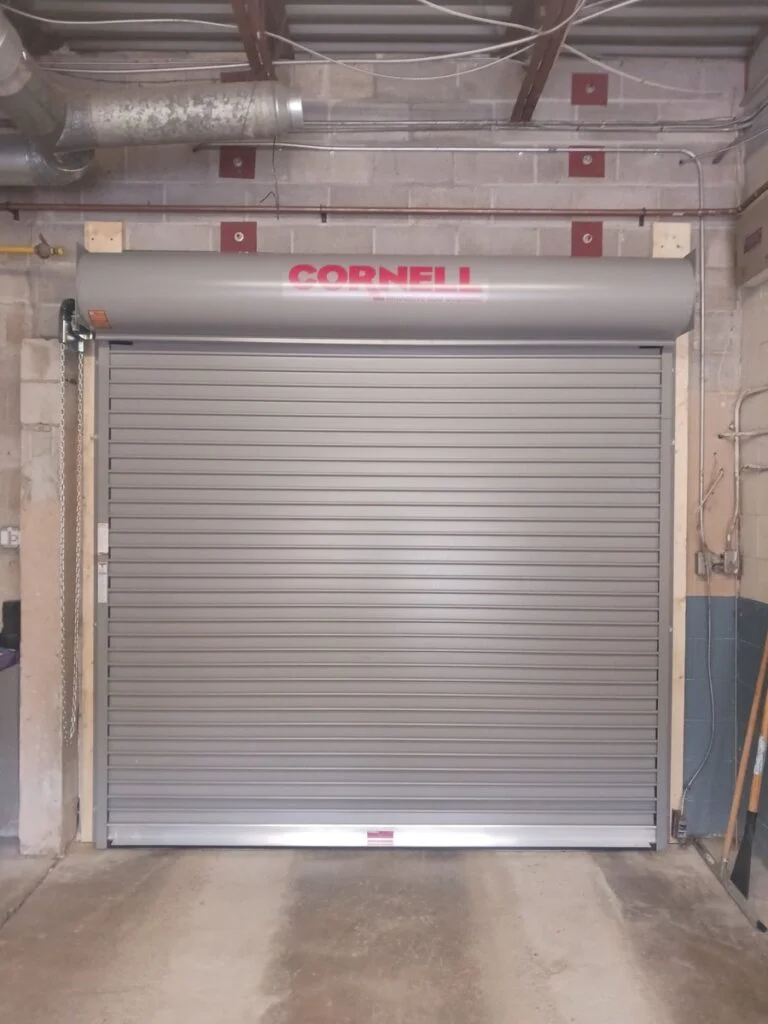
8. Keeping one running
Rolling doors fail slowly and then suddenly. The cheap interventions are inspection and lubrication; the expensive ones begin with a curtain that came out of its guides.
- Guides and endlocks. Check for wear and impact, and lubricate as specified. A dry guide wears the endlock and the slat edge together.
- Curtain and slats. Look for bent or torn slats, and for any slat that has started to separate at the interlock.
- Bottom bar and seals. Impact here is the earliest sign of a vehicle problem, and it usually breaks the floor seal first.
- Counterbalance. A door that has become heavy to lift, or that drops, needs a technician. Springs are under load.
- Hood and barrel. Water ingress rusts the coil and seizes bearings. A hood that has lost its fixings is letting water in.
- Safety devices on powered doors. Test the entrapment protection monthly, and never leave a door in service with a defeated device.
On a door that also serves as a fire separation, the inspection and testing obligations are stricter than routine maintenance, and the door carries a label that determines what may be done to it. Those requirements are covered on our fire door ratings page and in fire door drop testing.
9. Motors, controls and UL 325
Most problems with a motorised coiling door are not mechanical failures. They are a control configuration nobody has checked, a clutch tightened to hide a damaged door, or a safety device that has quietly stopped working. The operator side is worth understanding even if you never touch the wiring.
How the operator responds to the buttons
Every commercial operator is set to one of a few control modes, and the mode decides how much the person has to hold the button, and what safety devices the installation is obliged to include.
| Wiring | Behaviour on CLOSE | What it obliges |
|---|---|---|
| C2 | Constant pressure: the door moves while the button is held | The traditional configuration on most doors |
| B2 | Momentary contact: one press and the door closes | An external monitored entrapment protection device |
| D1 | Constant contact to open and to close | Common on rolling grilles |
There are others, E2 reverses when the close button is released and TS (timer secure) being the usual examples. Before 2010, most operators were set for C2 and rewired to B2 if the site wanted momentary close. The 2010 revision to UL 325 changed that: a commercial operator set to B2 now requires an external monitored entrapment protection device, unless it is a fire door operator closing in an alarm condition.
The three configurations you will meet on a commercial coiling door, and the obligation that comes with B2.
Entrapment protection is not optional
Any door that closes on its own needs something that notices a person or vehicle underneath. Reversing edges, photocells and similar devices are part of the door system, not accessories, and the type has to suit the application. Whatever is fitted needs to be checked at every service, because a failed device looks identical to a working one until someone is under the door.
Where the control station goes
- Within sight of the door, so the operator can watch it travel.
- Positioned so the user is not close enough to be struck by the door.
- At least 5 feet from the floor, so a child cannot reach it.
- Secured if it is outdoors or somewhere the public can get to it, to prevent unauthorised operation.
Setting limits
Limits stop the door at the top and bottom. They are either mechanical, typically three or four limit switches, or electronic and adjusted through the operator control board. Either way they have to be set before the door is run to its extremes, and retested after any adjustment of travel. An operator that fails to stop at the end of travel is a door trying to wind itself through the header.
Two traps worth knowing. First, never overtighten a clutch to compensate for a damaged or badly balanced door: the clutch is there to slip, and hiding a problem with it transfers the force into the door and the operator. Second, some manufacturers tape the shipping cotter pin against the clutch pulley. It has to be removed and the adjusting nut pinned as the manufacturer specifies, or the clutch is not doing its job.
The maintenance schedule to hold your contractor to
This schedule is what a service contract should be delivering, and it is a fair way to judge one. It assumes a normal commercial duty cycle; a door running hundreds of cycles a day needs more, which is why cycle counting matters when a door is specified.
Operator and door maintenance by interval. The door itself, corrosion and operator noise are on the annual visit; the safety devices are monthly.
| Item | What is checked | Interval |
|---|---|---|
| Photocell / sensing edge | Verify proper operation | Monthly |
| Drive chain | Excessive slack, adjust, lubricate | 3 months (monthly check) |
| Sprockets | Set screw tightness | 3 months |
| Bearings and shafts | Wear, lubricate | 3 months |
| Clutch | Check and adjust | 6 months |
| Belt | Condition and tension | 6 months |
| Fasteners | Check and tighten | 6 months |
| Manual disconnect | Check and operate | 6 months |
| Door | Wear and damage | 12 months |
| Operator | Unusual noise, evidence of corrosion | 12 months |
What a technician checks inside the control panel
Control panels and door mechanisms are technician work: they carry line voltage and stored spring energy. This sequence is what a competent service technician works through, which is useful when you are deciding whether a fault needs an electrician, a door company, or both. Facility staff should not open a door operator panel.
- Disconnect the power following proper lock-out procedure.
- Inspect the wiring compartment and clear any debris.
- Check grounding wires, power terminals and terminations for corrosion, and confirm terminal screws are tight.
- Verify the sensing devices are fully operational.
- Check input voltage while the operator is running: a drop of more than 10% is a problem.
- Verify current draw against the operator specification.
- On three-phase operators, confirm phasing. Wrong phasing runs the motor backwards.
Common operator faults, and what they usually mean
| Symptom | Likely cause |
|---|---|
| Door does not respond to open or close | Motor thermal protection or circuit breaker tripped, blown fuse, defective transformer, defective or loose push button connection |
| Responds one way but not the other | Defective push button, defective limit switch, or a loose wire on the button, limit switch or contactor coil |
| Moves in the wrong direction (3-phase) | Incorrect phasing of the power supply |
| Runs past the end of travel and does not stop | Defective contactor, or a limit switch that is defective or out of adjustment |
Need a rolling door serviced or specified?
We service all makes and models, and we’ll tell you whether the door you have is worth repairing before quoting a replacement.
Request rolling door service
Tell us the door type, the opening size and what it is doing wrong. We service and supply rolling steel doors on all makes and models.
Frequently asked questions
What is the difference between a rolling steel door and a sectional door?
A rolling steel door coils around a barrel above the opening and needs almost no backroom. A sectional door folds back along horizontal track into the room, so it needs headroom and backroom but insulates better.
How much headroom does a rolling steel door need?
Roughly half the opening height for the coil, plus room for the hood and hardware. Face-of-wall mounting needs more space above the opening than between-jamb mounting. Confirm against the door you are actually specifying.
Can a rolling steel door be insulated?
Only partly. Standard slat construction restricts thermal performance, and foam-filled insulated slats exist but still fall short of an insulated sandwich section. That is why heated or cooled space normally takes an insulated sectional, or an insulated high-speed door where cycles are high. In Canada most warehouse and production space is conditioned and every exterior opening is insulated, so on an exterior wall the minimum is insulated slats, and where energy or condensation matters the better answer is an insulated sectional or an insulated high-speed door. Rolling steel is then chosen for its other advantages: no track in the room, no backroom, security and high cycle duty.
What are windlocks and endlocks for?
They keep the curtain ends seated in the guides when wind pushes the door in. Without them, a loaded curtain can ride out of the guides and the door comes down.
Do powered rolling doors need safety devices?
Yes. UL 325 requires entrapment protection on door operators, which in practice means a photo eye or equivalent that stops or reverses the door on an obstruction. It must be tested and never bypassed.
How often does a rolling door need service?
High-cycle doors want planned service, because guides and endlocks wear fastest. Low-cycle doors mostly need inspection and lubrication. Any door that has become heavy, noisy or slow is overdue.
What does B2 wiring mean on a rolling door operator?
B2 is momentary contact to close: one press and the door closes by itself. Since the 2010 revision to UL 325, a commercial operator set to B2 requires an external monitored entrapment protection device, unless it is a fire door operator closing in an alarm condition.
How often should a rolling steel door operator be serviced?
The safety devices are checked monthly, the drive chain, sprockets, bearings and shafts every 3 months, the clutch, belt, fasteners and manual disconnect every 6 months, and the door, corrosion and operator noise annually. Heavy cycle counts need more frequent attention.
Where should the door control button be mounted?
Within sight of the door, close enough to watch it travel but not so close the user can be struck, at least 5 feet above the floor so children cannot reach it, and secured if it is outdoors or publicly accessible.
Can you tighten a slipping clutch to fix a hard-running door?
No. Overtightening the clutch to compensate for a damaged or unbalanced door hides the real fault and loads the door and operator. A slipping clutch is a symptom, not the problem.
Fire rated door? Our rolling steel fire door guide explains automatic closing, fusible link placement, governors and how drop testing is performed.