


A critical door lock fails at the worst possible time. It might be a rear personnel door before first shift, a pharmacy opening that won't secure, or a loading dock man door that won't latch after hours. In that moment, the problem isn't just the lock. It's security, life safety, downtime, and the risk of making the situation worse with a rushed fix.
This guide is built for that moment. It explains emergency door lock repair from an operations point of view, not a generic locksmith point of view. The focus is simple: protect people first, keep the facility controlled, gather the right facts quickly, and make decisions that support both compliance and continuity.
At Wilcox, the field reality is familiar. A failed lock can be a broken cylinder, but it can also be a sagging door, a strike that's shifted, panic hardware that's binding, or an access control issue that only looks like a lock failure. The fastest path to a stable repair starts with calm triage.
A Guide for When Critical Door Locks Fail
When a commercial lock fails, the first mistake is treating every failure the same way. A janitorial closet that won't secure is one problem. A main entrance, a rated fire door, or an access-controlled exit that won't operate properly is a different class of incident entirely.
The right response starts with three immediate questions:
- Who is affected right now
- What risk exists if the opening stays as-is
- Can the door still function safely for entry, exit, or both
Those questions matter because a lock failure can be both a security issue and a safety issue. In a warehouse, a failed exterior lock may expose product, tools, or controlled stock. In healthcare or government space, the same failure may also affect restricted access and emergency egress requirements.
Field rule: Treat the opening as a system, not just a piece of hardware. The lock, frame, latch, closer, hinges, strike, and access device all work together.
A practical response has four parts. First, assess whether anyone is in immediate danger. Second, stabilise the opening without blocking safe exit. Third, collect enough detail so the right technician arrives prepared. Fourth, decide whether the problem needs a repair, a same-day replacement, or a broader inspection of the opening.
That's the difference between a quick patch and a controlled response. Respected Partners, Reliable Service starts with helping facility teams regain control of the situation before tools ever come out.
Immediate Triage and Safety Actions
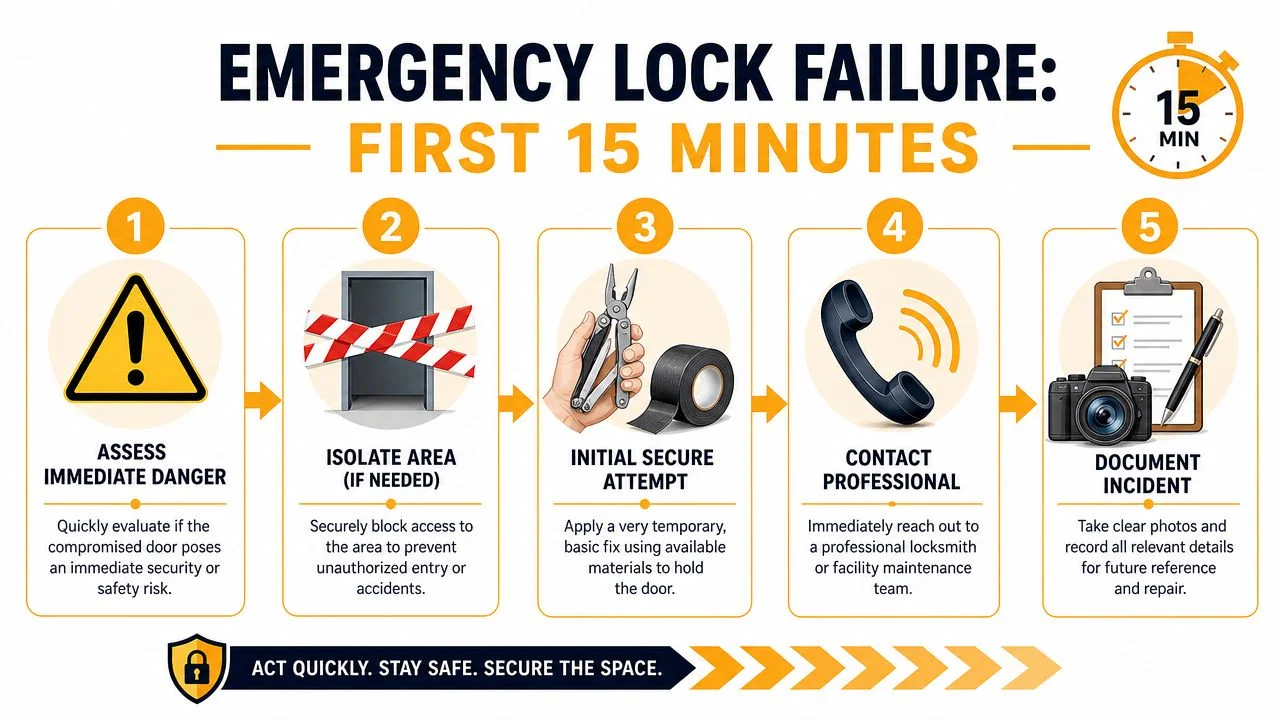
The first 15 minutes matter most. Not because every lock can be fixed in 15 minutes, but because the wrong decision in that window can create a security gap, an injury risk, or a code problem that didn't exist a moment earlier.
Start with the three critical checks
Ask these in order:
Is this a security breach
If the door won't lock, determine what the opening protects. Exterior perimeter door, server room, controlled stockroom, tenant suite, and cash office all carry different urgency.Is this a life-safety issue
A malfunction at an exit door, panic device, or rated opening needs a different response. For facility teams, a key question is when a lock malfunction is a simple security issue versus a potential life-safety or code violation. This is critical because emergency repairs can affect access-controlled exits, and a compliant repair requires more than a basic fix, especially in warehouses, healthcare, or government buildings where egress and fire-ratings are mandatory, as noted in this 24-hour emergency lock guidance.What operations stop if this door stays down
A failed office door is inconvenient. A failed shipping-office entrance, clean-room access point, or cross-corridor fire door can interrupt the whole shift.
Control the area before touching the hardware
In the field, the safest early actions are usually simple:
- Post temporary signage: Mark the door as out of service, staff-only, or use alternate entrance, depending on the condition.
- Notify the right people: Security, site leadership, maintenance, reception, and after-hours contacts should all know which opening is affected.
- Limit traffic: If people keep forcing a bad lock, the problem often spreads from the lock body to the latch, frame, or closer.
- Keep the egress path clear: Never create a temporary barrier that traps occupants or interferes with exit travel.
If the problem is at a standard entrance and the issue appears to be basic hardware replacement rather than a larger opening failure, these front door lock replacement tips give a useful general overview. For commercial sites, the important distinction is that entrance hardware may also have code, access, and fire-rating implications that a house door doesn't.
Separate inconvenience from emergency
Use this quick test:
| Door condition | Response priority |
|---|---|
| Non-critical interior room won't lock | Secure contents if needed, schedule repair |
| Main exterior entry won't latch or lock | Immediate containment and urgent service |
| Exit device or fire door won't function properly | Escalate as a safety and compliance event |
| Loading dock man door compromised after hours | Secure perimeter, notify operations and security |
Don't let a convenience problem become a safety problem because someone reached for a chain, wedge, or improvised fastener too early.
Temporary Mitigation and Securing the Opening
A temporary measure should do one thing well. Reduce risk until a proper repair happens. It should not pretend to be a finished solution.
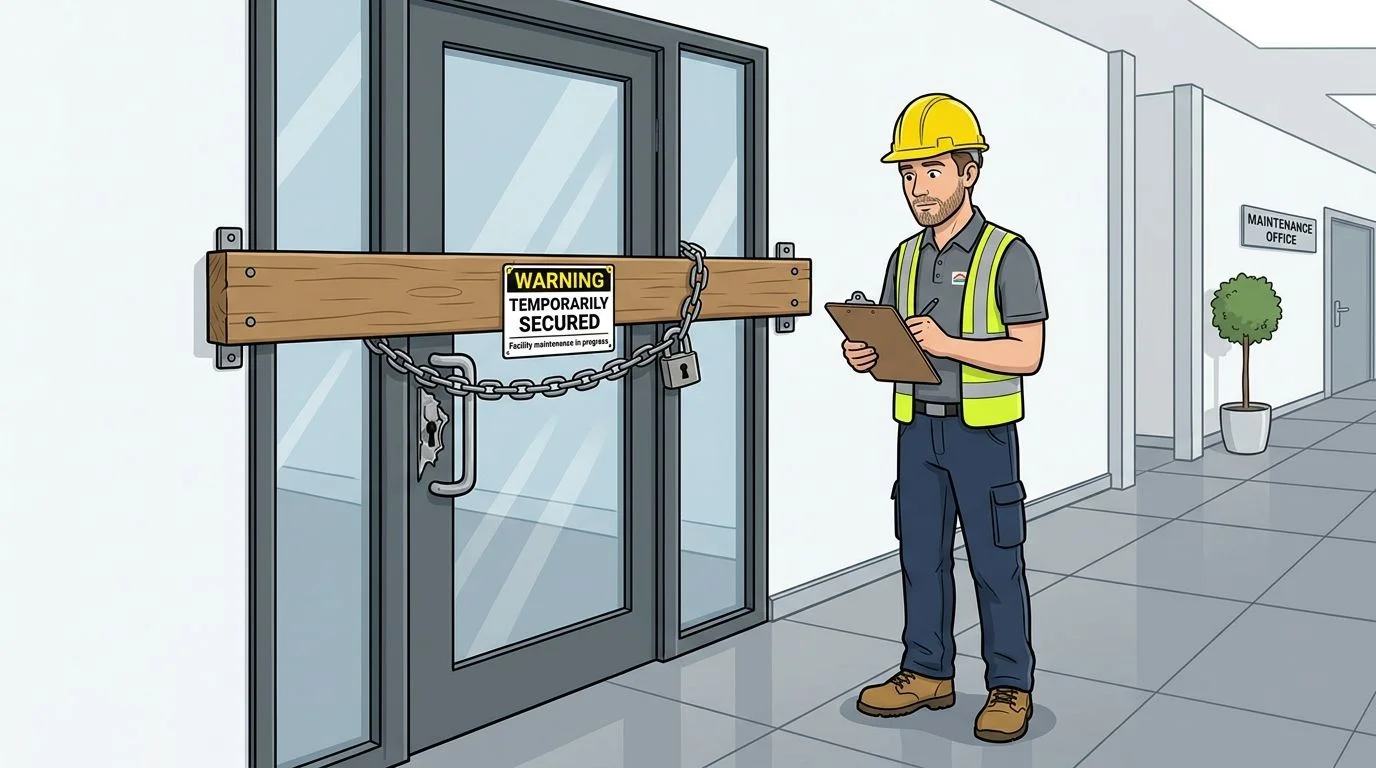
On a warehouse site, the temporary fix depends on the opening type. A rolling steel service door, a hollow metal pedestrian door, and a glazed aluminium storefront each fail differently and tolerate different stopgap measures.
What a realistic temporary measure looks like
For a non-egress storage opening, limited-use temporary securing may be reasonable if authorised by site management. That could mean restricting access to the room, moving valuable stock, or assigning staff control until repair arrives.
For a loading dock pedestrian door that won't secure after hours, a common practical step is to isolate the route, shift traffic to another staffed entry, and add oversight at the affected area. The goal is controlled access, not a homemade lock rebuild.
For a weather-exposed opening, temporary sealing may also matter. If a door won't close tightly, the site may need to protect inventory from rain, dust, or pests while preserving safe passage and fire separation requirements.
Temporary security is acceptable only if it does not interfere with safe exit, create a trip hazard, or damage the opening further.
What not to do
Avoid these improvised fixes on occupied commercial openings:
- Don't chain across an exit door: If people may need to leave through it, the chain becomes the hazard.
- Don't drive screws randomly into frames or doors: That can damage rated assemblies and complicate the final repair.
- Don't force a latch into alignment with repeated slamming: This often turns a minor strike issue into a broken latch or closer arm problem.
- Don't tape over access hardware and assume it's secure: Tape can mark the opening, but it rarely controls real use.
A simple visual walkthrough can help teams think about the opening as a whole before they improvise a bad fix:
Match the mitigation to the risk
A facility team usually has three temporary options:
| Situation | Best temporary response |
|---|---|
| Door can close but not lock | Control access with staffing and alternate routing |
| Door cannot latch consistently | Reduce use, isolate area, prevent repeated cycling |
| Opening is physically damaged | Restrict area and wait for proper hardware or opening repair |
The strongest temporary response is often operational, not mechanical. Redirect traffic. Move sensitive material. Post a person if the opening is critical. Those steps reduce exposure without creating a second problem that the technician has to undo later.
How to Prepare for Your Emergency Service Call
A good emergency call saves time before the truck rolls. Dispatch can only send the right technician and likely parts if the site gives clear information. That's especially important when the lock issue may involve panic hardware, a closer, a frame condition, or an access control device.
Budget matters too. A 2026 pricing guide says emergency or after-hours calls typically add $50 to $150 per visit, and commercial lockout service is commonly priced at $100 to $250, depending on the situation, in this locksmith pricing guide. Better information up front helps control time on site.
Pre-call checklist for emergency door lock repair
| Information Category | Details to Collect |
|---|---|
| Door location | Building name, entrance number, suite, dock, corridor, or room |
| Door type | Pedestrian door, rolling steel door, sectional opening, storefront, fire door |
| Lock type | Mortise lock, cylindrical lock, deadbolt, panic bar trim, magnetic lock |
| Exact symptom | Key won't turn, latch won't retract, door won't align, hardware is loose, access reader works but door won't release |
| Current condition | Door stuck open, stuck closed, unsecured, or intermittently working |
| Safety impact | Exit affected, fire-rated opening involved, restricted area exposed |
| Temporary measures used | Signage, staff post, area isolation, alternate route |
| Visual record | Photos of lock edge, frame, strike, handle, and full opening |
What dispatch needs to hear clearly
Call notes should answer these points in plain language:
- What failed first: Was it hard to turn for days, or did it stop suddenly after impact or heavy use?
- What happens now: Can the key insert but not rotate. Does the lever turn without retracting the latch. Does the reader beep but not disengage the lock.
- What hardware is attached: Door closer, electric strike, mag lock, request-to-exit device, panic hardware, or automatic operator.
- What's at risk: Security exposure, blocked operations, compliance concern, or weather intrusion.
If you need urgent help, Wilcox lists an emergency door repair service for commercial openings. Whatever provider you call, the same principle applies. Specific information raises the chance of a first-visit repair.
Clear photos of the latch edge, strike, frame gap, and full opening often tell a technician more than “the lock is broken”.
What to Expect from Your Wilcox Technician
A professional emergency response starts with preserving the opening if possible. The best outcome is usually non-destructive entry first, then diagnosis, then repair or replacement based on what the opening needs.
One locksmith repair guide recommends checking proper installation, ensuring the frame is flush, tightening loose screws and strike plates, and testing the deadbolt and latch for sticking before moving to replacement in its door lock repair process guidance. That approach lines up with what experienced commercial technicians do in the field.
The first diagnosis is bigger than the lock
When a technician arrives, the lock itself is only one part of the inspection. Expect checks such as:
- Door and frame alignment: If the door has dropped or the frame has shifted, the latch may be innocent.
- Strike position: A strike that's moved can make a good lock look failed.
- Loose fasteners and hardware wear: Lever trim, escutcheons, cylinders, and through-bolts all work loose over time.
- Latch and deadlatch behaviour: The technician will test whether the latch moves freely and seats correctly under load.
- Connected systems: If the opening uses a door magnetic lock, electrified trim, or release device, the problem may sit in the hardware interaction rather than the cylinder.
Repair first, replace when the facts support it
Professional practice favours a systematic sequence. Check the simple mechanical causes. Open the door with the least damage possible. Inspect the inside components. Clean and reassemble if the mechanism is salvageable. Replace parts only when damage, wear, or compatibility makes repair unreliable.
That same repair guidance also notes that lubricant isn't a cure-all. Graphite-based lubricant is commonly used in some emergency lock applications, while wet sprays can attract dust and dirt over time. In commercial settings, technicians need to know where lubrication helps and where it only masks misalignment for a day or two.
A smooth key turn means very little if the latch is still hitting the strike low, high, or off-centre.
When the answer is replacement
Replacement becomes more likely when parts are damaged, the hardware is obsolete, or the opening has repeated failures that point to a larger system problem. Older commercial doors often show this pattern. The lock gets blamed because it's the visible symptom, while the underlying cause is poor closing force, frame movement, or panic hardware wear.
A sound technician should explain that distinction clearly. If a repair will hold, they should say so. If it's only going to buy time until the next failure, they should say that too.
From Reactive Repairs to Proactive Prevention
Most lock emergencies announce themselves early. Teams just don't always recognise the warning signs for what they are.
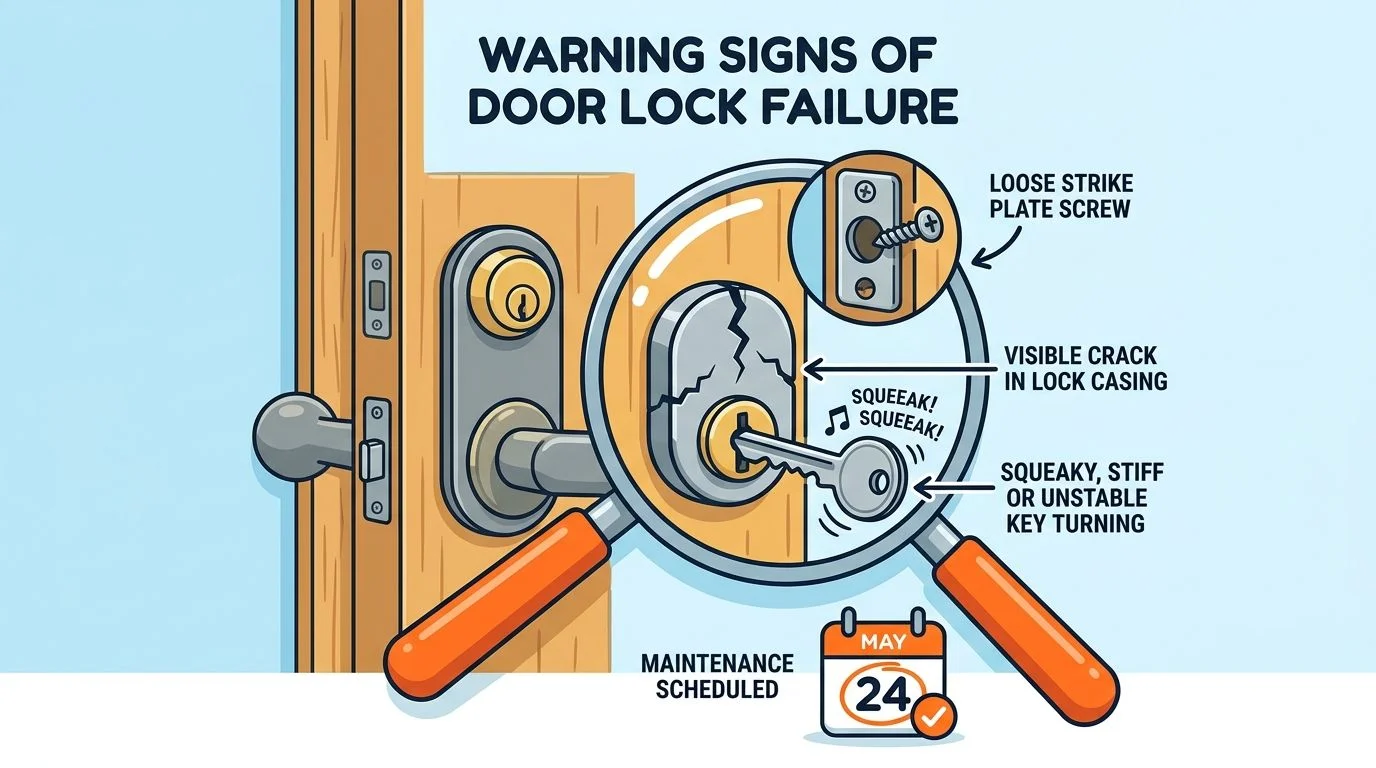
A key starts dragging. The latch needs a shove. Staff begin pulling the door upward to get it to lock. Someone mentions the panic trim feels loose. Those are maintenance signals. Left alone, they become emergency calls.
Warning signs worth acting on
Watch for patterns like these:
- Stiff operation: The key, thumbturn, or lever suddenly needs extra force.
- Intermittent latching: The door secures sometimes, then fails under normal closing speed.
- Visible movement: Strike plates shift, trim loosens, or the cylinder starts to wobble.
- Door position changes: New rubbing at the header or frame often points to sag or alignment drift.
- Repeat service history: If the same opening keeps failing, the lock may not be the underlying problem.
A locksmith service page focused on lock repair notes that repeated emergency repairs can signal deeper trouble such as worn closers, frame misalignment, or panic hardware issues in older commercial doors, in this commercial lock repair discussion.
Planned maintenance reduces repeat failures
One practical baseline from repair guidance is to clean and lubricate locks at least once per year, with the mechanism tested after servicing to confirm smooth cycling under load, according to this emergency locksmith workflow overview. On high-cycle doors, annual attention is a starting point, not a guarantee.
That matters even more where lock hardware interacts with access control. If your site is reviewing card readers, electrified locks, release devices, and door behaviour together, this comprehensive guide on commercial access control gives useful background on the system side of the equation. For commercial facilities managing secure openings, Wilcox also works with door access control as part of the wider opening, not as a stand-alone gadget.
The cheapest emergency repair is the one you never need because someone corrected the sagging door, loose strike, or failing closer first.
A preventive mindset doesn't mean replacing every old lock. It means tracking recurring openings, inspecting the whole assembly, and deciding where repair still makes sense and where a planned upgrade will remove repeat disruption.
Secure Your Facility with a Trusted Partner
A failed lock creates pressure fast, but the response should stay orderly. Protect people first. Decide whether the opening presents a security issue, a life-safety issue, or both. Use temporary control measures that don't compromise egress. Gather accurate details before the service call. Then expect a proper diagnosis that looks at the whole opening, not just the lock body.
For teams reviewing broader site security at the same time, this overview of secure systems for home or business can help frame how locks, access, and monitoring work together. On commercial sites, that system thinking is what keeps small failures from becoming major disruptions.
If you need immediate help with a failed commercial door lock, or you want to reduce repeat emergency calls through a planned inspection, contact Wilcox Door Service Inc.. We help facility teams stabilise critical openings, identify root causes, and plan repairs that support safety, uptime, and compliance.