


A draft at the loading dock rarely stays a “small issue” for long. It turns into rising utility bills, ice near thresholds, wet cartons, pest pathways, and complaints from staff working beside doors that never seem to close off properly.
That’s why a door weather sealer deserves more attention than it usually gets. In a warehouse, plant, distribution centre, or commercial property, the sealer is part of the building envelope. If it fails, the rest of the opening starts working harder. Your HVAC runs longer. Your door hardware sees more strain. Your team spends more time reacting to symptoms instead of fixing the cause.
For Canadian facilities, that choice also sits inside a tougher operating environment. Cold winters, summer heat, wind-driven rain, and tighter energy requirements all push seal performance from a maintenance detail into a cost-control decision.
Your Guide to Enhancing Facility Performance
If you're managing a facility today, you may already know the pattern. One dock door shows daylight at the jamb. Another lets in cold air every time the wind picks up. A third has a bottom seal that's gone hard and flat, so snowmelt and debris keep finding their way inside.
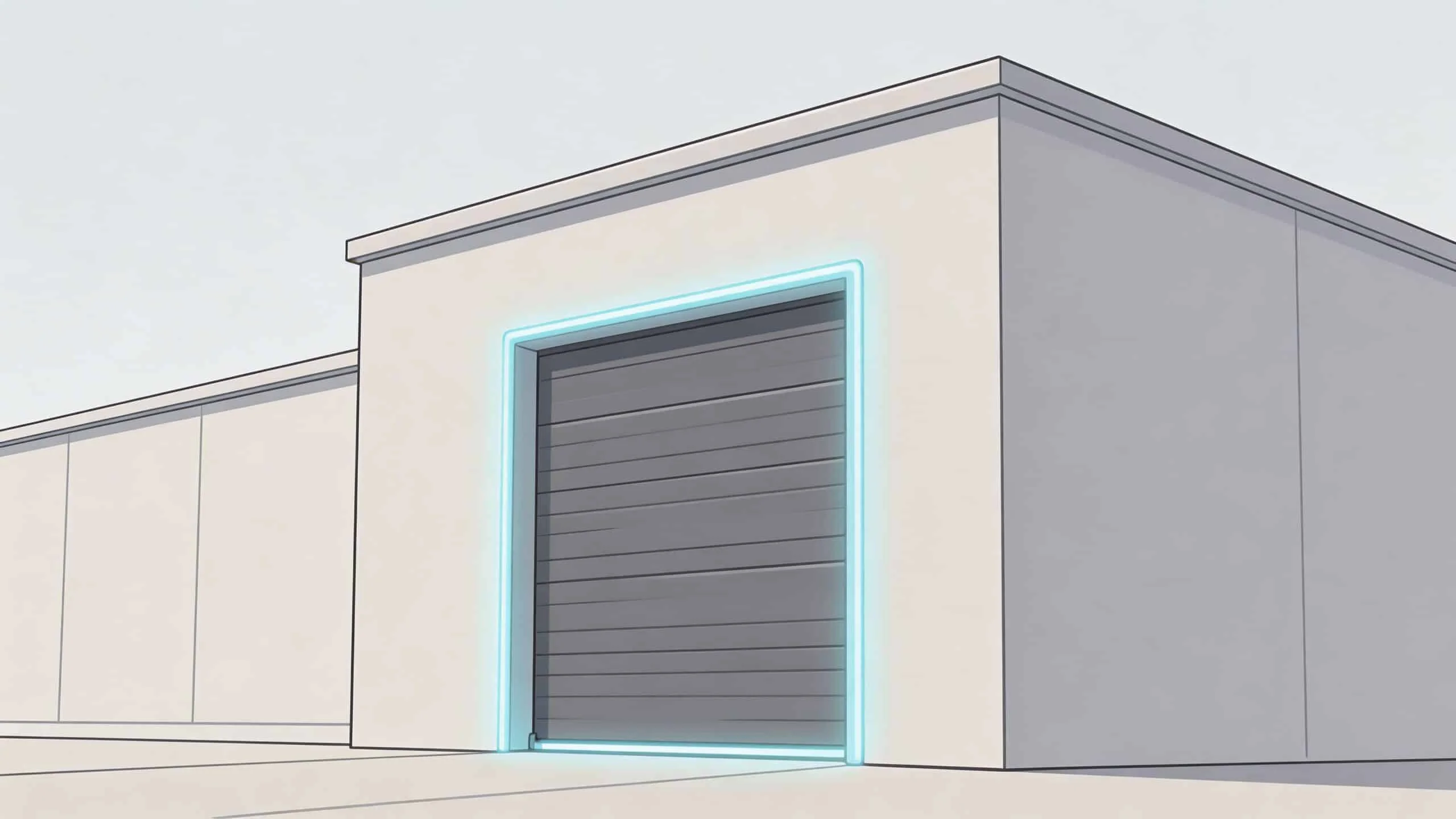
Those small failures add up fast. Stricter energy efficiency standards enforced by Natural Resources Canada since the 2020 National Energy Code of Canada for Buildings require reduced air infiltration, and properly sealed doors can lead to up to 30% reductions in heating and cooling bills according to Fact.MR's weatherstrip seal market report.
A good door weather sealer helps control more than temperature. It supports cleaner interior conditions, reduces water intrusion, protects stored product, and helps maintain safer work areas around door openings.
What matters most in practice
A facility manager usually isn’t choosing between “seal” and “no seal.” The choice is between:
- Cheap replacement cycles: Lower upfront spend, more callbacks, more frequent failure
- Better total cost of ownership: Higher quality material, proper fit, fewer recurring issues
- Code-aware retrofits: Seals chosen to support performance, not just to fill a gap
A weather sealer should be judged the same way you judge any other facility component. By what it prevents, how long it lasts, and how often your team has to think about it.
The rest of this guide focuses on that business view. It covers what a door weather sealer does, which materials and formats suit different openings, how to read performance ratings, how to choose for specific applications, and when replacement becomes the smarter financial move.
What a Door Weather Sealer Does for Your Facility
A door weather sealer is easiest to understand as a gasket for the opening. When the door closes, the sealer compresses or wipes against the frame, floor, or panel edge to close the gap. If that contact is consistent, the opening performs. If it isn’t, outside conditions start entering the building on their own terms.
It controls air movement
Air leakage is usually the first issue people notice. Staff feel drafts near the dock, the mechanical room runs longer, or one work zone never stays comfortable.
At the perimeter, a proper sealer limits uncontrolled airflow around the sides, top, and bottom of the door. In practical terms, that means:
- Less strain on HVAC equipment: Conditioned air stays inside more effectively
- Better comfort at workstations: Especially beside shipping doors and service entrances
- More stable interior conditions: Important in production, packaging, and storage areas
It blocks water where doors are most vulnerable
Water doesn’t need a big opening. A poor bottom seal, damaged jamb seal, or misaligned threshold can be enough.
At loading docks and service doors, the sealer helps stop:
- Rain blow-in
- Snowmelt at the sill
- Pooling near door tracks
- Slip hazards for pedestrians and lift truck traffic
If the opening faces prevailing wind or sees washdown conditions, the wrong seal profile often fails before the door itself does.
It helps with pest and debris control
For food, beverage, pharmaceutical, and clean handling spaces, sealing isn’t just about comfort. It’s part of basic environmental control.
A worn perimeter seal can allow entry for:
- Dust and airborne debris
- Insects at light gaps
- Rodents using lower edge openings
- Outdoor contaminants near sensitive product flow
This is one reason brush, compression, and bottom seal combinations are often specified together instead of as isolated parts.
It blocks light, which reveals bigger problems
Light leakage is useful because it’s easy to see. If you can see daylight around a closed commercial door, air, dust, and pests can pass through too.
Practical rule: If a closed door shows light at the corners, don’t assume the sealer alone is the problem. Check door alignment, track condition, floor slope, and hardware wear before replacing material.
It protects the whole opening system
A failed seal often triggers secondary wear. Moisture reaches metal components. Ice forms at the threshold. Dirt enters guide areas. Operators and closers work against resistance caused by poor fit.
That’s why seal condition should be reviewed as part of overall opening performance, not treated as trim.
A Guide to Sealer Materials and Formats
Material selection drives long-term cost. Two sealers can look similar on day one and perform very differently after repeated exposure to cold, heat, sunlight, washdown, and traffic.
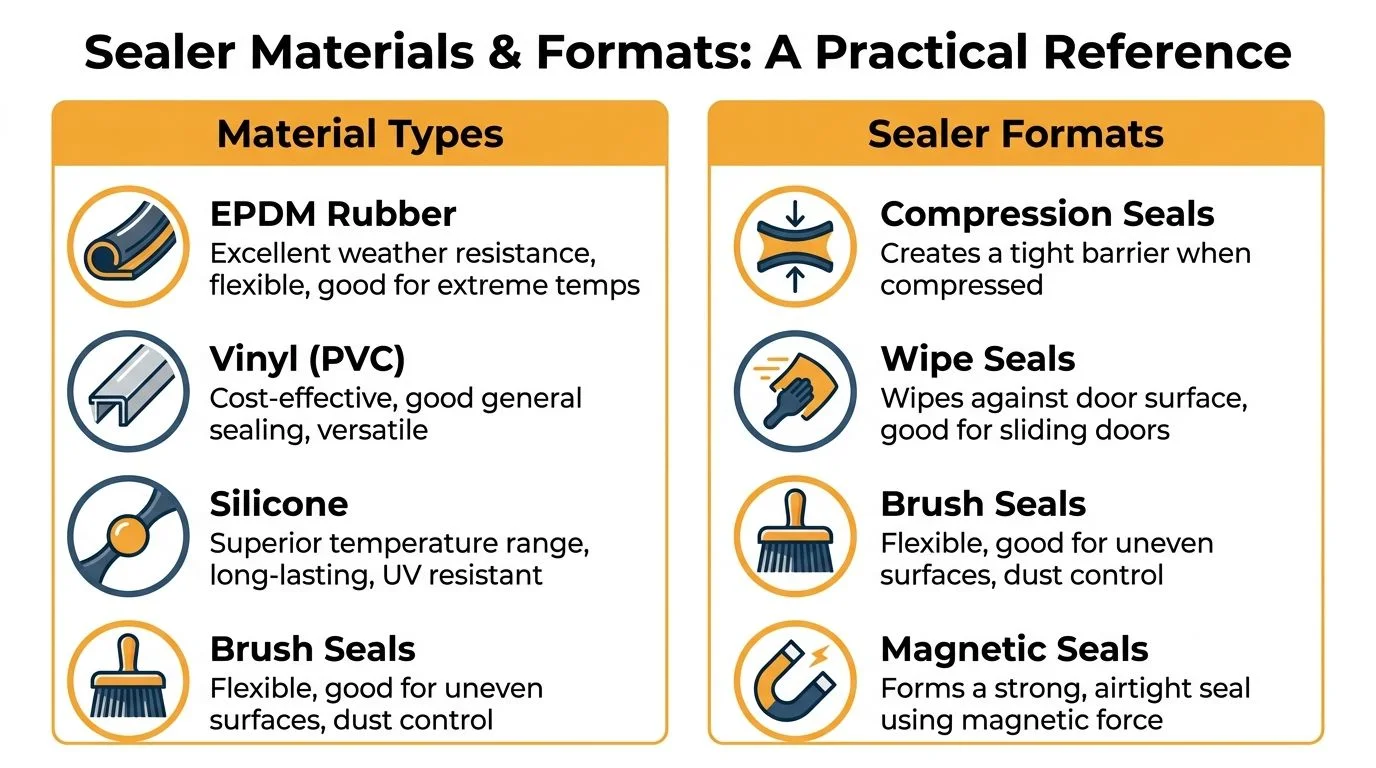
For facilities planning upgrades across multiple openings, it helps to start with the broader Commercial Door portfolio page and then match the seal system to the door type, duty cycle, and environment.
Material choice affects replacement frequency
In Canadian conditions, EPDM is often the most dependable choice where temperature swings are severe. According to Dow's weatherseal material information, EPDM-based door weather seals show compression set resistance below 25% after prolonged exposure to high temperatures, and that resilience helps avoid the 40 to 60% failure rates seen in vinyl alternatives within 2 to 3 years under freeze-thaw conditions.
That matters because compression set is the material’s tendency to stay flattened after being squeezed. Once a seal stops rebounding, it stops sealing.
Common materials in commercial use
EPDM rubber
This is the workhorse material for many industrial and commercial openings. It stays flexible in harsh weather, handles repeated compression well, and suits doors that open and close often.
Best use cases include sectional overhead doors, loading dock perimeter applications, and exterior openings in cold regions.
Vinyl PVC
Vinyl is often selected when budget is the first filter. It can work well in moderate conditions and on lower-demand openings, but it usually isn’t the first choice where freeze-thaw exposure is severe or where the door cycles constantly.
It can still be a practical fit for some jamb and perimeter uses when the opening is sheltered and inspected regularly.
TPE
TPE, or thermoplastic elastomer, sits between rubber and plastic in feel and performance. It’s used where flexibility, repeatability, and cleaner manufacturing specifications matter.
In the field, it can be a strong option when you need a modern material with good consistency, but the exact formulation matters a lot.
Brush seals
Brush seals don’t create the same compression barrier as a bulb or blade seal. They do handle uneven surfaces well, though, which makes them useful for dust, light, and pest control where the door or floor isn’t perfectly uniform.
They’re often part of a combination approach rather than a stand-alone answer for weather.
Commercial Door Sealer Material Comparison
| Material | Best For | Durability / Lifespan | Temperature Range (CDN Climate) | Cost |
|---|---|---|---|---|
| EPDM | High-traffic exterior doors, docks, cold climates | High | Strong choice for wide temperature swings | Higher upfront |
| Vinyl (PVC) | General perimeter sealing on moderate-duty openings | Moderate | Better for less severe exposure | Lower upfront |
| TPE | Specialised commercial applications needing flexible manufactured profiles | Moderate to high | Depends on formulation | Mid-range |
| Brush | Uneven surfaces, dust control, light blockage | Moderate | Useful across varied conditions, but not a primary thermal barrier | Mid-range |
Formats matter as much as material
The wrong format can undermine a good material choice.
- Jamb and header seals: Used around the sides and top of the frame. These control perimeter drafts and light gaps.
- Bottom seals: Mounted to the bottom door section. These help with floor contact, water control, and pest exclusion.
- Threshold seals: Mounted to the floor. These are useful where the slab is uneven or where water control is the main concern.
- Astragals: Overlapping seals between meeting door sections or leaves, often used to reduce leakage at joints.
For a detailed primer on common profiles and placement, Wilcox has a useful guide on types of weatherstripping for exterior doors.
The best-performing sealer is the one that matches the gap, the traffic pattern, and the environment. Product selection by material alone usually leads to callbacks.
Understanding Sealer Performance Ratings
A facility manager doesn’t need to memorise every test standard. You do need to know what the ratings mean when a vendor or spec sheet presents them. Performance data is what separates a sealer that looks adequate from one that protects the opening.
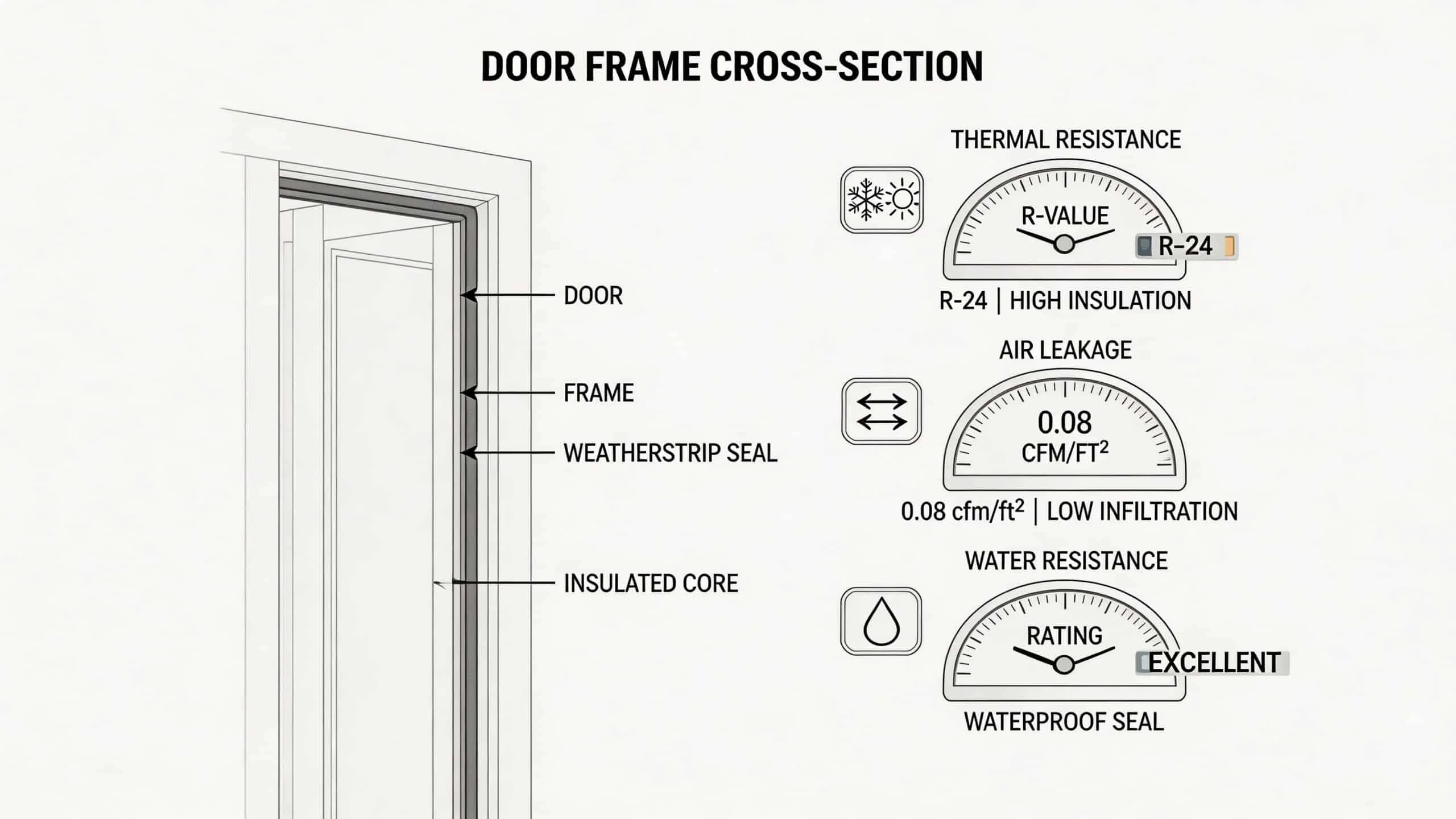
Air leakage tells you how much outside air gets through
Air leakage ratings describe how much air passes through or around a closed assembly under a pressure difference. In practical terms, lower leakage means fewer drafts and less energy waste.
For daily operations, that affects:
- Heating and cooling stability near doors
- Building pressure control
- Product protection in conditioned spaces
- Staff comfort in loading and production areas
If you’re comparing quotes, ask whether the contractor is evaluating only the seal material or the whole opening condition. A strong rating on paper won’t overcome a twisted frame or poor door alignment.
Water penetration resistance matters at exposed openings
This rating is especially important for facilities in driving rain, coastal conditions, or washdown zones. It measures how well the sealed opening keeps water from passing inward under test pressure.
For coastal provinces such as British Columbia, Energy Saver's weatherstripping guidance is tied in your verified data to the point that rubber vinyl tubing seals can outperform foam by 35% in water penetration resistance under ASTM E331 tests, and moisture intrusion can contribute to mould remediation costs of $5,000 or more per incident.
That kind of difference matters most at:
- Loading docks exposed to weather
- Service doors on windward walls
- Openings near sensitive stored product
- Facilities where wet floors create safety exposure
Thermal performance needs plain language
Two terms come up often.
- R-value means resistance to heat flow. Higher is better.
- U-factor means how quickly heat passes through. Lower is better.
You don’t need to turn every door opening into an engineering study. You do need to know whether the sealer contributes to keeping a heated or cooled space stable, especially if the opening serves production, refrigeration, or employee work areas.
What to ask before approving a replacement
Ask for application-specific performance
A sealer chosen for a dry service corridor may not suit a dock opening facing weather.
Ask how the rating was achieved
Was the product tested as part of an assembly, or is the number only for the material itself?
Ask what field verification will be used
Smoke pencils, light checks, and operating-cycle review often reveal more than a catalogue page does.
If performance data can’t be connected to your actual opening conditions, treat the quote as incomplete.
How to Select the Right Door Weather Sealer
Most poor sealer decisions come from buying by habit. The team replaces the old profile with whatever looks close, then hopes the problem goes away. Sometimes it does. Often it doesn’t, because the opening conditions were never the same as the last time.
Selection works better when you start with the opening’s job.
High-traffic warehouse doors
A warehouse door that cycles constantly needs a seal that can recover after repeated compression and tolerate impact, vibration, and dirt. In these openings, heavy-duty perimeter sealing usually makes more sense than a budget material that flattens early.
Look for:
- A material that stays flexible in outdoor conditions
- A profile that can tolerate slight variation in the opening
- Hardware and retainers that won’t loosen under frequent use
If the dock area also needs trailer gap control, it’s worth reviewing related Loading Dock Seals & Shelters so the opening is treated as one system instead of separate parts.
Cold storage and temperature-controlled spaces
Cold storage is less forgiving. A sealer that becomes stiff, loses contact, or allows frost paths around the perimeter quickly creates bigger operating issues.
Priorities change here:
- Low-temperature flexibility: The material must keep its shape and contact in cold conditions.
- Consistent compression: Uneven contact leads to leakage and ice buildup.
- Washable surfaces where required: Especially around food, pharma, or clean handling.
Bottom seals and jamb seals often need to be considered together. Solving only one side of the opening usually leaves the other as the weak point.
Food and beverage plants
These openings need strong environmental control, but they also need maintainability. Complex profiles that trap debris can create sanitation headaches.
A practical specification often favours:
- Smooth, cleanable surfaces
- Tight perimeter contact
- Seal formats that don’t create unnecessary harborage points
- Materials suited to the cleaning methods used in the plant
Brush seals can still be useful in the right location, but they aren’t always the first answer in washdown or hygiene-sensitive zones.
Commercial properties and mixed-use sites
Back-of-house retail doors, parkade entries, and service corridors usually require balance. Budget matters, appearance matters, and the opening may not cycle as often as a main dock.
That’s where it helps to separate initial price from service cost over time. A lower-cost seal can be perfectly reasonable on a sheltered opening. It’s a poor bargain if it needs repeated replacement or still leaves comfort complaints unresolved.
Don’t overlook code-related performance
One detail many teams miss is air leakage compliance. According to Action Industries' reverse-angle jamb seal article, Canada’s National Building Code calls for air leakage rates below 0.20 L/s·m² at 75 Pa for commercial buildings, and properly installed vinyl reverse-angle jamb seals can reduce infiltration by up to 35% in -30°C conditions.
That doesn’t mean every opening needs a reverse-angle jamb seal. It does mean your sealer decision should consider code performance, not just visible gap coverage.
Choose the sealer that fits the opening’s duty, exposure, and compliance requirements. If one of those three is ignored, the replacement usually costs more than expected.
Installation Maintenance and Troubleshooting
A quality door weather sealer can still fail early if the installation is rushed. Most recurring callouts come from poor surface prep, loose retainers, wrong fastener spacing, or a door that was never aligned before the new material went on.
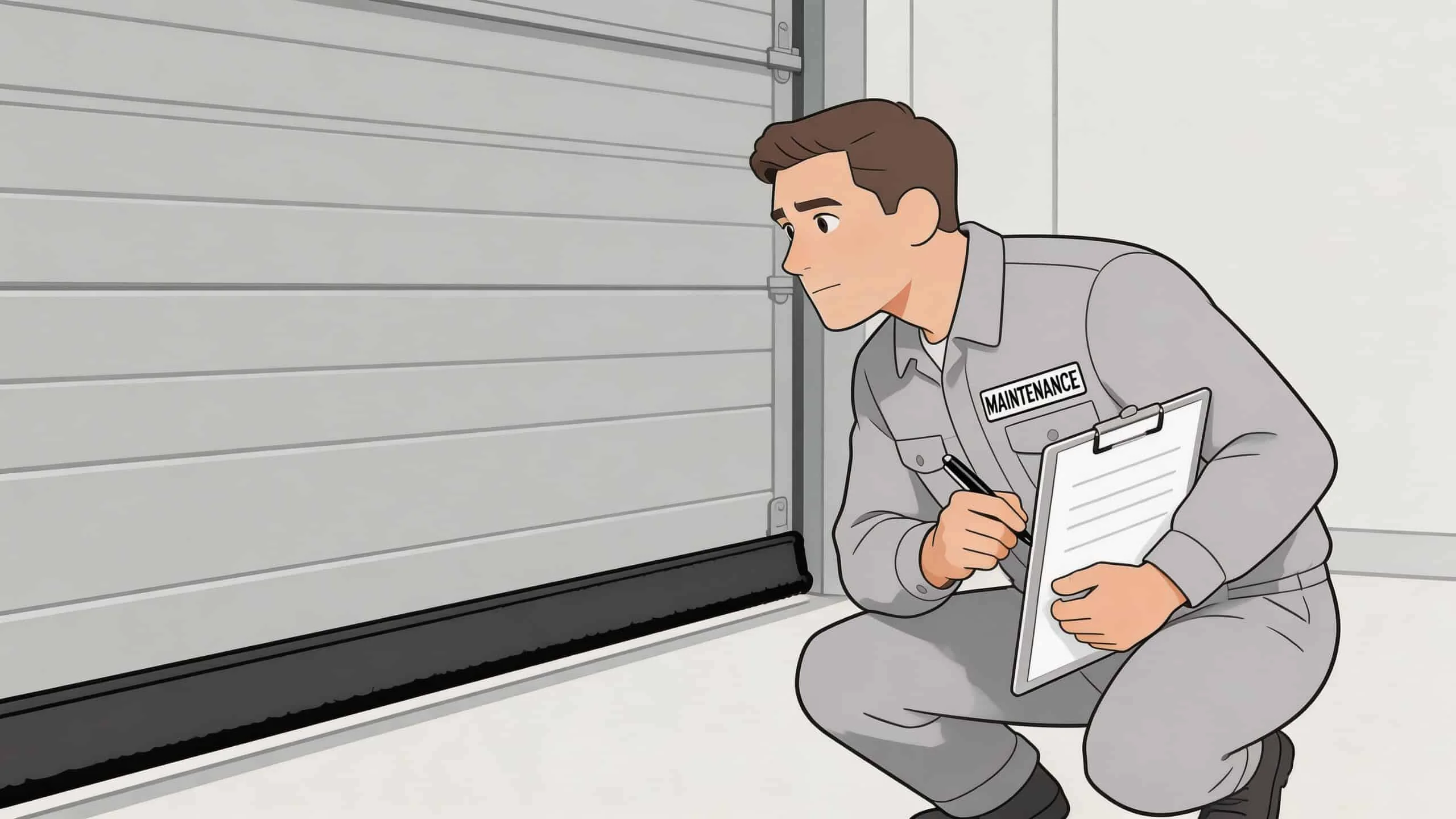
For teams that want a simple residential-style visual on the basics, this guide on how to install garage door weather stripping can help explain the parts and placement. Commercial openings are more demanding, but the core idea of continuous contact still applies.
What professional installation should include
A proper commercial installation starts before the new seal is unpacked.
Surface preparation
Old adhesive, bent retainers, corrosion, and damaged fasteners need attention first. Installing over a poor surface usually creates gaps or premature tearing.
Door and frame review
The technician should check whether the door closes squarely and whether the frame is true enough for the selected profile. Replacing a seal on a misaligned opening often hides the underlying problem for a short time, then the complaint returns.
Correct attachment method
Fastener type, retainer condition, and even seal orientation matter. A bottom seal installed with twist or stretch won’t sit evenly at the floor.
Functional testing
Post-install verification matters. A simple light check is useful. Smoke testing is better when you need to confirm edge performance in real operating conditions.
A practical maintenance checklist for facility teams
You don’t need to turn seal maintenance into a large programme. You do need consistency.
- Inspect for daylight: Check corners, jamb contact, and bottom edge closure when the door is fully shut.
- Clean the sealing surface: Dirt, salt, and debris can abrade material and stop proper compression.
- Look for hardening or cracking: This often shows up first at high-contact points and exposed corners.
- Watch for flattening: A seal that stays compressed is nearing the end of useful life.
- Check door travel and alignment: Seal wear can be a symptom of door issues, not the root cause.
For a focused look at perimeter sealing on automated openings, Wilcox also has a practical article on automatic door weather stripping.
Common problems and likely causes
Daylight at the top corners
Usually linked to poor alignment, incorrect profile size, or a retainer sitting out of plane.
Water under the door
Often caused by a worn bottom seal, damaged threshold interface, or floor slope that the seal profile was never designed to handle.
Ice buildup at the sill
This can point to air leakage, water intrusion, or both. Replacing only the bottom seal may not solve it if the perimeter is leaking.
Repeated tearing or pull-out
That often signals impact damage, excessive friction, loose retention, or the wrong material for the duty cycle.
A recurring seal failure is rarely just a material problem. Check the opening, the floor, and the way the door moves before ordering the same part again.
When the issue goes beyond the sealer itself, it’s time to involve a commercial door specialist for commercial door repair.
The Business Case for Upgrading Your Seals
The strongest case for a better door weather sealer isn’t cosmetic. It’s financial. Seal decisions affect utility spend, service frequency, sanitation risk, moisture exposure, and the working life of the entire opening.
That’s why the useful measure is total cost of ownership, not purchase price alone.
Cheap sealers often cost more over time
The lower-cost option can look attractive on a bid sheet. But if it hardens early, loses compression, or needs repeat labour, then the cost extends well past the invoice amount.
A stronger sealer usually pays back in three ways:
- Lower energy waste
- Fewer maintenance callouts
- Less collateral wear on the door system
In one practical example from the verified data, a well-chosen EPDM-based sealer can support long service life in harsh exposure. That’s the type of result that changes annual maintenance planning, especially across multiple openings.
Replacement triggers worth acting on
Facility teams often wait too long because the door still opens and closes. Operation alone isn’t the right threshold.
A replacement deserves attention when you see:
- Cracking, hardening, or shrinkage
- Visible light around a closed opening
- Persistent water entry
- Draft complaints near the door
- Pressure or energy issues that point back to leakage
If the same opening has needed repeat seal work, that’s also a sign to stop treating the symptom.
When seal replacement is enough
A straightforward replacement usually makes sense when the door structure is sound and the issue is isolated to worn material, damaged retainers, or age-related loss of compression.
That tends to apply where:
- The door remains aligned
- The opening is otherwise dry and stable
- Hardware isn’t contributing to poor closure
- The slab and frame condition are still serviceable
When the door system needs a broader review
Sometimes the sealer is only exposing a larger problem. If the panels are damaged, the frame has shifted, the floor is badly out of level, or the opening no longer supports operational needs, patching the perimeter becomes a short-term spend.
For teams looking at broader savings opportunities, this article on enhancing commercial door energy efficiency during seasonal shifts by sealing the gaps is a useful next read.
A structured service plan also helps prevent piecemeal decisions. Wilcox Door Service Inc. offers a Planned Maintenance Program that includes ongoing review of commercial and industrial door components such as seals, hardware, and operating condition.
Why TCO thinking works better across a portfolio
Property managers and multi-site operators benefit most when they standardise how they assess openings.
Use a simple lens:
- How much does the opening leak today
- How often does it need service
- What happens to operations if it fails again
That approach shifts the discussion from “What’s the cheapest strip we can install?” to “What reduces repeat cost and protects uptime?”
Secure Your Facility and Your Bottom Line
A door weather sealer isn’t trim. It’s part of how the facility controls energy, moisture, cleanliness, and safe operation at the opening.
The right choice depends on the environment, the duty cycle, and the condition of the full door system. Material matters. Format matters. Installation matters just as much. When those three line up, you usually see fewer nuisance issues, fewer weather-related complaints, and a cleaner path to code-conscious operation.
Facility teams that already think this way often apply the same logic elsewhere in the building envelope and mechanical system. For example, this practical resource on sealing ductwork effectively is useful if you’re reviewing air leakage beyond door openings.
The broader lesson is clear. Small leakage points create large operating costs over time. Fixing them properly is usually cheaper than managing the consequences.
If you’re seeing daylight, drafts, water intrusion, or recurring seal failure, don’t just replace material by guesswork. Review the opening as a system and specify for total cost of ownership.
If your facility needs a door weather sealer review, replacement recommendation, or a full opening assessment, contact Wilcox Door Service Inc. to schedule an inspection or request a quote. Respected Partners, Reliable Service.