
Meta description: Door magnetic lock basics for Canadian facilities, including code compliance, fail-safe operation, installation tips, and when to choose alternatives.
A loading dock side door is one of the easiest places for a facility to get security wrong.
You need that opening controlled. Staff, drivers, contractors, and visitors should not move freely through it. But if the fire alarm trips, or if power drops during a storm, nobody should be trapped behind a locked door. That tension is exactly where the door magnetic lock fits.
For Canadian warehouses, manufacturing plants, commercial towers, and public buildings, a maglock is often the practical answer when you need controlled access with safe egress. It is not the right answer for every opening. It is also not a piece of hardware you can judge by holding force alone. Performance depends on code compliance, door condition, alignment, wiring, and how the lock interacts with the rest of the building.
Your Essential Guide to the Door Magnetic Lock
At a warehouse side door in January, the key question is not whether a maglock can hold. The pertinent question is whether that opening will stay secure through heavy traffic, release properly on alarm, and keep working after temperature swings, vibration, and years of use.
A door magnetic lock is an electromechanical lock that uses magnetism, rather than a latchbolt, to secure a door. That makes it useful for card reader access, keypad entry, and controlled staff doors. It also means the lock has to be treated as more than security hardware. In practice, a maglock is a component of the building's life-safety system, governed by fire and building codes.
Facility managers start looking at maglocks when a specific opening keeps causing trouble. The common cases are a side entrance that needs access control, a high-cycle door that wears out mechanical hardware, or a retrofit opening where glass, aluminum, or frame limitations make other electrified hardware harder to install cleanly.
Canadian industrial sites add a few practical concerns that generic product sheets rarely cover. Cold weather can affect door closers, seals, alignment, and the speed of relatching. Dust, forklift vibration, and constant traffic can loosen hardware over time. If the door does not close square and the armature does not meet the magnet face correctly, published holding force on paper stops meaning much on the opening.
Where facility teams get tripped up
Problems start when the maglock is chosen for the lock alone instead of for the whole opening.
The door, frame, closer, power supply, access control, fire alarm interface, request-to-exit device, and code-compliant egress all have to work together. In a manufacturing plant or warehouse, that coordination matters more than the catalog rating. A strong magnet installed on a weak, misaligned, or poorly integrated opening turns into nuisance callbacks fast.
What matters in practice
Before approving a door magnetic lock, check these five points:
- Does the opening require fail-safe release for code-compliant egress?
- Is the door package stable enough to maintain proper alignment year-round?
- Will the lock release correctly through the fire alarm, exit hardware, and access control system?
- Is the holding force appropriate for the door size, wind exposure, and security risk?
- Who will test it, document it, and maintain it after installation?
A maglock can solve the right problem well. It can also create new problems if it is used to compensate for a bad door, poor integration, or code issues that should have been addressed first.
How a Door Magnetic Lock Works
At a warehouse side door in January, the card reader can work perfectly and the opening can still fail to secure. The usual cause is not the reader. It is the maglock and armature missing full contact because the closer is slow, the frame has shifted, or ice and grit have changed how the door lands.
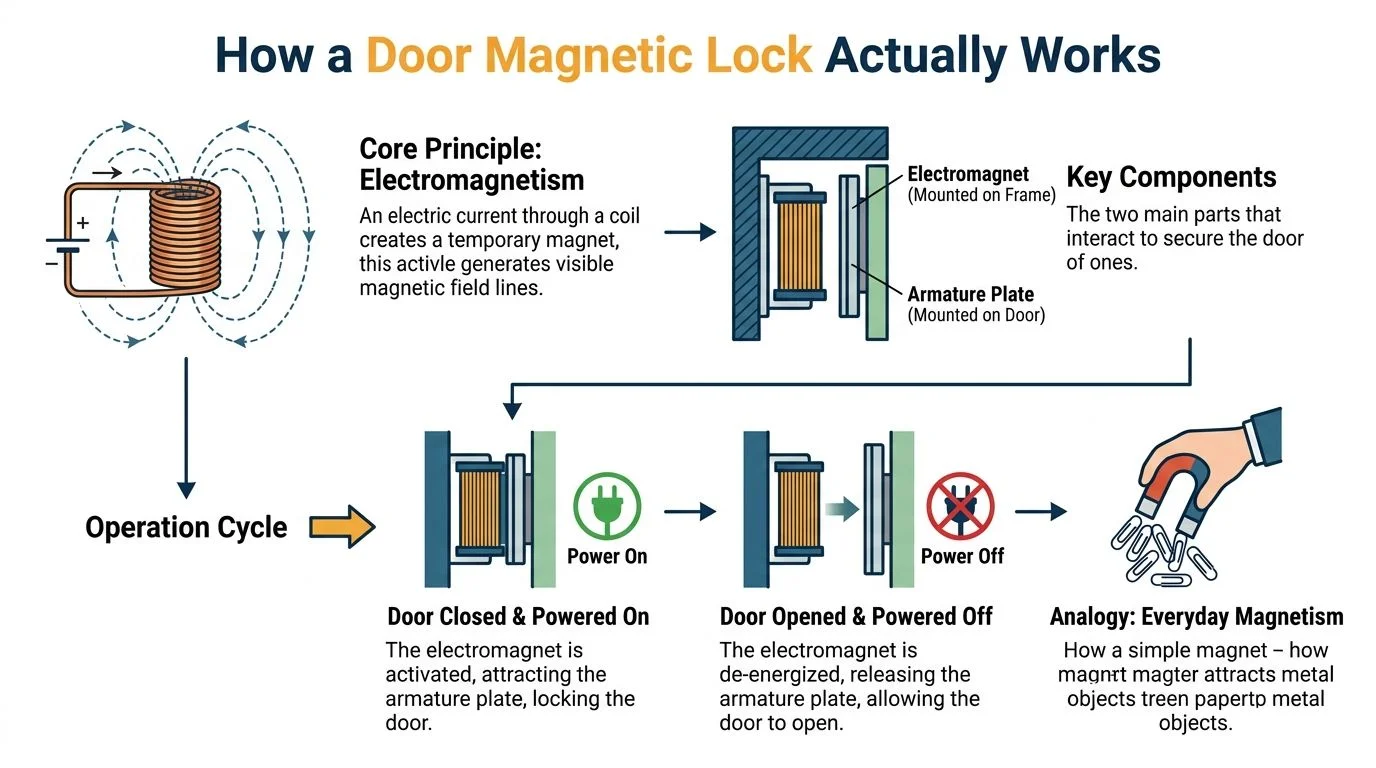
A door magnetic lock works by using electrical current to create a magnetic field that holds the door closed. Cut power to the magnet, and the holding force disappears.
The basic idea
Inside the lock body is an electromagnet mounted to the frame, usually at the header. On the door, an armature plate lines up with that magnet. When the lock is energized, the magnet pulls the plate tight against its face and holds the opening shut.
When power is interrupted, the magnetic field collapses and the door is free to open.
That operating principle is straightforward. Reliable performance on an industrial opening is not.
The two parts that matter
A standard maglock depends on two main components working together:
- The electromagnet: Mounted to the frame.
- The armature plate: Mounted to the door leaf.
The contact between those two faces is what makes the lock work. If the plate is loose, warped, dirty, or landing out of square, holding force drops fast in real conditions. In a Canadian plant or distribution facility, that can show up seasonally. Cold weather, building movement, and heavy traffic change alignment more than many buyers expect.
Why there are no moving parts
A maglock does not secure the opening with a latchbolt or strike pocket. It holds by magnetic attraction at the face of the lock.
That changes the service profile. There are fewer internal mechanical parts to wear out, but the opening still depends on good door control. Technicians spend more time correcting sag, closer speed, bracket movement, and power issues than rebuilding lock bodies. On high-cycle doors, that can be an advantage if the frame and door are stable enough to keep proper contact.
What happens in one full cycle
A normal operating cycle looks like this:
The door closes
The closer brings the leaf back to the frame.The armature plate seats against the magnet
The two surfaces need to meet cleanly and fully.Power keeps the magnet energized
The magnetic field holds the door shut.A release signal interrupts power
That signal may come from access control, a request-to-exit device, or a life-safety interface.The magnetic field disappears
The door releases at once and can be opened.
On paper, that sequence looks easy. In the field, each step depends on the rest of the opening doing its job.
What this means on a door
On a warehouse man door beside a loading dock, a maglock sits at the frame header and relies on the closer to bring the door in the same way every cycle. If the closer drifts out of adjustment in cold weather, the plate may not seat fully. If forklift vibration loosens mounting hardware, the magnet face may no longer sit true. If the fire alarm release is wired correctly but the door binds on the frame, the opening can still become a service problem.
That is why a maglock should be treated as part of the full door system, not as a standalone electrical device. In Canadian industrial settings, the lock only works as well as the door, frame, closer, power supply, and release interfaces around it.
Understanding Fail-Safe vs Fail-Secure Operation
A plant loses power at 5:10 a.m. during a January cold snap. The shipping crew is arriving, the fire alarm panel is still active on backup, and the exterior man doors have to do two things at once. They must let people get out without delay, and they must still fit the building’s security plan. That is the practical difference between fail-safe and fail-secure operation.
What fail-safe means
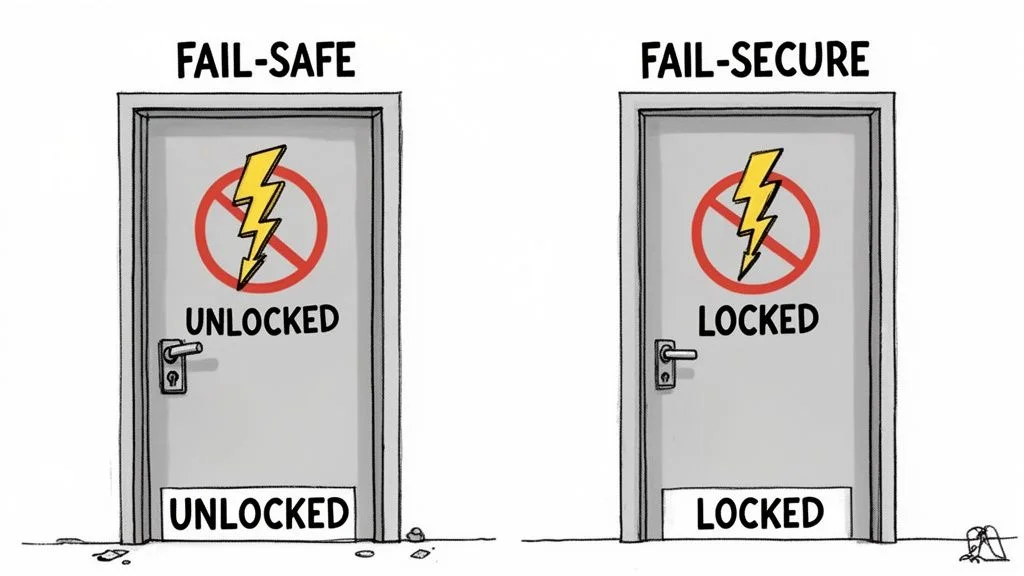
A fail-safe lock unlocks when power is lost.
That is standard maglock behaviour. The magnet only holds while it is energized. If power drops, the lock releases.
On an exit door, that is often the reason a maglock is even being considered. Fail-safe operation reduces the chance of occupants being trapped during an outage and supports the life-safety intent behind Canadian code requirements for egress and emergency release. In industrial buildings, that also means the lock has to release properly through the fire alarm interface, the request-to-exit device, and any other code-required releasing method.
What fail-secure means
A fail-secure lock stays locked when power is lost.
That approach is common with electric strikes and some electrified locksets. The opening remains secure during a blackout, which can suit rooms where controlling access matters more than free passage through that specific door. Examples include parts cages, IT rooms, records storage, or interior control rooms, but only where the opening is not required to function as a free egress door in the same way.
The trade-off is straightforward. Fail-secure helps with security continuity. It can create a code problem fast if it is used on the wrong opening.
Side-by-side comparison
| Feature | Fail-safe maglock | Fail-secure lock or strike |
|---|---|---|
| Power loss | Unlocks | Stays locked |
| Typical use | Exit doors, many perimeter egress openings, high-traffic doors | Security-focused interior openings |
| Life-safety fit | Common where immediate release is required | Depends on door function, occupancy, and code path |
| After-hours security | Usually needs backup power or another security layer | Keeps the opening secured without power |
How to choose in a Canadian industrial building
Start with the opening’s job.
If people may need to exit through that door during an alarm, power failure, or evacuation, fail-safe hardware is usually the right starting point. In a warehouse or manufacturing plant, that includes staff exits, vestibule doors on the egress route, and some perimeter doors tied to access control.
If the door is there to protect inventory, data, tools, or a restricted process area, fail-secure hardware may be the better fit. That is especially true where the opening already has a proper latch and the security plan cannot accept an unlocked door during an outage.
Cold weather adds another layer. In Canadian facilities, backup power does not solve every problem if the door closer slows down, weather seals stiffen, or ice affects door movement. A fail-safe maglock may release correctly and still leave the opening unreliable if the rest of the door system is struggling. That is why hardware selection cannot be separated from site conditions.
Common examples in facilities
Use a fail-safe maglock when:
- The door is part of the required egress route
- The fire alarm system must drop the lock for life-safety release
- The opening has heavy traffic and fast electronic release makes operational sense
- The security plan includes backup power, monitoring, or secondary perimeter control
Use fail-secure alternatives when:
- The opening protects assets during a power loss
- The door already depends on mechanical latching
- The opening is interior and not intended to provide the same emergency egress function
- The door is rated or configured in a way that makes a maglock the wrong hardware choice
Rated openings need extra caution. Door label, frame prep, closer, latch, and release hardware all affect what can be installed and what will pass inspection. For that broader context, Wilcox covers the basics in its article on fire door ratings.
Decoding Key Specifications and Mounting Types
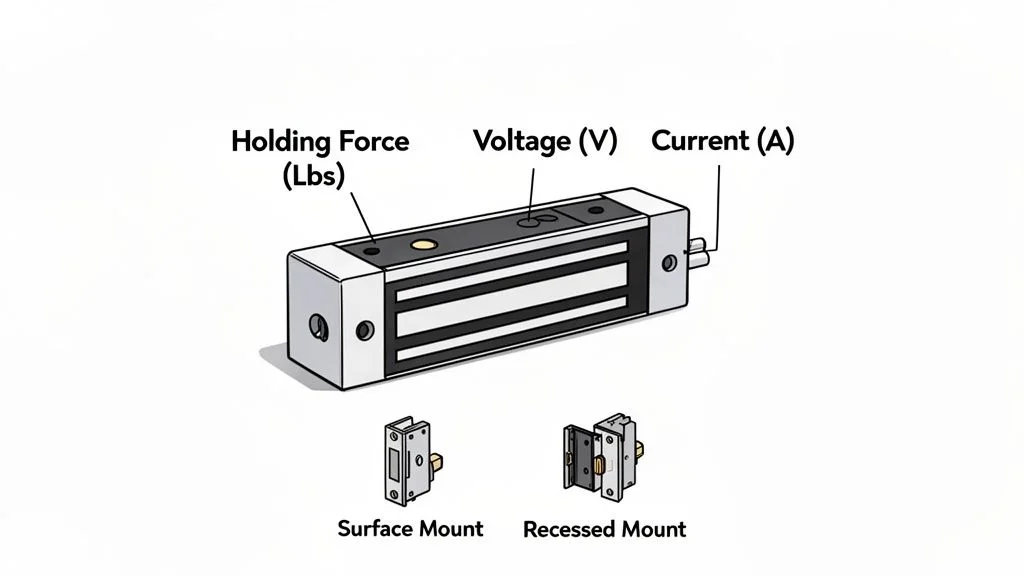
Spec sheets can make maglocks look simpler than they are. Holding force, voltage, current draw, and mounting style all matter, but none of them mean much unless you connect them to the actual opening.
That translation is where many purchasing mistakes happen.
Holding force in plain language
Holding force is the amount of force the lock can resist when the magnet and armature are properly engaged.
In Canadian facilities, maglocks must comply with CAN/ULC-S532 and typically range from 280 kg (617 lbs) to over 1500 lbs (680 kg), according to the Hikvision DS-K4H250S datasheet. The same source states that improper alignment can reduce effective force by up to 50%.
That last point matters more than many buyers expect. A lock with a high published rating can perform poorly if the door sags, the closer does not seat the leaf fully, or the armature is not landing flat.
Matching force to the opening
A practical way to think about holding force:
- Lighter-duty interior openings: Lower-force models may suit office or corridor doors where traffic is controlled and abuse is limited.
- Standard commercial entries: Mid-range models are common when a typical staff entrance needs controlled access.
- Industrial and hollow metal openings: Higher-force locks are often the safer choice where doors are heavy, wind-affected, or exposed to rough use.
The lock should match the entire assembly, not just the wish list. A weak frame, poor fasteners, or worn closer can undermine a strong magnet.
Voltage and current draw
Most facility managers care about voltage only when something does not work. It matters earlier than that.
A maglock is usually powered by low-voltage DC. The chosen voltage affects power supply selection, wiring runs, battery backup planning, and integration with the access control panel. Matching the lock, power supply, and control hardware prevents nuisance issues like chatter, delayed release, or inconsistent holding.
Mounting style changes the job
The mounting method affects both performance and installation difficulty.
Surface-mounted maglocks
These are common because they are straightforward to fit to many commercial openings.
They mount at the top of the frame, with the armature plate fixed to the door. This style is often used on aluminum storefront doors, some glass door applications with proper brackets, and retrofit work where cutting into the frame is not ideal.
Shear or specialty-mounted options
These can be useful in specific conditions, but they demand better alignment.
On doors that do not close square, specialty magnetic setups can become frustrating. If the door shifts seasonally, racks under traffic, or has a worn hinge condition, tighter-tolerance products can lose reliability quickly.
A short product demonstration helps show what installers look for when evaluating fit and mounting:
Quick spec translation table
| Spec | What it means on site |
|---|---|
| Holding force | How much resistance the lock can provide when the magnet and plate meet properly |
| Voltage | What power supply and backup setup the opening needs |
| Current draw | How much load the power circuit must support |
| Mounting type | Whether the lock suits the frame, door material, and retrofit conditions |
| Alignment tolerance | How forgiving the lock will be if the opening moves or wears over time |
If a door already drags, rattles, or fails to latch consistently, changing lock type alone rarely fixes the problem. The opening condition comes first.
Integrating Maglocks with Access and Safety Systems
A door magnetic lock should never be treated as a standalone device in a commercial building.
It is one part of a chain that includes the access control system, power supply, exit devices, and fire alarm interface. If one part is wrong, the opening may still lock and unlock during routine use, but fail when the building needs it.
Access control is the day-to-day layer
In normal operation, the maglock responds to a release signal.
That signal comes from a card reader, keypad, fob system, or other credentialed device. The access control hardware tells the power circuit to interrupt the magnet so the door can open. After the door closes again, power restores and the lock secures the opening.
This is why programming matters as much as wiring. Door timing, relock delay, and credential permissions all affect how usable the opening is.
Safe egress is the legal layer
For egress doors, the lock must also release through life-safety controls.
Since their Canadian debut, maglocks have become part of the code conversation. On egress paths, ULC-S532 certification is mandatory, and locks must release within 15 seconds of fire alarm activation, as described in Wikipedia’s overview of electromagnetic locks.
That requirement changes how the opening is wired. You are not just securing a door. You are creating a release path that has to work under alarm conditions.
The role of REX devices
A Request-to-Exit device, shortened to REX, tells the system that someone is leaving and the lock should release.
Common examples include:
- Motion sensors: Used on the secure side to detect a person approaching the door.
- Push-to-exit buttons: A manual release method that staff can use directly.
- Integrated exit hardware controls: Used where the opening and occupancy type require a more specific setup.
In practical terms, a compliant egress opening needs more than the magnet itself. It needs the lock, power, controls, release logic, and fire alarm tie-in to act as one system.
Coordination matters more in industrial buildings
In warehouses and plants, doors often sit near conveyors, dock traffic, freezer zones, washdown areas, or high air pressure differences.
That environment affects how quickly doors close, whether sensors false-trigger, and whether service staff can troubleshoot the opening efficiently. A maglock that works perfectly in a quiet office corridor may need different supporting hardware at a shipping door or clean transition area.
For teams reviewing broader system design, Wilcox’s article on access control system installation gives useful context on the wiring and hardware side of integrated openings.
Installation and Maintenance Best Practices
A warehouse door that works fine in July can start missing, dragging, or refusing to relock in January. In Canadian industrial buildings, installation quality shows up fast once cold, dust, vibration, and heavy traffic get involved.
Maglocks reward precise door work. A straight opening, solid mounting, proper wiring, and a closer that brings the door back the same way every cycle mean fewer callbacks. A twisted frame, a weak bracket, or a door that slams and rebounds will turn the lock into a maintenance problem.

What good installation looks like
A good maglock install starts with the opening itself. If the door does not close squarely and stay stable, the magnet and armature plate will never meet the same way twice.
Technicians should check these points before calling the job complete:
- Frame and door condition: The opening needs to be square enough for consistent contact across the magnet face.
- Correct mounting hardware: Brackets and fasteners must match the frame type, door construction, and expected abuse level.
- Closer performance: The door has to close fully without bounce, drag, or hesitation.
- Clean wiring and terminations: Power and control wiring should be protected from vibration, moisture, and service damage.
- Release verification: Exit devices, push buttons, and alarm-triggered release functions need to be tested at the door, not only at the panel.
Alignment is still a frequent field problem. A maglock can have plenty of rated holding force on paper, but if the armature plate lands crooked, loose, or under side load, real holding performance drops.
Cold-weather openings add another trade-off. Metal frames shift, weather seals stiffen, and door closers slow down if they are not adjusted for the season. At freezer entries, shipping doors, and plant transitions with pressure differences, the lock may be working exactly as designed while the door is the actual source of trouble.
What maintenance should include
Maglocks have fewer moving parts than many other electrified locks, but they still need routine service. In industrial settings, reliability falls off because contact surfaces get dirty, hardware loosens, or the opening starts drifting out of alignment.
Dust, moisture, corrosion, forklift vibration, and repeated door impact are common causes. Coastal and washdown environments are especially hard on exposed fasteners, wiring terminations, and armature hardware.
A useful maintenance routine is simple.
Monthly visual checks
- Look for loose hardware: Check the magnet body, armature plate, and any angle brackets or filler plates.
- Watch the door close: It should latch into position cleanly against the magnet without rebounding.
- Listen for changes: Buzzing, chatter, delayed release, or inconsistent relocking usually point to alignment or power issues.
Periodic cleaning and testing
- Clean magnetic contact surfaces: Dirt, rust film, and residue interfere with full contact.
- Test every release method: Verify card access, REX, push-to-exit, and fire alarm release at the opening.
- Inspect wiring and power supplies: Look for heat damage, corrosion, loose terminals, and weak backup power performance.
Annual service items
- Confirm alignment under normal operating conditions: Check the opening during regular traffic, not only when the area is quiet.
- Verify code-related release functions: Egress doors need the full release sequence to work reliably every time.
- Document recurring issues: Repeated service on one door often points to frame movement, closer problems, or environmental exposure rather than a bad magnet.
The lock is only as reliable as the door it sits on. In practice, the magnet gets blamed first, even when the actual fault is a sagging leaf, a worn closer, or a frame that has shifted.
For facilities that need support on worn or damaged openings before the maglock can be tuned properly, related service work often starts with commercial door repair and, where rated assemblies are involved, fire door testing and inspection.
When to Choose Alternatives like Electric Strikes
A door magnetic lock is useful, but it is not universal. Good facility planning means choosing the hardware that fits the opening, the code path, and the security objective.
Sometimes that is a maglock. Sometimes it is not.
Choose the lock by door function
If the opening needs controlled access with fail-safe release, a maglock is a strong fit.
If the opening needs to stay secure during a power outage, an electric strike or another fail-secure solution may be the better call. That is especially true for rooms where asset protection is the priority and the egress arrangement is handled differently.
If the opening is low-risk and does not need electronic control, a heavy-duty mechanical lock may be the cleanest answer. Simpler hardware can be easier to maintain when the security requirement is modest.
A practical comparison
| Opening type | Usually the better fit | Why |
|—|—|
| High-traffic egress door | Maglock | Easy integration with access control and emergency release |
| Interior secure room | Electric strike or other fail-secure hardware | Better when the door must remain locked during outage |
| Basic storage or low-traffic room | Mechanical lock | Fewer system components to maintain |
| Challenging retrofit on a latch-prepped opening | Often an electric strike | Can use the existing latching setup more effectively |
Where maglocks can be the wrong choice
A maglock may not be ideal when:
- After-hours outage security is critical: Fail-safe behaviour works against the security goal.
- The door never closes consistently: The opening condition makes reliable magnetic contact unlikely.
- The assembly already favours a latch-based solution: Existing hardware and frame prep may support an electric strike better.
- The rating or code path needs a different hardware package: Some openings are better addressed with panic hardware, electric latch retraction, or another tested assembly approach.
Where electric strikes often win
Electric strikes make sense when you want the door to keep its mechanical latch and control whether that latch can release.
That can be a cleaner solution on many commercial pedestrian doors. It also avoids some of the visual bulk of a surface-mounted magnet, which can matter on main entrances or tenant-facing spaces.
Where mechanical hardware still deserves respect
Not every problem needs electronics.
For a low-use storage room, adding a power supply, release devices, and maintenance burden can create more failure points than value. In those cases, durable mechanical hardware gives the facility the outcome it needs.
The best question to ask
Do not ask, “Should we use maglocks everywhere?”
Ask, “What does this opening need to do during normal use, during an alarm, and during a power loss?” That question leads to the right answer faster.
Where an opening also needs emergency egress hardware, panic devices may shape the decision as much as the lock type itself. Wilcox’s article on panic bar doors is a useful reference for that part of the hardware package.
A practical next step is to walk your facility door by door and separate openings by function: egress, asset protection, high traffic, rated assembly, and low-risk interior use. If you need help sorting out which doors should use a door magnetic lock and which should not, Wilcox Door Service Inc. can assess the openings, identify code and reliability issues, and recommend a serviceable path forward. Respected Partners, Reliable Service.